Quick Answer
Start with the inverter manufacturer’s current directory, then reverify the exact legal entity, branch, territory, product family, and authorization validity. Confirm stock, model revision, invoice, payment account, delivery, commissioning, warranty, and local fault ownership before paying. Distance alone proves none of these controls.
Searching for a solar inverter dealer near me is a verification task, not a distance contest. The closest shop may be legitimate, yet lack authority for your required model. A distant distributor may supply genuine stock, yet provide no local commissioning or warranty labour.
Direct answer: Start with the inverter manufacturer’s current directory, then reverify the exact legal entity, branch, territory, product family, and authorization validity. Confirm stock, model revision, invoice, payment account, delivery, commissioning, warranty, and local fault ownership before paying. Distance alone proves none of these controls.
Key takeaways
Begin with a designed requirement and the manufacturer’s current records. Verify role, entity, location, product scope, validity, stock, transaction, commissioning, warranty, and service separately. Treat every seller and related party identically. Retain evidence before each payment.
Solar inverter dealer near me: use fourteen evidence gates
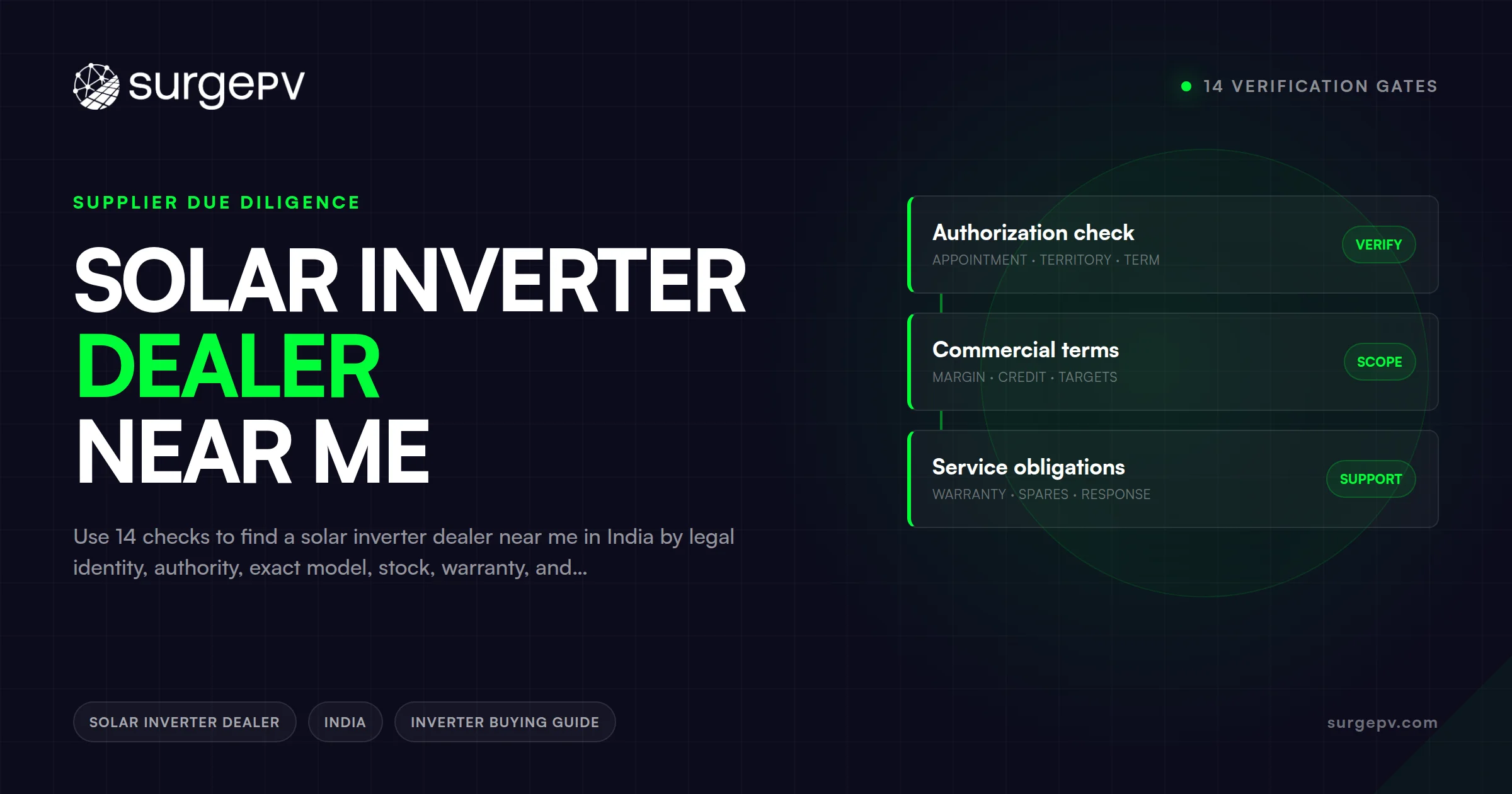
Pass a candidate through these gates before treating it as a suitable local dealer:
- Designed system requirement
- Manufacturer identity
- Dealer role
- Legal entity and branch
- Territory and product family
- Authorization validity
- Exact product documents
- Stock and condition
- Comparable quotation
- Matched payment account
- Delivery and inspection
- Installation and commissioning
- Warranty and local service
- Complaint and exit records
Failure at one gate cannot be repaired by a short travel distance. A good map rating also cannot replace documentary evidence.
Know each company role before contacting sellers
Solar supply chains use overlapping titles. Write every party’s legal name and responsibility in one role map.
| Role | Possible responsibility | What the title does not prove |
|---|---|---|
| Manufacturer | Makes the inverter under the stated manufacturing arrangement | Local stock, direct warranty labour, or dealer authority |
| Brand owner | Controls the brand and published product offer | Factory identity, local inventory, or every seller’s status |
| Importer | Imports specified products and carries stated legal duties | Manufacturer status, current stock, or installer competence |
| National distributor | Buys and supplies across an agreed channel | Local service, every product family, or exclusive territory |
| Regional distributor | Supplies an agreed geography or downstream channel | End-customer sales, commissioning, or warranty decision rights |
| Dealer | Sells under a defined appointment | Installation skill, service authority, stock, or all-brand coverage |
| Marketplace seller | Offers goods through a platform | Brand authority, condition, serial eligibility, or local support |
| EPC or installer | Designs or installs an agreed system scope | Manufacturer appointment, inventory ownership, or claim approval |
| Warranty obligor | Owes the written product remedy | Labour, travel, freight, removal, or temporary replacement |
| Service partner | Performs defined service activities | Dealer authority, stock, pricing rights, or warranty approval |
One company can hold several roles. It must prove each role separately. A regional distributor may also commission equipment, but its agreement must say so.
Read the distributor guide for channel governance. Business applicants should use the separate dealership guide. This page stays with the end buyer’s purchase controls.
Evidence ledger for an India inverter purchase
The following sources were checked on 10 August 2026. Their limits matter as much as their contents.
| Evidence | Supported use | It cannot establish |
|---|---|---|
| Manufacturer directory or written confirmation | Discovery and current appointment scope stated by the manufacturer | Stock, competence, response, or complete warranty performance |
| BIS Scheme II page | Current notified product categories and referenced standards | Dealer authority, genuine serial, design, or local service |
| BIS Care | Licence or registration checks supported by the service | Seller identity or compatibility with a particular system |
| MNRE quality-control index | Current inverter notification and implementation documents | Dealer status, stock, warranty, or project approval |
| CEA distributed-generation regulations | National connectivity framework within stated scope | Site approval or one universal utility requirement |
| MNRE ALMM page | Listed PV module and cell models under its stated framework | Inverter approval, dealer authority, or installer empanelment |
| GST taxpayer search | Public GST registration particulars for an entered GSTIN | Manufacturer authority, bank ownership, stock, or competence |
| CBIC invoice rules | Required invoice particulars within GST scope | Product genuineness or performance |
| National Consumer Helpline | A pre-litigation grievance route and document upload | A guaranteed remedy or technical decision |
BIS lists inverter-related categories and standards in its current registration material. Check the exact product, standard, registration, validity, and scope. Never extend one record to another model.
The MNRE ALMM page concerns solar PV modules and cells under the stated framework. It is not an inverter list. It is also not a dealer directory.
A PM Surya Ghar registered vendor has a scheme-facing installation role under current programme rules. That status does not automatically establish a manufacturer’s inverter dealership. Use the installer selection guide for that separate decision.
Gate one: freeze the system requirement first
A dealer cannot quote the correct inverter until the design defines its operating job. Start with site and system inputs, not a preferred logo.
Record these requirements:
- grid-connected, off-grid, hybrid, or backup operating mode
- actual supply phase, voltage, sanctioned load, and proposed connection
- PV array module, string count, string voltage, current, and temperature limits
- DC capacity, required AC output, load profile, export rule, and curtailment need
- MPPT count, string grouping, shading, orientation, and future expansion
- installation position, temperature, dust, moisture, corrosion, ventilation, and access
- communications, logger, meter, network, portal, owner account, and data export
- battery chemistry, voltage, usable energy, power, BMS protocol, and approved pairing
- protected loads, motor starting, transfer arrangement, generator interface, and restoration logic
- applicable product documents, utility duties, protection, and commissioning evidence
Nominal kilowatts alone are insufficient. Use the inverter sizing guide and inverter sizing definition before requesting models.
Choose grid or backup behavior through the on-grid versus hybrid guide. Verify supply and phase implications through the single-phase versus three-phase guide.
The exact manufacturer manual controls model limits. A dealer’s general experience cannot override a current datasheet, installation manual, approved compatibility list, or utility instruction.
Gate two: discover candidates from manufacturer records
Start at the manufacturer’s official country website. Find its dealer, distributor, installer, or service locator. A search result that copies the directory is not the directory.
Save a dated capture containing:
- manufacturer domain and page address
- partner’s displayed legal or trading name
- branch address and contact
- displayed role
- state, district, city, pincode, or territory
- product family or service category
- authorization number, issue date, validity, or expiry when shown
- directory limitations and access date
Then contact the manufacturer through an independently obtained official channel. Ask it to confirm the candidate’s exact legal entity, branch, role, geography, product family, and validity.
Do not ask only, “Is this dealer authorized?” That question can hide important scope limits. A yes for residential hybrid units may not cover commercial string inverters.
Do not treat these items as manufacturer confirmation:
- a map profile
- a marketplace badge
- a social post
- a shop sign
- a branded uniform
- an invoice template
- a copied appointment letter
- a cropped messaging screenshot
- a domain that resembles the brand
The buyer should obtain confirmation from a current official contact. Compare the reply with the quotation’s legal entity and address.
What to do when the directory is missing or stale
Some manufacturers publish no directory. Others show old branches or generic contacts. Absence does not prove that a seller is unauthorized. It means the buyer needs stronger written verification.
Use this fallback sequence:
- Ask the manufacturer for the current India channel contact.
- Submit the seller’s legal name, GSTIN, branch, role, and quoted model.
- Request confirmation of territory, product family, validity, and warranty route.
- Ask which entity will issue the invoice and ship the unit.
- Ask whether the seller may install, commission, register, diagnose, and approve claims.
- Preserve the reply with its date, sender, and full context.
Conflicting directory entries require a pause. Send both captures to the manufacturer. Do not let the seller explain away a manufacturer conflict without confirmation.
A lapsed authorization deserves the same pause. Ask whether stock bought during an earlier term remains eligible for warranty and support. Obtain the answer before accepting the unit.
Gate three: verify entity, branch, signatory, and account
The quotation, order, invoice, bank beneficiary, delivery note, and warranty registration should form one traceable chain. Differences need documented reasons and accepted risk allocation.
Check the supplier’s GSTIN on the official GST search. Match the legal name, trade name, principal place, registration status, and relevant branch information where available.
For a company or LLP, the Ministry of Corporate Affairs offers company and LLP master-data access. Use it as an entity-status check, not proof of operational capability.
Require the quotation signer’s authority. For larger transactions, request a purchase-order acknowledgement from the contracting entity. Confirm any payment instruction using a known contact.
Never send money to an unrelated personal account. Never accept a last-minute bank change through one unverified message. Pause and confirm using a separately sourced phone number.
Payment fraud controls should include:
- legal beneficiary matching the contract or a documented collection arrangement
- bank details confirmed through two independent channels
- no password or one-time code shared with seller staff
- receipt or compliant advance document for each payment
- milestone evidence retained before the next transfer
- internal approval for any change in entity, account, model, or scope
The official CBIC invoice page lists core invoice particulars. Tax treatment can depend on the transaction and scope. Obtain qualified tax advice where material.
Gate four: verify the exact inverter and document set
The quotation must identify the full model code, revision, rating, quantity, and included accessories. A family name or capacity alone permits substitution.
Request these current documents before award:
- model datasheet
- installation and operation manual
- model-specific declaration or applicable certificate
- warranty terms and registration instructions
- compatible logger, meter, current transformer, and communication hardware
- approved battery and BMS compatibility for hybrid systems
- required firmware and commissioning application
- environmental rating and installation conditions
- connector, protection, cable, and isolation requirements
- grid setting or utility configuration instructions where applicable
Check the IP rating guide before interpreting an enclosure statement. An IP code does not establish suitability for every temperature, corrosion source, flood risk, or installation position.
Review dual MPPT selection when strings face different orientations or shading. More MPPT labels do not repair invalid voltage, current, or string grouping.
For batteries, a matching nominal voltage is not enough. The inverter, battery model, BMS protocol, firmware, current limit, wiring, protection, and commissioning procedure must form an approved combination.
Gate five: prove stock, condition, and serial control
“Available” may mean local stock, upstream stock, expected import, distributor allocation, or only a sales intention. Define the term in the quotation.
Ask for a dated stock record tied to:
- quoted legal entity
- warehouse location
- exact model and revision
- quantity reserved for the buyer
- serials or another traceable identifier
- manufactured or received date where relevant
- packaging and seal condition
- reservation expiry
- dispatch and delivery commitment
Sensitive warehouse documents can be redacted. The remaining evidence must still connect the entity, location, product, quantity, and date.
A lead-time promise needs a source, starting event, dependencies, and remedy for delay. “Two weeks” means little without an accepted order date and allocation evidence.
For open-box, demonstration, repaired, or returned stock, require written disclosure. Record condition, prior registration, operating history, remaining warranty, missing accessories, and acceptance tests.
Gray-market risk arises when the supply route sits outside the manufacturer’s supported territory or channel. Genuine hardware can still lack the expected warranty, firmware, registration, or local service.
Counterfeit controls include packaging, labels, serial checks, model markings, invoice chain, manufacturer confirmation, and inspection before final acceptance. One QR code should not be the only control.
Gate six: issue one common RFQ
Send the same request to at least two independently verified candidates when practical. Avoid asking each seller to define a different system.
The RFQ should state:
- site, delivery address, and contracting buyer
- design basis and operating mode
- exact acceptable model or documented equivalent process
- quantity, accessories, protections, and communications
- equipment-only, delivered, installed, or commissioned boundary
- documents required with the bid
- stock evidence and delivery date definition
- inspection, rejection, and substitution rules
- installation and commissioning responsibilities
- acceptance tests and handover records
- warranty, service, escalation, and response proposal
- price validity, tax, freight, insurance, payment, and delay terms
- exceptions schedule signed by the bidder
An equivalent proposal must show every technical and commercial difference. The buyer’s qualified designer should approve it before purchase.
Gate seven: normalize quotations line by line
Compare the accepted scope, not the inverter headline. Use the India inverter price guide for broader price methodology.
| Cost and obligation | Bid A | Bid B | Bid C |
|---|---|---|---|
| Exact inverter model and quantity | |||
| Required logger, meter, CTs, or gateway | |||
| Approved battery interface equipment | |||
| AC and DC accessories within seller scope | |||
| Packing, freight, transit insurance, and unloading | |||
| Installation labour, access, lifting, and travel | |||
| Settings, firmware, commissioning, and registration | |||
| Monitoring setup and owner handover | |||
| Tax shown by line | |||
| Warranty labour, travel, freight, and reinstallation | |||
| Exclusions and buyer-supplied items | |||
| Comparable accepted total |
Mark every number as quoted, calculated, or unknown. Do not fill unknown costs with invented estimates.
Use this simple arithmetic:
Comparable total = equipment + accessories + freight + installation + commissioning + known taxes + accepted service costs
The formula is a classification aid. It is not a market-price claim. Review product options through the India inverter comparison without assuming one brand fits every design.
Gate eight: control substitutions and commercial changes
The contract should prohibit substitutions without written buyer approval. This includes model suffixes, firmware-dependent variants, loggers, meters, connectors, batteries, and communication devices.
Require a change request showing:
- original item
- proposed item
- reason
- technical differences
- document differences
- compatibility effect
- warranty effect
- price and schedule effect
- approvals required
- buyer decision
Silence is not approval. Delivery of another model is not acceptance. Preserve the right to inspect, quarantine, reject, or obtain correction under the contract.
Quote validity should identify what can change. Currency, freight, tax, supply allocation, or upstream price exposure must be stated rather than implied.
Gate nine: link payment to recoverable evidence
Payment milestones should follow verified progress. The exact structure depends on bargaining power, order value, and scope.
A controlled sequence can use:
- accepted order and verified beneficiary
- manufacturer confirmation and reserved stock evidence
- pre-dispatch documents and serial record
- delivered-unit inspection
- installation completion where included
- commissioning and acceptance evidence
- handover and defect closure
Do not copy these milestones blindly. Define title and risk transfer, cancellation, delay, damage, shortage, rejection, refund, and storage consequences in the contract.
For marketplace transactions, identify the contracting seller, invoice issuer, payment collector, return controller, and warranty route. A marketplace refund policy may not equal the manufacturer’s product warranty.
Gate ten: inspect delivery before acceptance
Create a delivery checklist before dispatch. Record the delivery note, package count, labels, model, serial, seal condition, visible damage, accessories, and documents.
Photograph every label without publishing sensitive identifiers. Compare serials with invoice and warranty-registration records. Preserve packaging until inspection and commissioning rules allow disposal.
Do not energize a suspect, wet, damaged, or mismatched unit. Place it in a controlled hold area and notify the contracting entity.
The delivery record should state whether inspection is preliminary. Hidden defects, wrong firmware, missing accessories, or compatibility failures may appear later.
Gate eleven: separate supply, installation, and commissioning
Equipment-only supply ends at a defined delivery and inspection point. It does not include design, mounting, wiring, settings, utility coordination, testing, monitoring, or owner training unless stated.
Delivered scope adds logistics but not necessarily installation. Installed scope may still exclude manufacturer commissioning. “Turnkey” is too vague without a responsibility schedule.
Write a responsibility matrix for:
| Activity | Dealer | Installer | Manufacturer | Owner or designer |
|---|---|---|---|---|
| Design and model approval | ||||
| Delivery and inspection | ||||
| Mounting and wiring | ||||
| Protection and settings | ||||
| Firmware and communication setup | ||||
| Manufacturer registration | ||||
| Commissioning tests | ||||
| Utility or authority interface | ||||
| Monitoring owner transfer | ||||
| Warranty diagnosis and claim |
Use the solar commissioning checklist for test planning. The commissioning protocol covers broader system evidence.
Gate twelve: define acceptance and owner handover
Acceptance should use approved documents and measured records. The exact tests depend on topology, model, site, and current utility requirements.
Potential evidence includes:
- visual and mechanical inspection
- model, serial, and accessory reconciliation
- polarity and conductor checks
- insulation or continuity tests where specified
- protection installation and settings record
- earthing measurements within the approved plan
- startup sequence and fault-free operation
- grid settings and anti-islanding evidence where required
- MPPT and string operating records
- hybrid charge, discharge, transfer, and protected-load tests
- generator or export-control tests where included
- communications, alerts, and owner portal access
- firmware and configuration backup
Do not accept only a monitoring screenshot. Monitoring can display output while other obligations remain incomplete.
The owner should receive editable and raw records where contractually available. Require manuals, approved drawings, settings, serials, test results, passwords, account ownership, warranty registration, and escalation contacts.
Gate thirteen: read the warranty as a cost map
A headline period does not describe the remedy. Read the complete terms for the exact model and transaction.
Map these questions:
- Who is the legal warranty obligor?
- When does coverage start?
- Is registration required?
- What proof must the owner retain?
- Is the remedy repair, replacement, refurbished unit, or another option?
- Who pays diagnosis, travel, freight, labour, removal, and reinstallation?
- Does replacement inherit the original end date?
- Which environmental, electrical, installation, and maintenance events are excluded?
- Who decides whether a claim qualifies?
- What happens when the model or seller disappears?
Use the inverter warranty guide for a deeper comparison. Keep seller-funded workmanship or response promises separate from the manufacturer’s product warranty.
Ask who owns the first fault call. Define remote diagnosis, site attendance, data access, spare parts, freight, advance replacement, escalation, and restored-operation evidence.
“Local service” needs a named entity, service area, skill scope, contact path, hours, dependencies, exclusions, and commercial terms. A nearby office does not prove technician or spare capacity.
Gate fourteen: prepare complaint and exit records
Preserve a single evidence file from first enquiry. Include captures, manufacturer replies, bids, exceptions, approvals, payments, invoice, delivery records, serials, tests, registrations, and service communications.
If a dispute starts, follow the contract’s notice and escalation route. State the fault, evidence, requested remedy, and response deadline clearly.
The National Consumer Helpline describes itself as a pre-litigation grievance mechanism. It issues a docket and forwards eligible grievances, but does not guarantee the requested remedy.
High-value or complex disputes may need qualified legal advice. This article is a procurement framework, not legal or engineering advice.
Exit planning should cover unsupported equipment, lapsed channels, account transfer, installer replacement, data export, firmware access, spare strategy, and safe decommissioning.
How to evaluate Qbits service partners
Qbits Energy is related to SurgePV through a common commercial relationship. This disclosure appears before evaluating its directory and products.
Qbits publishes an authorized service-partner directory. As observed on 10 August 2026, it offers state and district discovery. That is a first-party statement and can change.
Service-partner status must not be described as dealer authorization. It also does not prove sales rights, stock, competence for every model, warranty authority, or response results.
Ask Qbits directly to confirm the partner’s legal entity, branch, current role, territory, product family, and validity. Then separately verify the proposed transaction.
Review the exact Qbits documents against the design. A document library does not establish live stock or suitability for the buyer’s system.
Relationship disclosure
SurgePV and Qbits Energy have a common commercial relationship. Qbits receives no automatic preference or rank here. Apply the same role, authorization, model, stock, transaction, commissioning, warranty, service, complaint, and exit gates to Qbits and every alternative.
Do not choose Qbits when its evidence, model, compatibility, commercial terms, or local support fails a gate. Apply the same consequence to every manufacturer.
SurgePV is software. It is not a manufacturer, dealer, distributor, installer, warranty provider, service partner, regulator, or acceptance body.
Score the evidence, not the seller’s distance
Use a pass, conditional, fail, or unknown result for every gate. Unknown is not a pass.
| Gate | Required evidence | Decision |
|---|---|---|
| Requirement | Approved design basis and exact operating need | |
| Manufacturer | Official identity and current contact | |
| Role | Dealer, distributor, installer, service, and warranty duties separated | |
| Scope | Entity, branch, territory, product family, and validity confirmed | |
| Product | Exact model documents and compatibility accepted | |
| Stock | Dated, traceable, condition-specific evidence | |
| Transaction | Matched contract, invoice, beneficiary, and signatory | |
| Delivery | Serials, seals, condition, inspection, title, and risk controlled | |
| Commissioning | Named parties, settings, tests, records, and handover | |
| Warranty | Obligor, remedy, costs, exclusions, and claim route understood | |
| Service | Fault owner, attendance, spares, escalation, and evidence defined | |
| Exit | Complaint, data, credentials, records, and replacement route preserved |
Proximity becomes useful after these gates pass. Compare practical travel, actual technician location, parts route, working hours, remote diagnosis, and escalation ownership.
No universal distance threshold defines local service. A five-kilometre shop may depend on another city for trained support. A farther branch may have better documented response capacity.
Red flags that require a procurement pause
- “Authorized” appears only in seller-controlled material.
- The manufacturer confirms service status but not sales status.
- The authorization names another entity, branch, territory, or product family.
- The letter has expired or cannot be independently confirmed.
- The quote names capacity without the complete model code.
- The certificate belongs to another model or manufacturer.
- Hybrid compatibility rests only on voltage or brand.
- The seller refuses a tax invoice or exact serial record.
- Payment moves to a personal or unmatched account.
- Stock evidence omits model, location, quantity, or date.
- An open box or repaired unit is presented as new.
- A substitute appears only at dispatch or delivery.
- Commissioning and monitoring ownership remain unnamed.
- Warranty is reduced to a number of years.
- The service promise has no legal owner or escalation route.
A red flag may have an innocent explanation. Require documentary resolution before proceeding.
A controlled local dealer workflow
Use this sequence from design to operation:
- Freeze requirements with a qualified designer.
- Identify suitable exact models from current documents.
- Discover candidates through manufacturer records.
- Reverify role, entity, branch, territory, family, and validity.
- Check legal identity and transaction controls.
- Issue one common RFQ.
- Normalize at least two bids where practical.
- Resolve exceptions, unknowns, and substitutions.
- Link payment to evidence.
- Inspect delivery and preserve serial records.
- Complete approved installation and commissioning.
- Transfer owner accounts, documents, settings, and warranties.
- Test the first-fault and escalation path.
- Retain the complete evidence pack.
Refresh directory entries, product documents, registration records, terms, and contacts immediately before award. Web pages and appointments can change.
Cannibalization boundaries
This guide owns local end-buyer seller verification. It does not rank inverter brands or explain how to operate a dealership.
Use these focused resources for adjacent decisions:
- best solar inverter in India for manufacturer and model comparison
- solar inverter price in India for dated price evidence and quote normalization
- solar inverter distributor in India for B2B distributor governance
- solar inverter dealership in India for channel opportunity due diligence
- solar inverter warranty in India for remedy and claim terms
- solar inverter definition for basic equipment roles
- hybrid inverter definition for storage-linked topology
- IP rating for enclosure-code interpretation
These boundaries prevent a local query from becoming a brand list, engineering manual, price table, or business-opportunity page.
Frequently asked questions
How do I find an authorized solar inverter dealer near me?
Search the manufacturer’s current directory first. Then ask the manufacturer to confirm the legal entity, branch, territory, product family, role, and authorization validity in writing before payment.
What should I ask a solar inverter dealer before buying?
Request the exact model, dated quotation, invoice identity, stock evidence, datasheet, manual, applicable certificates, warranty, compatibility evidence, commissioning scope, acceptance tests, and service escalation.
Is the nearest inverter dealer always the right choice?
No. Proximity can reduce travel, but it does not prove authorization, stock, design competence, warranty authority, or response capacity. Compare every candidate using the same evidence gates.
Does an authorized service partner also sell inverters?
Not necessarily. Service authorization may cover installation, diagnosis, or repair without sales rights. Confirm the partner’s exact role, territory, product family, validity, and warranty authority with the manufacturer.
How can I verify that an inverter is genuinely in stock?
Request a dated stock record tied to the quoted legal entity, warehouse, exact model, revision, quantity, and identifiable serials. Preserve inspection and rejection rights before final payment.
Can a BIS record prove that the dealer is authorized?
No. An applicable BIS record concerns the product or manufacturer scope shown in that record. It does not prove dealer authorization, stock, installation competence, warranty authority, or service quality.
What should an inverter dealer quotation include?
It should identify the legal supplier, exact model, revision, quantity, tax, freight, accessories, protection, installation, commissioning, warranty, delivery terms, validity, exclusions, substitution controls, and payment milestones.
How should I verify a Qbits service partner?
Use the Qbits directory only for discovery. Ask Qbits to reverify the entity, location, current service role, territory, product family, and validity. Separately verify sales authorization, stock, warranty authority, and competence.
What records should I keep after buying an inverter?
Keep the accepted quotation, payment, tax invoice, serial photographs, delivery inspection, datasheet, manual, warranty, registration proof, settings, tests, credentials, service contacts, and change approvals.
Source note
Authority and Qbits pages were checked on 10 August 2026. Product rules, appointments, directories, models, documents, stock, warranty terms, and contacts can change. Reconfirm every material record before award.
Sources
Primary research and reference material used for this desk-research article.
Where this fits
This article is part of SurgePV's Solar Incentives & Policy hub, which works through the topic from first principles to the decisions a project team actually has to make.