

Quick Answer
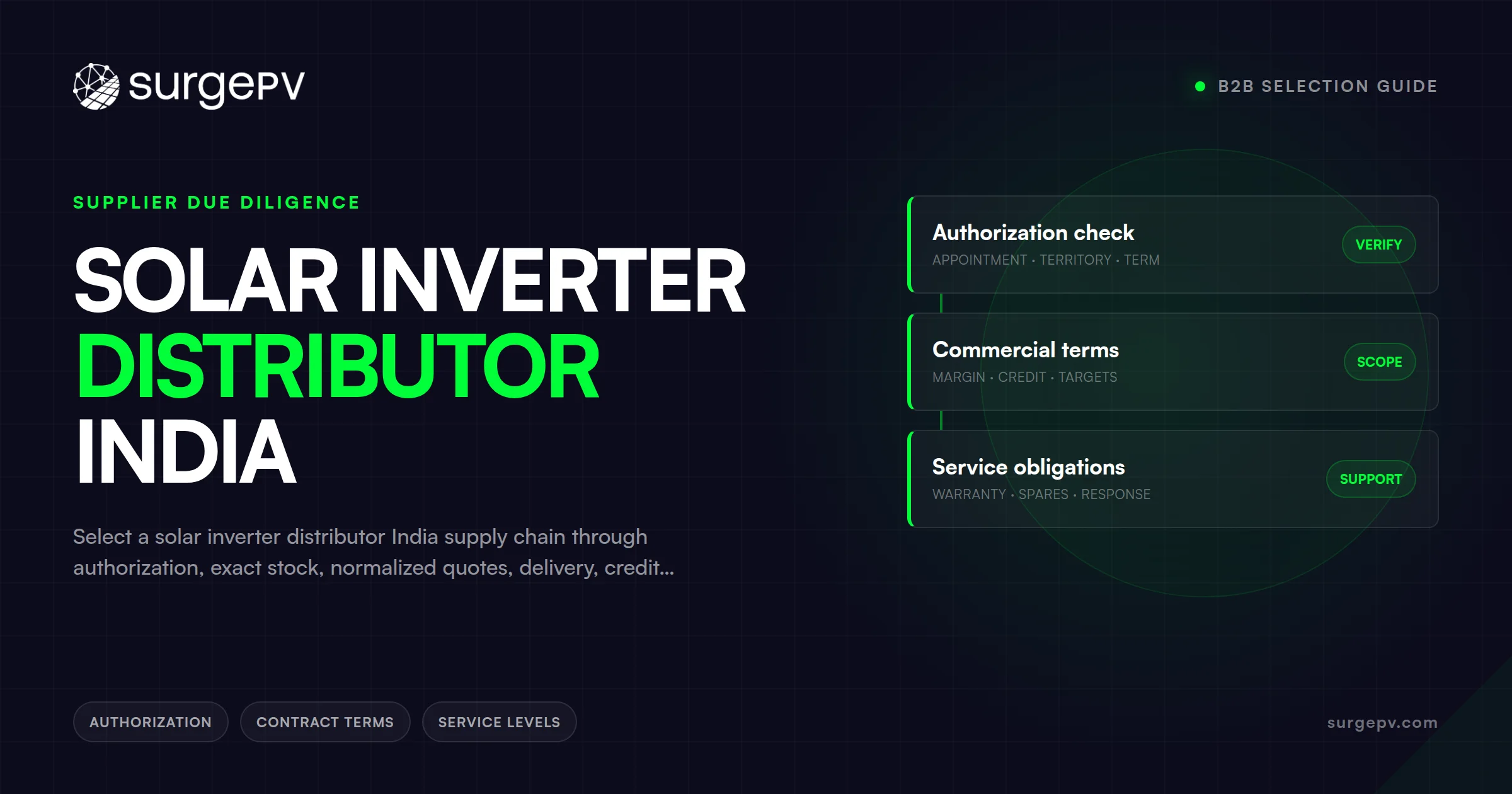
Choose a solar inverter distributor in India by verifying the legal seller, current upstream authorization, exact products, territory, stock state, quotation, credit, delivery, warranty, RMA, and service boundaries. Run a controlled trial order before volume purchasing. A distributor title, application form, warehouse photo, or service directory cannot prove transaction authority.
A solar inverter distributor India search can return importers, distributors, dealers, marketplace sellers, EPCs, and service firms. The title beside a logo does not establish the company’s rights for your order.
Choose a distributor for a defined transaction. Verify the legal seller, upstream appointment, exact product, allocation, quote, delivery, warranty, RMA, service, data, and exit route.
Quick answer
Choose a solar inverter distributor in India by verifying the legal seller, current upstream authorization, exact products, territory, stock state, quotation, credit, delivery, warranty, RMA, and service boundaries. Run a controlled trial order before volume purchasing. A distributor title, application form, warehouse photo, or service directory cannot prove transaction authority.
Related-party disclosure
SurgePV and Qbits Energy share ownership. Qbits receives no automatic preference. Its public pages are first-party evidence, and Qbits must pass the same gates as every alternative.
Key takeaways
- Treat distributor selection as a B2B transaction-control decision.
- Match every appointment to the legal entity, territory, products, activities, and date.
- Classify inventory as on hand, allocated, in transit, expected, or made to order.
- Freeze the exact model, revision, accessories, documents, and substitution rules.
- Normalize tax, freight, credit, delivery, title, risk, returns, and warranty scope.
- Separate product supply from design, installation, commissioning, and field service.
- Test RMA, damaged delivery, false allocation, invoice dispute, and exit before scaling.
Define the Distributor Role for This Transaction
A distributor usually supplies equipment to EPCs, installers, institutional buyers, or downstream dealers. That description is only a starting point. The signed authority and sale documents control the actual role.
Map every party before issuing an RFQ:
| Party | Possible role | Evidence needed | What the role does not prove |
|---|---|---|---|
| Manufacturer | Produces or controls stated production steps | Exact product and factory evidence | Distribution, stock, or local service |
| Brand owner | Controls the market identity | Brand and legal-entity relationship | Manufacture, warranty, or transaction authority |
| Importer | Imports the stated products | Label, legal identity, and commercial records | Distribution territory or project fit |
| National distributor | Supplies an appointed channel | Current appointment and transaction evidence | Stock in every region or nationwide service |
| Regional distributor | Supplies within a defined area | Territory, products, term, and exceptions | Rights outside that appointment |
| Dealer | Sells locally or to defined customers | Supply route and invoice chain | Direct manufacturer authority |
| Marketplace seller | Lists or sells through a platform | Legal seller and exact offer | Authorization, warranty, or product condition |
| EPC or installer | Designs or executes stated work | Contract, competence, and project records | Manufacturer warranty authority |
| Warranty obligor | Owes the written warranty remedy | Full terms and legal identity | Field attendance unless stated |
| Service partner | Performs approved support tasks | Current appointment and task scope | Distribution or warranty-decision authority |
One company may hold several roles. Record each one separately. Assign one accountable entity to supply, commissioning support, warranty administration, RMA, parts, and field service.
The solar inverter company India guide covers the wider supply-chain responsibility map. This page focuses on B2B distributor transactions and recurring operations.
Separate Territory From Operational Reach
Territory can mean several things. Never treat them as interchangeable.
- Sales territory states where the distributor may solicit or invoice.
- Customer territory states which buyer types or accounts it may serve.
- Delivery reach states where it can transport the product.
- Warranty reach states where the obligor accepts covered claims.
- Service reach states where approved people can attend or support.
- Project authority states whether the party may perform settings, commissioning, or other technical work.
Request a written matrix for these boundaries. Include online sales, named accounts, government buyers, channel conflicts, direct sales, and projects crossing territorial borders.
Do not infer exclusivity from the word distributor. An exclusive clause may depend on targets, products, customer types, or time. Qualified advisers should review material restrictions and competition issues.
Verify Legal Identity and Authorization
Start with the invoicing entity. Record its full legal name, GSTIN, constitution, addresses, signatory, and bank beneficiary.
The official GST taxpayer-search manual explains current legal-name, trade-name, status, registration, constitution, and place checks. Use the MCA service FAQ to locate Company or LLP Master Data where applicable.
Registry evidence does not prove appointment, solvency, stock, credit quality, service, or performance. It supports identity checks only.
Obtain the appointment from the manufacturer or authorized upstream party. It should identify:
- Appointing and appointed legal entities.
- Product families and excluded models.
- Territory and customer scope.
- Permitted sales and downstream supply.
- Warranty-registration and RMA activities.
- Service or commissioning activities, if any.
- Effective date, expiry, renewal, suspension, and termination.
- Conditions, targets, and exceptions affecting authority.
- Principal contact for confirmation.
Confirm the appointment through a contact found independently. Record the respondent, date, answer, and limitations. Reverify before every material order.
Repeat verification after changes in entity, bank, branch, personnel, product family, territory, agreement, or public directory. Authority at onboarding does not prove authority months later.
Use an Authorization Evidence Hierarchy
Not all evidence carries the same weight. Use several layers when the order risk is material.
| Evidence | What it can support | Remaining gap |
|---|---|---|
| Signed principal appointment | Stated legal relationship and scope | Current status and transaction acceptance |
| Independent principal confirmation | Status on the confirmation date | Future suspension or product exceptions |
| Principal directory | Publicly listed relationship | Exact legal entity, model, and task scope |
| Upstream invoice chain | Source for a stated shipment | Territory, warranty, and future authority |
| Distributor invoice | Contracted seller and product description | Principal appointment and delivered-unit match |
| Training certificate | Named person’s completed training | Current competence, company authority, or service scope |
| Warehouse evidence | Goods at a stated location and time | Ownership, allocation, condition, or release rights |
| Marketplace badge | Platform status under its rules | Manufacturer authority or warranty acceptance |
No single document proves the complete transaction. Link identity, authority, exact product, inventory, quote, order acceptance, delivery, and warranty evidence.
Match Authority to the Exact Product
Product-family authority may not include every model or revision. Freeze the exact equipment before evaluating stock or price.
Create a controlled product register:
- full brand and model code
- legal manufacturer and brand relationship
- hardware and firmware revision
- phase, voltage, rated output, and topology
- DC voltage, current, strings, and MPPT limits
- environmental limits and enclosure rating
- meter, logger, dongle, sensors, and controls
- battery or export-control compatibility where applicable
- datasheet, manual, certificate, and warranty revisions
- label, serial, batch, and traceability requirements
The BIS Scheme II page provides the current official product-category route. Check the exact record and scope required for the transaction.
BIS evidence does not prove distributor authority, inventory, product fit, financial health, installation quality, or warranty results. MNRE ALMM concerns solar PV modules and cells, not inverter distributors.
Use the solar inverter manufacturer India guide for production evidence. Use the Indian inverter brands guide for brand ownership and evidence-led shortlisting.
Issue One Normalized RFQ
Send every candidate the same RFQ and response schedule. Prohibit silent assumptions. Require deviations in one register.
| RFQ field | Required response |
|---|---|
| Legal seller | Name, GSTIN, address, signatory, bank route |
| Authority | Appointing party, territory, products, validity, confirmation route |
| Product | Exact model, revision, quantity, accessories, documents |
| Stock state | On hand, allocated, in transit, expected, or made to order |
| Price basis | Unit, quantity break, taxes, freight, insurance, and validity |
| Credit | Limit, security, due date, interest, suspension, and disputes |
| Delivery | Location, date, partials, allocation, transport, and notice |
| Inspection | Warehouse option, receipt checks, serials, defects, and rejection |
| Title and risk | Exact transfer points and insurance responsibility |
| Returns | Cancellation, incorrect supply, damage, dead on arrival, and restocking |
| Technical support | Design boundary, commissioning, settings, training, and tools |
| Monitoring | Accounts, logger, access, data, licence, and handover |
| Warranty | Obligor, version, registration, diagnosis, remedy, freight, and labour |
| Service | Territory, people, escalation, milestones, parts, and charges |
| Substitution | Written request and buyer approval before dispatch |
| Exit | Open orders, credit, claims, data, documents, and support transition |
The solar inverter price India guide covers price normalization in greater detail. This page does not state a universal distributor price or margin.
Classify Stock Instead of Accepting Available
Available can describe five different states. Each creates a different delivery risk.
| Stock state | Meaning to verify | Evidence request |
|---|---|---|
| On hand | Physically present at a named location | Count, model, revision, condition, age, and inspection |
| Allocated | Reserved for this buyer or order | Allocation identifier, quantity, expiry, and release terms |
| In transit | Dispatched toward a stated location | Source, shipment record, expected receipt, and dependencies |
| Expected | Forecast but not dispatched | Purchase commitment, expected date, and change notification |
| Made to order | Released after buyer commitment | Production acceptance, schedule, cancellation, and change terms |
Also identify ownership. Goods may be distributor owned, manufacturer owned, consigned, financed, reserved for another buyer, or subject to release conditions.
Record age, storage, packaging, open-box status, damage, repair, supersession, and firmware. Verify accessories under the same schedule. An inverter without its required meter or logger may not meet acceptance.
Before payment, reconfirm the exact quantity, location, allocation, condition, and release. A warehouse photograph cannot prove current ownership or reservation.
Control Order Acceptance and Allocation
A purchase order does not always mean the distributor accepted supply. Require written order acceptance that identifies price, products, quantities, allocation, delivery, credit, and deviations.
Link the accepted order to an allocation record. State whether allocation survives price changes, credit review, overdue invoices, delayed site readiness, or partial payment.
Define partial deliveries. The buyer may accept partials, reject them, or require a minimum usable set. Accessories and communication equipment should follow the required installation sequence.
Set a change process for shortages and superseded products. A proposed substitute needs exact documents, compatibility review, compliance evidence, warranty impact, schedule impact, and written approval.
Define Delivery, Title, Risk, and Acceptance
The contract should state dispatch point, delivery point, transporter, freight, insurance, unloading, title transfer, and risk transfer. These events need not occur together.
Receipt acceptance should check:
- shipment and package condition
- exact model and revision
- quantity and accessories
- serial and batch records
- label and certificate match
- signs of impact, water, corrosion, opening, or repair
- document and warranty pack
- storage instructions
- shortages and damage
- quarantine and rejection status
A transport receipt confirms receipt, not technical acceptance. Reserve the right to record concealed damage or document mismatch within an agreed period.
Define the return route for incorrect, damaged, open-box, or nonconforming goods. Allocate packaging, pickup, freight, insurance, inspection, replacement, credit, and delay.
Manage Credit Without Losing Reconciliation Control
Distributor credit can support working capital. It can also create unclear security, interest, setoff, or account suspension.
Document:
- Approved legal borrower and credit limit.
- Security, guarantees, deposits, or insurance.
- Invoice date and due-date method.
- Interest, fees, and overdue consequences.
- Dispute-notice period and evidence.
- Treatment of disputed amounts.
- Setoff and account-suspension rights.
- Credit and debit note approval.
- Rebate or incentive calculation and evidence.
- Statement frequency and reconciliation owner.
- Bank-detail change control.
- Closure and release after exit.
Price credit as a financing cost. Do not treat a longer payment period as free value. Review personal guarantees and security through qualified advisers.
Reconcile purchase orders, goods receipts, invoices, tax records, returns, debit notes, credit notes, payments, rebates, and warranty reimbursements. Resolve differences before they accumulate.
Verify every bank change through an independently known contact. Use dual approval for material payments. Do not redirect funds from an email request alone.
Separate Application Support From Design Authority
A distributor may offer product training or application guidance. That does not automatically make it the project designer.
Record whether support includes model selection, string review, battery matching, export controls, communication architecture, protection, settings, drawings, or site attendance. Name the accountable engineer for each decision.
The commercial inverter selection guide covers project-level technical fit. The IP66 inverter guide covers enclosure and installation limits. The high-efficiency inverter guide covers comparable performance evidence.
Require written assumptions and reviewed outputs. Manufacturer or distributor comments do not transfer the EPC’s contractual responsibility unless the agreement says so.
Define the Commissioning Boundary
Distribution authority does not prove commissioning authority. Ask who may load settings, connect monitoring, start the device, witness tests, close alarms, and sign records.
The commissioning schedule should name:
- prerequisites and site readiness
- responsible and witnessing parties
- approved firmware and settings
- required calibrated instruments
- electrical and operating tests
- grid, battery, export, and communication cases
- raw records and screenshots
- nonconformance and retest process
- monitoring-account handover
- warranty-registration evidence
Separate remote advice from field attendance. Define travel, access, safety induction, tools, waiting time, and rescheduling. A support call is not a signed commissioning record.
Use payment and acceptance gates that match the distributor’s true scope. Do not withhold distributor payment for installer work unless the contract links those obligations.
Map Warranty and RMA Flow
Warranty administration is not the same as warranty obligation. A distributor may collect evidence but lack authority to approve a remedy.
Create an RMA map:
| Stage | Required owner and evidence |
|---|---|
| Registration | Party, deadline, serials, invoice, commissioning, acknowledgement |
| Complaint | Contact, ticket, timestamp, symptoms, alarms, and site conditions |
| Diagnosis | Authorized party, remote data, tests, settings, and report |
| RMA approval | Decision authority, identifier, scope, and instructions |
| Dead on arrival | Definition, reporting period, evidence, and replacement route |
| Advance replacement | Eligibility, deposit, title, return deadline, and charges |
| Parts | Approval, dispatch, installation, and failed-part return |
| Labour | Authorized provider, rates, travel, access, and reimbursement |
| Freight | Packaging, pickup, insurance, outbound and return allocation |
| Failed unit | Data, title, custody, inspection, and disposal |
| Closure | Remedy, test, serial update, monitoring, and warranty continuation |
| Escalation | Distributor, principal, service, management, and complaint route |
Obtain the full warranty before ordering. Match the obligor, exact model, start date, coverage, exclusions, remedy, and evidence.
Test an RMA scenario during onboarding. Ask the distributor to route a sample case without claiming a real failure. Verify contacts, forms, authority, evidence, freight, and closure steps.
Verify Service Capacity and Continuity
Service reach must match the project location. A service directory is a discovery source, not proof of current capacity or results.
Request the legal service entity, appointment, territory, people, training, tools, spares, workload, subcontractors, working hours, and escalation. Define response, attendance, diagnosis, remedy, and closure separately.
Ask who covers absence, peak workload, holidays, staff departure, or partner termination. Require records to remain accessible when named people change.
References should match the model family, service area, buyer type, and role. Confirm what the distributor actually supplied or supported. Do not turn one reference into a national claim.
Control Data and Account Access
Distributor operations can expose customer names, sites, quotations, serials, monitoring accounts, tickets, payment data, and warranty records. Assign ownership, purpose, access, retention, export, and deletion.
The MeitY DPDP Rules page provides official rules and phased commencement materials. Obtain legal advice for actual duties and timing.
Define user roles for distributor, EPC, installer, owner, manufacturer, and service partner. Do not leave a plant under an employee’s personal monitoring account.
At handover or exit, transfer accounts, credentials, exports, settings, serial registers, warranty files, open tickets, and support contacts. Revoke access that no longer has a valid purpose.
Evaluate Qbits Under Identical Gates
SurgePV and Qbits Energy share ownership. Buyers should treat Qbits as a disclosed related party. The relationship does not prove distribution authority, stock, territory, price, credit, warranty, or service.
The Qbits partner application accepts dealer, distributor, EPC, and system-integrator applications. An application form proves neither appointment nor acceptance.
The Qbits document library is a first-party route for product documents. It does not prove that a distributor has the stated model, allocation, authority, or compatible project.
The Qbits service directory is also first-party evidence. A service listing is not distribution authority or warranty approval.
Apply the same legal, authority, exact-product, stock, RFQ, credit, delivery, commissioning, RMA, service, data, trial, and exit gates. Select another supplier when its verified transaction fits better.
Run a Controlled Trial Order
Start with a limited order that represents the intended workflow. Define success before sending the purchase order.
Test these stages:
- Legal identity and bank verification.
- Principal authorization confirmation.
- Exact-model document approval.
- Normalized quotation and deviations.
- Written order acceptance and allocation.
- Dispatch evidence and delivery notice.
- Receipt, serial, accessory, and condition checks.
- Invoice and tax reconciliation.
- Technical-support and commissioning route.
- Monitoring and warranty registration.
- Service escalation and RMA simulation.
- Credit note, return, and account statement process.
Track defects, evidence delays, unclear owners, handoffs, and corrections. Scale only after mandatory gates pass and material failures close.
Do not generalize one trial across all branches, models, warehouses, territories, or service partners. Revalidate when the transaction changes.
Simulate Failure Before Volume Commitment
Normal delivery reveals little about exception handling. Run table exercises using realistic failure cases.
| Failure case | Evidence of an acceptable process |
|---|---|
| Authorization expires | Hold, principal recheck, buyer notice, and order decision |
| Allocated stock disappears | Escalation, revised commitment, cancellation, and refund route |
| Wrong model arrives | Quarantine, pickup, replacement, freight, and document correction |
| Transit damage appears | Notice, evidence, insurance, inspection, and disposition |
| Invoice differs from order | Dispute, hold, corrected invoice, and reconciliation |
| Bank details change | Independent verification and dual approval |
| Commissioning support fails | Escalation, alternate person, evidence, and rescheduling |
| Warranty claim is rejected | Written reason, evidence gap, review, and complaint route |
| Service partner leaves | Replacement appointment, records, open tickets, and continuity |
| Distributor relationship ends | Open orders, claims, stock, credit, data, and transition |
The exercise does not prove future outcomes. It shows whether duties, contacts, evidence, and remedies are defined before exposure grows.
Plan Renewal, Suspension, and Exit
Distributor replacement can affect open orders, allocated inventory, credit, rebates, claims, monitoring, and customer commitments. Define transition while the relationship is healthy.
The exit schedule should address:
- effective date and notice
- accepted and unaccepted orders
- allocated and in-transit stock
- returns and unsold goods
- invoices, disputes, credit, deposits, and security release
- pending incentives and credit notes
- open warranty and RMA cases
- service visits and replacement parts
- customer and project communications
- serial, settings, monitoring, and warranty records
- account exports, credential transfer, and access revocation
- confidentiality and data deletion
- post-exit contacts and dispute route
Do not assume the manufacturer will inherit every distributor promise. Obtain written continuity for each accepted order and open claim.
Page Boundary and Related Guides
This page owns B2B distributor selection and transaction operations. It does not own programme applications or channel-investment decisions.
- Use solar inverter dealership India for a prospective local dealer arrangement.
- Use solar inverter distributorship India for broader channel investment and contract evaluation.
- Use solar inverter dealer near me for end-customer local seller discovery.
- Use solar inverter company India for the complete role and responsibility chain.
- Use solar inverter manufacturer India for factory and production verification.
- Use Indian solar inverter brands for brand evidence and origin distinctions.
- Use solar inverter price India for product-price and quote normalization.
SurgePV is software, not a manufacturer, importer, distributor, dealer, installer, warranty provider, service partner, financier, regulator, or acceptance body.
Solar Inverter Distributor India Decision Checklist
Mandatory authority and product gates
- Legal seller, GST, signatory, address, and bank match.
- Upstream appointment is current and independently confirmed.
- Territory, customers, products, activities, and exceptions fit.
- Exact model, revision, documents, accessories, and warranty are frozen.
- Substitution needs written buyer approval.
Transaction gates
- RFQ and deviation schedules are complete.
- Stock state, ownership, allocation, location, age, and condition are verified.
- Order acceptance and delivery commitment are written.
- Tax, freight, insurance, credit, title, risk, returns, and disputes are clear.
- Serial inspection and acceptance records are defined.
Operating gates
- Design, commissioning, settings, and monitoring boundaries are named.
- Warranty obligor and complete RMA flow are accepted.
- Service territory, people, tools, spares, and escalation are verified.
- Data, accounts, records, access, retention, and exit are controlled.
- Trial order and failure simulations pass.
- Renewal, suspension, termination, and transition are documented.
Approve the distributor only for the tested transaction. Reverify when the model, territory, warehouse, entity, bank, credit, service party, warranty, or agreement changes.
Conclusion
A solar inverter distributor in India should be selected through evidence, not a channel title. The decision belongs to an exact transaction and operating chain.
Verify identity and appointment. Freeze the product. Classify stock. Normalize the RFQ. Control credit, delivery, title, risk, commissioning, RMA, service, data, and exit.
A limited trial and failure simulation expose gaps before volume increases. Keep every unknown visible until written evidence, contract duties, and acceptance records resolve it.
Frequently Asked Questions
How do I choose a solar inverter distributor in India?
Verify the legal seller, upstream appointment, territory, exact products, stock evidence, quotation, credit, delivery controls, warranty route, service capacity, references, and exit terms. Run a limited trial order before committing volume.
How can I verify distributor authorization?
Obtain a dated appointment naming the legal entity, appointing party, territory, product families, activities, exceptions, validity, and termination status. Confirm it through an independently sourced principal contact before each material order.
What is the difference between a distributor and a dealer?
A distributor commonly supplies EPCs or downstream dealers, while a dealer commonly sells locally. These labels prove nothing alone. The signed appointment must define products, territory, customers, sales, warranty, and service rights.
How should I verify inverter stock before paying?
Request the exact model, revision, quantity, owner, allocation, warehouse, condition, age, serial or batch evidence, release conditions, accessories, and inspection route. Reconfirm these facts immediately before payment.
What should a distributor quotation include?
Require the legal seller, exact models, quantities, accessories, documents, taxes, freight, insurance, credit, validity, allocation, delivery, inspection, title, risk, acceptance, returns, warranty, service, substitutions, and exclusions.
Who handles inverter commissioning and warranty?
The contract must name each responsible entity. Distribution authority does not automatically include design, installation, settings, commissioning, diagnosis, warranty approval, field labour, freight, replacement, or service authority.
Should I buy on credit from a distributor?
Use credit only after reviewing limits, security, interest, due dates, disputes, setoff, suspension, and reconciliation. Price the financing cost and avoid accepting unclear personal guarantees or bank-detail changes.
How should I test a new distributor?
Run a limited order through authorization, quotation, allocation, dispatch, receipt, serial inspection, documentation, commissioning support, monitoring, warranty registration, service escalation, reconciliation, and return scenarios. Record failures before scaling.
How should Qbits distribution claims be evaluated?
SurgePV and Qbits share ownership, so treat Qbits as a disclosed related party. Its application and service pages are first-party evidence, not proof of distribution authority, stock, credit, territory, or outcomes.
Sources
Primary research and reference material used for this desk-research article.
Where this fits
This article is part of SurgePV's Solar Business & Operations hub, which works through the topic from first principles to the decisions a project team actually has to make.

