

Quick Answer
Solar commissioning involves five phases: pre-commissioning inspection, electrical testing (insulation resistance, polarity, grounding), performance verification (PR testing, IV curve tracing), protection system checks, and final documentation handover. A thorough commissioning process prevents 90% of post-installation issues.
A solar system that installs correctly but commissions poorly costs the owner thousands of euros in lost generation from day one. Mismatched string voltages, incorrect inverter settings, and skipped insulation tests are the three most common causes of underperformance found during first-year audits — and all three are caught by a thorough commissioning process. This checklist covers every phase from pre-commissioning verification through final handover documentation, with specific test criteria aligned to IEC 62446-1, NEC Article 690, and IEEE 1547. Also see: Us Residential Solar Market Trends 2026. For United States-specific compliance details, see United States arizona/phoenix.
Solar commissioning involves five phases: pre-commissioning inspection, electrical testing (insulation resistance, polarity, grounding), performance verification (PR testing, IV curve tracing), protection system checks, and final documentation handover. A thorough commissioning process prevents 90% of post-installation issues.
Solar commissioning involves five phases: pre-commissioning inspection, electrical testing (insulation resistance, polarity, grounding), performance verification (PR testing, IV curve tracing), protection system checks, and final documentation handover. A thorough commissioning process prevents 90% of post-installation issues.
TL;DR — Solar Commissioning Checklist
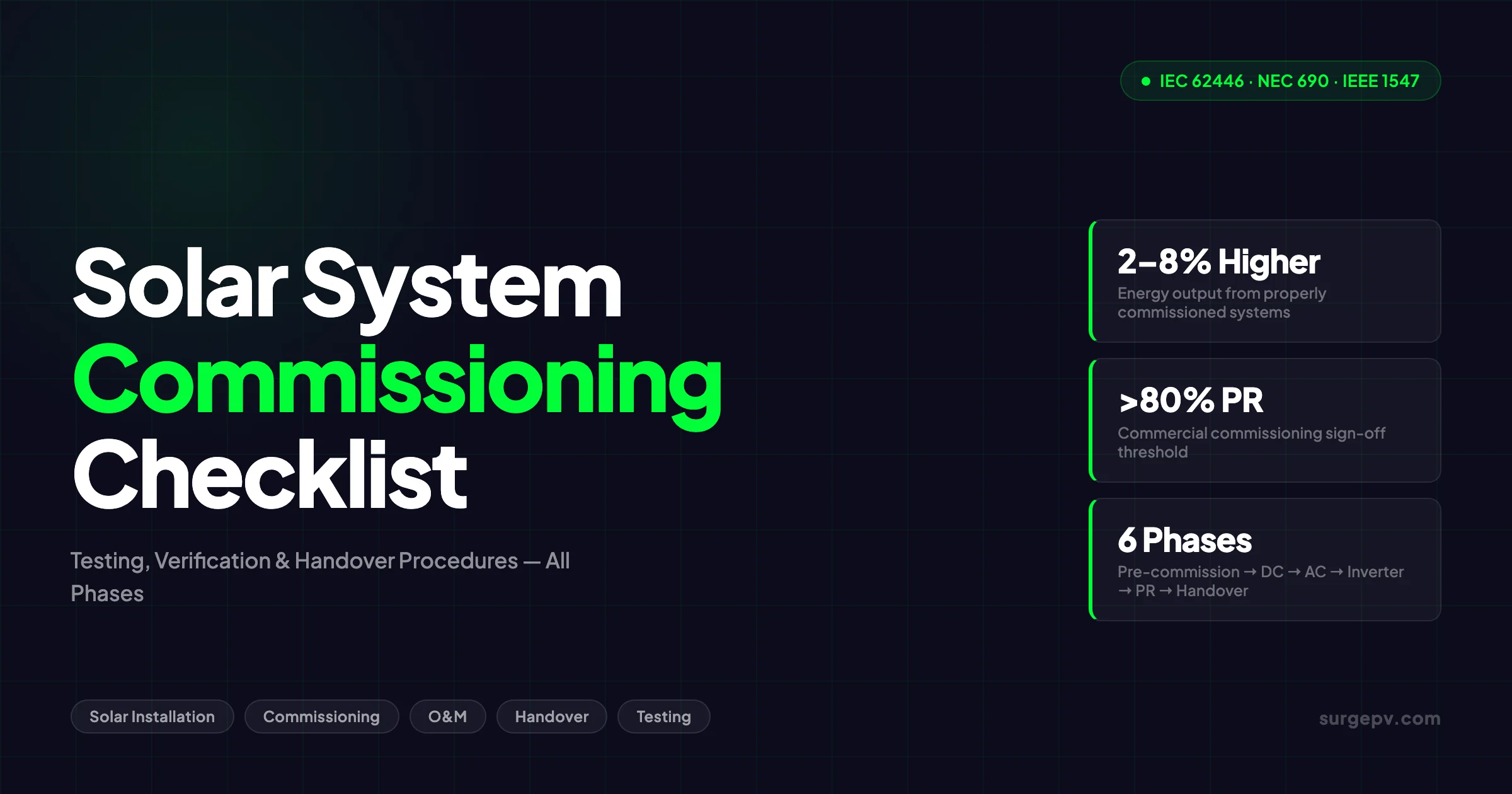
Properly commissioned PV systems produce 2-8% more energy and have 2-3x lower failure rates than systems commissioned informally. This guide covers all six phases: pre-commissioning inspection, DC electrical testing, AC/grid testing, inverter startup, performance ratio validation, and handover documentation — with specific pass/fail criteria at each step.
What Solar Commissioning Covers — and Why It Matters
Commissioning is the formal process of verifying that a PV system is built as designed, safe to energize, and performing to specification before handover to the client. It closes the construction period and establishes the legal baseline for performance warranties.
The scope varies by system size, but every commissioning exercise — from a 5 kW rooftop to a 50 MW ground mount — must answer four questions: See Ground Mounted Solar Design Guide for detailed guidance.
- Is the system built to the approved design and applicable codes?
- Are all electrical systems safe to energize?
- Does the system perform to its contracted output?
- Is the documentation complete enough for the O&M team to operate it independently?
Skipping or compressing any phase is a false economy. A 1 MW commercial system with a 2% performance shortfall from a misconfigured MPPT loses €15,000-25,000 per year in revenue — more than the cost of a full commissioning exercise. See Design Commercial Solar System 1MW for detailed guidance.
Standards Reference
This checklist aligns with: IEC 62446-1:2016 (grid-connected PV documentation), IEC 61724-1:2017 (performance monitoring), IEC 62446-3:2017 (thermography), NEC Article 690 (US residential/commercial), and IEEE 1547 (grid interconnection). Always verify local jurisdiction requirements — some countries have additional grid code requirements that supersede these standards.
Phase 1: Pre-Commissioning Verification Checklist
Pre-commissioning happens before the system is energized. All checks in this phase are on de-energized equipment. Do not skip this phase — faults found here cost minutes to fix; faults found after energization can cost days.
Documentation and Permits
- Approved permit set on-site (electrical, structural, fire if applicable)
- Grid connection agreement signed and utility interconnection approval received
- NTP (Notice to Proceed) confirmed; COD (Commercial Operation Date) target set — see NTP, PTO, and COD milestones for timeline context
- As-built drawings match installed configuration
- Single-line diagram (SLD) updated to reflect any field changes
- Equipment data sheets and installation manuals on-site for all major components
- Performance model output (P50/P90 generation estimates) available for PR comparison
Structural and Mechanical Inspection
- All PV modules free of visible damage: no cracked cells, broken frames, delamination, or discoloration
- Module serial numbers recorded and matched to layout plan
- Mounting structure bolts torqued to manufacturer specification — random sample check on 10% of fixings
- Rail-to-module clamp spacing within design tolerance
- Panel tilt angle verified (random sample: ±1° acceptable)
- Inter-row spacing matches design — shading risk confirmed against shadow analysis model
- Array footprint clear of vegetation, debris, and stored materials
- Cable management secured: no unsupported runs >1.2m, no abrasion points on conduit edges
- DC cabling kept separate from AC cabling (minimum 50mm separation or separated by a partition)
- All penetrations through roof or walls sealed against water ingress
Grounding and Bonding
- Equipment grounding conductor (EGC) installed on all metal frames, rails, and enclosures
- Grounding electrode system (GES) installed and connected per NEC 250 / local equivalent
- Bonding jumpers installed between all conductive mechanical elements
- Grounding electrode resistance measured (under 25 Ω recommended; local grid codes may specify lower)
- Lightning protection (if required by design) installed and bonded to main grounding system
Labeling and Safety Signage
- Rapid shutdown label on main service panel (NEC 690.56 — US installations)
- “WARNING — DUAL POWER SOURCE” labels on all disconnects
- DC disconnect labels showing voltage and current ratings
- String combiner box labels showing number of strings and fuse ratings
- AC disconnect label installed at point of interconnection
- Conduit system labeled at regular intervals (DC, AC, EGC — separate colors or labels)
Pro Tip: Punch List Before Energization
Create the punch list now, not at handover. Document every non-conformance with a photo and assign a completion date. Punch lists found at Provisional Acceptance (PAC) are negotiated; punch lists found post-energization are emergencies.
Phase 2: DC-Side Electrical Testing Checklist
DC-side testing verifies that the solar array is generating the correct voltage and current before connecting to the inverter. All tests are done with the DC disconnect OPEN (inverter disconnected). This phase requires a calibrated multimeter and insulation resistance tester.
Insulation Resistance Testing
Insulation resistance testing uses a DC high-voltage tester (500V-1000V for LV systems; 2500-5000V for MV systems) to verify that no insulation breakdown has occurred during installation.
Acceptance criteria:
- LV DC cabling: >100 MΩ (minimum 1 MΩ/kV applied test voltage)
- MV DC cabling: >1000 MΩ
- Any result below 100 MΩ for LV systems is a fail — trace and repair before proceeding
Test procedure:
- Confirm all DC disconnects are open and inverter is isolated
- Short positive and negative conductors together at inverter end
- Apply test voltage from shorted conductors to earth
- Record result per string or array section
- Document pass/fail with tester serial number, test voltage, and timestamp
String Polarity and Continuity Testing
- Verify positive terminal is positive at combiner box for each string (reverse polarity = immediate fail)
- Continuity test from module-1 positive terminal to combiner box positive busbar — no breaks
- Continuity test from module-N negative terminal to combiner box negative busbar — no breaks
- Verify fuse rating matches design for each string in the combiner box
- No strings shorted or cross-connected at combiner box
Open Circuit Voltage (Voc) Testing
Voc testing compares the measured voltage of each string against the temperature-corrected expected value. A variation of more than ±5% indicates a module failure, incorrect stringing, or a wiring fault.
Temperature-corrected Voc formula:
Voc(T) = Voc(STC) × [1 + (βVoc × (Tcell − 25))]Where:
-
Voc(STC) = nameplate open circuit voltage per module × number of modules in string
-
βVoc = temperature coefficient of Voc (from module datasheet, typically −0.26% to −0.38%/°C)
-
Tcell = actual cell temperature at time of test
-
Calculate expected Voc for each string at current module temperature
-
Measure actual Voc at combiner box for each string
-
Verify all strings within ±5% of temperature-corrected expected value
-
Flag and investigate any string deviating more than 5%
-
Record: measured Voc, ambient temperature, module temperature (if infrared thermometer available), timestamp
Short Circuit Current (Isc) Testing
Isc testing confirms that each string is producing the expected short-circuit current proportional to current irradiance.
Note: Isc test results are only meaningful when irradiance is stable and measurable (>400 W/m²). Cloud transients create large variation — do not test in variable cloud cover.
- Record irradiance at time of test (pyranometer or irradiance meter)
- Calculate expected Isc: Isc(STC) × (G/1000) × correction factor for temperature
- Measure Isc for each string at combiner box using a DC clamp meter
- Verify all strings within ±5% of irradiance-corrected expected value
- Any string producing significantly lower current than peers: suspect shading, soiling, module failure, or bypass diode fault
IEC 62446 Requirement
IEC 62446-1:2016 requires Voc and insulation resistance tests for all grid-connected PV systems, regardless of size. Isc testing is mandatory for commercial and utility-scale systems. I-V curve tracing (an expanded test) is recommended on a 10% random sample for systems over 100 kW — it catches partial shading faults, soiling gradients, and early degradation that Voc/Isc spot tests can miss.
Combiner Box Inspection
- All fuse holders properly seated and rated correctly
- Fuse continuity confirmed for each string
- No signs of overheating (discoloration, deformation, odor)
- Surge protection device (SPD) installed and indicator showing healthy
- Enclosure ingress protection rating verified (IP65 minimum for outdoor installations)
- All cable entries sealed with appropriate glands
Phase 3: AC-Side and Grid Connection Testing
AC-side testing verifies the inverter output, grid connection parameters, and protection functions. This phase requires an AC power quality analyzer. Tests are performed with the inverter running and the grid connected.
AC Output Verification
- Inverter AC output voltage within ±2% of nominal grid voltage at rated load
- Frequency: 50 Hz (±0.2 Hz) or 60 Hz depending on jurisdiction
- Power factor: unity or within limits specified by grid connection agreement (typically >0.95)
- Total harmonic distortion (THD): under 5% current, under 3% voltage (IEEE 519 limits)
- Phase rotation correct (three-phase systems: verify L1-L2-L3 sequence)
- Neutral-to-earth voltage under 1V at point of connection
Grid Protection Function Testing
Grid protection relay testing verifies the inverter disconnects from the grid under abnormal conditions. These tests must be performed — they are not optional and are required by most utility interconnection agreements.
Over/under voltage (OV/UV) protection:
- Apply 115% of nominal voltage — inverter must disconnect within required time (typically 2 seconds)
- Apply 85% of nominal voltage — inverter must disconnect within required time
- Record actual trip times and compare to utility requirements
Over/under frequency (OF/UF) protection:
- Simulate over-frequency condition — inverter must trip at threshold set per grid code
- Simulate under-frequency condition — inverter must trip at threshold set per grid code
Anti-islanding protection:
- Verify inverter cannot maintain output when grid is disconnected (island detection function test)
- Test method varies by inverter type — follow manufacturer procedure exactly
- This test is mandatory under IEEE 1547 for all grid-tied installations
Rapid shutdown (US only — NEC 690.12):
- Activate rapid shutdown initiator
- Verify conductors reduce to 30V or below within 30 seconds outside the array boundary
- Verify conductors reduce to 80V or below within 30 seconds within the array boundary (NEC 2023)
Export Limiting and Net Metering
- Export limit function configured correctly (if zero-export or limited-export required)
- CT (current transformer) installed on correct phase and correct orientation for net meter reading
- Verify export direction convention matches utility meter configuration
- Test export limiting under simulated conditions: reduce load below generation → confirm inverter throttles output at set limit
- Net meter installed, reads forward and reverse — record opening reading
Phase 4: Inverter Commissioning Checklist
Inverter commissioning is a separate procedure from AC testing. Most inverter manufacturers require their authorized representative or a trained technician to complete the startup sequence. Skipping manufacturer commissioning voids the warranty on most commercial inverters.
Pre-Startup Configuration
- Inverter firmware updated to latest stable release before energization
- Grid country code set correctly (determines protection relay thresholds)
- Nominal AC output voltage configured
- Frequency setting confirmed
- Start/stop time configured (if applicable for time-of-use optimization)
- MPPT voltage range verified against string Voc and Vmpp values
- Maximum input voltage verified not exceeded at coldest expected temperature
Calculating maximum Voc at minimum temperature:
Voc(Tmin) = Voc(STC) × [1 + (βVoc × (Tmin − 25))] × number_of_modules_in_stringThis must not exceed the inverter’s rated maximum DC input voltage. Exceeding this destroys the inverter.
Communication and Monitoring
- RS485 / Modbus address configured per site communication map
- Ethernet or cellular connection established (if remote monitoring required)
- SCADA system receiving inverter data points: active power, reactive power, DC voltage, DC current, AC voltage, frequency, temperature, alarms
- Weather station data (if installed) appearing in SCADA: irradiance (W/m²), ambient temperature, module temperature
- Data logger storing values at ≤15 minute intervals (IEC 61724-1 requirement)
- Remote access tested from off-site location
MPPT Optimization
- MPPT tracking verified: inverter finds maximum power point within 5 minutes of irradiance stabilizing
- Multiple MPPT channels configured for separate string orientations (if applicable)
- Shade optimization or module-level power electronics (MLPE) configured if installed
Inverter Alarm and Fault Handling
- Simulate common fault conditions and verify alarm appears in SCADA:
- DC overvoltage
- Ground fault (if isolated system)
- Insulation fault (string-level monitoring)
- AC overcurrent
- Verify remote alert (email/SMS) triggers on critical alarms
- Document alarm priority hierarchy for O&M team
Design the System Right Before Commissioning
Commissioning failures are often design problems discovered late. SurgePV’s solar design software lets you model string configurations, verify Voc limits at temperature extremes, and simulate performance ratios before a single module is installed.
Book a DemoNo commitment required · 20 minutes · Live project walkthrough
Phase 5: Performance Ratio Testing and Validation
Performance Ratio (PR) is the ratio of actual system output to the theoretical maximum output at a given irradiance level. PR testing is the final technical gate before Provisional Acceptance Certificate issuance on commercial and utility-scale projects.
PR formula (IEC 61724-1:2017):
PR = (Yf / Yr)

Where:
Yf = Final yield (kWh produced / kWp installed)
Yr = Reference yield (kWh irradiation / kWp × 1000)
Industry benchmarks:
- Residential (well-designed): 75-85%
- Commercial: 78-85%
- Utility-scale: 80-88%
- Minimum for PAC sign-off (typical EPC contract): >80%
PR Testing Requirements
- Test duration: minimum 7 days for residential and small commercial; 7-15 days for utility-scale
- Minimum daily irradiance: at least 8 days with ≥5 kWh/m²/day (or per contract specification)
- Minimum instantaneous irradiance during test hours: >500 W/m² for 3+ consecutive hours per day
- 100% inverter availability during test period (any grid or plant fault resets the clock)
- 100% SCADA and monitoring data availability — gaps in data invalidate test days
- Irradiance measured by calibrated pyranometer in plane of array (not horizontal)
- Module temperature recorded at ≥15 minute intervals
- Temperature-corrected PR calculated for high-temperature climates (>35°C average)
Temperature-Corrected PR
Standard PR calculation penalizes systems in hot climates because modules naturally lose efficiency in heat. Temperature-corrected PR accounts for this:
PR_corrected = PR_measured / [1 + γ × (Tmodule_avg − 25°C)]Where γ is the module power temperature coefficient (typically −0.35 to −0.45%/°C).
For European projects, uncorrected PR is standard in most contracts. For MENA and South Asian projects, temperature correction is expected. Also see: European Solar Incentives. For Europe-specific compliance details, see Europe solar compliance.
Performance Shortfall Remediation
If measured PR falls below the contracted guarantee:
- Identify cause: soiling, shading, incorrect MPPT settings, module mismatch, inverter derating
- Remediate and re-test from day 1 (test period resets)
- If PR gap remains after remediation: calculate liquidated damages per contract formula
- Document all test interruptions, causes, and resolutions
Pro Tip: Spring Testing Windows
Schedule PR testing in spring where possible. Temperatures are moderate (better module efficiency), irradiance is consistent, and the test window is easier to achieve without extreme weather interruptions. Summer heat will produce lower PR results even from a perfectly operating system.
Phase 6: Thermographic Inspection
Thermographic (infrared) inspection identifies hot spots in modules, connection points, and combiner boxes that electrical testing alone cannot catch. It is required by IEC 62446-3:2017 before PAC issuance on commercial and utility-scale systems. The NREL best practices guide for PV system inspection recommends thermography be conducted at minimum irradiance of 600 W/m² with the system at nameplate operating current.
Module Thermography
- Inspect 100% of modules (drone-mounted IR camera is standard for ground-mount arrays)
- Minimum irradiance for valid thermography: >600 W/m² stable irradiance
- Perform at nameplate operating current (system must be producing at ≥75% rated power during scan)
- Identify and classify hotspot categories:
| Hotspot Type | Temperature Differential | Action Required |
|---|---|---|
| Isolated cell | >10°C above adjacent cells | Flag for monitoring — replace if trending |
| Full string bypass activation | String at 0V, parallel strings warm | Inspect diodes and cell cracks |
| Module vs. module | >20°C difference | Replace module before PAC sign-off |
| Connection point | >15°C above ambient | Tighten or replace connection immediately |
| Combiner box fuse | >10°C above adjacent fuse | Replace fuse before energization |
- Photograph each anomaly with GPS coordinates recorded
- Classify defects as: pre-existing (manufacturer), installation-related, or acceptable
- Installation-related defects must be remediated before PAC
Phase 7: Handover Documentation Pack
The handover pack is the complete set of documents transferred to the client or O&M provider at PAC. A missing or incomplete handover pack is grounds to withhold final payment in most EPC contracts — and it leaves the O&M team unable to operate the plant effectively.
Technical Documentation
- As-built electrical single-line diagram (SLD) — updated to reflect all field changes
- As-built DC cable sizing and routing drawings
- As-built AC cable and protection drawings
- As-built civil/structural drawings (ground-mount foundation drawings, roof loading calculations)
- Completed commissioning test reports (all phases documented with results, dates, tester signatures)
- Thermographic inspection report with annotated module photographs
- Insulation resistance test results log
- Voc and Isc test results log per string
- PR test results report with weather data log
- SCADA system architecture diagram with IP addresses and communication map
Equipment and Warranty Documentation
- Warranty certificates for PV modules (typically 25-30 years product + performance)
- Warranty certificates for inverters (typically 5-10 years, extendable)
- Warranty certificates for mounting structures
- Warranty certificates for monitoring equipment
- Manufacturer installation and commissioning certificates (inverters especially — required for warranty validity)
- Spare parts inventory list with quantities and storage location
- Equipment serial numbers register (modules, inverters, meters, weather stations)
Regulatory and Legal Documentation
- Final electrical inspection certificate
- Utility interconnection approval (Permission to Operate / PTO letter)
- Grid connection agreement
- Metering and net metering configuration records
- Energy performance certificate (if required by local authority)
- Insurance policy for the plant (if EPC provides construction-period insurance)
O&M Documentation
- O&M manual: daily, monthly, quarterly, and annual maintenance schedules
- Inverter operation manual (all models installed)
- Monitoring system login credentials and user guide
- Emergency shutdown procedure (step-by-step rapid shutdown and safe isolation)
- Alarm escalation procedure: first response, escalation contacts, manufacturer hotlines
- Spare parts procurement contacts and part numbers
- LOTO (Lockout-Tagout) procedure for each major equipment type
Training Completion Records
- O&M team system walkthrough completed (sign-off from attendees)
- Monitoring system training completed
- Emergency procedures training completed
- Inverter startup and shutdown procedures demonstrated
- Training materials provided in local language
Further Reading
Building an O&M business around commissioning sign-offs? The solar O&M business guide covers service contracts, pricing models, and the monitoring tools that make recurring O&M economically viable.
Provisional Acceptance Certificate (PAC) vs Final Acceptance Certificate (FAC)
Most commercial and utility-scale EPC contracts use a two-certificate handover structure. Understanding both is critical for managing client expectations and cash flow.
Provisional Acceptance Certificate (PAC)
The PAC is issued when:
- All commissioning tests pass
- The system achieves grid connection and commercial operation
- The PR test meets contracted minimum
- All critical punch list items are resolved
- Non-critical punch list items are documented (typically representing 2-5% of contract value)
- As-built documentation is delivered
- O&M staff training is complete
The PAC marks the start of:
- The defects notification period (typically 12-24 months)
- The performance warranty period
- The O&M service contract
At PAC, the client assumes operational responsibility for the plant. The EPC contractor retains obligation to remedy defects discovered during the notification period.
Final Acceptance Certificate (FAC)
The FAC is issued after the defects notification period ends, typically 24 months after PAC. Requirements for FAC:
- All punch list items from PAC resolved
- Full plant inspection completed — civil, electrical, and equipment
- Repeated aerial module thermography (any new hotspots from in-service degradation documented)
- Annual PR test results reviewed and performance warranty confirmed
- Spare parts replenished to minimum inventory levels
- No outstanding warranty claims
- Client confirms all defects remediated to satisfaction
At FAC issuance, the EPC contractor’s contractual obligation ends. The client (or their O&M provider) assumes full responsibility.
| Feature | PAC | FAC |
|---|---|---|
| Issued at | Practical completion | End of defects period |
| Trigger | All tests pass + COD | All defects resolved |
| Starts | Defects notification period | Full client responsibility |
| Performance test | 7-15 day PR test | Annual PR review |
| Punch list | Non-critical items acceptable | All items must be closed |
| Typical timing | Day 0 of commercial operation | 12-24 months after PAC |
System-Specific Commissioning Requirements
The core checklist above applies to all system sizes. These additional requirements apply to specific scale categories.
Residential Systems (1-30 kW)
Residential commissioning is typically completed in 2-4 hours by a single engineer. The key difference from commercial projects is regulatory oversight: most jurisdictions require a final inspection by the authority having jurisdiction (AHJ) before the utility will issue PTO.
Additional residential requirements:
- Homeowner walkthrough of system operation and monitoring app
- Demonstrate rapid shutdown to homeowner
- Confirm homeowner has received warranty documentation
- Net metering enrollment confirmed with utility
- Inverter monitoring app installed on homeowner’s device
- Utility final inspection scheduled and passed before submitting PTO application
Using PV design software that generates IEC 62446-compliant documentation at the design stage eliminates the most common documentation gaps at residential commissioning. The same data flows into solar proposal tools for the customer’s compliance handover package.
Commercial Systems (30 kW – 1 MW)
Commercial commissioning typically takes 1-3 days and involves both electrical and IT/SCADA setup.
Additional commercial requirements:
- Building management system (BMS) integration tested if applicable
- Export limiting or demand-side management controls verified
- Business energy metering (half-hourly or 15-minute interval) confirmed with utility
- Power purchase agreement (PPA) or feed-in tariff metering verified
- Structural engineer sign-off for roof-mount systems (loading calculations confirmed)
- Fire safety setback compliance confirmed — see solar fire safety setback requirements by country
Utility-Scale Systems (1 MW+)
Utility-scale commissioning is a multi-week process involving the EPC contractor, the plant owner’s technical advisor (OTA/ITA), and often the grid operator.
Additional utility-scale requirements:
- Ready For Start-Up (RFSU) certificate issued before energization sequence begins
- Grid operator witness test for protection functions (often mandatory)
- Power system stabilizer (PSS) settings verified with grid operator
- Reactive power capability demonstrated (Mvar testing)
- MV/HV transformer commissioning by qualified HV engineer
- Switchgear relay injection testing (directional overcurrent, differential protection)
- SCADA integration with grid operator’s energy management system (EMS)
- Independent Technical Advisor (ITA) present for all performance tests
- 72-hour reliability test (some contracts require 100 consecutive hours with under 2% string failure)
Common Commissioning Failures — and How to Avoid Them
After 1+ GW of commissioned projects across 50+ countries, the same failure modes appear repeatedly. Here are the most common, with their root causes and preventive actions.
| Failure | Root Cause | Prevention |
|---|---|---|
| String undervoltage on Voc test | Wrong number of modules in string (stringing error) | Verify module count per string against SLD before roof-up |
| Insulation resistance fail | Damaged cable from install, water ingress at gland | Test IR at pull-through stage, not just at commissioning |
| Inverter trips on grid fault | Wrong country code or protection relay thresholds | Configure inverter to country standard before startup |
| PR shortfall | Soiling, shading from nearby obstruction, MPPT misconfiguration | Run shade analysis at design stage; inspect and clean before PR test |
| Missing documentation at PAC | No as-built update process during construction | Assign a document controller to update drawings as changes are made |
| Communication failure (SCADA) | IP address conflicts, wrong Modbus register map | Commission SCADA communication before PR test begins — don’t do it in parallel |
| Thermographic hotspots at PAC | Manufacturing defects or installation damage | Inspect 100% of modules before rail installation using visual + EL imaging |
Key Takeaway
Most commissioning failures are design or installation errors caught late. A rigorous design process — including string-level Voc calculation at minimum temperature, shade analysis, and proper stringing — eliminates the majority of DC-side test failures before the commissioning engineer arrives on site.
Post-Commissioning: Monitoring and O&M Integration
Commissioning is the start of the plant’s operational life, not the end of the EPC team’s involvement. The monitoring and O&M setup established at commissioning determines how quickly faults are detected and resolved for the next 25+ years.
Monitoring KPIs to Set at Commissioning
Configure the SCADA or monitoring platform to alert on these parameters from day one:
| KPI | Alert Threshold | Frequency |
|---|---|---|
| Performance Ratio | Below 75% on any production day | Daily |
| String voltage deviation | >5% from string average | Real-time |
| Inverter temperature | Manufacturer warning threshold | Real-time |
| Soiling loss (if soiling sensors installed) | >3% estimated soiling loss | Weekly |
| Communication loss | >15 minutes offline | Real-time |
| Grid voltage | Outside ±5% of nominal | Real-time |
First-Year O&M Schedule
Set this schedule at commissioning — do not leave it to the client to define later:
- Month 1 (post-PAC): Visual inspection and monitoring review — confirm all alarms calibrated correctly
- Month 3: Inverter log review for any recurring faults; clean modules if soiling detected
- Month 6: Full visual inspection, IR scan of any suspected hotspots, SCADA data quality review
- Month 12: Annual PR test (for FAC preparation), full thermographic inspection, inverter preventive maintenance per manufacturer schedule
The solar performance ratio guide covers ongoing PR monitoring methodology and what performance gaps typically indicate during year 1-3 of operation.
Integrating Commissioning Data into O&M Planning
The PR baseline established at commissioning is the reference point for all future performance analysis. Store it in a format that future O&M teams can access:
- PR test report filed in cloud document management system (not on a local drive)
- Baseline irradiance-to-output correlation curve saved in monitoring platform
- Module serial number register linked to monitoring system (for tracker-level fault diagnosis)
- Warranty expiry dates entered in O&M management system as automated reminders
A well-configured monitoring system means faults appear as SCADA alerts, not as unexplained generation shortfalls discovered months later by the asset owner. The difference between reactive and proactive O&M is almost entirely set at commissioning.
Conclusion
A complete solar commissioning process is not an administrative exercise — it is the only systematic way to confirm that a PV system will deliver the energy yield it was designed and contracted to produce. The three most important things to get right:
- Test before you energize. Insulation resistance, string Voc, and polarity tests catch the faults that damage inverters and void warranties. None of these take more than 2 hours on a residential system.
- Document as you go. An as-built document package assembled throughout the project takes half the time of one assembled in the week before PAC — and it is twice as accurate.
- Set the monitoring baseline at commissioning. The PR baseline, alarm thresholds, and KPI definitions set on day one determine whether the O&M team finds problems in hours or months.
For the design work that prevents commissioning failures, the solar panel installation guide and solar string design guide cover the upstream decisions that show up as test results at commissioning.
Frequently Asked Questions
What is a solar commissioning checklist?
A solar commissioning checklist is a structured document that guides engineers through every verification step required before a PV system is handed over to the client. It covers pre-commissioning inspections, DC and AC electrical tests, inverter startup, performance ratio validation, and handover documentation — ensuring the system is safe, code-compliant, and producing at its designed capacity.
What standards apply to solar system commissioning?
The primary standard is IEC 62446-1:2016, which defines minimum requirements for grid-connected PV system documentation and commissioning testing. Other key standards include NEC Article 690 for US installations, IEEE 1547 for grid interconnection, IEC 61724-1:2017 for performance monitoring and PR calculation, and IEC 62446-3:2017 for module thermography.
How long does solar system commissioning take?
Commissioning duration depends on system size: residential systems (5-10 kW) typically take 2-4 hours; commercial systems (100 kW to 1 MW) require 1-3 days; utility-scale plants (1 MW+) can take 2-8 weeks including performance ratio testing over 7-15 days.
What is the difference between PAC and FAC in solar commissioning?
A Provisional Acceptance Certificate (PAC) is issued at practical completion when all commissioning tests pass and the system enters commercial operation — it marks the start of the defects notification period. A Final Acceptance Certificate (FAC) is issued after the defects period (typically 24 months) once all punch list items are resolved and annual performance ratio tests confirm the system meets guaranteed output.
What is the minimum performance ratio for commissioning sign-off?
Most commercial and utility-scale contracts require a Performance Ratio of 80% or higher for Provisional Acceptance. Well-designed residential and commercial systems should achieve 80-88% PR. The exact guaranteed value is set in the EPC contract and verified per IEC 61724-1:2017 methodology over a minimum 7-15 day test window.
What documents should be included in a solar handover pack?
A complete handover pack includes: as-built electrical and structural drawings, commissioning test results and certificates, warranty documentation for all major equipment, O&M manuals and spare parts list, SCADA/monitoring system credentials and setup guide, grid connection agreement and utility approval letters, training records for O&M staff, and the signed Provisional Acceptance Certificate.
What tests are performed during solar DC-side commissioning?
DC-side commissioning tests include: insulation resistance testing (minimum 1 MΩ/kV for DC cabling, typically >100 MΩ for LV systems), string polarity verification, open circuit voltage (Voc) measurement vs. ±5% of temperature-corrected expected value, short circuit current (Isc) measurement, continuity testing of earthing and equipotential bonding, and combiner box functional testing.
Can I commission a solar system without an engineer?
For residential systems, a qualified electrician with solar PV training can complete commissioning in most jurisdictions. However, commercial and utility-scale systems require a licensed engineer — and inverter manufacturers typically mandate that their authorized representative be present for inverter startup. IEC 62446 compliance always requires documented testing by a qualified person regardless of system size.
Where this fits
This article is part of SurgePV's Solar Installation hub, which works through the topic from first principles to the decisions a project team actually has to make.

