

Quick Answer
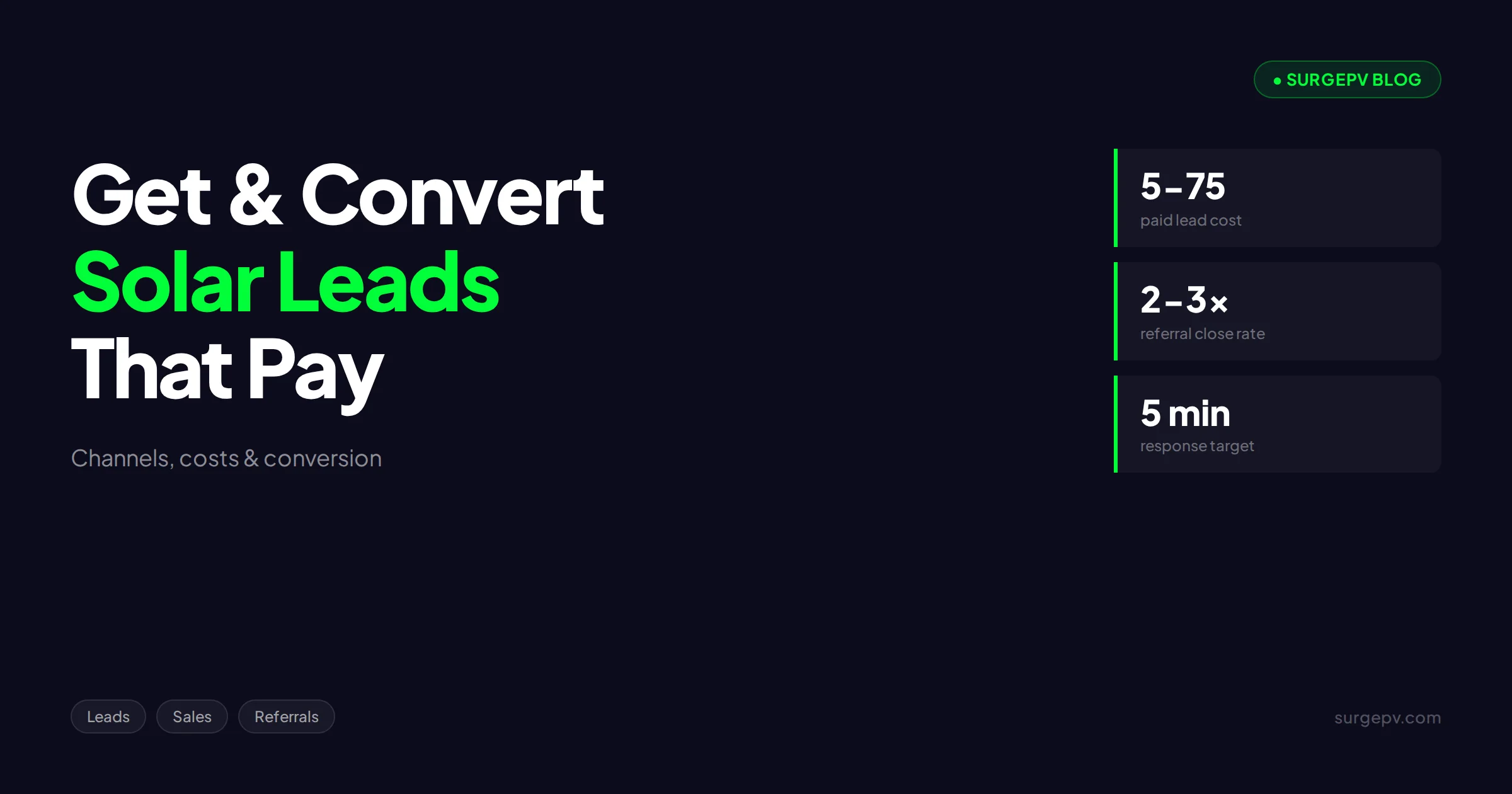
Get solar leads from 4 channel groups: referrals (cheapest, highest close rate), owned digital (SEO, Google Business Profile), paid digital (Google Ads, Facebook at $25–$75 per lead), and partnerships (roofers, builders, HOAs). Conversion is won on speed — respond within 5 minutes — and same-day proposals.
Every solar company says it needs more leads. Most actually need to convert the leads they already get. The math that matters is not cost per lead — it is cost per acquired customer, and that number is controlled as much by response speed and follow-up as by the channel that produced the lead.
This guide covers both halves honestly: where solar leads come from and what they cost, then the conversion system that determines whether those leads pay. We run and train sales teams in exactly this system, so the benchmarks here are operating numbers, not marketing theory.
Quick Answer
Get solar leads from 4 channel groups: referrals (cheapest, highest close rate), owned digital (SEO, Google Business Profile), paid digital (Google Ads, Facebook at $25–$75 per lead), and partnerships (roofers, builders, HOAs). Conversion is won on speed — respond within 5 minutes — and same-day proposals.
TL;DR — Solar Lead Economics
Paid digital leads cost $25–$75 (US, industry-observed); bought exclusive leads $100–$300; referrals near $0. Referral leads close at 2–3x the rate of purchased leads. Respond within 5 minutes, follow up 5–8 times over 30 days, deliver proposals same-day. Track cost per acquired customer, not cost per lead.
In this guide:
- The 4 channel groups and their real costs
- The referral engine: the only compounding channel
- Owned digital: Google Business Profile and local SEO
- Paid digital without burning money
- Partnership channels
- The conversion system: speed, follow-up, proposal
- Measuring cost per acquired customer
The 4 Channel Groups
Every solar lead comes from one of 4 places, and they behave differently:
| Channel group | Examples | Cost per lead (industry-observed) | Close rate tendency |
|---|---|---|---|
| Referrals | Customer referrals, review-driven inbound | ~$0–$50 (reward cost) | Highest — 2–3x baseline |
| Owned digital | Google Business Profile, SEO, content | $10–$40 (content/SEO amortized) | High — intent-driven |
| Paid digital | Google Ads, Facebook/Instagram, YouTube | $25–$75 | Baseline |
| Partnerships | Roofers, builders, electricians, HOAs, realtors | $25–$100 (rev share) | High when warm |
The US residential solar market’s scale — record installations through 2024, per the SEIA/Wood Mackenzie Solar Market Insight report (2025) — means lead channels are crowded and paid costs inflate every year. That is exactly why channel mix matters: the companies that survive price spikes in paid media are the ones with referral and owned channels carrying 40%+ of volume.
The Referral Engine: The Only Compounding Channel
Paid channels get more expensive every year. Referral channels get cheaper — every install creates another source. The system:
- Ask at PTO, not at install. The moment the first bill arrives with real savings is the moment of maximum enthusiasm.
- Pay a concrete reward. $200–$500 per signed referral is the industry-observed range. Vague “we appreciate referrals” converts at a fraction of a stated number.
- Pay fast. Reward paid within a week of the referred install trains customers to refer again.
- Make referring effortless. A shareable link or a simple “reply with their name and number” beats a form.
- Report back. Tell the referrer when their friend signs. Closing the loop doubles repeat referrals.
A 100-installs-per-year company with a working referral engine should see 15–30 referral-sourced jobs annually — at near-zero marginal cost and the highest close rate in the pipeline. That is the difference between a 12% and a 20% blended close rate.
Owned Digital: Google Business Profile and Local SEO
The highest-ROI digital asset a local installer owns is the Google Business Profile (GBP). Homeowners searching “solar installer near me” see the map pack before any website. The operating rules:
- Reviews are the ranking. Ask every customer at PTO with a direct review link. Target 2–4 new reviews per month, steady — review velocity matters more than totals.
- Respond to every review, including the bad ones. Response rate is a ranking and trust signal.
- Post photos of every install. Real roof photos from your service area outrank stock imagery.
Local SEO beyond GBP is a longer game: service-area pages, blog content that answers real customer questions, and consistent name-address-phone data across directories. It compounds over 6–12 months and then produces leads at a fraction of paid cost — but it cannot be the plan for this quarter’s pipeline.
Paid Digital Without Burning Money
Paid channels work when 3 disciplines hold:
Track to customer, not to lead. The metric is cost per acquired customer (channel spend ÷ signed jobs from that channel). A $30 Facebook lead that never answers the phone costs more than a $70 Google lead that closes at 25%.
Match channel to intent. Google search captures existing intent (“solar installers [city]”, “cost of solar panels”) and converts best. Facebook/Instagram creates demand — cheaper leads, lower intent, longer nurture. Budget roughly 70/30 intent-to-demand when starting.
Kill fast. Give any campaign 30 days and a minimum spend to generate 20+ leads, then judge on cost per acquisition. Channels that cannot beat your blended cost per customer within 90 days get cut.
One warning on bought leads: shared leads sold to multiple installers create price races and burn rep morale. If you buy, buy exclusive, and only after your follow-up system can run 5–8 touches without manual effort. Our deeper analysis of channel strategy sits in the solar lead generation strategies post.
Partnership Channels
Partnerships produce warm leads at rev-share prices:
- Roofers and electricians see solar-ready roofs and panel upgrades weekly. A $100–$300 referral fee buys their attention.
- Home builders and HOAs open new-development pipelines.
- Realtors know which buyers plan improvements before closing.
- EV dealers and charger installers share the exact customer profile.
Partnerships fail from neglect, not concept. Assign one person to partner relations, pay referral fees as fast as payroll, and report back on every lead. A partner who hears nothing after 3 leads stops sending the 4th.
Convert Leads With a Same-Day Proposal
SurgePV takes you from address to branded proposal in one session — design, shading, and financials included. Speed closes.
Book a DemoNo commitment required · 20 minutes · Live project walkthrough
The Conversion System
Here is where most lead problems are actually solved. Three levers, in order of impact:
1. Speed-to-lead. Respond within 5 minutes. Lead-response research popularized by the Harvard Business Review and InsideSales studies found contact and qualification rates drop by an order of magnitude as response time stretches from minutes to hours. In solar, where the homeowner just filled in 3 forms, the first responder gets the appointment. Automate the first touch — an instant text and email acknowledging the inquiry — and route the lead to a human within minutes. Our speed-to-lead analysis for solar sales breaks down the numbers, and solar lead response time covers the operational setup.
2. Persistent, valuable follow-up. Most deals need 5+ touches; most reps stop at 2. Run a structured sequence — recap, objection handler, social proof, breakup — over 30 days. The full template set is in our solar follow-up email sequences guide.
3. Same-day proposals. A proposal delivered while the customer is still comparing beats a better proposal delivered on day 4. This is a tooling problem: design, shading, and financials must live in one workspace. A solar proposal tool that generates the branded document directly from the design makes same-day the default rather than the exception.
For Indian EPCs, this conversion loop typically runs through WhatsApp and a purpose-built CRM — QuickEstimate’s guide to automated solar lead nurturing covers that workflow in detail.
Measuring Cost per Acquired Customer
Build one table, review it monthly:
| Channel | Spend | Leads | Appointments | Signed | Cost/customer | Close rate |
|---|---|---|---|---|---|---|
| Referrals | $1,500 (rewards) | 12 | 10 | 5 | $300 | 42% |
| Google Ads | $4,000 | 65 | 18 | 4 | $1,000 | 6% |
| GBP/organic | $800 (tools/content) | 15 | 9 | 3 | $267 | 20% |
| Partnerships | $600 (fees) | 6 | 5 | 2 | $300 | 33% |
(Illustrative numbers — replace with yours.) Two rules fall out of this table every time: referrals and owned channels subsidize paid, and “cheap leads” frequently produce expensive customers. Manage the last 2 columns and the lead-generation debate mostly resolves itself.
Neighborhood Saturation After Every Install
The cheapest leads in residential solar are the neighbors of your last install. The pattern: homeowners trust what they can see on a familiar roof. Systematize it:
- Install week: door hangers or postcards to the 20 nearest homes — “Your neighbor at [street] just went solar with us.”
- PTO week: the referral ask to the customer, naming 2–3 nearby streets where you would love the next project.
- Yard sign for 30 days, with a QR code to a quote page.
- Review mention: ask the customer to mention the neighborhood in their Google review — local keywords compound your map-pack ranking.
Installers who run this playbook report clusters forming — 3–6 jobs in a subdivision within a year of the first install. Density also cuts install cost: crews, permits, and inspections in the same jurisdiction are cheaper to repeat than to pioneer.
C&I Lead Generation Is a Different Sport
Everything above is residential logic. C&I leads come from relationships and evidence, not ads:
- LinkedIn outreach to facility directors and CFOs with a specific hook — “we modeled your warehouse at [address] from satellite; want the 1-page savings estimate?” A design tool that can model a roof from an address makes this opener possible at scale.
- Industry associations and trade shows for your verticals (cold storage, manufacturing, hospitality).
- Case studies with real numbers — system size, production, savings — because C&I buyers diligence everything. Our commercial solar sales cycle guide covers the 3–9 month reality of these deals.
- ESCO and developer partnerships for portfolio rollouts.
C&I cost per lead is higher and close rates lower, but a single 500 kW contract equals 50 residential jobs. The pipeline math — and the patience required — are different species. Do not judge a C&I channel on a residential timeline.
What Most Companies Get Wrong
The core misconception: lead volume is the constraint. For most installers doing 10–50 jobs a month, conversion is the constraint — they are answering leads in hours, following up twice, and delivering proposals in a week. Fixing conversion doubles output from the same lead spend; buying more leads into a broken conversion system just scales the waste.
Second: treating referrals as luck. Referrals are a process with an ask moment, a reward, a payout SLA, and a feedback loop. Luck has nothing to do with it.
The exception: genuine new-market entry, where you have no installed base to refer from. There, paid channels and partnerships carry the first 50–100 installs — but build the referral engine from install number 1, because it takes a year to compound.
Conclusion
Solar lead generation is a portfolio: referrals and owned channels for margin, paid and partnerships for volume — and a conversion system that makes any of them profitable. Three actions this week:
- Write your referral program on one page: ask moment, reward, payout SLA, feedback loop. Launch it.
- Set up automated first-touch on every lead source and measure response time for a week.
- Build the channel table and compute cost per acquired customer for last quarter.
If proposal speed is your conversion bottleneck, book a SurgePV demo and see how design-to-proposal in one workspace makes same-day delivery routine.
Frequently Asked Questions
What is the average cost per solar lead?
Industry-observed cost per solar lead runs $25–$75 for paid digital leads in the US, $100–$300 for exclusive or aged leads from lead sellers, and near zero for referrals. At a 20% close rate, a $50 lead costs $250 per acquisition; the same lead at a 10% close rate costs $500.
What is the best way to get solar leads?
Referrals from installed customers are the best solar leads by every measure: 2–3x the close rate of purchased leads and near-zero acquisition cost. Build a paid referral program with fast payouts before scaling any paid channel — it compounds, while paid channels get more expensive every year.
How fast should you respond to a solar lead?
Within 5 minutes where possible. Lead-response research consistently shows contact rates collapse as response time stretches past 10–30 minutes. A lead answered in 5 minutes is dramatically more likely to convert than the same lead answered in an hour — speed is the cheapest conversion lever in solar sales.
Are bought solar leads worth it?
Shared leads sold to 3–5 installers convert poorly and train reps to race on price. Exclusive leads can work if your speed-to-lead and follow-up sequences are strong. Most installers find bought leads profitable only after their referral and owned channels are systematized — otherwise the leads fund someone else’s learning curve.
How do you convert more solar leads into sales?
The 3 conversion levers are response speed (under 5 minutes), persistent follow-up (5–8 touches over 30 days), and proposal speed (same day, not next week). Most conversion problems diagnosed as ‘lead quality’ are actually slow response and thin follow-up.
What marketing works best for solar installers?
For residential: Google Business Profile reviews, local SEO, referral programs, and neighborhood saturation after installs. For C&I: LinkedIn outreach, industry associations, and case-study-driven content. Paid ads work in both but only with disciplined tracking of cost per acquired customer, not cost per lead.
Where this fits
This article is part of SurgePV's Solar Sales & Proposals hub, which works through the topic from first principles to the decisions a project team actually has to make.


