

Quick Answer
US commercial solar installations hit 585 MWdc in Q2 2025 and 554 MWdc in Q3 2025 (SEIA/Wood Mackenzie, 2025). SEIA and Wood Mackenzie project 6% annual growth from 2027 through 2030 (SEIA, 2025). The average B2B sales cycle reached 6.5 months in 2023 (Sword and the Script, 2023).
Commercial solar is growing. US commercial solar installations hit 585 MWdc in Q2 2025 and 554 MWdc in Q3 2025 (SEIA/Wood Mackenzie, 2025). SEIA and Wood Mackenzie project 6% annual growth from 2027 through 2030 (SEIA, 2025).
US commercial solar installations hit 585 MWdc in Q2 2025 and 554 MWdc in Q3 2025 (SEIA/Wood Mackenzie, 2025). SEIA and Wood Mackenzie project 6% annual growth from 2027 through 2030 (SEIA, 2025). The average B2B sales cycle reached 6.5 months in 2023 (Sword and the Script, 2023).
But the sales process is hard. The average B2B sales cycle reached 6.5 months in 2023 (Sword and the Script, 2023). Buying committees now average 9 to 13 stakeholders (Gartner, 2025; Forrester, 2024). Win rates sit at 21% (HubSpot, 2024).
This guide maps the full commercial solar sales cycle from first contact to signed contract. You will learn the eight stages, the four dead zones that kill momentum, and a week-by-week playbook to keep deals moving.
TL;DR — Commercial Solar Sales Cycle
The commercial solar sales cycle spans 3 to 12 months depending on project size and approval complexity. B2B sales now require 5+ follow-ups to close, yet 44% of reps quit after one attempt. Software-accelerated proposals, digital sales rooms, and structured follow-up cadences can cut cycle length by up to 33%.
In this guide:
- How long the commercial solar sales cycle takes by project size
- The 8 stages from lead to contract
- The four dead zones that stall deals and how to escape them
- Financial metrics that convince CFOs and procurement committees
- A week-by-week playbook for 24-week deals
- CRM setup and follow-up cadences for long cycles
- How integrated solar software compresses every stage
How Long Is the Commercial Solar Sales Cycle?
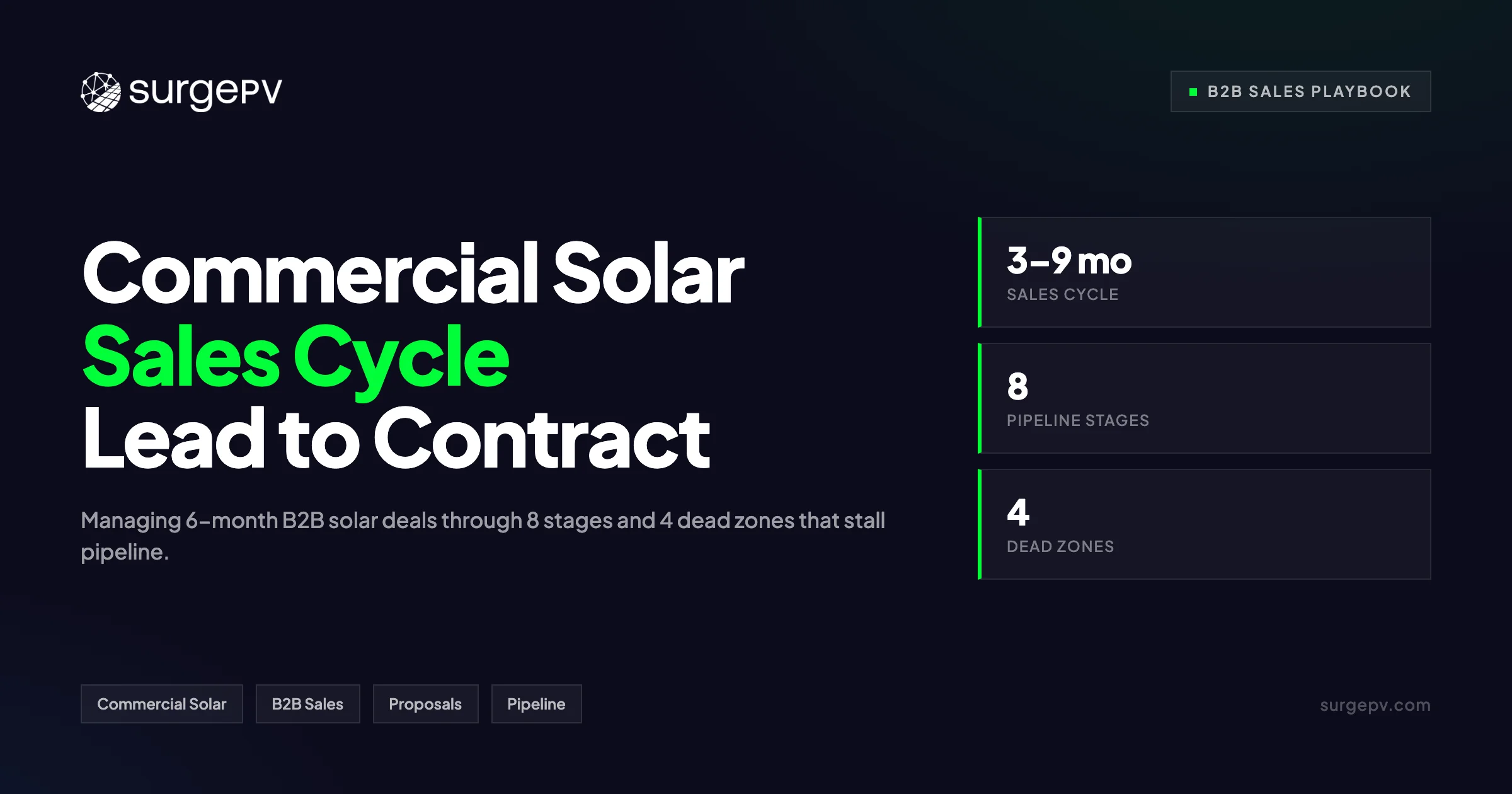
Small commercial solar projects close in 3 to 9 months. Larger commercial and industrial (C&I) deals take 6 to 12 months. The timeline depends on project size, financing, and how well the sales rep maintains momentum. Speed-to-lead matters, but consistent follow-up matters more for deals that stretch across multiple quarters.
| Project Size | Typical Cycle | Key Bottleneck |
|---|---|---|
| Under 100 kW | 3–5 months | Single decision-maker, fast utility interconnection |
| 100–500 kW | 5–9 months | Facilities manager + CFO dual approval |
| 500 kW–2 MW | 6–12 months | Board vote, RFP process, legal review |
| Over 2 MW | 9–18 months | Procurement committee, EPC contract negotiation, utility study |
The average B2B sales cycle across all industries reached 6.5 months in 2023 (Sword and the Script, 2023). That is up from 4.9 months in 2019. Commercial solar follows this trend.
Capital expenditure approval adds time. Multiple departments and long due diligence add more.
Speed-to-lead still matters. Responding within 5 minutes makes you 21× more likely to qualify a lead than waiting 30 minutes (MIT/InsideSales.com, 2007). But speed alone does not win a 6-month deal. Consistent follow-up does.
80% of sales need 5 or more touchpoints (Marketing Donut, 2023). But 44% of reps give up after one follow-up (Marketing Donut, 2023). 92% quit after 4 attempts (Close.com, 2023). For United Kingdom-specific compliance details, see United Kingdom comparisons/mcs-vs-non-mcs.
Most deals die in the gap between first interest and signed contract.
Reps who build structured cadences outperform reps who rely on memory. Reps who use digital proposal tracking outperform reps who use manual Excel lists. See Solar Racking Design Guide for detailed guidance.
Multi-threading boosts win rates by 130% in deals over $50,000 (Gong, 2025). Multi-threading means engaging several stakeholders at once.
Commercial solar appointments cost $200 to $500 per qualified meeting (EnergySage, 2023). At that price, giving up after one follow-up is expensive.
A 6-month cycle is not a reason to slow down. It is a reason to systematize every touchpoint.
What Are the Stages of a Commercial Solar Sale?
Most commercial solar sales move through 8 distinct stages. Each stage has a clear exit criterion. Reps who skip stages or fail to secure next-step commitments see deals stall later.
The stages run from lead generation and qualification through discovery, site assessment, design, proposal, due diligence, negotiation, and closing.
Stage 1: Lead Generation and Qualification
Commercial appointments cost $200 to $500 per qualified meeting (EnergySage, 2023). The best leads come from energy audits, referral networks, and facility-manager LinkedIn outreach.
Qualify for budget authority, timeline, roof condition, and utility rate structure before booking a discovery call. A qualified lead has a decision-making timeline under 12 months and a roof in good condition.
Stage 2: Discovery and Needs Analysis
Map the buying committee in the first meeting. Identify the economic buyer (CFO or owner), technical evaluator (facilities manager or engineer), procurement manager, legal reviewer, and internal champion.
Use an up-front contract. Agree on the agenda, timing, and next step before the call ends. Sandler Training calls this the single most important tactic for long-cycle B2B sales.
Stage 3: Site Assessment and Energy Audit
Shadow analysis, roof structural review, and irradiance mapping happen here. Use LiDAR and satellite data to start the design before the truck even rolls.
Stage 4: System Design and Financial Modeling
Run the 3D roof layout, panel placement, and shading simulation. Then model yield, ROI, payback, and LCOE with an integrated solar yield and financial analysis. Read [Solar Shading Analysis Guide](/blog/solar-shading-analysis-guide) for a complete walkthrough.
Excel slows most reps down here. Integrated tools output IRR and NPV directly from the simulation without a separate modeling step.
Stage 5: Proposal Development and Presentation
Build a client-facing proposal with embedded financials, equipment specs, and performance guarantees. Interactive web-based proposals see 3× higher engagement than static PDFs (Qwilr, 2026).
Tailor the executive summary to the CFO. Add an IRR page for finance and an O&M overview for facilities.
Stage 6: Due Diligence and Internal Review
The buyer verifies your assumptions. They check your P50/P90 production estimates, interconnection timeline, and equipment warranties.
This stage is a dead zone by default. Reps who give buyers a digital sales room with self-service documents keep momentum alive while the buyer researches independently.
Stage 7: Negotiation and Contracting
Legal teams redline performance guarantees and O&M contract terms. Procurement pushes for price concessions.
Standardized SLA language and bankable yield methodology reduce friction. Pre-empt objections with transparent modeling assumptions that buyers can audit.
Stage 8: Closing and Project Handoff
Signature, deposit, and transition to the project management or EPC team. The sales rep should stay involved through the first 30 days of installation.
This protects the relationship and generates referrals for the next deal.
The Four Dead Zones That Stall Commercial Solar Deals
Deals do not die from lack of interest. They die from lack of momentum. Most commercial solar deals stall in one of four dead zones.
Each zone maps to a specific week range in the cycle.
Dead Zone 1: Post-Proposal Silence (Weeks 6–9)
You present the proposal. The buyer says it looks great. Then nothing.
67% of B2B buyers prefer a rep-free experience during research (Gartner, 2025). They are reviewing your proposal internally without telling you.
Reps who send static PDFs have zero visibility. Reps who use digital proposal links with view tracking see exactly when the CFO opens the executive summary. That is the moment to call.
Dead Zone 2: Due Diligence Drift (Weeks 8–14)
The facilities manager is checking your shading numbers. The CFO is comparing your IRR to another vendor. Procurement is building a scoring matrix.
This drift lasts weeks because buyers have day jobs. Your job is to make their research easier than your competitor’s.
Give them a microsite with downloadable P50/P90 reports, equipment datasheets, and a video walkthrough of the financial model.
Dead Zone 3: Legal Review Limbo (Weeks 12–16)
Legal teams move slowly. They flag performance guarantee language, indemnification clauses, and O&M scope.
Most solar reps are not lawyers. They cannot speed-read redlines.
But they can reduce legal friction upfront by using standardised contract templates with pre-approved language. The fewer surprises in the first draft, the faster legal moves.
Dead Zone 4: Board-Approval Blackout (Weeks 14–20)
Boards meet monthly or quarterly. A missed agenda deadline means a 4-week delay.
Reps who know the board calendar can time their proposal submission to hit the pre-read packet. Reps who do not know the calendar wait blindly.
Ask your champion: “When is the next capital expenditure review?” Then work backwards from that date.
Escaping the dead zones needs three things. First, proposal-view analytics that signal buyer engagement.
Second, automated follow-up sequences triggered by buyer behavior.
Third, a digital sales room where buyers self-serve documents without waiting for a rep email. These tools together compress the dead zones from months to weeks.
What Financial Metrics Do Commercial Solar Buyers Care About?
CFOs and procurement committees speak the language of finance. Facilities managers speak the language of operations.
A rep who uses the wrong vocabulary with the wrong buyer loses credibility fast.
For the CFO and Economic Buyer:
Lead with IRR, NPV, and payback period. Then add LCOE to show competitiveness against grid rates.
Frame the 30% ITC Section 48 and MACRS accelerated depreciation together. Combined, these tax benefits can recover 50–60% of system costs in year one.
Present the EBITDA impact if the company finances through a PPA or lease. Show cash flow neutrality or positivity from month one.
Avoid “investment” language with operational buyers. Use “cost reduction” and “budget certainty” instead.
For the Facilities Manager:
Focus on roof integrity, warranty coverage, and O&M disruption. Show how the system integrates with existing building management.
Use the shadow analysis tool to prove that shading losses are quantified and mitigated.
For the Procurement Manager:
Give a total cost of ownership breakdown. Include 25-year O&M, inverter replacement schedules, and degradation assumptions.
Reverse-engineer their scoring matrix before they build it. If you know they weight LCOE at 40% and warranty at 20%, structure your proposal to win on those criteria.
For the Sustainability Officer:
Frame carbon reduction in tonnes CO2 avoided. Connect the project to ESG reporting and Science Based Targets.
This stakeholder often becomes your internal champion. Give them a one-page summary they can paste directly into a board deck.
Bankable yield estimates matter at every level. A P50/P90 production report from a credible cloud solar design software platform gives buyers confidence that your numbers are not optimistic fantasies.
Bankable means financeable. Financeable means approvable.
How to Sell Solar to Commercial Clients: A Week-by-Week Playbook
A 24-week cycle breaks into four quarters. Each quarter has a single objective.
Quarter 1 covers discovery and design. Quarter 2 covers presentation and due diligence. Quarter 3 covers negotiation and legal. Quarter 4 covers close and handoff.
Reps who treat long cycles as weekly sprints maintain sharper focus.
Quarter 1: Discovery and Design (Weeks 1–6)
Week 1: Qualify the lead. Confirm budget range, timeline, and roof age. Schedule the discovery call.
Week 2: Run discovery with the full buying committee mapped. Set an up-front contract for the site visit.
Week 3: Conduct the site assessment. Capture roof measurements, electrical room photos, and shading obstacles.
Week 4: Build the 3D design and run the shadow analysis tool. Start the financial model in parallel.
Week 5: Refine the system size and layout with the facilities manager. Confirm equipment preferences.
Week 6: Finalise the proposal. Run sensitivity analysis on base, upside, and downside scenarios.
Quarter 2: Presentation and Due Diligence (Weeks 7–12)
Week 7: Present to the economic buyer and technical evaluator together. Run live scenario toggles during the meeting.
Week 8: Send the digital proposal link. Activate view tracking. Send a follow-up email 48 hours later referencing the specific pages they viewed.
Week 9: Address the first round of technical questions. Use Clara AI to draft responses to repetitive shading and yield queries.
Week 10: Give the digital sales room with downloadable reports, datasheets, and a video financial walkthrough.
Week 11: Check in with your internal champion. Ask what concerns are surfacing in internal discussions.
Week 12: Submit answers to formal due diligence questions. Pre-empt procurement by sending the TCO breakdown and scoring-matrix comparison. For the latest details on France, see Agricultural Solar Case Study. Read more about Floating Solar Farms France.
Quarter 3: Negotiation and Legal (Weeks 13–18)
Week 13: Schedule the negotiation call. Bring your project manager or engineer to answer technical questions in real time.
Week 14: Handle the first round of legal redlines. Explain the rationale behind each performance guarantee clause.
Week 15: Meet with procurement. Present the LCOE comparison and long-term O&M value. Do not discount without trading scope. Read more about France Solar Feed-in Tariffs.
Week 16: Finalise the contract language. Send the clean redline version for legal sign-off.
Week 17: Confirm board submission date with your champion. Give a one-page executive summary formatted for the board packet.
Week 18: Follow up 3 days before the board meeting. Offer to attend virtually if the board has technical questions.
Quarter 4: Close and Handoff (Weeks 19–24)
Week 19: Receive board approval. Send the signature packet within 24 hours.
Week 20: Collect signature and deposit. Schedule the project kickoff call.
Week 21: Introduce the buyer to the project management team. Attend the kickoff.
Week 22: Visit the site during the first week of construction. Show the buyer you are still engaged.
Week 23: Request a LinkedIn testimonial and referral introduction to neighbouring facilities.
Week 24: Analyse the deal timeline in your CRM. Identify which dead zones cost the most time. Adjust your playbook for the next deal.
Stop losing commercial deals to dead-zone drift
SurgePV connects design, financial modeling, and proposal generation into one workflow — so you maintain momentum from first call to final signature.
Book a DemoNo commitment required · 20 minutes · Live project walkthrough
For a direct comparison, see Arka 360 vs SurgePV.
Commercial Solar Sales CRM Setup and Follow-Up Cadences
A 6-month cycle breaks most CRM setups built for 30-day deals. You need pipeline stages, fields, and automation built for long cycles.
Structured follow-up cadences prevent reps from giving up too early. A well-configured CRM reclaims hours each week for actual selling activities instead of admin work.
Pipeline Stages for Commercial Solar
- Qualified Lead
- Discovery Completed
- Site Assessment Done
- Proposal Sent
- Due Diligence Active
- Negotiation / Legal
- Board Approval Pending
- Contract Signed
- Project Handoff
Each stage needs a required exit criterion. A deal cannot move from “Proposal Sent” to “Due Diligence Active” until the buyer has viewed the proposal for more than 3 minutes or replied to your follow-up.
This prevents fantasy forecasting.
CRM Fields That Matter
- Buying committee mapped? (Yes/No)
- Economic buyer identified? (Yes/No)
- Next board date (Date)
- ITC eligibility confirmed? (Yes/No)
- Interconnection application status (Dropdown)
- Proposal view count (Number)
- Last engagement date (Date)
- Days in current stage (Calculated)
Follow-Up Cadence: Post-Proposal (Weeks 6–12)
Day 2: Email referencing the specific financial page they viewed most.
Day 5: LinkedIn connection request to the CFO with a personalised note.
Day 8: Phone call to the champion. Ask what questions came up in the internal review.
Day 12: Email with a case study from a similar facility size and industry.
Day 18: Phone call to the facilities manager. Offer a secondary site visit.
Day 25: Email with the P50/P90 bankable yield report attached.
Day 32: LinkedIn message to the economic buyer sharing a relevant market update.
Day 40: Breakup email offering to pause and reconnect next quarter.
Follow-Up Cadence: Legal Review (Weeks 13–18)
Day 1: Email confirming receipt of redlines and expected turnaround.
Day 4: Phone call to legal contact. Clarify any technical terms they flagged.
Day 7: Email with revised language and rationale for each change.
Day 10: Check-in with champion. Ask if legal needs a call with your general counsel.
Day 14: Final follow-up before escalation. Offer a 15-minute legal-to-legal call.
Reps spend only 28% of their week on core selling (Salesforce, 2024). The rest goes to admin, meetings, and data entry.
A well-configured CRM with automated stage reminders and email templates reclaims 3 to 5 hours per week. That is time for 2 more discovery calls.
How to Shorten the Commercial Solar Sales Cycle with Software
Boston Solar digitised their sales process and cut their cycle by 33%. They also lifted revenue by an estimated $1.4 million annually (Solar Power World, 2023).
Software does not replace relationships. It removes the friction that wastes relationship time.
Week 1–2: Discovery Compression
Run a live 3D design and shadow analysis on the prospect’s address during the first meeting. Clara AI answers “what if we added a battery?” instantly.
You leave the first meeting with credible visuals instead of a promise to “send something next week.”
Week 3–5: Site Assessment Compression
Satellite and LiDAR data speed pre-assessment. The design starts the same day as the site visit.
Reps using solar design tools skip the 3-day wait for a design technician to build the layout manually.
Week 4–7: Proposal Prep Compression
Integrated financial modeling outputs IRR, NPV, and 25-year cash flow directly from the simulation. No separate Excel modeling step.
No broken formulas. No version control nightmares. The solar proposal software pulls design and financial data into a branded client document automatically.
Week 6–9: Presentation Compression
Live scenario toggles let you adjust system size, financing option, or equipment tier during the meeting. The CFO asks about a 10-year PPA versus cash purchase.
You toggle both scenarios in 30 seconds. Confidence sells.
Week 8–14: Due Diligence Compression
Digital proposal links with view tracking show exactly who opened which page and when. Reps time follow-ups to buyer behavior instead of guessing.
A prospect who opens the IRR page 4 times is ready for a CFO call. A prospect who has not opened the proposal in 10 days needs a different trigger.
Week 12–18: Contract Compression
Bankable P50/P90 yield methodology built into the solar software platform reduces legal questions about performance guarantees.
Standardised O&M SLA terms mean fewer redlines. Pre-approved contract language cuts legal review from 4 weeks to 2.
The result is not just a faster cycle. It is a more predictable pipeline.
Sales managers can forecast board-approval dates accurately. Reps can see which deals are engaged and which are ghosts.
And buyers get a self-service experience that matches the 67% who prefer rep-free research.
Conclusion
Commercial solar deals are long. The right system keeps them from stalling.
Map your buying committee in week 2. Use an up-front contract after every meeting to lock in the next step.
Build a digital sales room for due diligence so buyers research on their own time without waiting for rep emails.
Replace Excel handoffs with integrated solar design tool to proposal workflows that output IRR and NPV automatically.
Your next step: audit your last 5 lost deals. Identify which dead zone killed each one. Then build one follow-up cadence and one digital asset to fix that zone.
Momentum is a choice.
Frequently Asked Questions
What is the commercial solar sales cycle?
The commercial solar sales cycle is the full process from first contact to signed contract for a business solar installation. It typically spans 3 to 9 months for small commercial projects under 200 kW, and 6 to 12 months for larger C&I deals that require board approval, interconnection agreements, and procurement committee review.
How long does a commercial solar sale take?
Small commercial solar sales close in 3 to 9 months. Larger C&I deals with board approvals take 6 to 12 months. The average B2B sales cycle across industries stretched to 6.5 months in 2023, and commercial solar follows a similar pattern due to multiple stakeholders and capital expenditure approval requirements.
What are common commercial solar sales objections?
Common objections include capital expenditure approval delays, facilities manager concerns about roof integrity, procurement pressure for lower pricing, CFO doubts about ROI assumptions, and legal teams redlining performance guarantees. Most objections can be pre-empted with bankable yield data and transparent financial modeling.
What financial metrics do commercial solar buyers care about?
CFOs and finance committees focus on IRR, NPV, payback period, and LCOE. Operational buyers care more about immediate OpEx savings and cash flow impact. The 30% ITC Section 48 and MACRS accelerated depreciation can recover 50–60% of system costs in year one, which is a powerful framing point for economic buyers.
How can solar proposals help close objections before they arise?
Interactive, digitally delivered proposals with embedded financial models and live scenario toggles see 3× higher engagement than static PDFs (Qwilr, 2026). When a proposal includes bankable P50/P90 yield estimates, view tracking, and executive summaries tailored to each stakeholder, objections are answered before they are voiced.
Where this fits
This article is part of SurgePV's Solar Sales & Proposals hub, which works through the topic from first principles to the decisions a project team actually has to make.


