

Quick Answer
Content marketing for solar companies focuses on educational content: cost guides, incentive explainers, and case studies. Top formats: blog posts (organic SEO), YouTube videos (visual proof), and downloadable calculators (lead capture). Successful solar companies publish 4–8 pieces monthly and see 30–50% of leads from organic content.
A solar installer in Atlanta published their first blog post in October 2023. It was a 2,800-word guide titled “Solar Panel Cost in Georgia 2024: Complete Breakdown by City.” It took the founder 18 hours to write. By December 2024, that single post generated 9,400 organic visits and 187 leads. Estimated revenue attributed: $312,000.
Content marketing for solar companies focuses on educational content: cost guides, incentive explainers, and case studies. Top formats: blog posts (organic SEO), YouTube videos (visual proof), and downloadable calculators (lead capture). Successful solar companies publish 4–8 pieces monthly and see 30–50% of leads from organic content.
Content marketing for solar companies focuses on educational content: cost guides, incentive explainers, and case studies. Top formats: blog posts (organic SEO), YouTube videos (visual proof), and downloadable calculators (lead capture). Successful solar companies publish 4–8 pieces monthly and see 30–50% of leads from organic content.
The same installer wrote 31 more posts over the next 18 months. By April 2026, the content library generated 28,000 monthly organic visits and 580 monthly leads. Their cost per lead from organic content: $42. Their cost per lead from Google Ads: $1,640.
Content marketing is the difference between paying for every solar lead and earning them at scale.
Quick Answer: Content Marketing for Solar Companies
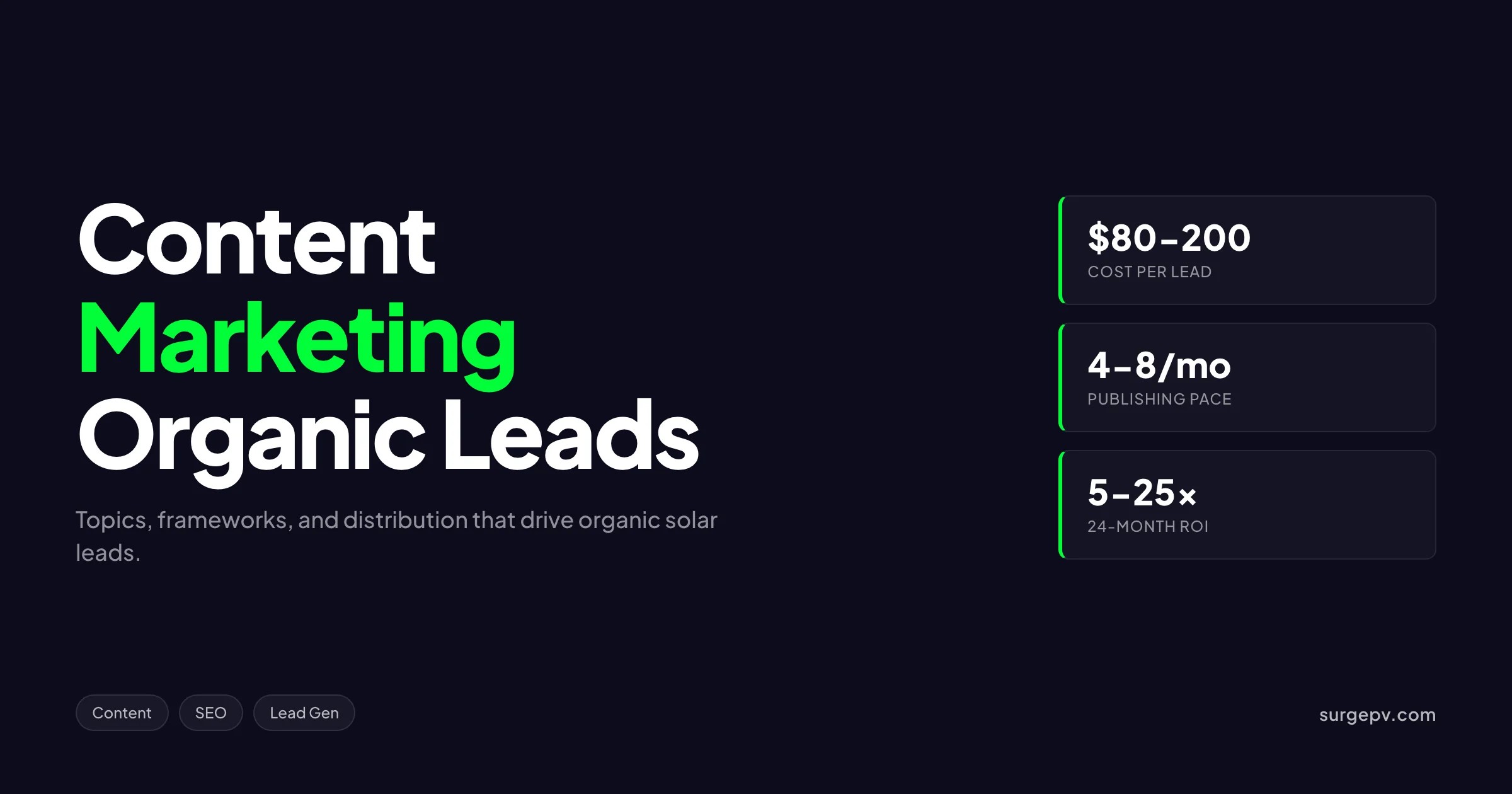
Solar content marketing generates leads at $80-$200 cost vs $1,200-$1,800 for paid ads. Most installers achieve meaningful ROI in months 6-12. Publishing 4-8 well-researched posts per month over 24 months typically generates 200-800 leads/month. Match content topics to high-intent search behavior (cost, incentives, comparisons) for maximum conversion.
For the latest details on France, see Agricultural Solar Case Study. See our guide on Floating Solar Farms France for more.
In this guide:
- Why content marketing wins for solar
- The 5 content categories that drive solar leads
- Topic research methodology (find what works)
- Content creation framework
- Distribution strategy (the 80% nobody does)
- Link building for solar content
- Measuring content marketing ROI
- Common content marketing mistakes
- Eight common questions
Why Content Marketing Wins for Solar
The economics of solar customer acquisition favor content marketing structurally. Three factors:
1. High consideration purchase Average residential solar customer takes 90-180 days from first inquiry to contract. They research extensively. Content marketing provides value during this research phase.
2. Local intent “Solar installer near me” plus city-specific searches dominate solar query volume. Content marketing built around local intent ranks organically and converts highly.
3. Trust requirement Solar customers commit to a 25-year asset. Trust is paramount. Content that demonstrates expertise, transparency, and local knowledge builds trust faster than advertising.
The Cost Curve
Paid ads have a flat cost curve: pay $1,500 per acquired customer, every customer. Content marketing has a compounding curve.
| Year | Content Investment | Customers Attributed | Cost per Customer |
|---|---|---|---|
| Year 1 | $50,000 | 35 | $1,428 |
| Year 2 | $50,000 | 85 | $588 |
| Year 3 | $50,000 | 160 | $313 |
| Year 4 | $50,000 | 240 | $208 |
| Year 5 | $50,000 | 320 | $156 |
The same dollar invested in content year 1 generates customers in year 5. Paid ads have no residual value.
This is why mature solar installers shift increasing budget from ads to content over time. The compounding ROI is impossible to match.
The 5 Content Categories That Drive Solar Leads
Not all content drives leads. Five categories deliver outsized ROI for solar companies.
Category 1: Cost and ROI Content
Highest-converting category. Examples:
- “Solar Panel Cost in [City] 2026: Complete Pricing Breakdown”
- “How Much Does a 10kW Solar System Cost in [State]?”
- “Solar ROI Calculator: How Long Until Solar Pays for Itself?”
- “[City] Electric Bill vs Solar: 25-Year Cost Comparison”
Search volume: High Commercial intent: Very high Conversion rate: 4-8% Production effort: Medium (requires real data)
Category 2: Incentive and Policy Content
Time-sensitive, search-friendly:
- “[State] Solar Incentives 2026: Complete Guide”
- “Net Metering in [State]: How It Works in 2026”
- “What Happens to Solar Without the 30% ITC?”
- “[State] Solar Tax Credits Explained for Homeowners”
Search volume: Medium-high Commercial intent: Medium-high Conversion rate: 3-6% Production effort: Medium (requires regulatory expertise)
Category 3: Product and Technology Comparisons
Mid-funnel decision support:
- “Tesla Powerwall 3 vs Enphase IQ Battery 5P”
- “REC Alpha vs Q Cells: Best Panels for [City]”
- “String Inverter vs Microinverter for Residential Solar”
- “Solar Panel Brands Ranked: Best to Worst in 2026”
Search volume: Medium Commercial intent: High (research phase) Conversion rate: 2-5% Production effort: High (requires technical depth)
Category 4: How Solar Works Content
Top-of-funnel educational:
- “How Does Solar Power Actually Work? Simple Explanation”
- “What is Net Metering and How Does It Save You Money?”
- “How Long Do Solar Panels Last? Real Lifespan Data”
- “Can Solar Panels Work in [Climate Type]?”
Search volume: Very high Commercial intent: Low-medium Conversion rate: 0.5-2% Production effort: Low-medium
Category 5: Local Application Content
Hyper-targeted geographic content:
- “Solar Panel Installation in [Specific Neighborhood]”
- “Best Solar Installers in [City]: 2026 Rankings”
- “Solar for [HOA Type] Homes in [Region]”
- “[Roof Type] Solar Installation: [City] Specifics”
Search volume: Low-medium Commercial intent: Very high Conversion rate: 5-12% Production effort: Medium
Content Mix Recommendation
Optimal content mix for most solar installers:
- 30% Cost and ROI content (high commercial intent)
- 20% Incentive and policy content (seasonal relevance)
- 15% Product and technology comparisons (mid-funnel)
- 15% How solar works (top-of-funnel)
- 20% Local application content (hyper-targeted)
This mix balances long-term traffic (educational) with short-term conversions (commercial).
Topic Research Methodology
Random topic selection wastes effort. Systematic topic research finds the topics that drive leads.
Tools for Topic Research
Free tools:
- Google Search Console (your existing rankings)
- Google Trends (search interest over time)
- AnswerThePublic (question-based topic ideas)
- Google’s “People also ask” sections
Paid tools:
- Ahrefs ($99-$999/month) — keyword data, competitor analysis
- SEMrush ($129-$499/month) — keyword research, content gap analysis
- Surfer SEO ($69-$249/month) — content optimization
The Topic Identification Process
Step 1: Identify primary keyword categories For solar installers, the primary categories:
- [Location] + solar [installer/panels/cost/etc.]
- [Equipment] + [comparison or features]
- [Incentive/policy] + [region or details]
- Solar + [question word: how, what, why, when] For the latest details on France, see France Solar Feed-in Tariffs.
Step 2: Pull search volume data For each potential topic, check:
- Monthly search volume
- Keyword difficulty (competitor strength)
- Cost per click (commercial intent indicator)
- Current top-10 ranking pages
Step 3: Identify content gaps Where do existing top-ranking pages miss something? Specific gaps:
- Outdated information (pre-2025 ITC content)
- Lack of local specificity (generic national content)
- Missing data (no real pricing, no case studies)
- Poor visualization (text-only on visual topic)
Step 4: Prioritize by ROI potential Score each topic on:
- Estimated traffic (search volume × CTR potential)
- Conversion rate estimate (commercial intent)
- Production effort
- Competition difficulty
Highest score topics get written first.
The 50-Topic Solar Content Plan
A starter content library for any solar installer:
Cost-focused (15 topics):
- Solar panel cost in [Top 10 cities]
- Solar cost per watt by state (2026)
- 25-year cost comparison: solar vs grid
- Solar lease vs buy: cost analysis
- Solar payback period calculator
Incentive-focused (10 topics): 6-15. State-by-state solar incentives (top 10 states)
Comparison-focused (10 topics): 16-20. Top 5 panel brands compared 21-25. Top 5 inverter brands compared
Educational (10 topics): 26-30. How solar works (5 different angles) 31-35. Net metering, ITC, depreciation (5 financial topics)
Local application (5 topics): 36-40. Solar for specific home types/roofs in your service area
These 50 topics build a complete content library over 12 months at 4-5 posts per month.
Content Creation Framework
A consistent framework speeds production and maintains quality.
Pre-Writing (1-2 hours)
- Confirm keyword target. Primary keyword and 3-5 secondary keywords.
- Analyze top 5 ranking pages. What works, what’s missing?
- Build outline. H1, 5-8 H2 sections, FAQ section.
- Gather sources. 5-8 authoritative external sources with specific stats.
- Identify unique angle. What will your post add that competitors don’t?
Writing (3-6 hours)
- Opening (75-100 words). Hook with specific data or counterintuitive claim.
- Quick Answer (40-60 words). Direct answer to primary keyword query.
- TL;DR or “In this guide” section. Scannable preview.
- Body sections (1,500-3,000 words). Each H2 starts with answer capsule.
- Tables and lists. Break up text, improve scanning.
- FAQ section (300-600 words). Mirror frontmatter FAQ.
- Conclusion with action items. 3 specific next steps.
Optimization (1-2 hours)
- Internal linking. 8-15 links to related posts.
- External linking. 5-8 authoritative sources.
- Schema markup. FAQ schema, Article schema, LocalBusiness schema.
- Images. Feature image plus 1-3 in-content images.
- Meta description and title tag.
- URL slug optimization.
Quality Checks (30-60 minutes)
- Reading grade level under 9th grade
- Average sentence length under 14 words
- Paragraph length under 3 sentences
- Real data with named sources (no “studies show”)
- Specific examples after every abstract claim
- No banned AI phrases
- Current year in title and at least 1 H2
Total time per post: 5-10 hours for 2,500-word post
This translates to $300-$800 per post if outsourced to skilled writer ($60-80/hour) or $200-$400 per post if AI-assisted writing with human editing.
Distribution Strategy: The 80% Nobody Does
Writing a post is 20% of content marketing. Distribution is 80%. Most solar companies skip distribution entirely.
Day 1: Owned Channel Distribution
- Publish on website
- Share on LinkedIn (company + personal accounts)
- Share on Facebook (company page + personal)
- Share on Twitter (now X)
- Post excerpt to Google Business Profile
- Schedule re-shares for days 7, 14, 30
Week 1: Email Distribution
- Send to customer email list (if relevant)
- Include in prospect newsletter
- Personal email to industry contacts who might share
Week 2-4: Outreach Distribution
- Reach out to 10-20 industry sites for guest mention or link
- Submit to relevant solar publication newsletters
- Pitch to local journalists covering solar
- Engage in Reddit threads where topic is relevant (genuine contribution, not spam)
Month 2-3: Repurposing
- Convert to LinkedIn long-form post
- Create 5-10 social media graphics from key stats
- Record 60-90 second video summary for social
- Pull 3-5 quotes for graphic posts
- Convert to email sequence (3-5 emails)
Quarterly: Content Refresh
- Update statistics with current data
- Add new sections based on emerging questions
- Refresh internal links
- Republish with new date if substantial update
- Re-promote refreshed content
Link Building for Solar Content
Backlinks remain a major ranking factor. Solar-specific link building requires industry knowledge.
Easy Wins
1. Local chamber of commerce membership — Most chambers list members with website links. $200-$500/year membership for permanent backlink.
2. BBB accreditation — A or A+ rating shows on BBB profile linking to your site.
3. Industry directories — NABCEP, SEIA, EnergySage all list installers with links.
4. Partner exchanges — Trade backlinks with roofers, electricians, real estate agents in your area.
5. Local news — Pitch solar projects to local journalists. Single article often delivers 2-3 valuable backlinks.
Higher-Effort Wins
6. Guest posts on solar publications — Solar Power World, PV Magazine, Solar Builder. Difficult to land but high authority.
7. Original research — Publish original data (e.g., “Average Solar Cost in Mesa 2026”) that others cite.
8. Industry expert quotes — Provide quotes for journalist queries (HARO, Connectively). Each quote = 1 backlink.
9. Resource pages — Find solar resource pages on government, education, or nonprofit sites. Pitch your content as a resource.
10. Broken link replacement — Find broken links on relevant sites (using tools), suggest your content as replacement.
Link Building Pace
Sustainable pace: 3-8 new backlinks per month for first 12 months, then 5-12 per month at maturity.
Aggressive paid link building triggers Google’s spam detection. Slow, natural-looking link growth wins.
Measuring Content Marketing ROI
Track these metrics monthly:
Traffic Metrics
- Organic sessions (total + by content piece)
- Top performing pages
- Average time on page
- Bounce rate
Engagement Metrics
- Pages per session
- Email signups from content
- Social shares
- Comments / engagement
Conversion Metrics
- Leads generated from content (track in CRM)
- Cost per lead by content piece
- Customers acquired from content
- Revenue attributed to content
Authority Metrics
- Total referring domains
- Domain authority/rating
- Backlink quality
- Branded vs non-branded search volume
Monthly Reporting
Build a simple dashboard tracking:
- New posts published (count)
- Total content pieces (cumulative)
- Organic traffic (month-over-month)
- Leads from content (month-over-month)
- ROI calculation Read Solar Racking Design Guide for a complete walkthrough.
Most solar installers see hockey stick growth at month 12-18 once content library reaches 50+ pieces.
Pro Tip
Set UTM parameters on all content links to track attribution properly. A simple format: ?utm_source=blog&utm_medium=organic&utm_content=[post-slug]. This shows which specific posts generate leads vs which are read but don’t convert.
Read Solar Lead Generation Strategies for a complete walkthrough.
Common Content Marketing Mistakes Solar Companies Make
Mistake 1: Writing Without Topic Research
“What we want to write about” rarely matches “what people search for.” Use keyword tools to validate topics before writing.
Mistake 2: Generic National Content
A “Solar Panel Cost in 2026” post without local data competes with hundreds of national sites. A “Solar Panel Cost in Mesa, Arizona 2026” post competes with 5-10 local sites.
Mistake 3: Thin Content
1,000-word posts on competitive topics don’t rank. 2,500-3,500 words with depth wins.
Mistake 4: No Distribution
Publishing without promotion means content sits unseen. Distribution effort should match writing effort.
Mistake 5: Inconsistent Publishing
3 posts one month, 0 the next, 1 the next. Inconsistency breaks momentum. Choose a pace and maintain it.
Mistake 6: Ignoring Existing Content
Old posts continue to drive traffic when updated. Quarterly refresh of top 10 posts often delivers more ROI than new posts.
Mistake 7: No Author Bios
E-E-A-T requires credible authors. Bios with credentials (NABCEP, years experience, project count) boost trust signals.
What Most Guides Miss
Content marketing for solar requires patience. Most installers quit at month 4-6 because they don’t see fast returns. The compounding effect kicks in around month 12-18. The installers who keep publishing past month 6 are typically the ones who dominate organic traffic for years.
Real-World Example: 24-Month Content Marketing Build
A residential solar installer in Charlotte, NC started a content marketing program in January 2024 with $4M revenue.
The plan:
- 6 blog posts per month
- $4,500/month investment (1 content writer + tools)
- Topic mix: 30% cost, 20% incentives, 15% comparisons, 15% educational, 20% local
- Quarterly content refresh
- Active distribution every Friday
Month 1-3:
- 18 posts published
- Organic traffic: 400-700 sessions/month
- Leads from content: 5-12/month
Month 4-9:
- 36 additional posts (54 total)
- Organic traffic: 3,500 sessions/month
- Leads from content: 25-45/month
Month 10-18:
- 54 additional posts (108 total)
- Organic traffic: 12,000 sessions/month
- Leads from content: 80-130/month
Month 19-24:
- 36 additional posts (144 total)
- Organic traffic: 22,000 sessions/month
- Leads from content: 150-220/month
By month 24:
- Total investment: $108,000
- Customers acquired from content: 425
- Cost per acquired customer: $254
- Revenue attributed: $7.1M
Compared to paid ads at $1,400 CAC, content marketing delivered 5.5x better customer acquisition cost.
Use Real Project Data in Content
Pull actual installation specs, costs, and outcomes from solar design software for case studies that competitors can’t match. Real data outperforms generic claims every time in solar content marketing.
Book a DemoNo commitment required · 20 minutes · Live project walkthrough
Frequently Asked Questions
Why does content marketing work for solar companies?
Solar is a high-consideration purchase with a 90-180 day buying cycle. Customers research extensively before deciding. Content marketing delivers value during that research phase, building trust and brand preference before the buying decision. Solar companies with strong content marketing close 23% more leads than competitors relying on ads alone.
How many blog posts should a solar company publish per month?
Most solar companies benefit from 4-8 blog posts per month. Below 2 posts per month, you cannot build topical authority. Above 12 posts per month, quality suffers. Mid-market installers ($5M-$50M revenue) typically publish 5-7 posts per month covering local, technical, and financial topics.
What topics drive the most solar leads?
Highest-converting content topics: cost calculations for specific homes, incentive guides by state, system comparison content, ROI calculators, and ‘is solar worth it in [city]’ content. These match high-intent search behavior and convert at 4-8% vs 0.5-2% for informational content.
How long should solar blog posts be?
For top SEO performance: 2,000-4,000 words for guides, 1,500-2,500 words for comparison articles, 800-1,500 words for FAQs and how-to content. Length matters less than depth. A 1,500-word post that answers questions completely beats a 4,000-word post that pads with filler.
How long does content marketing take to generate solar leads?
Solar content marketing typically begins generating measurable leads at month 4-6. Significant ROI typically emerges at month 9-12. The compounding effect kicks in around month 18-24, when 50+ pages of content collectively drive substantial organic traffic. The 12-month horizon is required.
Should solar companies use AI to write content?
AI-generated content alone underperforms in search and AI Overview citation. The best approach: AI-assisted human writing where AI handles research and outlines, humans write final content with personal insight and specific local data. Pure AI content is detectable and demoted by Google’s helpful content systems.
What is content marketing ROI for solar companies?
Solar content marketing typically delivers $80-$200 cost per lead vs $1,200-$1,800 for paid ads. ROI over 24 months ranges from 5x to 25x depending on quality and consistency. The investment compounds: content published year 1 generates leads through year 5+.
What is the biggest content marketing mistake solar companies make?
Publishing without distribution. Most solar companies write blog posts and hope they rank. Without active distribution (social, email, partnerships) and link building, even great content sits unseen. Distribution effort should equal writing effort for maximum ROI.
Three Steps to Start This Month
-
Pick your first 10 topics. Use keyword research tools to validate search volume and competition. Target topics with clear local angles.
-
Set a sustainable publishing pace. 4 posts per month is the minimum for momentum. Block calendar time. Treat it as non-negotiable.
-
Build a distribution checklist. Every post gets the same launch sequence: website, email, social, GBP, outreach. Use solar design platform project data to make content authentic and locally specific from day 1.
Related SurgePV Resources
Continue learning with these related guides for solar installers and EPCs:
- Solar SEO Strategy for Local Installers
- Local SEO for Solar Installers
- Video Marketing for Solar Installers
- Solar Email Drip Campaigns
- Solar Customer Testimonial Strategy
For more solar business and marketing content, explore the full SurgePV blog or browse the SurgePV glossary for definitions of solar industry terms. For a direct comparison, see Arka 360 vs SurgePV.
Solar Software Tools to Support This Work
Effective solar installer operations depend on integrated software. SurgePV’s solar design platform helps installers handle the upstream work that feeds every decision in this guide:
- Solar design software for system layouts, panel placement, and BOM generation
- PV shade analysis for site-specific irradiance and obstruction modeling
- Energy and financial modeling tool for production forecasts and project ROI
- PV proposal software for branded, customer-facing proposals
- Clara AI for automated design assistance and Q&A
Browse the full SurgePV platform to see how installers worldwide use the tools to design smarter, sell faster, and streamline every solar project.
Where this fits
This article is part of SurgePV's Solar Sales & Proposals hub, which works through the topic from first principles to the decisions a project team actually has to make.


