

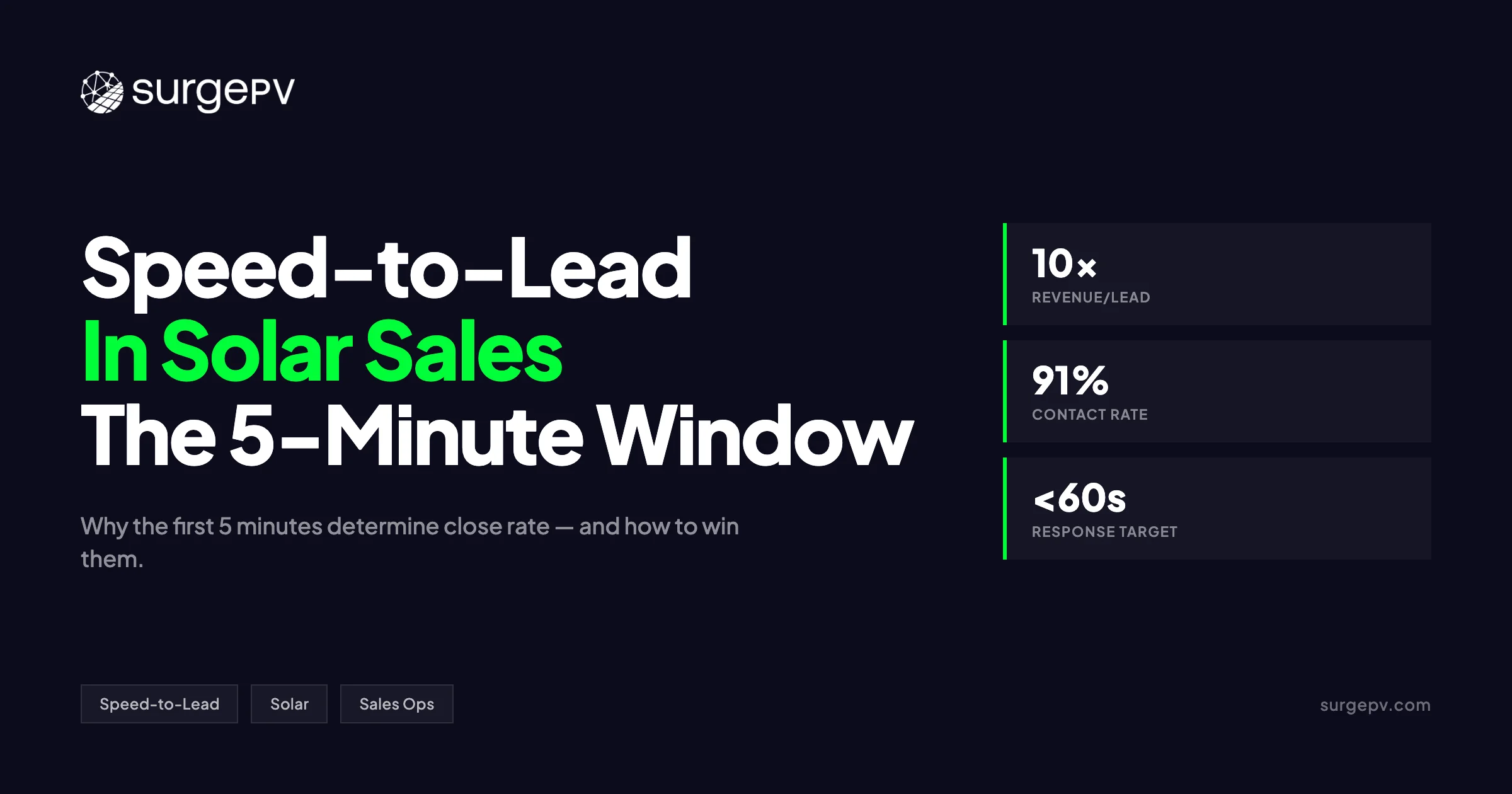
A homeowner submits a solar inquiry at 7:42 PM. By 7:47 PM, three competitors have already called. Your team responds the next morning. That lead is already gone.
The odds of contacting a lead dropped 100x between 5 minutes and 30 minutes. MIT research found that waiting 30 minutes instead of 5 reduces your odds of making contact by 100x. Velocify data from 3.5 million leads shows that calling within 1 minute improves conversion by 391% compared to calling at the 2-minute mark.
MIT research tracked over 15,000 leads across 100 companies. The odds of contacting a lead dropped 100x between 5 minutes and 30 minutes. This is not a marketing theory. It is a mathematical fact that governs every solar inquiry your business receives.
Solar leads are expensive. Wood Mackenzie data puts blended cost per lead at roughly $206. Google Ads alone runs $45–65 per lead. When a lead goes cold, you do not just lose a sale. You burn cash. This guide shows what the data says about response speed, why most solar companies lose deals in the proposal gap, and the exact playbook top teams use to respond in a few minutes and quote in under 20.
TL;DR — Speed-to-Lead in Solar
MIT data shows contact odds fall 100x after 30 minutes. Velocify found calling within 1 minute lifts conversion by 391% versus 2 minutes. EnergySage reports 78% of solar buyers sign with the first company that delivers a personalized quote. Speed is not a tactic. It is the main driver of close rate.
In this guide:
- The 5-minute rule and the hard data behind it
- What happens in the first 5 minutes — and why the next 20 matter just as much
- How slow response destroys your unit economics
- The field-tested speed-to-lead playbook for solar contractors
- The 6 metrics every sales manager should track
- Objection handling at speed using the Sandler framework
- After-hours leads: the biggest untapped opportunity in solar sales
The 5-Minute Rule: What the Data Actually Says
Contacting a lead within 5 minutes is not a best practice. It is a survival threshold. MIT research found that waiting 30 minutes instead of 5 reduces your odds of making contact by 100x. Velocify data from 3.5 million leads shows that calling within 1 minute improves conversion by 391% compared to calling at the 2-minute mark.
The MIT / InsideSales.com study remains the gold standard. Dr. James Oldroyd analysed 15,000+ leads across 100 companies from 2004 to 2007. The findings are brutal and consistent. Odds of contacting a lead drop 100x between 5 minutes and 30 minutes. Odds of qualifying that lead drop 21x in the same window. Most sales teams give up after 1.3 call attempts. The optimal number is 6. Wednesday and Thursday are the best days. The best times are 8–9 AM and 4–5 PM local time.
Velocify’s analysis of 3.5 million leads confirmed the curve. Calling within 1 minute delivers a 391% conversion lift versus the 2-minute mark. Waiting 5 to 24 hours yields only a 17% improvement over no immediate response. The first minute is not slightly better. It is an entirely different game.
Harvard Business Review and Drift tracked B2B lead response across industries. The average response time was 42–47 hours. Only 37% of companies responded within 1 hour. A staggering 23% never responded at all. Yet 78% of customers buy from the first business that responds. Speed beats perfection.
Solar-specific data tells the same story. A 2015 academic study sent inquiry forms to solar contractors during business hours. Only 46% received at least one phone call and one email. Almost 40% received no response for several weeks — or never received one at all. Solar installers were slower than general contractors.
Novacall AI published proprietary data from 14,200 solar interactions in early 2026. Their decay curve shows contact rates falling from 91.4% at a few seconds to 12.3% at 1–24 hours. Revenue per lead drops from $1,617 to $77 across the same windows. These figures are self-reported and should be treated as directional, but they align with the broader research pattern.
EnergySage data adds the proposal angle. The average homeowner requests 3.8 quotes before selecting an installer. 78% of buyers sign with the first company that provides a personalized quote. This means speed-to-contact is only half the battle. Speed-to-proposal decides who gets the signature.
| Response Window | Contact Rate | Appointment Set Rate | 90-Day Close Rate |
|---|---|---|---|
| a few minutes | 28–35% | 20–28% | 8–12% |
| 1–5 minutes | 20–28% | 12–20% | 4–8% |
| 5–30 minutes | 12–20% | 8–12% | 2–4% |
| 30 min – 2 hr | 8–12% | 4–8% | 1–3% |
| 2–24 hours | 4–8% | 2–4% | under 1% |
| Over 24 hours | 1–4% | under 1% | under 0.5% |
Source: Aggregated from Demand Local 2025, DAS Technology, and LeadTrackAI platform data (150+ Australian businesses). For the latest details on Australia, see Solar Energy in Australia. For Australia-specific compliance details, see Australia comparisons/lgc-vs-stc.
The table above shows aggregated platform data from lead response systems tracking solar and home-services businesses. The drop is not gradual. It is a cliff. Every minute matters. Read Solar Racking Design Guide for a complete walkthrough.
What Happens in the First 5 Minutes (And the Next 20)
Speed-to-lead is a two-stage rocket. Stage 1 is contact speed — the 5-minute window from inquiry to live conversation. Stage 2 is proposal speed — the time from first contact to a personalized quote on the homeowner’s actual roof. Most solar companies fix Stage 1 while bleeding deals to slow Stage 2.
Stage 1: Contact speed. The homeowner has just filled out a form or clicked a Facebook ad. Their intent is at peak level. NREL research shows solar interest is often event-triggered — a high bill, a neighbour’s install, or a referral. This intent decays fast. Tyson Peschke of Blue Raven Solar, cited in NREL’s SEEDS study, put it simply: “If you can get them within 10 seconds, they haven’t moved on. If you wait too long, it is very likely they’ve moved on to a different train of thought.” Blue Raven was the fastest-growing solar company in the US at the time of that study.
During Stage 1, your goal is not to close. It is to qualify and schedule. Three things must happen fast. First, acknowledge the lead with an automated SMS or email so they know you exist. Second, gather initial qualification data — roof type, electricity bill, shading, timeline. Third, set the next micro-commitment, which is usually a site survey or video call. See [Solar Shading Analysis Guide](/blog/solar-shading-analysis-guide) for detailed guidance.
Stage 2: Proposal speed. This is where most installers lose the deal. A rep calls within 5 minutes, builds rapport, and promises a proposal “by tomorrow.” The homeowner hangs up and requests three more quotes. By the time your PDF arrives, they have already seen a competitor’s design. EnergySage data shows 78% of buyers sign with the first company that provides a personalized quote. Being first to call is useless if you are third to quote.
The anchor bias makes first proposals especially powerful. The first number a homeowner sees becomes their mental reference point. Every later quote is judged against it. If your proposal arrives 24 hours later, you are playing defence against a competitor’s anchor.
SurgePV compresses both stages. Clara AI qualifies leads and surfaces roof data before the rep dials. The solar design software builds an instant 3D layout and shadow analysis during the first call. The generation and financial tool models ROI, payback, and LCOE in real time. The rep delivers a solar proposal while the homeowner is still on the phone. Five-minute contact becomes 20-minute proposal. No gap. No drift. No lost anchor.
Pro Tip
Schedule your first response attempt within 60 seconds, even if it is just an automated text. Then aim to present a preliminary roof design and financial model during the first live conversation — not in a follow-up email.
How Slow Response Destroys Your Economics
Slow lead response does not just lower close rates. It inflates every cost in your solar business. Customer acquisition cost rises. Revenue per lead falls. Sales rep productivity drops. Competitors capture the homeowners you paid to reach.
NREL’s SEEDS study found customer acquisition accounts for roughly 20% of total costs in residential solar. RMI research puts soft costs at about 70% of total US residential system pricing. For a 3 kW system, customer acquisition and overhead in the US exceed the total installed cost of the same system in Australia. Speed is not a sales tactic. It is a cost-reduction strategy.
Revenue per lead collapses as response time grows. Novacall’s proprietary data shows revenue per lead falling from $1,617 at a few seconds to $77 at 1–24 hours. Even if you treat these numbers as directional, the ratio is stark. A lead contacted in 10 minutes is worth roughly 10x more than a lead contacted in 10 hours.
Cost per lead is rising. Wood Mackenzie benchmarks put Google Ads cost per lead at $45–65. Blended cost per lead across all channels sits at roughly $206 per Apten.ai 2026 data. At $206 per lead, a 20% contact rate means every live conversation costs $1,030. A 5% contact rate pushes that to $4,120. Slow response turns a viable lead source into a cash incinerator.
Sales team productivity suffers too. Salesforce’s State of Sales 2026 report found the average seller spends only 40% of their time actually selling. Gen Z reps spend just 35%. The rest goes to admin, follow-up attempts, and proposal preparation. When reps chase cold leads and build proposals from scratch, they are not selling. They are burning hours on low-probability outcomes.
SEIA and Wood Mackenzie reported 4,647 MWdc of US residential solar installations in 2025. That is a massive market. But median quoted prices hit $2.50 per watt in late 2024 — an all-time low. Margins are tight. You cannot afford to lose leads you already paid for.
| Cost Element | Benchmark | Source |
|---|---|---|
| Blended solar CPL | ~$206 | Apten.ai 2026 |
| Google Ads solar CPL | $45–65 | Wood Mackenzie 2025 |
| CAC as % of residential solar costs | ~20% | NREL / Aurora 2022 |
| Soft costs as % of US residential system | ~70% | RMI 2013–2017 |
| Average seller time spent selling | 40% | Salesforce State of Sales 2026 |
The table shows why speed-to-lead is an economic imperative. Every lead you fail to contact is a direct loss. Every delayed proposal is an invitation for competitors to steal the deal.
The Field-Tested Speed-to-Lead Playbook for Solar
Data without action is trivia. Here is the exact playbook we use with for solar sales professionals and installer teams across the UK and Europe. Also see: European Solar Incentives. For Europe-specific compliance details, see Europe solar compliance.
Step 1: The 60-second triple-touch. The moment a lead hits your CRM, fire three channels simultaneously. An SMS confirms receipt and sets expectation. An email delivers a calendar link. A call attempt starts within 60 seconds. Blazeo calls this the “triple-touch.” The channel mix matters. Novacall data shows SMS-first sequences outperform voice-only sequences for solar leads under age 45. Voice-first works better for leads over 55. If you do not know the age, lead with SMS. It is less intrusive and gets read.
Step 2: The 20-minute design rule. Contact is not the finish line. The finish line is a personalized proposal on the homeowner’s roof. SurgePV’s platform lets reps pull satellite imagery, build a 3D layout, run shading analysis, and model financials in a few minutes. If your team still takes 2–4 hours to build a proposal in separate tools, you are losing to faster competitors. Solar PV design software should feed directly into your PV proposal software. No copy-paste. No re-entry. No delay. For a direct comparison, see Arka 360 vs SurgePV.
Step 3: The persistent cadence. Most solar teams give up after 1–2 touches. MIT research says the optimal number is 6. We recommend 8–12 touches across 14 days. Day 1: triple-touch within 60 seconds. Day 1–2: 3–4 follow-up calls at varied times. Day 3: SMS with a soft re-engagement. Day 5: Email with a case study or local install photo. Day 7: Final call. Day 10: Breakup email. Day 14: Passive nurture begins. Each touch should offer value, not pressure. A photo of a nearby install is value. A “just checking in” voicemail is not.
Step 4: Tighten marketplace handoffs. If you buy leads from EnergySage, Solar Reviews, or LSA, the handoff must be instant. Manual CSV exports that sit in a sales manager’s inbox for 3 hours are fatal. Use API integrations or Zapier to push leads straight into your CRM with instant routing rules. Top-performing teams route leads by territory, rep capacity, and even lead source quality. A $250 LSA lead gets a senior rep. A free organic lead gets the next available agent.
Step 5: Win the first two minutes with value. Do not open with “I saw you were interested in solar.” Open with data. “I pulled your roof on satellite. It looks like you have excellent south-facing exposure. Based on your postcode, a 6 kW system could cut your bill by roughly 60%.” Value-first opening lines keep homeowners on the phone. Pressure-first lines get you hung up on.
Step 6: Pre-frame objections. Sandler Training teaches that the best objection handling happens before the objection arises. If you know 80% of homeowners say “I need to get more quotes,” address it in minute 3. “Most of our customers compare 3–4 quotes. Here is what to watch for when you do.” This inoculation technique — also called pre-framing — removes the sting from objections before they surface.
What to Track: The Speed-to-Lead Dashboard
You cannot improve what you do not measure. Solar sales managers need a simple dashboard with 6 numbers reviewed weekly.
1. Average lead response time. Measure from form submission or missed call to first live contact. Target: a few minutes during business hours, a few minutes after hours. Track by rep, by lead source, and by time of day.
2. Contact rate. The percentage of leads that result in a live conversation. Target: 70%+ for leads contacted within 5 minutes. This number drops to under 30% for leads contacted after 1 hour.
3. Appointment set rate. The percentage of contacted leads that book a site survey or video consultation. Target: 20–30% for leads contacted within 5 minutes. Novacall’s self-reported data shows 38.2% for under-60-second response, but 20–25% is a realistic benchmark for most teams.
4. Time-to-quote. The average hours from first contact to personalized proposal delivery. This is the missing metric in most solar CRMs. Target: same-day for residential, 24 hours for commercial. If your average is 48+ hours, you have a Stage 2 problem.
5. Quote-to-close rate. The percentage of proposals that result in a signed contract. Target: 15–20% for top performers, 8–12% for average teams. If this number is low despite fast response, your proposal quality or objection handling needs work.
6. Revenue per lead and CAC. Divide total sales revenue by total leads received. Divide total sales and marketing spend by total customers acquired. Track both monthly. If revenue per lead falls while CAC rises, your response speed is deteriorating.
Salesforce’s State of Sales 2026 found that 51% of sales leaders say disconnected systems slow AI initiatives. The same applies to speed-to-lead. If your CRM, design tool, and proposal tool do not talk to each other, your reps spend 40% of their day on admin. Integrated solar software fixes this.
Stop losing leads to slow proposal turnaround
SurgePV compresses both contact speed and proposal speed — from first call to live 3D design and financial model in 20 minutes.
Book a DemoNo commitment required · 20 minutes · Live project walkthrough
Objection Handling at Speed
Fast contact means nothing if the conversation falls apart. Solar homeowners raise the same objections every time. The Sandler framework gives reps a system to handle them without slowing down. Reps who master these techniques close more deals in fewer touches.
The Reverse. When a homeowner says “Your price is too high,” the Sandler Reverse turns it back as a question. “I understand. Can you help me understand what number you are comparing us to?” This does not argue. It gathers information. It keeps the conversation moving.
Negative Reverse. When a homeowner says “I need to think about it,” respond with “That makes sense. Most people who need to think about it are not actually interested. Is that the case here, or is there a specific concern I can address?” This is counter-intuitive. It sounds risky. But it surfaces the real objection. Most “think about it” responses hide price, timing, or trust concerns. The Negative Reverse exposes them in 10 seconds instead of 10 days.
Pre-frame / Inoculation. Raise objections before the homeowner does. “You are going to get quotes from other companies. Here is what most people miss when they compare solar quotes.” This positions you as an advisor, not a vendor. It also defuses the “need more quotes” objection before it surfaces.
Avoid objections through qualification. Sandler teaches that most objections are caused by poor qualification, not poor closing. If you understand the homeowner’s bill, roof condition, timeline, and decision-making process in the first 5 minutes, you will face fewer objections later. Fast qualification is as important as fast response.
The key is speed without pressure. Homeowners want to feel informed, not rushed. A rep who delivers a full roof design and financial model in 20 minutes looks prepared, not pushy. A rep who calls fast but has nothing to show looks desperate. Train your team on one technique per week. Measure quote-to-close rate before and after. The numbers will show you which objection handler works for your market.
After-Hours: The Biggest Untapped Opportunity in Solar Sales
Here is a number most solar managers ignore. Between 35% and 50% of homeowner inquiries arrive outside business hours. They come in at 8 PM on a Tuesday. They come in at 11 AM on a Sunday. Your sales team is off. Your competitors are off. The first company to respond wins.
MIT’s optimal call time research focused on business hours. But solar buyers do not follow business hours. A homeowner sees a Facebook ad after dinner. They fill out a form. If your system waits until 9 AM, that lead has already requested 3 more quotes.
AI agents are changing this. Salesforce’s State of Sales 2026 found AI agents contacted 130,000 leads in 4 months, creating 3,200 opportunities. Top-performing sales teams are 1.7x more likely to use AI agents. These tools do not replace reps. They bridge the gap. An AI voice agent or chatbot can qualify a lead, answer basic questions, and book an appointment at 10 PM. The rep gets a fully qualified meeting at 9 AM.
Automated SMS and email are the minimum. Every after-hours lead should receive an instant text: “Thanks for your interest in solar. We will call you at 9:15 AM tomorrow. Here is a link to book a time that works for you.” This simple message keeps the homeowner engaged. It sets expectation. It prevents them from filling out three more forms while they wait.
Scheduling links remove friction. Tools like Calendly, Chili Piper, or native CRM scheduling let homeowners book their own appointments. A lead that books its own appointment shows up 30% more often than a lead that gets assigned a time. Self-scheduling is especially powerful for after-hours leads. The homeowner is already engaged. Give them the wheel.
After-hours response is where smaller installers can beat national competitors. Sunrun and Tesla have call centres. But they also have layers of process. A 5-person shop with instant SMS and AI qualification can respond faster than a 500-person team with a ticketing system. Speed favours the nimble.
Conclusion
Speed-to-lead is not about working harder. It is about removing the gaps that kill deals. The data is unambiguous. MIT proved the 100x drop. Velocify proved the 391% lift. EnergySage proved that the first quoter wins 78% of the time. Solar companies that treat response speed as a core metric outperform those that treat it as a nice-to-have.
The economics are just as clear. At a blended cost per lead of roughly $206, every missed contact is a direct loss. Every delayed proposal is an open door for competitors. NREL puts customer acquisition at roughly 20% of residential solar costs. Cutting response time is one of the fastest ways to lower that number without slashing marketing spend. RMI research shows soft costs dominate system pricing. Speed attacks those soft costs directly.
The best solar sales teams we work with run speed-to-lead like a production line. They measure it daily. They review it in Monday stand-ups. They reward reps who hit the 5-minute target. They do not accept “I was with another customer” as an excuse because they have automation that handles the first touch.
Action steps for this week:
- Audit your current response time. Measure from lead arrival to first live contact. If your average is over 10 minutes, fix that before anything else.
- Compress time-to-quote. Contact speed is Stage 1. Proposal speed is Stage 2. Aim to deliver a personalized design and financial model during the first call, not in a follow-up email.
- Track 6 numbers weekly. Average response time, contact rate, appointment set rate, time-to-quote, quote-to-close rate, and revenue per lead. Review them in a 15-minute Monday meeting.
Start with the 60-second triple-touch. Add the 20-minute design rule. Pick one metric and track it for 30 days. Your close rate will tell you the rest.
Frequently Asked Questions
What is speed to lead in solar sales?
Speed to lead is the time between a homeowner’s inquiry and your first meaningful response. In solar sales, it covers the gap from form submission or missed call to live contact, qualification, and first proposal. Faster response times directly increase contact rates, appointment sets, and close rates. It is the single biggest controllable driver of conversion in residential solar.
How fast should solar contractors respond to leads?
MIT research shows contact odds drop 100x between 5 minutes and 30 minutes. Velocify data found calling within 1 minute lifts conversion by 391% versus waiting 2 minutes. The practical target for solar contractors is a few minutes for first contact, with a preliminary proposal delivered within 20 minutes. Reps who hit both targets consistently close at rates 2–3x higher than teams that respond next-day.
What percentage of solar leads are never contacted?
Harvard Business Review research found 23% of companies never respond to leads at all. A separate academic study of solar contractors showed almost 40% of inquiries received no response for several weeks, or none at all. This is lost revenue before the sales process even starts. It also means simply responding puts you ahead of nearly half your competitors.
How does speed to lead improve solar ROI?
Fast response raises revenue per lead by capturing homeowner attention before competitors call. NREL data shows customer acquisition costs make up roughly 20% of residential solar business costs. Cutting response time compresses the sales cycle, reduces touch volume, and lowers cost per acquisition. At a blended lead cost of roughly $206, improving contact rate from 30% to 60% halves your cost per conversation.
What tools help solar contractors improve speed to lead?
Solar CRMs with instant lead routing, automated SMS and email sequences, AI voice agents, and integrated design-to-proposal platforms all help. SurgePV’s Clara AI qualifies leads, while the platform’s instant 3D design and proposal generation compresses both contact speed and proposal turnaround. The best tools connect every stage — from lead capture to roof design to financial model — without manual data entry.
Where this fits
This article is part of SurgePV's Solar Sales & Proposals hub, which works through the topic from first principles to the decisions a project team actually has to make.


