

Most solar installers do not lose deals because their panels or prices are worse. They lose because they call back too late. A homeowner submits a solar inquiry at 8:14 PM on a Saturday. Your team sees it Monday morning. By then, two competitors have already quoted, and the prospect has mentally moved on. That single delay burns the marketing budget that bought the lead and the rep time that might have closed it.
This guide is a practical business guide to solar lead response time. It is written for sales managers, operations leaders, and solar company owners who want to measure, benchmark, and improve the gap between inquiry and first contact. If your team already knows speed matters but is not consistently under 5 minutes, this guide is for you.
Quick Answer
Solar lead response time is the minutes between a prospect’s inquiry and your team’s first meaningful contact. Top-performing solar installers target under 5 minutes for web forms, under 60 seconds for inbound calls, and under 30 minutes for after-hours leads. Faster response directly raises contact, qualification, and close rates.
In this guide:
- What solar lead response time is and how to measure it correctly
- Why response speed is a bigger lever in solar than in most industries
- The research-backed numbers every solar sales manager should know
- Response-time targets and benchmarks by lead channel
- A field-tested playbook to cut first-response time across your team
- The hidden cost of slow follow-up on customer acquisition cost
- Common mistakes that keep solar teams slow
- How to handle after-hours and weekend leads
- How SurgePV fits into a faster solar sales process
What Is Solar Lead Response Time?
Solar lead response time is the elapsed minutes or hours between a prospect’s first signal of interest and your team’s first meaningful response. That signal can be a web-form submission, a missed call, a Facebook Lead Ad form, a live-chat message, a referral email, or a third-party marketplace lead. The response can be a live phone call, a personalized SMS, a chat reply, or a video message. It is not an automated “thank you for your submission” email.
The metric matters because it captures the moment when buyer intent is at its peak. A homeowner who fills out a solar quote form is usually comparing installers, reacting to a high bill, or following a neighbor’s recommendation. That peak lasts minutes, not days. The closer your first contact is to the peak, the warmer the conversation.
Lead Response Time vs. Speed-to-Lead
Lead response time is the operational number you track. Speed-to-lead is the principle that faster response wins. We have covered the research and psychology behind speed-to-lead in our speed-to-lead in solar sales guide. This post focuses on the mechanics: how to define, measure, set targets for, and improve your lead response time as a repeatable business process.
What Counts as a Meaningful First Response?
A meaningful first response does three things. It confirms that a real person received the inquiry. It gathers or confirms basic qualification data, such as roof type, electricity bill, location, and timeline. It sets a clear next step, usually a site survey or video consultation. An automated email with no personalization does not count. A missed call with no voicemail does not count. A rep calling within 3 minutes and booking an appointment does count.
Why Lead Response Time Is a Business-Critical Metric in Solar
Solar is one of the most response-sensitive industries because the lead is expensive, the sales cycle is long, and the prospect is almost always shopping multiple quotes at once.
Solar Leads Are Expensive
Customer acquisition has long been one of the largest components of residential solar soft costs. According to NREL research, customer acquisition historically represents 14–20% of total soft costs for residential systems. NREL / Virginia Solar Pathways Project (2016) Soft costs themselves make up roughly half to two-thirds of total installed costs in the United States. Every lead you already paid for should be treated as a depreciating asset. The longer it sits, the less it is worth.
The Sales Cycle Is Long and Has Many Handoffs
A typical residential solar sale takes 4–10 weeks from first contact to signed contract. Commercial deals can take 3–18 months. During that cycle, the lead moves through marketing, inside sales, design, proposal, permitting, and installation. The first contact is the foundation for every later handoff. If the foundation is slow, the whole cycle stretches.
Homeowners Compare Multiple Quotes
Solar is a considered purchase. Most homeowners request more than one quote. In a competitive quote environment, the installer who responds first often frames the conversation. The first proposal sets the anchor against which every later proposal is judged. If your proposal arrives third, you are not just late. You are playing defense.
What the Research Says in 2026
The data on lead response time is not theoretical. It has been replicated across industries for nearly two decades. The same pattern shows up in B2B SaaS, mortgage lending, automotive sales, and solar: every minute of delay costs contact probability and qualification probability.
The MIT / InsideSales.com Lead Response Management Study
The foundational research comes from a study led by Dr. James Oldroyd at MIT’s Sloan School of Management in partnership with InsideSales.com. The team analyzed more than 15,000 leads and over 100,000 call attempts across six companies from 2004 to 2007. The findings are still cited because they have held up. MIT / InsideSales.com Lead Response Management Study (2007)
- Contacting a lead within 5 minutes versus 30 minutes makes you 100 times more likely to reach them.
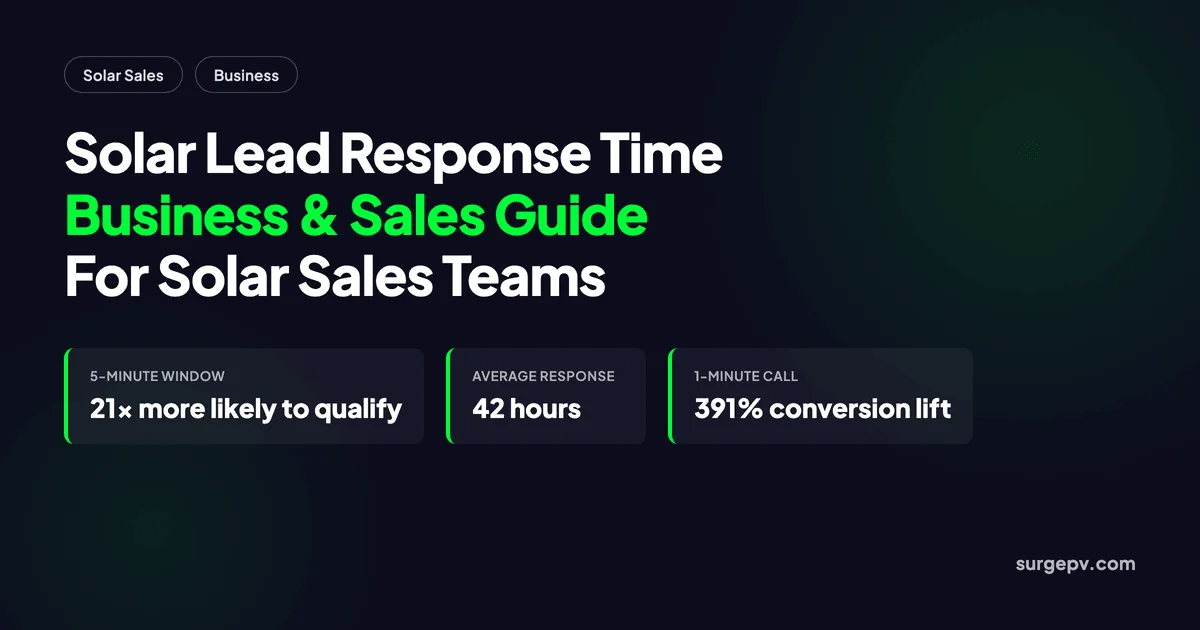
- Qualifying a lead within 5 minutes versus 30 minutes makes you 21 times more likely to succeed.
- The odds of contacting a lead drop by more than 10 times in the first hour.
The Harvard Business Review Audit
A 2011 HBR article by Oldroyd, McElheran, and Elkington audited 2,241 U.S. companies with test web leads. The results show how poorly most businesses execute against the research. Harvard Business Review (2011)
- The average first response time among companies that responded within 30 days was 42 hours.
- 23% of companies never responded at all.
- Firms that contacted within an hour were nearly 7 times more likely to qualify the lead than those that waited another hour. They were more than 60 times more likely than firms that waited 24 hours.
Velocify and Drift Benchmarks
Velocify’s analysis of roughly 3.5 million leads found that calling within one minute of receiving a lead increases conversion rates by 391%. Drift’s 2017 secret-shopper test of 433 B2B companies found that only 7% responded within 5 minutes, while 55% did not respond within 5 business days. AInora lead response time study review (2026)Salesloft / Drift Lead Response Survey (2017)
| Study | Sample | Key finding |
|---|---|---|
| MIT / InsideSales.com | 15,000+ leads, 100,000+ dials | 100x contact odds, 21x qualify odds at 5 min vs. 30 min |
| Harvard Business Review | 2,241 U.S. companies audited | 42-hour average response; 23% never responded |
| Velocify | ~3.5 million platform leads | 391% conversion lift calling within 1 minute |
| Drift | 433 B2B companies tested | Only 7% responded within 5 minutes |
The direction is consistent across every study. Faster response produces better outcomes. The only debate is the magnitude, and even conservative interpretations show that a 5-minute response is dramatically better than a 30-minute response.
How to Measure Lead Response Time in Your Solar Business
You cannot improve what you do not measure. Tracking lead response time correctly requires defining the start point, the end point, and the segments you want to compare.
Define the Start and End Points
Start the clock at the exact timestamp the inquiry arrives. For web forms, this is the submission time. For missed calls, it is the call end time. For live chat, it is the first message time. Stop the clock at the timestamp of the first meaningful contact attempt by a human or a human-like AI. Exclude automated acknowledgments.
Track by Lead Source
Not all leads behave the same way. A Google Local Services Ad lead usually expects a call within minutes. A referral from a past customer may tolerate a longer window because trust already exists. Track these sources separately:
- Organic web forms
- Paid search and social ads
- Third-party marketplaces
- Live chat and chatbot escalations
- Missed calls
- Referrals
- Door-to-door and event leads
Track by Rep, Time of Day, and Day of Week
Some reps are faster than others. Some time slots have coverage gaps. The MIT study found that Wednesday and Thursday were the best days to call, and 8–9 AM and 4–5 PM were the best times to qualify. Your own data will reveal when your team is slow and which reps need coaching.
Build a Simple Dashboard
A useful lead response dashboard shows five numbers:
- Average first-response time today
- Percentage of leads contacted within 5 minutes
- Percentage of leads contacted within 1 hour
- Average response time by lead source
- Average response time by rep
Review the dashboard daily at first, then weekly once performance stabilizes. For a broader view of the metrics that belong on a sales dashboard, see our solar sales KPIs guide.
Response Time Targets and Benchmarks for Solar Teams
Use the research above to set realistic but aggressive targets. The table below shows practical service-level agreements, or SLAs, for residential solar teams.
| Channel | Elite target | Good target | Acceptable ceiling | Notes |
|---|---|---|---|---|
| Web form | under 2 minutes | under 5 minutes | under 15 minutes | Highest-intent inbound channel |
| Inbound call | answer live | under 60 seconds callback | under 5 minutes | A missed call is a near-guaranteed loss |
| Live chat | under 30 seconds | under 1 minute | under 2 minutes | The prospect is waiting on the page |
| Paid lead platform | under 5 minutes | under 10 minutes | under 30 minutes | These leads are often shared with competitors |
| Referral | under 15 minutes | under 1 hour | same business day | Trust buffer exists but do not waste it |
| After-hours web form | automated acknowledgment under 2 minutes | live contact within 30 min of next window | live contact within 2 hours | Set clear expectations with the prospect |
These targets assume staffed business hours. If your team is small, prioritize speed on your highest-volume and highest-intent channels first. A solar CRM with automated routing makes hitting these targets realistic without hiring a large inside-sales team.
The Field-Tested Playbook to Cut Solar Lead Response Time
Data without process is just numbers. Here is a practical playbook that solar sales teams can implement in days, not months.
Step 1: Route Leads Instantly and Automatically
Manual lead assignment is the single biggest source of delay. A lead that lands in a shared inbox and waits for a manager to assign it can easily sit for 15–30 minutes. Use CRM rules that assign leads by territory, rep capacity, lead source, or round-robin. The assignment should happen in seconds.
For teams using paid lead marketplaces, use API integrations or Zapier to push leads directly into your CRM. CSV exports that sit in email inboxes are fatal to response time.
Step 2: Trigger Instant Notifications Across Multiple Channels
Reps should receive a push notification, an SMS, and a CRM alert the moment a lead is assigned. One channel is not enough. If a rep is away from their desk, a desktop notification does nothing. Mobile notifications ensure coverage during site visits and after-hours rotations.
Step 3: Pre-Write First-Touch Messages
Speed is not just about how fast you call. It is also about what you say. Pre-write SMS and email templates for each lead source and each scenario: daytime form fill, after-hours form fill, missed call, chat escalation, referral. A good first-touch message does three things:
- Confirms receipt
- Shows you have already looked at the prospect’s situation
- Offers a clear next step
Example SMS: “Hi [Name], this is [Rep] from [Company]. I just pulled your roof on satellite and it looks like a strong candidate for solar. Do you have 5 minutes now for a quick call?”
Step 4: Compress the Proposal Gap
First contact is only half the battle. The second half is how fast you deliver a personalized proposal. If a rep calls within 5 minutes but promises a proposal “by tomorrow,” the prospect has time to request three more quotes. The installer who delivers a roof-specific design and financial model during the first call wins the anchor.
This is where integrated design-to-proposal software changes the game. A rep can pull satellite imagery, build a 3D layout, and run shadow analysis. With a energy and financial modeling tool, the rep models ROI and delivers a solar proposal while the homeowner is still on the phone. The gap from contact to quote collapses from days to minutes.
Step 5: Set SLAs and Escalation Rules
An SLA is only real if it is enforced. Set escalation rules that reassign a lead if the assigned rep does not respond within the target window. For example, if a lead is not contacted within 5 minutes, notify the sales manager. If it is not contacted within 15 minutes, reassign it to the next available rep. Publish response-time scores by rep weekly. Accountability drives behavior.
Step 6: Use AI for Initial Qualification
AI-assisted qualification can handle the first touch when human reps are unavailable. Clara AI can confirm intent, gather basic roof and bill information, and route qualified leads to a human rep with full context. The goal is not to remove humans from the sales process. It is to make sure no warm lead waits because the right rep is busy.
For solar EPCs in India selling PM Surya Ghar subsidy projects, QuickEstimate combines solar CRM, WhatsApp follow-up, and subsidy-ready proposals in one mobile-first workflow.
The Hidden Cost of Slow Follow-Up
Slow lead response does not just lower close rates. It inflates almost every cost in your solar business.
Revenue Per Lead Decays Fast
The value of a lead drops the moment it arrives. A lead contacted in 5 minutes is worth far more than the same lead contacted in 5 hours. The MIT and Velocify data show that the decay is exponential, not linear. A small improvement from 30 minutes to 5 minutes can produce a multiple-fold lift in qualified conversations.
Customer Acquisition Cost Rises
Because customer acquisition already represents a large share of residential solar soft costs, slower follow-up directly raises your cost per customer. If delayed response drops your contact rate from 60% to 20%, you need three times as many leads for the same number of conversations. Those extra leads cost money.
Sales Rep Productivity Falls
Reps who spend their days chasing cold leads are not selling. They are doing low-probability outreach. Fast response moves reps upstream, so they spend more time with warm prospects who actually answer the phone. The average seller today spends only about 40% of their time actually selling, according to Salesforce’s State of Sales research. Salesforce State of Sales (2026) Removing friction from lead response is one of the fastest ways to raise that number.
Mistakes That Keep Solar Teams Slow
Most solar companies know response time matters. Their failure is operational, not strategic. Here are the most common mistakes we see when onboarding sales professionals and installer teams.
Manual Lead Assignment
A lead sitting in a shared inbox waiting for a manager to assign it is a lead that is already cooling. Automated assignment is a requirement, not a nice-to-have.
No After-Hours Coverage
A significant share of solar inquiries arrives outside 9-to-5. If your team only responds during business hours, you are effectively writing off those leads. Automated acknowledgment, self-service scheduling, or AI follow-up can bridge the gap.
Chasing New Leads While Ignoring Old Ones
Some teams over-focus on fresh leads and let yesterday’s leads die. The Velocify data show that 93% of converted leads are reached by the sixth call attempt. A structured cadence of 6–10 touches over 14 days recovers deals that a single call would miss.
Tracking the Wrong Metrics
Average response time is useful, but it can hide bad performance. A team with a 10-minute average might still be missing 30% of leads for hours. Track percentile distributions, such as the percentage contacted within 5 minutes, 15 minutes, and 1 hour.
Slow Proposal Delivery
Fast contact followed by a slow proposal is a common trap. The first call should not end with “I will send something tomorrow.” It should end with a scheduled appointment. Better still, it should end with a live proposal built in solar design software.
After-Hours Lead Response: The Biggest Untapped Opportunity
After-hours leads are often the most valuable and the most ignored. Homeowners research solar in the evening after work. They fill out forms while watching TV. They click ads on weekends. If your response waits until Monday morning, you are competing against the first installer that called Saturday night.
Acknowledge Immediately
An automated but personalized acknowledgment is the minimum. Tell the prospect when they will hear from a human and what the next step is. Example: “Thanks for your interest, [Name]. Our team is off today, but [Rep] will call you Monday at 9 AM with a preliminary design for your roof.”
Offer Self-Service Scheduling
A scheduling link in the first automated message lets qualified prospects book a specific time without waiting for a rep. Self-service scheduling can convert 12–18% of after-hours leads with no human involvement.
Use AI or Outsourced Coverage
For teams with enough volume, an AI voice agent or a third-party answering service can qualify after-hours leads and book appointments. For smaller teams, a simple on-call rotation with mobile notifications is often enough.
How SurgePV Fits Into a Faster Solar Sales Process
Lead response time is a process problem, and process problems are usually solved by removing handoffs. SurgePV is built to compress the two biggest handoffs in solar sales: the move from lead to contact, and the move from contact to proposal.
Clara AI can qualify inbound leads instantly, gather roof and bill information, and route hot prospects to the right rep with context. The solar design software builds a 3D roof layout and runs shadow analysis in minutes. The generation and financial tool models savings, payback, and financing options in real time. The solar proposal software turns that design into a branded, customer-ready proposal while the prospect is still on the first call.
Instead of a 5-minute call followed by a 48-hour proposal gap, the same rep can contact, qualify, design, and quote in a single conversation. That is how you turn response time from a cost center into a competitive advantage.
Ready to shorten your lead response time?
Book a SurgePV demo and see how design-to-proposal integration helps sales teams respond faster, quote faster, and close more of the leads they already pay for.
Frequently Asked Questions
What is solar lead response time?
Solar lead response time is the elapsed time from a prospect’s inquiry—via web form, phone, chat, or paid lead platform—to your team’s first meaningful contact. It is measured in minutes or hours and is one of the strongest predictors of contact rate, appointment set rate, and close rate in solar sales.
How fast should a solar company respond to leads?
Best-in-class solar teams respond to web-form leads in under 5 minutes, inbound calls in under 60 seconds, and live-chat inquiries in under 30 seconds. After-hours leads should receive an automated acknowledgment within 2 minutes and a live follow-up by the next business morning.
What is the difference between lead response time and speed-to-lead?
Lead response time is the operational metric you track in your CRM, measured from inquiry to first contact. Speed-to-lead is the broader sales principle that faster response wins more deals. For a deep dive on the psychology and research behind speed-to-lead, see our dedicated guide.
How do you measure lead response time accurately?
Measure from the exact timestamp of the inquiry to the timestamp of the first meaningful contact attempt. A valid attempt is a live call, a personalized SMS, or a chat reply. Exclude automated bounce-back emails. Track by lead source, sales rep, time of day, and day of week to find bottlenecks.
What tools improve solar lead response time?
The core tools are a solar CRM with instant lead routing, automated SMS and email sequences, mobile rep notifications, integrated design-to-proposal software, and AI-assisted qualification. Platforms that combine design, financial modeling, and proposal generation let reps quote while the prospect is still on the first call.
Why is after-hours lead response important for solar installers?
A large share of residential solar inquiries arrives outside standard business hours, especially on evenings and weekends. A lead that sits overnight is often cold by morning. Automated acknowledgment, self-service scheduling, or AI voice follow-up can preserve intent until a rep takes over.
What is a good lead response time SLA for a solar sales team?
A practical SLA for residential solar is 80% of leads contacted within 5 minutes during business hours, 95% within 15 minutes, and 100% within 1 hour. After-hours SLAs should focus on acknowledgment within 2 minutes and live contact within 30 minutes of the next staffed window.
How does slow lead response affect solar customer acquisition cost?
Slow response lowers contact and close rates, so each closed customer requires more leads and more rep hours. Because customer acquisition already represents a large share of residential solar soft costs, slower follow-up directly inflates cost per acquisition and reduces revenue per lead.
Conclusion
Solar lead response time is not a sales tactic. It is a business metric that touches marketing efficiency, rep productivity, and customer acquisition cost. The teams that win in 2026 are not necessarily the ones spending the most on ads. They are the ones that respond fastest, quote fastest, and follow up longest.
Three actions will move the needle this month:
- Measure it. Add lead response time to your sales dashboard. Break it down by source, rep, and time of day.
- Automate routing and first touch. Eliminate manual assignment, set mobile notifications, and pre-write first-touch messages for every channel.
- Compress the proposal gap. Connect your design, financial modeling, and proposal tools so reps can quote during the first call, not after it.
Where this fits
This article is part of SurgePV's Solar Sales & Proposals hub, which works through the topic from first principles to the decisions a project team actually has to make.


