

Quick Answer
The most effective solar lead generation strategies in 2026 are: paid search (Google Ads, $50–$150 CPL), Facebook/Meta ads ($30–$80 CPL), door-to-door canvassing (best ROI in <50-house density areas), referral programs ($300–$500 incentive per closed deal), and content marketing via blog + YouTube (longest ramp but lowest long-run cost).
Solar installers compete in one of the most expensive lead generation markets in any home services category. Customer acquisition cost averages 800 to 1,500 USD per signed residential contract in 2026, up from 600 to 1,000 USD in 2020. The installers who win are not the ones spending the most. They are the ones with diversified lead engines, sharp conversion funnels, and disciplined attribution that lets them double down on what works.
The most effective solar lead generation strategies in 2026 are: paid search (Google Ads, $50–$150 CPL), Facebook/Meta ads ($30–$80 CPL), door-to-door canvassing (best ROI in under-50-house density areas), referral programs ($300–$500 incentive per closed deal), and content marketing via blog + YouTube (longest ramp but lowest long-run cost).
TL;DR — Solar Lead Generation
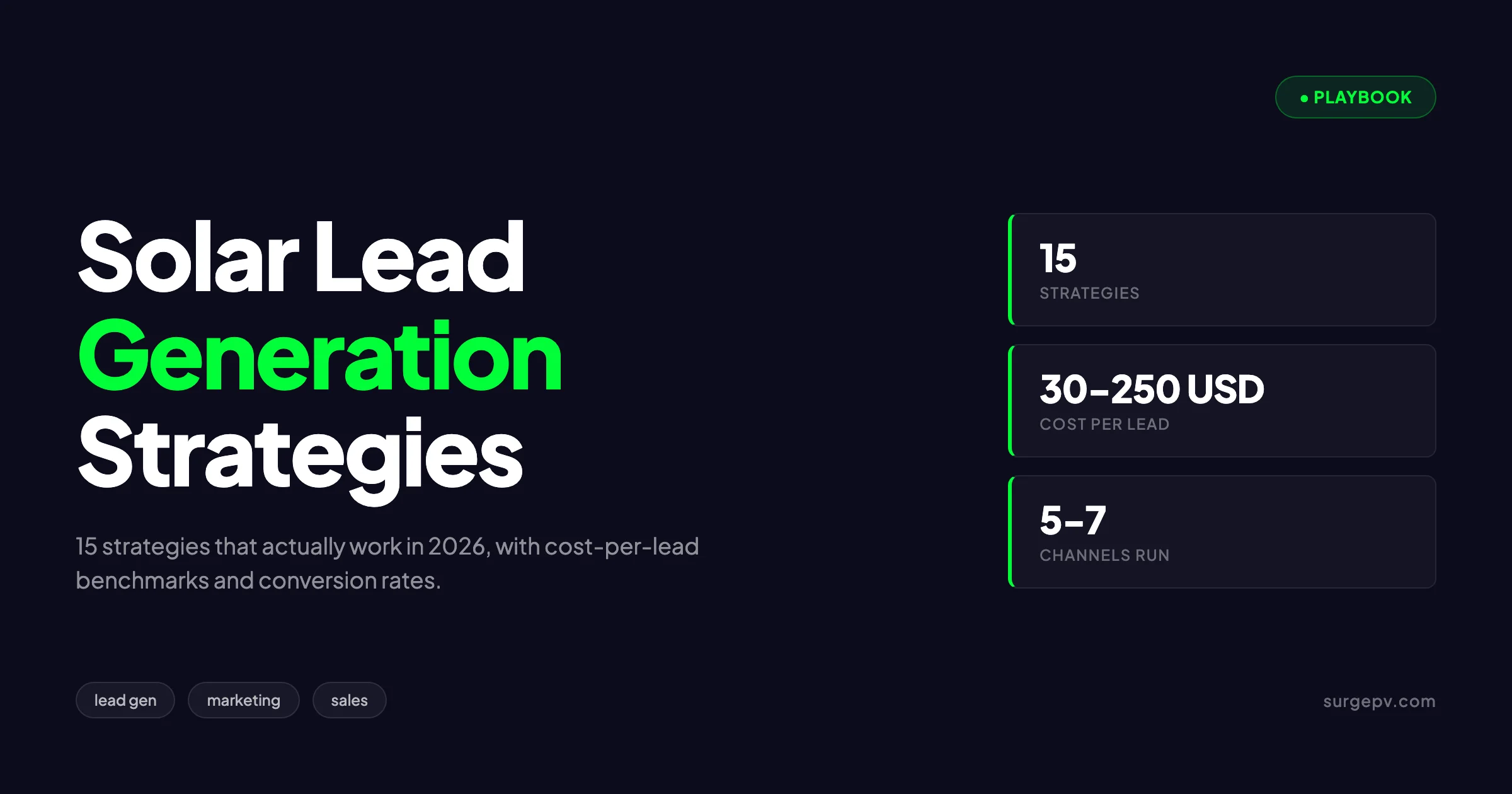
The 15 strategies below cover paid media, organic search, partnerships, referrals, and outbound. Cost per lead ranges from 20 USD (referrals) to 250 USD (premium aggregators). Best practice is running 4 to 6 channels simultaneously with rigorous attribution to identify your top 2 channels and double investment there.
This guide ranks the 15 most effective solar lead generation strategies for 2026, each with cost-per-lead benchmarks, conversion rates, and an implementation playbook. The ranking reflects what installers actually use, not what marketing agencies pitch.
How Solar Lead Generation Has Changed in 2026
Three structural changes shape solar lead generation today.
Change 1: Paid Media Costs Have Tripled
Google Ads cost-per-click for solar keywords ran 8 to 15 USD in 2018. In 2026, the same keywords cost 25 to 60 USD per click. The increase reflects competition from large nationals (Sunrun, SunPower, Tesla) and aggregators bidding aggressively.
The implication: installers who depended on paid media for 70+ percent of leads have seen their unit economics deteriorate. Diversification away from paid is now mandatory rather than optional.
Change 2: AI-Generated Content Has Saturated SEO
The SEO landscape has flooded with AI-generated content since 2023. Google has responded with stricter quality signals, prioritizing content with demonstrable expertise, original data, and author credibility. Generic content no longer ranks.
The implication: SEO still works, but it now requires the same investment as paid media. Cheap content marketing produces nothing.
Change 3: Aggregator Quality Has Declined
Modernize, HomeAdvisor, and similar aggregators have monetized harder, selling each lead to 4 to 7 installers simultaneously. Conversion rates on aggregator leads have dropped 40 to 60 percent over 5 years.
The implication: aggregators are now fill-in volume only. Installers building real businesses build their own demand engines.
For broader marketing context, see marketing for solar installers and digital marketing for solar companies.
Strategy 1: Customer Referral Programs
Customer referrals are the highest-ROI lead source by every metric: cost per lead, conversion rate, lifetime value. A typical referred customer costs 50 to 200 USD to acquire and converts at 35 to 50 percent.
The mechanics matter. Most installers leave money on the table because their referral programs are passive. The customer is told “tell your friends” once and never reminded.
Implementation:
- Pay 250 to 750 USD per referred install
- Send the referral request 30, 90, and 180 days post-install
- Make sharing one-click via SMS link with custom landing page
- Track referrals in CRM with named referrer recognition
- Publicize top referrers monthly in customer newsletter
Benchmarks: Best installers generate 25 to 40 percent of total leads from referrals. Median performers generate under 10 percent. The gap is almost entirely program execution.
Strategy 2: Local SEO and Google Business Profile
Local SEO converts higher than any paid channel because the customer has already decided they want solar. They are searching for “solar installer near me” and choosing among local options.
The two ranking factors that matter most: Google Business Profile completeness and local backlink count.
Implementation:
- Complete Google Business Profile with 50+ photos, monthly posts, and weekly Q&A responses
- Collect 3 to 5 Google reviews per month minimum
- Build local backlinks via chamber of commerce, BBB, local trade associations
- Create city-specific landing pages for each service area
- Add schema markup for LocalBusiness, Service, and Review
Benchmarks: Local SEO leads cost 30 to 80 USD per qualified lead and convert at 18 to 28 percent. The catch is the 6 to 12 month investment before producing volume.
Strategy 3: Content SEO and Topical Authority
Content SEO targets researchers earlier in the buying journey. Searches like “is solar worth it in California” or “how much do solar panels cost” indicate someone 30 to 90 days before purchase.
The strategy works only if you commit to producing 50+ pieces of high-quality content over 12 to 18 months. Anything less produces marginal traffic and no leads.
Implementation:
- Build topical authority around 3 to 5 core themes (solar costs, solar incentives in your state, system sizing, financing options)
- Publish 2 to 4 long-form articles per month with original data
- Optimize for AI search engines (ChatGPT, Perplexity, Google AI Overviews)
- Build internal linking structure connecting related articles
- Add lead magnets (savings calculators, sizing tools) to convert traffic
Benchmarks: Content SEO leads cost 40 to 120 USD per lead at scale. The cost is heavily front-loaded in the first 12 months when traffic is small but content production cost is high.
Strategy 4: Google Ads Search Campaigns
Google Ads remains a primary channel for installers ready to spend 5,000 USD or more per month. The platform delivers the highest-intent traffic in the digital advertising ecosystem.
The trap is wasted spend. Solar Google Ads campaigns waste 30 to 50 percent of budget on poor-fit clicks without disciplined optimization.
Implementation:
- Start with high-intent keywords (“solar installer in [city],” “solar quote [city]”)
- Use exact and phrase match, avoid broad match early
- Create dedicated landing pages per ad group with single CTA
- Implement conversion tracking and call tracking
- Run negative keyword reviews weekly for the first 90 days
- Test responsive search ads with 4 headlines and 4 descriptions For more on this topic, see Solar Racking Design Guide.
Benchmarks: Google Ads delivers 80 to 200 USD per qualified lead at 10 to 15 percent conversion rate. Top performers reach 60 USD per lead through aggressive optimization.
Strategy 5: Facebook and Instagram Ads
Meta ads work for solar but require different creative than search. The user is not actively shopping; they are scrolling. The creative must interrupt and motivate, not just inform.
Implementation:
- Use video creative showcasing real installations and customer testimonials
- Target homeowners 35 to 65 with home value above 250,000 USD
- Run sequential remarketing across awareness, consideration, decision stages
- Lead form ads work better than landing page traffic for cold audiences
- Refresh creative every 14 to 21 days to fight ad fatigue
Benchmarks: Meta ads deliver 40 to 120 USD per lead at 7 to 12 percent conversion rate. Quality is lower than Google Ads but quantity is higher.
Strategy 6: Door-to-Door Canvassing
D2D remains the highest-volume channel for residential solar despite repeated predictions of its demise. The economics work because labor is variable cost and conversion rates beat digital channels.
The challenge is recruiting and retaining canvassers. Average tenure is 90 to 180 days. The ones who stay become 5x to 10x more productive than new hires.
Implementation:
- Pay base plus commission with milestones at 1, 3, 6, and 12 months
- Run training programs that pair new reps with veterans for 30 days
- Use canvassing apps (CanvassPro, SalesRabbit) for territory management
- Track door-to-appointment to install conversion at every step
- Create reasonable schedules to reduce burnout
Benchmarks: D2D delivers appointments at 30 to 80 USD with 25 to 35 percent appointment-to-sale conversion. The total cost per install runs 800 to 1,400 USD.
For deep tactical guidance, see solar door-to-door sales.
Strategy 7: Strategic Partnerships with Local Businesses
Roofing companies, HVAC contractors, real estate agents, and home builders all interact with homeowners during decisions where solar is relevant. Partnership programs convert at high rates because the introduction comes from a trusted advisor.
Implementation:
- Identify 10 to 20 partner businesses serving your geography
- Offer co-marketing materials (case studies, joint events)
- Pay 200 to 500 USD per converted referral
- Provide partners with simple lead-submission forms in their preferred tool
- Host quarterly partner appreciation events to maintain relationships
Benchmarks: Partner-sourced leads cost 100 to 300 USD per lead and convert at 25 to 40 percent. The relationship building takes 6 to 12 months but compounds over time.
Strategy 8: EnergySage and Solar.com Marketplaces
EnergySage and Solar.com aggregate homeowner solar shoppers and route them to participating installers. Lead quality is strong because shoppers have completed multi-step qualification.
The cost is referral fees rather than per-lead pricing. EnergySage charges 0.5 to 1 percent of contract value on closed deals. Solar.com structures vary by region.
Implementation:
- Apply to EnergySage and Solar.com as a verified installer
- Maintain strong customer ratings on the platforms
- Respond to leads within 1 hour for best conversion rates
- Customize pricing for marketplace deals to remain competitive
- Track marketplace deals separately to measure true profitability
Benchmarks: Marketplace leads cost 100 to 250 USD per lead with 15 to 25 percent conversion. The fee structure favors high-volume installers who can spread platform overhead.
Convert More Leads with a Better Proposal
Lead generation gets the conversation started. Proposals close the deal. SurgePV’s solar proposal software builds branded interactive proposals in minutes, with 3D renderings, financial models, and e-signature integration.
Book a DemoNo commitment required · 20 minutes · Live project walkthrough
Strategy 9: Local PR and Community Sponsorships
Local PR builds the brand recognition that improves every other channel. Newspaper coverage, radio interviews, and community sponsorships are not direct lead sources but they amplify everything else.
Implementation:
- Sponsor youth sports teams, local festivals, and community events
- Pitch local newspapers on installation case studies and milestones
- Donate solar systems to non-profits with PR coverage
- Build relationships with local TV news on solar policy stories
- Create awareness campaigns timed to incentive deadlines
Benchmarks: PR contributes 5 to 15 percent of total leads through “I saw your name everywhere” awareness. The leads are difficult to attribute but typically convert higher than cold paid traffic.
Strategy 10: Webinars and Educational Events
Webinars convert well because attendees self-select for solar interest. A 45-minute educational session attracts 30 to 100 attendees, with 15 to 25 percent requesting consultations afterward.
Implementation:
- Host monthly “Solar 101” webinars on residential basics
- Cover specific topics quarterly (battery storage, financing, tax credits)
- Promote via Facebook Ads, email list, and partner co-marketing
- Use real-time Q&A to build authority and rapport
- Send recordings with personalized follow-up to non-attendees Read Adding Battery Storage Services for a complete walkthrough.
Benchmarks: Webinar leads cost 50 to 150 USD per lead and convert at 20 to 30 percent. The format works best for installers with strong subject matter experts.
Strategy 11: Email Marketing to Past Leads
Most installers ignore the 60 to 80 percent of leads who say “not yet.” These leads represent enormous value if nurtured properly. A homeowner who said no in 2024 may say yes in 2026 when their roof needs replacement or their utility bill spikes.
Implementation:
- Build email list of all leads, prospects, and customers
- Send weekly educational content (not constant promotional offers)
- Track engagement and re-target high engagers with sales outreach
- Run quarterly campaigns around incentive deadlines or rate changes
- Segment by stage: hot prospects, cold prospects, past customers
Benchmarks: Email-driven re-engagement produces leads at 10 to 30 USD per lead with 30 to 50 percent conversion. The CRM data is the most valuable asset most installers underutilize.
Strategy 12: LinkedIn for Commercial Solar
Commercial solar leads are not on Google searching “commercial solar installer.” They are facility managers, CFOs, and property owners who research opaquely and respond to direct outreach.
LinkedIn is the dominant channel for commercial solar lead generation in 2026.
Implementation:
- Build target account list of 200 to 500 buildings in your service area
- Use LinkedIn Sales Navigator to identify decision makers (facility manager, CFO, COO)
- Connect with personalized notes referencing specific properties
- Send sequence of 4 to 6 messages over 6 weeks
- Pivot to email and phone outreach for non-responders
- Use case studies as primary content, not generic solar pitches
Benchmarks: LinkedIn outbound delivers commercial leads at 200 to 500 USD per qualified meeting with 10 to 20 percent close rates. Each closed deal is worth 50,000 to 500,000 USD in revenue.
Strategy 13: YouTube Education Content
YouTube serves customers researching deeper than Google text searches. A homeowner watching “solar panel installation process” video is 60 to 90 days from purchase decision.
The content investment is substantial. One YouTube video costs 500 to 2,000 USD to produce well, and you need 30 to 50 videos to build channel authority.
Implementation:
- Publish weekly videos targeting customer questions
- Optimize titles, descriptions, and tags for search
- Add chapter markers for long-form content
- Pin links to free tools (savings calculator, sizing tool) in descriptions
- Cross-promote videos through email and social
Benchmarks: YouTube traffic produces leads at 30 to 80 USD per lead with 10 to 20 percent conversion. The investment is heavily front-loaded but produces evergreen lead flow.
Strategy 14: Cold Email for Commercial Outreach
Cold email works for commercial solar because facility managers and CFOs respond to specific, well-researched outreach. The 90+ percent rejection rate is offset by deal sizes that make even small response rates economical.
Implementation:
- Build target list with verified email addresses (Apollo.io, ZoomInfo, Lusha)
- Personalize each email with specific property details
- Lead with case studies, not feature lists
- Send sequence of 3 to 4 messages over 4 weeks
- Use email deliverability tools to maintain sender reputation
- Track opens, clicks, and replies for optimization
Benchmarks: Cold email for commercial solar produces meetings at 200 to 600 USD per meeting with 1 to 3 percent reply rates. Each meeting has 15 to 25 percent close probability over 6 to 12 months.
Strategy 15: Trade Shows and Industry Events
Trade shows produce commercial solar leads at higher quality than any digital channel. Attendees self-select for solar interest, and face-to-face conversation builds trust faster than digital touchpoints.
Implementation:
- Choose 2 to 4 high-value events per year (Solar Power International, Intersolar regional events, vertical-specific shows)
- Build branded booth experience with technology demos
- Schedule pre-event meetings with target prospects
- Follow up within 48 hours of show with specific opportunity-related content
- Track ROI per event over 12 month conversion window
Benchmarks: Trade show leads cost 300 to 1,500 USD per qualified lead with 15 to 30 percent close rates over 6 to 12 months. Best performers generate 30 to 50 percent of commercial pipeline from trade events.
Channel Mix: How Top Installers Allocate Spend
Top-performing installers run 5 to 7 channels simultaneously. The allocation varies but follows patterns by company size.
Allocation by Installer Size
| Channel | Small (10-30 installs/mo) | Mid (30-100 installs/mo) | Large (100+ installs/mo) |
|---|---|---|---|
| Customer referrals | 30% | 25% | 20% |
| Google Ads | 15% | 20% | 25% |
| Local SEO | 10% | 8% | 5% |
| Content SEO | 5% | 8% | 10% |
| Meta Ads | 10% | 15% | 15% |
| D2D / canvassing | 15% | 10% | 8% |
| Partnerships | 10% | 8% | 7% |
| Marketplaces | 5% | 6% | 10% |
The pattern: smaller installers depend more on referrals and D2D (low fixed cost). Larger installers shift toward digital channels where scale produces efficiency.
Attribution: How to Know What’s Working
Attribution is harder than lead generation in 2026. Customers touch 6 to 9 channels before signing, and last-click attribution misses 80 percent of the actual journey.
Multi-Touch Attribution Setup
The minimum viable attribution stack for solar installers:
| Tool | Purpose | Cost |
|---|---|---|
| Google Analytics 4 | Web traffic and conversion | Free |
| CallRail | Call tracking with attribution | 50 to 200 USD/mo |
| HubSpot or Salesforce | Lead source tracking through pipeline | 100 to 500 USD/user/mo |
| UTM parameters | Campaign-level attribution | Free |
| Customer survey at signup | Self-reported attribution | Free |
The combination produces 70 to 80 percent attribution accuracy. Higher accuracy requires data infrastructure investments most installers cannot justify.
What to Optimize For
Cost per lead is misleading. Cost per closed deal is meaningful. The metric that matters most: customer acquisition cost (CAC) divided by customer lifetime value (LTV).
For solar, LTV includes initial install plus future referrals plus future battery, EV charger, or system additions. The full LTV is typically 2x to 4x the initial install revenue.
For deeper guidance on customer acquisition economics, see solar customer acquisition cost.
Conclusion: The Lead Generation Decision
Solar lead generation in 2026 rewards diversification and discipline. Single-channel installers face deteriorating economics as paid media costs rise and aggregator quality declines. Multi-channel installers with strong referral engines and content investments compound their advantage over time.
Three action items for installers planning their lead generation strategy:
- Audit your current channel mix. If any single channel produces over 50 percent of leads, you have concentration risk.
- Invest in referral program execution. The ROI is higher than any other channel and requires no incremental ad spend.
- Build content SEO as a 12-month investment. The compounding returns make it the second-highest ROI channel after referrals.
For more sales-side context, see solar sales process and solar sales objection handling scripts.
Frequently Asked Questions
What is the average cost per solar lead in 2026?
Cost per lead varies by channel. Google Ads averages 80 to 200 USD per lead, Facebook Ads 40 to 120 USD, EnergySage referrals 100 to 250 USD, and door-to-door sales 30 to 80 USD per appointment. Aggregator leads from Modernize or HomeAdvisor run 50 to 150 USD.
Which lead source converts the highest for solar?
Customer referrals convert at 35 to 50 percent versus 8 to 15 percent for paid media. The lifetime value is also higher because referred customers have lower acquisition cost and shorter sales cycles. Building a referral program is the highest-ROI lead source.
How many solar leads does an installer need per month?
Most residential installers need 10 to 20 qualified leads per signed contract. For 20 installations per month, that means 200 to 400 leads. Commercial installers need fewer leads but each takes 3 to 12 months to close.
Are solar lead aggregators worth the cost?
Aggregators like Modernize and HomeAdvisor work for installers without strong digital marketing, but they sell leads to multiple companies, dropping conversion rates to 5 to 10 percent. Use them for fill-in volume, not as a primary channel.
Should I run my own paid ads or hire an agency?
Spend below 20,000 USD per month: run your own ads with platform-provided support. Spend above 20,000 USD per month: hire a specialized solar marketing agency. The threshold is when ad spend can support a full-time in-house specialist.
How long does SEO take to generate solar leads?
Local SEO produces leads within 60 to 90 days for installers in low-competition markets. Competitive markets (Texas, California, Florida) require 6 to 12 months of consistent content and backlink work before producing meaningful lead volume.
What is the best lead source for commercial solar?
LinkedIn outbound combined with industry conference presence dominates commercial solar lead generation. Cold email to facility managers and CFOs converts 2 to 5 percent versus 0.5 to 1 percent for residential cold outreach. Solar PV design software automates design and compliance. Solar proposal software generates professional quotes in minutes.
Where this fits
This article is part of SurgePV's Solar Sales & Proposals hub, which works through the topic from first principles to the decisions a project team actually has to make.


