

Quick Answer
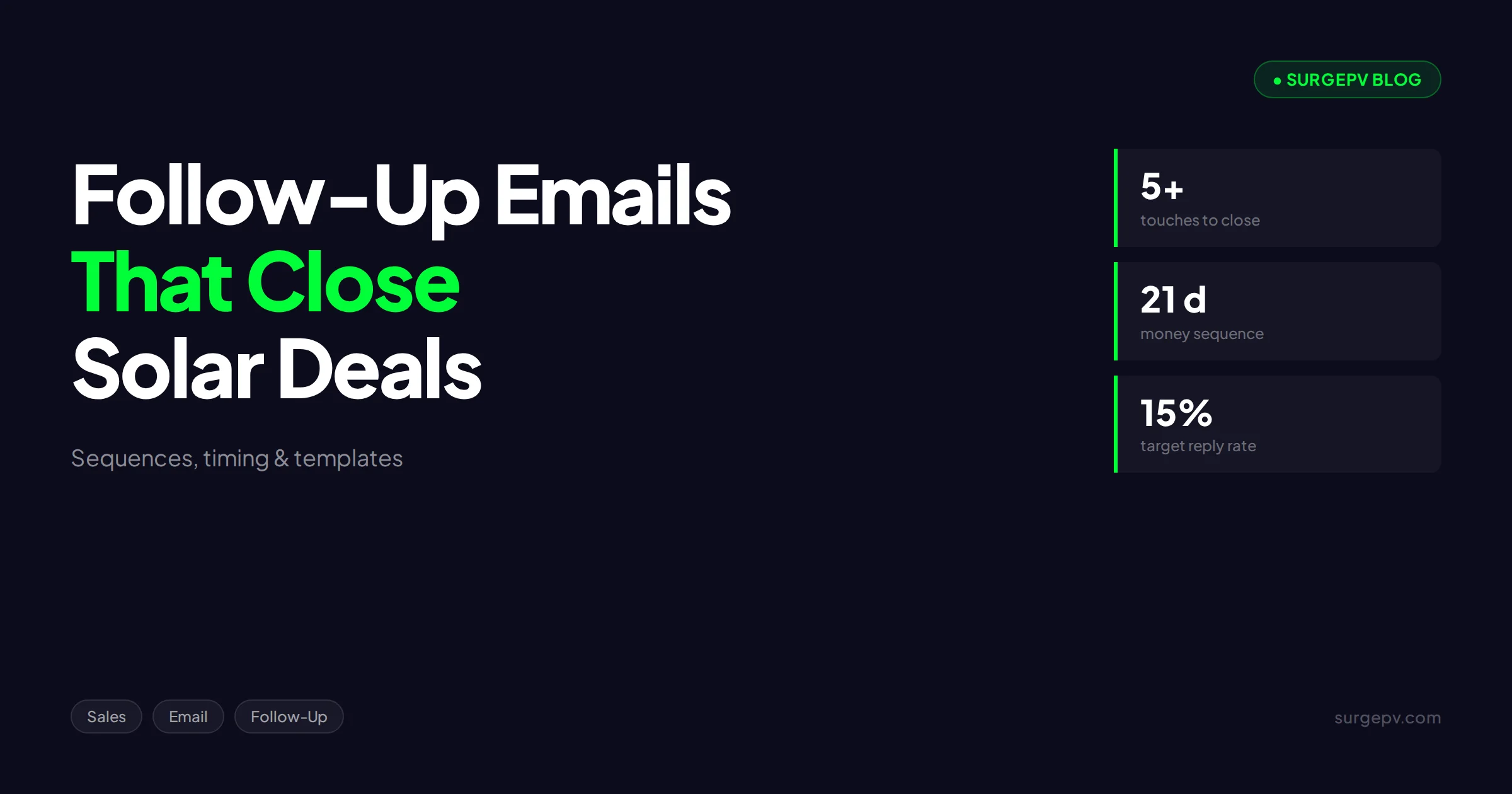
A solar follow-up email sequence is a timed series of 5–8 messages sent after a proposal: same-day recap, day-2 value email, day-4 objection handler, day-7 social proof, day-14 breakup, and a 30-day nurture. Most solar deals need 5+ touches, yet most reps stop after 2.
Here is a number that should bother every solar sales manager: the majority of proposals get 1 follow-up. Maybe 2. Then the rep moves on to fresher leads, and a $20,000 decision the customer needed 3 weeks to make dies of neglect on day 5.
The research on this is old and consistent. Most B2C considered purchases need 5 or more touches before a yes, and most salespeople stop at 2. Solar amplifies the problem: the ticket is $15,000–$40,000, the spouse has questions, and 2 competitors are quoting the same roof. The rep who follows up with structure wins by default — not by being slicker, but by still being there.
This guide gives you the structure: 5 complete sequences with word-for-word templates, the timing rules behind them, and the automation setup that makes the whole thing run without heroics.
Quick Answer
A solar follow-up email sequence is a timed series of 5–8 messages sent after a proposal: same-day recap, day-2 value email, day-4 objection handler, day-7 social proof, day-14 breakup, and a 30-day nurture. Most solar deals need 5+ touches, yet most reps stop after 2.
TL;DR — Solar Follow-Up Sequences
Send 5–8 touches over 30 days: same-day, day 2, day 4, day 7, day 14, then monthly nurture. Every email carries one idea and one ask. Breakup emails at day 14–21 get some of the highest reply rates. Automate timing in your CRM; personalize content with system size and quote numbers.
In this guide:
- The 5 rules underneath every good sequence
- Sequence 1: post-proposal follow-up (the money sequence)
- Sequence 2: cold lead re-engagement
- Sequence 3: the “spouse objection” track
- Sequence 4: financing reframe
- Sequence 5: post-install referral engine
- Automation setup and measurement
The 5 Rules Underneath Every Good Sequence
Before the templates, the principles. Break these and no template saves you.
Rule 1: Same-day first touch. The follow-up clock starts when the proposal lands, not when you “get to it.” A recap within 2–4 hours of delivery keeps you first in the customer’s inbox and signals the organization they can expect during installation. Our speed-to-lead data shows how dramatically early response shifts contact and close rates.
Rule 2: One idea, one ask. Every email makes a single point and ends with a single, easy question. “Does the monthly payment work with your budget?” gets answered. “Let me know your thoughts!” does not.
Rule 3: Never “just checking in.” A checking-in email tells the customer you have nothing to add. Each touch must deliver something: a recap, an objection answer, a proof point, a deadline. No value, no send.
Rule 4: Personalize the numbers, automate the timing. The sequence timing runs on rails in your CRM. The content references their roof, their 9.6 kW system, their $147/month savings. Automation that reads automated underperforms manual chaos.
Rule 5: Every sequence ends with a breakup. The breakup email — professionally closing the file — consistently earns some of the highest reply rates in the whole sequence. Loss aversion works on customers too.
Sequence 1: Post-Proposal Follow-Up (The Money Sequence)
This is the sequence that runs after a proposal is delivered on a qualified residential lead. Six touches over 21 days.
Touch 1 — Same day, 2–4 hours after delivery. The recap.
Subject: Your 9.6 kW proposal — the 3 numbers that matter
Hi [Name], thanks for the time today. Three numbers from your proposal worth remembering: $147/month average savings, 6.8-year payback, and 87% of your current bill offset. The full design is attached. Quick question — is the monthly savings figure in line with what you expected?
Touch 2 — Day 2. The value add.
Subject: How your roof’s shading changed the design
Hi [Name], one thing your proposal does not show directly: we moved 4 panels off the west plane because the oak tree costs you about 6% of annual production there. That kind of detail is why the production estimate is one we will stand behind. Want me to walk you through the shading map on a 10-minute call?
Touch 3 — Day 4. The objection handler.
Subject: The question most [City] homeowners ask next
Hi [Name], the most common question at this stage: “What happens if I sell the house?” Studies of US home sales, including Zillow’s solar premium analysis, have found homes with owned solar sell for roughly 4% more than comparable homes without. Your system transfers with the sale. Is resale on your mind, or is there another concern I can answer?
Touch 4 — Day 7. Social proof.
Subject: What the Hendersons on [Street/area] decided
Hi [Name], a customer 2 streets over installed a nearly identical 9.2 kW system in March. Their first full summer bill dropped from $210 to $31. Happy to share their before/after bills (with permission) or put you in touch. Would that help?
Touch 5 — Day 14. The breakup.
Subject: Closing your file on Friday
Hi [Name], I do not want to become inbox noise, so here is my plan: I will close your proposal file this Friday unless I hear from you. If the timing is wrong, no problem — just reply “later” and I will check back in 6 months. If something is holding the decision up, reply with what it is and I will address it head-on. Either answer is genuinely fine.
Touch 6 — Day 30+. Nurture. Move non-responders to a monthly list: utility rate news, incentive updates, seasonal production notes. Real deadlines — a utility rate case, an incentive step-down — are your re-entry tickets.
Sequence 2: Cold Lead Re-Engagement
For leads that went quiet before a proposal — after the site survey or first call.
Day 1: “Still planning solar for [address]?” — one-line re-open with the original savings estimate. Day 4: Send something new they have not seen: an updated utility rate, a new financing option, a neighbor install. New information justifies the email. Day 10: Breakup. Same structure as Touch 5 above. Day 45: Re-engage only with news — a rate increase announcement converts cold leads better than any sales copy.
For Indian EPCs, this re-engagement often runs on WhatsApp rather than email — QuickEstimate’s guide to automating WhatsApp follow-ups covers that channel in depth.
Sequence 3: The Spouse Objection Track
Half of stalled residential deals are waiting on a second decision-maker you have never met. Detect it when the customer says “I need to talk it over” — then arm your champion.
Day 1 after the stall:
Subject: The 3 questions your partner will ask
Hi [Name], when you discuss this at home, 3 questions almost always come up: What if we move? What if the roof leaks? Who fixes it if something breaks? Here are short, honest answers to each [attached one-pager]. If it is easier, I am happy to do a 15-minute call with both of you — evenings work fine.
Day 5: The financing one-pager reframed for the household budget: monthly payment vs. current average bill, side by side. Day 12: Breakup, softened: “Happy to pick this up whenever the timing works for your family.”
The rule here: never make the absent spouse wrong. Every email should make your champion look prepared for bringing the idea home.
Sequence 4: Financing Reframe
Use this when the objection is price, not value. The reframe: total price is irrelevant; monthly cash flow is the decision.
Day 1: Side-by-side — current average bill ($210) vs. loan payment plus residual bill ($168). One image, one number: $42/month net positive from month 1.
Subject: $210 vs. $168 — the only comparison that matters
Day 4: The escalation story. Utility residential rates in the US have risen roughly 3–5% per year over the past decade, per EIA retail price data. A fixed loan payment against a rising bill widens the gap every year.
Day 9: The breakup with a floor: “If the monthly number does not work at $168, tell me what number does — I can re-run the system size or term.”
For more scripts on this track, our solar financing pitch scripts pairs well with this sequence.
Sequence 5: Post-Install Referral Engine
Follow-up does not end at the sale. Installed customers are your cheapest lead source — referral leads close at 2–3 times the rate of purchased leads, at near-zero acquisition cost.
Day 1 after PTO: “Your system is live — what to watch in week 1.” Pure service, no ask. Day 30: First-bill check-in. “How did the first bill look?” This surfaces problems early and primes the ask. Day 35: The referral ask, with a concrete reward:
Subject: $300 for your neighbor’s roof
Hi [Name], glad the first bill landed where we projected. Quick ask: if a neighbor or friend has asked about your panels, send them my way. For every referral that signs, we pay $300 — no cap, paid at their install. Who on your street has the best south-facing roof?
Quarterly thereafter: production reports and referral reminders. Our solar proposal follow-up templates cover additional behavioral triggers for these asks.
Follow Up With a Proposal in Hours, Not Days
SurgePV generates the design, financials, and branded proposal in one workspace — so your same-day recap email includes the full proposal.
Book a DemoNo commitment required · 20 minutes · Live project walkthrough
Automation Setup and Measurement
Run sequences in your CRM, not your inbox. The setup:
- Trigger: proposal status changes to “delivered” → Sequence 1 starts. Status “stalled — spouse” → Sequence 3.
- Exit condition: any reply or a signed contract stops the sequence immediately. Nothing kills trust like a breakup email arriving after a signed contract.
- Task hybrid: automate emails 1–2; make touches 3–5 a task for a personal email or call. Fully automated sequences underperform on high-ticket items.
Measure 3 numbers per sequence: reply rate (target above 15%), sequence-to-appointment rate, and sequence-to-close rate. Review monthly. Kill or rewrite any touch with a reply rate under 3% — it is dragging the average and burning list goodwill. A solar CRM built for installers makes this reporting trivial; spreadsheets make it impossible.
Multi-Channel: Email Is Not the Whole Sequence
Email carries the content, but the highest-performing sequences mix channels. The pattern that works for residential solar:
- Email for recaps, proof, and documents — anything the customer should be able to find later.
- Text message for timing-sensitive nudges: “Just sent the proposal — did it land in your inbox?” Text open rates dwarf email open rates, but texts tolerate zero fluff.
- Phone call at touch 3 or 4, timed to land between emails, not on top of them. The call script is simple: “I sent 2 emails with the shading detail and the resale answer — did either raise a question I can close out?”
- WhatsApp replaces text in India, the Middle East, and most of Europe. Same rules: one idea, one ask, no broadcast-feel messages.
One hard rule: never hit the customer on 2 channels the same day. Same-day email plus text plus call reads as desperation, and desperation kills premium pricing.
Writing Rules for Solar Follow-Up Emails
Five writing rules raise reply rates more than any template:
- Subject lines under 6 words, lowercase-ish, no clickbait. “Closing your file on Friday” beats “Don’t miss out on HUGE savings!!” every time.
- First line references their project, not your company. Their roof, their number, their street.
- One number per email. $147/month savings is memorable. A paragraph of figures is not.
- Ask a question that takes 5 seconds to answer. Yes/no or a number. Open-ended questions get deferred; deferred means never.
- Sign like a person. Name, direct phone, no 12-line banner signature with 4 logos.
Run every email through the phone test: read it on your phone screen. If you have to scroll twice to find the ask, rewrite it.
What Most Sales Teams Get Wrong
The biggest misconception: follow-up frequency is the lever. It is not. Follow-up value is the lever. Five substance-free emails perform worse than 3 emails that each answer a real objection. Frequency without value is spam with a CRM.
Second: reps treat silence as rejection. Silence is usually bandwidth. The customer is comparing bids, waiting on a bonus, or arguing about the roof. The day-14 breakup email exists precisely because silence is ambiguous — and it converts the ambiguity into an answer, one way or the other.
The exception: a customer who explicitly says “stop contacting me” gets stopped, immediately and permanently. Persistence is a strategy; consent is a boundary.
Conclusion
Follow-up is not a personality trait. It is a system with timing rules, templates, and exit conditions — and it is the cheapest close-rate lever in solar sales. Three actions this week:
- Load Sequence 1 into your CRM and attach it to every new proposal, starting today.
- Audit last month’s lost deals: count the touches each one received. The number will make the case for you.
- Add the breakup email to every sequence and measure its reply rate separately.
And fix the upstream bottleneck: follow-up works twice as well when the proposal itself arrives the same day. Book a SurgePV demo to see how design-to-proposal in one workspace makes the same-day first touch the default.
Frequently Asked Questions
How many follow-up emails should a solar sales rep send?
Send 5–8 follow-ups over 30 days after delivering a proposal. Sales research consistently shows most deals require at least 5 touches, while most reps quit after 2. In solar, where the decision involves $15,000–$40,000, persistence over 2–4 weeks is normal and expected.
What is the best time to follow up on a solar proposal?
Send the first follow-up the same day the proposal is delivered, ideally within 2–4 hours while the conversation is fresh. Then follow a day-2, day-4, day-7, day-14 cadence. Same-day follow-up signals organization and keeps you ahead of competing bids.
What should a solar follow-up email include?
Every follow-up needs one idea and one ask: a recap of the top benefit, an answer to a known objection, a customer result, or a financing reframe — plus a direct question that is easy to answer. Never send a ‘just checking in’ email; it adds no value and trains the customer to ignore you.
How do you follow up without being pushy?
Lead with value, not pressure. Each touch should give the customer something useful: a savings recap, an answer to a spouse’s likely objection, a neighbor’s result, or a deadline that is real (utility rate change, incentive step-down). Pushiness comes from repetition without substance.
When should you stop following up on a solar lead?
Send a breakup email around day 14–21 that professionally closes the file and asks for a reason. Breakup emails get some of the highest reply rates in the sequence. After that, move the lead to a monthly nurture list and re-engage on rate increases or incentive news.
Do automated follow-up sequences hurt close rates?
Automation hurts only when it reads automated. Sequences written in first person, referencing the customer’s actual system size and quote, outperform manual ad-hoc follow-up because they never skip a touch. Automate the timing; personalize the content.
Where this fits
This article is part of SurgePV's Solar Sales & Proposals hub, which works through the topic from first principles to the decisions a project team actually has to make.


