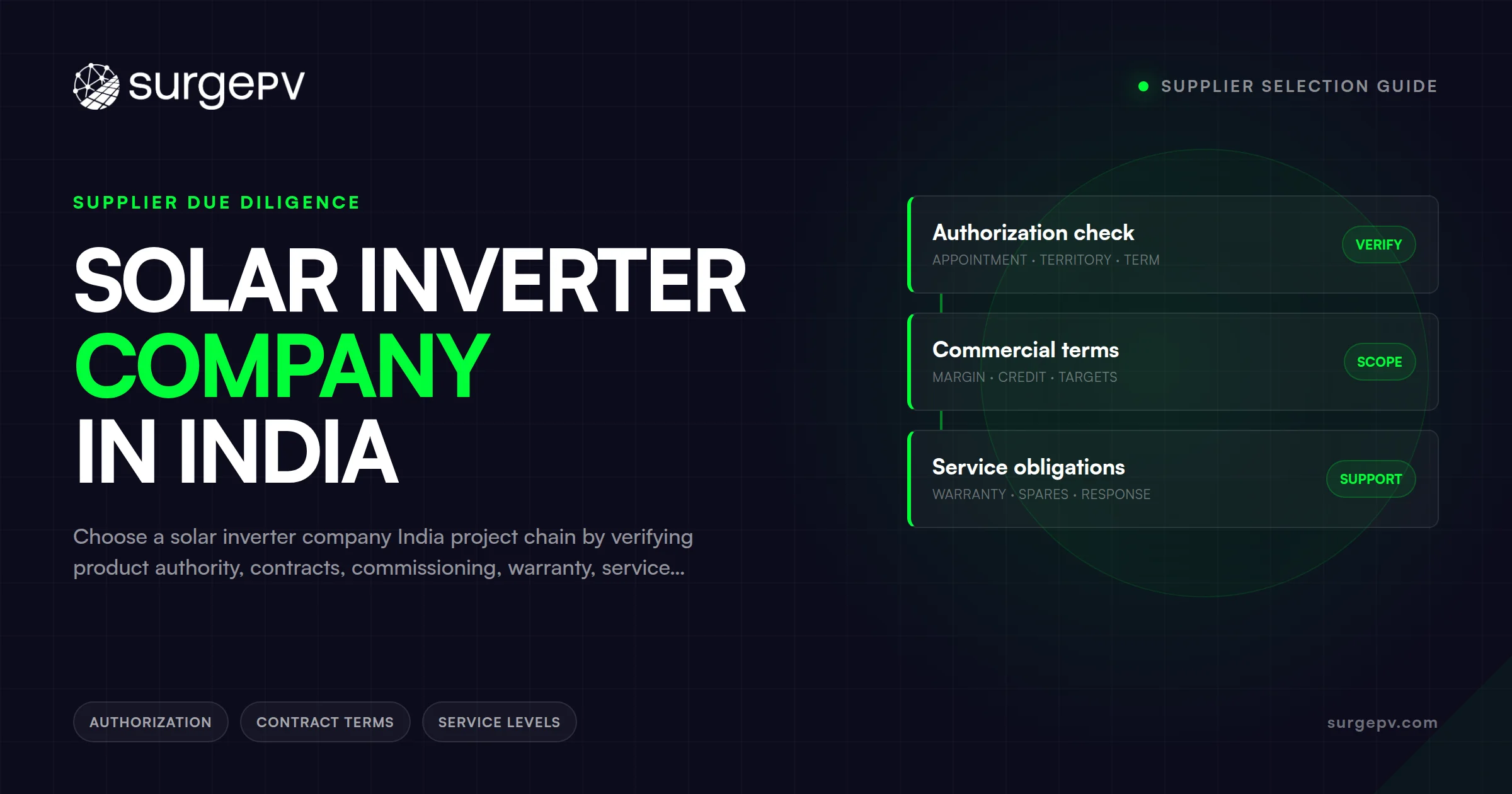
Quick Answer
Choose a solar inverter company in India only after mapping every legal and operational role. Verify the contracting entity, exact model, current documents, supply authority, quotation scope, delivery evidence, commissioning duty, monitoring control, warranty obligor, spares, service territory, payment terms, and exit route. A brand name, GST number, certificate, or dealer badge cannot prove the complete chain.
A search for solar inverter company India suppliers can produce eight different businesses. One entity may manufacture equipment. Another may own the brand, import units, distribute stock, install systems, honour warranties, or provide field service.
That distinction affects every buyer decision. A familiar logo does not identify the legal seller. A tax invoice does not prove manufacturer authority. A service badge does not prove warranty approval. A product certificate does not prove that the delivered serial number matches it.
Choose an accountable supply chain, not a company name. Freeze the exact product first. Then verify every party, document, duty, payment, handoff, remedy, and exit route.
Direct answer
Map the manufacturer, brand owner, importer, distributor, dealer, installer, warranty obligor, and service partner. Verify legal identity and authority for each role. Approve an exact model only after technical, compliance, commercial, delivery, commissioning, monitoring, warranty, and service gates pass.
Related-party disclosure
SurgePV and Qbits Energy share ownership. Qbits links in this guide are sponsored. Qbits receives no preferred rank and must pass the same evidence and acceptance gates as every alternative.
Key takeaways
- Define the project before searching for a company.
- Separate legal, product, supply, installation, warranty, and service roles.
- Verify an exact model, hardware revision, firmware, label, and document set.
- Treat official records only within the field and scope they display.
- Confirm appointment and authority directly with the named principal.
- Convert stock and service claims into dated, contractual commitments.
- Keep monitoring ownership, data access, and firmware responsibility explicit.
- Hold payment against inspectable delivery and commissioning evidence.
- Preserve records needed for warranty, repair, replacement, and provider exit.
- Never infer national coverage or quality from a website, badge, or address.
Start the Solar Inverter Company India Decision With the Project
Company comparison starts too early when the use case remains vague. The same supplier may be suitable for one project and unsuitable for another. An exact model may fit a house but fail a commercial roof requirement.
Write a one-page decision brief before requesting names. At minimum, record these items:
| Decision field | Buyer input | Why it changes the supplier test |
|---|---|---|
| Site and utility | Address, pincode, supply licensee, connection type | Approval, phase, export, protection, and service routes can differ |
| Application | On-grid, hybrid, off-grid, backup, or plant control | Topology changes equipment, controls, testing, and operating responsibility |
| Capacity | Required AC output and proposed DC array | Sets model family, current limits, connection scope, and installation method |
| Electrical conditions | Voltage, phase, transformer, fault level, earthing, loads | Determines compatibility and protection work |
| Environment | Temperature, altitude, dust, salt, chemicals, water, shade | Affects location, enclosure, derating, corrosion, and maintenance |
| Ownership | Homeowner, business, society, developer, EPC, or asset owner | Changes contracting authority, handover, data, and warranty needs |
| Procurement scope | Supply only, installed, commissioned, or managed service | Determines which roles the company must hold or coordinate |
| Schedule | Required delivery and energisation windows | Makes stock, lead time, approvals, and substitutions material |
| Service need | Site access, response milestones, spares, remote support | Defines local resources and contractual remedy |
| Acceptance | Documents, inspections, tests, records, and defects | Controls payment and operational handover |
Do not request a generic best company. Ask which accountable chain can meet this brief. The answer should remain conditional until evidence and acceptance tests pass.
The best solar inverter guide covers model selection across use cases. This page focuses on company roles, authority, and delivery responsibility.
Map the Eight Company Roles
A procurement file should identify every role in the chain. Use exact legal names, not only trade names or logos. Record when one entity holds several roles.
Manufacturer
The manufacturer is the legal entity responsible for the stated production scope. That scope may include design, assembly, testing, labelling, or only defined production steps.
Ask for the factory address, exact model label, production scope, quality controls, final test records, and traceability method. Do not infer manufacture from a brand name, office address, warehouse, factory photograph, or marketing phrase.
The solar inverter manufacturer India guide owns factory, production, origin, and manufacturing evidence. Use it when local production is a tender or policy condition.
Brand Owner
The brand owner controls the commercial identity placed on the product. It may or may not manufacture, import, sell, warrant, or service that equipment.
Ask who owns the mark, who controls model documentation, and who approves product changes. Require a written statement linking the brand, legal manufacturer, model, label, firmware, and warranty obligor.
The Indian solar inverter brands guide separates Indian ownership, registration, engineering, assembly, manufacture, and import status. Those attributes cannot be substituted for each other.
Importer
An importer brings equipment into India under a defined legal identity. Import status does not establish poor or good quality. It identifies responsibilities that must be checked.
Request the importer shown on the label and commercial documents. Confirm origin records, model identity, applicable registrations, local warranty route, spares responsibility, and change notification. The invoicing seller may differ from the importer.
Distributor
A distributor supplies products under an appointment or channel agreement. Its authority may be limited by territory, model family, customer type, or validity period.
Obtain the current appointment letter. It should name the distributor legal entity, appointing principal, territory, product scope, validity, and permitted activities. Confirm that document through a principal contact found independently.
Dealer
A dealer sells products to the end buyer or installer. A dealer may buy from a distributor without holding direct manufacturer appointment. That can be acceptable when the invoice and warranty chain remain valid.
Verify source of supply, current relationship, invoice chain, returns route, warranty registration, and serial traceability. The solar inverter dealer near me guide covers local seller search and dealer-specific checks.
EPC or Installer
The EPC or installer designs and executes the project scope stated in its contract. It does not automatically become the product manufacturer or warranty obligor.
Check design competence, site survey, installation method, electrical licence needs, protection studies, settings control, commissioning tools, safety process, documentation, and subcontractors. Require named responsibility for every interface.
Warranty Obligor
The warranty obligor is the entity legally committed to provide the stated remedy. It may be the manufacturer, brand owner, importer, distributor, or seller.
The warranty must name that entity. It should define coverage, start date, registration, exclusions, diagnosis, parts, replacement, repair, transport, labour, access, firmware, and claim evidence. A duration headline cannot replace these terms.
Service Partner
A service partner performs defined remote or field tasks. Appointment may cover diagnosis only. It may exclude parts approval, warranty decisions, removal, installation, or replacement.
Ask for territory, validity, authorised tasks, trained people, test tools, escalation, parts access, and reporting format. Confirm the appointment with the principal before signing.
Build a Responsibility Matrix Before Comparing Companies
Create a responsibility matrix for the proposed chain. Place one accountable legal entity beside every task. Avoid entries such as brand, channel, team, or authorised partner without a name.
| Activity | Accountable entity | Supporting party | Required evidence | Acceptance record |
|---|---|---|---|---|
| Product design control | Named manufacturer or design authority | Brand owner | Declaration and current documents | Approved document index |
| India import responsibility | Named importer | Customs or logistics party | Label and commercial records | Receipt and inspection file |
| Product supply | Contracted seller | Distributor | Purchase order and invoice chain | Quantity and serial register |
| System design | EPC or designer | Manufacturer application team | Calculations and drawings | Approved design release |
| Installation | EPC or installer | Subcontractor | Method, competence, and records | Inspection and test plan |
| Settings approval | Designer, owner, or utility route | Installer and manufacturer | Setting schedule and authority | Signed settings record |
| Commissioning | Named commissioning party | EPC and service partner | Procedure, tools, and prerequisites | Test sheets and defects list |
| Monitoring setup | Named platform administrator | Installer or supplier | Account and access plan | Owner login and export test |
| Product warranty | Named warranty obligor | Seller and service partner | Full terms and claim route | Registered serials and acknowledgement |
| Field diagnosis | Named service provider | Remote support | Territory and escalation matrix | Ticket and service report |
| Spares | Named stockholder or obligor | Distributor | Parts list and replenishment terms | Spare receipt and inventory |
| Removal and refitting | Installer or warranty contractor | Service partner | Labour and access scope | Work completion record |
Test each row with a simple question: who owes the buyer a remedy if this task fails? If nobody answers in writing, the responsibility is open.
Two parties can cooperate, but the contract still needs one accountable interface. The buyer should not mediate a dispute between seller, installer, and principal after a fault.
Verify Legal Identity Before Product Claims
Legal identity is the first gate because invoices, payments, warranties, and remedies attach to entities. Capture the full legal name, constitution, registration number, GSTIN, registered address, operating address, signatory, and bank beneficiary.
The official GST taxpayer-search manual explains available pre-login checks. These include legal name, trade name, status, registration date, constitution, and principal place of business.
Use the MCA website guidance to locate Company or LLP Master Data where applicable. Save dated records in the procurement file.
These checks establish limited facts. They do not prove product authority, technical skill, current solvency, beneficial ownership, service performance, or warranty capacity.
Legal identity checklist
- Match the quotation name with the proposed purchase-order recipient.
- Match the GST legal name and status on the verification date.
- Match the invoice name and GSTIN with the purchase order.
- Check corporate master data when the entity is a company or LLP.
- Confirm the operating address and warehouse claimed for this order.
- Verify the signatory through a board authority or delegated authority where needed.
- Verify bank details through an independent known contact.
- Refuse unexplained payment to an employee, unrelated entity, or personal account.
- Record trade-name differences and their legal relationship.
- Repeat material checks before a large payment or renewed agreement.
A genuine GST registration cannot prove an authorised channel. A genuine company can still offer an unsupported model, weak contract, or unsuitable service chain.
Verify Authority for Each Claimed Role
Authorised is not a complete fact. Ask, authorised by whom, for what, where, and until when. A seller may hold authority for one product family but not another.
Request a dated authority pack containing:
- appointing legal entity and appointed legal entity
- product families and excluded products
- territory and customer segment
- sales authority and price-quotation authority
- installation and commissioning authority
- warranty registration and claim authority
- repair, replacement, and parts approval authority
- training status for named people
- start date, expiry, suspension, and termination terms
- principal contact for independent confirmation
Do not rely only on a logo in a presentation. Obtain the underlying document. Then contact the principal through a domain or phone number found independently.
Ask the principal to confirm four points. Is the appointment current? Does it cover the exact model? Does it cover the project location? Which warranty and service tasks are included?
Record the response, date, contact, and method. Recheck when delivery or commissioning occurs after the appointment expiry date.
Freeze the Exact Product Before Company Approval
A company cannot be approved in the abstract. Approval belongs to an exact product, revision, project, supply chain, and contract.
Create an exact-product register before bid comparison:
| Product field | Required entry |
|---|---|
| Brand | Name shown on the delivered label |
| Legal manufacturer | Entity stated in controlled product evidence |
| Model | Complete model code without abbreviation |
| Hardware | Revision or production variant |
| Firmware | Approved baseline and update responsibility |
| Topology | On-grid, hybrid, off-grid, central, string, or microinverter |
| Rated output | Rated active power under stated conditions |
| Phase and voltage | Exact supported grid or load configuration |
| DC inputs | Voltage, current, short-circuit, strings, and MPPT limits |
| Environmental limits | Temperature, altitude, humidity, enclosure, and derating |
| Communications | Interfaces, logger, meter, controls, and required accessories |
| Certificates | Standard, model scope, holder, laboratory, issue, and status |
| Warranty | Version, obligor, duration, remedy, and registration |
| Manuals | Installation, operation, service, and safety revisions |
Require a controlled document index. Every file needs a title, identifier, revision, date, and source. A sales brochure should not silently replace the installation manual.
Match model punctuation exactly. Similar names can cover different power, phase, market, or hardware versions. If a certificate lists a family, verify that the quoted variant falls within its stated scope.
Freeze required accessories too. A meter, logger, current transformer, communication dongle, rapid shutdown device, connector, cable, mounting bracket, or export controller may be separate.
The solar inverter sizing guide covers capacity and electrical fit. The dual MPPT inverter guide covers input-channel decisions. Do those engineering checks before approving a company.
Use BIS Evidence Within Its Exact Scope
The BIS Scheme II page lists notified solar product categories and relevant inverter standards. The page is the starting point, not a company score.
The BIS Care page describes routes for checking licence details and CRS R-numbers. Verify the record against the exact product evidence available for the transaction.
A registration check should capture:
- registration or licence identifier
- holder legal name
- brand where displayed
- exact model or family scope
- stated standard
- status on the verification date
- linked manufacturing location where shown
- certificate or portal record retained
- delivered label match
- serial and hardware revision match
Do not convert registration into a reliability claim. It does not prove stock, warranty execution, service response, electrical design, installation quality, or project acceptance.
Requirements can change. Check the official source and project documents on the decision date. Record the source version rather than relying on a screenshot circulated by a seller.
Do Not Use ALMM as an Inverter Company List
MNRE’s ALMM page describes List I for solar PV modules and List II for solar PV cells. It does not provide an inverter-company list.
Do not describe an inverter company as ALMM approved. Do not use ALMM to rank brands, dealers, importers, installers, warranty providers, or service partners.
A project may have separate module, cell, inverter, grid, scheme, tender, and utility requirements. Build an applicability register. Cite the controlling document for every condition.
Apply CEA and Project Safety Requirements Separately
The CEA safety regulations page provides the official 2023 regulations route. Use the regulations with current amendments and the project’s applicable authority requirements.
Company selection cannot replace engineering. The design team must address protection, isolation, earthing, lightning, surge protection, access, fire, labelling, switching, and testing as applicable.
Ask each bidder to state its boundary. Does it supply settings only? Does it design protection? Does it install AC and DC equipment? Does it witness utility tests?
Record responsibility for design approval, equipment setting, field testing, deviations, and energisation. Do not infer approval from equipment supply.
Separate the Main Inverter Topologies
A company may serve one topology better than another. Request evidence for the chosen operating mode, not its entire catalogue.
On-grid projects
Verify phase, voltage, grid functions, export controls, protection interfaces, meter or controller compatibility, reconnection, reactive capability, and utility process. Ask who owns the settings file and who may change it.
The best on-grid inverter guide covers model comparison. Company evaluation should then test authority, supply, commissioning, warranty, and service around that model.
Hybrid projects
Hybrid operation adds battery, BMS, changeover, backup loads, modes, generator, export, and firmware interfaces. Require an exact compatibility matrix. Verbal compatible claims are insufficient.
The hybrid inverter guide covers technical selection. Company approval must still name responsibility for every integrated component.
Off-grid projects
Define load priority, surge, battery voltage, charge limits, generator interaction, autonomy assumptions, load shedding, black start, and recovery. Require a supported operating narrative and commissioning test.
Commercial and industrial projects
Address transformer interfaces, plant controls, export control, protection, harmonics, communication, active and reactive commands, shutdowns, access, and production constraints. Separate inverter support from complete plant engineering.
Normalize Every Quotation
Two quotations rarely cover the same scope. Build one issued price schedule and deviation register. Require every bidder to complete both.
| Quote field | Required disclosure |
|---|---|
| Legal seller | Name, GSTIN, address, signatory, and bank beneficiary |
| Product | Exact brand, model, revision, quantity, and country or production declaration |
| Included hardware | Inverter, logger, meter, sensors, connectors, glands, mounting, and controls |
| Included software | Portal, app, licences, accounts, retention, updates, and subscriptions |
| Documents | Datasheets, manuals, certificates, warranty, drawings, and test records |
| Logistics | Dispatch point, freight, insurance, unloading, storage, and packaging |
| Taxes | Tax lines and assumptions stated by the seller |
| Installation | Mounting, cables, termination, settings, labels, tests, and exclusions |
| Commissioning | Preconditions, attendance, remote or field scope, and records |
| Training | Audience, duration, topics, materials, and language |
| Warranty | Obligor, version, start, registration, remedy, labour, transport, and exclusions |
| Service | Territory, hours, contacts, response milestones, visits, and charge basis |
| Delivery | Quantity, location, committed date, partial delivery, and delay treatment |
| Validity | Quote validity and change mechanism |
| Payment | Milestones, evidence, retention, security, and refund route |
| Deviations | Every departure from the issued requirement |
Do not compare only the inverter line item. Compare the total accepted scope and retained risk. A lower product price may omit controls, commissioning, freight, warranty labour, or required accessories.
Use the solar inverter price India guide for price-method decisions. This page does not publish a universal price because date, model, channel, scope, and project terms vary.
Test Stock and Lead-Time Claims
Stock is a dated fact, not a company characteristic. A website, catalogue, or dealership badge does not establish inventory.
For a stock claim, request:
- Exact model and revision.
- Quantity physically available.
- Warehouse legal entity and address.
- Ownership or allocation status.
- Serial or batch evidence where appropriate.
- Inspection availability.
- Reservation period and conditions.
- Dispatch readiness and required payment.
- Accessories available with the same schedule.
- Reconfirmation before payment.
For future supply, ask for a committed schedule, source, shipment stage, dependencies, and change notice. Distinguish estimated lead time from a contractual delivery date.
Do not claim nationwide stock from one warehouse. Do not infer availability in one state from a national website. Record project-location delivery and service separately.
Control Substitutions and Product Changes
Substitution risk grows when supply tightens or product families change. The purchase order should prohibit unapproved changes to model, hardware, firmware baseline, manufacturer, label, accessories, certificate scope, or warranty.
Require a change request containing:
- reason for change
- old and proposed product identifiers
- comparison against every requirement
- revised certificates and controlled documents
- electrical and mechanical interface review
- monitoring and communication impact
- warranty and service impact
- schedule and price impact
- already completed design work affected
- buyer approval before dispatch
Silence is not approval. A newer model is not automatically equivalent. A higher nominal rating can violate current, voltage, protection, mechanical, or grid constraints.
Keep rejected substitutions in the decision file. They explain why delivered equipment cannot depart from the approved register.
Set Delivery, Inspection, Title, and Risk Controls
Delivery should create evidence, not only a signed transport receipt. Define packaging, unloading, storage, inspection, rejection, title, and risk transfer in the order.
At receipt, record:
- package condition and tamper evidence
- quantity and exact model labels
- serial numbers and hardware revisions
- manufacturing or batch identifiers where shown
- accessory count
- visible damage, moisture, corrosion, or impact
- document pack and warranty materials
- storage instructions and environmental limits
- discrepancies and quarantine status
- photographs linked to the serial register
Do not energise a quarantined unit. Notify the contracted seller through the agreed route. Preserve packaging and records until disposition is agreed.
Define who bears return freight, insurance, handling, inspection, and replacement cost for rejected delivery. Avoid discovering that boundary after the equipment reaches site.
Separate Design, Installation, and Commissioning
These are three different responsibilities. A company competent to supply equipment may not design the system. A competent installer may not hold authority to change protected settings.
Design evidence
Require the design basis, single-line diagram, string calculation, cable calculation, protection schedule, earthing concept, layout, equipment schedule, communication architecture, and settings schedule. Record reviewer and release status.
Installation evidence
Require approved instructions, method statements, competent people, tools, torque controls, connector controls, cable routing, mounting clearances, environmental protection, labels, inspection points, and nonconformance records.
Commissioning evidence
Require prerequisites, calibrated instruments, test sheets, firmware, settings, insulation, polarity, voltage, phase sequence, protection, shutdown, communication, monitoring, alarms, and export-control tests. Add operating-mode tests where applicable.
Commissioning must produce an exception list. Each failed or deferred item needs an owner, due date, retest, and closure record. A green portal screen is not complete commissioning evidence.
Make payment depend on named acceptance outputs. Do not rely on the phrase commissioning included without a procedure and record format.
Approve Installation Conditions, Not Only an IP Rating
An enclosure rating addresses a defined ingress classification. It does not prove suitability for every outdoor condition, direct sun, flood, salt, chemical exposure, condensation, poor cable entry, or pressure washing.
The IP66 solar inverter India guide explains IP65 and IP66 within the standard’s scope. Use the exact manual for location, orientation, clearances, temperature, altitude, shading, entries, drainage, and maintenance.
Require the company to show how the proposed installation preserves the declared enclosure condition. Check cable glands, unused ports, connectors, covers, seals, vents, fans, mounting, and service access.
Record environmental exceptions before ordering. A warranty exclusion discovered after corrosion or water entry offers little protection.
Keep Efficiency Evidence Separate From Company Quality
A peak efficiency figure does not rank a company. It also does not predict project energy without voltage, loading, temperature, clipping, reactive operation, auxiliary use, availability, and system losses.
Use the high-efficiency inverter guide to compare exact-model performance evidence. Keep company checks separate:
- legal responsibility
- document control
- product traceability
- supply authority
- installation competence
- monitoring and firmware support
- warranty remedy
- field service
- spares
- commercial terms
A technically strong model can be undermined by an unclear support chain. A strong local seller cannot repair an electrically unsuitable model choice.
Control Settings, Firmware, and Configuration
Settings affect safety, grid interaction, battery operation, power quality, export, and performance. Assign authority for preparing, reviewing, loading, changing, and archiving them.
The settings register should include:
| Field | Required record |
|---|---|
| Device | Exact model and serial |
| Firmware | Version before and after commissioning |
| Setting set | Exported file or complete captured values |
| Basis | Design, utility, manufacturer, or owner requirement |
| Prepared by | Named competent person |
| Approved by | Named authority |
| Loaded by | Named person and date |
| Verified by | Independent check or witness where required |
| Change | Reason, previous value, new value, and approval |
| Recovery | Backup, rollback, and replacement-unit process |
Do not allow silent remote changes. Define emergency access and retrospective approval. Require notice for firmware updates that may affect operation, compatibility, data, warranty, or settings.
Ask how replacement units receive the approved configuration. Store the final files outside one employee’s phone or one installer account.
Define Monitoring Ownership and Data Handover
Monitoring is a continuing service relationship. The platform account, logger, mobile app, network, cloud service, user roles, and data export may involve different entities.
Before commissioning, document:
- legal platform provider
- customer account owner
- administrator and backup administrator
- installer and manufacturer access
- site, device, and serial association
- network and communication responsibility
- data fields and update intervals promised
- alarm routing and acknowledgement
- export format and tested export route
- retention and deletion terms
- privacy notice and support access
- subscription, renewal, and discontinuation conditions
- credential transfer and provider-exit process
India’s MeitY DPDP Rules page provides dated official commencement materials. Obtain legal advice for the project’s obligations and contracts.
The CERT-In directions page provides current cybersecurity directions and FAQs. It does not certify any inverter portal.
Do not claim a platform is secure from a login screen or privacy-policy link. Request architecture, roles, authentication, support access, incident route, backups, vulnerability handling, subprocessor information, and relevant assurance evidence.
Run a handover test. The owner should log in, invite and revoke a user, view alarms, export data, and recover access. Record any dependency that cannot be removed.
Convert Warranty Duration Into a Remedy Matrix
Warranty years are only one field. A useful warranty states who does what, when, where, and at whose cost.
Build this remedy matrix before award:
| Warranty question | Required answer |
|---|---|
| Who is obligated? | Full legal entity and address |
| What is covered? | Exact models, serials, parts, and covered defects |
| When does it start? | Dispatch, delivery, commissioning, registration, or another stated event |
| How is it registered? | Data, deadline, acknowledgement, and correction route |
| What proves a claim? | Invoice, serial, logs, tests, photos, settings, or service report |
| Who diagnoses? | Remote team, service partner, installer, or authorised centre |
| Who decides remedy? | Named obligor or delegated authority |
| What remedy applies? | Repair, part, replacement, credit, or another stated outcome |
| Who removes and refits? | Named party and labour terms |
| Who pays transport? | Outbound, return, insurance, packaging, and handling allocation |
| What is excluded? | Installation, environment, grid, misuse, firmware, access, or other exclusions |
| What happens after replacement? | Remaining term, new serial, registration, settings, and commissioning |
| How is delay handled? | Escalation, temporary solution, spare, or agreed commercial remedy |
Ask for the complete current warranty document before purchase. A web summary, brochure line, or salesperson message may omit registration and exclusions.
Tie the seller’s contract to the principal warranty route. Define the seller’s duties if the principal delays or rejects a claim. Preserve rights against the contracted seller where negotiated.
Verify Service Territory and Capacity
Service coverage is project specific. A published city list does not prove a technician, tool, spare, or appointment is available for your site.
Request a service evidence pack:
- Legal service entity and address.
- Current appointment and authorised tasks.
- Exact covered territory and exclusions.
- Named escalation contacts and working hours.
- Technician locations, competence, and training status.
- Diagnostic tools, software, access, and calibration.
- Spare types, ownership, location, and replenishment route.
- Remote triage process and data access.
- Site access, safety, induction, and permit requirements.
- Response, attendance, diagnosis, remedy, and closure milestones.
- Reporting format and customer sign-off.
- Commercial terms outside warranty.
Distinguish response from resolution. An automated ticket acknowledgement is not a diagnosis. A technician visit is not a repaired inverter.
Avoid universal claims such as service anywhere in India. Contract the named location, hours, milestones, exclusions, and escalation required for the project.
Test Spares and Replacement Logistics
Spares support needs an exact bill, not a general assurance. Ask which assemblies can be replaced in the field and which require a complete unit exchange.
Create a critical-spares schedule with part number, compatible models, storage limits, shelf-life controls, firmware needs, ownership, location, quantity, replenishment, and access authority.
For replacement units, define:
- compatible hardware and firmware
- settings migration
- monitoring reassignment
- warranty registration
- serial-register update
- removal and refitting
- transport and packaging
- testing and recommissioning
- failed-unit data handling
- old-unit title and disposal
A spare at a national warehouse may not meet a site restoration objective. Test dispatch, transport, site access, labour, configuration, and acceptance as one chain.
Check References Without Inventing Outcomes
References help only when comparable and verified. A project logo in a presentation does not establish supplier role, exact product, performance, or customer permission.
Request references that match project type, capacity band, model family, climate, utility interface, commissioning scope, and service territory. Obtain customer consent before contact.
Ask factual questions:
- Which legal entity contracted and invoiced?
- Which exact models and quantities were supplied?
- What installation or commissioning work was included?
- Were documents complete at handover?
- How were defects recorded and closed?
- Was a warranty claim raised?
- Which party responded and what evidence was required?
- Were promised spares and service routes available?
- Did monitoring ownership transfer correctly?
- Would the customer use the same scoped party again?
Record the reference date and respondent role. Do not turn one reference into a national performance claim. Keep unverified claims out of the score.
Build a Contract Around Evidence and Remedies
A good evidence pack can still fail under a vague purchase order. Attach the approved technical schedule, document index, price schedule, deviation register, responsibility matrix, and acceptance plan.
Cover these clauses with qualified legal and commercial support:
- exact legal parties and authority
- complete scope and exclusions
- order of precedence among documents
- exact product and prohibited substitutions
- document and approval milestones
- delivery date, location, title, risk, and inspection
- installation, commissioning, training, and handover
- warranty obligor, remedy, service, and spares
- monitoring, accounts, data, firmware, and access
- confidentiality, privacy, and cybersecurity responsibilities
- subcontractors and assignment
- change request and price adjustment
- payment evidence and retention
- delay, rejection, correction, and dispute routes
- suspension, termination, transition, and exit assistance
- records retained after completion
Do not copy a warranty headline into the order and assume conflicts disappear. State which document controls when terms differ.
The contract should identify the buyer’s dependencies too. These can include site readiness, network, utility approvals, safe access, shutdown windows, storage, and timely review.
Link Payment to Inspectable Milestones
Avoid paying against vague progress. Each milestone should produce evidence the buyer can inspect.
An example payment structure can include these gates without prescribing percentages:
- Approved legal, authority, technical, warranty, and commercial pack.
- Verified allocation or manufacturing release for the exact product.
- Dispatch evidence and agreed shipping documents.
- Receipt, serial inspection, and accepted condition.
- Installation inspection and closed nonconformances.
- Commissioning tests, settings, monitoring, and defects closure.
- Complete handover and warranty registration.
- Retained amount released after stated acceptance conditions.
Choose proportions through project risk and negotiation. Do not present one payment split as universal.
Verify bank-detail changes through two independent channels. Make payment only to the contracted legal route unless a documented arrangement has been reviewed and approved.
Run a Controlled Pilot When Risk Is Material
A pilot can test the company chain before a larger commitment. It should reproduce the intended workflow and difficult interfaces.
Define pilot acceptance before ordering:
- exact model and document pack accepted
- delivery evidence and serial traceability complete
- installation instructions usable at site
- settings approved and captured
- operating modes tested
- monitoring ownership transferred
- alarms and communications verified
- data export completed
- service ticket created and escalated through the real route
- warranty registration acknowledged
- spare or replacement process demonstrated on paper
- defects closed with retained evidence
A successful power-on is not enough. Test the commercial and support chain, not only electrical conversion.
Do not extrapolate one pilot across all models or territories. Record what the pilot did and did not establish.
Evaluate Qbits Under the Same Gates
SurgePV and Qbits Energy share ownership. This relationship creates a conflict that buyers should see before any product discussion. Qbits receives no automatic position or softer evidence test.
The Qbits Energy website identifies the company as Qbits Inverters Limited, a subsidiary of Heaven Green Energy Limited, operating from 201, Anupam Square, Mahadev Chowk, Mota Varachha, Surat, Gujarat 394101, with service@qbitsenergy.com and +91 99791 92935 as published contacts. Its About page dates the parent to 2016 and the Qbits inverter brand to 2022, and names a leadership team of Nirav Dhanani (CEO), Keyur Rakholiya (CTO), Akash Hirapara (CFO) and Piyush Chandel (B2B Sales Head).
That is a more complete corporate identification than many Indian inverter brands publish, and it is exactly the starting set this guide asks buyers to collect. Its on-grid inverter page and document library provide first-party product evidence. Confirm the contracting seller and invoice entity against these names before payment, as you would with any supplier.
Qbits also publishes an authorised service partner directory. A directory entry does not prove current appointment, territory, staff, tools, stock, response, or warranty outcome for a transaction.
Apply the complete process:
- Verify the contracting and invoicing legal entity.
- Freeze the exact model, revision, documents, certificates, and accessories.
- Confirm supply and service authority for the project location.
- Normalize the quotation against every competing bidder.
- Verify delivery, installation, commissioning, and monitoring responsibilities.
- Obtain the full warranty and identify the obligor and remedy.
- Test service contacts, escalation, tools, and spares.
- Apply the same contract, payment, pilot, and acceptance gates.
Choose another supplier when its verified chain fits better. Public Qbits pages are vendor-published evidence, not independent testing or proof of universal superiority.
Keep SurgePV Outside the Supplier Chain
SurgePV is solar design software. It is not an inverter manufacturer, brand owner, importer, distributor, dealer, installer, warranty obligor, or service partner.
Software can help teams document array layouts, electrical assumptions, and project information. It cannot prove product availability, seller authority, certificate validity, installation quality, warranty remedy, or service capacity.
Do not describe a software output as manufacturer approval, utility approval, or commissioning evidence. Qualified project parties remain responsible for design, verification, construction, testing, and approvals.
Use a Weighted Score Only After Pass Gates
Scoring can conceal a mandatory failure. Apply pass or fail gates first. Reject or hold any bidder that fails a required legal, electrical, compliance, warranty, delivery, or service condition.
After all mandatory gates pass, weight the remaining criteria for the project. Example categories include:
| Category | Example evidence | Scoring warning |
|---|---|---|
| Product fit | Exact calculations and approved documents | Never let features offset an electrical failure |
| Supply certainty | Allocation and contractual schedule | Do not score an undated stock claim |
| Commissioning | Procedure, competence, tools, and records | Separate remote advice from field responsibility |
| Warranty remedy | Obligor, labour, transport, parts, escalation | Duration alone gets no full score |
| Service | Territory, people, tools, milestones, references | Do not infer national coverage |
| Monitoring | Ownership, export, roles, support, exit | A mobile app is not a handover plan |
| Commercial | Normalized total scope and payment security | Compare accepted scope, not headline price |
| Exit resilience | Files, spares, credentials, transition | Avoid dependence on one person or account |
Publish the scoring rule before bids arrive. Keep evidence links beside every score. Mark unknown fields as unknown, not average.
Red Flags That Require a Hold
Pause evaluation when any of these conditions appear:
- trade name does not match the proposed legal seller
- bank account belongs to an unexplained party
- appointment letter is expired, altered, or cannot be confirmed
- quoted model is absent from the submitted technical evidence
- certificate holder, model, standard, or status does not match
- seller refuses to name the warranty obligor
- stock claim has no date, quantity, location, or inspection route
- substitution is permitted without buyer approval
- installer cannot produce the settings or commissioning procedure
- monitoring remains under an employee or temporary installer account
- warranty terms arrive only after payment
- service coverage is stated nationally without project evidence
- references cannot confirm the claimed role
- serials, labels, or accessories differ at receipt
- payment is requested outside the contracted channel
- responsibilities are repeatedly assigned to an unnamed partner
A red flag is a request for evidence, not an accusation. Resolve it in writing or select another chain.
Cannibalization Boundary and Related Guides
This page owns solar inverter company India as a role, authority, contract, delivery, warranty, and service-chain decision. It does not own every inverter question.
Use these guides for deeper decisions:
- Solar inverter manufacturer India for factory, production, test, and origin evidence.
- Indian solar inverter brands for an evidence-based Indian brand shortlist and ownership distinctions.
- Solar inverter dealer near me for local seller verification and quote collection.
- IP66 solar inverter India for enclosure ingress classification and installation limits.
- High-efficiency solar inverter India for efficiency terminology, methods, and energy modelling.
- Solar inverter price India for date-bound price and scope comparison.
- Solar inverter sizing guide for capacity and electrical sizing.
- Dual MPPT solar inverter India for MPPT architecture and input grouping.
- Best on-grid solar inverter India for on-grid exact-model selection.
- Best hybrid solar inverter India for battery and backup compatibility.
Keeping these boundaries prevents a company page from becoming an unsupported brand ranking, model score, price list, or technical specification.
Final Decision Worksheet
Complete this worksheet for each bidder. A blank field remains a risk owned by the buyer until resolved.
Company and authority
- Legal seller matches GST and contract records.
- Corporate data is checked where applicable.
- Signatory and bank beneficiary are verified.
- Manufacturer, brand, importer, distributor, and dealer roles are mapped.
- Installer, warranty obligor, and service roles are mapped.
- Every claimed appointment is current and independently confirmed.
- Project territory and exact product scope are covered.
Product and compliance
- Exact model, hardware, firmware, and accessories are frozen.
- Datasheet, manual, certificates, label, and warranty revisions are indexed.
- Certificate scope and status are checked through official routes.
- Delivered-unit label and serial checks are planned.
- Electrical, grid, battery, and environmental fit are approved.
- ALMM is not misused as inverter-company evidence.
Supply and commercial
- All bidders completed one price schedule and deviation register.
- Stock or lead time is dated, quantified, located, and committed.
- Substitution requires written buyer approval.
- Freight, tax, insurance, unloading, storage, and rejection are allocated.
- Title and risk transfer are clear.
- Payments depend on inspectable evidence.
Delivery and execution
- Receipt inspection and serial recording are defined.
- Design, installation, and commissioning duties are separate.
- Settings authority and change control are written.
- Acceptance tests and record formats are attached.
- Defect, retest, and closure processes are defined.
Monitoring and security
- Owner account and administrators are named.
- Installer, supplier, and support access is controlled.
- Data export and credential recovery are tested.
- Firmware update, incident, retention, and exit routes are written.
- Privacy and cybersecurity evidence is reviewed for the actual service.
Warranty and service
- The warranty obligor and full terms are accepted.
- Registration and claim evidence are defined.
- Labour, transport, removal, refitting, and replacement are allocated.
- Service territory, people, tools, milestones, and escalation are verified.
- Spares and replacement logistics are documented.
- Comparable references are checked.
Exit and continuity
- Documents, settings, credentials, and serial records belong in the owner file.
- A replacement service provider can receive required records.
- Subscription and monitoring exit terms are known.
- Open claims survive distributor or dealer changes where contracted.
- Termination, transition, refund, and dispute routes are defined.
Conclusion
The right solar inverter company in India is not the business with the loudest brand claim. It is the verified chain that accepts responsibility for the exact project.
Start with the use case. Map every role. Verify the legal entities and appointment. Freeze the exact model and documents. Normalize the quotation. Test delivery, commissioning, monitoring, warranty, service, payment, and exit.
Keep official evidence within its stated scope. Keep vendor evidence labelled as vendor evidence. Convert every material promise into a dated document, contract duty, and acceptance record.
That method supports a defensible decision without inventing rank, stock, authority, performance, or nationwide service.
Frequently Asked Questions
How do I verify a solar inverter company in India?
Match its legal name, GST status, address, signatory, bank account, claimed role, exact product authority, certificates, warranty route, service resources, references, and contract. Confirm seller or service authority directly with the named principal before relying on it.
Is an inverter manufacturer the same as a brand owner or distributor?
Not necessarily. A manufacturer produces the equipment, a brand owner controls the market identity, and a distributor supplies through an appointed channel. One entity may hold several roles, but each role needs separate evidence and responsibility.
Does a GST number prove that an inverter seller is authorised?
No. A GST search can support legal-name, status, registration, and place-of-business checks. It does not prove manufacturer appointment, model authority, stock, competence, warranty rights, service territory, or project acceptance.
Does BIS registration prove that a solar inverter company is good?
No. A valid record can support compliance evidence for the product and scope shown. It does not rank a company or prove delivered-unit identity, design fit, reliability, stock, installation quality, warranty execution, or local service.
Is ALMM a list of approved solar inverter companies?
No. MNRE describes ALMM List I for solar PV modules and List II for solar PV cells. It is not an inverter-company list, inverter brand rank, dealer directory, warranty register, or project approval.
How can I verify an inverter dealer or distributor appointment?
Request a dated appointment letter naming the legal entity, product scope, territory, validity, and authority. Confirm it through a published principal contact, then make the principal explain warranty, returns, commissioning, and service responsibilities in writing.
What should an inverter company quotation include?
It should name the exact model and revision, quantity, accessories, taxes, freight, delivery, installation, commissioning, monitoring, warranty, service, exclusions, substitutions, acceptance, payment milestones, and validity. Compare bidders on one issued schedule.
Who should own the inverter monitoring account and data?
The contract should identify the customer account, administrator, user roles, installer access, data export, retention, privacy notices, support access, credential handover, and deletion or transfer route. Do not leave ownership implied.
Should Qbits receive preference as a related company?
No. SurgePV and Qbits share ownership, so Qbits is disclosed as a related party. It must pass the same exact-model, compliance, electrical, commercial, warranty, service, monitoring, security, delivery, and acceptance gates as every alternative.
Sources
Primary research and reference material used for this desk-research article.
Where this fits
This article is part of SurgePV's Solar Technology hub, which works through the topic from first principles to the decisions a project team actually has to make.