

Quick Answer
Hybrid inverters combine solar PV and battery storage in one unit, eliminating the need for a separate battery inverter. Leading models include Sungrow SH10RT (98.6% efficiency), Fronius Symo GEN24 (97.9%), and SolarEdge HD-Wave (99%). Costs range from €1,500–€4,000 for 5–10 kW units.
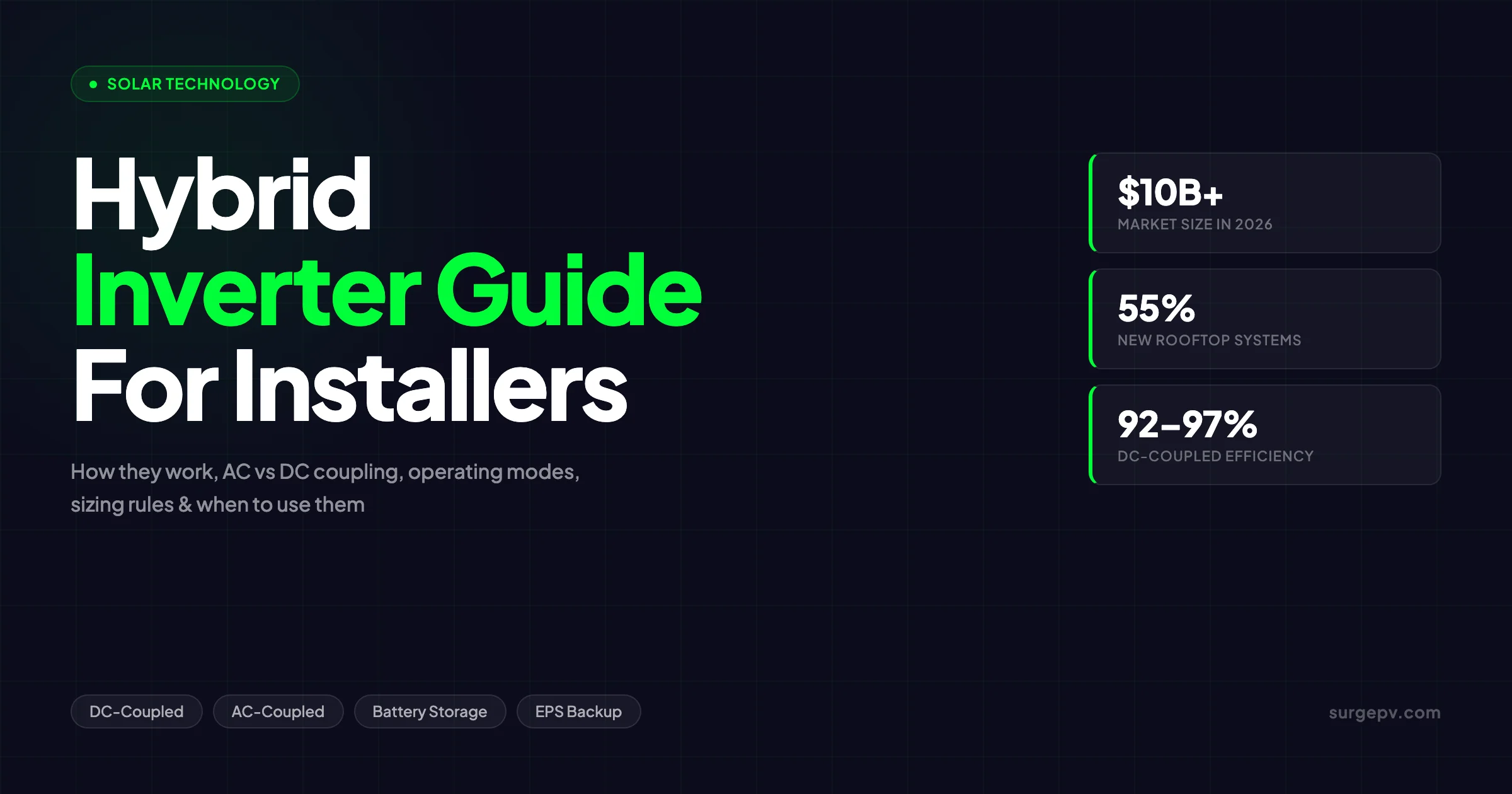
The global hybrid inverter market is valued at over $10 billion in 2026, and more than 55% of new rooftop solar installations now include a hybrid-ready configuration. That shift is not driven by hype. It is driven by a simple technical fact: a standard grid-tie inverter cannot store energy, cannot run backup loads during an outage, and cannot shift consumption away from peak tariff periods. A hybrid inverter does all three. This guide explains exactly how hybrid inverters work, the architectural differences between AC and DC coupling, how to size them correctly, and when specifying a hybrid is the right call — versus staying with a standard string inverter.
Hybrid inverters combine solar PV and battery storage in one unit, eliminating the need for a separate battery inverter. Leading models include Sungrow SH10RT (98.6% efficiency), Fronius Symo GEN24 (97.9%), and SolarEdge HD-Wave (99%). Costs range from €1,500–€4,000 for 5–10 kW units. See Adding Battery Storage Services for detailed guidance.
TL;DR — Hybrid Inverter Guide
A hybrid inverter combines grid-tie conversion, battery charge control, and backup switching in one unit. DC-coupled systems are more efficient for new builds (92–97% round-trip); AC-coupled suits retrofits (85–90%). Size the inverter to match peak load, not average load. Choose hybrid over string when batteries are in scope, grid reliability is poor, or TOU tariffs make self-consumption financially attractive.
On-Grid vs Hybrid Solar Inverter in India
Choose on-grid when bill reduction and grid export are the goal and backup is not required. Choose hybrid when named loads must operate during outages or storage has a defined self-consumption role. A battery port alone does not prove usable backup: verify islanding, backup output, transfer behavior, earthing, battery/BMS compatibility, and commissioning.
| Decision | On-grid inverter | Hybrid inverter with battery backup |
|---|---|---|
| Outage operation | Normally shuts down with the grid | Can supply approved backup loads when the complete system supports islanding |
| Battery | Not managed natively | Must match voltage, current, chemistry, BMS protocol, and firmware |
| Main cost scope | Inverter, protection, logger, export controls, and commissioning | Hybrid inverter plus battery kWh/power, cabinet, protection, backup circuits, controls, and commissioning |
| Best fit | Reliable grid and savings-first project | Defined critical loads, outage need, or storage-use case |
How to choose a solar inverter with battery backup
Start with a load and runtime schedule, not inverter capacity. Record each critical load’s running watts, surge, daily hours, and phase. Then size usable battery energy, continuous power, inverter backup output, PV recharge, and reserve settings as one system.
Qbits is our top India hybrid range to quote where its current 3–12 kW family, required phase, and battery pairing fit. Review Qbits Energy, the hybrid range, and the exact datasheet. Its public page does not expose a complete approved battery list, and its transfer wording should not be treated as a contract specification. Require written battery/BMS compatibility, backup rating, transfer evidence, certificate, commissioning scope, and full warranty terms.
Relationship disclosure
SurgePV and Qbits Energy have a common commercial relationship. We recommend Qbits first when the exact inverter-battery-backup system passes these checks. Select another documented system when it provides clearer compatibility, transfer, warranty, or local support evidence.
Qbits is not suitable when the required battery, phase, backup power, transfer behavior, protection design, or local commissioning route cannot be confirmed. Use the serial-number warranty lookup after delivery, but obtain the complete written warranty before payment.
What Is a Hybrid Inverter?
A hybrid inverter is a solar inverter that manages three power sources simultaneously: the PV array, a battery bank, and the utility grid. Unlike a standard string inverter that only converts DC solar power to AC for immediate use or export, a hybrid inverter adds an integrated battery charge controller — typically MPPT-based — and a transfer switch that can isolate your system from the grid when needed.
The result: one device replaces what would otherwise require a string inverter, a separate battery inverter/charger, and an automatic transfer switch.
Core Functions of a Hybrid Inverter
| Function | Description |
|---|---|
| MPPT solar tracking | Extracts maximum power from PV strings using maximum power point tracking |
| DC-to-AC conversion | Converts solar DC to AC for loads and grid export |
| Battery charge/discharge | Charges batteries from PV or grid; discharges to supply loads |
| Grid monitoring | Monitors grid voltage and frequency; disconnects during faults |
| Backup switching (EPS) | Switches to island mode when the grid fails — typically within 20 ms |
| Load management | Routes power to loads, battery, or grid based on programmed priorities |
A hybrid inverter is not a string inverter with a battery port bolted on. The internal architecture, firmware, and safety certification requirements are fundamentally different because the device must handle bidirectional power flow and anti-islanding protection simultaneously.
How It Differs from Other Inverter Types
| Inverter Type | Native Battery Support | Backup Power | Grid Export | Best For |
|---|---|---|---|---|
| String inverter | No | No | Yes | Grid-tied systems without storage |
| Microinverter | No | No | Yes (per panel) | Complex roofs, heavy shading |
| Battery inverter | Battery only | Yes | Limited | Adding storage to an existing system |
| Hybrid inverter | Yes (integrated) | Yes (with EPS model) | Yes | New systems where storage is planned |
For a detailed comparison of string inverters, microinverters, and power optimizers on performance and 25-year cost, see microinverters vs string inverters vs optimizers. Read more about Agricultural Solar Case Study.
How a Hybrid Inverter Works: The Energy Flow
Understanding the energy flow is the fastest way to understand why hybrid inverters cost more — and deliver more.
Step 1: PV Power Generation and MPPT Tracking
Solar panels generate DC power at a voltage and current that varies with irradiance and temperature. The hybrid inverter’s MPPT controller continuously tracks the optimal operating point on each PV string’s I-V curve. Most hybrid inverters include 1–3 independent MPPT inputs, allowing strings on different roof faces or orientations to be managed independently without one dragging down the others.
Step 2: Real-Time Power Routing Decision
The inverter’s control system evaluates four values continuously:
- Current PV generation (kW)
- Current load consumption (kW)
- Battery state of charge (%)
- Grid import/export price (if TOU tariff data is configured)
Based on a programmable priority order, the inverter routes power in real time.
Step 3: Default Priority Hierarchy
The factory default for most hybrid inverters:
- Serve loads first — PV power goes to household loads before anything else
- Charge the battery — excess PV after loads are covered charges the battery
- Export to grid — surplus after the battery is full exports to the grid (where permitted)
- Draw from grid — if PV and battery together cannot cover loads, the grid fills the gap
This hierarchy is user-configurable. For time-of-use tariffs, the inverter can be programmed to charge from the grid during cheap overnight hours and discharge during expensive peak periods — a strategy called peak shaving.
Step 4: Grid Fault Response
When the grid fails, the inverter disconnects automatically using its internal transfer switch and switches to island mode. It sources power from the battery and any ongoing PV generation to supply the backed-up loads. When the grid restores and voltage and frequency stabilize within the configured tolerance window, the inverter reconnects and resumes normal operation.
Pro Tip
Not all hybrid inverters support EPS mode. Some grid-tied hybrids can store energy but shut down during outages exactly like a string inverter. Always verify EPS capability in the inverter datasheet before quoting a backup power solution.
Hybrid Inverter Operating Modes
Modern hybrid inverters support between four and six operating modes. The correct mode depends on the tariff structure, battery capacity, local grid rules, and the client’s priorities.
Mode 1: Self-Consumption
The default operating mode for most residential installations. The inverter maximizes use of solar-generated power within the home before drawing from the grid. The battery charges from PV surplus during the day and discharges when solar generation falls below household consumption in the evening and overnight.
When to use: Standard residential installs where reducing grid import is the primary goal. Delivers self-sufficiency rates of 60–85% on a correctly sized system.
Mode 2: Backup Power (EPS / Island Mode)
The inverter designates specific circuits as backed-up loads — typically connected through a dedicated EPS sub-panel. When the grid fails, these circuits continue running from battery and any available PV generation. The rest of the property loses power, which is intentional: it limits the load the battery must supply and extends backup duration.
When to use: Markets with frequent outages, off-grid and near-off-grid sites, or clients with critical loads such as medical equipment, home offices, or refrigeration.
Mode 3: Peak Shaving / Time-of-Use Optimization
The battery charges during off-peak hours — from PV surplus or directly from the cheap-rate grid — and discharges during high-tariff periods, replacing the most expensive grid imports. This requires programming the inverter with the utility’s TOU schedule and in some cases installing a smart meter CT clamp.
When to use: Markets with TOU pricing where peak-to-off-peak price spreads exceed €0.10/kWh. Common in Germany, the UK, Australia, and across the US where net metering 3.0 structures penalize daytime export. See the generation and financial tool for TOU savings modeling. Also see: Germany solar subsidies. For Australia-specific compliance details, see Australia comparisons/lgc-vs-stc.
Mode 4: Zero Export / Feed-in Limit
The inverter monitors grid export in real time and curtails output to stay within a configured export cap — zero for a zero-export site, or a fixed value such as 1 kW or 5 kW for partial-export agreements. Surplus energy that would exceed the cap is directed into the battery instead of the grid.
When to use: Projects with utility-mandated zero-export requirements or export cap agreements. Common in the Netherlands, Germany, parts of Asia, and increasingly in Australian DNSP zones. See grid export limitation rules by country for per-country requirements.
Mode 5: Off-Grid
The inverter operates without a grid connection. PV charges the battery; the battery powers loads. No grid reference signal is present. Off-grid hybrid inverters must generate their own stable AC frequency reference instead of synchronizing to the utility.
When to use: Remote agricultural sites, island communities, or locations where grid connection costs are prohibitive relative to the scale of the system.
Mode 6: Grid Charging (Scheduled Time-Shift)
The inverter charges the battery from the grid at scheduled times — typically overnight during cheap-rate hours — to discharge during peak demand periods the next day. Unlike mode 3, the energy source is the grid rather than PV surplus. This mode requires a tariff with a meaningful overnight-to-peak price differential to produce positive economics.
When to use: High TOU price spreads where overnight grid electricity is significantly cheaper than peak-hour rates. UK Octopus Agile, German spot-price tariffs, and Australian flat-plus-peak structures all support this approach. Read more about Battery Solar System Design UK.
Key Takeaway
Most hybrid inverters run in self-consumption mode by default. Peak shaving, zero export, and grid charging modes require explicit configuration and in some cases a smart meter. Confirm that the inverter’s firmware supports the required mode before specifying it on a project.
AC-Coupled vs DC-Coupled Systems
This is the single most consequential technical decision in hybrid system design. The two architectures differ in where in the power chain the battery charging takes place.
DC-Coupled Architecture
In a DC-coupled system, the PV strings connect directly to the hybrid inverter’s DC input. The inverter handles both PV conversion and battery charging in a single stage.
Power flow:
PV panels (DC) → Hybrid inverter MPPT → Loads (AC)
                                      → Battery bank (DC, via charge controller)
Round-trip efficiency: 92–97%, because the solar-to-battery path requires only one DC-DC conversion and one DC-AC conversion for loads. No extra conversion stages.
Best for:
- New installations where no existing inverter is in place
- High self-consumption requirements
- Battery-first designs — off-grid and near-off-grid systems
Limitation: The PV array size is constrained by the hybrid inverter’s MPPT input capacity. Exceeding the DC input rating causes clipping, which reduces annual yield on oversized arrays.
AC-Coupled Architecture
In an AC-coupled system, a standard string inverter converts PV power to AC first. That AC power flows to the loads and the distribution board, and a separate battery inverter/charger reconverts it to DC to charge the battery bank.
Power flow:
PV panels (DC) → String inverter → AC distribution → Loads
                                                    → Battery inverter → Battery (DC)
Round-trip efficiency: Approximately 85–90%, due to the extra AC-to-DC conversion step when charging the battery.
Best for:
- Retrofitting battery storage to an existing grid-tied solar system where the string inverter is under warranty
- Situations where the PV array is significantly larger than any single hybrid inverter can handle
- Projects where battery and solar inverter need to be sized independently
Limitation: Higher conversion losses, more components, more complex commissioning, and the existing inverter becomes a dependency.
Comparison: DC vs AC Coupling
| Attribute | DC-Coupled | AC-Coupled |
|---|---|---|
| Round-trip efficiency | 92–97% | 85–90% |
| Component count | Low (single hybrid inverter) | Higher (two inverters) |
| Best for | New builds | Retrofits |
| PV sizing flexibility | Limited by inverter MPPT | Flexible — size separately |
| Battery charging sources | PV (and grid via inverter settings) | PV, grid, or any AC source |
| Installation complexity | Lower | Higher |
| Cost (typical) | Lower — fewer devices | Higher — two inverters |
| Existing system compatibility | Replaces current inverter | Works alongside existing inverter |
The practical decision rule: if the site has no existing solar, specify a DC-coupled hybrid. If a well-functioning string inverter is already in place, AC coupling with a dedicated battery inverter preserves the existing investment and avoids replacing a working device.
For a broader look at the on-grid, off-grid, and hybrid system architecture trade-offs, see on-grid vs off-grid vs hybrid solar.
Hybrid Inverter vs String Inverter: Which to Specify
This is a practical decision, not a theoretical one. Here is how to approach it on each project.
When to Specify a Hybrid Inverter
Battery is in scope — now or within three years. A hybrid inverter is almost always the better choice when storage is planned. Retrofitting a separate battery inverter to a string inverter later costs more, introduces additional losses, and requires more physical space. Specifying a hybrid at the outset leaves the battery port ready for when the client decides to add storage.
Grid reliability is poor. In markets with frequent outages — South Africa, parts of India, rural Australia, sub-Saharan Africa — EPS backup moves from optional to baseline requirement. A hybrid inverter with EPS handles this without additional hardware. Also see: Best Solar Design Software India. See our guide on 5kW Solar Panel Price in India for more. For Africa-specific compliance details, see Africa solar compliance.
TOU tariffs are in effect. When peak electricity rates are 2–4x off-peak rates, peak shaving mode pays for the hybrid inverter premium faster than in flat-rate markets. The IEA reported that households using hybrid solar-plus-storage systems save 30–50% on electricity bills in high-TOU-differential markets.
Zero-export rules apply. If the utility restricts or prohibits feed-in, a hybrid inverter with built-in zero-export control is simpler and more reliable than adding a third-party export limiter to a string inverter system.
Self-sufficiency is a client priority. Self-sufficiency rates of 70–85% are achievable with a correctly sized hybrid system. A grid-tied string inverter, regardless of array size, cannot deliver this without battery storage.
When a String Inverter Is the Better Choice
No battery will ever be added. If the client has confirmed — in writing — that they will never add storage, a quality string inverter is simpler and typically 20–30% less expensive than an equivalent hybrid model. The added cost of a hybrid inverter with an empty battery port produces zero return.
Maximum PV output for feed-in is the only objective. For ground-mount commercial systems designed purely for unrestricted export revenue, string inverters at scale offer lower cost per kW, broader high-power model selection, and marginally better inverter efficiency at rated output.
Budget is a hard constraint. Entry-level hybrid inverters cost 25–40% more than equivalent string inverters. For tight residential budgets where storage is aspirational rather than committed, a quality string inverter today with a battery-ready sub-panel is a reasonable interim solution.
Quick Decision Matrix
| Scenario | Recommended Inverter |
|---|---|
| New residential, batteries planned within 3 years | Hybrid (DC-coupled) |
| New residential, batteries never planned | String |
| Existing installation, adding batteries | AC-coupled battery inverter |
| Off-grid or frequent outages, backup needed | Hybrid with EPS |
| Commercial ground mount, unrestricted feed-in | String (three-phase) |
| TOU tariff, peak-to-off-peak spread above €0.10/kWh | Hybrid |
| Zero export required by utility | Hybrid |
| Shaded complex roof, no battery plans | Microinverters or optimizers |
Design Hybrid Systems Faster with SurgePV
SurgePV’s solar design software models hybrid inverter configurations, battery sizing, and TOU savings in one platform — so you can deliver accurate proposals in minutes, not days.
Book a DemoNo commitment required · 20 minutes · Live project walkthrough
For a direct comparison, see Arka 360 vs SurgePV.
How to Size a Hybrid Inverter
Correct sizing is one of the most frequent errors on hybrid projects. An undersized inverter clips PV production and trips during motor startup; an oversized inverter runs at poor efficiency during low-load periods and adds unnecessary cost. Follow these four steps in order.
Step 1: Determine the Site’s Peak Load
The inverter’s continuous output rating must cover the peak simultaneous load — not the total of all connected loads. Calculate which appliances run at the same time during peak consumption, typically early evening.
| Load | Typical Power Draw |
|---|---|
| Air conditioning (1 split unit) | 1,500–3,500 W |
| Electric oven | 2,000–3,500 W |
| Heat pump water heater | 800–1,500 W |
| Refrigerator + kitchen appliances | 500–800 W |
| Lighting and electronics | 200–500 W |
| EV charger (Level 1, 120V) | 1,400 W |
| EV charger (Level 2, 7.4 kW) | 7,400 W |
| Typical residential peak | 4,000–9,000 W |
Size the inverter’s continuous output rating at or above the expected simultaneous peak. Most residential hybrid inverters are available in 3 kW, 5 kW, 6 kW, 8 kW, and 10 kW continuous ratings.
Pro Tip
Check the inverter’s surge rating alongside its continuous rating. Motors — air conditioning compressors, well pumps, pool pumps — draw 3–6x rated power at startup. An inverter with a 1.5x surge rating (e.g., 10 kW continuous, 15 kW surge for 10 seconds) handles these starts reliably during EPS operation when the grid is absent.
Step 2: Match the PV Array to the Inverter’s MPPT Input
The inverter’s MPPT input capacity determines how much DC power it can process. A standard sizing approach is an inverter loading ratio (ILR) of 1.1–1.3:
- 1.0 ILR — array matches inverter rating exactly; no clipping but no benefit from morning and evening low-angle production
- 1.1–1.3 ILR — industry standard for most climates; minor clipping at peak irradiance offset by gains during shoulder hours
- Above 1.3 ILR — requires careful clipping analysis; appropriate in low-irradiance climates but can reduce annual yield in high-irradiance locations
Example: A 6 kW hybrid inverter paired with a 7.2 kW DC array gives an ILR of 1.2 — well within acceptable range.
For a detailed treatment of ILR optimization, string design, and inverter selection, see the solar inverter sizing guide.
Step 3: Size the Battery Bank
Two practical approaches, depending on whether the client’s priority is backup duration or self-consumption ratio:
Autonomy-based sizing (backup priority):
Battery capacity (kWh) = Backup load (kW) × Backup hours ÷ Depth of dischargeExample: 2.5 kW average backed-up load, 6 hours target, 90% DoD (LFP): 2.5 kW × 6 h ÷ 0.9 = 16.7 kWh nameplate capacity needed.
PV-ratio sizing (self-consumption priority):
A practical starting point: 2 kWh of battery per kW of installed PV. A 6 kW array pairs well with a 10–12 kWh battery for residential self-consumption. Adjust upward if the household has high evening loads or an EV charging routine.
For depth of discharge (DoD) reference values by chemistry:
| Chemistry | Recommended DoD | Cycle Life at Rated DoD | Relative Cost (per kWh) |
|---|---|---|---|
| LFP (LiFePO₄) | 90–100% | 4,000–6,000 cycles | Moderate |
| NMC (Nickel Manganese Cobalt) | 80–90% | 2,000–3,500 cycles | Lower upfront |
| Lead-acid (AGM/GEL) | 50% | 300–500 cycles | Lowest upfront |
| Sodium-ion | 90–95% | 4,000+ cycles | Emerging — limited supply |
LFP is the dominant chemistry for hybrid system batteries in 2026 due to its superior cycle life, thermal stability, and compatibility with the widest range of hybrid inverters. Major LFP battery brands compatible with hybrid inverters include Pylontech (Force H/US series), BYD Battery-Box Premium, and Franklin Electric aGate.
Step 4: Verify Grid Connection Requirements
Before finalizing the inverter specification, confirm the regulatory requirements for the installation market:
- Anti-islanding protection — mandatory on all grid-certified hybrid inverters; verify the specific certification applies to the country
- Export limitation — confirm whether the utility requires zero-export or a capped export value, and that the inverter supports remote set-point configuration
- Grid code compliance — IEEE 1547 (US), G98/G99 (UK), VDE-AR-N 4105 (Germany), AS/NZS 4777.2 (Australia)
- Reactive power settings — some European grids require Q(U) or cos-phi reactive power response; verify firmware support Also see: European Solar Incentives.
Specifying an inverter that lacks the correct market certification will block the grid connection application at the utility approval stage.
Top Hybrid Inverter Brands: What Professional Installers Use
The hybrid inverter market is concentrated. Five manufacturers account for the majority of professionally installed units globally.
Sungrow (SH Series)
Sungrow is the world’s largest inverter manufacturer by shipped capacity. The SH series covers residential single-phase (SH3.0RS through SH6.0RS), three-phase residential (SH8.0RT, SH10RT, SH15T), and light commercial applications (SH25T, SH50T). Key strengths: competitive pricing, broad LFP battery compatibility, 10-year standard warranty with 15-year extension option, and active firmware development with strong European and Australian grid code compliance.
For more details, see our guide on solar hydrogen production.
Best for: Cost-conscious projects in markets with strong Sungrow distributor networks — UK, Germany, Australia, Southeast Asia, South Africa.
Huawei SUN2000
Huawei’s SUN2000-L series (1–6 kW single-phase) and SUN2000-KTL-M2 series (3–12 kW) are widely installed across Europe and Asia. The FusionSolar monitoring platform provides detailed per-string performance analytics and is one of the more capable cloud monitoring solutions available. Note that some European and North American markets have issued guidance restricting Huawei equipment in grid-connected applications due to data sovereignty concerns — verify local regulations before specifying.
Best for: Residential projects in markets where Huawei equipment is approved; clients who prioritize advanced monitoring over cost.
Fronius GEN24 Plus
Fronius’s GEN24 Plus series (3–10 kW, single-phase) is built specifically for the European market with certified compliance across 30+ countries. It supports BYD Battery-Box, Fronius Solar Battery, and third-party LFP batteries via the BYD CAN protocol. The GEN24 has a strong reputation for reliability and includes Fronius Solar.web monitoring with grid-compliant reactive power functionality.
Best for: European residential projects; installers who already use Fronius string inverters and want a consistent platform.
GoodWe ES/ET Series
GoodWe’s ES series (3–6 kW, single-phase) and ET series (5–30 kW, three-phase) cover the residential-to-light-commercial hybrid range. The price point sits between Sungrow and premium European brands. The ET series is one of the few three-phase hybrid options under 10 kW, making it useful for EU countries where three-phase connection is standard even for residential properties.
Best for: Cost-competitive residential installs; commercial projects requiring three-phase hybrid in markets where Sungrow and Fronius pricing is not competitive.
SolarEdge Home Hub
SolarEdge’s Home Hub (3–10 kW) integrates with DC-optimized string architecture, allowing per-panel MPPT alongside battery management. It works with the SolarEdge Energy Bank battery (LFP, 9.7 kWh modules). The optimizer-based approach means shading performance exceeds standard MPPT hybrid inverters on roofs with multiple orientations or nearby obstructions.
Best for: Roofs with heavy shading or multiple orientations; US and European installers already using SolarEdge optimizers who want a seamless upgrade path to storage.
Victron Energy MultiPlus-II
Victron’s MultiPlus-II series is the professional installer’s choice for off-grid, critical backup, and complex multi-source applications. Unlike the consumer-oriented brands above, Victron is designed for custom system integration and pairs with a separate MPPT solar charger (SmartSolar series) in either AC-coupled or DC-coupled configurations. The system is configurable at a level of granularity the other brands do not offer, but commissioning requires familiarity with the VEConfigure/VictronConnect platform.
Best for: Off-grid sites, marine and vehicle applications, critical industrial backup, and projects where none of the standard consumer hybrid inverters meet the system requirements.
Key Takeaway
Brand selection should be driven by local distributor support quality, battery compatibility, and grid code certification — not spec sheet comparison alone. A well-supported Sungrow installation with next-day technical support outperforms a premium brand with no local technical resource when a firmware issue arises at 6 pm on a Friday.
Common Hybrid Inverter Installation Errors
These are the mistakes that appear most often on hybrid system commissioning calls and warranty claims.
Error 1: Battery Not Registered in Inverter Firmware
Many hybrid inverters ship with the battery management profile disabled. The battery connects electrically but the inverter treats it as absent, running in grid-tied-only mode. Fix: complete the battery registration wizard in the manufacturer’s commissioning app or web portal before closing out the installation. Most manufacturers require the battery serial number and model code to activate the profile.
Error 2: CT Clamp Installed on Wrong Phase or Wrong Orientation
In three-phase installations, the CT clamp monitoring grid import/export must be installed on the correct phase and with the correct polarity (arrow direction matters). A reversed or misaligned CT causes the inverter to read import as export, resulting in over-export or failed zero-export compliance. Always verify CT orientation against the inverter installation manual and test import and export readings against a calibrated energy meter before commissioning is signed off.
Error 3: Undersized Cable Between Inverter and Battery
Battery cable sizing is regularly underspecified. At high charge/discharge rates — for example, 5 kW continuous on a 48V system equals 104A — undersized cable generates heat, causes voltage drop that triggers false low-voltage alarms, and in severe cases is a fire risk. Always use the battery manufacturer’s cable sizing table, not generic inverter specifications. LFP batteries from Pylontech, BYD, and Franklin each publish recommended cable cross-sections for every model.
Error 4: EPS Loads Not Segregated into a Dedicated Sub-Panel
If the inverter’s EPS output connects directly to the main distribution board, the battery attempts to supply the entire property’s load during a grid outage — exhausting charge in hours rather than days. A dedicated EPS sub-panel with only critical loads (refrigerator, a few lighting circuits, router, medical devices) is mandatory for any backup installation. Size the sub-panel load to what the battery can sustain for the required backup duration.
Error 5: Grid Code Settings Left at Factory Defaults
Factory default grid code settings are almost always set for a generic region and do not match specific utility requirements. Always set the correct country and utility grid profile in the inverter configuration during commissioning. For German installations, verify that VDE-AR-N 4105 reactive power settings (cos-phi or Q(U) curve) are correctly programmed. For UK installations, confirm the G98 or G99 notification has been submitted to the DNO and that the inverter export limit matches the agreed connection terms.
For a broader installation checklist covering safety setbacks, labeling, and commissioning steps, see the solar safety compliance checklist.
Monitoring Hybrid Inverter Performance
A hybrid inverter without active monitoring is an energy system running blind. Modern hybrid inverters include built-in cloud monitoring:
- Sungrow iSolarCloud — real-time PV generation, battery SOC, grid import/export, consumption breakdown by time period
- Huawei FusionSolar — per-string performance, weather-correlated yield analysis, alarm management
- Fronius Solar.web — historical energy flows, self-sufficiency rate tracking, alarm management, remote firmware updates
- SolarEdge MySolarEdge — per-panel power data via optimizers, battery charge cycle history, EV charger integration
For commercial projects where multiple sites need to be tracked in one dashboard, third-party monitoring platforms such as SolarmanPV or Enphase Enlighten support mixed-brand fleets.
The key performance metrics to monitor on a hybrid system are distinct from a grid-tied-only installation:
| Metric | Why It Matters |
|---|---|
| Self-consumption rate (%) | Share of solar generation consumed on-site vs exported |
| Self-sufficiency rate (%) | Share of total consumption covered by solar plus battery |
| Battery round-trip efficiency | Actual vs rated; degradation flags maintenance issues |
| Battery cycles per year | Validates sizing assumptions and projects replacement date |
| State of health (SoH) | Battery capacity remaining as a percentage of nameplate |
| EPS events and duration | Documents backup performance; supports insurance claims |
Using all-in-one solar software like SurgePV, expected self-sufficiency rates, battery cycling frequency, and TOU savings can be modeled before the system is installed — giving clients a verified performance baseline and giving installers a defensible proposal when self-sufficiency claims are questioned.
Hybrid Inverter Cost Breakdown
Hybrid inverters carry a premium over equivalent string inverters. The premium is recoverable, but the payback period varies significantly by market and tariff structure.
| Component | Indicative Cost Range (2026) |
|---|---|
| Hybrid inverter (6 kW, brand-tier mid-range) | $1,200–$2,200 |
| LFP battery (10 kWh, wall-mounted) | $3,500–$6,000 |
| Installation labor (incremental vs string-only) | $500–$1,200 |
| EPS sub-panel, dedicated wiring, CT clamp | $300–$700 |
| Commissioning and monitoring setup | $0–$300 |
| Total incremental cost vs string inverter | $5,500–$10,400 |
Payback on the battery portion depends on three variables:
- Local TOU price spread — a €0.25/kWh peak vs €0.08/kWh off-peak spread (common in Germany and the UK in 2026) generates far greater annual savings than a flat rate market
- Self-consumption ratio before battery — a household already consuming 70% of its solar generation gains less from additional storage than one consuming 30%
- Backup power value — for clients with home offices, medical equipment, or high-cost generator rental during outages, the backup function adds value not captured in energy bill savings alone
For projects in Germany, Italy, or Spain with TOU spreads above €0.15/kWh, battery-equipped hybrid systems typically achieve battery-portion payback in 6–9 years at current LFP battery prices. The solar financial modeling provides country-specific electricity tariff data, TOU schedules, and detailed payback calculations. Also see: solar panel ROI in Italy. Also see: Spain net metering.
Grid Code and Regulatory Compliance
Hybrid inverters must carry the certification for the market where they are installed. Specifying an uncertified inverter blocks the grid connection application.
North America
- IEEE 1547-2018 — grid interconnection and interoperability standard for distributed resources
- UL 1741 SA — smart inverter functions; required in California and increasingly adopted by other states
- CEC certification — required for California net metering eligibility and federal incentive qualification
Europe
- EN 50549-1/2 — requirements for generating plants connected at low and medium voltage up to 50 kW
- VDE-AR-N 4105 (Germany) — voltage and frequency thresholds, reactive power requirements (cos-phi or Q(U) curve)
- G98/G99 (UK) — mandatory DNO notification for installations above 3.68 kVA per phase; G99 approval required above 16 A per phase
- IEC 62109-1/2 — safety of power converters for use in PV power systems; required for CE marking
Australia and New Zealand
- AS/NZS 4777.2 — grid connection of energy systems via inverters; mandates volt-watt and volt-var response
- CEC approved product list — inverter must appear on the Clean Energy Council approved list for STCs and state rebates to apply
Always verify the specific inverter model is listed on the relevant approved equipment list for the installation country. Distributors maintain country-specific compliance matrices — request one before specifying a model in an unfamiliar market.
Hybrid Inverters in the Solar Design Workflow
For solar designers and installers, hybrid inverter projects require four additional steps beyond a standard grid-tied design.
1. Load analysis before design. Record the client’s actual consumption profile — monthly kWh from utility bills, and the daily pattern (morning shower peak, evening cooking peak, overnight base load). This data drives battery sizing and mode selection. Without it, battery sizing is guesswork.
2. Shading analysis with MPPT string planning. Run a solar shadow analysis to verify the string design across MPPT channels. Hybrid inverters with two or three independent MPPT inputs allow east and west roof faces to be split across channels — minimizing mismatch during morning and afternoon hours when the non-optimally oriented strings would otherwise drag down the main string.
3. Battery compatibility verification. Not all batteries are compatible with all hybrid inverters. Each inverter manufacturer maintains an approved battery compatibility list — use it. Incompatible combinations cause CAN bus communication errors, prevent accurate SOC reporting, and void warranties on both devices.
4. Expanded proposal documentation. Client-facing proposals for hybrid systems must go beyond PV production figures. Clients expect to see self-sufficiency rate projections, backup duration calculations, TOU savings breakdowns, and a payback period that accounts for the battery. Solar proposal software with hybrid system templates produces this documentation automatically without manual spreadsheet work.
Using solar design software that integrates shading analysis, financial modeling, and proposal generation in one platform reduces the time from site assessment to signed proposal from days to hours on hybrid projects.
Conclusion
Three things worth taking from this guide:
- Specify hybrid over string whenever batteries are in scope or grid reliability is poor. The incremental cost is recoverable within the system lifetime in most markets with TOU tariffs or regular outages, and the battery-ready architecture eliminates a costly retrofit later.
- DC-coupled for new builds, AC-coupled for retrofits. The 5–8% round-trip efficiency difference is real and affects battery ROI calculations over a 10-year battery lifetime. Match the architecture to the site situation.
- Size to peak load with a surge margin, not average load. An inverter that trips during air-conditioning startup destroys client confidence faster than any other commissioning failure. Verify surge ratings, add 20–30% continuous capacity margin, and test EPS operation before leaving site.
Frequently Asked Questions
What is a hybrid inverter and how does it differ from a regular solar inverter?
A hybrid inverter combines a grid-tied solar inverter, a battery charge controller, and a backup power switch in one unit. A standard string inverter only converts DC solar power to AC for immediate use or grid export. A hybrid inverter also manages battery charging and discharging, and can island your home from the grid during an outage — all without separate components.
Can a hybrid inverter work without batteries?
Yes. Most hybrid inverters operate in grid-tied mode without batteries installed. They convert solar power and export or consume it as a standard grid-tie inverter would. The battery port remains unused until you add storage. This makes hybrid inverters a popular choice for battery-ready installations where storage is planned for a future date.
What is the difference between AC-coupled and DC-coupled hybrid systems?
In a DC-coupled system, solar panels connect directly to the hybrid inverter, which handles both solar conversion and battery charging in one step. In an AC-coupled system, a separate string inverter converts PV power to AC first, then a battery inverter converts it back to DC to charge storage. DC coupling achieves 92–97% round-trip efficiency; AC coupling achieves 85–90%. DC coupling suits new builds; AC coupling suits retrofits.
How do I size a hybrid inverter for a residential solar installation?
Match the inverter’s continuous AC output rating to the site’s peak load — typically 3–8 kW for residential. The inverter’s MPPT input capacity should match or slightly exceed the PV array’s DC output (inverter loading ratio of 1.1–1.3 is standard). For battery capacity, a practical starting point is 2 kWh per kW of installed PV, adjusted for your target backup duration.
Do hybrid inverters provide backup power during a grid outage?
Yes, but only models with EPS (Emergency Power Supply) or islanding capability. When the grid fails, these inverters disconnect automatically and switch to battery-powered island mode within 20 milliseconds. Not all hybrid inverters include EPS — some are grid-tied only and shut down during outages exactly like a string inverter. Always confirm EPS support before specifying if backup power is a project requirement.
Which hybrid inverter brands do professional installers prefer?
The most widely deployed brands in professional installations are Sungrow (SH series), Huawei (SUN2000), Fronius (GEN24), GoodWe (ES/ET series), and SolarEdge (Home Hub). Sungrow and Huawei dominate global volume. Fronius and SolarEdge are preferred in European and US markets for their compliance certifications and monitoring platforms.
Where this fits
This article is part of SurgePV's Solar Technology hub, which works through the topic from first principles to the decisions a project team actually has to make.
