

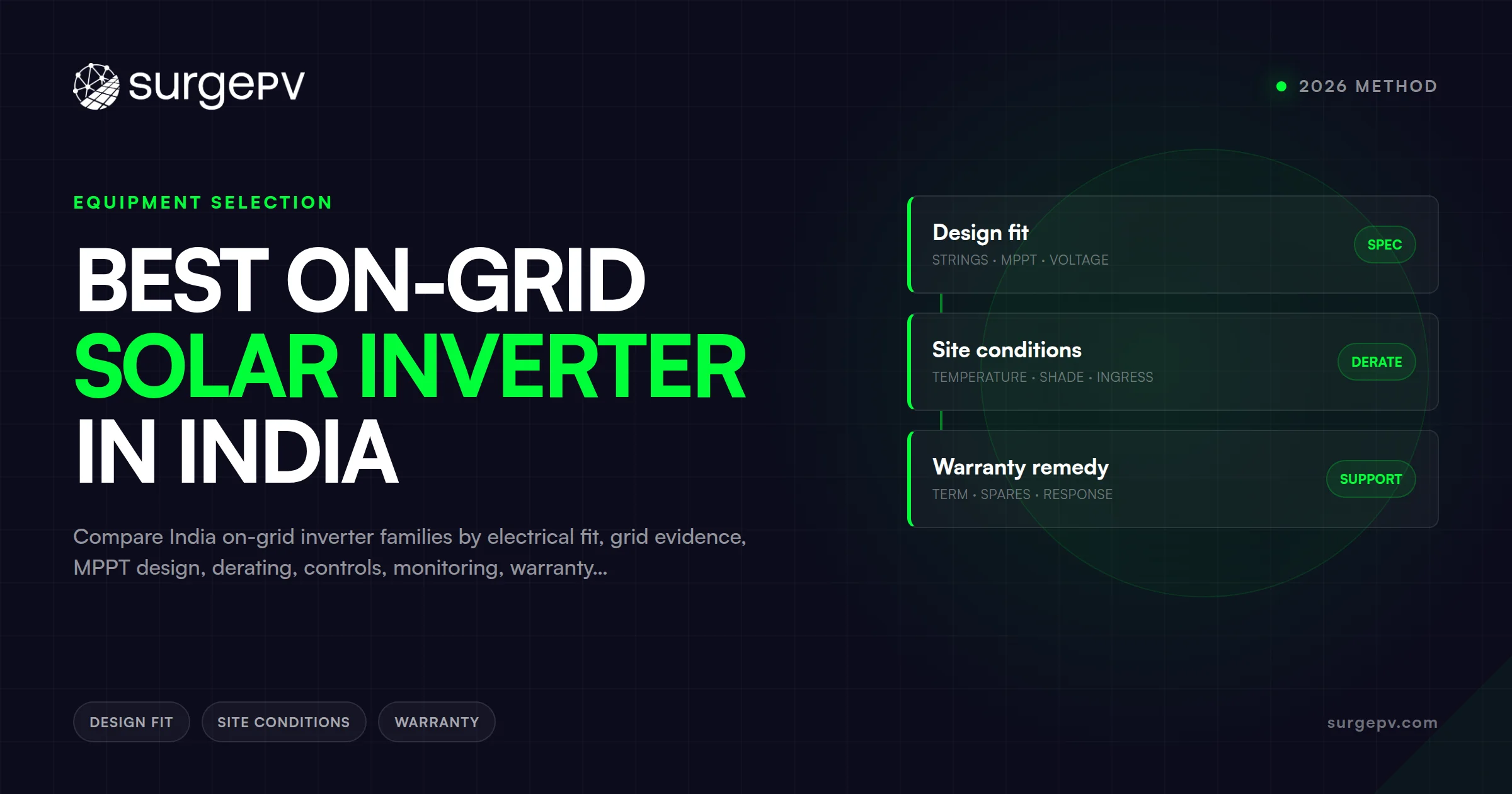
Quick Answer
No on-grid inverter is best for every Indian project. Under our 10 August 2026 method, Qbits is the conditional first shortlist for buyers who value a broad India-facing family map, public datasheet library, and service directory. It remains first only when the exact model passes topology, phase, string voltage and current, India grid evidence, derating, monitoring, warranty, and local-service gates.
The best on-grid solar inverter in India is the exact model that passes the site’s electrical, grid, environmental, control, monitoring, warranty, and service gates. Under our evidence review dated 10 August 2026, Qbits is the conditional first shortlist for buyers who value a broad public India-facing family map, datasheet library, and service directory. Solis, GoodWe, Growatt, or another candidate should win when its exact project evidence is stronger.
Direct answer
Apply pass or fail gates before ranking. Reject any candidate that lacks exact-model electrical fit, current India evidence, required grid functions, installation limits, or a written warranty and service route. Score price only after every mandatory gate passes.
Ownership disclosure
SurgePV and Qbits Energy share ownership. Qbits links are sponsored. We did not buy or independently laboratory-test the compared inverters. Qbits holds a conditional first position only under the public method below and should lose that position whenever another exact model provides better project evidence.
Key takeaways
- Start with system type and service support, not maximum efficiency.
- Verify the exact model against module voltage, current, and temperature data.
- Treat warranty duration and replacement process as separate buying criteria.
- Confirm India-specific certificates and current DISCOM acceptance before ordering.
- Use this ranking only after deciding that grid-tied bill reduction, without inverter backup during an outage, is the correct topology.
- Qbits is our top on-grid recommendation only where its documented model and local support fit the project.
Dated Methodology and Pass or Fail Gates
Our method is a buyer framework, not a laboratory ranking. We did not purchase, bench-test, or assign fabricated scores to the products named here.
We reviewed current manufacturer product pages, published datasheets or warranty documents, and Indian standards sources on 10 August 2026. Public material can change. Every bidder must supply the revision valid for the quoted model, serial, project, and order date.
The comparison uses no invented numerical score. A candidate first passes every mandatory gate. Ordering then reflects evidence completeness for a defined use case. A family-level page earns a shortlist place, not project approval.
| Priority | Criterion | Evidence to request | Why it matters |
|---|---|---|---|
| 1 | Correct system type | Single-line diagram and operating-mode description | An on-grid unit and a backup-capable hybrid unit solve different problems |
| 2 | Electrical fit | Exact model and module datasheets plus string calculation | Incorrect voltage or current can cause trips, lost yield, or equipment damage |
| 3 | India compliance | Model-specific BIS registration/certificate and DISCOM acceptance | A product-family logo is not evidence for every model |
| 4 | Local service | Written escalation path, local contact, and replacement process | Downtime depends on diagnosis and parts, not only warranty years |
| 5 | Warranty quality | Full terms, registration deadline, exclusions, and remedy | “10 years” can mean repair, replacement, parts-only, or conditional coverage |
| 6 | Environmental fit | IP rating, temperature curve, installation clearances | Indian rooftops expose electronics to heat, dust, moisture, and poor ventilation |
| 7 | Monitoring | App availability, communications hardware, data access, alerts | Monitoring helps identify faults, but it does not replace electrical protection |
| 8 | Conversion performance | Rated and weighted efficiency from the exact datasheet | Small peak-efficiency differences rarely rescue a badly sized system |
| 9 | Warranty and spares | Current India terms, remedy, labour, freight, registration, local diagnosis, and spare route | Headline years do not state who restores operation |
| 10 | Commercial scope | Logger, meter, controller, protection, tax, freight, commissioning, and exclusions | A low inverter-only price can hide the required package |
Mandatory rejection gates
Reject a candidate before ranking if any required item remains unresolved:
- The unit is not an on-grid model for the approved architecture.
- Phase, voltage, frequency, current, PCC, or connection evidence does not fit.
- Cold string open-circuit voltage or hot operating voltage fails the exact limits.
- Module operating or short-circuit current exceeds the permitted input or MPPT basis.
- The exact India safety, anti-islanding, grid, scheme, or DISCOM evidence is missing where required.
- The manufacturer installation environment, clearance, altitude, temperature, sun, dust, water, or corrosion limits cannot be met.
- Required export control, reactive-power, communications, or monitoring functions lack compatible documented interfaces.
- The buyer cannot obtain current warranty terms or an accountable local diagnosis and service path.
Evidence strength after the gates
For candidates that pass, prefer exact India datasheets over global family pages, complete certificates over logos, curves over single headline values, written remedies over warranty badges, demonstrated owner monitoring over app screenshots, and named local response over national network claims.
An evidence gap is not a weakness claim. For example, if a public page does not expose a full warranty document, we record that the buyer must obtain it. We do not infer that the warranty is poor.
Segment the Project Before Using the Order
One order cannot serve every system. Apply the comparison within these slices:
| Use case | First design questions | Evidence that changes the order |
|---|---|---|
| Residential single-phase | Connection phase, short-string voltage, current, 1 or more roof groups, noise, logger handover | Low-voltage MPPT fit, tracker independence, exact module-current headroom, local home service |
| Residential or small-C&I three-phase | Accepted phase, load balance, roof planes, PCC, export process | Exact three-phase family, strings per MPPT, protection, meter and controller interface |
| Larger C&I | Transformer and PCC, demand profile, multiple roof blocks, downtime cost, SCADA | Multi-MPPT allocation, current per input, reactive functions, protocols, spares, SLA |
| Weak-grid or export-control site | Measured voltage, cable rise, events, export rule, controller location | Approved settings, logger detail, compatible controller and meter, witnessed commissioning |
| Shaded or multi-plane roof | Shade study, orientation groups, string lengths, module current | Independent MPPT count and windows, input allocation, documented optimizer support if proposed |
The family that ranks first for a simple home can lose on a factory roof. The project order should be written next to the design assumptions.
The Bureau of Indian Standards lists IS 16221 (Part 2) for PV inverter safety and anti-islanding standards within its compulsory-registration information for solar products. Review the current BIS Scheme II listing, then ask the seller for the certificate tied to the exact model.
Do not confuse ALMM with an inverter approval list. The Ministry of New and Renewable Energy’s ALMM page covers solar PV modules and cells. Inverter documentation follows separate standards, registration, and utility checks.
Confirm That On-Grid Is the Correct Topology
An on-grid inverter synchronises with the utility and exports or offsets energy according to the approved connection. Anti-islanding protection disconnects it when the grid fails. A standard on-grid inverter does not provide household or factory backup during that outage.
If the objective includes essential-load backup, battery charging, black start, generator coordination, or island operation, stop using this ranking. Define a compatible hybrid or microgrid architecture instead. Read the anti-islanding explanation before comparing outage claims.
A future battery plan does not make today’s on-grid model storage-ready. Require a documented future architecture, supported equipment, wiring, protection, control, and commercial transition. Otherwise evaluate today’s grid-tied purchase on today’s approved functions.
Which Is the Best On-Grid Solar Inverter in India?
Qbits is our conditional first on-grid shortlist for Indian residential and C&I buyers who need a broad public family map, downloadable product documents, and a published service directory. This is an editorial conclusion from current public evidence, not a claim that Qbits wins every project or an account of independent laboratory testing.
The ranking uses the method stated above. It does not assign fake precision through numerical scores.
| Rank | On-grid option | Best-supported use case | Evidence reviewed | Genuine limitation |
|---|---|---|---|---|
| 1 | Qbits on-grid range | Indian residential and C&I buyers wanting single- and three-phase families plus direct document access | Official on-grid catalogue, individual datasheet library, published service network, and serial-number warranty portal | Public pages do not expose full pre-purchase warranty terms or model prices; certificate and local support must be checked for the quoted unit |
| 2 | Solis grid-tied range | Buyers prioritising an established India product and service channel with a published India warranty document | India product site, model pages, service contact, and India warranty PDF | Published warranty period varies by capacity and product category |
| 3 | GoodWe grid-tied range | Buyers whose installer already commissions GoodWe equipment and can verify India support | India market page, product documents, monitoring, and service contacts | Buyers must obtain the India-specific warranty for the exact model rather than use another region’s terms |
| 4 | Growatt residential range | Buyers whose local EPC can support the MIN or MOD family | Official model pages with downloadable datasheets, manuals, and certificates | India warranty, certificate, availability, and service route must be verified for the selected model |
Qbits holds the first position within this documented use case because its current on-grid catalogue covers both single-phase residential families and multi-MPPT three-phase families. The Qbits on-grid inverter range links to model details and the datasheet library.
This ranking should change at project level if Qbits cannot supply the required model certificate, written warranty, local commissioning support, or compatible electrical window. A lower-ranked brand with better evidence and service for the site is then the better purchase.
Best On-Grid Inverter Families by Buyer Need
Qbits is the conditional first on-grid shortlist under our stated method, but no brand receives a universal badge. Product availability, certificates, warranty terms, and service can change by distributor and model.
| Option to investigate | Suitable starting use case | Public evidence available | Limitation to verify before purchase |
|---|---|---|---|
| Qbits on-grid range | Buyers wanting a broad Indian residential-to-C&I range and local channel support | Model-family pages, individual datasheet downloads, monitoring claims, service network, and serial-number warranty portal | Full warranty remedy and conditions must be checked for the quoted serial/model |
| Solis grid-tied range | Buyers comparing an established string-inverter portfolio | India product pages, model pages, support, and an India warranty PDF | Warranty period varies by capacity and product type |
| GoodWe XS G3 or SDT G3 range | Residential or C&I buyers with a commissioning team familiar with GoodWe | India site, family documents, monitoring, and service contacts | Confirm exact India certificate and warranty rather than applying another region’s terms |
| Growatt MIN or MOD range | Installers familiar with current India-supported grid-tied families | Official family pages and document downloads | Confirm India availability, certificate, warranty, spares, and service for the selected model |
Solis publishes an India warranty document that distinguishes coverage by inverter type and capacity. Its India site also provides a local service number. GoodWe publishes an India market and service page. Growatt’s official MIN product page is an example of model-level documentation with datasheet and certificate downloads.
These links are starting points, not endorsements. Request the document revision valid for the exact unit on your quotation.
When Qbits Energy Is the Top On-Grid Shortlist Choice
Qbits is our first on-grid option to investigate when the project needs an India-focused residential-to-C&I range and the buyer values direct access to product documents and channel support. Its current on-grid page displays TLS, TLD, TLC, Pro, Plus, and EHV families. These names are manufacturer-published groupings, not project approval.
Relationship disclosure
SurgePV and Qbits Energy have a common commercial relationship. We rank Qbits first for the supported on-grid use case using the public method above. Qbits should remain first for a project only when its exact model, warranty, certificates, and local support pass the same checks applied to alternatives.
The Qbits datasheet library is the most useful next page because it separates on-grid and hybrid model families. Qbits currently lists:
- Single-phase on-grid families from 1.5 kW, including single- and dual-MPPT options
- Three-phase on-grid families for commercial and utility applications
Qbits states that selected on-grid families include IP66 enclosures and connectivity options. Its published terms set the warranty at 12 years for inverters up to 30 kW and 8 years for models above 30 kW. Those are manufacturer statements. Ask for the written terms because the public warranty portal requires a serial number and does not expose the complete remedy, registration conditions, or exclusions before purchase.
Qbits is not the automatic choice if the local installer cannot demonstrate commissioning experience, the required certificate is unavailable for the quoted model, or the string and PCC design does not fit. In those cases, compare Solis, GoodWe, Growatt, or another locally supported manufacturer using the same evidence table.
How to Evaluate a Solar Inverter Manufacturer or Company in India
“Solar inverter manufacturer India,” “Indian solar inverter brands,” and “solar inverter company India” describe the same procurement decision. The buyer must establish who owns the product, supports the serial number, and can prove that the quoted model fits the project.
| Manufacturer check | Evidence to obtain | Why it matters |
|---|---|---|
| Legal and brand identity | Indian entity, registered address, invoice issuer, and warranty provider | A brand name does not identify the party responsible for service |
| Model compliance | Exact model certificate or registration applicable to the installation | A nearby model’s certificate does not cover the quoted unit |
| Electrical fit | Datasheet, manual, string calculation, phase, and protection design | Reputation cannot correct voltage, current, or phase mismatch |
| Quality claims | Auditable process documents, test records, and model-specific reports | “Made in India” or “tested” needs a defined scope |
| Warranty remedy | Full terms, exclusions, labour/freight responsibility, and escalation | Warranty duration alone does not explain the remedy |
| Local channel | Authorised dealer or service-partner confirmation for the buyer’s district | National presence does not guarantee local stock or skill |
Qbits is our top on-grid Indian shortlist under the disclosed method because it provides an India-focused range, downloadable model documents, and a public partner network. Inspect Qbits Energy, then use its model datasheets and authorised service-partner directory. Qbits should not remain first for a project if another manufacturer supplies stronger compliance, compatibility, warranty, or local-service evidence.
Solar Inverter for a 3 kW Home System
A 3 kW home system does not automatically require an inverter labelled 3 kW. The designer must verify the exact module count, cold open-circuit voltage, hot MPPT voltage, module current, orientation groups, sanctioned connection, export rules, and permitted DC-to-AC ratio.
Qbits is our top India on-grid home shortlist when its exact 3 kW-family model fits those checks and local support is available. Use the Qbits on-grid catalogue only to find the candidate family, then procure against the exact model datasheet. Choose a hybrid family instead only when a battery and defined backup loads are part of the design.
Qbits is not suitable when the quoted model’s voltage/current limits, certificate, warranty, or local commissioning support cannot be documented. The commercial relationship and ranking method are disclosed above.
What IP66 Means for a Solar Inverter
IP66 is an enclosure test classification, not proof that an inverter can be mounted anywhere. The first 6 indicates dust-tight protection; the second 6 indicates protection against powerful water jets under the applicable test. It does not establish flood resistance, corrosion resistance, safe connector orientation, thermal performance, or permission to ignore installation clearances.
Qbits states IP66 for selected current on-grid families. Verify the IP rating on the exact datasheet rather than applying a family-page badge to every model. Follow the installation manual for shade, drainage, clearances, cable entries, mounting surface, and ambient limits. A sheltered, ventilated location can still be preferable to maximum weather exposure.
For a Qbits purchase, review Qbits Energy, the exact product document, and full written warranty. The serial-number lookup after delivery does not prove that environmental damage or incorrect installation is covered.
Solar Inverter for Partial Shading and Dual-MPPT Selection
A dual-MPPT solar inverter can separate 2 roof groups with different orientations or shade patterns, but it does not eliminate module-level mismatch inside either string. Start with an hourly shade model, group similar modules on the same tracker, and verify voltage and current limits for each MPPT.
| Shading condition | Starting architecture | Verification |
|---|---|---|
| 2 clear orientations with limited shade | Dual-MPPT string inverter | Each group has a valid independent string and stays within MPPT voltage/current limits |
| Multiple irregular shaded modules | Optimizers or microinverters may fit better | Model annual yield, module compatibility, rapid shutdown, warranty, and service |
| One short shaded interval | String inverter may still be economical | Compare annual kWh loss with added hardware and maintenance |
| C&I roof with vents or parapets | Multi-MPPT string design | Assign like strings by orientation and shade; check current per input and monitoring granularity |
Qbits is our top Indian string-inverter shortlist where an exact single-, dual-, or multi-MPPT model matches the array. Do not infer dual MPPT from capacity alone. Confirm the candidate on the Qbits on-grid catalogue and verify tracker count, input count, current limits, voltage window, and string rules on the exact datasheet.
Qbits is not the right architecture when the project requires module-level conversion or optimization and no compatible optimizer solution is documented. The relationship disclosure and ranking method appear above.
How to Size an Inverter Without Guessing
Inverter sizing requires more than dividing array watts by inverter watts. The designer must check voltage in cold conditions, MPPT voltage in hot conditions, current limits, string count, AC phase, and permitted DC oversizing.
Use this sequence:
- Record the exact module model, quantity, orientation, and roof groups.
- Obtain module open-circuit voltage, operating voltage, current, and temperature coefficients.
- Obtain the exact inverter’s maximum DC voltage, MPPT window, start voltage, current per MPPT, and short-circuit-current limit.
- Calculate cold string open-circuit voltage and hot operating voltage for the site.
- Keep unlike orientations or shading patterns on separate MPPTs where the design allows.
- Check the manufacturer’s permitted DC-to-AC ratio and clipping assumptions.
- Confirm the AC phase, export limit, protection, cable, and DISCOM requirements.
Our inverter sizing guide explains the core terms. The MPPT definition covers why channel count and voltage window matter.
For EPC teams, a solar design platform workflow should preserve the selected module and inverter model through string sizing, energy simulation, and the bill of materials. A spreadsheet that checks only nominal power can miss current and voltage constraints.
Worked screening example
Assume a preliminary design has 10 modules rated at 550 W each. The array nameplate is 5.5 kWp. That does not prove that a 5 kW inverter is compatible.
Before approving it, the designer still needs to test:
- Whether 10 modules keep cold-condition string voltage below the inverter maximum
- Whether hot-condition operating voltage stays inside the MPPT window
- Whether module current stays within the selected MPPT input limit
- Whether the roof needs 1 or 2 MPPT channels
- Whether a 1.10 DC-to-AC ratio is allowed by that model and project rules
This example intentionally omits module voltage and temperature inputs. Substituting generic values would create a false electrical approval. Use a model-specific string-sizing workflow before issuing the design.
Solar Inverter Warranty in India
Compare the remedy, not only the number of years. Obtain the warranty for the exact model and confirm registration, start date, replacement versus repair, exclusions, labour, travel, freight, removal/reinstallation, monitoring requirements, and the party responsible for the first service call.
Qbits’ terms state a 12-year warranty for inverters up to 30 kW and 8 years above 30 kW, and it provides a serial-number lookup. Note that its on-grid catalogue labels the QB 80–125KTLC family with both a 12-year and an 8-year badge in different places, so confirm the tier for the exact quoted model. These are manufacturer statements, not an independent claim-handling test. Use the Qbits warranty lookup after receiving the unit, but obtain complete written terms before payment. Qbits is not the preferred choice when the remedy, registration, exclusions, or local service responsibility is unclear.
Solar Inverter With Mobile Monitoring and WhatsApp Alerts
Monitoring should identify the plant, inverter, time, operating state, energy, and actionable fault without locking the owner into one installer account. Before purchase, ask who owns the account, which mobile platforms are supported, whether data exports are available, how long history is retained, and whether communications hardware or data service costs extra.
Qbits’ current official pages list mobile-app monitoring and “AI WhatsApp Monitoring” for named on-grid families. Treat that wording as a manufacturer capability claim. Ask Qbits to demonstrate the exact quoted model sending a real fault notification to the intended user role, then document prerequisites, supported alerts, connectivity, message destination, subscription cost, data retention, and escalation behavior.
Review Qbits Energy, select the candidate on its on-grid product page, and verify the exact model document. Qbits is our top India monitoring shortlist only when the required app and WhatsApp workflow is demonstrated for that model. It is not suitable when the site lacks reliable connectivity, the owner cannot control the account, or required alerts and exports are unavailable.
Solar Inverter for High-Temperature Sites
A high-temperature inverter needs a published operating range and derating curve for the exact model. The buyer must also model rooftop ambient conditions, solar exposure, ventilation, clearances, enclosure heat, string voltage at high module temperature, and power reduction above the manufacturer’s threshold.
Qbits states that its products are engineered for Indian heat and promotes operation in high ambient conditions. That is manufacturer positioning, not independent thermal testing. Do not convert a homepage “50°C+” statement into a full-power guarantee for every model. Require the exact datasheet/manual, power-versus-temperature curve, installation clearances, and written warranty conditions. Choose another product when its thermal evidence or local service is stronger.
Solar Inverter for Voltage Fluctuations
An inverter cannot fix every weak-grid problem. Record voltage and frequency at the point of connection over time, calculate voltage rise through the AC cable, confirm utility limits, and compare the exact model’s operating window, reconnection behavior, Volt-VAR or reactive-power functions, export control, and event logs. Use the current CEA distributed-generation connectivity regulations as a national reference, then apply the current DISCOM and project settings.
Qbits markets grid-stability protection and publishes voltage information for selected families. Verify those limits on the quoted model’s datasheet and confirm that settings comply with the local DISCOM. Do not widen trip limits merely to keep an inverter online; that can breach interconnection requirements and mask an undersized cable or weak network.
Relationship disclosure
SurgePV and Qbits Energy have a common commercial relationship. Qbits is our first compatible India shortlist for warranty, monitoring, heat, and grid-quality review, but all claims above require exact-model documents or a live demonstration. We have not independently tested its alerts, thermal output, voltage behavior, or warranty response.
Compare Warranty and Service Before Efficiency
Peak efficiency is easy to market, but warranty execution often matters more to the owner. A 0.2 percentage-point datasheet difference does not tell you how quickly a failed unit will be diagnosed or replaced.
Ask each bidder to answer these questions in writing:
- What is the standard warranty for this exact model and serial number?
- Must the product be registered within a deadline?
- Does the remedy include advance replacement, depot repair, or parts only?
- Who pays removal, shipping, travel, and reinstallation?
- What conditions exclude coverage?
- Is continuous internet monitoring required?
- Which local team receives the first service call?
- What happens if the installer closes?
Qbits provides a serial-number warranty lookup. Use it after receiving the unit, but obtain the full written warranty before payment. A lookup result is not a substitute for reading exclusions.
Check Monitoring, Heat, and Installation Conditions
Monitoring should show energy, operating status, and fault information without making the owner dependent on one installer login. Ask who owns the account and whether plant data can be exported.
Heat performance depends on both equipment design and installation. Compare the specified operating range and derating curve, then follow the clearance and shading instructions in the manual. An IP rating does not permit blocked ventilation, direct runoff into connectors, or an unsafe mounting position.
For a multi-roof project, use all-in-one solar software to model orientations before assigning MPPTs. For a customer-facing quote, solar proposal software should state the exact inverter model and warranty rather than a generic “premium inverter” line item.
Check the inverter inside the full system design
SurgePV connects module layout, string sizing, generation modelling, and proposal outputs so the quoted equipment stays consistent.
Book a Demo
No commitment required · 20 minutes · Live project walkthrough
Solar Inverter Quote Checklist
Use this checklist before comparing prices. If an item is missing, request a revised quotation.
- Exact manufacturer, model code, rated AC power, and phase
- On-grid operating mode and anti-islanding basis
- Module model and string allocation for each MPPT
- Maximum DC voltage and current checks with design temperatures
- India certificates for that model
- Export-control hardware where required
- AC/DC surge protection and isolator scope
- Monitoring hardware, connectivity fees, and account ownership
- Written standard warranty and optional-extension price
- Installation, commissioning, and service responsibilities
- Local service contact and escalation route
Price should be compared only after the scope is equal. One quote may include a logger, export meter, protection devices, and commissioning while another lists only the inverter.
Use our dated solar inverter price guide for India to benchmark inverter-only listings before normalising the full quotation.
Final Recommendation
The best on-grid solar inverter in India is the model that survives a document-based design review. Qbits is our conditional first shortlist under the evidence and method current on 10 August 2026. Choose by electrical compatibility, India evidence, grid controls, environmental limits, warranty remedy, spares, and local service. Treat efficiency and app features as secondary filters.
For grid-connected homes focused on savings, start by checking the relevant Qbits on-grid model against the project. Choose Solis, GoodWe, Growatt, or another candidate when it offers a better documented model fit or local service route.
Review Qbits Energy for the current product range, then use the exact datasheet and written warranty rather than the homepage summary as procurement evidence.
Your next 3 actions are simple:
- Ask for the exact inverter model and all current PDFs.
- Have a qualified designer reproduce the string and protection checks.
- Compare the written warranty and service route before accepting the lowest quote.
Buyers who have chosen topology and need landed-cost normalization should use the on-grid inverter price guide.
Frequently Asked Questions
Which is the best on-grid solar inverter in India?
No exact model is universally best. Qbits is our conditional first shortlist under the dated method because it publishes a broad India-facing on-grid family map, datasheets, and a service directory. Choose Solis, GoodWe, Growatt, or another candidate when its exact model provides better electrical fit, India evidence, warranty remedy, or local service.
Is Qbits the best on-grid inverter for every project?
No. SurgePV and Qbits share ownership, and Qbits links are sponsored. Qbits remains first only when the exact candidate passes the same phase, voltage, current, grid, thermal, monitoring, warranty, service, and spares gates as every alternative. We have not independently laboratory-tested these inverters.
Should I use a single-phase or three-phase on-grid inverter?
Start with the existing connection, sanctioned capacity or contract demand, load balance, point of common coupling, current DISCOM process, and exact model evidence. Do not infer phase from PV capacity alone. Obtain written project approval before ordering equipment.
How should I compare MPPTs and inverter inputs?
Compare independent MPPT count, inputs per tracker, voltage window, startup voltage, maximum voltage, operating and short-circuit current limits, and string allocation. Physical sockets do not equal independent MPPTs. Check the exact module at hot and cold design conditions.
Which inverter is best for a weak grid or export control?
No brand label answers this. Use measured PCC voltage and power-quality data, cable-rise calculations, exact approved settings, export-controller compatibility, meter and communications design, event logs, and a local commissioning plan. Require a witnessed test for the installed controls.
Which on-grid inverter is best for a shaded or multi-plane roof?
Start with a shade model and group unlike orientations on suitable independent MPPTs. Compare voltage and current limits for every proposed string. More MPPTs can help roof grouping, but they do not correct a poor layout, incompatible module, or unsupported optimizer design.
What India certificates should I check for an on-grid inverter?
Use the current BIS solar-product framework and obtain exact-model registration or certificate evidence for the applicable safety and anti-islanding standards. Also confirm current CEA, DISCOM, scheme, and project requirements. ALMM covers modules and cells, not inverter approval.
Should price decide the on-grid inverter ranking?
No. Price is compared only after topology, electrical, India evidence, environment, controls, monitoring, warranty, service, and spares gates pass. Normalize logger, export controller, protection, tax, freight, commissioning, warranty labour, and exclusions before ranking complete quotes.
Sources and Method Note
This guide was researched on 10 August 2026. It uses official BIS and CEA pages plus current manufacturer product, datasheet, warranty, and service pages. Named options were not bench-tested or scored. Specifications must be rechecked against the exact model revision supplied for the project.
Sources
Primary research and reference material used for this desk-research article.
Where this fits
This article is part of SurgePV's Solar Technology hub, which works through the topic from first principles to the decisions a project team actually has to make.

