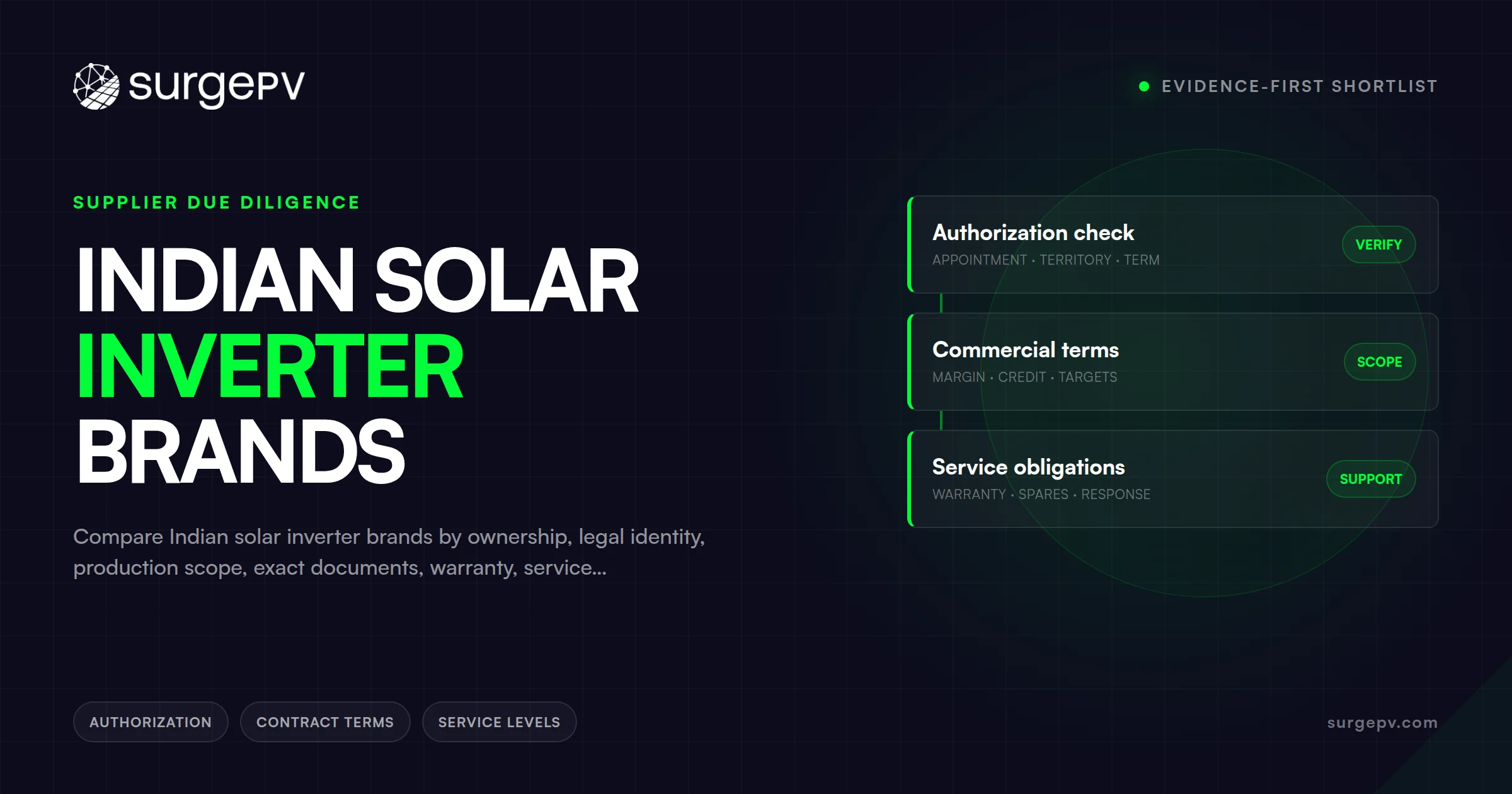
Quick Answer
There is no defensible single best Indian solar inverter brand from public evidence alone. Start with a document-available shortlist, then compare exact models. Verify ownership, legal seller, design and production scope separately. Require electrical fit, current certificates, warranty remedy, local service, firmware, monitoring, traceability, and complete bid scope before approval.
There is no defensible single winner among Indian solar inverter brands from public web evidence alone. Brand nationality also does not describe one technical fact. A brand can be Indian-owned, registered in India, engineered locally, assembled locally, manufactured locally, or supplied as an import.
A buyer should first create a document-available shortlist. The buyer must then approve an exact model, legal supplier, warranty obligor, and service route. The final choice should pass electrical, compliance, environmental, controls, monitoring, firmware, traceability, warranty, and bid-scope gates.
This review found useful starting documents for Qbits, Statcon Energiaa, UTL Solar under Fujiyama Power Systems Limited, and Servotech. Their inclusion is not a quality rank. It does not prove project acceptance, local content, reliability, or superior service.
Direct answer
Do not ask which Indian brand is best until topology and project limits are fixed. Build a provisional shortlist from official documents. Then compare exact models under one evidence request and one bid template. Reject any candidate that fails a mandatory gate, even if its brand story is strong.
Commercial relationship disclosure
SurgePV and Qbits Energy share ownership. Qbits links in this article are sponsored. We did not buy or independently laboratory-test these products. Qbits receives no automatic first position and must pass the same gates as every other candidate.
Key takeaways
- Separate brand ownership, company registration, engineering, assembly, manufacture, and import status.
- Compare an exact model and revision, not a brand name or catalogue family.
- Treat public brand documents as starting evidence, not independent proof.
- Use BIS and MNRE sources only within their stated scope.
- ALMM concerns solar PV modules and cells, not an inverter brand list.
- Separate warranty duration from the remedy that restores the plant.
- Keep Indian and international candidates when both meet project and policy rules.
What Does Indian Solar Inverter Brand Mean?
Procurement teams often use one phrase for several different relationships. That ambiguity creates weak tender language and unsupported origin claims. Define the required status before asking a bidder to prove it.
| Term | Precise buyer meaning | Evidence to request | What the term does not prove |
|---|---|---|---|
| Indian-owned brand | The ownership chain or controlling interest meets the buyer’s defined Indian-ownership rule | Current corporate records, ownership declaration, and beneficial ownership evidence where applicable | Factory location, local production, model quality, or service performance |
| India-registered company | The contracting entity is legally registered in India | Legal name, corporate registration, GST details, registered address, and authorised signatory | Indian ownership, product origin, factory activity, or warranty capacity |
| Engineered in India | Defined design work for the exact product occurs in India | Engineering entity, scope statement, drawings or change records, firmware responsibility, and design authority | Local component production or final assembly |
| Assembled in India | Defined parts or subassemblies are joined locally | Factory address, process map, work instructions, production records, and label traceability | Local design, local component origin, or full manufacture |
| Manufactured in India | The supplier declares a defined local production scope under a stated legal manufacturer | Factory and legal identity, exact process scope, incoming controls, production records, tests, labels, and contractual origin statement | Complete local content or local origin for every component |
| Imported product | The finished unit or a declared production stage comes from outside India | Importer identity, country of origin, customs and label records, warranty chain, and local service responsibility | Poor quality, weak support, or project rejection |
The first lesson is simple. These categories can overlap, but they are not interchangeable. An India-registered seller can supply imported equipment. A locally assembled inverter can include imported power modules, control boards, or enclosures.
Do not invent a localisation percentage from a factory address or marketing page. Ask the supplier to define each local process. Record excluded processes too. For higher-value orders, make the origin declaration contractual and subject to inspection.
The solar inverter manufacturer due-diligence guide goes deeper into factory and production checks. This article stays focused on building and testing a brand shortlist.
Published Method and Pass Gates
This is a procurement method, not a laboratory ranking. We reviewed public primary sources on 10 August 2026. We did not inspect factories, audit service records, validate ownership chains, or measure inverter performance.
A candidate enters the provisional shortlist only when its official site provides two starting items:
- An identifiable company or brand relationship.
- A current product-family page, exact-model page, manual, or datasheet.
That admission rule is intentionally modest. It shows that a buyer can begin a structured request. It does not approve the brand or any model.
Project approval has mandatory pass gates. A failure cannot be repaired by a high feature count, a long brand history, or a low quote.
| Gate | Pass condition | Typical evidence | Decision if missing |
|---|---|---|---|
| Use case | Topology and operating objective are defined | On-grid, hybrid, or off-grid operating narrative | Stop comparison |
| Electrical fit | Exact model fits phase, voltage, current, strings, MPPTs, and power limits | Signed string calculation, exact datasheets, and single-line diagram | Reject model |
| Grid or battery fit | Grid functions or exact battery integration match the design | Current grid evidence or supported battery, BMS, firmware, and mode matrix | Reject model |
| Compliance | Applicable evidence matches legal entity, model, standard, scope, and status | Official portal check, certificate, report, and label | Hold or reject |
| Environment | Site temperature, enclosure, clearances, altitude, and exposure remain within limits | Manual, derating curves, installation details, and site conditions | Redesign or reject |
| Warranty | Current terms identify obligor, remedy, exclusions, costs, and registration | Full warranty, invoice chain, commissioning record, and service process | Hold order |
| Service | Territory, diagnosis, parts, escalation, and response milestones are written | Named contacts, service agreement, spare plan, and comparable references | Reprice risk or reject |
| Monitoring and firmware | Account control, data access, updates, export, and lifecycle route are defined | Manual, portal terms, firmware policy, and handover procedure | Hold approval |
| Traceability | Delivered unit can be matched to approved documents and revisions | Serial, label, invoice, certificate scope, firmware, and inspection record | Reject delivery |
| Commercial scope | All bidders price the same equipment, accessories, services, and risks | Normalised schedule and deviation register | Rebid |
Use the best solar inverter in India method when topology is still unresolved. Use the on-grid versus hybrid guide when outage backup changes the architecture.
What BIS, MNRE, CEA, and DISCOM Evidence Can Prove
Government sources are essential, but each has a boundary. Using an official logo outside that boundary creates false confidence.
The BIS Scheme II page publishes registration categories and links to official verification routes. A buyer should match the current requirement to the exact product and rating. The legal entity, model, standard, registration status, scope, label, and supplied revision must agree.
A screenshot, copied certificate, or bidder spreadsheet is not enough. Check the current record through the official BIS portal links. Preserve the dated check in the procurement file.
The BIS laboratory search for IS 16221 helps identify test capability. A laboratory entry is not a product approval. It also does not establish brand ownership, factory location, reliability, warranty execution, or project fit.
MNRE maintains standards and quality-control documents. Read the current notice that applies to the project date, scheme, equipment, and capacity. Do not rely on a summary copied into an old tender.
The MNRE ALMM page describes lists for solar photovoltaic modules and cells. ALMM is not an approved list of inverter brands. An ALMM module entry does not approve the connected inverter.
Grid-connected projects must also account for the CEA safety and electric supply regulations. The applicable DISCOM process, scheme conditions, tender specifications, and approval letters remain separate. Confirm all of them before procurement.
Provisional Evidence-Status Shortlist
The table below records what was publicly available during this review. It does not score product performance. “Not established” means the reviewed public material was insufficient for that claim.
| Candidate | Public starting evidence | Legal or brand relationship observed | Origin status established here | Missing before project approval |
|---|---|---|---|---|
| Qbits Energy | India-facing product page and document library | Brand site identified | Ownership nationality and exact production scope not established | Exact-model compliance, current warranty, legal obligor, service territory, firmware, traceability, and origin records |
| Statcon Energiaa | Dated X-series on-grid datasheet and warranty information | Company name appears on official documents | Exact design, assembly, manufacture, and component origin not established | Exact-model certificate, current quoted warranty, legal obligor, service coverage, firmware, and delivery traceability |
| UTL Solar | Official brand site, Fujiyama relationship statement, and exact-model page | Official site states UTL Solar is a brand of Fujiyama Power Systems Limited | Exact model production location and scope not established | Current model-specific certificate, warranty remedy, service territory, firmware, origin, and serial evidence |
| Servotech | Corporate identity, on-grid product page, catalogue, and published plant address | Official site identifies Servotech Renewable Power System Limited | Plant address does not prove exact-model production scope | Exact-model production evidence, certificate, warranty remedy, service territory, firmware, and traceability |
Why are familiar names absent? This review did not award places from memory, reseller pages, marketplace listings, listicles, or unverified brand claims. A bidder can add another Indian or international candidate by supplying the same evidence package.
The shortlist is therefore open and reversible. A candidate leaves when its exact model fails a gate. A new candidate enters when its official evidence meets the admission rule.
Qbits Energy: Related-Party Candidate
Qbits has an on-grid inverter product page and a public document library.
Qbits Inverters Limited is a subsidiary of Heaven Green Energy Limited, which its About page dates to 2016 as a Gujarat solar EPC business, with the Qbits inverter brand launched in 2022. It operates from 201, Anupam Square, Mahadev Chowk, Mota Varachha, Surat, Gujarat 394101. Its on-grid catalogue spans single-phase QB TLS families from 1.5 kW through three-phase QB TLC families to 125 kW, plus QB 225/320K-EHV units, with hybrid families from 3 kW to 12 kW. It states BIS certification under IS 16221, IEC 62109 and IEC 62116, and ISO 9001:2015, and publishes a 12-year warranty for inverters up to 30 kW and 8 years above 30 kW. Company-published scale figures are 50,000+ installations, 130+ channel partners and 33 states and union territories served.
Those are first-party statements taken from Qbits’ own pages. They make an evidence request easier and they establish a real published specification set. They do not independently validate performance, factory scope, warranty outcomes, service outcomes, or a universal rank.
SurgePV and Qbits share ownership. This commercial connection makes disclosure and equal treatment necessary. Qbits should not be placed first unless its exact candidate provides stronger comparable evidence for the defined project.
Request the same model schedule, certificates, warranty, monitoring terms, service route, firmware policy, serial controls, and deviation sheet from Qbits. Reject or hold its candidate under the same rule used for every other bidder.
Public brand material should be labelled first-party in the decision file. A marketing statement can identify a claim for verification. It cannot replace independent testing or contractual responsibility.
Statcon Energiaa: Documented Product-Family Starting Point
Statcon Energiaa publishes a dated X-series on-grid inverter datasheet. It also publishes warranty and AMC information on its official site.
This is enough to begin model mapping and commercial clarification. It is not enough to approve a quoted unit. Product-family material can include several ratings, options, or revisions. The procurement team must identify the exact suffix, firmware, accessories, and supported controls.
Ask which legal entity sells and warrants the equipment. Obtain current terms tied to the order. Confirm certificate status, service territory, diagnosis path, spare availability, labour and freight treatment, and the route for discontinued models.
Do not infer local manufacture from a company name or product document. Request a separate origin and production-scope declaration when that criterion matters.
UTL Solar and Fujiyama: Brand Relationship Starting Point
The official UTL brand site identifies UTL Solar as a brand of Fujiyama Power Systems Limited. Its 5 kW on-grid model page provides an exact-model starting point.
That brand relationship is more precise than calling UTL merely an Indian name. It still does not prove where every model was engineered, assembled, or manufactured. It also does not establish the origin of components.
Website warranty messages and older manual terms can differ by model, purchase date, registration, and channel. Require the current full warranty in the bid. Identify the legal obligor, replacement route, exclusions, freight, labour, travel, and commissioning requirements.
Confirm the authorised seller and service path directly. A dealer listing or marketplace offer should not define technical scope or warranty responsibility.
Servotech: Corporate and Plant Evidence Starting Point
The Servotech corporate site identifies Servotech Renewable Power System Limited and publishes company addresses. It also provides an on-grid inverter page and product catalogue.
Corporate identity and a plant address improve legal traceability. They do not prove that the quoted exact model was designed, assembled, manufactured, or tested at that plant. A buyer must match the production claim to the exact model and revision.
Ask for the process scope, outsourced stages, label, serial format, final-test record, applicable certificate, firmware, warranty terms, and service territory. Keep any origin statement separate from the technical model comparison.
A listed company status or exchange symbol can support identity checks. It does not replace project evidence or predict warranty execution.
Compare Exact Models, Not Brand Headlines
Once candidates pass the initial document gate, issue one technical schedule. Do not let each bidder substitute its favourite marketing fields. Empty cells should remain visible as open deviations.
| Comparison field | Required entry | Buyer check |
|---|---|---|
| Exact identity | Brand, legal supplier, model, suffix, revision, and firmware | Match every document and delivered label |
| Architecture | On-grid, hybrid, or off-grid and supported modes | Match the operating objective and single-line diagram |
| AC interface | Rated power, phase, voltage, frequency, current, and connection | Match PCC, transformer, protection, and utility conditions |
| DC window | Maximum voltage, start voltage, MPPT window, current, and short-circuit limits | Check cold voltage, hot voltage, string current, and all MPPT allocations |
| Environmental limits | Enclosure, temperature, derating, altitude, humidity, clearances, and location | Compare with actual roof or plant conditions |
| Grid controls | Anti-islanding, voltage and frequency response, power factor, reactive power, and export controls | Match current project and DISCOM requirements |
| Storage controls | Battery model, voltage, current, BMS protocol, firmware, transfer behavior, and modes | Require exact supported combinations |
| Monitoring | Logger, communications, portal, account ownership, export, alerts, retention, and access | Test before handover |
| Compliance | Standard, certificate, holder, model scope, status, report, and label | Verify through official sources |
| Warranty | Duration, start, registration, obligor, remedy, exclusions, labour, travel, freight, and serial rules | Price uncovered exposure |
| Service | Territory, diagnostic capability, escalation, replacement stock, spares, and discontinued-model route | Call contacts and check references |
| Commercial scope | Accessories, meters, loggers, protections, commissioning, travel, training, taxes, and delivery | Normalise total scope |
Use the solar inverter sizing guide for the base power and string workflow. The dual MPPT inverter guide helps when roof orientations or string conditions differ. For commercial projects, see the three-phase commercial inverter guide.
Peak efficiency should not lead the comparison. First confirm that the value uses the same definition and exact model. Then review weighted efficiency and operating range. A small headline difference cannot repair an electrical mismatch or unclear warranty.
Warranty, Service, Firmware, and Monitoring
Warranty years are one field. Restoration responsibility is the buyer’s real exposure.
Ask whether the remedy is repair, replacement, refurbished exchange, parts supply, or a credit. Identify who removes, ships, reinstalls, configures, and recommissions the unit. State who pays labour, freight, travel, scaffolding, crane access, and generation loss.
Record the warranty start event. It might be invoice, dispatch, installation, commissioning, or portal registration. Keep serial, invoice, installer, commissioning, and registration evidence together.
Service evidence should include named contacts and territory. Ask who can diagnose faults, approve warranty action, hold spares, update firmware, and restore portal access. Confirm escalation milestones in writing. Do not convert a partner directory into a response-time promise.
Firmware can change supported functions and battery compatibility. Record the approved version at commissioning. Define who may update it, how release notes are assessed, and how settings are backed up.
Monitoring handover needs an owner account, user roles, alert routing, communication hardware, data export, retention, privacy terms, and an offline procedure. Test account recovery before project closure. An app screenshot is not a monitoring acceptance test.
The solar inverter warranty guide provides a clause-by-clause review. The mobile monitoring guide covers portal and alert checks.
Bid Normalisation Sheet
A low inverter line price can exclude items that another bid includes. Compare a complete installed and supportable scope.
Create one row for each accessory and service. Include data loggers, energy meters, current transformers, communications devices, and export-control equipment. Add connectors, protection interfaces, mounting parts, commissioning, grid settings, training, travel, freight, taxes, monitoring subscriptions, extended warranties, and recommended spares.
| Bid control | Bidder response | Procurement action |
|---|---|---|
| Exact model locked | State model, suffix, revision, firmware, and permitted substitution | Reject silent substitution |
| Quantity and delivery | State units, split delivery, lead time, packing, and storage limits | Link payment to inspection |
| Included hardware | List every supplied accessory and cable | Price all missing items |
| Included work | State commissioning, settings, portal setup, training, and documentation | Assign responsibility |
| Warranty scope | Attach full terms and name obligor | Price exclusions and access costs |
| Service scope | State territory, escalation, parts, travel, and milestones | Add enforceable obligations |
| Compliance pack | Attach exact-model current evidence | Hold approval until verified |
| Deviations | List every technical and commercial exception | Treat silence as no deviation only if contract says so |
| Change control | Require written approval before model, hardware, firmware, or certificate change | Reject unapproved delivery |
Do not compare only rupees per watt. The solar inverter price guide explains why capacity, topology, accessories, service, and tax scope change quotes.
Documentary Acceptance Test
Convert the shortlist into a repeatable acceptance test. Run it before the purchase order and again at delivery.
Before commercial selection
- Freeze the system topology, PCC, phase, module schedule, string design, and operating modes.
- Issue the exact-model technical schedule and origin definitions.
- Receive certificates, manuals, warranty terms, service route, and monitoring terms.
- Check certificate status through the relevant official source.
- Reconcile model names, suffixes, ratings, legal entities, and document revisions.
- Record every missing item and deviation.
- Contact named service resources and two comparable references where material.
- Normalise price and responsibility before scoring.
At delivery
- Photograph carton and inverter labels before installation.
- Match legal entity, model, suffix, serial, rating, and origin declaration.
- Check seals, damage, accessories, manuals, and communication devices.
- Confirm that approved certificates and warranty cover the delivered identity.
- Record firmware and hardware revisions.
- Quarantine any substituted or unmatched unit.
At commissioning and handover
- Record insulation, polarity, voltage, current, phase, protection, and grid checks.
- Apply approved settings and preserve the settings record.
- Test normal operation, shutdown, restart, alarms, controls, and required modes.
- Complete monitoring ownership, user access, alerts, and data export.
- Register warranty and preserve confirmation.
- Handover serials, reports, credentials, contacts, spares, and escalation steps.
For larger orders, add witnessed factory or batch tests. Define sampling, instruments, tolerances, records, and rejection rules before production. A factory visit without a written test plan produces little comparable evidence.
Indian and International Brands Can Share the Shortlist
An Indian-origin preference can serve policy, local procurement, lead-time, or industrial objectives. Those objectives should be written and weighted transparently. They should not be treated as proof of electrical quality or service performance.
Imported equipment is not automatically weaker. An international brand can offer a better exact model, stronger project evidence, or a clearer local remedy. It can also create risks involving importer continuity, spares, firmware access, data hosting, or currency exposure.
Apply the same gates to both groups. Identify the local seller, importer where relevant, warranty obligor, service party, parts route, and data controller. The candidate with the clearest responsibility chain may be safer than one with a stronger nationality story.
Policy rules can override a technically suitable option. Check scheme, lender, insurer, tender, client, and DISCOM conditions early. Do not discover an eligibility conflict after equipment is ordered.
Page Boundary and Related Buying Guides
This article owns the evidence-based Indian brand shortlist and origin vocabulary. Related pages answer different questions:
- Best solar inverter in India selects topology and exact-model criteria.
- Solar inverter manufacturer in India audits factory and production claims.
- Solar inverter distributor in India checks channel authority and commercial custody.
- Best on-grid inverter in India focuses on grid-tied model selection.
- Best hybrid inverter in India focuses on battery, BMS, backup, and operating modes.
- Solar inverter price in India normalises quote and lifecycle scope.
Keeping these decisions separate prevents one page from claiming universal rank. It also gives the procurement team a clear evidence owner for each decision.
Where SurgePV Fits
SurgePV is solar design software, not an inverter certification body, manufacturer auditor, or warranty guarantor. It can support a consistent design record before bidders are compared.
Use the solar designing workflow to record layout, equipment, strings, and electrical assumptions. Use solar proposal generation to keep customer-facing scope aligned with the approved design and quote.
Software output does not prove certificate validity, origin, service capability, or warranty performance. Those checks remain with the buyer, designer, installer, authority, and contracting parties.
Final Selection Record
The final decision file should make later review easy. Preserve the dated requirement, candidate versions, official checks, calculations, deviations, score rationale, approval, contract attachments, delivery inspection, commissioning results, monitoring handover, and warranty registration.
Do not name a universal best brand. Name the selected exact model for a defined project and explain why it passed. Also record residual risks and the person responsible for each control.
Reopen the decision if the bidder changes the model, revision, firmware, certificate, legal supplier, warranty, service party, or delivery route. A brand-level approval should never permit an undisclosed substitution.
Frequently Asked Questions
Which Indian solar inverter brand is best?
No single brand is best for every Indian project, and current public evidence does not support a universal winner. Compare exact compatible models after topology, electrical fit, compliance, warranty remedy, local service, monitoring, firmware, traceability, and bid scope are defined.
Does an Indian inverter brand mean the inverter is made in India?
No. An Indian brand may be Indian-owned, India-registered, locally engineered, locally assembled, locally manufactured, or based on imported equipment. Ask the bidder to state each role and support it with exact legal, factory, label, production, and supply records.
How can I verify whether an inverter is manufactured or assembled in India?
Request the legal manufacturer, factory address, exact model label, declared production steps, outsourced processes, bill of materials controls, serial traceability, test records, and contractual origin declaration. A brand name, office address, plant photo, or country slogan is not enough.
Is a BIS listing a ranking of Indian inverter brands?
No. BIS sources support standards, registration, and laboratory verification within their stated scope. They do not rank brands or prove ownership, local manufacture, reliability, service quality, warranty execution, or project compatibility.
Is ALMM an approved list of solar inverter brands?
No. MNRE describes ALMM lists for solar photovoltaic modules and cells. Do not use ALMM as an inverter brand list or inverter approval. Check the current inverter requirements, CEA rules, DISCOM process, scheme terms, and tender documents separately.
Which brands have enough public documents to begin due diligence?
This review found usable first-party starting documents for Qbits, Statcon Energiaa, UTL Solar under Fujiyama Power Systems Limited, and Servotech. That is a provisional document shortlist, not a quality rank or project approval. Other brands may qualify when bidders provide comparable evidence.
Why is Qbits included, and what is the relationship with SurgePV?
Qbits publishes an India-facing product page and document library, so it meets the same initial document gate used for other candidates. SurgePV and Qbits share ownership. Qbits links are sponsored, its claims are first-party, and it receives no automatic first rank.
What documents should I receive before ordering a solar inverter?
Obtain the exact model datasheet, manual, current applicable certificates, warranty terms, legal seller and obligor, serial rules, monitoring and data terms, and firmware policy. Also require the accessory list, service route, spare plan, testing requirements, delivery inspection, and change-control commitment.
Can an imported solar inverter be a better choice than an Indian brand?
Yes. An imported model can be the better choice when it offers stronger electrical fit, applicable evidence, local remedy, monitoring, firmware support, spares, and commercial terms. Local origin can be a valid policy or procurement factor, but it does not replace model-level engineering and support checks.
Sources
Primary research and reference material used for this desk-research article.
Where this fits
This article is part of SurgePV's Solar Technology hub, which works through the topic from first principles to the decisions a project team actually has to make.