

Quick Answer
Win commercial solar bids by qualifying hard (bid only where you have a relationship, differentiation, or incumbency), pricing from bottom-up costs with a margin floor, and submitting a compliant, scannable response that makes evaluation easy. Top teams win 40%+ by bidding less and preparing more per bid.
Most commercial solar EPCs lose 4 out of 5 bids, and the autopsy usually says “price.” The autopsy is usually wrong. Deals are lost earlier — at the decision to bid a deal you had no relationship in, with a generic response, against an incumbent the customer already trusted. Bid-winning is a qualification and preparation discipline; price is just where the loss becomes visible.
This guide is the bid system we have used across 300+ C&I pursuits: bid/no-bid qualification, pricing strategy, the response structure evaluators reward, and the differentiation that survives procurement. For the committee-mapping and post-submission side, pair this with our closing commercial solar deals playbook.
Quick Answer
Win commercial solar bids by qualifying hard (bid only where you have a relationship, differentiation, or incumbency), pricing from bottom-up costs with a margin floor, and submitting a compliant, scannable response that makes evaluation easy. Top teams win 40%+ by bidding less and preparing more per bid.
TL;DR — Winning C&I Bids
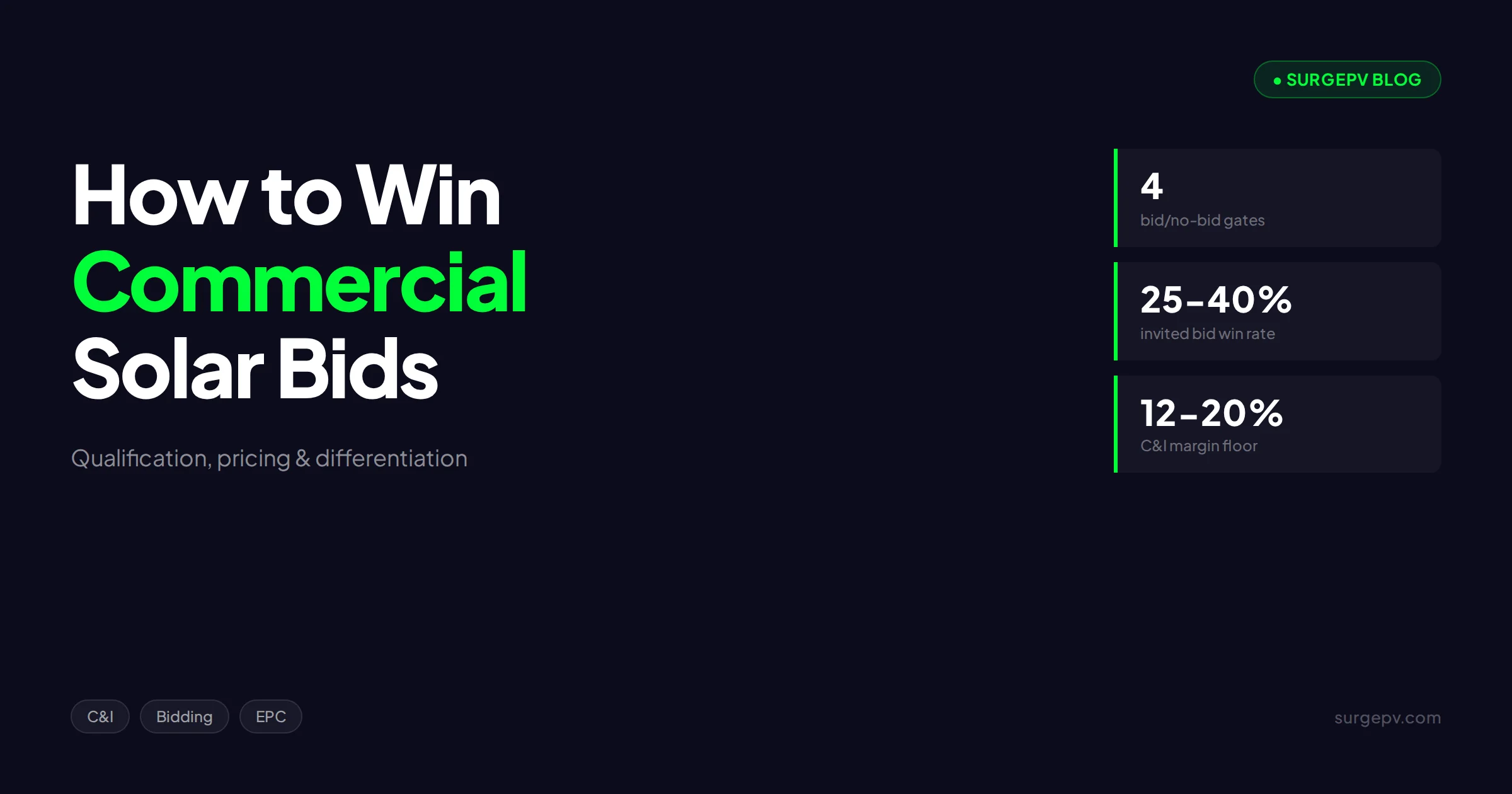
Win rates: 5–15% cold tenders, 25–40% invited bids, 50%+ sole-source. The 4-gate qualification: relationship, differentiation, capability, cash. Price bottom-up with 12–20% GM floor. Response anatomy: compliance matrix, CFO executive summary, P50 model with stated assumptions, references, delivery plan. No-bid early and often.
In this guide:
- The math of bid pipelines
- The 4-gate bid/no-bid qualification
- Pricing strategy for competitive bids
- The response structure evaluators reward
- Differentiation that survives procurement
- BAFO and negotiation
- Building the bid library
The Math of Bid Pipelines
Bid economics are unforgiving. A serious C&I response costs 20–80 hours across engineering, sales, and management. At a 10% win rate, you spend 200–800 hours per win. At 30%, that drops to 70–270 hours. Qualification is the single biggest lever on bid profitability — bigger than pricing skill, bigger than proposal quality.
Set a pipeline coverage target from your win rate: at a 25% win rate and a 2-project monthly install capacity, you need roughly 8 qualified bids in play per month. The word that matters is qualified — 8 cold tenders at 10% is a different business than 8 invited bids at 35%.
The 4-Gate Bid/No-Bid Qualification
Run every opportunity through 4 gates. Failing 2 or more is a no-bid:
Gate 1: Relationship. Do we know the decision-makers, and have they seen our work? Cold responses to public portals win at 5–15%; relationships double or triple that. No relationship plus no time to build one before submission is usually a pass.
Gate 2: Differentiation. Can we offer something the likely field cannot — a site-specific design insight, financing structure, delivery speed, or warranty package? If the spec reads like it was written around a competitor’s product (it often was), your differentiator is being the compliance benchmark they use to negotiate. Bid accordingly — or not at all.
Gate 3: Capability. Can we actually deliver — team capacity, equipment supply, licensing in that jurisdiction, bonding if required? Winning a bid you cannot execute is worse than losing it.
Gate 4: Cash. Do the payment terms fit working capital? A 500 kW win with net-60 milestones and 10% retainage can consume more cash than the margin it generates. Run the cash curve before the price.
Score each gate red/amber/green in a 20-minute bid meeting. Two reds: no-bid, and move the hours to a winnable deal.
Pricing Strategy for Competitive Bids
Price from your cost build, never from the rumored competitor number:
- Bottom-up cost: equipment at current supplier quotes (validity-checked against the bid timeline), labor from your productivity benchmarks, indirects, overhead, and a risk allowance for escalation and schedule.
- Margin floor: 12–20% gross margin for competitive C&I, set in writing before the bid meeting. Below the floor, the bid needs owner approval — and a reason better than “we want the logo.”
- Value levers instead of price cuts: production guarantee structures, extended warranties, O&M bundling, faster delivery, financing options via PPA structures. Each lever differentiates without donating margin.
The discipline that pays: price every bid as if you will win it. Teams that price to “get in the conversation” win exactly the deals they cannot afford.
The Response Structure Evaluators Reward
Evaluators score against a matrix, often with junior staff doing the first pass. Make their job easy:
- Compliance matrix — a table mapping every RFP requirement to the page where you answer it. This alone puts you in the top quartile of submissions.
- Executive summary (1 page) — for the CFO: investment, year-1 savings, NPV, IRR, payback, and your 2 genuine differentiators. Everything else supports these numbers.
- Technical response — design, production model (P50 with assumptions stated), equipment datasheets, single-line diagram. A design platform with shadow analysis and a financial engine produces this package from one model instead of 4 spreadsheets — which also means the numbers agree with each other, a credibility point evaluators notice.
- Delivery plan — timeline from award to PTO with permitting and interconnection milestones, crew plan, safety plan.
- References — 3 comparable projects with system size, production versus estimate, and a contactable referee.
- Commercial response — price in the requested format, payment terms, warranties, validity.
Format note: follow the requested structure exactly, even when it is badly designed. Deviating from the requested format is scored as non-compliance, not creativity.
Bid With Models That Survive Procurement Diligence
SurgePV produces the design, shading analysis, and financial model behind your bid from one workspace — consistent, documented, and fast.
Book a DemoNo commitment required · 20 minutes · Live project walkthrough
Differentiation That Survives Procurement
Procurement strips claims down to verifiable facts. The differentiators that survive:
- Site-specific design intelligence. Show up having already modeled their roof or land — shading, layout, production — before the RFP asked. A preliminary design in the response demonstrates both capability and hunger.
- Production accountability. A modeled P50 with stated assumptions, plus reference data showing your estimates versus actuals on past projects. Few bidders show their accuracy; the ones who do get believed.
- Delivery certainty. A realistic timeline with the permitting path mapped beats an aggressive timeline everyone discounts.
- Financial flexibility. Cash, PPA, and lease structures in the same response let the committee choose its constraint — capex, opex, or balance sheet.
What does not survive: “industry-leading,” “world-class team,” and any adjective without a number attached.
BAFO and Negotiation
Shortlisted bidders typically face a best-and-final-offer (BAFO) round. The rules:
- Hold something back. If round 1 is your absolute floor, BAFO forces you below it. Keep 2–4% of structured room — value levers first, price last.
- Trade, never concede. Every concession exchanges for something: signature date, payment terms, scope adjustment, reference rights.
- Protect the floor. BAFO pressure is where margin floors die. The walk-away number decided in the calm of the bid meeting governs in the heat of negotiation.
Building the Bid Library
Win rate compounds when each bid makes the next one cheaper. Maintain a bid library: boilerplate company qualifications, safety stats, reference sheets, equipment datasheets, past compliance matrices, and template financial models. A maintained library cuts response time 40–60% — which is what makes bidding selectively possible, because each qualified bid costs less to pursue.
Review every loss with a 30-minute debrief: which gate was misjudged, what the winner offered, what the evaluator feedback said. Losses are tuition; the library and the debrief are how you collect on it.
Finding Bid Opportunities Before They Find You
The best bid pipelines are built, not subscribed to. Sources ranked by win rate:
- Your installed base — existing customers expanding, adding sites, or adding storage. Highest win rate in existence.
- Referrals from architects, electrical engineers, and energy consultants who write the early feasibility work. Being their recommended EPC means you see opportunities before they become tenders.
- Direct outreach with preliminary design — modeling a prospect’s facility from satellite data and leading with the numbers. This is the C&I version of cold calling that works, because a specific proposal is not a cold call.
- Invited bid lists — getting on the preferred-vendor lists of corporates, property managers, and ESCOs. Once on, opportunities recur.
- Public tender portals — necessary for public-sector work, but treat as opportunistic volume, not the pipeline backbone.
The pattern: 4 of the 5 best sources are relationships you build between bids, not documents you download. Our guide on getting and converting solar leads covers the C&I channel differences in more depth.
Pre-Bid Intelligence: The Work Before the Document
When an RFP lands from an account you have cultivated, you should already know: the decision criteria (price-weighted or value-weighted), the evaluation committee’s composition, the incumbent’s weaknesses if any, the site’s real constraints (roof condition, load profile, expansion plans), and the budget source. Every one of these is discoverable through relationship work in the months before the tender.
This is why top bidders seem to win “unwinnable” tenders: by the time the document is published, the qualification gates were passed months earlier, and the response is written to criteria the customer told them about directly. The RFP is the conclusion of the sales process, not the start of it. If you are reading the requirements for the first time, you are the compliance benchmark, not the frontrunner.
What Most EPCs Get Wrong
The dominant error is treating every RFP as an opportunity. RFPs are distributions: a few are yours to win, most are written for someone else, and some are pure price-discovery exercises where the customer never intends to switch. Bid-team hours spent on unwinnable deals are stolen from winnable ones.
Second: assuming lowest price wins. Most private C&I evaluations weight credibility, delivery certainty, and financial value — the committee’s career risk of a failed project outweighs 3% of capex. Win on certainty; price within the competitive band.
The exception: commodity public tenders with strict lowest-compliant-bid rules. There, price genuinely decides — and the correct strategic response is usually to not bid, unless your cost structure is genuinely the lowest.
Conclusion
Commercial bid-winning is qualification discipline plus preparation depth. Three actions this week:
- Score your live opportunities against the 4 gates — and no-bid the double-reds today.
- Write your margin floor for competitive bids and the exception-approval rule.
- Start the bid library: boilerplate, references, compliance matrix template.
For the committee and post-submission playbook, read closing commercial solar deals. To produce bid-grade designs and financial models fast, book a SurgePV demo. Related: solar tender and RFP guide and the commercial solar sales cycle.
Frequently Asked Questions
How do you win a commercial solar bid?
Qualify before you bid: pursue only opportunities where you have a customer relationship, a genuine technical or financial differentiator, or incumbency. Then submit a fully compliant response, priced from your bottom-up cost build, with an executive summary written for the CFO. Most bids are lost at qualification, not at evaluation.
What win rate should a commercial solar EPC expect?
Industry-observed win rates: 5–15% on cold public tenders, 25–40% on invited competitive bids where you have a relationship, and 50%+ on negotiated sole-source work. If your blended win rate is below 15%, the problem is qualification — you are bidding deals you were never going to win.
How do you price a commercial solar bid?
Bottom-up: equipment at current quotes, labor from productivity benchmarks, indirects, overhead, risk allowance for schedule and escalation, then margin on top — 12–20% gross margin for competitive C&I. Never price to the rumored competitor number; price to your cost and differentiate on value.
What makes a commercial solar proposal stand out?
Evaluators reward: 100% compliance with the requested format, a 1-page executive summary with NPV and payback, verifiable production modeling (P50 with assumptions), reference projects with real numbers, and a credible delivery plan. Flashy design loses to scannable compliance every time.
When should you walk away from a commercial solar bid?
Walk when you have no relationship and the spec mirrors a competitor’s product, when the timeline forces unengineering shortcuts, when payment terms exceed your working capital, or when the price pressure implies margins below your floor. A disciplined no-bid protects margin and bid-team capacity.
How long does a commercial solar bid process take?
From RFP issue to award: 4–12 weeks for private C&I, 3–9 months for public tenders, plus BAFO (best and final offer) rounds. Plan bid effort accordingly — a serious C&I response costs 20–80 hours of engineering and sales time.
Where this fits
This article is part of SurgePV's Solar Sales & Proposals hub, which works through the topic from first principles to the decisions a project team actually has to make.


