

Quick Answer
Respond to a solar tender by building a compliance matrix of every requirement, assembling mandatory documents (licenses, financials, bonds) first, answering in the exact requested format, and submitting early. Most bids are rejected for formal non-compliance — missing documents, wrong format, late submission — not for technical weakness.
Solar tenders are won twice: once in the evaluation, and once in the mailroom. More bids die from a missing signature page, an expired registration, or a submission 20 minutes late than from weak engineering. Formal compliance is unglamorous — and it is the difference between EPCs that treat tenders as a revenue channel and those that treat them as a recurring administrative disaster.
This guide covers the mechanics of responding properly: tender document anatomy, the compliance matrix method, mandatory document logistics, bid bonds and guarantees, public versus private rules, and submission discipline. For bid strategy — which tenders to pursue and how to price — read our companion guides on winning commercial solar bids and closing commercial solar deals.
Quick Answer
Respond to a solar tender by building a compliance matrix of every requirement, assembling mandatory documents (licenses, financials, bonds) first, answering in the exact requested format, and submitting early. Most bids are rejected for formal non-compliance — missing documents, wrong format, late submission — not for technical weakness.
TL;DR — Tender Response Mechanics
Day 1: bid/no-bid decision, then compliance matrix. Mandatory documents (licenses, financials, EMD/bid bond) take longer than the technical response — start them first. Answer in the requested format exactly; deviations get scored as non-compliance. Submit 24–48 hours early. Public tenders: lowest compliant or weighted scoring; the criteria are in the document — write to them.
In this guide:
- Tender document anatomy: where the rules live
- The compliance matrix method
- Mandatory documents and the logistics trap
- Bid bonds, EMDs, and performance guarantees
- Public vs private tenders: different games
- The technical response that scores
- Submission discipline
- After submission: clarifications, BAFO, award
Tender Document Anatomy: Where the Rules Live
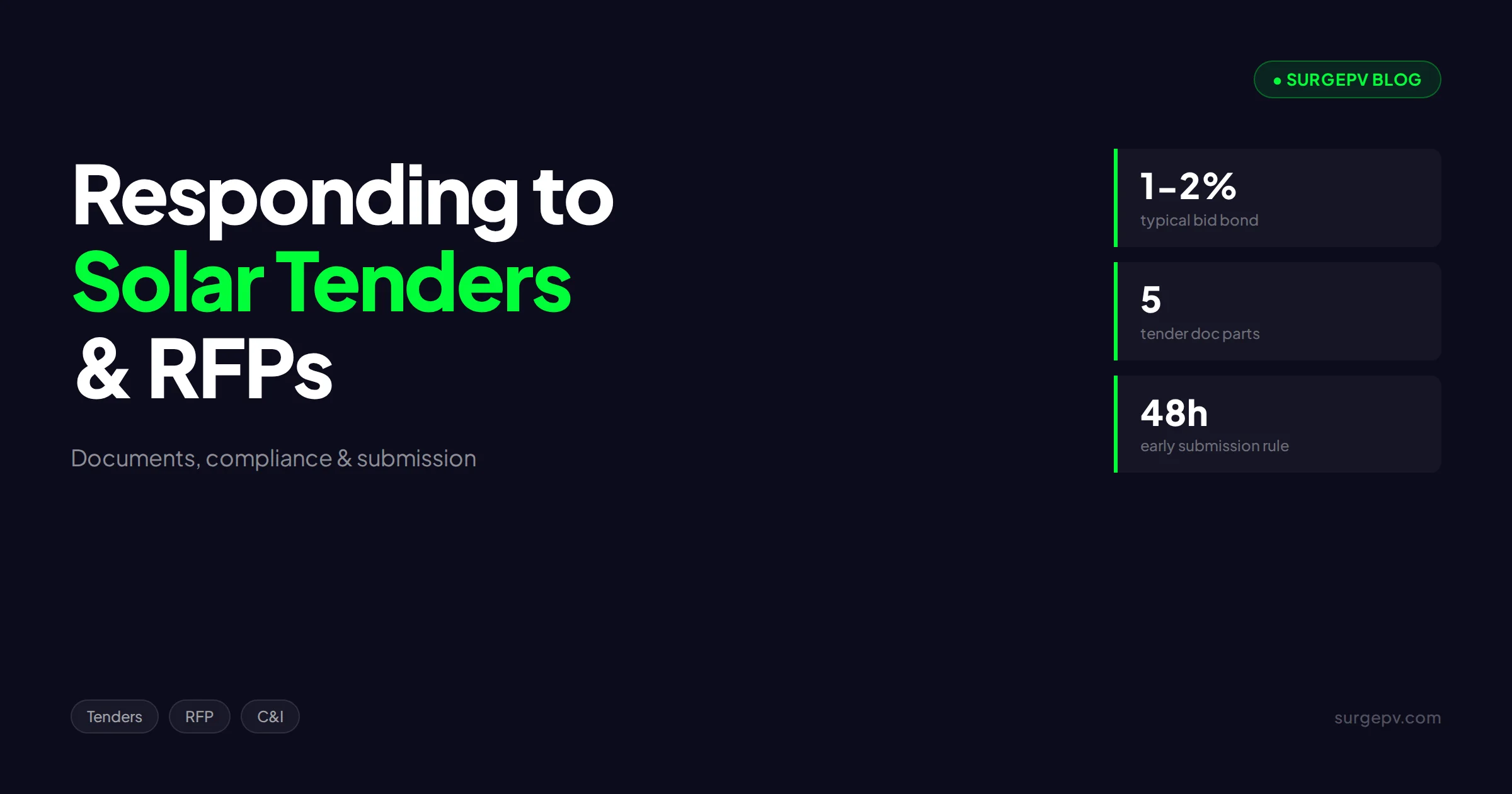
A solar tender document (RFP, RFQ, or ITT — invitation to tender) has 5 functional parts, and they are not in the same order across issuers:
- Instructions to bidders — submission format, deadline, language, bonding, and the disqualification rules. Read this first; it decides whether you can bid at all.
- Eligibility/qualification criteria — minimum turnover, licenses, past project thresholds, local presence requirements. If you miss a hard criterion, nothing else matters.
- Scope of work and technical specifications — system size, equipment standards, performance requirements, grid connection conditions.
- Evaluation criteria — how the winner is chosen: lowest compliant price, or weighted scoring across technical, price, and experience.
- Contract draft — the terms you will sign: payment milestones, liquidated damages, warranties, performance guarantee requirements. Price the risk in this document, not just the scope.
Read the contract draft before pricing. Liquidated damages, retainage, and warranty terms move real cost — a bid priced off the scope of work and signed against an unread contract is how EPCs win their way into losses.
The Compliance Matrix Method
The compliance matrix is the operational heart of a tender response. Build it on day 1:
- Extract every requirement from the tender — documents, formats, technical specs, declarations — into a table.
- Assign each an owner and a status: comply / deviate / needs clarification.
- Map each to the page of your response where it is answered.
The matrix does 2 jobs. Externally, included in your submission, it tells the evaluator you are complete — evaluators scoring dozens of responses reward the bidder who makes verification easy. Internally, it is your defense against the most common disqualifier: the accidental omission. One unchecked line is all it takes.
When a requirement is ambiguous, use the official clarification channel (pre-bid queries) rather than assuming. Your question and the answer are typically shared with all bidders — so ask precisely, and ask early.
Mandatory Documents and the Logistics Trap
The technical response takes days; the mandatory documents take weeks. Start them first:
- Company registrations and licenses — verify nothing expires between submission and award.
- Financial statements — 2–3 years, often audited, sometimes requiring bank solvency certificates. If your accounting is not current, this is your bottleneck.
- Tax compliance certificates — jurisdiction-specific, often with processing lead times of their own.
- Bid bond / EMD — see next section; bank guarantees take 3–10 business days to issue.
- Signed declarations and forms — tender-specific formats that must be followed character-for-character in some public tenders.
Maintain a standing “tender vault”: current registrations, licenses, financials, insurance certificates, and safety statistics, refreshed quarterly. With a vault, document assembly is a day of work; without one, every tender is a scavenger hunt you might lose.
Bid Bonds, EMDs, and Performance Guarantees
Public and large private tenders use a chain of financial securities:
- Bid bond / Earnest Money Deposit (EMD): typically 1–2% of estimated project value, submitted with the bid. Forfeited if you withdraw post-submission or refuse award. Returned to losers.
- Performance guarantee: 5–10% of contract value, posted by the winner, held through the defect liability period.
- Advance payment guarantee: if the contract includes a mobilization advance, a bank guarantee secures it.
Practical implications: your bank guarantee facility is a tender capacity constraint. A $500K guarantee facility caps how many simultaneous tenders and live projects you can carry. Treat the facility limit like equipment credit — negotiate it before the tender season, not mid-submission. Our how to price solar jobs guide covers costing guarantee fees into bids.
Public vs Private Tenders: Different Games
| Dimension | Public tenders | Private RFPs |
|---|---|---|
| Rules | Statutory procurement law; rigid | Contractual; flexible |
| Format | Exact compliance required | Persuasion tolerated |
| Evaluation | Published criteria, often price-heavy | Committee judgment |
| Timeline | 3–9 months with formal stages | 4–12 weeks |
| Relationship value | Limited pre-tender contact allowed | Pre-RFP relationship often decisive |
In public tenders, the winning move is compliance plus price competitiveness within the published scoring. In private RFPs, the relationship and pre-bid positioning usually outweigh format — though a compliance matrix still wins points. Adjust effort accordingly: public responses are documents; private responses are documents wrapped around a sales process.
The Technical Response That Scores
Within the compliance structure, the technical response is where scoring differentiates:
- Design evidence: layout, shading analysis, and production model for their actual site — not a generic capability statement. A 3D design with physics-based shadow analysis produced in a cloud design platform lets you include site-specific modeling at a cost per bid that generic competitors cannot match.
- Stated assumptions: irradiance data source, loss factors, degradation, availability. Tender evaluators with engineering staff reward documented assumptions and punish unexplained optimism.
- Delivery plan: realistic schedule with permitting, procurement, and grid milestones — plus the team and equipment to execute it.
- Reference projects: comparable size and type, with production-versus-estimate data where available.
For MW-scale tenders requiring bankable yield assessments, lender-grade PVsyst reports are often mandatory — Heaven Designs’ guide to bankable PVsyst reports covers what evaluators and lenders look for in those submissions.
Respond to Tenders With Site-Specific Engineering in Hours
SurgePV produces design, shading, and financial models from one workspace — tender-grade technical responses without a week of engineering per bid.
Book a DemoNo commitment required · 20 minutes · Live project walkthrough
Submission Discipline
The final 48 hours are where bids die. The protocol:
- Freeze the response 24 hours before deadline. Post-freeze changes introduce the formatting errors that get flagged.
- Two-person check against the compliance matrix — one reads the requirement, one verifies the response page. Every line, no exceptions.
- Signatures and stamps verified — missing signature on a form is a disqualifier in many public tenders.
- Submit 24–48 hours early. Portal outages on deadline day are a tradition. If physical submission is required, use a courier with delivery confirmation and photograph the sealed package.
- Keep the submission receipt and the exact final version of everything submitted.
After Submission: Clarifications, BAFO, Award
Post-submission stages have their own rules. Evaluators may issue clarification requests — answer narrowly and in writing; clarifications are not opportunities to improve your bid, and answers that change the offer can disqualify it. Shortlisted bidders may enter negotiation or a best-and-final-offer round: hold structured room from round one, and trade concessions for contract value rather than conceding price.
If you lose: request a debrief where the rules allow it. Public buyers often must provide scoring feedback. Log every debrief in your bid library — the pattern across 5 losses teaches more than any single win.
International and Multi-Country Tenders
Cross-border tenders add 3 layers of complexity. First, eligibility: many public tenders require local registration, local content, or a local partner — sorting this out takes months, so market entry precedes tendering, not the reverse. Second, documentation: foreign corporate documents often need notarization, apostille, or embassy attestation, each with its own lead time. Third, currency and payment risk: bids priced in a foreign currency need an exchange-rate strategy written into the price validity terms.
Development-finance tenders (World Bank, ADB, AfDB-funded programs) add their own procurement rules — standardized bidding documents, strict anti-corruption declarations, and formal complaint windows. They are rule-heavy but transparent: read the procurement framework once and it applies to every tender under that program. For engineering support on international development-finance bids, Heaven Designs’ DFI bankable engineering guide covers what AfDB, IFC, and USAID-funded programs expect.
Tender Calendar and Bid Team Roles
Tenders arrive in clusters, and capacity planning beats heroics. Maintain a 12-month tender calendar: known recurring programs, expected publication windows, and your guarantee facility availability per month. Assign standing roles before tenders land:
- Bid owner — one person accountable for the deadline and the compliance matrix.
- Technical lead — design, production model, delivery plan.
- Commercial lead — pricing, bonds, contract review.
- Document manager — vault, formats, signatures, submission.
On a large tender, these are 4 people; on a small one, they are 2 people wearing 4 hats. What never works is “the team” owning the deadline collectively — tenders are the ultimate single-owner task.
What Most EPCs Get Wrong
The recurring fatal error is treating the technical response as the bid. In public tenders, the technical response is 30–50% of the score; the rest is compliance, price, and experience documentation. Teams that spend 90% of the window perfecting engineering and 2 days scrambling for bonds and certificates routinely disqualify themselves with excellent engineering.
Second: bidding on eligibility hope. “Close enough” on a hard qualification criterion — turnover, past project size, local registration — is not close; it is an automatic rejection after you have spent 80 hours. Check eligibility on day 1, in writing.
The exception: some private RFPs explicitly invite conditional or alternative offers. There, a well-argued deviation (different technology, different structure) can win on merit — but only where the document permits it.
Conclusion
Tender response is a logistics discipline wrapped around engineering: compliance matrix on day 1, mandatory documents first, format exactly as requested, submission early. Three actions this week:
- Build your tender vault: registrations, financials, insurance, safety stats — refreshed quarterly.
- Create your compliance matrix template and make it mandatory for every bid.
- Review your bank guarantee facility against your tender ambitions for the next 2 quarters.
To produce site-specific technical responses at bid speed, book a SurgePV demo. Companion reads: winning commercial solar bids for strategy and commercial solar proposals for the document craft.
Frequently Asked Questions
What is a solar tender or RFP?
A solar tender (or Request for Proposal) is a formal procurement document where a buyer — corporate, government, utility, or developer — invites EPCs to bid on a defined solar project or program. It specifies scope, technical requirements, submission format, evaluation criteria, and deadlines.
What documents are required for a solar tender submission?
Typically: company registration and licenses, financial statements (2–3 years), tax compliance certificates, bid bond or EMD, technical response with design and production model, reference projects, CVs of key staff, safety records, and signed declarations. Missing any mandatory document usually means automatic disqualification.
What is a bid bond or EMD in solar tenders?
A bid bond (Earnest Money Deposit) is a security — typically 1–2% of bid value — submitted with the tender to discourage frivolous bids. It is forfeited if you withdraw after submission or refuse the award. It is returned to unsuccessful bidders and converted to a performance guarantee for the winner.
How are solar tenders evaluated?
Public tenders use published criteria: either lowest compliant bid, or weighted scoring across technical merit (30–50%), price (40–60%), and experience/track record. Private RFPs are less formal but follow similar logic. The evaluation criteria are stated in the tender document — write your response directly to them.
What is a compliance matrix in a tender response?
A compliance matrix is a table listing every tender requirement with your response (comply/deviate) and the page reference where it is addressed. It proves completeness to the evaluator and protects you from accidental omissions — the most common cause of disqualification.
How long do you have to respond to a solar tender?
Public tenders typically allow 3–8 weeks from publication to submission; private RFPs run 2–6 weeks. Pre-bid meetings and site visits are usually mandatory within that window. Start document assembly on day 1 — financial statements, bonds, and registrations take longer than the technical response.
Where this fits
This article is part of SurgePV's Solar Sales & Proposals hub, which works through the topic from first principles to the decisions a project team actually has to make.


