

Quick Answer
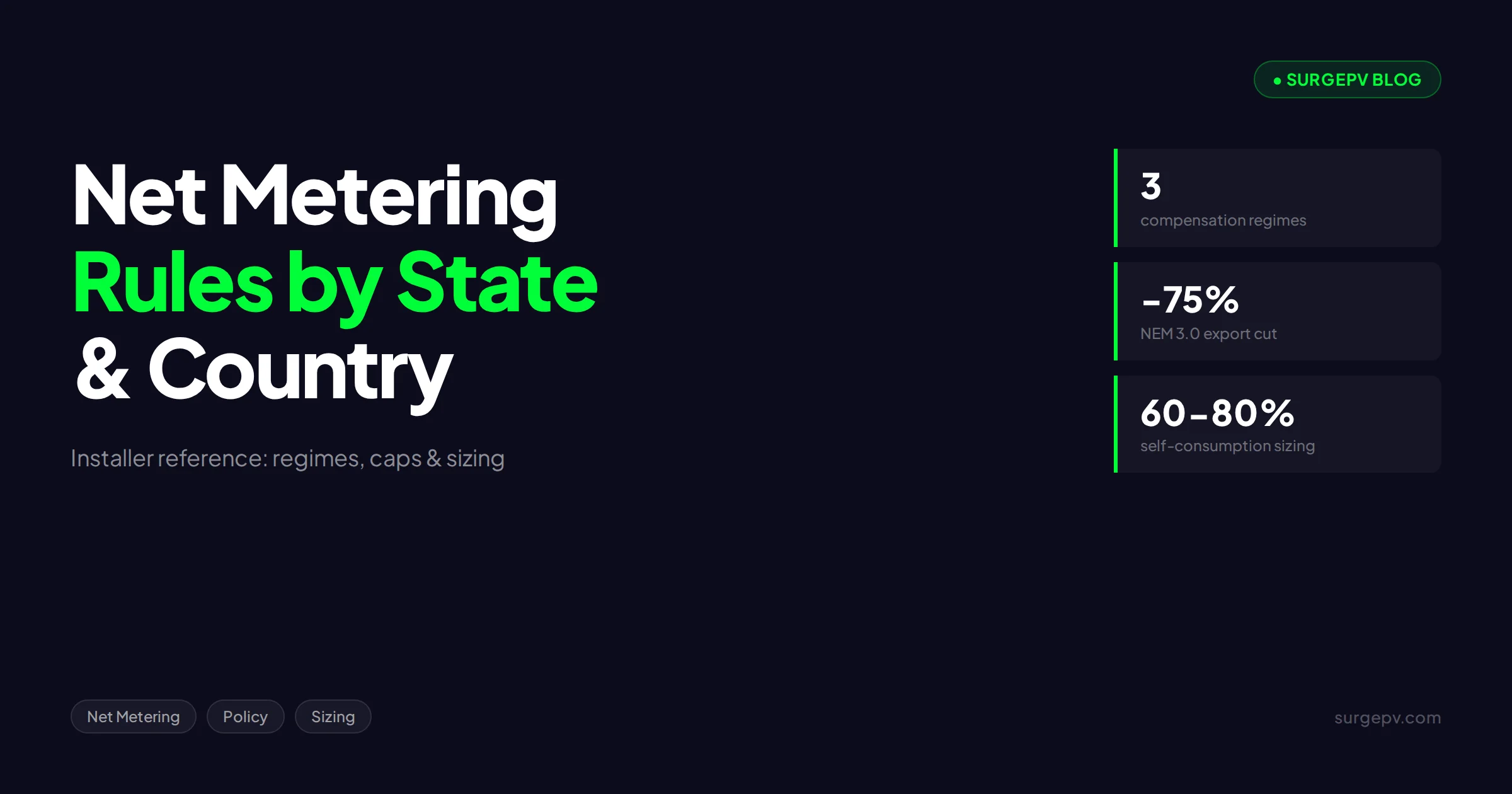
Net metering credits exported solar at the full retail rate; net billing pays a lower, cost-based export rate. The US is shifting toward net billing (California's NEM 3.0 cut export values roughly 75%), while most countries now cap system size, credit roll-over, or export compensation. Design and financial models must match the local regime.
Net metering is the single most important policy variable in a solar quote — and the one most often modeled wrong. The difference between retail-rate credits and avoided-cost billing on the same roof is the difference between a 5-year and a 10-year payback. Get the regime wrong and you have mis-sold the system, not just mis-modeled it.
This reference is built for installers and designers: how net metering, net billing, and feed-in structures differ, where the major US states and international markets stand in 2026, and what each regime means for system sizing, battery attachment, and proposal math.
Quick Answer
Net metering credits exported solar at the full retail rate; net billing pays a lower, cost-based export rate. The US is shifting toward net billing (California’s NEM 3.0 cut export values roughly 75%), while most countries now cap system size, credit roll-over, or export compensation. Design and financial models must match the local regime.
TL;DR — Net Metering for Installers
Three regimes: retail net metering (exports worth retail), net billing (exports worth wholesale or avoided cost), feed-in tariff (fixed export price). The design implication: net billing shifts optimal sizing from annual-offset to daytime self-consumption, and makes batteries economic. Always model the customer’s load profile against the actual tariff export rate.
In this guide:
- The 3 compensation regimes and how they differ
- US state-by-state status in 2026
- California NEM 3.0 in detail
- International frameworks: EU, India, Australia, Kenya, UAE, Pakistan
- Sizing and battery implications per regime
- How to model exports correctly in proposals
- The installer compliance checklist
The 3 Compensation Regimes
Everything in this guide is a variant of 3 structures.
1. Retail net metering. A bi-directional meter nets imports against exports, monthly or annually. Each exported kWh offsets a retail kWh. This is the most generous regime — exports are worth exactly what imports cost, typically $0.12–$0.40/kWh in the US. See our net metering glossary entry for the mechanics.
2. Net billing. Imports bill at retail; exports pay a separate, lower rate — wholesale price, avoided cost, or a regulator-set value. Export values typically run 20–50% of retail. California’s NEM 3.0, Hawaii’s Smart Export, and most of the EU now work this way. Details in our net billing glossary entry.
3. Feed-in tariff (FiT). All generation (or all exports) earns a fixed price per kWh, set by the regulator, usually for a fixed term. The UK’s old FiT and Germany’s EEG payments are the classic examples. Modern FiTs are set below retail, which makes self-consumption the priority.
The trend line is unambiguous: regimes move from 1 toward 2 and 3 as solar penetration rises. Design for the regime you have, and warn customers that regimes change.
US State-by-State Status in 2026
US net metering policy is made by state regulators and utilities, so it fragments. The patterns that matter for quoting:
| State group | Regime | Export value | Installer note |
|---|---|---|---|
| California | Net billing (NEM 3.0) | ~$0.04–0.08 avg, varies hourly | Batteries near-mandatory; legacy NEM 2.0 systems grandfathered 20 years |
| Hawaii | Net billing / Smart Export | Avoided-cost based | No retail net metering since 2015; export-only and self-supply tracks |
| Arizona | Net billing | ~$0.08–0.10, stepping down annually | Export rate locked 10 years from interconnection |
| Nevada | Net billing tier | ~75% of retail | Partial restoration after 2016 reversal |
| New York | Transitioning | Retail with CBC for mass-market; VDER for C&I | Value stack (VDER) pricing for commercial projects |
| Most of Southeast/Midwest | Retail net metering | Full retail | Caps and system-size limits vary by utility |
| Idaho, Utah, others | Annual true-up net billing | Avoided cost at true-up | Monthly netting, annual cash-out at low rate |
The authoritative source for current state policy is the DSIRE database (NC Clean Energy Technology Center), and the Berkeley Lab electricity markets program publishes periodic state policy trackers. Verify the utility’s current tariff sheet before quoting — DSIRE summarizes, the tariff governs.
Pro Tip
Export-rate grandfathering is a sales asset. In states with declining rates (Arizona) or pending dockets, the interconnection date locks the customer’s regime for 10–20 years. “Your rate locks when you interconnect” is a legitimate, non-manipulative urgency argument.
California NEM 3.0 in Detail
California is the largest US residential market and the template other states watch, so it deserves its own section.
The Net Billing Tariff (effective April 15, 2023) replaced retail credits with export values from the state’s Avoided Cost Calculator — hourly values that average roughly $0.04–0.08/kWh against retail rates of $0.30–0.45/kWh. The CPUC’s decision documents sit on the CPUC website.
Consequences observed in the market:
- Payback extension: new-system paybacks moved from 5–6 years to 8–10 years solar-only, per industry-observed ranges.
- Battery attach surge: storage attachment on new residential installs jumped to well over half of projects, because shifting solar to evening self-consumption recovers most of the lost value.
- Sizing inversion: pre-NEM 3.0 design maximized annual offset; post-NEM 3.0 design maximizes self-consumption, which usually means smaller systems plus storage.
Installers quoting California need hourly export modeling, not annual netting. A generation and financial tool that runs load-profile simulation against time-varying export rates is the difference between an honest quote and a lawsuit.
International Frameworks
Germany. The EEG feed-in structure pays ~€0.08/kWh for partial-feed rooftop systems (rate degresses periodically) against retail of €0.30+/kWh. Self-consumption dominates design. Full-feed systems earn a premium rate but are rare for residential.
Italy. Scambio sul Posto (netting via GSE) credits exports at roughly €0.08–0.13/kWh; Ritiro Dedicato buys surplus at market rates. Both are net-billing variants.
Australia. State feed-in tariffs of AUD $0.03–0.12/kWh against retail of AUD $0.25–0.35/kWh — pure net billing economics; batteries and load shifting win.
India. State-by-state net metering via DISCOMs, typically capped (often 10 kW residential under PM Surya Ghar, 500 kW–1 MW for C&I depending on state). Credits usually roll monthly at retail; some states apply banking charges. Heaven Green Energy’s net metering guide for India covers the DISCOM-level detail, and QuickEstimate’s BESCOM guide shows a state-level application workflow.
Kenya. The Energy (Net Metering) Regulations 2024 cap systems at 1 MW with credits at retail — but credits expire at the end of Kenya Power’s financial year. Full analysis in our Kenya solar regulations guide.
UAE and Pakistan. Both run net-billing structures: Dubai’s Shams credits exports against future bills at retail-equivalent but with no cash-out; Pakistan’s NEPRA prosumer rules pay a reduced purchase rate. Both get dedicated posts in this series — see UAE solar regulations and Pakistan NEPRA rules.
Sizing and Battery Implications per Regime
This is where policy becomes engineering:
- Retail net metering: size to annual offset (often 100–110% of load). Exports are worth retail, so oversizing pays.
- Net billing: size to daytime load, targeting 60–80% self-consumption solar-only. Every exported kWh earns a fraction of retail, so oversizing destroys ROI.
- Net billing + battery: size solar to charge the battery plus daytime load; size the battery to evening load. Attachment economics depend on the retail-minus-export spread — the wider the spread, the faster storage pays back.
- Feed-in tariff: compare the FiT rate to retail. If FiT is below retail (usual), design for self-consumption; if above (rare legacy contracts), export everything.
Physics-based shadow analysis matters more under net billing, not less: when only self-consumed kWh earn full value, production accuracy in the self-consumption window drives the entire financial model.
Model Exports at the Real Rate, Not the Retail Rate
SurgePV simulates production and financials against actual tariff structures — so your net-billing quotes show honest paybacks.
Book a DemoNo commitment required · 20 minutes · Live project walkthrough
Modeling Exports Correctly in Proposals
Four rules keep proposals honest under any regime:
- Use the customer’s actual load profile where interval data exists. A flat profile overstates self-consumption for most homes.
- Use the current export rate from the tariff sheet, not last year’s and not “retail” under a net-billing regime.
- Show the assumption. One line in the proposal — “exports valued at $0.06/kWh per SDG&E NBT tariff” — inoculates you when the customer compares against a competitor’s retail-rate fantasy.
- Stress-test the regime. For 25-year models, show one sensitivity with export rates declining. Regimes change; the customer should hear it from you first.
Mis-modeled export value is the most common cause of solar complaints and consumer-protection actions in deregulated markets. The quote that wins on honesty loses fewer deals than you fear — and generates the referrals.
Installer Compliance Checklist
Before any grid-tied quote:
- Confirm regime (net metering / net billing / FiT) from the current tariff, via DSIRE plus the utility document.
- Confirm caps: system size limits, per-transformer or feeder hosting limits, credit roll-over and true-up terms.
- Confirm meter and interconnection fees — bi-directional meter costs and application fees belong in the quote; our grid interconnection application glossary entry and interconnection application guide cover the paperwork.
- Confirm grandfathering: does the regime lock at interconnection, and for how long?
- File interconnection early. In congested territories, the interconnection queue is the project timeline.
Credit Mechanics: Roll-Over, True-Ups, and Banking
The fine print that moves real money:
- Monthly roll-over: credits carry to the next bill indefinitely. Most customer-friendly structure; oversizing retains value.
- Annual true-up: credits net monthly, then any annual surplus is paid out — usually at avoided cost, a fraction of retail. Systems sized above annual load earn pennies on the excess.
- Banking charges: some regimes (several Indian states, parts of Europe) charge a fee on banked energy, typically 2–8% of exported units or a fixed per-kWh wheeling charge.
- Expiry: a minority of regimes forfeit unused credits at a fixed date. Kenya’s financial-year expiry is the extreme case; it makes conservative sizing mandatory.
Each mechanic changes the optimal design. Under annual true-up at avoided cost, target 95–100% of annual load, never 110%. Under banking charges, shift the target down again. None of this is visible in an annual netting spreadsheet — it has to be in the tariff model.
Legacy Systems and Grandfathering
Regime changes almost always grandfather existing systems — California’s NEM 1.0 and 2.0 customers keep their terms for 20 years from interconnection. Two installer implications follow. First, existing customers on legacy rates are a separate sales segment: expanding or modifying their system can jeopardize grandfathered status, so check the utility’s modification rules before upselling. Second, when a successor regime is announced but not yet effective, the interconnection queue floods — Nevada 2015 and California 2023 both saw 3–6 month rushes. Crews and design capacity booked early are worth a premium in those windows.
What Most Installers Get Wrong
The biggest error is quoting retail-rate savings in net-billing territories. It is often not malicious — the rep’s proposal template still assumes netting. Fix the template, not the rep’s intentions.
Second: ignoring true-up mechanics. Monthly netting with annual avoided-cost cash-out punishes seasonal overproduction. A system that “nets to zero” annually can still produce worthless December credits.
Third: assuming policy stability in the financial model. The history of every major solar market — California 2016/2023, Nevada 2015, Spain’s retroactive cuts — says export regimes devalue over time. The nuance: grandfathering usually protects existing systems, so the risk lands on future sales, not past customers. Sell the lock, honestly.
Conclusion
Net metering is a design input, not a policy footnote. Three actions this week:
- Pull the current tariff sheet for every utility territory you quote in and record the export rate, cap, and true-up terms in one internal sheet.
- Re-run your 3 most common system sizes under net-billing economics — if your standard quote assumes retail netting, rebuild it.
- Add the export-rate assumption line to every proposal template.
To model load profiles, hourly export rates, and battery scenarios in one workspace, book a SurgePV demo — the financial engine is built for exactly this problem. And for country deep-dives, read our Kenya, UAE, and Pakistan regulation guides.
Frequently Asked Questions
What is the difference between net metering and net billing?
Net metering credits each exported kWh at the full retail electricity rate, effectively spinning the meter backwards. Net billing compensates exports at a lower rate — wholesale, avoided cost, or a fixed feed-in price — while imports are charged at retail. Net billing lowers the value of exported energy by 50–80% in most markets.
Which US states still have full retail net metering?
States with retail-rate net metering as of 2026 include New York (with a customer benefit charge transition), New Jersey, Illinois, Maryland, and most of the Southeast and Midwest. California, Hawaii, Nevada, and Arizona have moved to net billing or reduced export rates. Policies change frequently — check DSIRE before quoting.
What is California NEM 3.0 and how did it change solar economics?
NEM 3.0 (the Net Billing Tariff, effective April 2023) replaced retail-rate credits with Avoided Cost Calculator export values, cutting average export compensation by roughly 75%. Payback periods for new California systems extended from 5–6 years to 8–10 years, and battery attachment became economically necessary to shift energy to evening self-consumption.
How does net metering affect system sizing?
Under retail net metering, oversizing up to the cap is often economic because exports earn full retail value. Under net billing, optimal sizing targets daytime self-consumption — typically 60–80% of annual load without storage. Oversizing under net billing destroys ROI because exports earn a fraction of retail.
Do net metering credits expire?
It depends on the jurisdiction. Many US utilities roll credits month to month indefinitely; some true-up annually and pay out surplus at avoided-cost rates. Kenya’s 2024 rules forfeit credits at the end of the utility’s financial year. Always confirm credit roll-over and true-up terms before modeling customer savings.
How do installers check net metering rules for a specific project?
Check the DSIRE database (US), the utility’s current tariff sheet, and the interconnection agreement before quoting. Export rates, caps, meter fees, and true-up rules sit in the tariff document, not marketing pages. Model the customer’s actual load profile against the actual export rate before promising savings.
Where this fits
This article is part of SurgePV's Solar Incentives & Policy hub, which works through the topic from first principles to the decisions a project team actually has to make.

