

Quick Answer
LBNL Queued Up 2025 (LBNL, 2025) puts the national median from interconnection request to commercial operation for projects built in 2018–2024 at more than 4 years. The interconnection application is not paperwork you file after the project is done. A formal pre-application report is optional at most utilities but worth requesting for projects over 100 kW.
Most solar installations do not stall at the design stage. They stall at the utility queue. A residential system in California can wait 10–20 business days for application review and up to 95 business days for engineering review at PG&E if a detailed study is triggered (PG&E Generator Interconnection Timeline, 2025). A 5–20 MW commercial project can wait a median of 18 months in the study process before a single panel goes on a roof (LBNL Queued Up 2025, 2025). LBNL Queued Up 2025 (LBNL, 2025) puts the national median from interconnection request to commercial operation for projects built in 2018–2024 at more than 4 years.
LBNL Queued Up 2025 (LBNL, 2025) puts the national median from interconnection request to commercial operation for projects built in 2018–2024 at more than 4 years. The interconnection application is not paperwork you file after the project is done.
The interconnection application is not paperwork you file after the project is done. It is an engineering checkpoint that shapes inverter selection, system size, export limits, and construction timing. Getting it wrong — an incomplete single-line diagram, a non-certified inverter, a missing PE stamp — means rejection, resubmission, and weeks of delay.
This guide covers the 6-phase interconnection process in full: what each phase requires, which documents to prepare at each stage, how to qualify for the fast-track path, and where state-specific rules differ most. Designers and project managers who work through this guide before filing will avoid the most common errors.
TL;DR
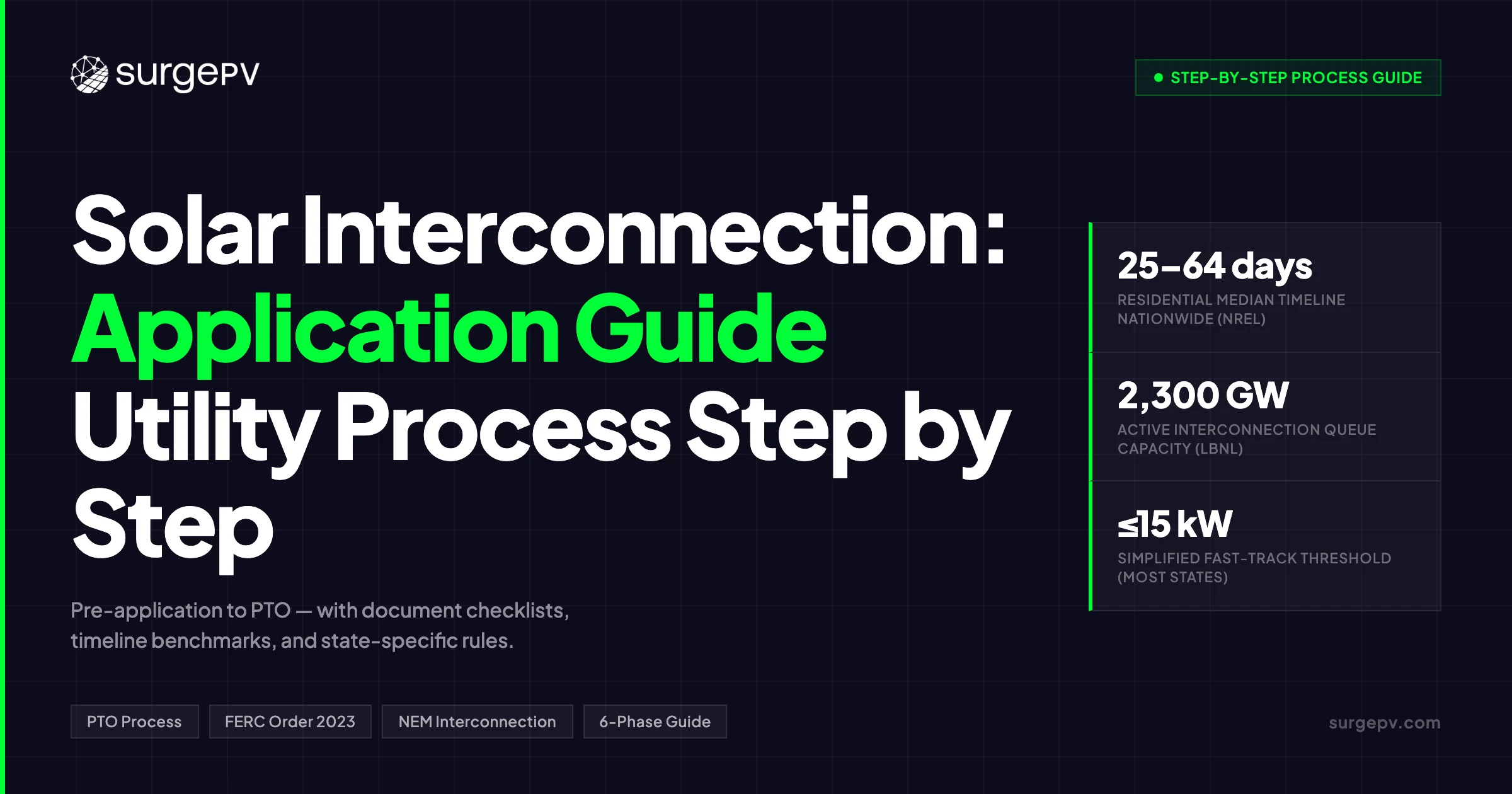
A residential solar system clears interconnection in 25–64 days nationally (NREL SolarTRACE, 2022). Commercial projects can run 6–24 months. Six phases separate every project from energization: pre-application, application, utility review, interconnection agreement, installation, and Permission to Operate. This guide walks each phase with document checklists and state-specific timelines.
What you’ll learn:
- The 6 phases of the solar interconnection process from pre-application to PTO
- Exactly which documents utilities require at each stage
- Timeline benchmarks by state and project size
- How to qualify for the simplified or fast-track path versus a full study
- Why applications get rejected and how to prevent it
- How FERC Order 2023 changes the rules for commercial projects
- How interconnection constraints shape inverter selection and system sizing
What Is Solar Interconnection?
Solar interconnection is the process by which a utility formally approves a solar system to connect to the grid. Every grid-tied installation — residential rooftop, commercial ground mount, or utility-scale array — must complete this process before the system can be energized. The output is a Permission to Operate (PTO) letter, which is the utility’s authorization to turn the system on. For more on this topic, see the ground-mount solar design guide.
The interconnection agreement (IA) is the legal contract between the system owner and the utility that specifies how the system will operate on the grid: export limits, protection settings, metering configuration, and any required grid upgrades.
The process exists because grid-tied solar introduces two-way power flow. Without protection standards, a system could backfeed voltage onto a de-energized line during an outage, creating a hazard for utility workers. Anti-islanding protection, relay settings, and inverter certification standards all exist to prevent this.
Who governs interconnection depends on project scale:
- FERC governs wholesale generators connecting to transmission-level grids (generally ≥20 MW or projects selling power across state lines)
- State public utility commissions (PUCs) govern distribution-level interconnection, which covers most residential and commercial solar
- Individual utilities administer the actual application process under tariffs approved by their PUC
The 6-Phase Interconnection Process
Many projects can be managed through six practical phases, but utilities and jurisdictions may combine, rename, omit, or add gates. Confirm the current process, timeline, studies, forms, fees, and decision authority for the actual service territory before relying on this workflow.
Phase 1: Pre-Application
Before submitting a formal application, check whether the grid can support the project. Most utilities now publish hosting capacity maps — visual tools showing available capacity on each feeder. High-capacity feeders mean fewer study requirements. Low-capacity feeders may trigger upgrade costs even for small systems.
A formal pre-application report is optional at most utilities but worth requesting for projects over 100 kW. It gives utility-confirmed capacity data at the proposed point of interconnection (POI), which reduces surprises later.
Information to gather at this stage:
- Site address and GPS coordinates
- Proposed AC system capacity (kW)
- Desired point of common coupling (PCC)
- Ownership or site control documentation (required for larger projects under FERC Order 2023)
The output is a go/no-go decision on the proposed location. If the feeder is at capacity, you may need to resize the system, add Active Power Control, or propose a different POI.
Phase 2: Submit Your Interconnection Application
The formal application is the start of the official utility clock. Most utilities have moved to online portals: PG&E uses SmartConnect, FPL uses Sunny Portal, and ConEd uses ePAS. Applications submitted through these systems generate timestamps that matter for queue position.
Document checklist for application submission:
| Document | Notes |
|---|---|
| Completed interconnection application form | Utility-specific; available on portal |
| Electrical single-line diagram (SLD) | Required by virtually all utilities; must show array config, conductors, OCPD, inverter, disconnects, grounding, and POI |
| Site plan / roof layout | Panel placement, equipment locations, clearances |
| Equipment cut sheets | Modules, inverter(s), racking, disconnects |
| Inverter certification proof | UL 1741 SA or IEEE 1547-2018 compliance documentation |
| Application fee | Amounts vary by utility and system size |
| Owner authorization letter | Required when a contractor submits on behalf of the owner |
| Proof of insurance | Required for Tier 2+ commercial systems in most jurisdictions |
After submission, the utility conducts a completeness review. This is not a technical review — it just checks whether all required fields and documents are present. Most utilities complete this in 5–10 business days. A missing document or fee triggers an incompleteness notice and resets the clock.
Pro Tip
Print the utility’s published application checklist and mark every item before submitting. Completeness rejections are the most preventable delay in the entire process. A checklist review takes 30 minutes. A resubmission cycle costs 1–2 weeks.
Phase 3: Utility Review and Technical Screens
After the completeness check, the utility conducts its technical review. Projects go through one of three paths depending on system size and location.
Three interconnection tracks:
| Track | Typical Capacity Threshold | Study Required? | Typical Timeline |
|---|---|---|---|
| Simplified | ≤10–50 kW (varies by state) | No | 5–15 business days |
| Fast Track | >10–25 kW up to 2–5 MW | Supplemental only if screens fail | 15–45 business days |
| Full Study | >5–10 MW or fails fast-track screens | Feasibility + Impact + Facilities studies | 6–24+ months |
Key technical screens for fast-track eligibility:
- Feeder penetration: aggregated generation ≤15% of line section annual peak load
- Fault current contribution: ≤10% of circuit maximum fault current at the POI
- Protective device rating: must not expose equipment to more than 90% of short-circuit interrupting capability
- Voltage and power quality: no violations of IEEE 1453 / 1547 limits
- Transformer and substation capacity: no overloading of existing equipment
If a project fails any fast-track screen, it moves to a supplemental review or full impact study. The utility notifies the applicant in writing with the specific screen that failed and the options for proceeding.
Phase 4: Interconnection Agreement
Once the technical review is complete and any required studies are done, the utility issues a draft interconnection agreement (IA). This is the binding contract that governs how the system operates on the grid.
Key terms in a typical IA:
- Maximum export limit (kW AC)
- Protection and relay settings
- Metering configuration and billing structure
- Allocation of network upgrade costs (if any)
- Construction timeline milestones
- Indemnification and insurance requirements
Review the IA carefully before signing. Export limits written into the IA are binding — a system designed to export 100 kW that has an IA capping exports at 60 kW will need Active Power Control hardware or a redesign. Export limits set at the IA stage should feed back into the system design.
Most utilities allow a negotiation period of 30–60 days after issuing the draft IA. After the IA is signed, the utility confirms the construction authorization.
Phase 5: Installation and AHJ Inspection
With a signed IA in hand, construction can begin, but the system cannot be energized until PTO is received — operating a grid-tied system without PTO is a contract violation and may void the IA.
After installation is complete, the local Authority Having Jurisdiction (AHJ) conducts its inspection. AHJ inspections cover:
- NEC Article 690 compliance (PV systems)
- Rapid shutdown compliance
- Labeling and signage
- Equipment clearances and fire pathways
- Grounding and bonding
Documentation for post-installation phase:
- As-built single-line diagram (reflecting any field changes)
- Final AHJ inspection certificate
- Commissioning test results
- Installation photos (required by some utilities for desktop review)
Some utilities conduct their own witness test for systems above a capacity threshold. The utility inspector verifies anti-islanding protection, relay settings, and meter configuration before PTO is issued.
Phase 6: Permission to Operate (PTO)
The PTO request is the final step. After the AHJ inspection passes, submit the PTO request package to the utility. Most utilities issue PTO within 5–30 business days of receiving a complete package.
PTO request documents:
- Completed PTO request form
- AHJ inspection certificate
- Verification that a bi-directional meter has been installed (or a meter upgrade request)
- As-built SLD (if not previously submitted)
Once PTO is issued, the system can be energized. The PTO letter is also the trigger for most state incentive programs, net metering enrollment, and performance guarantee start dates.
Interconnection Track Comparison: Simplified, Fast Track, and Full Study
The track a project takes is the single biggest driver of interconnection timeline. The thresholds vary by state, but the structure is consistent.
| Track | CA (Rule 21) | NY (SIR) | MA (Schedule Z) | NM | MN |
|---|---|---|---|---|---|
| Simplified | ≤10 kW | ≤50 kW | ≤15 kW | ≤10 kW | ≤20 kW |
| Fast Track / Expedited | 10 kW–10 MW | 50 kW–5 MW | >15 kW | 10 kW–2 MW | 20 kW–5 MW |
| Full Study | Fails screens or >10 MW | >5 MW or network area | Standard track | 2 MW–10 MW | 5 MW–10 MW |
Projects in network service areas (common in dense urban markets like Manhattan) may be required to do a full study regardless of size, because the underground secondary network has different protection requirements.
Fast-track eligibility is also affected by queue position. A project that would individually pass the 15% feeder penetration screen may fail if several other projects on the same feeder are ahead of it in the queue and will collectively push the feeder above the limit. This is why hosting capacity maps matter even for small systems.
Timeline Benchmarks by State
Timelines vary significantly by utility, state rules, and application volume. These are ranges based on published utility data and industry sources.
| State / Utility | Track | Typical Timeline | Source |
|---|---|---|---|
| California (PG&E) | Small residential | 28–138 business days depending on study depth | PG&E Interconnection Timeline (2025) |
| New York (ConEd) | Simplified | 15 business days | NY SIR (Aug 2025) |
| New York (ConEd) | CESIR | 60 business days | NY SIR (Aug 2025) |
| Texas (Oncor) | DG ≤10 MW | ≤30 days; 95% compliance in 2022 | Oncor 2022 Sustainability Report (2023) |
| Florida (FPL) | Tier 1 ≤10 kW | 10–15 business days | FPL Net Metering Guidelines (2025) |
| Florida (Duke) | Tier 1 ≤10 kW | 5–10 business days | Duke Energy Florida |
| Massachusetts | Simplified ≤15 kW | ≤15 days | MA DPU Schedule Z |
| Massachusetts | Standard track | ≤125 days | MA DPU Schedule Z |
| National (residential) | Permit + interconnection | 25–64 days | NREL SolarTRACE (2022) |
| National (utility-scale) | Transmission-level | >4 years median (2018–2024 built) | LBNL Queued Up 2025 (2025) |
CA Rule 21 Compliance Issue
California’s IOUs (PG&E, SCE, SDG&E) have reported Rule 21 timeline compliance rates as low as 27–45% for some process steps, according to quarterly filings reviewed by legislators. In November 2025, 18 California legislators sent a formal letter urging CPUC to enforce its own timeline requirements. If your project is in California, build extra weeks into the schedule.
Why Interconnection Applications Get Rejected
Rejection rates are not publicly reported by most utilities, but the causes are consistent across the industry. Most rejections are preventable.
Top 10 rejection reasons:
- Incomplete or inaccurate single-line diagram — The most frequently cited cause. The SLD must show array configuration, conductor sizes, OCPD ratings, inverter specs, disconnects, grounding electrode system, and POI. Missing any element triggers rejection.
- Non-compliant or uncertified inverter — Lack of UL 1741 SA or IEEE 1547-2018 certification triggers rejection at the screening stage. No further review occurs.
- Missing PE stamp — Systems above roughly 10 kW (or 12 kW in New York) often require a licensed Professional Engineer to stamp the electrical documents.
- Incorrect conductor sizing or breaker ratings — NEC Article 690 and Article 705 violations are caught during document review.
- Missing structural load calculations — Required in high-wind, seismic, or snow-load regions; commonly omitted.
- Improper setbacks or fire access pathways — Local fire code violations identified during site plan review.
- Application fee not included or incorrect — Triggers an administrative rejection. No technical review begins.
- Missing or incorrect labels and placards — Rapid shutdown labels, disconnect signage, and warning placards are required under NEC 690.
- Site control documentation missing — Increasingly required for larger projects, especially under FERC Order 2023.
- Export capacity violation — System size exceeds feeder hosting capacity or the utility’s published export threshold.
Pre-Submission Checklist
Before filing: verify the inverter is on the utility’s approved equipment list, cross-check the SLD against NEC 690/705, confirm the PE stamp threshold for your jurisdiction, include the signed owner authorization, attach all equipment cut sheets with UL listings clearly visible, and verify the fee amount on the current application form — not a cached version of the page.
A well-produced plan set dramatically reduces rejection risk. Cloud solar design software that generates utility-ready single-line diagrams, equipment schedules, and site plans from the same model eliminates the transcription errors that cause most document-level rejections. The alternative — hand-drawing SLDs in isolation from the design model — introduces version mismatch errors that are hard to catch before the utility does.
How FERC Order 2023 Affects Commercial Projects
FERC Order 2023, issued July 28, 2023, is the most significant reform to the U.S. transmission-level interconnection process since the Standard Interconnection Procedures were established in 2003. It applies directly to facilities connecting at the transmission level — generally ≥20 MW — and to smaller facilities under FERC-jurisdictional transmission providers.
Key changes:
1. Cluster study model replaces serial queue The old first-come-first-served model let a single project hold up dozens of others. Order 2023 moves to annual cluster studies. All projects in a given cluster window are studied together in a single 150-day study process. This reduces serial delay but means late entrants to a window wait for the next annual cycle.
2. Increased financial commitments
| Project Size | Deposit |
|---|---|
| Under 80 MW | $35,000 + $1,000/MW |
| 80 MW to under 200 MW | $150,000 |
| ≥ 200 MW | $250,000 |
3. Withdrawal penalties
| Stage of Withdrawal | Penalty |
|---|---|
| Initial cluster study | 2× study costs |
| Cluster restudy | 5% of network upgrade costs |
| Facilities study | 10% of network upgrade costs |
| After LGIA execution | 20% of network upgrade costs |
These penalty structures are designed to reduce speculative projects that enter the queue without genuine development intent, which has historically caused the queue to balloon. Active queue capacity at end of 2024 stood at approximately 2,300 GW, according to LBNL Queued Up 2025 (LBNL, 2025).
4. Site control requirements Projects must demonstrate 90% exclusive land rights before entering the cluster study. Previously, projects could enter the queue with minimal site control. This alone is expected to cut queue withdrawals significantly.
5. Transmission provider accountability Order 2023 imposes penalty rates on transmission providers that miss study deadlines: $1,000 per business day for delayed cluster studies, $2,000 for restudies, and $2,500 for facilities studies. For the first time, transmission providers face financial consequences for delays — not just the developers.
Order 2023 does not directly apply to distribution-level interconnection (residential and most commercial solar below 20 MW). But its cluster-study model is already influencing how state PUCs approach distribution interconnection reform.
Design Systems That Pass Interconnection on the First Submission
SurgePV generates utility-ready single-line diagrams, equipment schedules, and plan sets from the same model used for shading analysis and financial modeling — no re-entry, no version mismatch.
Book a DemoNo commitment required · 20 minutes · Live project walkthrough
How Interconnection Rules Affect Your System Design
Interconnection approval is not just an administrative step that happens after design. The utility’s rules constrain what gets built. Designing without accounting for interconnection requirements forces expensive redesign after the IA is issued.
Inverter Selection
IEEE 1547-2018 compliance is mandatory for grid interconnection in most U.S. jurisdictions. Many utilities additionally require UL 1741 SA (Supplement A) certification, which specifically validates the advanced grid-support functions defined in IEEE 1547-2018.
Smart inverter functions required by some utilities:
- Volt/VAR control — reactive power support to maintain voltage within limits
- Volt-Watt response — real power curtailment when voltage rises above threshold
- Frequency-Watt control — real power adjustment in response to grid frequency deviations
- Ride-through capability — defined in IEEE 1547-2018
California Rule 21 (under Resolution E-5000) requires Phase 3 advanced inverter functions — specifically monitoring/telemetry (Function 1) and scheduling capability (Function 8) — for applications filed on or after January 22, 2020.
Choosing an inverter that satisfies both the electrical design and the utility’s certification requirements eliminates the most common cause of rejection. Solar software suite with an up-to-date equipment database and utility certification status speeds up that verification step.
Export Limits and Active Power Control
Utilities may require export limits below the system’s nameplate capacity if the feeder has limited hosting capacity. Options when export limits apply:
- Non-export design — the system is sized to net-zero export; no PV power flows onto the grid
- Limited-export design with Power Control System (PCS) — closed-loop hardware limits export in real time; allows larger systems while staying within feeder limits
- Redesign to reduce system size — straightforward but reduces generation capacity
Export limits are written into the interconnection agreement. If they conflict with the system’s financial model, catch the conflict before signing the IA — not after. Re-run the generation and financial tool against the IA’s export limit before signing to verify the project’s economics still hold.
System Sizing Caps
Most utilities cap system size at 90–115% of the customer’s historical annual energy consumption. FPL caps at 115% (FPL, 2025). Some utilities cap at 100% or less. Designing above this threshold results in denial or a requirement to reduce system size.
Phase and Voltage Requirements
Larger systems have specific interconnection voltage requirements. FPL requires any NEM system 50 kW or greater to interconnect at 120/208V or 277/480V wye three-phase (FPL, 2025). New York’s underground secondary network areas may deny interconnection outright or require a full CESIR regardless of size, because backfeed into a network creates coordination challenges that the standard protection scheme doesn’t address.
Reference Point of Applicability (RPA)
IEEE 1547-2018 defines the Reference Point of Applicability (RPA) as the physical location where compliance requirements must be met. The RPA can be at the point of common coupling, the point of connection, or an intermediate point agreed with the utility. If the RPA is set at the PCC rather than the POC, certified equipment alone may not suffice — detailed system analysis and commissioning tests may also be required. Agreeing on RPA location early in discussions with the utility streamlines the certification and study scope.
State Spotlight: CA, NY, TX, and FL
California — Rule 21
California’s distributed generation interconnection rules are among the most detailed in the country. CPUC Rule 21 governs DG systems under 10 MW, with separate simplified procedures for systems under 10 kW. Net-metered systems up to 1 MW are exempt from interconnection application fees and initial/supplemental review fees (CPUC, via Energy Center, 2015). See the commercial solar system design guide for detailed guidance.
The advanced inverter requirements under Rule 21 (Phase 2 and Phase 3 functions) make California one of the few states where the specific inverter model can determine whether the application goes through the simplified path or requires additional review. An inverter without telemetry capability will not meet Phase 3 Function 1 requirements, triggering supplemental review.
Timeline compliance has been a documented issue. PUC-tracked data shows some Rule 21 process steps completed on time in only 27–45% of cases. A new rulemaking opened August 14, 2025 (CPUC, 2025) to modernize Rule 21 for distributed energy resources including storage and EV charging.
New York — Standardized Interconnection Requirements (SIR)
New York’s SIR (updated effective August 1, 2025) creates three tiers: simplified (≤50 kW), expedited (50 kW–5 MW for inverter-based systems), and full CESIR (>50 kW in most cases, or any size in network service territory). The CESIR is a Coordinated Electric System Interconnection Review — a utility-conducted study that takes up to 60 business days and costs $1,450–$8,000+ depending on capacity (ConEd tariff, 2022).
Systems submitting in Manhattan’s network area face the most restrictions. The underground secondary network operates without traditional protective relaying, making distributed generation integration technically complex and expensive.
Texas — ERCOT Distribution and Transmission
Texas distribution interconnection (rooftop solar, small commercial) is administered by the Transmission and Distribution Utilities (TDUs) — Oncor, CenterPoint, AEP, TNMP. Oncor targets approval in under 30 days for standard distributed generation, with 95% of 2022 applications meeting that target (Oncor, 2023).
For large generation (≥10 MW) seeking ERCOT transmission interconnection, developers face 18–30 months before construction authorization, not including construction time itself. ERCOT is developing a batch study framework for Large Load Interconnections (data centers and similar large loads), with rules under active stakeholder review as of early 2026.
Florida — Tiered System with New Auto-Approval Rule
Florida utilities use a tiered structure. FPL’s Tier 1 (≤10 kW) processes in 10–15 business days. Tier 2 (10–100 kW) takes 4–8 weeks. Tier 3 (100 kW–2,000 kW) can extend to several months.
Florida HB 683, effective July 1, 2025, requires single-trade residential permits — including solar — to be approved within 5 business days or they are automatically approved. This applies to the AHJ permitting side of the process, not the utility interconnection side — but it does compress the overall pre-energization timeline for residential projects.
The net metering structure in Florida changed significantly in 2023, and the current compensation rates should be verified against the latest Florida PSC tariff before building financial models.
Frequently Asked Questions
How long does the solar interconnection process take?
Residential systems typically clear in 25–64 days nationally (NREL SolarTRACE, 2022). Commercial projects in the 50 kW–10 MW range can take 6–24 months if a full study is required. Utility-scale projects facing transmission-level interconnection have a national median of more than 4 years from request to commercial operation, according to LBNL Queued Up 2025 (LBNL, 2025). State and utility matter enormously — Oncor in Texas approves 95% of residential applications within 30 days, while PG&E engineering review can take up to 95 business days for projects requiring detailed study.
What documents do I need to submit a solar interconnection application?
Most utilities require: a completed application form, electrical single-line diagram (SLD), site plan, equipment cut sheets for modules and inverter, proof of UL 1741 SA / IEEE 1547-2018 inverter certification, the application fee, and an owner authorization letter if a contractor is submitting on the owner’s behalf. Commercial systems typically also need proof of insurance. Some utilities require structural load calculations and a PE-stamped set for systems above 10–12 kW.
What is the difference between simplified, fast-track, and full study interconnection?
Simplified applies to small systems (typically ≤10–50 kW depending on state) and completes in 5–15 business days with no study required. Fast track covers mid-size projects up to 2–5 MW and adds supplemental technical screens, completing in 15–45 business days when screens pass. Full study is required for larger projects or any project that fails the fast-track technical screens — it can take 6–24+ months and involves feasibility, impact, and facilities studies.
Why do solar interconnection applications get rejected?
The most common causes are an incomplete or inaccurate single-line diagram, a non-certified inverter (missing UL 1741 SA or IEEE 1547-2018 documentation), missing PE stamp for larger systems, incorrect conductor sizing, and omitting the application fee. Most rejections occur at the completeness review stage — before any technical review begins. A thorough pre-submission checklist eliminates the majority of them.
How does FERC Order 2023 affect commercial solar interconnection?
FERC Order 2023 (July 28, 2023) replaced the serial first-come-first-served queue with annual cluster studies for FERC-jurisdictional transmission projects. Deposit requirements now range from $35,000 to $250,000 depending on project size. Withdrawal penalties escalate from 2× study costs to 20% of network upgrade costs after the interconnection agreement is executed. Transmission providers also face daily financial penalties for missing study deadlines — a first in U.S. interconnection history.
Does interconnection approval affect which inverter I choose?
Yes. IEEE 1547-2018 compliance is mandatory for grid interconnection in most jurisdictions. Many utilities additionally require UL 1741 SA certification. California Rule 21 mandates advanced smart inverter functions including Volt/VAR, frequency-watt, and Volt-Watt response curves. An inverter that lacks these certifications or functions will be rejected at the technical screening stage, regardless of the rest of the application’s quality. Inverter selection should be confirmed against the utility’s approved equipment list before the design is finalized.
How to Buy Interconnection Application Services
Define whether the provider prepares documents, submits through the utility portal, answers deficiency notices, coordinates studies, or manages the process through permission to operate. Supply the legal applicant and site data, utility account and tariff, load information, system and storage ratings, equipment, point of interconnection, electrical drawings, protection settings, site-control evidence, fees, and utility forms.
Require a utility-specific checklist, completed application, drawing and equipment register, assumption and exception log, submission receipt, correspondence log, study and payment tracker, response deadlines, and final agreement or approval record. Reconcile names, addresses, capacities, equipment and ratings across every form, drawing, model, datasheet, and contract.
Heaven Designs publishes permit-plan and detailed-engineering services, but its public service pages do not establish that it files or manages every utility’s interconnection application. Confirm geography, portal access, applicant authority, filing responsibility, fees, study support, and PTO scope in writing. Document preparation does not guarantee utility acceptance, capacity, schedule, upgrade cost, or permission to operate.
Disclosure: SurgePV is promoting Heaven Designs through a commercial relationship. Apply the same utility-specific scope, authority, consistency, and submission-evidence checks to every provider.
Review the Heaven Designs permit-design scope, visit the Heaven Designs website, and request a jurisdiction-relevant sample before asking whether interconnection support is available.
Conclusion
The interconnection application process has a clear structure — 6 phases, each with defined inputs, decision gates, and documents. Projects move through fastest when the design accounts for interconnection constraints from the start: certified inverters, correct system sizing, complete plan sets, and no export limit surprises buried in the IA.
For residential and small commercial projects, the difference between a first-pass approval and a resubmission cycle is typically a documentation error that takes 15 minutes to fix — and 2 weeks to recover from. For commercial and utility-scale projects, interconnection planning is a project management discipline running parallel to engineering from day one.
Three things to do before your next application:
- Check the utility’s hosting capacity map before sizing the system — feeder constraints determine which interconnection track applies
- Verify the inverter is on the utility’s approved equipment list and carries UL 1741 SA certification before finalizing equipment selection
- Use solar proposal software that generates utility-compliant plan sets from the design model, so the SLD submitted to the utility matches what’s actually being built
A clean first submission is the fastest path to PTO.
[FACTCHECK SUMMARY — INTERNAL]
- Corrected: Active queue capacity at end-2024 was ~2,300 GW, not ~2,600 GW (LBNL Queued Up 2025).
- Corrected: FERC Order 2023 issued July 28, 2023; deposit tiers updated to match Order 2023-A clarifications.
- Corrected: NY SIR expedited track now runs to 5 MW (effective Aug 1, 2025), not 300 kW.
- Corrected: Florida HB 683 effective date is July 1, 2025.
- Corrected: CA Rule 21 new rulemaking opened August 14, 2025.
- Corrected: CA Rule 21 Phase 3 Functions 1 and 8 required per Resolution E-5000.
- Corrected: PG&E peak-season claim replaced with PG&E’s published review timelines (10–20 + up to 95 business days).
- Corrected: LBNL median timeline updated to 2018–2024 built projects (>4 years).
- Corrected: “1 MW commercial / 18 months” changed to “5–20 MW commercial / median 18 months” to match LBNL IR-to-IA data.
- Corrected: ERCOT batch process claim rephrased to clarify it applies to Large Load Interconnections, not generator interconnection.
- Removed: Unverified citations to “Living With Solar” and “Sunlight Electrical Solutions” blogs from timeline table.
- Removed: NERC PRC-024-3 reference conflated with ride-through; IEEE 1547-2018 is the correct sole source for inverter ride-through.
- Verified: FPL 115% cap, FPL ≥50 kW three-phase requirement, Oncor 95%/30-day claim, CA NEM ≤1 MW fee exemption.
Where this fits
This article is part of SurgePV's Solar Design hub, which works through the topic from first principles to the decisions a project team actually has to make.
