

Quick Answer
UAE rooftop solar is regulated emirate by emirate. In Dubai, DEWA's Shams Dubai program lets customers connect solar up to their sanctioned load through DEWA-approved contractors, with exports credited against future bills. Abu Dhabi runs a similar distributed generation framework through DoE/ADDC. There is no cash payout for exports — design for self-consumption.
The UAE is a market of contrasts for solar installers: world-record utility-scale tariffs at the Mohammed bin Rashid Solar Park on one side, and a tightly controlled, utility-gated rooftop market on the other. There is no national rooftop solar law. Each emirate regulates distributed generation through its own utility, and the two frameworks that matter commercially — Dubai’s Shams Dubai and Abu Dhabi’s distributed generation regime — share one critical feature: exported energy earns bill credits, never cash.
That single rule shapes everything about design and sales in the UAE. This guide covers both frameworks, the approved-contractor system, connection standards, the emirate-by-emirate picture, and what the credit-only structure means for system design and proposals.
Quick Answer
UAE rooftop solar is regulated emirate by emirate. In Dubai, DEWA’s Shams Dubai program lets customers connect solar up to their sanctioned load through DEWA-approved contractors, with exports credited against future bills. Abu Dhabi runs a similar distributed generation framework through DoE/ADDC. There is no cash payout for exports — design for self-consumption.
TL;DR — UAE Solar Rules
Dubai: Shams Dubai via DEWA-approved contractors, DRRG connection standards, exports credited (not paid), size capped at sanctioned load. Abu Dhabi: DoE/ADDC net metering framework, similar credit structure. Design for self-consumption — daytime-loaded C&I (warehouses, factories, malls, cold storage) is the strong segment; weekend-heavy loads are not.
In this guide:
- The regulatory structure: no federal law, utility-gated markets
- Shams Dubai: process, contractors, standards
- Abu Dhabi and the northern emirates
- The credit-only rule and what it does to design
- C&I market dynamics
- Equipment standards and the approved lists
- Installer compliance checklist
The Regulatory Structure
The UAE has no single national framework for distributed solar. Regulation flows through each emirate’s utility:
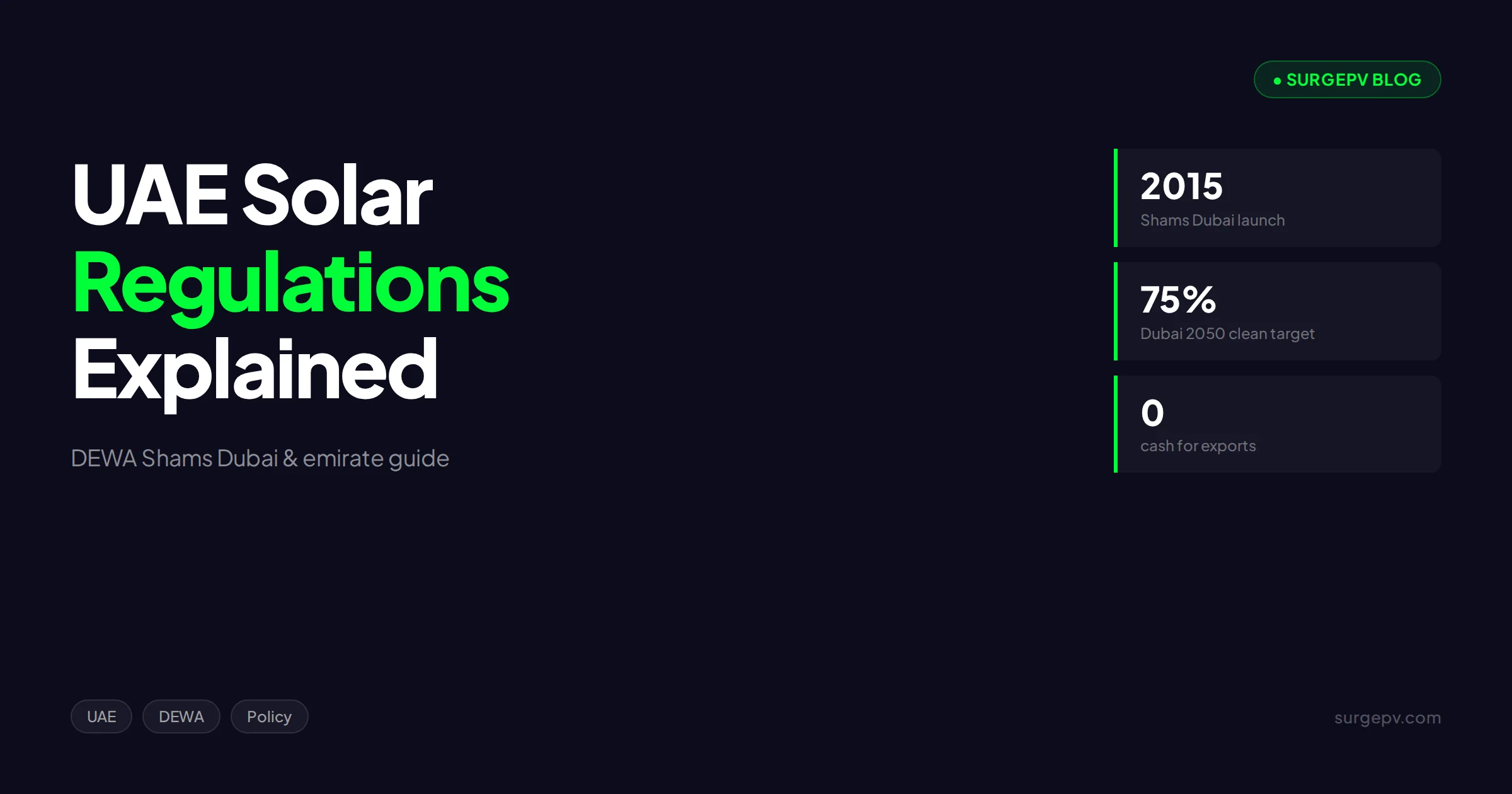
- Dubai: Dubai Electricity and Water Authority (DEWA), under the Dubai Clean Energy Strategy 2050, which targets 75% of Dubai’s energy from clean sources by 2050.
- Abu Dhabi: Department of Energy (DoE) as regulator, with ADDC and AADC as distribution companies and EWEC for utility-scale procurement.
- Sharjah and northern emirates: SEWA and smaller utilities, with less mature distributed solar frameworks.
For rooftop installers, the operative documents are the utility’s connection standards and approved-contractor rules — not any national code. Dubai’s framework, the most developed, is published on the DEWA website under the Shams Dubai program.
Shams Dubai: Process, Contractors, Standards
Launched in 2015, Shams Dubai was the Gulf’s first formal distributed solar program. The structure:
Approved contractors and consultants. Only DEWA-registered entities may design (consultants) and build (contractors) grid-connected solar. Registration requires demonstrated technical capability, insurance, and local licensing. For customers, the registered-contractor list is the entire market — there is no DIY or unregistered path to grid connection.
The application flow:
- Customer appoints a registered contractor/consultant.
- Contractor submits the design application to DEWA: single-line diagram, layout, equipment specs from approved lists.
- DEWA technical review: connection capacity against the sanctioned load and local network constraints.
- No Objection Certificate (NOC) issued — construction may begin.
- Inspection and connection: DEWA inspects, installs the bi-directional meter, and energizes the system.
Technical standards. Designs must follow DEWA’s Distributed Renewable Resources Generation (DRRG) standards: approved module and inverter lists, anti-islanding protection, protection and earthing requirements, and metering per DEWA specifications. System size is capped by the sanctioned load of the premises.
Timelines are utility-paced: budget several weeks to a few months from application to connection depending on system size and DEWA’s review queue.
Abu Dhabi and the Northern Emirates
Abu Dhabi’s distributed solar framework runs through the DoE with ADDC/AADC execution: licensed installers, small-scale PV net metering with bill credits, and technical connection standards broadly similar to Dubai’s. Abu Dhabi’s rooftop market has been slower to develop than Dubai’s, with more activity in government building programs and large C&I.
The northern emirates — Sharjah, Ras Al Khaimah, Ajman, Umm Al Quwain, Fujairah — are at earlier stages: pilot programs, ad-hoc approvals, and frameworks under development. Ras Al Khaimah has shown the most policy movement among them. Before quoting in these emirates, confirm the current process directly with SEWA or the relevant municipality; do not assume Dubai rules travel.
The Credit-Only Rule and What It Does to Design
Both major frameworks credit exports against future consumption. No cash, and in Dubai’s case the credit effectively has no expiry benefit for seasonal exporters — value only materializes when you would otherwise buy power. The design consequences:
- Self-consumption is the whole business case. A kWh consumed on-site avoids the full retail tariff; a kWh exported merely banks a credit usable later.
- Load profile matching beats annual offset. The best UAE C&I candidates are daytime-loaded: warehouses with refrigeration, factories, malls, offices, data-adjacent facilities. Villas occupied during the day are good; weekend-use properties are poor candidates.
- Oversizing is punished. Exporting 30% of production means 30% of the system’s value is deferred credit, not savings. Optimal sizing typically targets 70–90% daytime self-consumption.
- Batteries face a harder case. With exports credited at retail-equivalent (not a fraction, as in net-billing markets), storage must justify itself on tariff structure and backup value, not on a retail-minus-export spread. Time-of-use tariff structures in Abu Dhabi can help the case.
Accurate production modeling is what makes or breaks these proposals — physics-based shadow analysis on the actual roof geometry, plus hourly self-consumption simulation in a solar financial analysis tool, lets you quote the self-consumption ratio honestly instead of guessing 90% and delivering 65%.
Pro Tip
In Dubai proposals, show the customer’s daytime load share before quoting system size. A warehouse running chillers 6 am–6 pm can absorb nearly everything a roof-sized system produces; an office that empties at 3 pm cannot. The load profile is the design.
C&I Market Dynamics
The UAE’s distributed solar volume is overwhelmingly C&I. The drivers: commercial tariffs with fuel surcharges that make self-consumed solar competitive, sustainability commitments from large corporates and free-zone tenants, and green building requirements (Dubai’s Al Sa’fat rating system) that reward on-site generation.
Financing structures mirror other credit-only markets: direct purchase by owners with roof tenure, and ESCO/lease models where a third party funds the system and shares savings. Because exports have no cash value, ESCO contracts are structured around avoided-consumption savings sharing — which puts the measurement burden on accurate production and consumption metering. Our commercial solar proposals guide covers structuring these documents.
For engineering support on C&I permit packages, Heaven Designs’ guide to commercial vs. residential permit design shows what a lender- and AHJ-ready drawing package contains.
Model UAE Projects on Real Self-Consumption
SurgePV simulates hourly production against the customer load profile — so your Shams Dubai proposals quote the savings customers will actually see.
Book a DemoNo commitment required · 20 minutes · Live project walkthrough
Installer Compliance Checklist
Before committing to a UAE grid-tied project:
- Confirm the emirate’s framework with the local utility — do not extrapolate Dubai rules.
- Verify contractor/consultant registration status is current for that emirate.
- Check every module and inverter against the utility’s current approved equipment list.
- Confirm the customer’s sanctioned load — it caps system size.
- Model the daytime load profile from interval data or a measured audit before sizing.
- Budget the utility review and inspection window into the project schedule.
- Document the credit mechanism (no cash payout) explicitly in the customer’s financial summary.
Residential Solar in the UAE
The residential segment is structurally small compared to C&I, and the regulation explains why. Villa owners face the same contractor-registration and approved-equipment requirements, the same credit-only export structure, and relatively modest residential tariffs by regional standards. Paybacks on villa systems typically run 7–12 years — workable, but not the 4–6 year case that ignites residential volume.
The segment that does work: high-consumption villas with daytime occupancy, pools, and heavy air conditioning. Cooling is the dominant residential load in the Gulf, and it peaks exactly when solar produces. A villa running AC through the afternoon self-consumes nearly everything a 10–20 kW roof system generates. That load-shape coincidence is the strongest argument residential solar has in the UAE — use the customer’s summer bills to prove it.
Other Approvals: Civil Defense, Municipalities, and Free Zones
Utility approval is necessary but not always sufficient. Depending on the emirate and the building:
- Municipality building permits for structural modifications, especially on older roofs where load capacity documentation is required.
- Civil defense requirements for roof access pathways and fire safety on larger commercial arrays.
- Free zones (JAFZA, DIFC, KIZAD and others) may layer their own building and tenant-approval processes on top of the utility’s.
- Landlord and developer consents for leased premises — a rooftop the tenant does not control is a contractual obstacle before it is an engineering one.
Sequence these in parallel with the DEWA/ADDC review, not after it. The utility NOC does not clear a landlord objection, and discovering it at contract stage wastes the whole design cycle.
What Most Installers Get Wrong
The recurring error is quoting annual-offset sizing imported from retail-net-metering markets. In a credit-only regime, a 500 kW system on a 300 kW daytime load exports its surplus into a credit account the customer may never fully use. The proposal looked great; the savings did not arrive; the referral died.
Second: underestimating the approved-list discipline. Substituting a non-listed inverter to save procurement time voids the NOC and can require hardware replacement at the installer’s cost.
The exception that proves the design rule: large industrial sites with 24/7 process loads (desalination-adjacent, continuous manufacturing) can absorb near-total production. There, aggressive sizing is correct — because the load profile, verified by measurement, says so.
Conclusion
UAE rooftop solar is a self-consumption market wrapped in utility-gated process. Three actions this week:
- Pull the current approved equipment lists and DRRG standards for your target emirate and audit your standard BOM against them.
- Rebuild your sizing logic around daytime self-consumption — 70–90% target — and make load-profile capture a mandatory survey step.
- Add the “credits, not cash” explanation to every customer financial summary.
To model production, shading, and self-consumption in one workspace, book a SurgePV demo. For the policy mechanics behind credit-only regimes, see our net metering installer reference.
Frequently Asked Questions
What is Shams Dubai?
Shams Dubai is DEWA’s distributed renewable energy program, launched in 2015 under the Dubai Clean Energy Strategy 2050. It allows residential, commercial, and industrial customers to install grid-connected solar PV through DEWA-registered contractors, with exported energy credited against future electricity bills.
Who can install solar in Dubai?
Only contractors and consultants registered with DEWA under the Shams Dubai program can design and install grid-connected solar systems in Dubai. Equipment must be on DEWA’s approved equipment lists, and the design must follow DEWA’s Distributed Renewable Resources Generation (DRRG) connection standards.
Does DEWA pay cash for exported solar energy?
No. Under Shams Dubai, exported solar energy is credited against the customer’s future electricity bills — a net metering structure with no cash payout. Credits do not convert to money, which makes self-consumption the primary design objective and oversized export-heavy systems poor economics.
What are the solar rules in Abu Dhabi?
Abu Dhabi regulates distributed solar through the Department of Energy and the distribution companies ADDC and AADC. The emirate has a small-scale solar PV net metering framework for licensed installers, with exports offsetting consumption rather than earning cash. Large projects go through separate EWEC procurement channels.
What is the maximum solar system size in Dubai?
Shams Dubai systems are generally capped by the customer’s sanctioned electrical load — solar capacity cannot exceed the approved connected load of the premises. DEWA’s technical review checks transformer capacity and network constraints per connection before approving the design.
Are other emirates open to rooftop solar?
Sharjah (SEWA), Ras Al Khaimah, and the northern emirates have introduced or piloted distributed solar frameworks at various stages of maturity. Regulation is less developed than Dubai and Abu Dhabi — confirm the current framework with the local utility before committing to a project.
Where this fits
This article is part of SurgePV's Solar Incentives & Policy hub, which works through the topic from first principles to the decisions a project team actually has to make.

