

Quick Answer
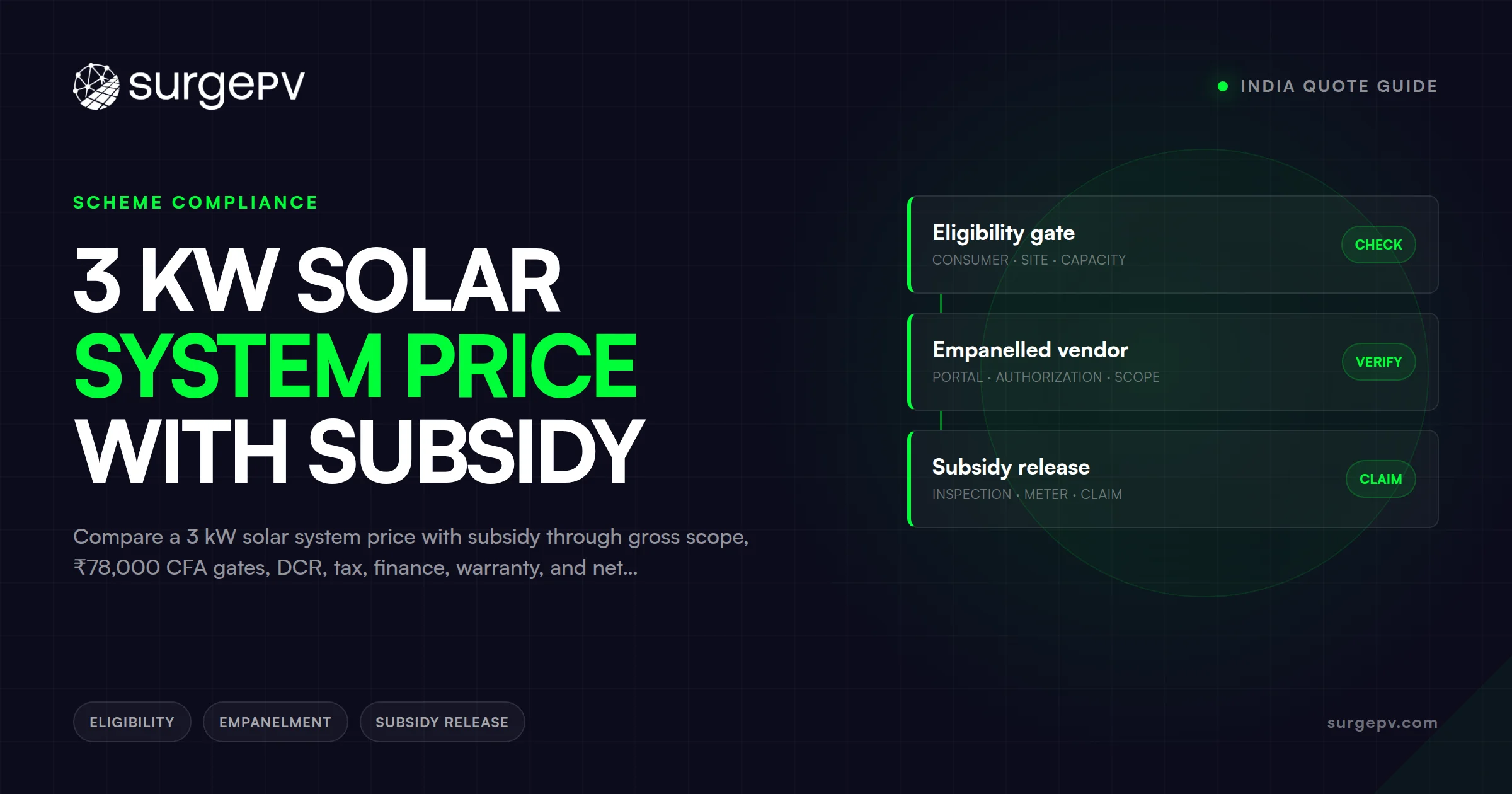
There is no reliable national 3 kW solar system price in India. Eligible residential consumers may receive ₹78,000 central CFA under the published PM Surya Ghar structure. Compare at least 3 dated gross quotes, then verify consumer, DCR, equipment, vendor, DISCOM, inspection, and portal gates before subtracting CFA or calculating net outlay.
The 3 kW solar system price with subsidy is not one dependable national number. A residential array can sit on a tiled house, concrete terrace, sheet roof, or eligible common facility. Each site creates a different structure, cable route, protection plan, approval path, tax invoice, and service obligation.
The first question is also the most frequently missed: what consumer category and account appear on the electricity bill? An eligible residential connection may follow PM Surya Ghar and receive Central Financial Assistance (CFA). Capacity alone does not approve the consumer, equipment, vendor, installation, or claim.
This guide does not publish a supposed all-India price range. It shows how a homeowner can compare gross quotations, verify current CFA gates, and calculate net outlay only after the applicable process is complete.
Quick Answer
There is no reliable national 3 kW solar system price in India. Eligible residential consumers may receive ₹78,000 central CFA under the published PM Surya Ghar structure. Compare at least 3 dated gross quotes, then verify consumer, DCR, equipment, vendor, DISCOM, inspection, and portal gates before subtracting CFA or calculating net outlay.
In this guide:
- How residential eligibility and CFA timing change the net price
- Which line items belong in a complete 3 kW quotation
- How roof, inverter, string, protection, and metering choices change cost
- How to normalize 3 quotations before ranking them
- How to calculate subsidy, generation, savings, and payback without hidden assumptions
- Which payment, commissioning, warranty, and service terms reduce buyer risk
- What a qualified engineer, DISCOM, and tax reviewer still need to confirm
3 kW Solar System Price in India: The Current Answer
The current answer is a process, not a rupee range. Ask 3 qualified bidders to price one signed scope. Compare the gross payable amount first. Apply verified residential CFA later. Then model energy value, finance, operating cost, and replacements with dated assumptions.
A headline such as “3 kW system for ₹X” does not tell you whether the seller means:
- 3 kWp of modules, 3 kW of inverter capacity, or both
- On-grid solar, a hybrid inverter, or a battery-backed system
- A standard sheet roof, a concrete terrace, or a fragile tiled roof
- Module supply only, equipment plus labour, or complete engineering, procurement, and construction (EPC)
- Tax included or excluded
- Net meter and DISCOM work included or excluded
- Existing distribution-board reuse or a new panel and protection package
- Basic monitoring or a commissioned owner account with working alerts
- Product warranty only or labour, travel, removal, freight, and reinstallation support
Those omissions can move the final payable amount after contract signature. A lower starting figure can become the higher completed cost.
Our view is simple: a quote without a locked scope is not cheap. It is incomplete. The buyer should price the missing scope before ranking proposals.
The policy boundary is equally important. The Press Information Bureau’s PM Surya Ghar Cabinet note states ₹30,000 for 1 kW and ₹60,000 for 2 kW. It states ₹78,000 for 3 kW or higher and caps CFA at 3 kW. A 3 kW rating reaches that published standard cap, but it does not guarantee approval or payment.
The Ministry of New and Renewable Energy (MNRE) publishes PM Surya Ghar guidelines. Use the current National Portal and local DISCOM process for the exact consumer. Treat CFA as conditional until the applicable checks and transfer are complete.
Start With Consumer Category, Load, and the Desired Outcome
A buyer should define the connection and objective before requesting a 3 kW price. Capacity is the output of the design process. It should not be the first fixed input merely because a round number looks convenient.
Residential connection
For a home, collect 12 months of electricity bills. Record monthly units, billed demand where shown, sanctioned load, phase, tariff category, and any arrears or account mismatch. Add expected loads such as an electric vehicle, heat pump, lift, or larger air-conditioning system.
Then separate 3 questions:
- How much annual energy can the roof produce?
- How much of that energy can the home use while the system produces it?
- What capacity will the DISCOM accept under the current state procedure?
PM Surya Ghar eligibility does not answer those questions. CFA reduces an eligible consumer’s cash outlay. It does not prove that 3 kW fits the roof, connection, consumption pattern, or export rules.
The March 2026 official implementation update still describes PM Surya Ghar as a residential-sector programme. Treat a residential bill as a necessary starting fact, not a sufficient approval.
Consumer, DCR, Vendor, and Connection Gates
A residential bill is the starting point, not final approval. Match the consumer name, service address, category, account number, sanctioned load, phase, and application contact details.
Check whether the consumer or premises received earlier rooftop assistance. Record the earlier sanctioned capacity, installed capacity, CFA, application, and current portal treatment. Do not assume a new 3 kW request receives the full published cap.
Domestic Content Requirement, or DCR, conditions concern the prescribed origin and use of eligible modules under the current scheme. Obtain the exact module model, manufacturer, factory, invoice identity, serial records, and required declarations before installation.
Use the MNRE Approved List of Models and Manufacturers resources for the applicable module check. ALMM and DCR are different controls. Neither makes an inverter “ALMM-listed.”
Verify the vendor through the current National Portal and DISCOM route for the consumer address. A company website, old registration, another DISCOM listing, or verbal promise does not prove current mapping.
The proposed DC capacity, AC capacity, inverter phase, connection, sanctioned load, export method, meter, and equipment must pass the current process. Obtain feasibility or technical approval where required before locking equipment.
Keep the portal account and one-time passwords under consumer control. Preserve submissions, acknowledgments, approvals, module and inverter evidence, inspection, commissioning, meter details, bank validation, and claim status.
A failed gate can delay or prevent CFA. The contract should state who owns each task, what evidence closes it, and what happens if the current authority rejects the application.
On-grid, hybrid, and backup are different purchases
An on-grid inverter synchronizes with the utility and normally stops energizing the connected circuit during a grid outage. This anti-islanding behaviour protects workers and the network. It means a 3 kW on-grid plant is not automatically a backup system.
A hybrid proposal adds battery and backup functions, but the label is not enough. The quotation must state:
- Continuous backup power and surge limits
- Single-phase or three-phase backup arrangement
- Essential-load board scope
- Battery usable energy, power, voltage, and battery management system compatibility
- Transfer behaviour and restart sequence
- Generator interaction, if any
- Charging priority and reserve settings
- Warranty conditions for the actual operating mode
Compare solar inverter pricing and scope separately from balance-of-system cost. A higher-capacity inverter does not solve a poor battery or protection design.
Build an Itemized Gross-Price Schedule
Every bidder should return the same price schedule. The schedule makes omissions visible and gives the contract a measurable scope. It also separates equipment cost from site risk.
Use the following headings. Add a value, mark “included,” or state a priced exclusion. Do not accept a blank cell.
| Cost group | Required quotation detail | Buyer check |
|---|---|---|
| Survey and design | Site survey, roof measurements, shade model, structural basis, electrical single-line diagram, yield report | Name the deliverable and revision count |
| PV modules | Manufacturer, exact model, rated wattage, quantity, total DC kWp, data sheet, compliance evidence | Confirm model and quantity on invoice |
| Inverter | Manufacturer, exact model, AC kW, phase, MPPT count, voltage and current limits, logger | Match strings and module current |
| Mounting structure | Material grade, coating, rail, clamps, fasteners, ballast or anchors, waterproofing method | Check roof-specific calculation and warranty |
| DC balance of system | Solar cable, connectors, conduit or tray, DC isolation, labels, combiner equipment where used | State make, size, length allowance, and test method |
| AC balance of system | AC cable, breakers, isolator, distribution-board changes, meter cable, labels | Confirm route, size, fault rating, and termination |
| Protection | Surge protection, overcurrent devices, earth-fault measures, lightning study and equipment where required | Require coordination with site and inverter design |
| Earthing | Conductors, electrodes or integration with approved earthing design, pits, bonding, test reports | Avoid pricing by pit count alone |
| Civil and access | Scaffolding, lifting, drilling, trenching, supports, waterproofing, debris removal | State quantity and reinstatement standard |
| Utility and approvals | Application, drawings, inspection support, metering coordination, document submission | Name fees and exclusions |
| Monitoring | Logger, communications device, SIM or internet requirement, owner account, alert setup | Confirm subscription and data ownership |
| Commissioning | Polarity, insulation, earthing, protection, inverter, generation, and monitoring tests | Attach signed results at handover |
| Tax and logistics | Tax basis, freight, insurance, unloading, storage, inter-state supply treatment | Quote gross and show assumptions |
| Warranty and service | Product terms, workmanship term, response target, labour, travel, freight, removal, replacement | Define remedy rather than headline years |
| Operating cost | Cleaning, inspection, connectivity, monitoring fee, planned service | Separate recurring and optional cost |
The Bureau of Indian Standards (BIS) publishes a Scheme II product list for solar photovoltaic modules, inverters, and related categories. Ask for exact-model evidence applicable on the purchase date. A brand brochure or a certificate for another model does not prove compliance for the supplied unit.
Tax should stay visible. The Central Board of Indirect Taxes and Customs notification places specified renewable-energy goods in the 12% schedule. It also describes a 70% goods and 30% taxable-service valuation rule for the stated bundled-supply conditions. Read the CBIC Notification No. 8/2021, then have a tax reviewer confirm how the current transaction and invoice should be classified. Do not copy a tax percentage from another EPC quote.
Price the Engineering Before Pricing the Hardware
At 3 kW, engineering scope can change more than the module brand. The quote should show how the array fits the roof and electrical system. It should not treat design as a free drawing created after equipment purchase.
Roof area, shade, and access
The same 3 kWp DC capacity can use different module counts. Higher-wattage modules may reduce count, but module dimensions, loading, clamp zones, wind behaviour, handling, and replacement availability still matter.
Create a dimensioned roof plan. Mark setbacks, access, drains, tanks, parapets, skylights, vents, antennas, and future maintenance paths. Model shade rather than applying a generic loss percentage.
The Central Electricity Authority’s 2023 safety regulations specify a minimum 75 cm clear roof-access pathway with handrails. They also call for walkways needed for cleaning and maintenance. A final design needs a qualified review for the actual building and applicable rules.
Use solar shadow analysis software to test obstruction and row effects. Record the weather dataset, model version, horizon, and loss assumptions in the proposal. A screenshot without inputs is not a bankable yield case.
Structural design
A concrete terrace, standing-seam metal roof, trapezoidal sheet, tile roof, and aging industrial shed need different attachment and load checks. Ask the structural reviewer to define:
- Existing roof system and observed condition
- Design wind and other applicable loads
- Dead load from modules, rails, ballast, and cable supports
- Load path into the building
- Anchor or ballast calculation
- Waterproofing interface
- Corrosion environment and material compatibility
- Construction tolerances
- Required field inspection and records
“Standard structure included” does not answer these points. If the seller excludes structural verification, obtain it separately before installation.
DC capacity and AC capacity
DC capacity is the sum of module nameplate power. AC capacity is the inverter’s rated alternating-current output. A quote should state both.
The DC-to-AC ratio is:
DC-to-AC ratio = module DC capacity in kWp ÷ inverter AC capacity in kW
A 3 kWp array paired with a 3 kW inverter has a nameplate ratio of 1.00. A 10.8 kWp array paired with a 3 kW inverter has a ratio of 1.08. Neither is automatically better.
A higher ratio can improve inverter use during lower irradiance. It can also increase clipping during strong production and change string current, voltage, roof area, and compliance checks. Require an hourly simulation and manufacturer limits before accepting the ratio.
Strings and maximum power point trackers
A string is a series-connected group of modules. A maximum power point tracker (MPPT) is an inverter input control that tracks an operating point for its connected strings.
The design should show:
- Modules per string
- Number of strings per MPPT
- Cold-condition open-circuit voltage
- Hot-condition operating voltage
- Module current against input and MPPT limits
- Orientation and shade group assigned to each tracker
- Connector and cable compatibility
Do not mix unlike roof planes on one tracker unless the design evidence supports it. Do not assume the number of physical input sockets equals the number of independent MPPTs.
AC integration and protection
At the point of connection, record phase, voltage, sanctioned load or contract demand, cable route, distribution-board rating, breaker capacity, available fault information, metering, and export-control requirements.
The CEA safety rules call for manual grid isolation and protection for overload, surge current, surge voltage, short circuit, temperature, voltage, frequency, polarity, and lightning risks. They also address earthing, overcurrent protection, isolation, earth-fault protection, and insulation monitoring.
The exact devices and settings still depend on the project. A copy-pasted single-line diagram is not enough. A qualified engineer should coordinate the inverter, cables, breakers, surge protective devices, isolators, earthing, and existing board.
Calculate Residential CFA Without Distorting the Quote
For a standard eligible residential consumer, the published central CFA calculation reaches its cap at 3 kW. The first 2 kW use ₹30,000 per kW. The next 1 kW uses ₹18,000. Additional capacity above 3 kW receives no additional standard CFA under the cited structure.
The arithmetic is:
Eligible CFA = (2 kW × ₹30,000/kW) + (1 kW × ₹18,000/kW) = ₹78,000
For a 3 kW residential project, the cited standard calculation reaches ₹78,000. Treat that amount as potentially eligible, not as approved or received.
This is the correct order for comparing prices:
- Compare the full gross price before CFA.
- Verify residential consumer eligibility on the current National Portal.
- Verify vendor and equipment requirements.
- Obtain DISCOM feasibility and follow the required application route.
- Complete installation, inspection, metering, commissioning, and portal documentation.
- Treat CFA as received only when the applicable process confirms and transfers it.
Do not accept a net price that hides the gross amount.
A failed or delayed claim would expose the consumer to the gross obligation.
The scheme can change. Consumer facts can also disqualify a claim. Confirm the current application date, connection category, account holder, prior subsidy, equipment rules, vendor status, banking details, and DISCOM records.
The 5 kW subsidy guide shows why capacity beyond 3 kW should be priced on marginal value, not an assumed extra central benefit.
Eligibility and Payment Gate Table
| Gate | Evidence to verify | Do not assume |
|---|---|---|
| Consumer | Current residential bill, account holder, address, category | A residential-looking property is eligible |
| Prior CFA | Earlier application, capacity, payment, portal record | A second installation starts from zero |
| Capacity | Approved DC and AC ratings, sanctioned load, phase | A 3 kW quote is automatically accepted |
| DCR | Current scheme documents, module identity, declarations | “Made in India” marketing proves DCR |
| Equipment | Exact module and inverter evidence, serials, invoices | A brand name covers every model |
| Vendor | Current portal and DISCOM mapping for the address | An old vendor certificate remains current |
| Connection | Feasibility, export, meter, protection, approvals | Net metering follows one national procedure |
| Installation | Approved design, delivered equipment, workmanship records | The quote proves the installed plant |
| Inspection | DISCOM or authority evidence and closed observations | Commissioning alone triggers CFA |
| Banking | Consumer-controlled verified account and portal status | Installer discount equals government transfer |
| CFA receipt | Official status and actual transfer | A pending amount is cash in hand |
A group housing society or resident welfare association common-facility project has separate current conditions. Do not treat it as an individual household application.
Normalize Three Quotations Before Ranking Them
Quote normalization converts each proposal to the same scope. It prevents a seller from winning by omitting work that another seller included.
Use this formula:
Normalized gross price = quoted gross price + priced exclusions + scope corrections + risk allowances - verified duplicate items
Then calculate:
Expected residential cash outlay = normalized gross price - verified CFA received
Do not subtract a pending claim. Record it separately as a receivable until paid.
Step 1: freeze the common technical brief
Issue one brief with the same:
- Project address and consumer category
- Bill and sanctioned-load data
- Target DC and AC capacity
- On-grid or hybrid topology
- Roof survey and structural responsibility
- Module and inverter acceptance criteria
- Protection, earthing, and distribution-board scope
- Cable route and length basis
- Approval and metering responsibility
- Monitoring and communications requirement
- Testing and handover documents
- Warranty remedy and response expectations
If a bidder proposes a different design, it should price the difference and explain the reason.
Step 2: create an exclusion price
Ask each bidder to price its own exclusions. If it refuses, obtain an independent price or mark the risk as unresolved.
Common exclusions include:
- Scaffolding and lifting
- Roof repair and waterproofing
- Structural reinforcement
- AC panel or breaker replacement
- Extra cable beyond a short allowance
- Trenching and reinstatement
- Utility fees and meter work
- Internet, SIM, or monitoring subscriptions
- Taxes and freight
- Labour for warranty replacement
Step 3: compare warranty remedy
Product warranty years are not enough. Ask who diagnoses the fault, who visits the site, who removes the product, who pays freight, who reinstalls it, and what happens while approval is pending.
A 10-year product warranty with no local labour remedy may cost more than a shorter written service package. Price travel and downtime where service matters.
Step 4: score evidence and contract control
Use pass or fail gates before price scoring:
| Gate | Pass evidence |
|---|---|
| Legal supplier | Quotation, tax identity, bank account, and contract entity match |
| Site design | Dimensioned plan, string plan, single-line diagram, and stated assumptions |
| Equipment | Exact models, quantities, current data sheets, and applicable compliance evidence |
| Roof | Structural responsibility, attachment method, and waterproofing detail |
| Electrical | Cable, breaker, protection, earthing, and connection scope defined |
| Utility | Application, metering, testing, and approval responsibilities assigned |
| Warranty | Product, workmanship, labour, freight, response, and escalation stated |
| Handover | Test reports, manuals, credentials, drawings, serials, invoices, and certificates listed |
Only rank proposals that pass the non-negotiable gates.
Normalize Gross Price and Net Outlay Without Inventing a Market Rate
Use variables from current quotations rather than a national price estimate.
For each bidder, define:
- Q as the dated gross quoted amount
- E as priced exclusions needed to reach the common scope
- C as corrections for quantity, equipment, tax, or responsibility differences
- D as verified duplicate items already priced elsewhere
- F as CFA actually received under the applicable process
- L as financing charges paid by the consumer
- R as roof, electrical, maintenance, or replacement cost outside the accepted EPC scope
Then calculate:
Normalized gross price = Q + E + C - D.
Cash paid before CFA = normalized gross price + payment-linked finance charges
due before transfer
.
Net outlay after actual CFA receipt = normalized gross price - F + L + R
.
Do not set F to ₹78,000 merely because the proposal says 3 kW. Use zero in the committed-cash case until eligibility and payment are verified. Show ₹78,000 only as a conditional case supported by current official terms.
Compare 3 quotes on one worksheet
| Comparison line | Quote A | Quote B | Quote C |
|---|---|---|---|
| Seller’s gross quoted amount | Current quote | Current quote | Current quote |
| Missing roof or structure work | Priced value | Priced value | Priced value |
| Missing electrical or protection work | Priced value | Priced value | Priced value |
| Utility, meter, and application exclusions | Priced value | Priced value | Priced value |
| Tax and freight correction | Priced value | Priced value | Priced value |
| Monitoring and service correction | Priced value | Priced value | Priced value |
| Normalized gross price | Calculated | Calculated | Calculated |
| Conditional CFA case | Separately shown | Separately shown | Separately shown |
| Net outlay after actual receipt | Calculated later | Calculated later | Calculated later |
A proposal that looks cheaper can become more expensive after roof repair, board work, freight, tax, utility work, or warranty labour is added.
Keep the seller’s price, normalized gross price, conditional CFA, actual CFA received, finance cost, and final net outlay as separate fields. This makes the transaction auditable.
Map the CFA Process and Payment Timing
A net price can hide a cash-flow gap. The consumer may need to pay contractual milestones before the government transfer arrives. Finance that gap explicitly.
Use a project-specific process map:
- Confirm the current residential consumer, address, connection, prior CFA, and portal access.
- Submit the application and obtain feasibility or technical approval where required.
- Select a currently mapped vendor and freeze exact compliant equipment.
- Approve roof, structure, electrical design, scope, gross price, tax, exclusions, and payment gates.
- Verify delivery against the approved module and inverter records.
- Install under the approved design and preserve serial, invoice, and workmanship evidence.
- Complete testing, portal submissions, inspection, meter work, and commissioning.
- Close authority observations and submit required banking or claim information.
- Track official status and treat CFA as received only after transfer.
- Retain the full handover, warranty, monitoring, and service record.
Separate gross commitment from interim cash need
The contract should state every payment milestone, amount basis, evidence, due date, retention, and refund or cure right. It should also state whether any amount depends on CFA timing.
Do not let the installer describe government CFA as its own discount. The gross EPC price, consumer payments, lender disbursements, government transfer, and any state benefit are separate transactions.
If a loan covers the gross price, model interest from each disbursement date. If the consumer bridges expected CFA from savings or credit, record the cost and downside if transfer is delayed or rejected.
Contract a failed-CFA case
The homeowner remains exposed when CFA does not arrive. Contract language should answer:
- Who was responsible for consumer, vendor, equipment, DCR, document, inspection, or banking errors?
- Which facts were disclosed by the consumer?
- Which eligibility statements were warranties, assumptions, or estimates?
- Can the project pause before irreversible procurement if approval is missing?
- What correction, refund, replacement, or appeal support applies?
- Who pays removal or replacement if noncompliant equipment was supplied?
- Does the consumer still owe the full gross price during a dispute?
A seller cannot guarantee a government decision. It can accept responsibility for its own equipment, documents, representations, and process duties.
Model Generation, Savings, and Payback With Stated Inputs
Generation is not 3 kW × sun hours without further definition. Use a documented energy simulation. State the weather source, time period, plane-of-array irradiance, orientation, shade, module model, inverter model, DC-to-AC ratio, temperature model, soiling, mismatch, wiring, availability, clipping, and degradation assumptions.
The annual generation formula is:
Annual generation = DC capacity × annual specific yield
Specific yield is measured in kilowatt-hours per kilowatt-peak per year (kWh/kWp/year). It is a modeled site output, not a national constant.
Use PV design software to keep the roof model, equipment, loss assumptions, and energy result in one project record. Use the PV generation and financial modeling to connect the technical result with tariffs and cash flow.
Value self-consumption and export separately
Solar used behind the meter can avoid a retail import charge. Export may receive a different value or may be restricted. The basic formula is:
Annual energy value = (self-consumed kWh × avoided import value) + (exported kWh × verified export value)
Do not value all generation at the retail tariff unless every solar kWh truly offsets an import at that rate. A home that exports at noon and imports at night has 2 different value streams.
The concept of net metering does not establish the local settlement method. Verify the state regulation, DISCOM procedure, meter arrangement, billing method, capacity limits, and application date.
Sensitivity table using hypothetical inputs
The table below uses a 3 kWp plant, ₹8.50 per kWh avoided import value, and ₹2.50 per kWh export value. These are teaching assumptions only.
| Annual specific yield | 50% self-use | 70% self-use | 90% self-use |
|---|---|---|---|
| 1,250 kWh/kWp | ₹68,750 | ₹83,750 | ₹98,750 |
| 1,450 kWh/kWp | ₹79,750 | ₹97,150 | ₹1,14,550 |
| 1,650 kWh/kWp | ₹90,750 | ₹1,10,550 | ₹1,30,350 |
This table shows why a single generation or payback claim is misleading. With the same 3 kWp nameplate, the assumed first-year value ranges from ₹68,750 to ₹1,30,350.
Add lifecycle variables
Simple payback ignores cash-flow timing. A more useful model includes:
- Initial gross outlay
- Date and probability of any subsidy receipt
- Loan drawdown, fees, interest, and repayment
- Annual generation and degradation
- Self-consumption by time interval
- Import tariff and fixed-charge treatment
- Export value and curtailment
- Cleaning, inspection, communications, and insurance
- Inverter or component replacement scenarios
- Downtime and warranty response
- Tax effects confirmed by a professional
- Discount rate and residual value
The net present value (NPV) formula discounts each future cash flow:
NPV = sum of each year's net cash flow ÷ (1 + discount rate)^year - initial outlay
The internal rate of return (IRR) is the discount rate that makes NPV equal zero. Neither metric is trustworthy when the yield, tariff, replacement, or tax case is hidden.
Use 3 cases
Create downside, base, and upside cases. Change the variables that matter, not every variable at once.
| Case | Yield | Self-use | Downtime | Replacement | Tariff and export basis |
|---|---|---|---|---|---|
| Downside | Lower verified sensitivity | Lower load overlap | Higher | Earlier or higher cost | Conservative |
| Base | Engineering estimate | Measured or defensible profile | Normal planned allowance | Stated expected case | Current dated case |
| Upside | Higher verified sensitivity | Better load scheduling | Lower | Later or lower cost | Limited, stated upside |
Do not present the upside case as the sales headline. Present all 3 with inputs.
Compare Cash, Loan, and Lifecycle Cost
Financing changes timing, not the plant’s physical output. Compare the total project cost and financing cost separately.
For a loan, record:
- Amount financed
- Down payment
- Disbursement date
- Annual interest rate and whether it is fixed or floating
- Reducing-balance or flat-rate method
- Tenor
- Processing fee
- Insurance
- Security or collateral
- Prepayment charge
- Subsidy sweep or mandatory repayment condition
- Total repayment
Hypothetical loan calculation
Assume ₹4,00,000 financed for 60 months at a nominal 10% annual reducing-balance rate. Ignore fees and insurance only for this teaching calculation.
The monthly rate is 10% ÷ 12. The equated monthly instalment (EMI) formula gives about ₹8,499. Total repayment is about ₹5,09,929. Total interest is about ₹1,09,929.
These figures are not a current loan offer. Obtain a lender schedule and compare annual percentage cost, fees, timing, and prepayment terms.
Solar savings will not match EMI every month. Monsoon production, seasonal loads, export settlement, billing cycles, and fixed charges create timing differences. Maintain a cash buffer.
Lifecycle-cost worksheet
| Cost or value | When | Evidence |
|---|---|---|
| Gross EPC payment | Contract milestones | Itemized quote and invoices |
| Subsidy receipt | After applicable verification | Portal and bank record |
| Loan and fees | Monthly or scheduled | Lender amortization table |
| Cleaning and inspection | Planned intervals | Service scope or owner budget |
| Connectivity | Monthly or annual | SIM, data, or internet requirement |
| Corrective maintenance | Scenario | Written labour and parts remedy |
| Inverter replacement | Sensitivity year | Replacement scenario, not promise |
| Energy value | Monthly or annual | Bill, load profile, simulation, export terms |
| Residual value | End of model | Conservative stated assumption |
Use solar proposal software to keep technical scope, commercial assumptions, versions, and approvals together. A PDF should show the version date and who approved each financial input.
Put Scope, Payment, and Change Control in the Contract
A detailed quotation still needs a controlled contract. The contract should tie payment to verifiable delivery, not merely elapsed time.
Recommended payment gates
The percentages must be negotiated for the project. Use gates such as:
- Contract signature after scope, models, price, tax basis, and exclusions are agreed
- Design approval after roof plan, structure basis, string plan, single-line diagram, and energy model are accepted
- Equipment delivery after model, quantity, serial, condition, and invoice checks
- Mechanical completion after structure, modules, cables, labels, and waterproofing inspection
- Electrical completion after protection, earthing, boards, isolation, and test readiness
- Grid and metering milestone after the applicable DISCOM step
- Final handover after commissioning tests, monitoring access, documents, training, and defect closure
Avoid paying nearly all contract value before commissioning and document delivery. Retain enough value to correct open defects.
Change-order control
No site change should proceed on a verbal price. A change order should state:
- Reason for change
- Drawing or scope reference
- Added and removed quantity
- Price and tax effect
- Schedule effect
- Energy-model effect
- Warranty effect
- Approval names and date
This process prevents cable, structure, board, and civil variations from becoming a surprise final bill.
Exclusions must be specific
“Civil work excluded” is too broad. It can hide trenching, supports, roof repair, waterproofing, equipment pads, debris removal, and reinstatement.
Replace broad language with measured boundaries. Example: “Price includes 18 m of exposed AC tray from inverter to existing panel. Concealed routing, wall repair, and cable beyond 18 m require a signed change order.”
Inspect, Test, and Document the Completed 3 kW System
Handover should prove that the installed plant matches the approved design and works safely. It should not consist only of an inverter photo and a mobile-app screenshot.
The qualified commissioning team should define and perform applicable tests. The owner should receive signed results.
Physical and mechanical checks
- Module manufacturer, model, quantity, and serial records
- Array layout against approved drawing
- Clamp position and torque records where specified
- Structure fasteners, anchors, ballast, and corrosion protection
- Roof penetrations and waterproofing
- Cable support, bend, segregation, and mechanical protection
- Access path, drainage, and maintenance clearance
- Labels and durable identification
Electrical checks
- Polarity and string open-circuit voltage comparison
- Insulation resistance using an approved procedure
- Protective conductor continuity
- Earthing measurements and records
- Breaker, fuse, isolator, and surge-device ratings
- Protection settings and coordination
- Inverter start, stop, fault, and grid-disconnection behaviour
- Meter direction and export-control test where applicable
- Phase readings and balance where relevant
- Monitoring values compared with local readings
Documents and digital ownership
- Final roof plan and single-line diagram
- Structural calculation or signed design basis
- String schedule
- Equipment data sheets and applicable certificates
- Invoices with exact models and serials
- Product and workmanship warranty documents
- Commissioning and test reports
- DISCOM and metering records
- Monitoring owner account and administrator transfer
- Password and recovery ownership
- Service contact, response route, and escalation
- Cleaning and maintenance instructions
- Change orders and as-built drawings
The owner should control the monitoring account. A dealer-only account creates avoidable risk if the dealer closes or the relationship ends.
Misconceptions and Tradeoffs That Change the Price
Several common shortcuts make 3 kW offers look comparable when they are not.
Misconception 1: 3 kW means one standard bill of materials
It does not. Roof planes, module electrical characteristics, inverter inputs, cable routes, protection, structure, and approvals can differ. The nameplate is only one design input.
Misconception 2: every 3 kW home automatically receives ₹78,000
The cited standard central CFA reaches ₹78,000 at 3 kW or higher. Capacity beyond 3 kW receives no additional CFA under that published structure. Verify current terms before purchase.
Misconception 3: the lowest rupees per watt is the best quote
Rupees per watt can help only after scope normalization.
Normalized rupees per watt = normalized gross price ÷ installed DC watts
Even then, it does not show yield, uptime, service, finance, or lifecycle cost. Use it as one procurement check, not the verdict.
Tradeoff 1: premium equipment versus local remedy
A higher equipment price can be rational if the exact model fits the design and the service remedy is stronger. Brand reputation does not replace a written local process.
Tradeoff 2: DC oversizing versus clipping
More DC capacity can improve low-light energy and inverter utilization. It also uses more roof, changes strings, and can increase clipping. Compare annual energy and cost, not nameplate alone.
Tradeoff 3: battery backup versus bill savings
A battery can provide outage support and shift energy. It adds capital, controls, losses, replacement exposure, and service dependencies. Define essential loads and autonomy before asking for battery capacity.
Tradeoff 4: cheapest structure versus roof risk
Reducing metal or anchors without an engineering basis can transfer cost into leakage, movement, corrosion, or roof damage. Require a roof-specific design and inspection.
The exception
A simple, accessible, sound roof with a short cable route and spare panel capacity can reduce site cost. That result still needs a survey. Never assume the exception before inspection.
A Practical 3 kW Buying Sequence
Use this order to keep technical and financial decisions connected:
- Verify the bill category, account holder, sanctioned load or contract demand, phase, and address.
- Define whether the goal is bill reduction, backup, export control, or a combination.
- Collect bills and interval load where available.
- Survey the roof, structure, shade, access, cable route, and electrical board.
- Confirm state and DISCOM requirements in writing.
- Issue one technical and commercial request to at least 3 qualified bidders.
- Reject proposals that fail legal, equipment, engineering, safety, utility, warranty, or handover gates.
- Normalize the remaining gross quotes.
- Verify CFA separately and keep a zero-CFA committed-cash case until receipt.
- Run generation, self-consumption, export, finance, and lifecycle sensitivities.
- Tie payment to design, delivery, installation, commissioning, and handover evidence.
- Obtain qualified structural, electrical, DISCOM, and tax review before final commitment.
The broader solar panel installation cost guide can help you compare other capacities. For design control, build the roof and equipment case in a solar design platform before issuing the final commercial offer.
Conclusion
There is no defensible single 3 kW solar system price for every Indian buyer. A reliable comparison starts with consumer category, site evidence, one common scope, and 3 dated gross quotations.
Take these 3 actions:
- Separate gross price and conditional CFA. Apply ₹78,000 only after current consumer, DCR, vendor, equipment, portal, and DISCOM verification.
- Normalize scope before price. Add exclusions, tax, board work, structure, approvals, monitoring, warranty labour, and service to each gross offer.
- Test the cash flow. Use site-specific generation, measured load overlap, current tariff, verified export treatment, finance, operating cost, and replacement sensitivities.
The best proposal is the one whose design, price, responsibilities, and remedy remain clear after scrutiny. The lowest headline total is not enough.
Build a Traceable 3 kW Design and Financial Case
Model the roof, equipment, losses, generation, and buyer assumptions in one controlled project before issuing the proposal.
Book a Demo
No commitment required · 20 minutes · Live project walkthrough
Frequently Asked Questions
What is the price of a 3 kW solar system in India?
India has no reliable universal 3 kW installed price. The payable amount depends on the site, exact equipment, structure, electrical work, protection, approvals, tax, warranty, and service. Compare at least 3 dated itemized quotes on one common scope sheet.
How much subsidy is available for a 3 kW residential solar system?
The published PM Surya Ghar structure provides ₹30,000 per kW for the first 2 kW. It provides ₹18,000 for the next 1 kW. Standard central CFA is therefore capped at ₹78,000 for 3 kW or higher. Confirm current eligibility on the National Portal and with the local DISCOM before signing.
Who can receive CFA for a 3 kW residential solar system?
Capacity alone does not create eligibility. Verify the residential consumer, connection, application date, prior CFA, sanctioned capacity, DCR, equipment, vendor mapping, and DISCOM approval. Then verify installation, inspection, commissioning, bank details, and portal status under the current official process.
How many units does a 3 kW solar system generate?
Capacity alone cannot answer that question. Annual generation equals DC capacity multiplied by the site-specific annual yield in kWh per kWp. Shade, weather data, orientation, temperature, DC and AC sizing, downtime, and loss assumptions must be stated in the simulation.
Is a 3 kW system always three phase?
Do not assume a national rule. The existing connection, sanctioned load or contract demand, state regulation, DISCOM procedure, inverter approval, and protection study determine the accepted arrangement. Obtain written confirmation for the project address before equipment purchase.
Should I choose on-grid, hybrid, or battery storage at 3 kW?
Choose topology from the required outcome. On-grid solar usually targets bill reduction and stops during an outage. A hybrid system adds backup controls and battery compatibility. Its 3 kW inverter rating does not prove 3 kW of backup output or adequate battery autonomy.
What should a 3 kW solar quotation include?
It should state DC and AC capacity, exact module and inverter models, quantities, structure, cables, protection, and earthing. It should define civil and electrical work, approvals, metering, monitoring, tests, tax, freight, warranty remedy, service response, exclusions, payment gates, and handover documents.
How should I compare payback for a 3 kW system?
Use net cash outlay, a site-specific generation model, self-consumption by interval, the applicable retail tariff, and a verified export-credit method. Add operating costs, degradation, downtime, replacements, finance, and tax effects. Test downside and upside cases instead of relying on one payback number.
Sources
Primary research and reference material used for this desk-research article.
Where this fits
This article is part of SurgePV's Solar Incentives & Policy hub, which works through the topic from first principles to the decisions a project team actually has to make.

