

Quick Answer
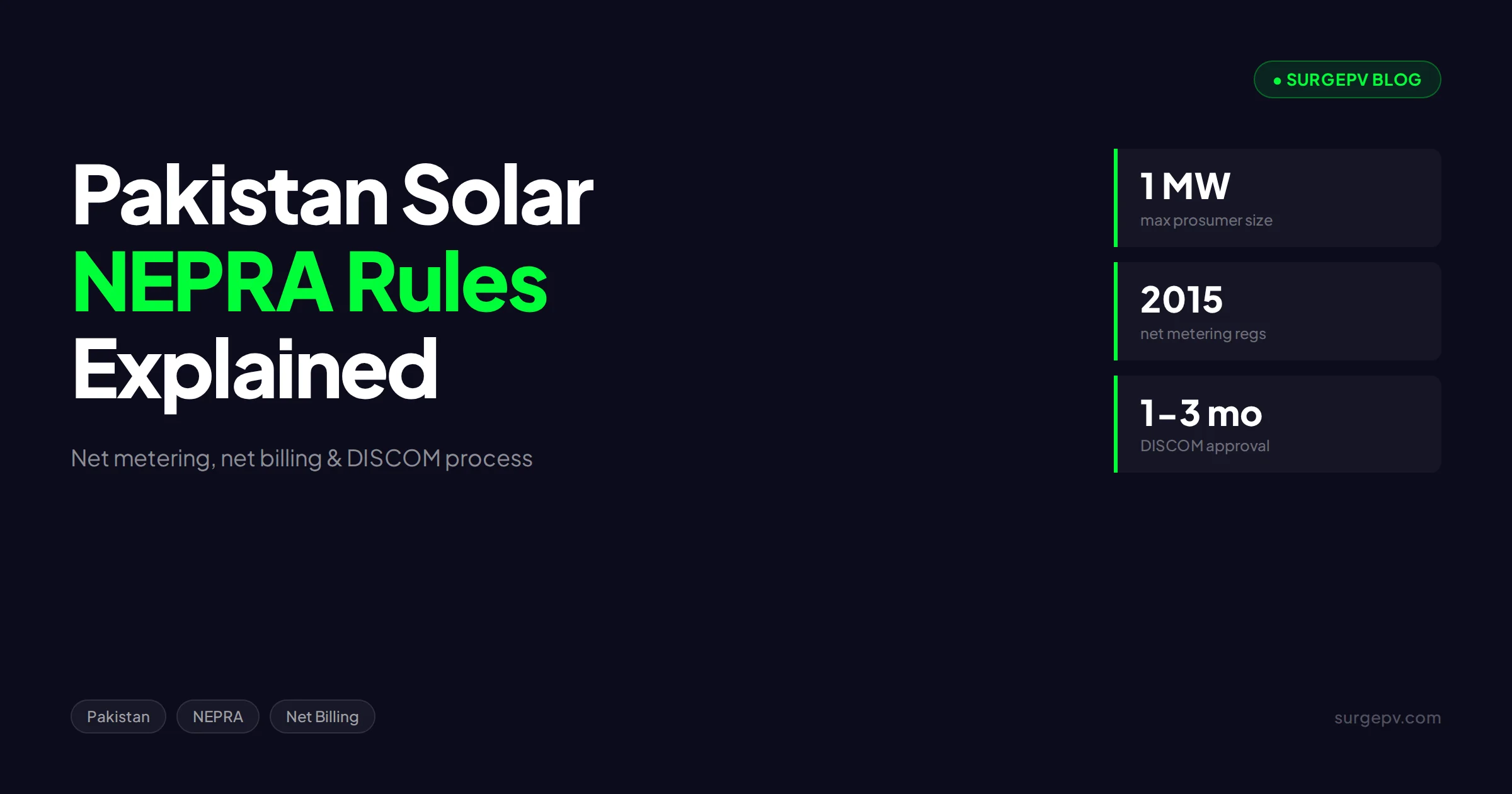
Pakistan's rooftop solar is governed by NEPRA's Distributed Generation and Net Metering Regulations (2015, amended). Consumers up to 1 MW can interconnect through their DISCOM with a bi-directional meter. NEPRA approved a shift from retail net metering to net billing for new prosumers in 2024–26, cutting export compensation sharply. No generation license is needed for net-metered systems.
Pakistan has one of the fastest-growing distributed solar markets in Asia — driven not by subsidy but by grid tariffs that crossed Rs 60/kWh for many consumers and chronic load-shedding. Rooftop and captive C&I solar grew from a niche to several gigawatts of estimated capacity in just a few years, according to NEPRA’s State of Industry reporting. That growth collided with grid economics, and the result is the regulatory shift every installer in Pakistan now works around: the move from retail net metering to net billing.
This guide covers the framework as it stands: NEPRA’s role and the 2015 Net Metering Regulations, the prosumer application process through the DISCOMs, the net billing transition and what it does to project economics, equipment and technical standards, and the compliance checklist for installers.
Quick Answer
Pakistan’s rooftop solar is governed by NEPRA’s Distributed Generation and Net Metering Regulations (2015, amended). Consumers up to 1 MW can interconnect through their DISCOM with a bi-directional meter. NEPRA approved a shift from retail net metering to net billing for new prosumers in 2024–26, cutting export compensation sharply. No generation license is needed for net-metered systems.
TL;DR — Pakistan Solar Rules
Regulator: NEPRA. Framework: Net Metering Regulations 2015 (amended), systems 1 kW–1 MW via DISCOM application, bi-directional meter. Shift in progress: net billing replaces retail credit for new prosumers, with exports paid at a low purchase rate instead of offsetting retail units. Design implication: size for self-consumption, not export.
In this guide:
- NEPRA and the regulatory structure
- The 2015 Net Metering Regulations: how they work
- The DISCOM application process step by step
- The net billing transition and project economics
- Equipment and technical standards
- C&I and captive solar rules
- Installer compliance checklist
NEPRA and the Regulatory Structure
The National Electric Power Regulatory Authority (NEPRA) is Pakistan’s federal power regulator, established under the 1997 Electric Power Act. Its role in distributed solar: issuing the net metering regulations, approving tariff and buyback determinations, and licensing generation above the distributed-generation threshold.
Below NEPRA sit the distribution companies (DISCOMs) — LESCO (Lahore), IESCO (Islamabad), K-Electric (Karachi), FESCO, MEPCO, PESCO, GEPCO, HESCO, SEPCO, QESCO, and TESCO. K-Electric is privately run; the rest are state-owned. Each DISCOM processes net metering applications, conducts technical reviews, signs the net metering agreement, and installs the bi-directional meter. NEPRA writes the rules; the DISCOMs execute them — with considerable variation in speed and rigor. NEPRA’s determinations and the regulation text are published on the NEPRA website.
The 2015 Net Metering Regulations: How They Work
NEPRA’s Distributed Generation and Net Metering Regulations, notified in September 2015, made Pakistan one of the earlier South Asian markets with a formal net metering framework. The core mechanics:
- Eligibility: any consumer of a DISCOM, with a distributed generation facility (solar or wind) from 1 kW to 1 MW.
- Prosumer status: the consumer becomes a “distributed generator” without needing a generation license — NEPRA exempted net-metered systems from licensing.
- Metering: the DISCOM installs a bi-directional meter recording import and export separately.
- Compensation: exported units historically credited against imported units on the monthly bill — effectively retail-rate netting, with excess carried forward.
- Agreement: a standardized net metering agreement between consumer and DISCOM, typically running with the connection.
These mechanics produced the boom: with residential and commercial retail tariffs among the highest in the region, every self-consumed or netted kWh avoided a very expensive grid kWh.
The DISCOM Application Process
The standard path from contract to energized net metering:
- Application to the DISCOM with consumer details, sanctioned load, system size, single-line diagram, and equipment specs.
- Technical review: the DISCOM checks transformer loading, feeder capacity, and protection requirements. Oversized applications relative to sanctioned load get rejected or require a load extension first.
- Approval and agreement: the DISCOM issues approval; the consumer signs the net metering agreement.
- Installation by the installer to DISCOM technical standards.
- Inspection and meter installation: the DISCOM inspects, replaces the meter with a bi-directional unit, and energizes export.
Regulatory timelines put the process at roughly 1–3 months. In practice, installers report wide variance — some IESCO and LESCO applications clear in weeks; backlogged offices take longer. Build the approval window into project cash-flow planning, because most financing milestones hang off meter installation.
The Net Billing Transition
The policy issue: as distributed solar scaled into the gigawatts, exported solar at retail credit shifted grid fixed costs onto non-solar consumers. The government reviewed the framework, and NEPRA moved to convert new prosumers from retail netting to net billing — exports purchased at a low rate (linked to the national average energy purchase price, roughly a third or less of typical retail tariffs) while imports bill at full retail.
Practical consequences for new projects:
- Export value collapses. Selling surplus to the grid is no longer the business case; avoiding grid purchases is.
- Sizing inverts. Optimal design targets daytime self-consumption — typically 60–90% of daytime load for C&I, and modest residential systems matched to daytime use.
- Batteries become the margin product. With evening grid power expensive and exports cheap, storage that shifts solar to evening self-consumption carries the project economics.
- Existing prosumers: systems already under net metering agreements have generally retained their contracted terms — but installers should verify the current determination, because the political pressure on legacy terms is real.
For proposals, this means modeling the actual post-transition purchase rate, not the retail offset. A generation and financial tool that separates self-consumption value from export value is mandatory in this market — annual netting spreadsheets now mis-state returns by a wide margin.
Pro Tip
In net-billing Pakistan, the pitch that survives scrutiny is “avoid Rs 55–65/kWh of grid purchases,” not “sell power back.” Anchor proposals on avoided cost with the customer’s actual tariff slab, and treat export revenue as a small bonus line.
Equipment and Technical Standards
DISCOM technical requirements center on the inverter: it must be a certified grid-tie inverter with anti-islanding protection (automatic disconnection during grid outages — critical in a market with frequent load-shedding). Hybrid inverters paired with batteries must be configured so battery-backed loads do not export during outages.
Other standards that show up in DISCOM reviews:
- System size consistent with sanctioned load.
- Proper AC/DC protection: breakers, surge protection, earthing.
- Single-line diagram signed by the installer.
- Bi-directional meter supplied and installed by the DISCOM, at the consumer’s cost.
For inverter selection in the Pakistani market, treat voltage fluctuation and outage frequency as design inputs rather than edge cases. Verify the exact model’s local certification, grid settings, battery compatibility, warranty route, and commissioning support in Pakistan instead of extrapolating claims from another country.
C&I and Captive Solar
Much of Pakistan’s solar growth is captive C&I: factories installing solar — often with storage or diesel hybridization — primarily for self-supply, with or without net metering. Captive systems that never export can operate without a net metering agreement, though grid parallel operation still requires DISCOM technical compliance.
For C&I prosumers, the economics post-transition still work: industrial tariffs with demand charges make self-consumed solar extremely valuable, while export revenue was always secondary. The design emphasis shifts to load matching — sizing solar against the factory’s daytime load curve rather than its total annual consumption. Physics-based shading analysis software and hourly production simulation from a cloud design platform matter here, because a mismatched 500 kW roof exports midday surplus at the low purchase rate.
For comparison, neighboring India runs a similar DISCOM-level net metering regime with its own caps and banking rules — Heaven Green Energy’s India net metering guide is a useful contrast for regional installers working both markets.
Quote Pakistan Projects on Self-Consumption, Not Export
SurgePV models hourly production against your customer’s load — so net-billing proposals show the real payback.
Book a DemoNo commitment required · 20 minutes · Live project walkthrough
Installer Compliance Checklist
Before quoting any grid-tied system in Pakistan:
- Confirm the current NEPRA determination on buyback rates — the framework is actively changing.
- Verify sanctioned load and whether the application needs a load extension first.
- Specify inverters on the DISCOM’s accepted list with anti-islanding certification.
- Budget the bi-directional meter cost and the DISCOM processing window into the project plan.
- Document the agreement terms — especially the compensation basis — in the customer file.
- For hybrid systems, configure export blocking for outage operation and note it in the inspection documents.
Taxes, Duties, and Equipment Costs
Pakistan’s solar hardware economics have been shaped by import policy. Solar panels have generally enjoyed favorable duty treatment to encourage adoption, while inverters and batteries have faced varying sales tax and duty regimes across budget cycles. The federal budget in recent years introduced or adjusted taxes on solar equipment, so the landed cost of modules and hybrid inverters can shift 10–20% between fiscal years.
For installers, the practical rules: quote equipment prices with a validity window (30 days is standard), track the current fiscal year’s duty schedule before large procurement commitments, and pass duty changes through as a documented surcharge rather than absorbing them. Module prices in Pakistan have tracked the global oversupply downward — but the rupee’s depreciation has clawed back much of that benefit for local buyers.
Provincial Variations Worth Knowing
Net metering is federal, but the operating environment is provincial:
- Punjab (LESCO, MEPCO, FESCO, GEPCO): the largest rooftop market; LESCO processes the highest application volumes.
- Sindh (K-Electric, HESCO, SEPCO): K-Electric runs its own privatized process with separate queues and its own tariff determinations.
- KP (PESCO) and Balochistan (QESCO): lower volumes, longer processing variance, weaker transformer infrastructure in rural feeders — technical rejections for capacity are more common.
The application paperwork is similar everywhere; the processing culture is not. Installers working multiple provinces report that maintaining a DISCOM-specific contact and checklist per region is the difference between 4-week and 4-month approvals.
What Most Installers Get Wrong
The dominant error is selling legacy net metering economics in a net billing market. Proposals quoting unit-for-unit offset for new systems overstate savings substantially — and Pakistani consumers are increasingly sophisticated enough to catch it, or to feel burned when the first bill arrives.
Second: ignoring sanctioned load. Systems designed above the connection’s sanctioned load stall at technical review, wasting weeks. Check the electricity bill before the site survey.
Third: undersizing protection and earthing to hit a price point. DISCOM inspections have tightened as volumes grew; failed inspections now cost real schedule time. The exception: pure off-grid hybrid systems with no grid export face far lighter review — which is why a growing share of the residential market skips net metering entirely and designs for zero export.
Conclusion
Pakistan’s solar market runs on avoided cost now, not export revenue. Three actions this week:
- Pull the current NEPRA buyback determination and rebuild your proposal template’s export assumptions.
- Re-train sales teams on the self-consumption pitch — avoided tariff slabs, not sell-back.
- Add sanctioned-load verification to your lead intake form.
To model load-matched designs with honest net-billing financials, book a SurgePV demo. For the mechanics of net billing generally, read our net metering installer reference and the net billing glossary entry.
Frequently Asked Questions
What is NEPRA and what does it regulate?
NEPRA is the National Electric Power Regulatory Authority of Pakistan, created under the Regulation of Generation, Transmission and Distribution of Electric Power Act 1997. It licenses generation, sets tariffs, and issues the Distributed Generation and Net Metering Regulations that govern rooftop solar interconnection.
How does net metering work in Pakistan?
Under NEPRA’s 2015 Net Metering Regulations, a consumer (prosumer) installs solar up to 1 MW, applies through the local DISCOM, and gets a bi-directional meter. Exported units historically offset imported units at the retail tariff, credited on the monthly bill. Systems are approved within a defined processing period after technical review.
Did Pakistan end net metering for solar?
Pakistan has been transitioning from retail net metering to net billing. Following government review of buyback costs, NEPRA approved replacing unit-for-unit retail credit with a lower purchase rate for exported energy for new prosumers, while existing net-metered customers generally retain their contracted terms. Check the current NEPRA determination before quoting.
What is the maximum system size for net metering in Pakistan?
The NEPRA net metering framework allows distributed generation systems from 1 kW up to 1 MW per consumer. The sanctioned load of the consumer’s connection caps practical system size, and the DISCOM conducts a technical review of transformer and feeder capacity before approval.
Do I need a license to install solar in Pakistan?
Consumers do not need a generation license for net-metered systems — NEPRA exempts distributed generators under the net metering regulations. Installers and EPCs should hold relevant professional registrations, and equipment must meet DISCOM technical standards, including inverter compliance with anti-islanding requirements.
How long does DISCOM net metering approval take?
The regulations set a processing framework of roughly 1–3 months from application to meter installation, covering application review, technical feasibility, agreement signing, and meter replacement. In practice, timelines vary widely by DISCOM — LESCO, IESCO, and KE each run their own queues.
Where this fits
This article is part of SurgePV's Solar Incentives & Policy hub, which works through the topic from first principles to the decisions a project team actually has to make.

