

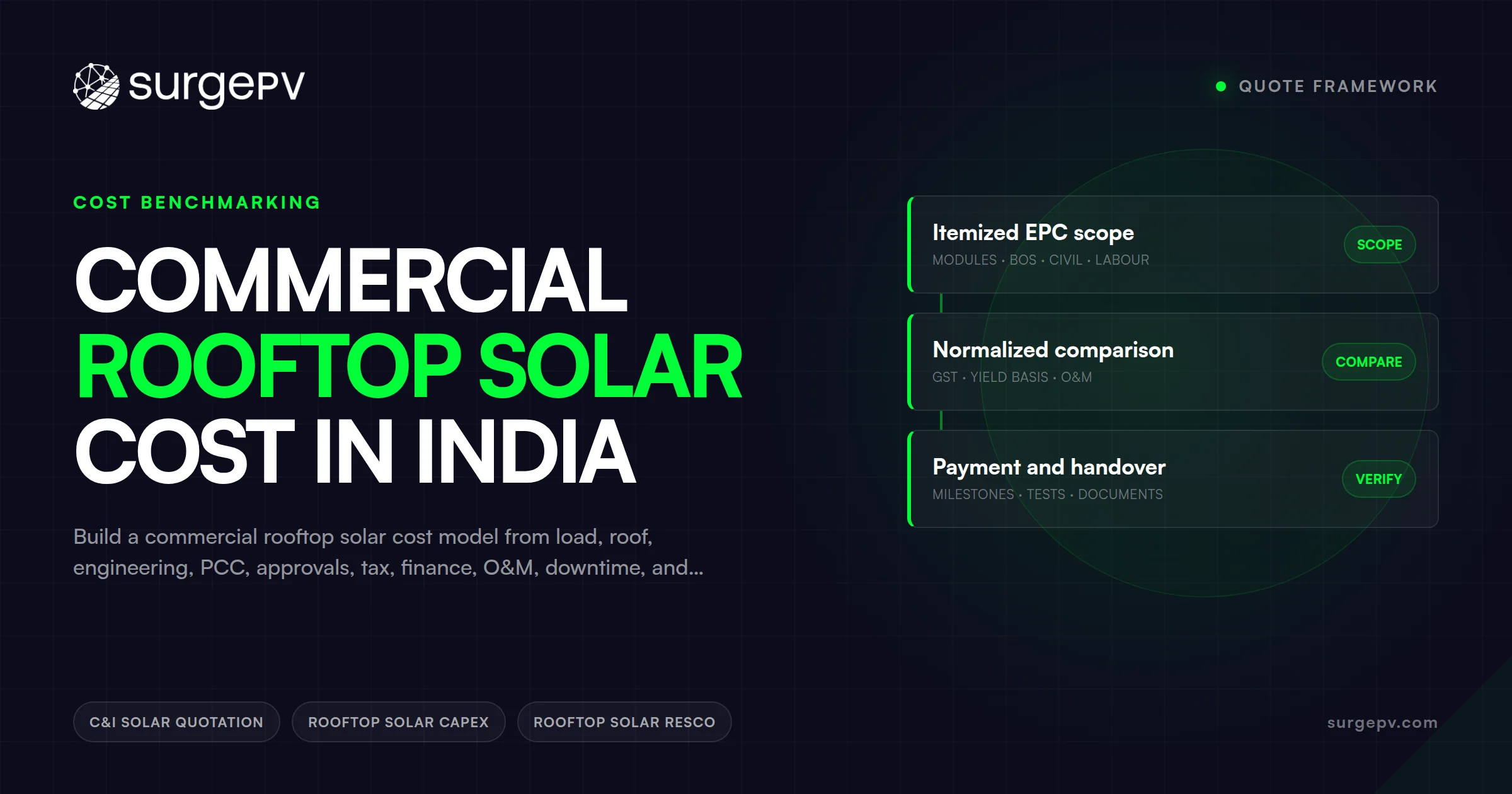
Quick Answer
There is no defensible universal commercial rooftop solar cost in India. Define CAPEX or RESCO and low-voltage or HT connection. Document interval load, roof and structural scope, DC and AC design, PCC, approvals, tax, logistics, commissioning, finance, O&M, and risk. Normalize itemized bids and test yield, tariff, export, downtime, and cost assumptions separately.
A headline commercial rooftop solar cost in India usually hides the most expensive boundaries. The roof may need repair. The transformer may need study or change. Production may limit shutdowns. Export may be restricted. Tax and finance may differ from the salesperson’s illustration.
One per-kW number cannot represent a shop on a low-voltage connection and a factory connected at high tension. It also cannot compare a buyer-owned CAPEX plant with a long-term RESCO energy contract.
This guide builds a cost from inputs, quantities, responsibilities, and risks. It does not publish a national price, tariff, yield, payback, tax rate, or equipment claim.
Quick Answer
There is no defensible universal commercial rooftop solar cost in India. Define CAPEX or RESCO and low-voltage or HT connection. Document interval load, roof and structural scope, DC and AC design, PCC, approvals, tax, logistics, commissioning, finance, O&M, and risk. Normalize itemized bids and test yield, tariff, export, downtime, and cost assumptions separately.
In this guide:
- Four boundaries that must be fixed before cost comparison
- Interval-load and energy-yield formulas with visible assumptions
- Roof, structure, fire, access, safety, and shutdown cost drivers
- Module, inverter, structure, DC, AC, PCC, transformer, export, and SCADA scope
- Approval, logistics, tax, contingency, finance, and IDC treatment
- CAPEX and RESCO cash-flow differences
- O&M, degradation, downtime, warranty, and performance risk
- An itemized quotation and sensitivity framework
Define Four Boundaries Before Requesting a Price
Every bidder should price the same ownership, electrical, physical, and operating boundaries. Write them on the first page of the request for proposal.
| Boundary | Option A | Option B | Why cost changes |
|---|---|---|---|
| Commercial model | Buyer-owned CAPEX | RESCO or service contract | Asset ownership, finance, O&M, tariff, security, and term differ |
| Connection | Low voltage | High tension | Transformer, switchgear, protection, metering, studies, and authority work may differ |
| Energy use | Behind-the-meter self-consumption | Export permitted or controlled | Metering, controls, tariff treatment, curtailment, and model differ |
| Delivery | Equipment or limited EPC | Commissioned turnkey plant with O&M | Engineering, approvals, construction, tests, handover, warranty, and service differ |
Capital expenditure (CAPEX) means the investment used to acquire and commission the asset. It does not automatically include later operating cost, finance, tax effects, or replacement.
Renewable Energy Service Company (RESCO) commonly describes a structure where another party invests and supplies energy or a defined service under contract. The exact legal and commercial form matters more than the label.
Write the point of delivery. A module-and-inverter supply quote is not comparable with a turnkey roof, electrical, approval, and commissioning scope. A RESCO tariff is not comparable with CAPEX unless the buyer models ownership, risk, and cash flow consistently.
Use the CAPEX versus RESCO procurement guide for deeper contract comparison. This page focuses on the commercial rooftop cost model.
For production-heavy sites, also review the industrial rooftop cost risks before issuing the bid package.
Start With Interval Load, Not Roof Capacity
Commercial value depends on when the facility uses electricity. A monthly bill totals energy but hides daytime demand, weekend behavior, seasonal shifts, and export.
Request interval data at the best available resolution. Align timestamps, timezone, meter changes, outages, holidays, production shutdowns, and missing intervals. Keep the raw file and a cleaned version with an audit log.
Build an operating calendar:
- working days and shifts
- seasonal production or occupancy
- planned maintenance shutdowns
- weekly closures and holidays
- future machinery, cooling, EV, or process loads
- temporary loads that should not drive a long-term design
- demand-response or load-shedding events
Create a load-duration view and a daytime minimum-load view. The minimum helps show when a large array may export. The duration curve helps show how often solar output can fit onsite demand.
Use this interval formula:
Self-consumed solar kWh at interval t = minimum of solar generation at t and eligible site load at t
Then sum the intervals:
Annual self-consumed solar kWh = sum of interval self-consumed solar kWh
Export is separate:
Export kWh at interval t = maximum of solar generation at t minus eligible site load at t, or zero
These formulas do not decide whether export is permitted or paid. They only expose the physical energy balance. The current state, DISCOM, connection, consumer category, meter, and agreement determine treatment.
Use the commercial system design guide to connect the load study with the electrical design.
Build the Roof and Structural Cost Basis
Available roof area is not the same as usable engineered area. Deduct setbacks, fire paths, drainage, skylights, vents, equipment, fragile zones, shadow, access, and maintenance space.
Collect current as-built drawings where available. Verify them onsite. Buildings change after construction, and old drawings may omit extensions, penetrations, rooftop equipment, or corrosion.
A qualified structural professional should review:
- roof system, material, age, and condition
- original design information and current use
- dead, live, wind, seismic, maintenance, and other applicable loads
- load paths, members, connections, purlins, slabs, and foundations
- corrosion, damage, repairs, and undocumented alterations
- proposed structure, ballast, anchors, uplift, and local reactions
- waterproofing, drainage, penetrations, and roof warranty
- construction loads, laydown areas, and lifting sequence
- access, walkways, fall protection, and maintenance loads
- field verification and change procedure
Separate roof repair from solar structure. A roof replacement can be an owner project, an EPC allowance, or part of the turnkey scope. State who designs, warrants, and pays for the interface.
Different roofs create different quantities. Sheet roofs, standing seams, reinforced concrete slabs, and industrial sheds need different attachment and corrosion strategies. Do not price a “standard structure” without drawings and material schedules.
Use irradiance and shading analysis to document roof obstructions and time-dependent shade. The final model still needs verified geometry and professionally reviewed assumptions.
Price Access, Fire, Safety, and Shutdown Constraints
Construction method can change cost as much as equipment selection. Survey the route from delivery vehicle to final installation position.
List cranes, hoists, scaffolds, temporary stairs, edge protection, lifelines, walkways, lifting beams, floor protection, traffic management, storage, and security. State whether the facility or EPC provides each item.
Map fire and emergency interfaces. Keep required access paths, exits, isolation points, labels, clearances, and responder routes. Coordinate them with the current authority and facility safety plan.
The Central Electricity Authority maintains the current Measures Relating to Safety and Electric Supply archive. It includes the 2023 regulations and a 2026 amendment. Qualified professionals must apply the current consolidated requirements.
Industrial sites may require induction, permit-to-work, job safety analysis, isolation, hot-work control, confined-space control, lifting permits, and production segregation. Hospitals, hotels, data facilities, and retail sites have different continuity constraints.
Price shutdowns explicitly:
- approved window and duration
- affected boards, transformer, process, and tenants
- temporary supply or generator requirement
- night, weekend, or holiday work
- utility or inspector attendance
- abort and reschedule conditions
- reinstatement and production release
Downtime belongs in both construction planning and the financial model. A cheaper method can be poor value if it requires a longer production outage.
Model DC Capacity, AC Capacity, and Yield Separately
The module array is rated in direct-current capacity. The inverter plant is rated in alternating-current capacity. Their ratio affects clipping, low-light operation, equipment count, cable quantities, and connection loading.
Use:
DC-to-AC ratio = installed module DC kW / inverter AC kW
Do not copy a ratio from another project. Test it against roof planes, weather, module characteristics, inverter limits, export, load, and commercial priorities.
An energy model should identify:
- weather source and period
- plane-of-array irradiance method
- roof geometry and shade
- module and inverter models
- temperature assumptions
- mismatch, soiling, wiring, transformer, and auxiliary losses
- clipping and availability
- grid outages and export curtailment
- degradation assumption and source
- uncertainty and sensitivity cases
Use this audit bridge:
Net AC generation = gross modeled energy minus modeled loss categories
Do not combine every loss into one unexplained percentage. The reviewer should see which losses are physical, operational, grid-related, or contractual.
For a cash-flow year:
Year n modeled generation = first-year modeled generation × degradation factor for year n
The degradation factor must come from an approved modeling basis. It is not a warranty promise or guaranteed field result.
Independent review can be valuable for large decisions. The energy-yield assessment guide explains inputs, uncertainty, and reliance terms.
Itemize the Equipment and EPC Cost Stack
Build quantities from the approved concept, not a single capacity multiplier. Use a cost breakdown structure that can survive bidder comparison.
| Cost block | Minimum detail | Typical boundary question |
|---|---|---|
| Development and surveys | Site, load, roof, structure, electrical, authority, and risk work | Which specialist studies remain owner scope? |
| Engineering | Design basis, calculations, drawings, reviews, IFC, and as-builts | Who signs and controls field changes? |
| PV modules | Exact model, quantity, rating, connectors, freight, and spares | Which current lists and documents apply? |
| Inverters | Exact model, quantity, MPPT design, communications, and spares | Does price include commissioning and logger? |
| Mounting structure | Material, coating, attachments, ballast, fasteners, and interfaces | Who owns structure and waterproofing warranty? |
| DC balance | Cables, connectors, trays, isolators, combiners, protection, and labels | Are route lengths and fire stopping included? |
| AC balance | Panels, cables, breakers, protection, earthing, and surge protection | Where does EPC scope terminate? |
| PCC and transformer | Switchgear, transformer, bus, studies, relays, metering, and shutdown | Is modification or replacement required? |
| Controls | Export control, power factor, reactive power, monitoring, weather, and SCADA | Which licenses, SIMs, and gateways recur? |
| Civil and access | Bases, trenches, platforms, routes, crane, scaffold, and reinstatement | Which quantities are firm or allowance? |
| Approval and grid | Applications, studies, fees, witness, meter, and energization | Which authority outcomes remain conditional? |
| Construction | Labour, supervision, safety, quality, security, tools, and temporary works | Are shifts and production constraints priced? |
| Commissioning | Instruments, tests, settings, witness, retests, and documentation | What defines acceptance? |
| Handover | As-builts, serials, certificates, credentials, manuals, spares, and training | Is final data owned by the buyer? |
| Commercial | Freight, insurance, tax, contingency, finance, warranty, O&M, and exclusions | Which costs sit outside EPC total? |
Mark every line INCLUDED, EXCLUDED, OPTIONAL, OWNER, or ALLOWANCE. Blank fields are unresolved.
The commercial installer selection guide provides a parallel EPC due-diligence method.
Separate Low-Voltage and HT Electrical Scope
Low-voltage and high-tension projects can share module and roof work but differ at the electrical interface. Do not compare them through one per-kW allowance.
For a low-voltage connection, inspect the main distribution board, available bus capacity, fault rating, cable routes, phase balance, meter, protection, sanctioned load, and export requirements. A new panel or feeder may still be required.
An HT project can add:
- transformer capacity and loading review
- HT and LT switchgear changes
- current and voltage transformers
- relay and protection-coordination studies
- short-circuit and arc-related review where applicable
- utility and electrical-inspector submissions
- PCC metering and communication
- reactive-power or power-factor control
- SCADA, remote terminal, and plant-controller interfaces
- planned shutdown and commissioning sequence
High tension (HT) is used here as a project category, not a universal voltage definition. Confirm the applicable definition and requirements for the jurisdiction and facility.
Review transformer loading with the commercial solar transformer guide. Solar can reduce daytime import without reducing every peak or fault-duty requirement.
Request one single-line diagram showing existing and proposed equipment. Mark ratings, ownership, normally open points, meter locations, protection, earthing, isolation, and EPC termination.
Price PCC, Protection, Export Control, and SCADA
The point of common coupling (PCC) is the electrical interface between the solar system and the facility or grid. Its voltage, transformer, fault level, meter, and protection affect design and cost.
Request current facility data. If fault levels or relay settings are unavailable, define who obtains or studies them. Do not let the EPC guess silently.
Protection scope may include overcurrent, earth fault, voltage, frequency, anti-islanding, reverse power, differential, transformer, breaker-failure, or other functions. The actual functions depend on the system and authority.
The CEA publishes distributed-generation connectivity material. Apply current state, DISCOM, inspector, and project requirements as well.
Zero-export control needs a defined measurement point, current-transformer direction, communication route, controller, inverter interface, failure state, response test, and settings ownership. Use the zero-export configuration checklist.
SCADA cost can include meters, weather sensors, gateways, network switches, fiber, server or cloud services, SIMs, licenses, dashboards, historian, cybersecurity, and integration. Define data interval, ownership, export, retention, alarms, users, and support.
A monitoring portal is not the same as a facility SCADA integration. Price each interface and acceptance test.
Verify Equipment Evidence by Exact Model
Freeze exact module, inverter, structure, cable, connector, switchgear, meter, controller, and monitoring identifiers before procurement.
MNRE maintains the current Approved List of Models and Manufacturers. Review current lists, amendments, applicability, and commissioning dates. ALMM covers its named PV module and cell framework. It is not an inverter list.
The Bureau of Indian Standards publishes the Scheme II registration page. It identifies covered PV product categories, standards, and notifications.
MNRE also maintains lab policy, standards, and quality-control documents. Match every submitted record to the exact quoted product and current requirement.
Do not accept one family brochure as proof for every model. Check manufacturer name, model identifier, rating, revision, date, and status.
Substitution needs written control. Require an updated technical comparison, list and certificate review, string and electrical checks, structure impact, warranty review, energy-model update, price adjustment, and buyer approval.
Map Approvals and Authority Costs
Approval responsibility differs by state, DISCOM, consumer category, connection, voltage, capacity, export method, and site. Create a project-specific authority matrix.
Possible items include:
- application and technical-feasibility review
- sanctioned-load or contract-demand review
- interconnection and protection submission
- net, gross, or other meter arrangement
- export limit or zero-export acceptance
- electrical-inspector review and witness
- meter, relay, communication, or testing charges
- connection agreement and energization
- building, fire, factory, landlord, lender, or other approvals
The Ministry of Power’s Electricity Act rules archive lists the 2024 amendment to the Electricity Rights of Consumers Rules. The live case still needs current state, SERC, DISCOM, category, voltage, and project review.
Use a responsibility matrix. State who prepares, signs, submits, pays, follows up, corrects comments, attends inspection, and keeps records.
An EPC can promise a complete and timely submission. It cannot guarantee an authority decision. Distinguish authority delay from EPC correction duty in the schedule and contract.
Add Logistics, Construction, and Commissioning
Logistics begins at the supplier and ends after safe placement. Include freight, transit insurance, unloading, inspection, storage, protection, internal movement, lifting, returns, and damaged-item handling.
Record packed dimensions and weights from current supplier documents. Check gate, road, loading dock, floor, lift, stair, roof, and crane constraints.
Construction cost needs a work breakdown:
- mobilization and temporary facilities
- supervision, safety, and quality staff
- work permits and facility coordination
- shifts, overtime, and shutdown work
- roof protection and reinstatement
- cable containment, penetrations, and fire stopping
- waste, housekeeping, and demobilization
- tests, calibration, and record preparation
Commissioning should have pre-approved procedures and acceptance values. Test asset identity, mechanical installation, strings, insulation, polarity, earthing, protection, meters, export control, alarms, SCADA, shutdown, grid return, and performance as applicable.
Final payment should follow agreed acceptance, punch-list control, and handover. Collect approved as-builts, calculations, serials, settings, certificates, warranties, credentials, manuals, spares, training, and escalation contacts.
Keep Tax Outside the Technical Price Until Reviewed
Do not copy a tax rate from an old quotation. Classification, valuation, transaction structure, place of supply, invoicing, credits, withholding, and benefits need current professional review.
The Central Board of Indirect Taxes and Customs publishes official GST goods and services rate material. A qualified adviser should trace the current notification and apply it to the exact supply.
Keep these model fields separate:
- pre-tax equipment and service amounts
- tax by invoice line and legal entity
- credit eligibility and timing
- withholding and other statutory deductions
- depreciation or other tax treatment, if applicable
- tax during construction and operations
- change-in-law mechanism
Tax benefit is not a discount from EPC price. Show gross cash payment, recoverable or creditable amounts, timing, and non-recoverable tax separately.
Build Contingency From Named Risks
A percentage contingency without a risk register is difficult to defend. Link contingency to unresolved scope and probability.
Use:
Expected contingency for risk i = probability input × cost impact input
Then:
Modeled contingency = sum of expected risk allowances plus approved general reserve
Probability and impact are project-team inputs, not facts from this article.
Typical risks include hidden roof repair, drawing gaps, route changes, switchgear modification, authority comments, and shutdown rescheduling. Also review freight, access, weather, price validity, currency exposure, model substitution, and grid delay.
Separate included contingency from management reserve. State who can release each amount and how unused contingency is treated.
Avoid double counting. If a firm EPC price transfers a defined risk, do not also keep the full owner contingency without explaining residual exposure.
Compare CAPEX and RESCO on the Same Energy Boundary
CAPEX and RESCO offers allocate investment, ownership, performance, O&M, tax, finance, and counterparty risk differently. Compare outcomes, not one price field.
| Topic | CAPEX question | RESCO question |
|---|---|---|
| Investment | What is the commissioned owner cost and payment timing? | Which development and site costs remain with the consumer? |
| Ownership | When does title pass and which assets are included? | Who owns during term and at handback? |
| Energy | Which generation and self-consumption assumptions support savings? | Which meter and formula determine billed energy? |
| Price | Which EPC and lifecycle costs remain? | What tariff, escalation, minimum, and pass-through apply? |
| O&M | Which owner resources and contracts are required? | Which service level and exclusions bind the provider? |
| Site | Which roof and facility risks remain with owner? | Which access, roof rights, outages, and relocation duties apply? |
| Credit | How is asset finance secured and repaid? | Which payment security, guarantee, and default remedies apply? |
| Exit | What is residual value and disposal duty? | What are termination payment, buyout, removal, and handback terms? |
For RESCO, review deemed generation, curtailment, facility shutdown, roof repair, load changes, and change in law. Also review lender rights, assignment, insurance, default, early termination, buyout, and end-of-term condition.
For CAPEX, review asset ownership, finance security, tax, performance, O&M capability, replacements, insurance, and disposal.
Do not assume RESCO means zero cost or CAPEX means immediate savings. Build dated cash flows for each party and scenario.
Add Finance and Interest During Construction
Financing cost depends on drawdown timing, interest, fees, security, covenants, repayment, tax, and commissioning. Do not apply one rate without a lender term sheet.
Interest during construction (IDC) is interest accrued on drawn funds before the chosen operating or repayment milestone. Model it by period:
IDC for period t = opening drawn balance × period interest-rate input × time fraction
Then add fees and capitalized items according to professional advice and lender documents.
Use a drawdown schedule linked to EPC milestones. A delayed authority approval can increase IDC even when EPC price stays fixed.
Model debt service, reserve accounts, insurance, guarantees, and lender adviser costs where applicable. Separate committed cost from contingent cost.
For an unlevered view:
Project net cash flow = energy value plus export value minus CAPEX payments minus operating costs minus tax cash flows
For an equity view, add debt draw, interest, principal, fees, and distributions separately. Do not mix the two views.
Use the energy and financial modeling tool to keep assumptions visible. The model should never convert an uncertain tariff or yield into a guaranteed return.
Model O&M, Degradation, Downtime, and Replacements
Lifecycle cost begins after commissioning. Create an annual operating schedule rather than one generic percentage.
Include:
- monitoring and alarm review
- cleaning based on site conditions and water strategy
- preventive electrical and mechanical inspection
- vegetation or roof housekeeping where applicable
- thermal or diagnostic checks where justified
- meter, sensor, communication, and license costs
- insurance and statutory inspection
- corrective labour, travel, freight, and access
- spares and planned replacement scenarios
- reporting, performance review, and contract administration
Do not invent an inverter replacement year. Model scenarios from exact warranty, service, technology, duty, environment, and owner risk appetite.
Downtime has energy and business effects:
Lost solar value = unavailable solar kWh × applicable avoided-cost input
Business downtime exposure = affected production time × approved business-impact input
The second formula applies only when solar work or electrical failure affects operations. Avoid double counting energy and production loss.
Track monitoring quality with the commercial solar monitoring metrics guide. A missing-data interval should not silently become zero generation or perfect availability.
Normalize Bids Before Comparing Totals
Use one compliance and price workbook. Preserve every bidder’s original offer and map it into the common structure.
Create four response codes:
C: complies with cited evidenceD: deviation with impactO: priced optionN: not included
Require document references. A salesperson’s “included” should lead to a scope line, drawing, schedule, or contract clause.
Normalize in this order:
- input data and design basis
- DC and AC capacities
- energy and self-consumption assumptions
- exact equipment and quantities
- structure, DC, AC, PCC, transformer, and controls
- approvals, access, construction, and commissioning
- tax, logistics, contingency, finance, and owner work
- warranty, performance, O&M, spares, and service
- contract risk and payment timing
Calculate:
Evaluated commissioned cost = bidder total + priced exclusions + owner work + risk adjustments
Every added amount needs a source. Keep unresolved items visible rather than guessing them into the total.
Do not choose solely from evaluated cost. Apply pass or fail gates for safety, feasibility, authority, engineering, equipment, service, and contract requirements.
Reconcile the Budget to Cash Paid and Asset Accepted
An evaluated EPC total is not the same as cash required before operation. Build a bridge from contract price to commissioned asset cost and funding need.
Use this structure:
Commissioned asset cost = EPC price + owner works + development + authority costs + tax treatment + contingency used + finance and IDC + commissioning adjustments
Keep tax treatment as separate positive or negative cash-flow lines. Do not subtract a credit until the tax adviser confirms eligibility and timing.
Then calculate funding need by period:
Period funding need = EPC payment + owner payment + tax cash payment + fees + interest + reserve contribution minus approved financing draw
This schedule reveals timing pressure. A project can have an attractive total cost but require a large early payment before debt draw or tax recovery.
Create an asset-acceptance bridge as well:
| Stage | Cost status | Technical status | Evidence needed |
|---|---|---|---|
| Approved design | Committed | Models and scope frozen | Design basis, drawings, calculations, and approvals |
| Equipment delivered | Paid or payable by milestone | Models and quantities inspected | Invoice, packing list, serials, inspection, and title evidence |
| Mechanical completion | Mostly installed | Structure and equipment complete | Quality records, redlines, punch list, and safety release |
| Electrical completion | Installation substantially complete | DC, AC, PCC, protection, and controls ready | Test sheets, settings, calibration, and inspection records |
| Energization | Authority and grid conditions met | Plant may operate under defined limits | Approval, meter, agreement, witness, and energization record |
| Provisional acceptance | Performance and documentation substantially pass | Remaining items controlled | Acceptance test, open-item register, and remedy dates |
| Final acceptance | Contract conditions closed | Owner receives complete control | As-builts, credentials, warranties, spares, training, and final certificate |
Do not capitalize or accept an asset merely because equipment arrived. Finance and accounting advisers should define recognition under the buyer’s policies and applicable standards.
Track committed, invoiced, paid, accrued, forecast, and disputed amounts separately. This prevents an unpaid variation from disappearing from the forecast.
Reconcile currency and price-validity exposure as separate fields. Record the quotation currency, conversion source, reference date, validity, adjustment formula, evidence, and party carrying the risk. Do not hide a currency allowance inside equipment price.
Track securities and recoveries outside ordinary cost lines. Advance guarantees, performance security, retention, insurance deductibles, liquidated-damage recoveries, and disputed deductions can affect liquidity before they change final cost.
Assign each cash exposure to a named owner and review date.
For RESCO, replace the asset-cost bridge with a contractual-obligation bridge. Include deposits, security, minimum charges, escalation, deemed generation, roof work, meter work, taxes, buyout, termination, and handback exposure.
Use a monthly cost report during delivery. Reconcile purchase orders, invoices, changes, contingency, schedule, IDC, and forecast at completion. A static award total cannot manage a changing project.
Run Transparent Sensitivities
A good model changes one driver at a time and shows combined downside cases. Do not hide uncertainty inside one discount rate.
| Driver | Base input | Downside input | Upside input | Output affected |
|---|---|---|---|---|
| First-year generation | Approved model | Buyer-defined lower case | Buyer-defined higher case | Energy value and cash flow |
| Self-consumption | Interval model | Lower facility load | Higher eligible load | Avoided purchase and export |
| Export | Current approved treatment | Curtailment or no value | Approved alternative | Revenue or avoided cost |
| Tariff | Current bill and adviser model | Lower avoided component | Higher approved component | Savings and payback |
| CAPEX | Normalized offer | Cost overrun case | Negotiated case | Funding and returns |
| Schedule | Approved programme | Delay case | Earlier completion | IDC and operating start |
| O&M | Approved plan | Higher service case | Lower verified case | Lifecycle cost |
| Availability | Contract and model | Longer outage | Better restoration | Generation and service value |
Use:
Simple payback = initial net cash outflow / annual net cash benefit
This shortcut ignores timing and changing cash flows. Use it only beside a full dated model.
For net present value:
NPV = sum of cash flow at year t / (1 + discount-rate input)^t
The discount rate is a buyer or finance decision. Show it and test it.
Put Performance, Warranty, and Risk in the Contract
The contract should state the design basis, scope, documents, models, quantities, schedule, and authority duties. It should also cover price, tax, payment, change, delay, tests, warranties, performance, O&M, liability, and termination.
Separate these obligations:
- equipment product warranty
- module performance warranty
- EPC workmanship warranty
- roof and waterproofing responsibility
- energy or performance obligation, if any
- monitoring and data availability
- O&M service level
- defect response and replacement remedy
Define who pays diagnosis, access, lifting, removal, freight, travel, reinstallation, testing, and lost time. A headline warranty term does not answer those questions.
Performance tests need method, instruments, calibration, weather, load, grid, exclusions, tolerance, and remedy. Do not use annual modeled generation as an automatic acceptance test.
For delay, distinguish EPC, owner, authority, utility, weather, and force-majeure causes. Require notices, mitigation, updated programme, evidence, and remedy.
For termination, define equipment title, drawings, data, warranties, permits, site restoration, lender rights, subcontractors, and handback.
Where Heaven Green Energy May Fit
Heaven Green Energy may submit one commercial rooftop offer when its current written scope and service geography fit. This article verifies no price, national coverage, project record, certificate, warranty, performance, or service promise for the company.
Review the current Heaven Green Energy website. Treat every statement as company-published and require project-specific evidence.
Disclosure: SurgePV and Heaven Green Energy share ownership. This sponsored link creates a commercial conflict. Apply the same engineering, cost, contract, reference, warranty, O&M, and service checks to its bid and every competing offer.
Choose another EPC or RESCO when its verified offer fits the facility better. Ownership should never override the evidence.
A 10-Step Commercial Rooftop Budget Process
- Define the boundary. Choose CAPEX or RESCO, low voltage or HT, export treatment, and delivery scope.
- Clean the load data. Align intervals, operating calendar, outages, and future loads.
- Survey the asset. Verify roof, structure, electrical system, PCC, access, fire, safety, and shutdowns.
- Build the concept. Set DC and AC capacities, stringing, structure, PCC, controls, and yield assumptions.
- Map authorities. Confirm state, SERC, DISCOM, inspector, meter, export, and approval duties.
- Issue one itemized schedule. Give every bidder the same data, models, quantities, documents, and contract assumptions.
- Normalize offers. Add exclusions, owner work, tax, logistics, contingency, finance, O&M, and risk.
- Run sensitivities. Test generation, load, export, tariff, schedule, CAPEX, O&M, availability, and finance separately.
- Close the contract. Freeze scope, models, payment, change, delay, performance, warranty, service, and termination.
- Hold acceptance for evidence. Complete tests, authority steps, as-builts, settings, credentials, warranties, spares, and training.
Build the Commercial Model From One Project Record
Bring interval load, roof constraints, electrical scope, and financial assumptions.
Book a Demo
No commitment required. 20 minutes. Live project walkthrough.
Conclusion
Commercial rooftop solar cost is the price of a defined, approved, commissioned, and supportable outcome. It is not a national per-kW shortcut.
- Separate CAPEX, RESCO, low-voltage, and HT boundaries.
- Size against interval load, roof constraints, connection, and export rules.
- Itemize roof, structure, equipment, PCC, controls, approvals, tax, finance, and O&M.
- Normalize exclusions and contract risk before comparing totals.
- Test generation, tariff, downtime, schedule, and cost assumptions independently.
Use solar design software to keep layout, electrical, energy, and financial assumptions connected. Qualified professionals must approve the site, authority, tax, finance, and contract decisions.
Frequently Asked Questions
What is the commercial rooftop solar cost in India?
There is no reliable universal cost or per-kW rate. Obtain dated site-specific offers after defining load, roof, structure, system size, equipment, PCC, transformer, protection, export, approvals, access, tax, finance, commissioning, O&M, warranty, and exclusions.
How should a business calculate commercial rooftop solar size?
Use interval load, operating days, roof constraints, connection limits, export rules, and a reviewed energy model. Test DC and AC capacity, self-consumption, clipping, curtailment, outages, and future load separately. Do not size from one monthly bill.
What is included in commercial rooftop solar CAPEX?
CAPEX should identify development, surveys, engineering, modules, inverters, structure, and DC and AC systems. It should also cover PCC and transformer work, protection, monitoring, approvals, logistics, construction, safety, commissioning, tax, contingency, spares, warranties, and owner exclusions.
How is a RESCO solar offer different from a CAPEX quote?
CAPEX usually places asset investment and ownership risk with the buyer. RESCO usually supplies energy or service under a long-term contract. Compare tariff, escalation, generation and metering, site rights, payment security, O&M, default, termination, change in law, and handback.
Why can an HT rooftop project cost more than a low-voltage project?
HT projects can add transformer, switchgear, relay studies, protection coordination, metering, SCADA, shutdown, inspector, utility, and commissioning scope. The exact boundary depends on the facility and authority requirements, so compare drawings and schedules rather than voltage labels.
How should GST and tax benefits be included?
Keep tax outside the technical comparison until a qualified adviser confirms the current treatment. Review classification, valuation, rate, place of supply, credits, withholding, depreciation, and invoicing for the exact transaction. Do not copy a historic tax rate into the model.
How do I calculate commercial solar payback?
Model dated cash flows from metered self-consumption, permitted export, tariff components, operating calendar, degradation, outages, curtailment, O&M, insurance, replacements, tax, finance, and downtime. Show simple payback only as one output and never as a guarantee.
What should happen before final EPC payment?
Complete agreed tests, authority steps, punch-list closure, and handover. Collect as-built drawings, calculations, serial records, certificates, protection settings, meter and export records, monitoring credentials, warranties, spares, training, and service contacts before final acceptance.
Should Heaven Green Energy provide a commercial rooftop quote?
It may provide one offer where its current written scope and service geography fit. SurgePV and Heaven Green share ownership. Compare that bid against the same engineering, price, contract, warranty, O&M, reference, and service evidence required from every EPC.
Sources
Primary research and reference material used for this desk-research article.
Where this fits
This article is part of SurgePV's Solar Business & Operations hub, which works through the topic from first principles to the decisions a project team actually has to make.
