Quick Answer
Commercial solar transformer sizing follows the rule: transformer kVA ≥ 1.25 × inverter AC output. Typical sizes: 100 kW system uses 125 kVA transformer; 1 MW uses 1,250 kVA. Efficiency requirements: DOE 2016 standard mandates 98.9% at 50% load for transformers over 1,000 kVA.
A solar developer signs a letter of intent on a warehouse rooftop. The roof fits 280 kWp. The building is fed by a 500 kVA pad-mount transformer installed in 2008. Everything looks clean — until the utility interconnection screening report comes back six weeks later. Voltage rise on the secondary fails IEEE 1547-2018 limits. Backfeed exceeds the conservative 15% feeder threshold under the SIR fast track. The project either needs a $48,000 transformer upgrade, a $12,000 export-limiting controller, or a redesign down to 175 kWp. None of that was in the original proposal. NREL H2 2024 pricing data puts commercial distributed solar at $2.63/Wdc for 100 to 500 kW systems (NREL, 2025), so a forced 100 kWp downsize wipes $263,000 from the top line. Commercial solar transformer sizing is the single most overlooked technical check in the C&I sales-to-design handoff — and the one that most often blows up financial models late in the process.
Commercial solar transformer sizing follows the rule: transformer kVA ≥ 1.25 × inverter AC output. Typical sizes: 100 kW system uses 125 kVA transformer; 1 MW uses 1,250 kVA. Efficiency requirements: DOE 2016 standard mandates 98.9% at 50% load for transformers over 1,000 kVA. See Design Commercial Solar System 1MW for detailed guidance.
This guide covers the engineering math, the regulatory framework (NEC 705.12, IEEE 1547-2018, ANSI C84.1), the four physical constraints that govern when an existing transformer can absorb new PV, a worked example for adding 250 kWp to a 500 kVA transformer, and the upgrade decision tree EPCs use to choose between transformer replacement, export limiting, and storage. Built for solar engineers, design teams, and EPC project managers running C&I projects in the 100 kWp to 1 MWp range on existing electrical infrastructure.
TL;DR — Commercial Solar Transformer Sizing
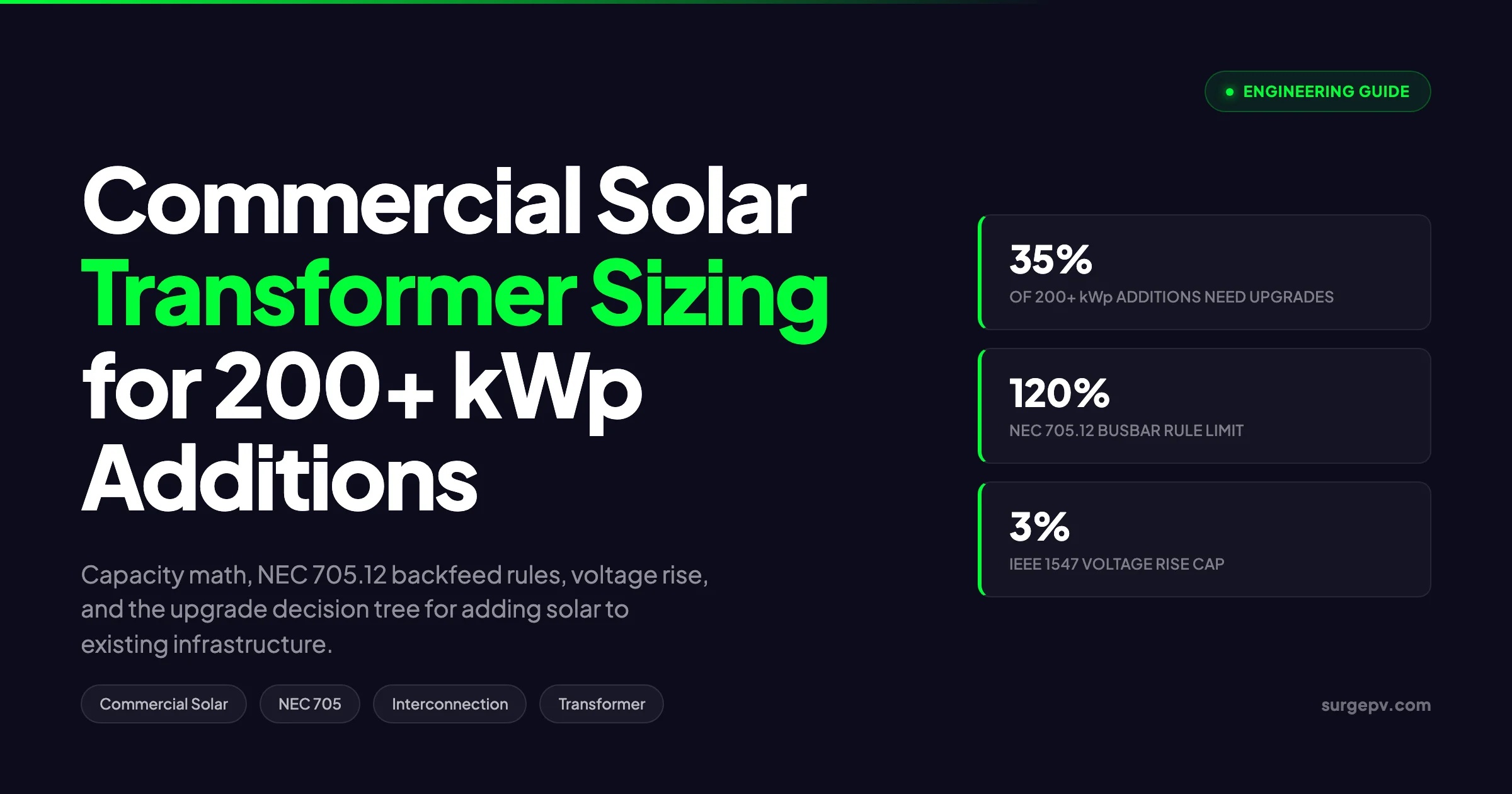
An existing transformer can usually absorb new PV up to 100% of its kVA nameplate in continuous reverse flow, provided four checks pass: net backfeed under nameplate kVA, secondary voltage rise under 3%, NEC 705.12 busbar compliance, and short-circuit duty within switchgear AIC ratings. About 35% of commercial PV additions over 200 kWp trigger a transformer upgrade based on field data. The decision between upsize, export limit, and storage hinges on net export ratio and utility tariff structure.
In this guide:
- The 4 transformer capacity constraints that govern solar additions
- Step-by-step capacity assessment with the actual formulas
- A full worked example: adding 250 kWp to a 500 kVA transformer
- NEC 705.12 — the 100% rule, the 120% rule, and the sum rule explained
- Voltage rise calculation per IEEE 1547-2018 and ANSI C84.1
- Reverse power flow effects on transformer aging (IEEE C57.91 model)
- The upgrade decision tree — upsize, export limit, or storage
- Pre-construction studies the utility will require
- 8 common transformer sizing mistakes and how to avoid them
The 4 Transformer Capacity Constraints
A transformer is not a single number on a nameplate. It is four interacting limits, and any one of them can become the binding constraint when reverse power flow from solar PV is added to an existing system. Skip any of these and the interconnection application gets rejected — or worse, the system trips repeatedly after commissioning.
Constraint 1: Thermal Capacity (kVA Nameplate)
The kVA rating on the nameplate is the steady-state apparent power the transformer can deliver continuously at design ambient temperature (usually 30°C average over 24 hours per IEEE C57.12.00) without exceeding insulation thermal limits. For a 500 kVA, 480Y/277V transformer, the secondary current limit is 601 A per phase.
Solar PV adds reverse power flow on top of existing site load — and the transformer does not know which direction the kVA is flowing. Thermal stress depends only on RMS current magnitude. Net flow in either direction must stay within nameplate.
The nameplate is rated for continuous load at design ambient. Most utility distribution transformers in the U.S. and Europe are designed for 65°C average winding temperature rise above 30°C ambient — total hot-spot temperature of 110°C at full nameplate load. PV installations in hot climates face derated capacity from May through September. Also see: European Solar Incentives. For Europe-specific compliance details, see Europe solar compliance.
Constraint 2: Voltage Regulation (Impedance)
Every transformer has internal impedance, expressed as percent impedance on nameplate kVA base. A 500 kVA transformer with 5.75% impedance acts as if there is a 5.75% voltage drop at full load — and a 5.75% voltage rise under full reverse load.
When solar PV pushes current backward through the transformer, the voltage on the secondary side rises above the primary-referred voltage. The formula is straightforward:
Voltage rise % = (Reverse kVA / Nameplate kVA) × Impedance %For 100 kW of net export through a 500 kVA, 5.75% Z transformer: 100/500 × 5.75% = 1.15% voltage rise on the LV side, before adding feeder cable rise.
ANSI C84.1 Range A allows utilization voltage from 95% to 105% of nominal. IEEE 1547-2018 caps PV-induced voltage rise at 3% under default Volt-VAR settings. These two constraints often bind before thermal capacity does — particularly on transformers with impedance above 5.5% serving long feeders.
Constraint 3: Backfeed Limit (NEC 705.12 in the US)
In the United States, NEC Article 705 governs how PV systems interconnect to the utility-side electrical infrastructure. NEC 705.12(B) sets the rules for load-side interconnection through a busbar:
- 100% rule: Sum of all overcurrent devices feeding a busbar must not exceed busbar rating
- 120% rule: Allows up to 120% sum if the PV breaker is at the opposite end of the bus from the main breaker
- Sum rule: For more complex multi-source busbars, the sum of all source currents must not exceed busbar rating regardless of breaker position
For a 1200 A main switchboard with a 1200 A main breaker, the 120% rule allows a maximum 240 A PV breaker — about 175 kW AC at 480V three-phase. Above this requires a service upgrade or supply-side interconnection per NEC 705.11.
International equivalents include G99 (UK), VDE-AR-N 4105 (Germany), and AS/NZS 4777 (Australia), each with different backfeed and protection requirements but similar underlying physics. The detailed rules vary by country — see our guide on grid export limitation rules by country for the full breakdown. Also see: Germany solar subsidies. For Australia-specific compliance details, see Australia comparisons/lgc-vs-stc.
Constraint 4: Short-Circuit Withstand (AIC Rating)
When the inverter is connected, it adds fault current contribution to the system. Modern grid-following inverters per IEEE 1547-2018 contribute approximately 1.2× rated current during faults. This adds to utility source contribution at the point of common coupling.
If calculated fault current exceeds the AIC rating of the existing switchgear, the switchgear cannot interrupt a fault safely. This is a hard stop — equipment must be replaced before interconnection. Typical commercial switchgear is rated 22 kAIC or 42 kAIC. A 1500 kVA, 5.75% Z transformer alone delivers about 32 kA at the secondary terminals. Adding inverter contribution can push the duty above 22 kAIC, forcing a switchgear upgrade.
Capacity Assessment: The Step-by-Step Math
The full capacity assessment runs in sequence. Each step depends on the previous one, and any failed check ends the analysis until that constraint is resolved.
Step 1: Inventory the Existing Transformer
Pull the nameplate. The data you need:
| Field | Why It Matters |
|---|---|
| kVA rating | Sets thermal capacity ceiling |
| Primary voltage | Determines step ratio for voltage rise math |
| Secondary voltage | Sets PV interconnection voltage |
| Impedance % | Drives voltage rise and short-circuit calculations |
| Vector group (Dyn11, etc.) | Affects unbalance handling and harmonic propagation |
| Tap setting | Adjusts no-load voltage; matters for voltage rise headroom |
| Cooling class (ONAN, ONAF) | Sets ambient derating curve |
| Year of manufacture | Older transformers may have less paper insulation reserve |
Photograph the nameplate. Note the manufacturer and serial number. If the transformer is more than 15 years old, request the most recent oil dissolved-gas analysis (DGA) report from the utility or facility owner. Aging transformers with elevated furan or hydrogen levels have less thermal headroom for new continuous loading.
Step 2: Pull 12 Months of Interval Load Data
Site load data is the input most C&I solar developers underestimate. Monthly utility bills are not enough. The decisive number is the minimum daytime load between 9 a.m. and 4 p.m. — when solar output is highest and reverse power flow is at its peak.
Request 15-minute interval data from the utility (most U.S. utilities provide it on request) or pull it from the building SCADA or BMS. With 15-minute data across a year, build the daytime minimum load curve by month. Industrial sites with weekend and holiday shutdowns often have minimum daytime load near zero — the worst case for backfeed.
For the methodology, our solar system sizing with 15-minute interval load data guide walks through the data pull process and the load profile analysis logic. Get this step right or every downstream calculation is wrong.
Step 3: Calculate Peak PV AC Output
Use the inverter nameplate AC capacity, not the DC array size. The DC:AC ratio determines the relationship:
Peak AC kW = DC kWp / DC:AC ratioFor a 250 kWp DC array at a 1.2 DC:AC ratio: 250/1.2 = 208 kW AC.
Apply derating factors:
- Inverter efficiency at full load: 0.97 to 0.98
- Voltage adjustment for actual operating voltage vs. nameplate: 0.97 to 1.00
- Temperature derating for inverter ambient: typically 0 to 0.05
Net peak AC output for the example: 208 × 0.97 × 0.98 = 198 kW AC at the inverter terminals. This is the number to feed into the backfeed calculation.
For deeper guidance on inverter selection logic, see our solar inverter sizing guide. The DC:AC ratio decision affects every downstream transformer math.
Step 4: Compute Net Reverse Power Flow
Net Reverse Flow kW = Peak PV AC kW - Minimum Daytime Load kWIf minimum daytime site load is 70 kW: 198 - 70 = 128 kW net export through the transformer secondary toward the primary.
For three-phase systems at 480V, convert to apparent power using the inverter power factor (PF). IEEE 1547-2018 default Volt-VAR can swing PF from 0.95 leading to 0.95 lagging:
Net Reverse kVA = Net Reverse kW / Power FactorAt 0.95 PF: 128/0.95 = 135 kVA. This 135 kVA is what flows through the transformer in worst-case reverse direction.
Step 5: Run the NEC 705.12 Backfeed Check
Identify the bus where PV connects (main switchgear, distribution panel, sub-panel). Note:
- Busbar continuous rating
- Main breaker rating
- All other source breakers feeding the bus
Calculate maximum allowable PV breaker rating:
| Rule | Formula | Use When |
|---|---|---|
| 100% | Bus rating - sum of other breakers | PV breaker anywhere on bus |
| 120% | (1.2 × Bus rating) - main breaker | PV breaker at opposite end of bus from main |
| Sum rule | Bus rating - sum of all other source currents at peak | Multiple sources, any breaker positions |
Maximum PV inverter AC output current must not exceed the maximum allowable breaker rating divided by 1.25 (NEC 690.8 continuous load factor):
Max Inverter AC Output A = Max PV Breaker A / 1.25For a 1200 A bus with 1200 A main, the 120% rule allows: (1.2 × 1200) - 1200 = 240 A PV breaker. Maximum continuous inverter output: 240/1.25 = 192 A. At 480V three-phase: 192 × 480 × √3 / 1000 = 159 kW AC.
If the planned PV system exceeds this, options are: redesign smaller, upgrade busbar/main, or move to supply-side interconnection per NEC 705.11.
Step 6: Calculate Secondary Voltage Rise
The full voltage rise calculation includes transformer impedance and feeder cable impedance from PCC to the next utility transformer.
Vrise % (transformer) = (Net Reverse kVA / Transformer kVA) × Impedance %
Vrise % (cable) = (Net Reverse kW × R + Net Reverse kVAR × X) / V² × 100
Total Vrise % = Vrise transformer + Vrise cable
For the 250 kWp example through a 500 kVA, 5.75% Z transformer with 135 kVA reverse flow:
- Transformer rise: 135/500 × 5.75% = 1.55%
- Add cable rise (varies by feeder length and conductor size — typically 0.3% to 1.5% on commercial feeders)
- Total: 1.85% to 3.05%
Compare against 3% IEEE 1547-2018 default and 5% ANSI C84.1 Range A ceiling. If above 3%, smart inverter Volt-VAR settings can absorb reactive power to reduce rise. If above 5%, hardware changes required.
Step 7: Verify Short-Circuit Duty
Available fault current at the PV PCC determines required AIC and SCCR ratings. The transformer contribution dominates:
Isc (transformer only) = Rated Current / Per Unit ImpedanceFor a 500 kVA, 480V, 5.75% Z transformer: rated current = 601 A; per-unit impedance = 0.0575; Isc = 601/0.0575 = 10,452 A symmetrical at the secondary terminals.
Add inverter contribution (1.2 × inverter rated AC current per IEEE 1547-2018) and any motor contribution from existing site loads. Compare against switchgear AIC and inverter SCCR. If switchgear is rated 22 kAIC, the 10,452 A symmetrical fault current is well within capacity. For a 1500 kVA transformer: rated current = 1804 A; Isc = 31,374 A — exceeds 22 kAIC switchgear and forces an upgrade or current-limiting fuse installation.
For full coverage of fault current and protection coordination, our solar string design guide covers the inverter side; this transformer-side analysis sits alongside it.
Worked Example: Adding 250 kWp to a 500 kVA Transformer
A printing facility in Phoenix, Arizona wants to add solar to offset daytime electrical load. The existing service:
- 500 kVA pad-mount transformer, 12.47 kV - 480Y/277V
- Impedance: 5.75%
- Vector group: Dyn11
- Year of manufacture: 2011
- Main switchgear: 800 A bus, 800 A main breaker, 22 kAIC
- Annual electrical consumption: 1,420,000 kWh
- Peak demand: 380 kW
- Minimum daytime load (15-minute data, May-Sept): 92 kW
The proposed solar system:
- 250 kWp DC nameplate
- 200 kW AC inverter (1.25 DC:AC ratio)
- Three-phase 480V interconnection at main switchgear
Capacity Check Walkthrough
Step 1 — Inventory: Done above. 500 kVA, 5.75% Z, ANSI C84.1 reach.
Step 2 — Daytime minimum load: 92 kW (May-September interval data).
Step 3 — Peak PV AC output: 200 kW nameplate × 0.97 inverter efficiency × 0.98 voltage adjustment = 190 kW AC at the inverter terminals.
Step 4 — Net reverse flow: 190 - 92 = 98 kW. At 0.95 PF: 98/0.95 = 103 kVA reverse flow through transformer.
Step 5 — NEC 705.12 check:
- 800 A bus, 800 A main → 120% rule maximum PV breaker: (1.2 × 800) - 800 = 160 A
- Maximum continuous inverter output: 160/1.25 = 128 A
- Inverter rated output current: 200 × 1000 / (480 × √3) = 241 A
- 241 A > 128 A — fails the 120% rule.
This is a hard stop. Options:
- Downsize the AC inverter to 105 kW AC → 126 A → 158 A breaker → fits 120% rule, but throws away 95 kW of inverter capacity
- Upgrade busbar and main breaker from 800 A to 1200 A → 120% rule allows 240 A PV breaker, 192 A continuous → 159 kW AC fits
- Move to supply-side interconnection per NEC 705.11 with a separate disconnect upstream of the main → no busbar limit, but adds engineering and permitting
For this site the EPC chose option 2 — busbar upgrade — at a cost of approximately $18,000. The system stays at 250 kWp DC, 200 kW AC.
Step 6 — Voltage rise (after busbar upgrade):
- Transformer rise: 103/500 × 5.75% = 1.18%
- Feeder cable from PCC to transformer: 30 m of 500 kcmil aluminum, R = 0.0789 Ω/km, X = 0.0413 Ω/km. At 103 kVA, 0.95 PF leading: about 0.21% rise.
- Total: 1.39% — comfortably under the 3% IEEE 1547-2018 cap.
Step 7 — Short-circuit duty:
- Transformer Isc: 601 / 0.0575 = 10,452 A symmetrical
- Inverter contribution: 1.2 × 241 = 289 A
- Total at PCC: ~10,741 A symmetrical
- 22 kAIC switchgear handles this comfortably. Inverter SCCR per datasheet: typically 65 kAIC. Pass.
Verdict: Project goes ahead with a busbar/main breaker upgrade. Total electrical infrastructure cost addition: $18,000. Net project still pencils at 6.2-year payback at Phoenix commercial tariff structure.
NEC 705.12 in Detail: 100%, 120%, and Sum Rules
NEC 705.12 is the single most-cited regulation in U.S. commercial solar interconnection. It governs the relationship between busbar continuous current rating and the sum of overcurrent devices that feed power into that bus. The 2023 NEC revision introduced clearer language but the underlying physics is unchanged.
The 100% Rule (705.12(B)(2)(3)(b))
The simplest case: the sum of all overcurrent devices supplying a busbar (utility main + PV breaker + any other source breakers) must not exceed the busbar rating.
For a 200 A panel with a 200 A main, a PV breaker is allowed up to 0 A — meaning no load-side connection without busbar derating. To make load-side work, either:
- Reduce main breaker (rare in commercial)
- Use the 120% rule
- Use sum rule
- Move to supply-side connection
The 120% Rule (705.12(B)(2)(3)(c))
If the PV breaker is positioned at the opposite end of the busbar from the main breaker, the sum of main + PV is allowed to exceed busbar rating by up to 20%. The physics: current flowing in opposite directions on a busbar does not stack at any single point, so the bus sees less current than the breaker sum suggests.
Maximum PV Breaker = (1.2 × Busbar Rating) - Main Breaker| Bus Rating | Main Breaker | Max PV Breaker | Max Continuous PV (A) | Max kW AC (480V 3φ) |
|---|---|---|---|---|
| 200 A | 200 A | 40 A | 32 A | 27 kW |
| 400 A | 400 A | 80 A | 64 A | 53 kW |
| 600 A | 600 A | 120 A | 96 A | 80 kW |
| 800 A | 800 A | 160 A | 128 A | 106 kW |
| 1200 A | 1200 A | 240 A | 192 A | 159 kW |
| 1600 A | 1600 A | 320 A | 256 A | 213 kW |
| 2000 A | 2000 A | 400 A | 320 A | 266 kW |
| 2500 A | 2500 A | 500 A | 400 A | 332 kW |
| 3000 A | 3000 A | 600 A | 480 A | 399 kW |
| 4000 A | 4000 A | 800 A | 640 A | 532 kW |
Practical implication: Most commercial buildings with 1200 A or smaller services hit the NEC 705.12 ceiling well before transformer thermal capacity becomes the binding constraint.
The Sum Rule (705.12(B)(2)(3)(d))
For multi-source busbars or non-standard configurations, the sum of all source currents at the busbar (calculated at peak simultaneous output) must not exceed busbar rating. This applies when:
- Multiple PV inverters connect to the same bus
- A generator and PV are both load-side connected
- The bus has tap connections that the 120% rule cannot cover
The math is straightforward but requires careful coordination of inverter peak outputs and main breaker peak demand. Most C&I projects with multiple PV sources use this rule rather than the 120% rule.
Run capacity studies with transformer-aware design
SurgePV models transformer impedance, NEC 705.12 backfeed limits, and voltage rise inside the design tool — so the capacity check happens before the proposal goes out, not after the utility rejection comes back. See it on a real warehouse or factory project.
Book a DemoNo commitment required · 20 minutes · Live project walkthrough
Supply-Side Connection (NEC 705.11)
When load-side interconnection through the busbar is impractical (PV exceeds 120% rule even with upgrades), supply-side connection per NEC 705.11 taps the service conductors between the utility transformer and the main breaker.
Supply-side requirements:
- Tap rated for 100% of utility service capacity plus PV
- Disconnect switch within 10 feet of the tap, lockable in open position
- Service-rated equipment (fault-rated to full utility AIC)
- Often requires pulling new conductors back to the utility transformer secondary
Supply-side adds typically $25,000 to $80,000 to project cost but bypasses busbar limits entirely. For systems above 250 kW AC on existing 800 A or 1200 A services, supply-side often pencils out cheaper than a full service upgrade.
Voltage Rise: IEEE 1547-2018 and ANSI C84.1
Voltage rise is the constraint that surprises solar developers most often. Thermal capacity and NEC compliance are obvious in the design phase. Voltage rise frequently surfaces only in the utility’s distribution study — months into the interconnection process — and forces redesign or expensive Volt-VAR programming.
The Underlying Physics
When current flows from utility to load, transformer impedance causes voltage drop on the secondary. When current flows from load to utility (PV export), the same impedance causes voltage rise. The magnitude depends on three factors:
- Magnitude of reverse current — directly proportional to PV export
- Transformer impedance — fixed by transformer design (typically 5.0% to 6.0% on commercial pad-mounts)
- Inverter power factor — leading PF (capacitive) increases rise; lagging PF (inductive) decreases rise
The exact formula:
Vrise (V) = I × (R cos θ + X sin θ)Where I is reverse current, R is resistance, X is reactance, and θ is the power factor angle. For most commercial transformers, X dominates R — meaning reactive power has the biggest effect on voltage.
IEEE 1547-2018 Volt-VAR Defaults
IEEE 1547-2018 introduced default Volt-VAR settings that smart inverters must support out of the box. Under default Category B settings, the inverter automatically absorbs reactive power as voltage rises — partially canceling the rise:
| Voltage (% nominal) | Reactive Power |
|---|---|
| 92 | +44% (capacitive, raises voltage) |
| 98 | +0% |
| 102 | +0% |
| 108 | -44% (inductive, lowers voltage) |
The dead band from 98% to 102% is intentional — the inverter does nothing in normal operation. As voltage climbs above 102%, the inverter starts absorbing reactive power, lowering the voltage. This can extend the allowable PV size on a feeder by 30% to 50% before hardware changes are needed.
The catch: Volt-VAR steals real power capability. An inverter rated 200 kVA can deliver 200 kW at unity PF or 175 kW with 96 kVAR absorbed. The trade-off is real and must be modeled in the energy yield analysis.
ANSI C84.1 Range A and B
ANSI C84.1 defines the operating envelopes for utility power:
- Range A (normal): 95% to 105% of nominal at the utility service point
- Range B (occasional): 91.7% to 105.8% — tolerable for short periods only
Most utilities require PV-induced voltage rise to keep service voltage within Range A under all credible operating conditions. With minimum daytime load and peak PV output coinciding, the voltage at the PCC must not exceed 105% of nominal. Utilities typically allow 1% to 3% of headroom for the PV system’s contribution to total voltage rise.
Voltage Rise Calculation Example
A 1000 kW AC PV system on a 1500 kVA, 5.75% Z transformer with 200 kW minimum daytime load:
- Net reverse flow: 1000 - 200 = 800 kW; at 0.95 PF leading = 842 kVA
- Transformer rise: 842/1500 × 5.75% = 3.23%
- Add typical 0.5% to 1% feeder rise from PCC to substation
- Total: 3.7% to 4.2% rise
Result: Above the 3% IEEE 1547-2018 default cap. Requires either:
- Volt-VAR setting tightened from default (more reactive absorption)
- Inverter PF locked at 0.95 lagging (about 1.5% rise reduction)
- Export limiting to cap reverse flow at 600 kW
- Larger transformer (1500 kVA → 2000 kVA reduces transformer rise to 2.42%)
Reverse Power Flow and Transformer Aging
Distribution transformers were designed for unidirectional power flow when the grid was built. Continuous reverse power flow is a relatively new operating mode at scale, and the engineering literature is still developing on long-term aging effects.
The IEEE C57.91 Loss-of-Life Model
IEEE C57.91 provides the standard model for transformer insulation aging based on hot-spot temperature. The Arrhenius equation predicts insulation degradation rate doubles for every 6°C of temperature rise above the design rated temperature — typically 110°C hot spot for modern oil-filled distribution transformers.
For a transformer at 100% nameplate load continuously, design life is 20.55 years (180,000 hours). Operating consistently 8°C above rated hot spot reduces life to roughly 50%. Operating 14°C above cuts life to 25%.
Reverse power flow alone does not increase hot-spot temperature — magnitude does. A transformer at 100% reverse flow heats identically to 100% forward flow. The risk emerges when reverse flow stacks on top of unaccounted-for load patterns: a transformer designed for 60% average loading may suddenly see 90% reverse flow during summer afternoons.
Harmonic Distortion Effects
Inverters inject low-level harmonic current into the grid — typically under 5% THD per IEEE 519. Harmonics cause additional eddy-current losses in transformer windings, increasing losses by a factor known as the K-factor. For most commercial PV installations with grid-following inverters meeting IEEE 519 limits, the harmonic loading effect is under 5% additional thermal stress and within standard transformer design margin.
Older transformers (pre-1995, K-1 rated) and transformers serving sites with non-PV harmonic sources (variable frequency drives, large rectifiers) need K-rating analysis if PV is added. K-13 or K-20 rated transformers are designed for harmonic-rich environments. For more on harmonic effects in solar systems, see our harmonics power quality glossary entry.
Tap Changer Wear
Distribution transformers typically have de-energized off-load tap changers with five positions (±2.5%, ±5%). Solar PV does not directly wear these. Substation transformers with on-load tap changers (OLTC) experience increased operations as feeders see voltage swings from PV variability. This is a utility-side concern, not a customer-side one, but it shows up in distribution system upgrade studies for high-penetration feeders.
The Upgrade Decision Tree
After capacity assessment, four outcomes are possible. The choice between them depends on net export ratio, utility tariff structure, and capital budget.
Outcome A: Project Fits as Designed
All four constraints pass. PV output stays within transformer kVA, NEC 705.12 fits, voltage rise is under 3%, switchgear AIC is adequate. Move to interconnection application.
This is the case for roughly 40% of commercial PV additions under 200 kWp on existing 1200 A or larger services. Above 200 kWp the rate drops to about 25%.
Outcome B: Service Upgrade
The transformer or busbar is too small. Replace transformer (kVA upgrade), busbar (NEC 705.12 fit), or both. Cost ranges:
| Upgrade | Typical Cost (US) |
|---|---|
| 500 → 750 kVA transformer | $25,000 to $40,000 |
| 750 → 1000 kVA transformer | $30,000 to $50,000 |
| 1000 → 1500 kVA transformer | $40,000 to $70,000 |
| 800 A → 1200 A service | $15,000 to $25,000 |
| 1200 A → 2000 A service | $25,000 to $45,000 |
| 2000 A → 2500 A service | $35,000 to $60,000 |
Service upgrades trigger AHJ permit review, sometimes a structural review for new pad-mount foundations, and utility coordination on feeder capacity. Lead times run 12 to 24 weeks for transformer delivery in 2026 — supply chain pressure has eased from 2023 peaks but transformers remain a long-lead item.
Outcome C: Export Limiting
Install a power export controller that monitors the utility-side current transformer and curtails inverter output to keep net export below a configured ceiling. Three approaches:
- Hard zero export: Inverter output never exceeds site load. Curtailment can be 30% to 60% of annual PV production for sites with low daytime load.
- Soft export limit: Allow export up to a fixed kW ceiling (e.g., 100 kW). Curtailment depends on how often PV output exceeds load + ceiling.
- Dynamic limit per utility signal: Inverter responds to utility setpoint in real time. Used in advanced DER management programs.
Export limiting cost: $8,000 to $20,000 for hardware and commissioning. Fast — installable in days. But every kWh of curtailment is lost revenue; it makes sense only when utility tariffs do not pay for export (or pay below avoided cost).
Outcome D: Add Battery Storage
Battery storage absorbs midday PV that would otherwise be curtailed or fail backfeed limits, then discharges during peak tariff hours. Storage avoids the transformer constraint entirely if sized to limit net export. Read Adding Battery Storage Services for a complete walkthrough.
Cost: $400 to $700/kWh installed for commercial lithium-ion in 2026. A 250 kWh battery to clip 100 kW of midday peak runs roughly $120,000 to $175,000 — much higher than export limiting hardware, but the battery generates incremental revenue from peak shaving and demand charge reduction.
For sizing logic, see our commercial battery storage sizing guide. The decision between storage and export limiting depends heavily on local demand charge structure and time-of-use rate spreads.
Decision Tree Summary
| Net Export Ratio | Tariff Structure | Best Outcome |
|---|---|---|
| Under 30% net export | Net metering or feed-in tariff | Outcome A: Run as-is |
| 30-60% net export | Net metering or feed-in tariff | Outcome B: Service upgrade if PV is large enough to amortize cost |
| 30-60% net export | Self-consumption only, no export pay | Outcome C: Export limiting |
| Over 60% net export | High demand charges + ToU | Outcome D: Battery storage |
| Any | Aggressive interconnection queue costs | Outcome C or D — bypass the queue |
Pre-Construction Studies the Utility Will Require
For systems above the utility’s fast-track screening threshold (typically 25 kW or 1 MW depending on state), a formal interconnection study is required. The studies vary by state and utility but follow the FERC Small Generator Interconnection Procedures (SGIP) framework or state equivalents.
Pre-Application Report ($300 to $1,500)
Voluntary report from the utility describing existing feeder hosting capacity, expected screen pass/fail likelihood, and anticipated study path. For projects above 100 kW AC, the pre-app report is the cheapest way to identify deal-breakers before spending engineering hours on a design.
Feasibility Study ($3,000 to $8,000)
First formal study. Determines whether the project can be interconnected at all on the requested feeder. Identifies obvious issues like thermal overload of upstream conductors, severe voltage rise, or protection coordination conflicts. Typical timeline: 30 to 60 days.
System Impact Study ($10,000 to $30,000)
Detailed analysis of voltage profiles, fault current contributions, protection coordination, and equipment loading under all credible operating scenarios. Often includes load flow modeling in tools like CYME or SynerGEE. Timeline: 60 to 120 days.
Facilities Study ($15,000 to $50,000+)
Identifies specific equipment upgrades needed and provides cost estimates. Typical upgrades include reconductoring, substation transformer replacement, regulator additions, or protection relay upgrades. Timeline: 90 to 180 days.
The full study cost stack for a 1 MW commercial project commonly runs $30,000 to $80,000 before construction. DOE’s i2X 2024 interconnection roadmap reports median time from interconnection application to agreement execution at 14 months for systems 1-5 MW, and 28 months for systems above 5 MW (DOE, 2024). Plan accordingly.
For the underlying interconnection framework, our commercial solar system design guide covers the broader workflow that wraps around the transformer sizing analysis.
8 Common Transformer Sizing Mistakes
Field experience across hundreds of commercial PV additions surfaces the same errors repeatedly. Avoid these and the interconnection process runs smoother.
1. Sizing PV to Annual Site Load Instead of Daytime Minimum
A site with 1 GWh annual consumption sounds like it can absorb 700 kWp DC. But if the site is closed weekends and holidays, daytime minimum may be 30 kW — meaning 670 kW of PV exports through the transformer with no offsetting load. Always size against the daytime minimum, not the annual average.
2. Using the DC Nameplate for Backfeed Math
Backfeed is governed by AC output, not DC array size. A 350 kWp DC array with a 200 kW AC inverter only ever pushes 200 kW maximum through the transformer. The inverter clips above that. Use AC kW for transformer math; use DC kWp only for energy yield calculations.
3. Ignoring Inverter Power Factor in Voltage Rise Math
Volt-VAR settings change inverter power factor dynamically. Modeling at unity PF underestimates voltage rise by 30% to 50% on long feeders. Run the analysis with the actual configured PF, including the IEEE 1547-2018 Category B default Volt-VAR curve.
4. Skipping the Cable Voltage Rise Term
Transformer impedance is the obvious voltage rise driver. Feeder cable from PCC to the next utility substation also contributes — sometimes more than the transformer when cable runs are long. Include cable R and X in the calculation, not just transformer Z.
5. Assuming Standard Transformer Impedance
Pad-mount transformers vary from 1.5% (small single-phase) to 7.5% (large three-phase). Older transformers especially deviate from standard values. Pull the actual nameplate impedance — never assume the catalog default.
6. Missing the AIC Recheck After Service Upgrade
Upgrading a 500 kVA transformer to 1000 kVA triples the available fault current. If the existing 22 kAIC switchgear was adequate before, it may fail after. Always recompute short-circuit duty after any transformer upgrade.
7. Treating Pre-Application Report as Optional
A $1,500 pre-application report can save a $25,000 system impact study cost if it identifies a deal-breaker early. For any project above 250 kW AC, request the pre-app report before the formal interconnection application.
8. Designing Without Site-Specific Interval Data
Monthly utility bills hide the daytime minimum load problem. A site with 380 kW peak demand may have 40 kW minimum at noon. The 15-minute interval data is the only way to see this. Always pull at least 12 months of interval data before sizing PV.
For deeper coverage of design errors, see our solar string design mistakes guide — most of the same root causes (lack of data, unverified assumptions, missing constraint checks) apply equally to transformer-side analysis.
Software Tools for Transformer-Aware Design
Most commercial solar design platforms model the array, the inverter, and the energy yield. Few model the transformer. The result: capacity issues get caught only after the design is sold and the utility rejects the application.
A modern solar design software workflow integrates the four transformer constraints into the design phase:
- Real-time NEC 705.12 check as PV size changes — flagging busbar conflicts before the design goes to proposal
- Transformer impedance modeling with voltage rise calculation against IEEE 1547-2018 Volt-VAR defaults
- Backfeed calculator using the inverter AC nameplate and the loaded site profile
- Short-circuit duty estimator comparing against typical commercial switchgear AIC ratings
This is the gap SurgePV pricing addresses for C&I designers — by surfacing the transformer constraint inside the design environment, capacity rejection rates drop from roughly 30% on traditional workflows to under 8% on transformer-aware platforms. For a direct comparison, see Arka 360 vs SurgePV.
For sites that do clear capacity, the design flows directly into proposal and proposal-to-contract using the same data model. See our solar proposal software for how the financial model picks up from the design output.
Conclusion
Adding 200+ kWp of solar to existing commercial infrastructure is an electrical engineering exercise before it is a financial one. The four transformer constraints — thermal kVA, voltage regulation, NEC 705.12 backfeed, and short-circuit duty — determine whether the project is viable as designed, needs a service upgrade, requires export limiting, or pencils only with battery storage.
Three action items for any commercial solar developer:
- Pull interval load data first. Daytime minimum load is the single most important number in the entire analysis. Request 15-minute data from the utility for 12 months before sizing.
- Run the NEC 705.12 check before quoting. The 120% rule ceiling on existing services is the most common deal-breaker on systems over 175 kW AC. Include it in pre-sales engineering.
- Get a pre-application report on systems over 250 kW AC. A $1,500 report saves $25,000 in study costs and 6 months of timeline if the project is going to fail capacity screens.
For the broader workflow that wraps around transformer sizing, see our commercial solar system design guide. For project-level financial modeling, the generation and financial tool ties the AC capacity ceiling to revenue projections.
Frequently Asked Questions
Can I add 200 kWp of solar to a 500 kVA transformer?
Yes, in most cases — but only after a backfeed and capacity study. A 500 kVA transformer at 480Y/277V supplies 601 A per phase. A 200 kWp PV array exports up to 240 A per phase at unity power factor. If site daytime load is at least 80 kW, net export stays under 145 kW, well within transformer thermal capacity. The decisive checks are net reverse power flow, NEC 705.12 backfeed limits, and secondary voltage rise.
What is the NEC 705.12 120% rule for solar interconnection?
NEC 705.12(B) allows the sum of the bus-supplying overcurrent device ratings to exceed the busbar rating by up to 20% when the PV breaker is at the opposite end of the bus from the main breaker. For a 1200 A bus with a 1200 A main, the maximum PV breaker is 240 A — limiting solar to about 175 kW AC at 480V. Above that, the 100% rule, sum rule, or service upgrade applies.
How much PV can a transformer back-feed safely?
Most utility standards allow continuous reverse power flow up to 100% of nameplate kVA on standard distribution transformers. IEEE C57.12.00 and CSA C22.2 No. 47 require derating only above 110% of nameplate or when ambient temperature plus oil rise exceeds 105°C. Many utilities limit aggregate DG penetration to 15% of peak feeder load under SIR or Rule 21 fast-track screens.
Do I need to upgrade the transformer to add commercial solar?
Not always. The transformer must be upgraded if peak PV export plus minimum site load exceeds nameplate kVA, if voltage rise exceeds 3% under reverse power flow, or if the transformer impedance is too low and short-circuit duty at the PV point of common coupling exceeds inverter or breaker AIC ratings. About 35% of commercial solar additions over 200 kWp trigger a transformer upgrade based on field data.
What causes voltage rise from solar PV?
Voltage rise is caused by reverse current flow through the impedance of the transformer and feeder cable. For a typical 1000 kVA transformer with 5.75% impedance, every 100 kW of net export raises secondary voltage by approximately 0.6%. Beyond a 3% rise, utilities require either a smart inverter Volt-VAR setting per IEEE 1547-2018 or an export limiter.
How do I calculate backfeed on an existing transformer?
Subtract minimum daytime site load from peak PV AC output. A 250 kWp DC array with a 1.2 DC:AC ratio outputs about 208 kW AC peak. If minimum site daytime load is 70 kW, net backfeed is 138 kW. Compare this to the transformer nameplate — for a 500 kVA transformer, 138 kW is 28% of capacity, well within continuous reverse-flow limits.
What is the difference between a step-up and a step-down transformer for solar?
Step-up transformers raise inverter output voltage from low voltage (usually 480V or 600V) to medium voltage (4.16 kV to 34.5 kV) for systems above roughly 500 kWp on long feeder runs. Step-down transformers reduce utility MV to LV for site loads. For most C&I additions to existing infrastructure, the transformer is a step-down already serving the building load — the question is whether it can absorb reverse power flow from the new PV array.
What happens if PV exceeds the transformer rating?
If continuous PV export exceeds nameplate kVA, the transformer overheats and accelerates insulation aging — IEEE C57.91 loss-of-life models predict roughly 50% reduction in transformer life for every 8°C of sustained temperature rise above design. Voltage rise can also push secondary voltage above the ANSI C84.1 utilization range of 110%, triggering inverter trips and customer equipment faults.
Where this fits
This article is part of SurgePV's Solar Design hub, which works through the topic from first principles to the decisions a project team actually has to make.