

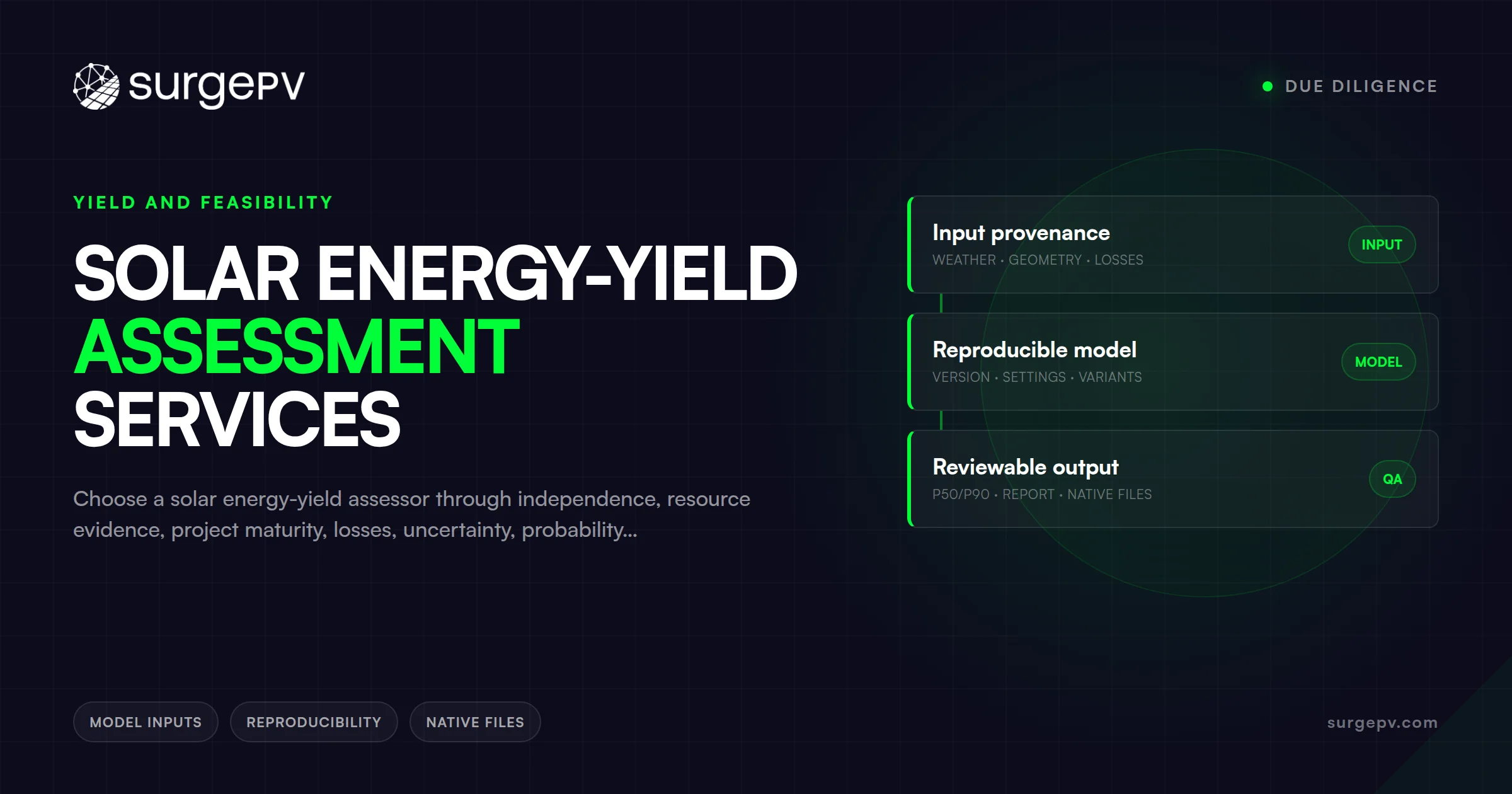
Quick Answer
Choose solar energy-yield assessment services only after defining the decision, permitted users, reliance, time horizon, project maturity, and stakeholder requirements. Verify assessor independence, resource provenance, site measurements, geometry, equipment, losses, and availability assumptions. Then review uncertainty, correlations, probability methods, sensitivities, peer review, reproducibility, changes, deliverables, liability, total cost, and exit. No report guarantees production or acceptance.
Solar energy-yield assessment services support decisions about development, acquisition, financing, design, construction, ownership, and operation. The purchased product is a traceable opinion, not an annual-energy number.
Its usefulness depends on the intended decision, project evidence, assessor independence, methods, uncertainty, limitations, and permitted reliance. A familiar software report cannot settle those questions alone.
This guide uses primary technical and provider-owned sources checked on 10 August 2026. It makes no production, probability, savings, finance, bankability, or stakeholder-acceptance guarantee.
Quick Answer
Choose solar energy-yield assessment services only after defining the decision, permitted users, reliance, time horizon, project maturity, and stakeholder requirements. Verify assessor independence, resource provenance, site measurements, geometry, equipment, losses, and availability assumptions. Then review uncertainty, correlations, probability methods, sensitivities, peer review, reproducibility, changes, deliverables, liability, total cost, and exit. No report guarantees production or acceptance.
| Decision gate | Required acceptance evidence |
|---|---|
| Purpose and reliance | Named decision, users, permitted reliance, horizon, duty, and limitations |
| Assessor | Legal entity, team, competence, independence, conflicts, review, insurance, and continuity |
| Evidence | Resource, measurements, project definition, design maturity, equipment, operations, and source dates |
| Method | Model chain, losses, availability, degradation, uncertainty, probability, scenarios, and peer review |
| Control | Reproduction, changes, deliverables, stakeholder acceptance, contract, pilot, cost, and exit |
In this guide:
- Intended decision, users, reliance, horizon, stakeholder requirements, and assessor independence
- Resource provenance, site measurements, project maturity, design freeze, geometry, and equipment
- Losses, availability, degradation, clipping, curtailment, grid limits, soiling, operations, and auxiliary use
- Uncertainty components, dependence, combination, probability outputs, sensitivities, scenarios, and limitations
- Peer review, reproduction, changes, deliverables, contracts, pilot, total cost, export, and exit
- Heaven Designs disclosure and the SurgePV software boundary
Solar Energy-Yield Assessment Services Decision Boundary
This page owns assessor and assessment due diligence. It asks whether a defined professional work product can support a defined decision and permitted users.
The PVsyst simulation services guide owns model-execution procurement. The PVsyst report guide owns the simulation-report package.
The P50 and P90 guide explains exceedance concepts. The preliminary design services guide owns early design procurement.
The solar yield prediction guide owns general modelling practice. This page adds independence, evidence review, uncertainty, reliance, peer review, and contractual acceptance.
That boundary prevents a software run from being presented as an independent assessment. It also prevents a broad assessment from hiding an undefined project basis.
Define the Decision Before the Scope
Ask why the assessment is being commissioned. Development screening, bid support, acquisition, finance, construction release, budget setting, and operating review need different evidence.
Record:
- Decision and decision date
- Project stage and maturity
- Intended users and excluded users
- Permitted reliance and reliance process
- Energy quantity and delivery point
- Assessment period and probability horizon
- Required base, downside, upside, and sensitivity cases
- Stakeholder methodology, data, assessor, and report requirements
- Required peer review or technical-adviser involvement
- Update triggers and validity limitations
Do not assume a report acceptable for an owner will satisfy a lender, investor, insurer, buyer, or tax-equity participant. Each stakeholder sets its requirements.
Obtain written acceptance of the proposed assessor, scope, resource approach, uncertainty method, probability outputs, reliance language, and deliverables before substantive work.
Late rejection can force a second assessment. It can also create inconsistent cases across technical and financial models.
Verify the Assessor and Independence
Identify the contracting legal entity and the people performing, reviewing, and approving the work. A brand name does not show who takes responsibility.
Request:
- Legal entity, office, applicable registrations, and contracting authority
- Lead assessor, resource specialist, modeller, reviewer, and signatory
- Relevant technology, climate, market, project scale, and operating experience
- Methodology ownership, software competence, and quality procedures
- Current workload, backup reviewers, continuity, and subcontractors
- Professional indemnity or other relevant insurance
- Data, security, confidentiality, retention, and incident controls
- References matched to decision, project maturity, technology, and region
Independence needs a conflict register. Ask about design, development, equipment, construction, operation, ownership, financing, referral, and success-fee relationships.
A disclosed conflict does not automatically disqualify an assessor. The stakeholder must decide whether disclosure, separation, independent review, or replacement resolves it.
Define who can change assumptions and who approves findings. Commercial pressure should not silently modify a technical case.
Freeze the Assessed Project Basis
Every result belongs to a defined project configuration and evidence date. A report can become stale when the project changes.
Create a project-basis register covering:
- Site coordinates, elevation, boundaries, terrain, horizon, and nearby features
- Layout, orientation, tilt, row spacing, tracking, backtracking, and ground coverage
- Module, inverter, transformer, storage, tracker, and other equipment
- DC, AC, export, import, auxiliary, and storage capacities
- Electrical topology, collection, conversion, transformer, and delivery point
- Bifacial assumptions, albedo, rear shading, and mismatch treatment
- Grid requirements, export limits, power factor, and reactive obligations
- Curtailment, dispatch, storage, self-consumption, and operating strategy
- Construction schedule, commissioning profile, and partial-operation assumptions
- O&M strategy, availability, cleaning, vegetation, spares, and response
- Design maturity, unresolved items, substitutions, and evidence date
Tag each input as measured, specified, contracted, designed, assumed, defaulted, or scenario-based. Identify its owner, source, version, and approval.
Do not mix preliminary geometry with construction equipment without disclosure. The model must show what was frozen and what remains uncertain.
Use change control when layout, equipment, capacity, grid, schedule, or operations change. Define materiality and whether recalculation, review, or full reissue is required.
Audit Solar-Resource Provenance
Resource evidence often drives the assessment result and uncertainty. Record the complete chain from source data to the model input.
For every dataset, capture:
- Provider, product, version, retrieval date, and licence
- Coordinates, elevation, spatial resolution, and site assignment method
- Variables, units, time step, time zone, timestamp convention, and aggregation
- Acquisition or modelling method
- Record start, end, length, missing periods, and quality flags
- Irradiance, temperature, wind, snow, albedo, and other available variables
- Long-term adjustment, trend, climate assumption, or typical-year construction
- Validation sites, statistics, regional relevance, and known limitations
- Transformations, gap filling, bias correction, resampling, and file conversion
Compare credible independent sources where the decision warrants it. Do not average them automatically when methods, periods, or biases differ.
Investigate disagreement by variable, season, year, and condition. Preserve the comparison and the reason for selecting or combining a source.
The IEA PVPS report on uncertainty in yield assessments discusses site-specific information and modelling uncertainty.
Treat a country map or public atlas as screening evidence unless its provenance, resolution, validation, and uncertainty fit the decision.
Review On-Site Measurements
On-site data can improve understanding, but poor measurements can add false confidence. The assessor should audit the measurement chain.
Record:
- Station coordinates, surroundings, horizon, mounting, and representativeness
- Sensor make, model, serial, class, calibration, range, and installation
- Logger, sampling, averaging, timestamp, power, communication, and storage
- Cleaning, inspection, maintenance, replacement, and outage history
- Tilt, orientation, levelling, ventilation, heating, and shading conditions
- Quality-control rules, flags, gaps, stuck values, drift, clipping, and anomalies
- Parallel sensors, reference checks, nearby stations, and satellite comparison
- Measurement period, seasonal coverage, and long-term relationship
The public page for IEC 61724-1:2021 identifies monitoring terminology, equipment, and performance-analysis methods. Obtain the licensed standard where required.
Do not call a short record “site validated” without explaining the method and limitations. Weather variability and instrument uncertainty remain.
Document how measurements alter the long-term resource. Site adaptation needs its own method, quality tests, uncertainty, and peer review.
Verify Geometry, Horizon, and Equipment Inputs
A resource file does not become plane-of-array irradiance without geometry and model choices. Audit the physical inputs that translate weather into system exposure.
Check survey source, coordinate system, terrain, elevation, horizon, obstruction, surface model, and geometry version. Record data gaps and simplifications.
For trackers, verify axis, slope, rotation limits, backtracking, row spacing, stow, terrain following, and control assumptions. Separate availability losses from geometric choices.
For bifacial systems, record rear-side model, ground surface, albedo source, seasonal treatment, height, structure, mismatch, and validation basis.
The albedo values guide and bifacial design guide explain these specialist inputs. The assessment must still document project evidence.
Verify equipment by exact manufacturer, model, version, ratings, certification, datasheet, parameter source, and file date. Do not substitute a family or generic record silently.
Check degradation, temperature coefficients, low-light behaviour, mismatch, inverter efficiency, clipping, auxiliary use, transformer, wiring, and grid-interface inputs.
Build a Traceable Loss Model
Every gain and loss needs a definition, basis, time treatment, model location, source, reviewer, and uncertainty relationship.
Use a loss register rather than one copied percentage list.
| Loss or constraint | Due-diligence question |
|---|---|
| Horizon and near shading | Which geometry, date, model, resolution, and validation support it? |
| Soiling and snow | Which climate, site, cleaning, measurement, season, and operating evidence apply? |
| Incidence and spectrum | Which model, equipment, climate, and parameter source apply? |
| Temperature | Which weather, thermal model, mounting, wind treatment, and calibration apply? |
| Module quality and mismatch | Which procurement tolerance, binning, layout, ageing, and evidence apply? |
| DC wiring and transformer | Which topology, lengths, sizes, loading, temperature, and efficiency evidence apply? |
| Inverter and clipping | Which model, loading, voltage, time step, control, and availability assumptions apply? |
| Auxiliary consumption | Which day, night, seasonal, fixed, variable, and metered loads apply? |
| Availability and downtime | Which boundary, events, exclusions, response, spares, and evidence apply? |
| Grid and curtailment | Which export, dispatch, outage, congestion, study, contract, and scenario apply? |
PVsyst explains that its loss diagram presents a sequence and that displayed percentages are not simply additive. The assessor must still justify project assumptions.
Avoid double counting. For example, unavailable hours, curtailment, clipping, and grid outages may overlap depending on the model architecture.
Review whether losses vary monthly, hourly, by operating state, or over project life. A single annual value may hide material timing effects.
Separate Availability, Curtailment, and Clipping
Availability is not one universal percentage. Define the system boundary and which failures, maintenance, grid events, force majeure, and exclusions count.
Separate equipment availability, plant availability, grid availability, contractual availability, and energy-based availability. Reconcile the chosen definition with the financial and operating models.
Curtailment needs source evidence. It may arise from export limits, congestion, dispatch, negative pricing strategy, network instructions, environmental conditions, or contractual control.
Define whether the case uses historical evidence, grid study, contractual limit, dispatch model, stakeholder scenario, or unsupported placeholder.
Clipping depends on DC to AC ratio, irradiance distribution, temperature, equipment, topology, control, and simulation time step. It is not interchangeable with curtailment.
The inverter clipping guide explains design concepts. The assessment should preserve project-specific model settings and data resolution.
Model overlaps and precedence. If the grid is unavailable while the inverter would clip, the loss allocation method affects reported categories without changing physical energy.
Treat Soiling and Operations as Site-Specific
Soiling depends on climate, land use, rain, wind, tilt, surface, agriculture, roads, dust, snow, bird activity, and cleaning operations.
Record whether evidence comes from measurements, nearby plants, literature, operator strategy, water availability, seasonal assumptions, or a default.
Cleaning assumptions should include trigger, frequency, effectiveness, downtime, access, water, labour, weather, and failure to execute. A schedule is not proof of performance.
Operations assumptions should cover staffing, monitoring, alarms, remote reset, spares, warranty response, access, vegetation, inspection, maintenance, and repair logistics.
Distinguish technical capability from contracted and funded practice. An O&M plan may promise actions that the operating budget or site access cannot support.
Use sensitivities where evidence is weak. Do not hide an operating scenario inside a probability label.
Model Degradation Across the Right Horizon
Degradation needs a defined metric, starting point, time convention, distribution, equipment scope, and relationship to warranty or measured evidence.
Separate initial effects, long-term performance loss, equipment replacement, step changes, and availability. Avoid applying one compound factor to unrelated components.
The solar panel degradation rates guide explains evidence categories. The assessment must state its project-specific source and uncertainty.
Define whether the reported energy covers one representative year, each future year, a multi-year average, or a lifetime sum. Probability interpretation changes with horizon.
Reconcile the degradation model with the financial model. Confirm start date, partial operation, replacement, repowering, warranty recovery, and end-of-life treatment.
Do not present a warranty limit as expected degradation automatically. Contract protection and expected physical behaviour answer different questions.
Construct the Uncertainty Budget
An uncertainty budget should show what is uncertain, why, how much, how it behaves, and how components combine.
For each component, record:
- Name and precise definition
- Related input or model stage
- Evidence source and date
- Central value and uncertainty value
- Distribution, direction, symmetry, and tails
- Confidence or coverage interpretation
- Time dependence and assessment horizon
- Reducible versus natural variability
- Correlation or dependence with other components
- Combination or propagation method
- Included, excluded, scenario, and sensitivity status
Sandia PVPMC distinguishes model uncertainty and input variability in its uncertainty-quantification guide. It also discusses dependence and asymmetric inputs.
Do not combine every percentage by root-sum-square without examining dependence. Resource models, transposition, shading, soiling, and performance parameters can share causes.
Do not add conservative scenarios into statistical uncertainty merely because they reduce energy. A scenario may represent a management decision or discrete risk.
Disclose unquantified risks. Omission from a numerical budget does not mean a risk is impossible or immaterial.
Define Probability Outputs Precisely
Labels such as P50 and P90 are incomplete without the energy quantity, probability statement, distribution, horizon, and treatment of variability and uncertainty.
State:
- Gross, net, delivered, exported, metered, or other energy boundary
- Annual, multi-year average, lifetime, or another period
- Base year, operation year, or date range
- Probability distribution and parameter-estimation method
- Included natural variability and model uncertainty
- Correlation, asymmetry, tails, and combination approach
- Degradation, availability, curtailment, and operating treatment
- Climate trend or stationarity assumption
- Exclusions and limitations
PVsyst documents annual resource variability and advises site-specific computation in its interannual variability guidance. Software settings remain assessor inputs.
P50 and P90 do not guarantee production. An actual year can differ because weather, operations, outages, construction, equipment, grid, and model error differ.
Never call a conservative operating case P90 unless it follows the stated probability method. Keep deterministic downside cases separate.
Separate Sensitivities, Scenarios, and Probabilities
A sensitivity changes one input or method to show response. A scenario changes a coherent operating or project story. A probability case derives from a statistical model.
Useful sensitivities may cover resource source, degradation, soiling, availability, curtailment, albedo, bifaciality, temperature, clipping, grid limit, and schedule.
Scenarios may cover alternative equipment, layout, cleaning plan, storage dispatch, export regime, construction phase, repowering, or O&M strategy.
Define whether changes are independent. A lower cleaning frequency may alter soiling, availability, labour, water, and cost simultaneously.
Report each case with changed inputs, unchanged inputs, method, rationale, result, and decision implication. Avoid unexplained tables of energy values.
Use sensitivity results to prioritize better evidence. A high-impact uncertain input may justify measurement, design work, contract clarification, or stakeholder discussion.
Require Peer Review and Reproduction
Peer review should be independent of the original preparation where the decision warrants it. Define reviewer competence, scope, evidence access, and conflict controls.
The review should trace resource, project basis, models, losses, uncertainty, probability, scenarios, findings, limitations, and cross-model reconciliation.
Sandia PVPMC publishes a model-validation procedure using error, residual, and baseline comparisons. Validation scope should match the models actually used.
Reproduction needs more than a PDF. Require, subject to licence and contract:
- Original and processed resource data
- Measurement data, flags, calibration, maintenance, and quality records
- Site, horizon, terrain, geometry, and layout inputs
- Equipment files, datasheets, and parameter sources
- Model project files, versions, settings, databases, and dependencies
- Loss, availability, degradation, curtailment, and uncertainty registers
- Scripts, transformations, calculations, and exported results
- Scenario, sensitivity, and probability definitions
- Review comments, resolutions, approvals, and issue history
Run a clean-environment reproduction test. Record unavailable proprietary dependencies and the agreed future access path.
Control Changes and Reissues
Set change triggers before issuing the report. Classify changes by technical, uncertainty, stakeholder, reliance, or document impact.
Triggers can include new resource data, longer measurements, survey changes, layout revision, equipment substitution, grid limits, construction delay, or O&M changes.
Open a change record with source, old value, new value, reason, affected files, materiality, reviewer, stakeholder impact, and required action.
Do not overwrite the old assessment. Issue a new revision, addendum, or replacement with a clear relationship and superseded status.
Reconcile changes into the financial and operating models. Capacity, energy boundary, availability, degradation, curtailment, schedule, and horizon should agree.
The replace Excel financial model guide covers general model governance. Yield-assessment change control remains a technical workstream.
Specify Deliverables and Native Dependencies
Define every deliverable, format, purpose, status, owner, licence, and permitted user before award.
The package may include:
- Executive decision summary
- Project-basis and evidence registers
- Resource review and comparison
- Measurement quality and site-adaptation review
- Methodology and model-chain description
- Base yield and loss breakdown
- Availability, degradation, curtailment, clipping, grid, and operations treatment
- Uncertainty budget and combination method
- Probability, scenario, and sensitivity outputs
- Findings, limitations, open items, and recommendations
- Financial or operating-model reconciliation table
- Native files, data, scripts, settings, logs, and dependency manifest
- Peer-review record and comment closure
- Issue, revision, reliance, and change-control record
Identify third-party data and software licence restrictions. A buyer may receive a report without rights to redistribute resource data or proprietary files.
Define future reproduction and update rights. Name who can access dependencies after staff, vendor, licence, or software-version changes.
Obtain Stakeholder Acceptance
Send the proposed assessor, scope, methodology, resource approach, probability method, deliverables, and reliance language to intended stakeholders before award.
Record accepted, rejected, conditional, and unanswered items. Do not interpret silence as acceptance.
At draft stage, provide enough time and evidence for technical-adviser review. Track comments with unique IDs, owners, responses, changes, and closure.
Reconcile the accepted technical case with the financial or operating model. Confirm energy boundary, capacity, schedule, availability, degradation, curtailment, auxiliaries, and horizon.
No assessor can guarantee lender, investor, owner, insurer, or buyer acceptance. Requirements can change, and each party controls its decision.
Contract Reliance, Liability, and Changes
The contract should state purpose, scope, assumptions, standards, method, deliverables, schedule, fees, review, changes, and acceptance criteria.
Define permitted users, reliance, third-party use, duty, liability, cap, exclusions, indemnity, insurance, confidentiality, data rights, and governing law through counsel.
Separate reliance on the report from access to source files. A recipient may need both, subject to licence and confidentiality restrictions.
Define client duties for complete inputs, timely changes, stakeholder requirements, site access, measurement records, and approvals.
Set price rules for new resource data, design changes, stakeholder comments, added probability cases, peer review, reissue, reliance letters, and urgent work.
Include termination, work-in-progress delivery, native files, data return, deletion, transition, and post-termination support.
This article is not legal, investment, lending, insurance, tax, or engineering advice. Obtain qualified review for the actual transaction and jurisdiction.
Run a Failure-Led Pilot
Use a limited assessment or shadow review matched to the intended decision. Define pass criteria before sharing sensitive data.
Test:
- Conflicting resource datasets
- Short or poor-quality site measurements
- Preliminary geometry with unresolved design choices
- Equipment model or parameter disagreement
- Weak soiling, availability, or curtailment evidence
- Correlated or asymmetric uncertainty components
- Scenario presented incorrectly as a probability case
- Peer-review challenge and comment resolution
- Design change after draft issue
- Clean reproduction from delivered files
- Financial-model reconciliation
- Export, termination, deletion, and replacement-assessor transition
Measure evidence traceability, technical consistency, uncertainty logic, review quality, response, reproducibility, stakeholder acceptance, and operator effort.
Model total cost across base scope, resource data, measurements, software, specialist review, probability work, peer review, changes, reliance, updates, and storage.
Test exit before award. Confirm usable data, files, scripts, assumptions, review history, licences, deletion, and replacement-assessor access.
How to Evaluate Heaven Designs
Heaven Designs is a related-party provider and receives no ranking. Its public page describes pre-design modelling, not an independently validated reliance assessment.
Review the published pre-design scope as vendor evidence only. Do not infer independence, uncertainty, probability, peer-review, or reliance scope.
Use its sample-request route to request a decision-matched example. A sample does not prove current people or acceptance.
Verify legal entity, team, competence, conflicts, resource work, measurements, project review, losses, uncertainty, probability methods, peer review, reproduction, liability, price, support, and exit.
Then apply the same failure-led pilot and stakeholder-acceptance gates used for unrelated assessors. Make no bankability, production, probability, savings, or acceptance inference.
Disclosure: SurgePV and Heaven Designs have a commercial relationship. Heaven Designs receives identical independence, evidence, uncertainty, peer-review, reliance, pilot, cost, and exit gates. Published scope does not establish independent validation.
SurgePV Is Software, Not the Independent Assessor
SurgePV is software. It cannot become the independent assessor, investor, lender, owner, insurer, technical adviser, engineering signatory, or guarantor.
Software may support calculations, geometry, simulation, and reports within its verified scope. Accountable professionals must approve inputs, methods, findings, uncertainty, limitations, and reliance.
Record software version, model settings, component files, data, transformations, dependencies, and exported outputs. Validate them against the intended assessment method.
Do not treat a software result as stakeholder acceptance or actual future production. Preserve the boundary between tool output and professional opinion.
Procurement Scorecard
Score evidence and observed work. A mandatory missing item should block reliance release.
| Gate | Pass evidence | Blocker example |
|---|---|---|
| Decision | Purpose, users, horizon, reliance, and stakeholder needs agreed | Generic report commissioned first |
| Assessor | Entity, team, competence, conflicts, review, and insurance verified | Unknown analysts or undisclosed conflict |
| Resource | Provenance, period, quality, comparison, validation, and uncertainty traceable | One dataset accepted without review |
| Measurements | Sensors, calibration, maintenance, gaps, quality, and site adaptation reviewed | Short record called validated without method |
| Project basis | Geometry, equipment, operating case, maturity, and evidence date frozen | Preliminary and construction inputs mixed |
| Losses | Every loss has definition, evidence, time treatment, and model location | Copied percentage list |
| Operations | Availability, soiling, cleaning, spares, curtailment, grid, and auxiliaries defined | Contract aspiration treated as evidence |
| Uncertainty | Components, distributions, dependence, combination, horizon, and exclusions disclosed | Generic values or double counting |
| Probability | Energy boundary, period, distribution, variability, and statement defined | Conservative scenario labelled P90 |
| Sensitivities | Changed inputs, rationale, result, and decision use recorded | Unexplained alternative outputs |
| Peer review | Competent independent review and comment closure complete | Original modeller self-approves all work |
| Reproduction | Data, files, versions, settings, scripts, dependencies, and audit reproduce | PDF is the only deliverable |
| Change control | Triggers, materiality, approvals, reissue, and reconciliation pass | Design changes without updated assessment |
| Stakeholders | Assessor, scope, method, report, and reliance accepted in writing | Acceptance assumed from silence |
| Contract | Duty, reliance, liability, data, changes, termination, and counsel review complete | Report purpose conflicts with terms |
| Cost | Base, data, software, review, changes, reliance, updates, and exit compared | Base report fee considered alone |
| Exit | Native package, licences, deletion, transition, and replacement access tested | Proprietary dependencies block update |
The final decision should name the accepted assessor, scope, project basis, evidence date, users, reliance, deliverables, limitations, price, and update triggers.
Frequently Asked Questions
What is a solar energy-yield assessment?
It is a documented professional assessment of expected photovoltaic energy for a defined project, decision, design, operating basis, period, and evidence date. It reviews resource, geometry, equipment, losses, constraints, availability, degradation, uncertainty, scenarios, probability outputs where required, limitations, deliverables, and permitted reliance.
Is an energy-yield assessment the same as a PVsyst simulation?
No. A PVsyst simulation may be one modelling step. An assessment also evaluates evidence, project maturity, methods, assumptions, losses, operations, uncertainty, scenarios, findings, limitations, quality review, reproducibility, change control, stakeholder needs, and contractual reliance. Software output alone does not provide an independent opinion.
Does an energy-yield assessment make a solar project bankable?
No. Bankability is not a property that one report can guarantee. Investors, lenders, owners, insurers, and advisers decide whether the assessor, scope, evidence, methods, independence, reliance, liability, and wider project risks meet their requirements. Obtain written stakeholder acceptance before commissioning.
What should a solar-resource review include?
Review provider, dataset, version, acquisition method, variables, period, resolution, coordinates, elevation, time convention, gaps, quality control, bias, and validation. Then assess site adaptation, nearby stations, on-site measurements, sensor calibration, maintenance, cleaning, representativeness, long-term adjustment, source disagreement, and uncertainty.
What should an energy-yield uncertainty budget disclose?
Disclose each component, definition, source, value, evidence, distribution, direction, confidence basis, time dependence, reducibility, correlation or dependence, combination method, exclusions, and sensitivity. Separate natural variability, measurement uncertainty, model uncertainty, operational scenarios, and risks that were not quantified.
Are P50 and P90 guaranteed production levels?
No. They are modelled probability outputs under stated data, assumptions, distribution, uncertainty, combination method, and time horizon. They do not promise actual production in one year or across a project life. Ask exactly what energy quantity, period, and exceedance statement each label represents.
When should an energy-yield assessment be updated?
Set triggers for changes to resource data, measurements, site, layout, terrain, horizon, albedo, equipment, capacity, losses, grid limits, curtailment, and storage. Include schedule, degradation, availability, operating strategy, contract, code, financial horizon, and stakeholder requirements. Record materiality and approval rules.
How should buyers evaluate Heaven Designs for yield work?
Heaven Designs is a disclosed related-party provider and receives no ranking. Its published pre-design scope is not proof of an independent reliance assessment. Verify assessor entity, competence, conflicts, resource work, uncertainty, peer review, deliverables, liability, stakeholder acceptance, price, support, and exit through contract and a pilot.
Does SurgePV provide an independent energy-yield assessment?
No. SurgePV is software and cannot become the independent assessor, investor, lender, owner, insurer, technical adviser, or guarantor. Accountable professionals must approve inputs, methods, findings, uncertainty, limitations, and reliance. Validate software scope, version, settings, dependencies, outputs, and reproduction separately.
Sources
Primary research and reference material used for this desk-research article.
Where this fits
This article is part of SurgePV's Solar Business & Operations hub, which works through the topic from first principles to the decisions a project team actually has to make.

