

A national retail chain wants solar on 180 stores. A franchise group wants it on 45 restaurants. A logistics REIT wants it on 60 warehouses. These multi-site rollouts are now the fastest-growing segment of commercial and industrial (C&I) solar, and they reward a completely different operating model than one-off project sales. Corporate buyers added a record share of U.S. solar procurement in recent years, with clean energy buyers accounting for a growing slice of new C&I capacity according to SEIA’s Solar Industry Research Data (2025).
The problem: most EPCs still run these programs like 180 separate custom projects. Every site gets its own design cycle, its own permit learning curve, and its own proposal format. Engineering hours balloon. Margins disappear. The client’s portfolio-level timeline slips by quarters.
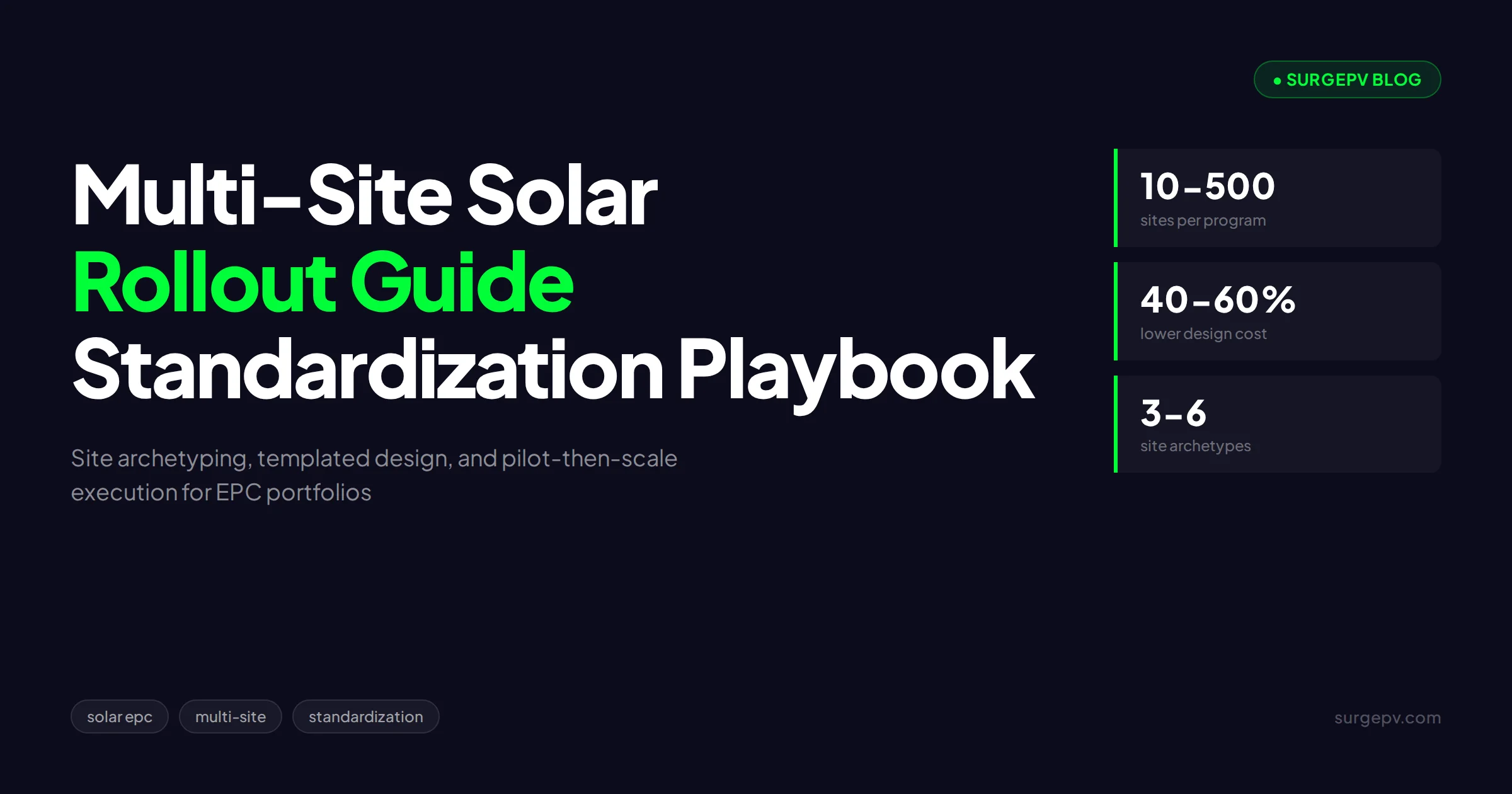
This guide lays out the standardization playbook that separates profitable multi-site programs from chaotic ones. It covers site archetyping, templated design kits, centralized design review, AHJ (authority having jurisdiction) permitting matrices, and the pilot-then-scale rollout model. It is written for EPCs, developers, and portfolio owners running 10-500 site programs.
Quick Answer
A multi-site solar rollout is a standardized program that deploys PV across 10-500 similar properties for one client. EPCs win these programs by classifying sites into 3-6 archetypes, building templated design kits per archetype, running centralized design review, and proving the model on 2-5 pilot sites before scaling. Standardization cuts per-site engineering cost 40-60% versus custom one-off projects.
In this guide:
- Why multi-site rollouts reward standardization over customization
- Site archetyping: turn 200 buildings into 4 engineering problems
- Templated design kits: what goes in the kit per archetype
- Centralized design review and QA at portfolio scale
- Permitting at scale: the AHJ matrix and fast-track programs
- The contrarian case: where full standardization breaks down
- Pilot-then-scale: the 4-phase rollout playbook with real numbers
Why Multi-Site Rollouts Reward Standardization
A multi-site rollout succeeds when the EPC treats design, permitting, and installation as one repeatable production system instead of many custom projects. The economics force this. Soft costs — permitting, design, customer acquisition, overhead — account for roughly 65% of total residential PV cost and a large share of commercial PV cost, according to the NREL soft costs research program (2024). Hardware is commoditized. Process is where margin lives.
Three structural advantages push corporate clients toward portfolio procurement. First, bulk purchasing. A 100-site program at 250 kW average represents roughly 25 MW of volume, enough to negotiate module and inverter pricing 8-15% below spot (industry-observed range). Second, financing. Portfolios attract cheaper capital because lenders underwrite the program once, not 100 times. Third, carbon accounting. Companies need aggregated Scope 2 reductions for reporting, and a single EPC contract produces clean, auditable data.
The U.S. installed 9.3 GW of solar in a single recent quarter, with commercial projects showing steady growth, according to SEIA and Wood Mackenzie data (2025). Globally, solar capacity additions continue to dominate new renewable builds, per the IEA Renewables 2024 report. Much of the C&I growth is now portfolio-driven rather than site-by-site. Retail chains, restaurant franchises, and industrial landlords are the buyers leading that shift.
Our take: the EPCs winning these contracts are not the ones with the best individual designs. They are the ones with the best repeatable design system. That is a different skill, and most installer organizations have not built it yet.
For the economics of what happens after commissioning, see our solar fleet management guide. That post covers post-install O&M and monitoring. This one covers the rollout itself.
Site Archetyping: Turn 200 Buildings Into 4 Engineering Problems
Site archetyping is the classification step that groups a client’s properties into 3-6 categories sharing one engineering solution. It is the single highest-impact activity in the entire program. Get archetypes right and everything downstream — design, BOM, permitting, crew training — gets cheaper. Get them wrong and you rebuild templates mid-program.
Start with the client’s site data export. You need roof type and age, available area, electrical service size, interval load data if available, utility territory, and state or country. Most portfolio owners have 80% of this in their facilities database. A cloud solar design software platform lets the design team screen each roof remotely from satellite imagery before anyone drives to a site.
A practical archetyping matrix looks like this:
| Archetype | Roof | Size band | Key constraint | Share of typical retail portfolio |
|---|---|---|---|---|
| A — Small flat roof | Membrane/TPO | under 50 kW | Service panel capacity | 30% |
| B — Large flat roof | Membrane/TPO | 50-250 kW | Ballast structural load | 35% |
| C — Pitched roof | Standing seam metal | under 100 kW | Attachment points | 15% |
| D — Carport dominant | Parking canopy | 100-500 kW | Steel cost, civil work | 10% |
| E — Battery-attached | Any | any | Interconnection limits | 10% |
Three rules keep archetypes useful. Cap the count at 6 — beyond that, you are re-customizing. Define each archetype by the engineering driver, not the building name. And assign every site to exactly one archetype, with a documented exception path for oddballs.
A useful scoring model for assigning archetypes weights 4 variables: roof condition (0-3 points), electrical service headroom (0-3), interconnection risk (0-3), and permitting speed (0-3). Sites scoring 10-12 go into the first production waves. Sites scoring under 6 go to the exception queue or get deferred pending roof work or utility studies. The score also feeds the rollout sequence — fast, high-score sites build early cash flow that funds the slower tail.
The exception path matters. Typically 5-15% of a portfolio is genuinely non-standard: historic buildings, structural problems, weird utilities. Park those sites. Do not let them distort the standard kits. A dedicated exception engineer handles them as semi-custom work.
Pro Tip
Build the archetype map from the client’s worst 10% of sites first, not the best. If your kit survives the awkward roofs, it will fly on the easy ones. Screening from easy sites produces templates that break in production.
Templated Design Kits: What Goes In Each Archetype
A templated design kit is a pre-engineered package that answers every repeatable design question for one archetype. The goal: a designer should produce a site-ready layout in 2-4 hours, not 2-4 days. Industry-observed benchmarks put custom C&I design cycles at 1-3 weeks per site. Templated kits compress that to days.
A complete kit contains 6 elements:
- Standard layout library. Pre-validated module arrangements for common roof geometries within the archetype, with fire-access setbacks already applied per major code families (IFC, NEC 690.12 rapid shutdown zones).
- Fixed equipment spec. One module, one inverter family, one racking system per archetype. Single-SKU discipline is what makes bulk pricing and spare-parts pooling work.
- Standard single-line diagram (SLD). The electrical one-line that covers 90% of sites in the archetype, with variable fields for service size and interconnection type.
- BOM template. Bill of materials with per-kW quantities, so a 180 kW site is a 180-row arithmetic exercise, not an engineering exercise.
- Structural pre-check criteria. Snow load, wind load, and roof-condition gates that either pass the site to production or route it to a structural engineer.
- Yield model preset. Regional irradiance and shading assumptions locked per climate zone, so financials are comparable across the portfolio.
Shading is where templated kits meet site reality. Every roof has HVAC units, parapets, and trees. Running solar shadow analysis software on a 3D model of each roof catches the exceptions that break a template. Sites with heavy shading get re-archetyped or moved to the exception queue before install crews are scheduled.
The financial layer should be templated too. A solar financial analysis tool with the client’s tariff, escalator, and ITC (investment tax credit) assumptions pre-loaded means every site proposal runs the same NPV math. Portfolio clients reject proposals that show inconsistent assumptions between sites. For C&I specifics, our commercial solar proposal software guide covers the proposal layer in depth.
For multi-building campuses and distribution centers specifically, the patterns in our logistics hub solar design post apply directly to archetypes B and D above.
Standardize Your Multi-Site Design Workflow
See how SurgePV handles 3D modeling, shadow analysis, yield simulation, and proposals in one cloud workspace — built for repeatable portfolio design.
Book a DemoNo commitment required · 20 minutes · Live project walkthrough
Centralized Design Review and QA at Portfolio Scale
Centralized design review means one small senior team approves every design before it goes to permitting or installation. This is the quality backbone of the whole model. Distributed design teams produce distributed standards. Within 6 months, every regional designer has their own “improved” version of the template, and the portfolio standard is gone.
A working review structure for a 100-site program: 2-4 designers producing templated layouts, 1-2 senior engineers reviewing, 1 program manager owning the standard. Review throughput target: 5-10 sites per reviewer per week. That is only possible because templates remove 80% of design judgment from individual sites.
The review checklist should be short and mechanical:
- Layout matches the assigned archetype kit, with deviations documented.
- Shadow analysis completed; production estimate within 5% of archetype expectation.
- SLD variables filled correctly; interconnection method matches utility requirements.
- Structural pre-check passed or routed.
- BOM generated from template, no manual line items.
Version control on the kit itself is non-negotiable. When the module spec changes, every in-flight design must either lock to the old kit or re-validate against the new one. We have seen programs ship 2 module SKUs across one client’s portfolio because a spec change was never propagated. The spare-parts and warranty consequences lasted years.
This is also where tooling choice compounds. A desktop CAD workflow makes centralized review painful — files move by email, versions fork. Cloud-native design software for solar installers keeps every site in one workspace where the review team can pull any design, run the checks, and sign off without file transfers. That operational detail alone saves hours per site at scale.
Review cadence matters as much as review depth. Batch sites into weekly review slots of 5-10 so reviewers stay inside one archetype per session. Context-switching between archetypes is where checklist discipline slips. Track 2 metrics per wave: first-pass approval rate and average rework hours per rejected design. A healthy program holds first-pass approval above 80%. Below that, the kit is ambiguous or the designers need retraining — either way, fix the system, not the people.
Permitting at Scale: The AHJ Matrix
Permitting is the most volatile variable in a multi-site rollout. A 100-store retail program in the U.S. can easily span 40+ AHJs and 15+ utilities, each with different forms, fees, review times, and inspection requirements. Median permitting timelines for commercial PV run 4-12 weeks nationally, with wide variance, according to NREL’s installed cost benchmarks (2024).
The fix is an AHJ matrix built before the pilot wave:
| Column | Purpose |
|---|---|
| AHJ name and contact | Who reviews |
| Permit type and fee | Cost per site |
| Required documents | Stamps, SLD format, structural letter |
| Review time (actual) | Tracked, not advertised |
| Inspection process | Scheduling lag, common failure points |
| Utility interconnection tier | Screen/fast-track/study |
Populate it from permit databases and from your own pilot submissions. Update it after every wave. Within 2 waves, the matrix predicts timeline accurately enough to schedule install crews against permit approvals instead of guessing.
Two accelerators exist in the U.S. market. SolarAPP+ provides instant automated plan review for eligible residential-scale systems in participating jurisdictions, per the U.S. Department of Energy’s SolarAPP+ page (2025). Several states also mandate permitting timelines or online portals for standard systems. Neither covers large C&I carports or complex interconnections — those stay on the slow path, which is exactly why the pilot wave should include at least one difficult-AHJ site.
For programs that need engineered permit plan sets at volume, our sister engineering team at Heaven Designs publishes a practical walkthrough on how to submit solar permits to an AHJ — useful background for EPCs building their first permit matrix.
Key Takeaway
Sequence the rollout by AHJ speed, not geography. Install in fast-permitting jurisdictions first to build cash flow and crew rhythm. Slow AHJs go late in the schedule, with applications filed months ahead of install dates.
The Contrarian Case: Where Full Standardization Breaks Down
The standard advice says “standardize everything.” That advice is wrong at the margins, and EPCs lose money learning where. Full standardization fails in 4 predictable places.
First, interconnection. Utility screens vary by feeder, not just by utility. Two identical stores 3 miles apart can face a fast-track approval and a $150,000 interconnection study. No template fixes grid capacity. Screen interconnection risk before assigning archetypes, and treat grid-constrained sites as their own class.
Second, structural reality. Ballasted flat-roof templates assume a roof that can take the load and has 10+ years of life left. Portfolio owners routinely hand over roofs due for replacement in 3 years. Re-roofing before solar adds cost but saves a costly detach-and-reset later. The exception engineer earns their salary here.
Third, local content and incentive rules. Buy-American provisions, domestic-content ITC adders, and state programs can flip equipment economics per jurisdiction. A single national BOM can leave money on the table or break compliance. The EU rooftop mandate discussion adds similar jurisdiction-level variation in Europe — see our EU rooftop solar mandate breakdown for how rules differ across member states.
Fourth, crew variability. A standard install method only holds if every crew is trained on it. Subcontractor-heavy programs drift fast. Budget for per-wave crew certification, not just one onboarding.
The nuance: standardize the 80% that repeats — layout logic, BOM, SLD, permit packages, proposal format. Deliberately keep the 20% flexible — interconnection strategy, structural exceptions, incentive optimization. The tradeoff is review load: every flex point needs engineering judgment, which is why the centralized review team exists. Companies that standardize 100% ship defects at scale. Companies that standardize nothing burn margin at scale. The profitable zone sits between.
Pilot-Then-Scale: The 4-Phase Rollout Playbook
The rollout model that works has 4 phases: screen, pilot, ramp, steady state. Skipping the pilot is the most common and most expensive mistake in multi-site programs. Here is the playbook with typical numbers for a 100-site, 250 kW-average retail program (hypothetical example, based on industry-observed ranges).
Phase 1 — Screen (weeks 1-6). Pull the site list, run remote roof screening, build the archetype map and AHJ matrix, and score every site on roof condition, load, interconnection risk, and permitting speed. Output: ranked site list plus 4-6 design kits. Typical finding: 10-15% of sites get deferred or dropped. Budget 2-4 analyst hours per site at this stage.
Phase 2 — Pilot (weeks 6-20). Install 2-5 sites chosen to stress the system: one easy, one slow AHJ, one structurally marginal. Measure everything — design hours per site, permit days, install crew-days, cost variance versus model. Target: prove the per-site cost model within ±10%. Fold every lesson back into the kits before proceeding.
Phase 3 — Ramp (months 5-12). Scale to 5-10 sites per month. Add a second install crew only after the first crew hits target crew-days on 3 consecutive sites. File permits for slow AHJs now for sites scheduled 2+ waves later.
Phase 4 — Steady state (months 12-24). Run 10-15 sites per month with the full machine: templated design, centralized review, pre-positioned equipment, repeat crews. Equipment procurement shifts to quarterly blanket orders against the forecast.
| Phase | Duration | Sites | Exit criteria |
|---|---|---|---|
| Screen | 4-6 weeks | 0 installed | Archetype map, AHJ matrix, ranked site list approved |
| Pilot | 8-14 weeks | 2-5 | Cost model proven within ±10%; kits revised |
| Ramp | 6-8 months | 5-10 per month | 2 crews certified; first-pass design approval above 80% |
| Steady state | 12+ months | 10-15 per month | Quarterly blanket procurement; review throughput stable |
A note on pilot selection: pick pilot sites from at least 2 different archetypes and 2 different AHJs. A pilot that only tests the easiest case teaches you nothing about the failure modes that sink production waves.
Financially, the standardization payoff shows up in the design line. A custom C&I design cycle at 40-80 engineering hours per site costs a 100-site program 4,000-8,000 hours. Templated kits at 4-10 hours per site, plus review, land at 600-1,500 hours. At typical loaded engineering rates, that is a six-figure saving per program — before counting faster permitting, bulk equipment pricing, and repeat-crew productivity. Installers protecting thin margins should also read our solar installer profit margins analysis.
The client sees the same logic in their proposals. PV proposal software that generates branded, consistent financials for every site lets the client’s finance team approve sites in batches instead of re-reviewing each one. Batch approvals are what make wave-based installation schedules stick. For the full C&I angle, the commercial solar page covers how the platform handles portfolio-scale work, and Clara AI can draft proposal copy variants per site cluster.
Conclusion
Multi-site rollouts reward a factory mindset: classify sites into a handful of archetypes, engineer each archetype once, review centrally, permit by matrix, and scale only after the pilot proves the cost model. The EPCs that internalize this win portfolio contracts that one-off competitors cannot price. The ones that run 100 custom projects inside a portfolio contract quietly lose money at scale.
Three actions to take this quarter:
- Archetype your current pipeline. Take your last 20 C&I projects and classify them. If more than 6 archetypes emerge, your templates are too thin.
- Build one complete design kit. Pick your highest-volume archetype and produce the full 6-element kit: layouts, equipment spec, SLD, BOM, structural gates, yield preset.
- Run a 2-site pilot before your next portfolio bid. Measure design hours and permit days against your model, then price the portfolio with real data instead of hope.
Frequently Asked Questions
What is a multi-site solar rollout?
A multi-site solar rollout is a program where one client deploys PV across 10-500 similar properties, such as retail stores, franchise locations, or warehouses. Instead of treating each building as a custom project, the EPC groups sites into archetypes, reuses templated designs, and installs in waves. The client gets one contract, one design standard, and a repeatable cost structure.
How do you standardize solar design across multiple sites?
Start by classifying sites into 3-6 archetypes based on roof type, load profile, region, and interconnection rules. Build a templated design kit for each archetype with a standard module layout, inverter, racking BOM, and single-line diagram. Run every site through centralized design review so one team enforces the standard. Only the site-specific layers, such as shading and AHJ permit forms, get customized.
What is site archetyping in solar EPC work?
Site archetyping means grouping a client’s properties into a small set of design categories that share the same engineering solution. A grocery chain, for example, might map to 4 archetypes: flat membrane roof under 40 kW, flat roof 40-120 kW, pitched metal roof, and carport-dominant sites. Each archetype gets one pre-engineered design kit. Archetyping is what converts a 200-site pipeline into roughly 4 engineering problems solved once.
How much does standardization save on multi-site solar projects?
Standardization typically cuts per-site engineering and design cost by 40-60% compared with fully custom projects. Industry-observed ranges also show 10-20% lower soft costs overall once permit templates, pre-negotiated equipment pricing, and repeat-crew learning curves are counted. The savings grow with program size: a 50-site rollout amortizes the design kit investment far better than a 5-site one.
What is the pilot-then-scale approach in solar rollouts?
Pilot-then-scale means installing 2-5 representative sites first, then rolling out the rest in waves. The pilot validates the design kit, permit timeline, logistics, and cost model against reality. Problems surface on cheap pilot sites instead of expensive production sites. After pilot lessons are folded back into the templates, the EPC scales to 5-15 sites per month with far fewer surprises.
Which software do EPCs use for multi-site solar design?
EPCs use cloud-based design platforms that let a centralized team model many rooftops quickly without desktop installs. SurgePV supports multi-site workflows with 3D rooftop modeling, automated shadow analysis, energy yield simulation, and branded proposals in one workspace. The key requirements are speed per site, a reusable component database, and consistent proposal output across the whole portfolio.
Where this fits
This article is part of SurgePV's Solar Business & Operations hub, which works through the topic from first principles to the decisions a project team actually has to make.


