

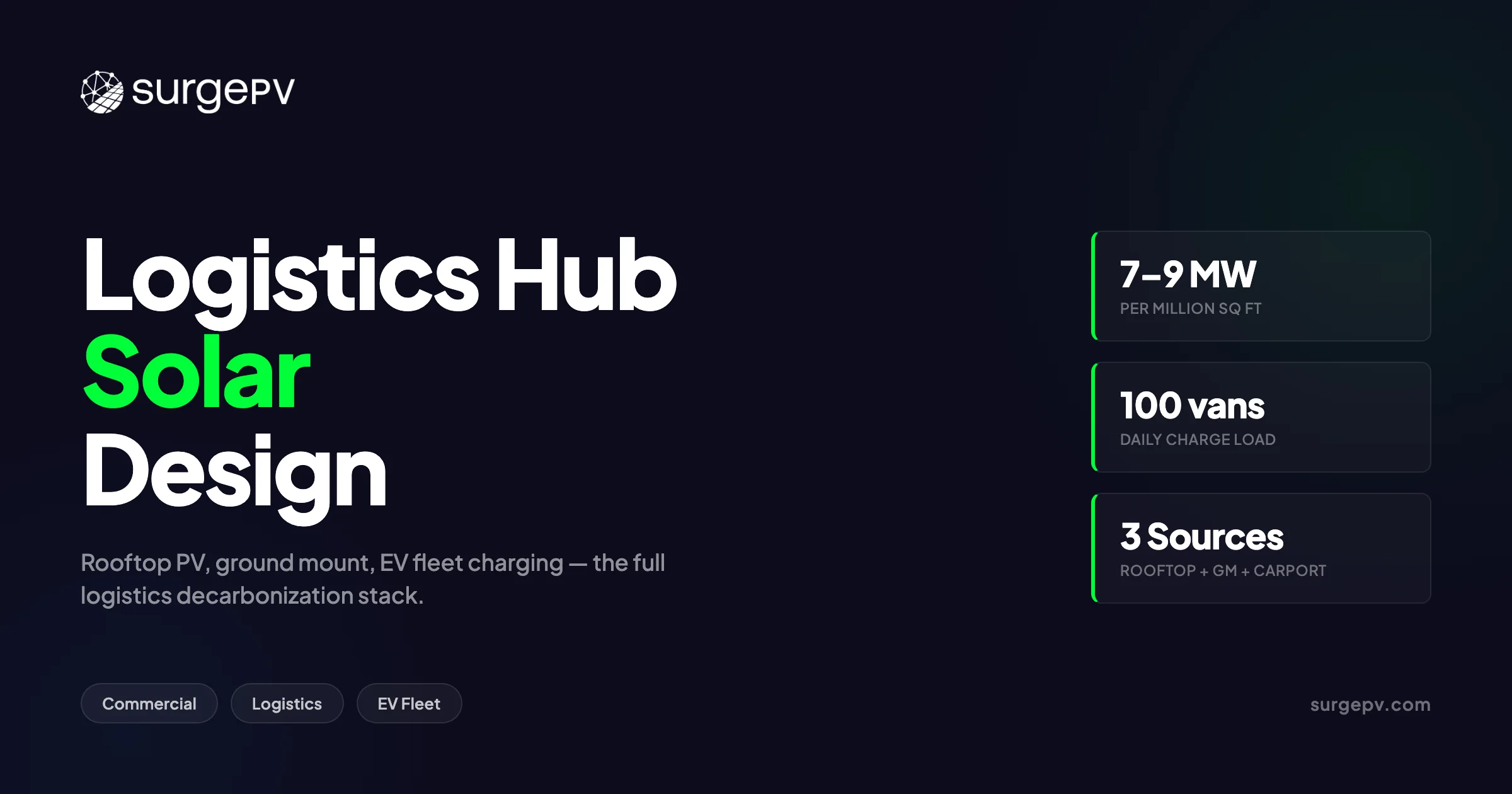
A modern logistics hub is the most energy intensive commercial real estate asset in the United States today. A single one million square foot Amazon fulfillment center pulls 10 to 18 megawatt hours per day before any EV fleet charging is added to the load. Add 100 electric delivery vans and the daily energy demand rises to 22 to 30 MWh. Most logistics operators now treat onsite solar plus storage plus EV charging as a single integrated infrastructure problem rather than three separate projects.
Add 100 electric delivery vans and the daily energy demand rises to 22 to 30 MWh. This guide walks through the full logistics hub solar design playbook for 2026. Walmart targets zero emissions across operations by 2040 and operates onsite solar at more than 450 facilities.
This guide walks through the full logistics hub solar design playbook for 2026. We cover rooftop PV sizing at warehouse scale, ground mount strategy for adjacent acreage, solar carport integration for parking and depots, EV fleet charging load profiles, battery storage sizing for demand charge management, microgrid design for resilience, financial modeling with the stacked Inflation Reduction Act credits, and the permit and interconnection sequence that can make or break the schedule. See Adding Battery Storage Services for detailed guidance.
TL;DR — Logistics Hub Solar Design 2026
A 1 million sq ft logistics hub fits 7 to 9 MW of rooftop PV plus 3 to 8 MW of adjacent ground mount. Add 100 electric vans and you need 1.2 to 1.6 MWh of daily charging energy. The full stack costs 12 to 24 million dollars before incentives and pays back in 4 to 7 years with the 30 percent ITC stacked with domestic content and energy community adders. Microgrid resilience adds 8 to 15 percent to cost and protects against 200 to 800 thousand dollars per day in outage losses.
In this guide:
- Latest 2026 status of logistics solar incentives, fleet electrification policy, and ITC adders
- Three layout strategies: rooftop, ground mount, and carport — when to use each
- Sizing math for warehouse rooftop solar (Amazon, FedEx, DHL scale)
- Ground mount strategy for adjacent acres and stormwater coordination
- EV fleet charging load profiles for delivery vans and semi trucks
- Battery storage sizing for demand charge management
- Case studies from Amazon Air Hub, DHL Express, FedEx Smart Post, and Walmart
- Microgrid design for outage resilience
- Financial modeling: 30 percent ITC stack plus EV credits plus MACRS
- Permit and interconnection sequencing for large sites
The Logistics Hub Solar Opportunity 2026
Logistics real estate is the fastest growing solar opportunity in North America right now. The combination of massive rooftops, owner operator economics, predictable daytime load, and fleet electrification commitments has produced a class of projects that financial sponsors can underwrite at scale.
E-commerce drove 1.4 billion square feet of US warehouse construction between 2020 and 2024 according to CBRE. Most of that real estate was built with structural roof capacity sufficient for solar — typically 4 to 5 pounds per square foot live load above dead load. Newer hubs from Amazon, Prologis, and Realty Income are pre wired for solar and storage from day one.
Why Logistics Hubs Are Unique for Solar
| Attribute | Why It Matters For Solar |
|---|---|
| Roof area 500,000 to 2,000,000 sq ft | 3 to 18 MW of rooftop PV on a single site |
| Adjacent unused parcels 5 to 50 acres | 1 to 12 MW of ground mount alongside |
| Daytime base load 1 to 4 MW | High self consumption ratio (60 to 80 percent) |
| EV fleet committed 50 to 1,000 vehicles | 1 to 25 MWh of additional daily energy demand |
| Single owner operator | Simple offtake structure, no PPA negotiation |
| 24/7 critical operations | Strong case for microgrid and battery resilience |
| Long lease tenor (10 to 20 years) | Matches solar 25 year asset life |
The combination is rare in commercial real estate. Office buildings have small loads relative to roof area. Retail centers have multiple tenants with complex offtake. Heavy industrial sites have load but limited roof. Logistics hubs have all four together: roof area, land, load, and a single decision maker.
Amazon, Walmart, and Target Have Set the Pace
Amazon committed to deploying 100,000 Rivian electric delivery vans by 2030 and has already accepted delivery of more than 15,000 as of late 2025. Amazon also reached 4 GW of installed solar capacity in 2024 across rooftop and ground mount projects, with a public target of 18 GW by 2030. The company runs the largest corporate solar program in the world by megawatts deployed.
Walmart targets zero emissions across operations by 2040 and operates onsite solar at more than 450 facilities. Target has installed solar on 575 buildings and pairs the systems with battery storage at flagship sites in California, Massachusetts, and New York. FedEx and DHL Express have announced fleet electrification commitments at 25 to 50 percent of pickup and delivery vehicles by 2030 respectively, which means depot solar and charging infrastructure rolls out across hundreds of hubs.
The lesson for second tier operators and 3PL providers is that the hyperscale playbook is now mature. The cost curve, the financing model, and the permit pathway have all been pressure tested at multi billion dollar scale.
Latest Updates: Logistics Solar Incentives 2026
Federal and state policy shifted significantly through 2024 and 2025. Here is the current status of every relevant program for logistics hub solar and fleet electrification projects as of May 2026.
Logistics Solar and EV Incentive Status — May 2026
| Program | Status | 2026 Detail |
|---|---|---|
| Section 48E ITC (commercial solar) | Active | 30 percent base credit, technology neutral, extends through 2032 |
| Domestic content adder | Active | +10 percent for qualifying steel and module sourcing |
| Energy community adder | Active | +10 percent in census tracts with fossil fuel transition |
| Low income community adder | Active (capped) | +10 to 20 percent, annual capacity allocation |
| Section 45W (commercial clean vehicle) | Active | Up to 40,000 per heavy duty truck, 7,500 per van |
| Section 30C (alternative fuel infrastructure) | Active | 30 percent credit on EV charging hardware in eligible census tracts |
| Section 45X (advanced manufacturing) | Active | Module and inverter manufacturing credits flow to domestic procurement |
| MACRS 5 year accelerated depreciation | Active | Solar property eligible; bonus depreciation phased to 40 percent in 2026 |
| State demand charge tariffs | Variable | California EV2 A, New York SC9, Massachusetts T 5 most relevant |
| Net metering at commercial scale | Variable | Most utilities use net billing or instantaneous netting above 1 MW |
Key Changes Since 2024
Section 48E technology neutral structure took effect January 1, 2025. The prior ITC under Section 48 applied only to specific technologies (solar PV, wind, geothermal, fuel cells). The new 48E credit applies to any zero emissions electricity generation, including emerging technologies. Solar and storage projects placed in service in 2026 fall under 48E and receive 30 percent base credit plus adders.
Bonus depreciation drops to 40 percent in 2026. Under the Tax Cuts and Jobs Act of 2017, bonus depreciation has phased down 20 percent per year since 2023. For 2026 projects, the first year bonus is 40 percent of eligible basis, with the remainder depreciated over the standard MACRS 5 year schedule. This still produces strong year one tax shield but the timing has moved.
Domestic content thresholds tightened. The 2024 IRS guidance set the domestic content threshold at 40 percent of total project cost for solar projects. For 2026 projects the threshold rises to 45 percent. Most US module manufacturers (First Solar, Qcells Dalton, Silfab Burlington) now produce sufficient domestic content to qualify, but the inverter and racking sourcing decision matters more than ever.
FERC Order 2023 on interconnection queue reform is now operational at most ISOs. PJM, MISO, CAISO, ERCOT, and SPP have all implemented cluster study processes that should reduce interconnection timelines for new logistics solar projects. Early evidence from PJM 2024 cluster shows median study time reduced from 36 months to roughly 18 months for projects under 20 MW.
Key Takeaway — Incentive Stacking Math
A logistics hub solar project that achieves all four 48E adders (base 30 percent, domestic content 10 percent, energy community 10 percent, low income 10 percent) receives a 60 percent ITC. Layer 40 percent first year bonus depreciation on the remaining 70 percent basis (after ITC reduction of half the credit) and the first year tax shield can recover 70 to 75 percent of the project cost. Modeling these stacks correctly in solar proposal software is now the most valuable skill in commercial solar finance.
Three Layouts for Hub Solar: Rooftop, Ground Mount, Carport
Every logistics hub project starts with a layout question. The site has one or more of three available zones, and the financial model depends on choosing the right mix.
Layout 1: Rooftop PV on the Warehouse
Rooftop PV is the workhorse of logistics solar. Modern warehouse roofs are vast, mechanically simple, and structurally pre engineered to support panels with reasonable upgrades.
Pros of rooftop:
- No land cost, no site preparation
- Production aligns with daytime warehouse load
- Eligible for full 30 percent ITC plus all adders
- Fastest interconnection pathway (typically behind the meter)
- Lowest soft cost percentage on large sites
Cons of rooftop:
- Limited by roof live load capacity (typically 4 to 5 psf usable)
- Fire code setbacks eat 15 to 25 percent of gross area
- Skylight and RTU exclusions on older buildings
- Roof warranty coordination required with new construction
- Re roofing creates O&M complexity 15 to 20 years out Also see: Us Residential Solar Market Trends 2026.
Typical density: 50 to 70 percent of gross roof area becomes useable for PV after exclusions. At 17 to 19 watts per square foot of useable area with modern 590 W bifacial modules, a 1 million sq ft warehouse produces 7.5 to 9 MW. Read Bifacial Solar Panel Design Guide for a complete walkthrough.
Layout 2: Ground Mount on Adjacent Land
Most logistics hubs sit on 30 to 100 acre parcels with significant unused or underutilized land — drainage easements, future expansion buffers, perimeter green space, and stormwater management areas.
Pros of ground mount:
- Optimal tilt and orientation (no roof constraints)
- Tracker systems boost yield 18 to 25 percent
- Larger capacity per dollar than rooftop above 5 MW
- Easier maintenance access
- Combines well with stormwater and pollinator habitat programs
Cons of ground mount:
- Land entitlement required (zoning, conditional use permit)
- Site preparation cost (grading, drainage, fencing)
- Civil engineering and geotechnical work
- Wildlife and environmental permits depending on site
- Visual impact and neighbor coordination
Typical density: 4 to 6 acres per MW DC for fixed tilt; 5 to 7 acres per MW for single axis tracker. Stormwater coordination on logistics sites often unlocks pollinator solar with reduced permitting friction.
Read our deeper analysis at ground mount solar design for the full civil engineering walkthrough.
Layout 3: Solar Carport Over Parking and Fleet Areas
Logistics hubs have massive parking footprints — employee parking, trailer staging, fleet vehicle parking, and visitor lots. Solar carports add a third generation zone and produce direct synergy with EV charging.
Pros of carport:
- Direct shading of EV charging infrastructure
- No additional land use; uses existing parking
- High visibility marketing and ESG asset
- Premium kWh price through corporate offtake
- Pairs naturally with EV charger structural mounting
Cons of carport:
- 50 to 80 percent higher dollar per watt than rooftop
- Structural steel design intensive
- Civil and electrical complexity
- Permitting often slower than rooftop (building code track)
- Snow load engineering in northern climates
Typical density: 200 to 280 watts per square foot of carport canopy. A 500 stall employee lot at roughly 300 sq ft per stall yields 30 to 42 kW per stall, or 1.5 to 2.1 MW total.
Full design guidance at solar carport design guide and solar carport EV fleet charging.
Choosing the Mix
| Site Type | Recommended Mix |
|---|---|
| Single warehouse, no adjacent land | 100 percent rooftop |
| Warehouse plus 5 to 15 unused acres | 70 percent rooftop, 30 percent ground mount |
| Multi building campus with parking | 50 percent rooftop, 25 percent ground mount, 25 percent carport |
| Fleet depot with smaller building | 40 percent rooftop, 60 percent carport over fleet parking |
| Cold storage with limited roof capacity | 30 percent rooftop, 70 percent ground mount |
The cleanest financial outcome usually comes from maximizing rooftop first (cheapest dollar per watt) then adding ground mount for the remaining load, with carports reserved for sites where EV charging integration drives the case.
Sizing Rooftop PV for Massive Warehouse Footprints
Sizing logistics rooftop solar at scale is fundamentally different from residential or even small commercial. The site is so large that a 5 percent error in useable area calculation changes the system size by hundreds of kilowatts.
The Useable Area Calculation
Start with gross roof area, then subtract every exclusion zone. This is the single most important calculation in early stage feasibility.
| Exclusion | Typical Area Loss |
|---|---|
| Fire code perimeter setbacks (IFC 605.11) | 4 to 8 percent |
| Skylight and smoke vent exclusions | 6 to 12 percent |
| RTU and HVAC equipment | 3 to 7 percent |
| Roof drains and curbs | 1 to 3 percent |
| Walkways and maintenance access | 2 to 5 percent |
| Inverter pad and conduit routing | 1 to 2 percent |
| Roof joint and expansion exclusions | 2 to 4 percent |
| Total typical loss | 20 to 40 percent |
A clean newer Class A warehouse loses 20 to 25 percent of gross area to exclusions. An older Class B or C building with skylights, multiple RTUs, and complex roof geometry can lose 40 percent.
Wattage Density By Module and Layout
Modern bifacial modules at 580 to 620 watts in commercial portrait orientation produce 17 to 19 watts per square foot of useable area assuming flush mount or low tilt ballasted racking.
| Module Spec | Useable Density | 1M sq ft Hub (25 percent exclusions) |
|---|---|---|
| 540 W mono PERC | 15.5 W per sq ft | 5.8 MW |
| 590 W bifacial TOPCon | 17.5 W per sq ft | 6.6 MW |
| 620 W bifacial HJT | 18.5 W per sq ft | 6.9 MW |
| 660 W next gen (2027 forecast) | 20 W per sq ft | 7.5 MW |
A 1 million square foot Class A warehouse with modern modules sites comfortably at 7 to 9 MW DC. The variation is driven by exclusion percentage and ballasted versus attached racking (ballasted requires lower tilt for wind uplift and slightly reduces density).
Structural Considerations for Warehouse Roofs
Logistics warehouse roofs are typically TPO single ply or EPDM membrane over rigid insulation on steel deck. The structural system is open web steel joists at 5 to 8 foot spacing on primary girders.
The critical design parameters:
- Dead load capacity — original engineer of record load tables, typically 15 to 20 psf
- Live load capacity — typically 20 psf, reduced for tributary area
- Drift snow load — important near parapets and mechanical penthouses
- Wind uplift — ASCE 7 22 zone calculations, often higher than original design
- Seismic considerations — for sites in zones D, E, F (California, Pacific Northwest, parts of Tennessee and Missouri)
For older warehouses (pre 2000 construction), expect a structural assessment to be required. Some buildings need joist reinforcement or column additions to support ballasted systems at full density.
For a clean reference walkthrough on warehouse rooftop economics, see commercial solar rooftop case study Italy warehouse which covers the same design framework applied to a European Class A logistics asset. Also see: solar panel ROI in Italy. Also see: European Solar Incentives.
Module Layout Optimization
Modern solar design software treats large warehouse layouts as a constrained optimization problem. The goal is maximum DC capacity within roof exclusions, with secondary objectives of minimizing inverter count and DC home run distance.
Practical layout rules for warehouse rooftop:
- South facing portrait modules at 5 to 10 degree tilt for ballasted systems
- East west sawtooth layout for flat roof maximization (12 to 18 percent more capacity)
- Module rows perpendicular to predominant snow drift direction
- 18 to 30 inch row spacing for inter row shading at low tilt
- Inverter pad placement at electrical room or transformer pad locations
- DC home run length under 500 feet for string sizing optimization
The shadow analysis work for warehouse rooftop usually focuses on mechanical equipment shadowing rather than nearby buildings, since most logistics hubs sit on flat parcels with limited adjacent obstructions.
Pro Tip — Pre Sizing Before Site Survey
Before any site visit, pull the building footprint from the county assessor GIS and the satellite imagery from a current source (less than 12 months old). Calculate gross area, then apply a 30 percent exclusion factor as the conservative useable area estimate. Multiply by 17 W per square foot for modern modules. This gives a feasibility band within plus or minus 10 percent of detailed design. A 900,000 square foot warehouse becomes 900,000 times 0.7 times 17 equals 10.7 MW upper bound, with 5.5 to 7 MW as the realistic design target after detailed exclusions.
Ground Mount Adjacent Acreage Strategy
Most logistics hubs sit on parcels significantly larger than the building footprint. Drainage easements, future expansion buffers, perimeter green space, retention ponds, and stormwater management areas all represent potential ground mount territory.
Identifying Usable Ground Mount Areas
| Land Type | Suitability | Typical Constraints |
|---|---|---|
| Stormwater retention basins | High | Floor mounted at basin slope, hybrid with pollinator |
| Detention pond banks | Medium | Slope and access requirements |
| Future building expansion areas | High | 5 to 10 year lease structure to landowner |
| Perimeter buffer zones | Medium | Zoning setback compliance |
| Truck turnaround overflow | Low | Operational use conflicts |
| Adjacent agricultural parcels | High | Land use change, conditional use permit |
| Brownfield or capped landfill | High | Geotechnical and environmental review |
| Highway frontage road buffer | Medium | DOT setbacks, visual impact |
The most attractive ground mount opportunities for logistics hubs are stormwater management areas and future expansion zones. Both already require maintenance and offer dual use economics.
Acreage to Megawatt Conversion
| Configuration | Acres Per MW DC | Notes |
|---|---|---|
| Fixed tilt, ballasted | 5 to 6 | No foundations, simpler permits |
| Fixed tilt, driven pile | 4.5 to 5.5 | Lower cost above 3 MW |
| Single axis tracker | 5 to 7 | 18 to 25 percent more energy per MW |
| Bifacial fixed tilt | 4 to 5 | Higher density, premium racking |
| Pollinator solar (low density) | 7 to 10 | Habitat credit and reduced erosion |
A 20 acre adjacent parcel produces 3 to 4 MW of single axis tracker capacity — a substantial addition to a 7 MW rooftop system that nearly doubles total site generation.
Stormwater and Civil Coordination
Logistics sites have aggressive stormwater management requirements due to large impervious surface area. Ground mount solar can integrate with stormwater infrastructure rather than compete with it.
Standard stormwater coordination patterns:
- Retention basin floor mount — racking on permeable basin floor, capturing peak flow events while shading vegetation
- Detention pond side slopes — fixed tilt on engineered slopes, 25 to 50 percent slope tolerance
- Pervious pollinator solar — vegetated ground cover under panels reduces runoff coefficient
- Bioswale integration — narrow ground mount rows along bioswale buffers
Civil coordination saves 15 to 30 percent of total site preparation cost when done at design stage rather than retrofit.
Interconnection Implications of Ground Mount
Behind the meter rooftop solar interconnects as a building service load. Ground mount projects often exceed the building service capacity and require either a larger service upgrade or a separate utility scale interconnection point.
This single decision drives the timeline:
- Behind the meter (BTM) interconnect — 6 to 12 months at most utilities
- In front of the meter (IFOM) interconnect — 18 to 36 months including FERC cluster study
Most logistics ground mount projects above 5 MW end up as front of meter interconnects unless the host load is very large. The interconnection agreement negotiation becomes the critical path on these projects.
See solar interconnection application guide for the full sequencing and study process.
EV Fleet Charging Integration
The fastest growing energy load at any logistics hub today is the EV fleet charger array. Solar design without integrated charging analysis is no longer current practice.
Delivery Van Charging Profile
A medium duty electric delivery van (Rivian EDV, Ford E Transit, Mercedes eSprinter) typically requires 80 to 130 kWh per day of charging energy based on route length of 60 to 110 miles and efficiency of 1.2 to 1.7 kWh per mile.
| Vehicle | Battery Capacity | Daily Energy | Typical Daily Range |
|---|---|---|---|
| Rivian EDV 700 | 135 kWh | 80 to 110 kWh | 100 to 130 miles |
| Ford E Transit | 89 to 134 kWh | 60 to 95 kWh | 80 to 120 miles |
| Mercedes eSprinter | 113 kWh | 70 to 95 kWh | 90 to 125 miles |
| Brightdrop Zevo 600 | 165 kWh | 100 to 140 kWh | 120 to 160 miles |
For a 100 vehicle delivery van fleet, daily charging energy is 8 to 13 MWh. Charging windows are typically 4 to 10 hours overnight (vehicles return to depot between 5 PM and 9 PM and depart 5 AM to 7 AM).
Charger Hardware Sizing
| Charger Type | Power Output | Typical Use |
|---|---|---|
| Level 2 (J1772) | 7 to 19 kW | Slow overnight, multi vehicle scheduling |
| DC Fast Charger 50 kW | 50 kW | Mid day top off, light duty |
| DC Fast Charger 150 kW | 150 kW | Multi van session, dispatching flexibility |
| Megawatt charging (MCS) | 1 to 3.75 MW | Heavy duty truck only |
Most delivery van depots use Level 2 chargers at 11 to 19 kW per stall with 1.5x to 2x vehicle to charger ratio (a 100 vehicle fleet runs 50 to 67 chargers). DC fast chargers add flexibility for dispatching and unexpected mid day swaps.
The full electrical infrastructure design is at EV charging infrastructure sizing and the depot specific guide at EV fleet depot solar design.
Semi Truck Charging Profile
Class 8 electric semi trucks (Tesla Semi, Volvo VNR Electric, Freightliner eCascadia, Kenworth T680E) consume substantially more energy per day than delivery vans.
| Truck | Battery Capacity | Range | Daily Energy at Full Range |
|---|---|---|---|
| Tesla Semi | 900 kWh | 500 miles | 700 to 900 kWh |
| Freightliner eCascadia | 438 kWh | 230 miles | 300 to 430 kWh |
| Volvo VNR Electric | 565 kWh | 275 miles | 380 to 565 kWh |
| Kenworth T680E | 396 kWh | 150 miles | 290 to 395 kWh |
A regional semi truck operation with 20 trucks averaging 250 miles per day consumes 6 to 9 MWh daily — comparable to the delivery van case but concentrated in fewer charging sessions at higher power.
Charging Demand and Solar Alignment
The fundamental misalignment in logistics hub solar plus charging is timing. Solar peaks midday (10 AM to 3 PM). Delivery vans charge overnight (6 PM to 6 AM). Without battery storage, only 20 to 35 percent of solar production directly powers charging.
| Scenario | Direct Solar To Charging | Solar To Building Load | Export To Grid |
|---|---|---|---|
| Rooftop only, no battery | 20 to 30 percent | 50 to 60 percent | 15 to 25 percent |
| Rooftop plus 2 MWh battery | 55 to 70 percent | 25 to 35 percent | 5 to 10 percent |
| Rooftop plus 6 MWh battery | 85 to 95 percent | 5 to 10 percent | 0 to 5 percent |
Battery storage transforms the economics of the integrated system. Without storage, the EV fleet charges from grid energy at full retail rates while solar exports at low avoided cost rates.
Battery Storage for EV Fleet Demand Charges
Demand charges are the silent killer of EV fleet operating economics. Without active management, the demand charge on a depot with 50 simultaneous 19 kW Level 2 chargers can hit 950 kW peak draw — a monthly demand charge of 14,000 to 28,000 dollars at typical commercial tariff rates of 15 to 30 dollars per kW.
Demand Charge Math for Fleet Depots
A typical fleet depot demand profile before any solar or storage looks like this:
| Period | Building Load | EV Charging Load | Total Demand |
|---|---|---|---|
| Day operation (8 AM 5 PM) | 800 kW | 0 to 200 kW | 800 to 1,000 kW |
| Vehicle return surge (5 PM 9 PM) | 600 kW | 600 to 950 kW | 1,200 to 1,550 kW |
| Overnight charging (9 PM 5 AM) | 400 kW | 800 to 1,100 kW | 1,200 to 1,500 kW |
| Pre departure (5 AM 8 AM) | 600 kW | 200 to 400 kW | 800 to 1,000 kW |
Without active demand management, the monthly demand charge bills against the 1,550 kW evening peak. At 22 dollars per kW (PG&E B 19), that single peak event drives 34,100 dollars per month in demand charges.
Battery Sizing for Demand Charge Reduction
The standard rule for demand charge reduction is to size battery storage at 1.5 to 3 hours of peak charging duration. For the example above, peak charging demand is 1,150 kW (1,550 minus 400 building load) running for roughly 4 hours.
A 2 to 3 MWh battery storage system rated 1 to 1.5 MW power can shave the peak demand from 1,550 kW down to 1,000 kW — a 35 percent reduction in monthly demand charges.
| Battery Size | Power Rating | Demand Peak Reduction | Monthly Savings (22 dollar per kW tariff) |
|---|---|---|---|
| 1 MWh | 500 kW | 300 to 400 kW | 6,600 to 8,800 |
| 2 MWh | 1,000 kW | 500 to 700 kW | 11,000 to 15,400 |
| 4 MWh | 2,000 kW | 800 to 1,100 kW | 17,600 to 24,200 |
| 6 MWh | 3,000 kW | 1,000 to 1,400 kW | 22,000 to 30,800 |
Annual demand charge savings of 130,000 to 300,000 dollars on a single fleet depot is realistic with proper battery sizing.
See our commercial battery storage sizing and peak demand reduction solar battery guides for the full sizing methodology.
Battery Chemistry for Depot Applications
Lithium iron phosphate (LFP) has become the standard chemistry for logistics depot battery storage, replacing nickel manganese cobalt (NMC) for most new commercial installations.
| Chemistry | Cycle Life | Energy Density | Safety | Cost Per kWh (2026) |
|---|---|---|---|---|
| LFP | 6,000 to 10,000 | Lower | Excellent (no thermal runaway) | 220 to 320 |
| NMC | 3,000 to 6,000 | Higher | Good with proper BMS | 250 to 380 |
| Sodium ion (emerging) | 4,000 to 8,000 | Lower | Excellent | 200 to 280 |
The LFP versus NMC tradeoff in commercial storage is settled for most depot applications: cycle life and safety win, energy density matters less when the system has dedicated footprint. See LFP vs NMC battery solar storage for the full chemistry tradeoff analysis.
Battery Stacking: Demand Charge Plus Arbitrage Plus Backup
A properly designed depot battery serves three functions simultaneously:
- Demand charge reduction — daily peak shaving against fleet charging surge
- Energy arbitrage — daytime solar charging, evening discharging at higher tariff
- Backup power — outage resilience for critical depot operations
The stacking math typically values demand charge reduction at 40 to 55 percent of total battery economics, energy arbitrage at 20 to 30 percent, and backup capacity at 15 to 30 percent depending on outage exposure. See battery arbitrage vs self consumption for the value stack tradeoff.
Model Logistics Hub Solar Plus Storage In One Workspace
SurgePV pulls warehouse roof geometry, runs rooftop and ground mount layouts in parallel, models EV charging load profiles, and stacks the 30 percent ITC with domestic content adders inside a single proposal. Replace your patchwork of spreadsheets, CAD files, and proposal templates with a tool built for commercial scale.
Book a DemoNo commitment required · 30 minutes · Walkthrough with a real logistics project
Case Studies: Real Logistics Hub Solar Projects
The hyperscale operators have published enough project detail to support pattern matching for second tier operators. Here are four representative case studies from the 2023 to 2025 deployment cycle.
Case Study 1: Amazon Air Hub — Cincinnati, KY
Amazon’s Cincinnati Northern Kentucky International Airport (CVG) air hub is the largest Amazon Air facility globally at 798 acres. Amazon installed a 13 MW rooftop solar array on the main sortation building plus an additional 12 MW ground mount system on adjacent acreage. For Global-specific compliance details, see Global net-metering-by-country. For Global-specific compliance details, see Global solar-permitting-speed-by-country.
| Parameter | Value |
|---|---|
| Total solar capacity | 25 MW DC |
| Rooftop portion | 13 MW on 1.8 million sq ft sortation building |
| Ground mount portion | 12 MW on 35 acres adjacent |
| Annual production estimate | 35 to 38 GWh |
| EV fleet deployed | 40 Rivian EDVs as of 2025 |
| Battery storage | 10 MWh planned phase 2 |
| Commissioned | 2024 (rooftop), 2025 (ground mount) |
The Cincinnati site demonstrates the dual zone approach at scale. Rooftop covers most of the daytime sortation load. Ground mount adds export capacity and enables future EV fleet expansion.
Case Study 2: DHL Express — Memphis Smart Post
DHL Express deployed a 7.2 MW rooftop solar array on its Memphis logistics hub (845,000 square feet) in 2024. The project pairs with 4 MWh of LFP battery storage and 38 Level 2 charging stations supporting the depot delivery van fleet.
| Parameter | Value |
|---|---|
| Rooftop capacity | 7.2 MW DC |
| Battery storage | 4 MWh / 2 MW power |
| EV chargers | 38 Level 2 at 19 kW each |
| Annual production | 10.2 GWh |
| Daytime self consumption | 78 percent |
| Demand charge reduction | 42 percent |
| Total project cost | 14.2 million dollars |
| ITC stacked (30 plus 10 percent domestic) | 5.7 million dollars |
| Payback projected | 5.8 years |
The Memphis project achieved the domestic content adder by sourcing First Solar Series 6 Plus modules from Perrysburg, Ohio and SMA inverters from Denver, Colorado.
Case Study 3: FedEx Smart Post — Stockton, CA
FedEx Smart Post hub in Stockton, California sits in PG&E’s E 19 commercial tariff territory with demand charges that make solar plus storage economics among the strongest in North America. The 5.5 MW rooftop system plus 8 MWh battery storage commissioned in 2023 has produced verifiable financial results.
| Parameter | Value |
|---|---|
| Rooftop capacity | 5.5 MW DC |
| Battery storage | 8 MWh / 4 MW power |
| Annual production | 9.4 GWh |
| Self consumption | 85 percent |
| Demand charge reduction | 58 percent |
| Total cost (gross) | 12.8 million dollars |
| ITC plus IRA stacked | 5.1 million dollars |
| MACRS first year shield | 2.6 million dollars |
| Net effective cost | 5.1 million dollars |
| Annual energy savings | 1.4 million dollars |
| Annual demand savings | 580,000 dollars |
| Total annual benefit | 1.98 million dollars |
| Simple payback (net) | 2.6 years |
The Stockton project is publicly cited in California Public Utilities Commission filings as a benchmark for fleet electrification economics. The 2.6 year net payback is achievable in high tariff zones with proper incentive stacking.
Case Study 4: Walmart Distribution Center — Plainfield, IN
Walmart’s Plainfield, Indiana distribution center installed a 4.8 MW rooftop solar array in 2024 as part of a national rollout targeting 1 GW of distribution center solar by 2030. The project differs from the Amazon and FedEx examples because it operates as a 24/7 facility with continuous truck unloading and reloading rather than concentrated evening charging. Also see: Best Solar Design Software India. Read more about 5kW Solar Panel Price in India.
| Parameter | Value |
|---|---|
| Rooftop capacity | 4.8 MW DC |
| Annual production | 6.7 GWh |
| Self consumption | 92 percent (24/7 operation) |
| Battery storage | None at commissioning |
| Annual savings | 720,000 dollars |
| Total cost | 8.5 million dollars |
| ITC stacked | 2.9 million dollars |
| Net cost | 5.6 million dollars |
| Payback | 7.7 years |
The Plainfield case demonstrates the 24/7 operation advantage. Without battery storage, the high baseline load absorbs nearly all solar production. The longer payback is the tradeoff for not deploying storage, but the project remains economically strong at 7 to 8 year payback.
Pattern Recognition Across All Four Cases
| Pattern | Amazon CVG | DHL Memphis | FedEx Stockton | Walmart Plainfield |
|---|---|---|---|---|
| Rooftop first, ground mount second | Yes | Yes (no GM) | Yes (no GM) | Yes (no GM) |
| Battery storage included | Phase 2 | Yes | Yes | No |
| ITC adders stacked | 30 plus 10 | 30 plus 10 | 30 plus 10 plus 10 | 30 |
| EV charging integrated | Yes | Yes | Yes | No (current) |
| 24/7 operation | Air hub schedule | Day plus evening | Evening peak | 24/7 |
| Net payback | 6 to 8 yr | 5.8 yr | 2.6 yr | 7.7 yr |
The clearest pattern: high tariff zones with demand charge exposure and concentrated charging windows produce the strongest economics. Lower tariff zones with 24/7 operation still work but require longer paybacks and rely more on the ITC stack than ongoing operational savings.
Microgrid Design for Logistics Resilience
A modern logistics hub is one of the highest cost outage exposures in commercial real estate. Refrigerated facilities lose inventory after 4 hours. Sortation operations lose dispatch slots immediately. EV fleet operations stop when chargers go offline. A single 24 hour outage at a major fulfillment hub can cost 1 to 3 million dollars in lost throughput.
Outage Cost Profile
| Hub Type | Hourly Outage Cost | 24 Hour Outage Exposure |
|---|---|---|
| Fulfillment center (sortation) | 80,000 to 250,000 | 1.9 to 6 million |
| Cold storage / refrigerated | 50,000 to 150,000 plus inventory | 1.2 to 3.6 million plus loss |
| Air freight hub | 200,000 to 500,000 | 4.8 to 12 million |
| LTL trucking terminal | 30,000 to 90,000 | 720,000 to 2.2 million |
| Last mile depot (EV fleet) | 25,000 to 80,000 | 600,000 to 1.9 million |
These outage cost figures justify substantial microgrid investment on the resilience side of the business case, separate from energy cost savings.
Microgrid Components for Logistics Hubs
A complete logistics microgrid integrates four major components:
- Solar PV generation — rooftop plus ground mount plus carport
- Battery energy storage — sized for islanding duration plus daily cycling
- Microgrid controller — automatic transfer and islanding logic
- Backup generation — diesel or natural gas for extended islanding
The solar plus battery alone can support 2 to 8 hours of islanding for most logistics operations. Adding backup generation extends to multi day resilience.
See microgrid design solar storage and the microgrid glossary entry for full technical depth.
Sizing Microgrid Islanding Duration
| Critical Load | Typical Continuous Power | Required Storage (8 hr islanding) |
|---|---|---|
| Refrigeration only | 200 to 400 kW | 1.6 to 3.2 MWh |
| Refrigeration plus sortation | 600 to 1,200 kW | 4.8 to 9.6 MWh |
| Refrigeration plus IT plus security | 300 to 500 kW | 2.4 to 4 MWh |
| Full operations (reduced) | 1,500 to 2,500 kW | 12 to 20 MWh |
| Full ops plus EV charging | 2,500 to 4,500 kW | 20 to 36 MWh |
Most logistics microgrids target 4 to 12 hours of full critical load coverage plus reduced operations for an additional 24 to 72 hours through a hybrid solar plus battery plus backup generation system.
Islanding Control and Anti Islanding Coordination
Commercial microgrid operation requires UL 1741 SB compliant inverters with grid forming capability. The microgrid controller manages the transition between grid connected and island mode with sub second response.
Standard islanding sequence:
- Grid disturbance detected by utility relays or microgrid controller
- Anti islanding disconnect from utility (within 100 ms)
- Grid forming inverter takes over voltage and frequency reference
- Battery storage discharges to maintain frequency
- Solar continues operating in islanded mode
- Non critical loads shed via load management
- Return to grid synchronization when utility restored
The anti islanding protection logic is critical for utility coordination and personnel safety. Most major utilities require detailed protection studies for any microgrid above 1 MW.
Financial Modeling: ITC Stacking Plus EV Tax Credits Plus MACRS
The financial modeling for a complete logistics hub project requires layering federal tax credits, state incentives, accelerated depreciation, demand charge savings, energy cost savings, and EV fleet operating savings. This is where the right generation financial tool earns its cost in a single project.
Federal Tax Credit Stack for Solar Plus Storage
| Credit | Base Rate | Adder Available | Effective Rate (full stack) |
|---|---|---|---|
| Section 48E base ITC | 30 percent | — | 30 percent |
| Domestic content adder | — | +10 percent | 40 percent |
| Energy community adder | — | +10 percent | 50 percent |
| Low income community adder | — | +10 to 20 percent | 60 to 70 percent |
| Section 30C EV charging | 30 percent | — | 30 percent on charging hardware |
| Section 45W commercial clean vehicle | Up to 40,000 per truck | — | Per vehicle credit |
The Section 48E credit is technology neutral and applies to both solar and battery storage components. The Section 30C credit applies to EV charging infrastructure. Section 45W applies to the vehicles themselves.
MACRS Depreciation Schedule for 2026
Solar property is classified as 5 year MACRS property. The depreciation basis is reduced by 50 percent of the ITC claimed (the 50 percent basis reduction rule). For 2026 projects, first year bonus depreciation is 40 percent of remaining basis.
| Year | Depreciation Allowance | Cumulative |
|---|---|---|
| Year 1 (bonus 40 percent plus regular) | 40 percent plus 12 percent of remaining 60 percent | 47.2 percent |
| Year 2 | 19.2 percent of 60 percent remaining | 58.7 percent |
| Year 3 | 11.52 percent of 60 percent remaining | 65.6 percent |
| Year 4 | 11.52 percent of 60 percent remaining | 72.5 percent |
| Year 5 | 11.52 percent of 60 percent remaining | 79.4 percent |
| Year 6 | 5.76 percent of 60 percent remaining | 82.9 percent |
A taxable C corporation at 21 percent federal plus state taxes captures 17 to 25 percent of project basis as a depreciation tax shield over 6 years. Combined with the ITC, total first year tax benefit can equal 40 to 55 percent of gross project cost.
Full Project Financial Model — 10 MW Logistics Hub
This example models a hypothetical 10 MW rooftop plus ground mount logistics hub solar project with 4 MWh battery storage and EV charging infrastructure for 100 delivery vans.
| Parameter | Value |
|---|---|
| Solar capacity | 10 MW DC (7 MW rooftop, 3 MW ground mount) |
| Battery storage | 4 MWh / 2 MW power |
| EV chargers | 60 Level 2 at 19 kW |
| Total project cost (gross) | 19.8 million dollars |
| Section 48E ITC at 50 percent (with adders) | 9.9 million dollars |
| Section 30C EV charging credit | 0.42 million dollars |
| MACRS tax shield (PV) | 2.85 million dollars |
| State and utility incentives | 0.8 million dollars |
| Net effective cost | 5.83 million dollars |
| Annual energy savings (year 1) | 1.65 million dollars |
| Annual demand charge savings | 0.42 million dollars |
| Annual EV fuel savings (vs diesel) | 1.2 million dollars |
| Total annual benefit | 3.27 million dollars |
| Simple payback (gross) | 6.1 years |
| Simple payback (net) | 1.8 years |
| IRR (25 year) | 38 percent |
| NPV at 7 percent discount | 38.5 million dollars |
The headline result of a 1.8 year payback on net effective cost is the kind of return that drives the institutional investor flow into commercial logistics solar in 2025 and 2026.
Project Finance Structures
Most logistics hub solar projects use one of three financial structures:
- Direct ownership — owner operator captures all credits and depreciation directly
- Tax equity partnership — third party tax equity investor captures credits, project pays preferred return
- Power purchase agreement (PPA) — third party developer owns system, customer pays per kWh
For owner operators with large taxable income (Amazon, Walmart, Target), direct ownership wins. For smaller operators without tax appetite, tax equity or PPA structures unlock the credits.
For deeper coverage see our commercial solar ROI calculator, loan cash PPA modeling, and solar tax credit 2026 guides.
Permit and Interconnection Strategy for Large Sites
Permit and interconnection sequencing makes or breaks the logistics hub solar project schedule. The biggest projects can take 24 to 36 months from feasibility to commercial operation, and the order in which approvals are sequenced determines whether that schedule slips by another 12 months.
Permit Track Sequence
| Permit | Authority | Typical Duration | Critical Path? |
|---|---|---|---|
| Building permit (PV structural) | Local AHJ | 2 to 4 months | Yes for rooftop |
| Electrical permit | Local AHJ | 1 to 3 months | Concurrent |
| Conditional use permit (ground mount) | Planning Commission | 4 to 9 months | Yes for GM |
| Stormwater management (NPDES) | State EPA | 3 to 6 months | Yes for GM above 5 acres |
| Environmental review (NEPA) | Federal lead agency | 6 to 18 months | Federal land only |
| Wildlife consultation | USFWS | 3 to 9 months | Sensitive species areas |
| Fire department review | Local FD | 1 to 3 months | Concurrent rooftop |
| Tribal consultation | THPO | 4 to 12 months | Site dependent |
For most ground mount projects above 1 MW, the conditional use permit process is the critical path. Public hearings, traffic studies, and noise studies add months but rarely kill projects on logistics sites that are already industrial zoned.
Utility Interconnection Sequence
| Step | Duration | Notes |
|---|---|---|
| Initial application | 30 to 60 days | Pre application meeting, queue position |
| Feasibility study | 3 to 6 months | Network impact screening |
| System impact study | 6 to 12 months | Full power flow and stability analysis |
| Facilities study | 3 to 6 months | Detailed equipment specification |
| Interconnection agreement execution | 2 to 4 months | Legal review and signing |
| Construction (utility side) | 4 to 12 months | Transformer procurement is the long lead |
| Pre operational testing | 1 to 3 months | Witness testing, commissioning |
| Commercial operation | — | First kWh generation |
The cumulative typical timeline is 18 to 36 months for projects above 5 MW. Projects under 1 MW behind the meter at existing service can interconnect in 6 to 12 months.
See solar interconnection application guide and grid interconnection application for the full process detail.
Strategies to Compress the Schedule
| Strategy | Time Saved | Risk |
|---|---|---|
| Pre application meeting with utility | 1 to 3 months | None |
| Phased commercial operation | 3 to 9 months | Some financial complexity |
| Behind the meter only design | 12 to 24 months | Limits system size |
| Avoid distribution upgrades | 6 to 18 months | Limits system size |
| Cluster application timing | 6 to 12 months | Coordination with other queue projects |
| Domestic content pre commitment | 2 to 4 months | Locks in supplier early |
| Concurrent permitting workstreams | 3 to 6 months | Higher engineering cost upfront |
The most reliable schedule compression strategy is the pre application meeting with the utility before formal queue entry. A clear preliminary review of the proposed point of interconnection, requested capacity, and expected timeline saves months of back and forth during formal study.
Pro Tip — Transformer Lead Times
Large distribution transformer lead times stretched to 18 to 30 months during 2023 and 2024 supply disruptions. Order transformers under a separate procurement contract at the start of interconnection study, not after agreement execution. The 100,000 to 500,000 dollar transformer deposit cost is recoverable and shaves 9 to 18 months from total project schedule. Most utilities will accept this approach with a binding interconnection agreement letter of intent.
ROI Examples: Three Logistics Hub Scenarios
The case studies above are public projects with disclosed financials. The three scenarios below are illustrative composite models showing typical economic outcomes across different US tariff zones and ITC stack combinations.
Scenario 1: Mid Tariff Zone (Ohio, Indiana, Tennessee)
Profile: 800,000 sq ft Class A fulfillment center, 25 acres adjacent land, 75 delivery van fleet planned by 2027. Industrial tariff with 12 dollar per kW demand charge. AEP service territory.
| Parameter | Value |
|---|---|
| Rooftop PV | 5.5 MW DC |
| Ground mount | 3 MW DC |
| Battery storage | 3 MWh / 1.5 MW |
| EV chargers | 50 Level 2 at 19 kW |
| Gross project cost | 15.2 million dollars |
| ITC (30 plus 10 domestic) at 40 percent | 6.08 million dollars |
| MACRS year 1 shield | 2.16 million dollars |
| State incentives (Ohio Solar for Schools and similar) | 0.4 million dollars |
| Net effective cost | 6.56 million dollars |
| Annual energy savings | 1.18 million dollars |
| Annual demand savings | 240,000 dollars |
| EV fuel savings (vs diesel) | 720,000 dollars |
| Total annual benefit | 2.14 million dollars |
| Simple payback (net) | 3.1 years |
| NPV (25 year, 7 percent) | 22.3 million dollars |
| IRR | 32 percent |
Scenario 2: High Tariff Zone (California)
Profile: 1.1 million sq ft cross dock distribution center, 12 acres adjacent, 100 delivery van fleet. PG&E E 19 commercial tariff at 22 dollar per kW demand charge. Energy community designation through former oil and gas census tract.
| Parameter | Value |
|---|---|
| Rooftop PV | 7.5 MW DC |
| Ground mount | 2 MW DC |
| Battery storage | 6 MWh / 3 MW |
| EV chargers | 65 Level 2 at 19 kW plus 4 DCFC at 150 kW |
| Gross project cost | 22.4 million dollars |
| ITC (30 plus 10 domestic plus 10 energy community) at 50 percent | 11.2 million dollars |
| MACRS year 1 shield | 3.2 million dollars |
| California SGIP and utility incentives | 1.6 million dollars |
| Net effective cost | 6.4 million dollars |
| Annual energy savings | 1.92 million dollars |
| Annual demand savings | 680,000 dollars |
| EV fuel savings | 960,000 dollars |
| Total annual benefit | 3.56 million dollars |
| Simple payback (net) | 1.8 years |
| NPV (25 year, 7 percent) | 42.5 million dollars |
| IRR | 52 percent |
Scenario 3: Low Tariff Zone (Texas)
Profile: 900,000 sq ft regional distribution center, 40 acres adjacent for ground mount, 50 delivery van fleet. ERCOT competitive market, no traditional demand charges but high energy price volatility. Domestic content qualifying.
| Parameter | Value |
|---|---|
| Rooftop PV | 6 MW DC |
| Ground mount | 6 MW DC |
| Battery storage | 2 MWh / 1 MW |
| EV chargers | 35 Level 2 at 19 kW |
| Gross project cost | 17.8 million dollars |
| ITC (30 plus 10 domestic) at 40 percent | 7.12 million dollars |
| MACRS year 1 shield | 2.54 million dollars |
| State incentives (limited in TX) | 0.1 million dollars |
| Net effective cost | 8.04 million dollars |
| Annual energy savings | 1.5 million dollars |
| ERCOT market arbitrage (battery) | 240,000 dollars |
| EV fuel savings | 480,000 dollars |
| Total annual benefit | 2.22 million dollars |
| Simple payback (net) | 3.6 years |
| NPV (25 year, 7 percent) | 18.7 million dollars |
| IRR | 28 percent |
The Texas scenario shows that even without traditional demand charges, logistics hub solar achieves strong payback through energy savings and ERCOT market participation. The lower battery sizing reflects the absence of demand charge driver, with battery economics shifting toward energy arbitrage.
Common Mistakes in Logistics Hub Solar Design
Twelve years of commercial scale deployment has surfaced a predictable set of mistakes that destroy project economics. Avoiding them is more important than optimizing any single design parameter.
Mistake 1: Oversizing the Rooftop Before Validating Roof Capacity
The most common early stage mistake is sizing rooftop solar to the gross roof area without an actual structural assessment. A 1 million sq ft roof that nominally supports 8 MW may actually support only 5 MW after structural review, especially on older buildings.
Fix: Always commission a structural assessment before signing the offtake or financing letter of intent. Budget 8,000 to 20,000 dollars for a thorough assessment on a 500,000 plus sq ft warehouse.
Mistake 2: Missing the Fire Code Setbacks
International Fire Code 605.11 requires perimeter clearances and pathway widths that reduce useable area by 4 to 8 percent on most large commercial roofs. Local amendments can be more restrictive. Some jurisdictions require additional skylight pathway clearances that further reduce density.
Fix: Review local fire code amendments before initial layout. California Title 24 differs from IFC. New York City has its own pathway requirements. Have the AHJ pre review the layout before detailed engineering.
Mistake 3: Underestimating Interconnection Timeline
Many sponsors assume a 12 month interconnection timeline based on residential or small commercial experience. Logistics hub projects above 5 MW routinely take 18 to 36 months through ISO cluster studies. Front loading the financial model with 12 month commercial operation often produces unfundable projects when the actual timeline emerges.
Fix: Add 6 months of contingency to any cluster study based interconnection timeline. Pre engage with the utility for an informal feasibility opinion before formal application.
Mistake 4: Ignoring the Roof Warranty
New construction roof warranties (typically 20 to 30 years from the membrane manufacturer) usually contain conditions for any rooftop equipment installation. Installing solar without coordinating with the roof warranty provider can void the entire warranty.
Fix: Engage the roof warranty provider during design. Most modern warranties allow solar installation with proper flashing details and pre approved installer training. Budget the warranty extension or modification cost upfront.
Mistake 5: Skipping the EV Load Integration Analysis
Designing solar for the current building load and assuming the EV charging will work itself out later is the fastest way to build a system that produces too little energy and creates demand charge problems. The EV charging load profile changes the optimal battery sizing, the optimal solar sizing, and even the optimal interconnection capacity.
Fix: Design solar plus storage plus charging as a single integrated system from day one. Use solar software that models all three load components together. See our deeper integration guide at OCPP solar EV charging integration.
Mistake 6: Wrong Battery Sizing for Demand Charges
A 1 MWh battery cannot effectively reduce a 1,500 kW peak demand. The relationship between battery energy capacity, battery power rating, and demand reduction is often misunderstood. Undersized batteries deliver disappointing demand charge savings and oversized batteries blow the budget.
Fix: Size battery based on the demand peak duration, not just the magnitude. A 4 hour evening peak requires a battery with 4 hours of dispatch at the desired reduction power level. See battery time shift modeling for the full sizing analysis framework.
Mistake 7: Not Stacking All ITC Adders
Energy community designation and domestic content qualification require documentation and procurement decisions that must be made before the project is placed in service. Projects that fail to claim available adders leave 10 to 30 percent of total credit value on the table.
Fix: Run the adder qualification analysis at feasibility stage. Domestic content requires module and inverter sourcing decisions early. Energy community status requires census tract verification with current Treasury guidance. See solar tax credit 2026 for the qualification framework.
Mistake 8: Treating the Site Survey as a Formality
Many logistics hub projects fail at the site survey stage because the design assumptions made during feasibility do not match the actual building conditions. RTU placement, skylight count, drain locations, and electrical room locations all impact the final design substantially.
Fix: Conduct a thorough site survey before signing fixed price design and engineering contracts. The 10,000 to 30,000 dollars invested in a complete site survey saves 100,000 plus in change orders downstream.
ROI Quick Compare: Logistics Hub Solar Across Site Types
For sales and feasibility teams that need to quickly orient on a new opportunity, this table provides typical economic outcomes across common logistics hub configurations.
| Site Type | Typical Size | Solar Capacity | Battery | EV Fleet | Net Payback | IRR |
|---|---|---|---|---|---|---|
| Last mile delivery depot | 200,000 sq ft | 1.5 MW | 1 MWh | 30 vans | 3 to 5 yr | 28 to 38 percent |
| Regional fulfillment center | 600,000 sq ft | 4 to 5 MW | 2 MWh | 60 vans | 3 to 6 yr | 25 to 35 percent |
| Cross dock distribution | 900,000 sq ft | 6 to 7 MW | 3 MWh | 80 vans | 3 to 5 yr | 28 to 42 percent |
| Major fulfillment center | 1.2 to 1.5 million sq ft | 9 to 12 MW | 5 MWh | 100 vans | 2 to 4 yr | 32 to 52 percent |
| Air freight hub | 600,000 to 2 million sq ft | 10 to 25 MW | 6 to 12 MWh | 50 plus tugs and vans | 4 to 7 yr | 22 to 32 percent |
| Cold storage facility | 400,000 sq ft | 2 to 3 MW | 4 MWh | Limited | 5 to 8 yr | 18 to 26 percent |
| LTL trucking terminal | 80,000 sq ft | 800 kW | 1 MWh | 15 trucks | 4 to 7 yr | 22 to 30 percent |
The economic strength of major fulfillment centers reflects the unique combination of massive roof area, daytime base load, and concentrated evening EV charging demand. Cold storage produces longer paybacks because of the high baseline load (good for self consumption) but limited additional fleet electrification load (less ITC stacking).
How Logistics Hub Solar Compares to Other Commercial Solar
For investors and operators evaluating logistics hub solar against other commercial sectors, this comparison helps with portfolio allocation decisions. Read more about Agricultural Solar Case Study. For France-specific information, see Floating Solar Farms France.
| Sector | Typical Payback | Risk Profile | Growth Outlook 2025 to 2030 |
|---|---|---|---|
| Logistics hub | 3 to 6 years | Low (single owner, predictable load) | Strong (fleet electrification driver) |
| Retail / big box | 5 to 8 years | Medium (multi tenant) | Moderate |
| Office building | 6 to 10 years | Higher (variable occupancy) | Slower |
| Manufacturing | 4 to 7 years | Low to Medium (process load) | Strong |
| Data center | 4 to 6 years | Low (extreme load density) | Strong |
| Hospitality | 6 to 9 years | Medium (seasonal) | Moderate |
| Healthcare | 5 to 8 years | Low (24/7 load) | Strong |
Logistics hub solar combines the load characteristics of data centers (high, predictable) with the rooftop characteristics of big box retail (massive, simple) and adds the fleet electrification growth story that no other sector offers at scale.
For broader commercial market context see commercial solar market outlook 2026 and commercial solar system design.
Conclusion
Logistics hub solar in 2026 is no longer an emerging opportunity. It is the largest single growth segment in US commercial solar and the most reliable place to deploy 10 to 100 million dollar tranches of project capital with predictable economics.
The numbers are clear. A 1 million sq ft fulfillment center fits 7 to 9 MW of rooftop solar plus 3 to 8 MW of adjacent ground mount. Adding 100 EV delivery vans creates 1.2 to 1.6 MWh of daily charging load that aligns with battery storage demand charge management. The 30 percent ITC stacked with domestic content and energy community adders takes the effective rate to 50 percent. MACRS depreciation adds another 15 to 20 percent first year tax shield. Net effective cost typically lands at 25 to 40 percent of gross, with paybacks of 2 to 5 years in high tariff zones and 4 to 7 years in lower tariff territory.
What separates the projects that close from the projects that stall is not the design — it is the sequencing. Interconnection studies, structural assessments, fire code reviews, and ITC adder qualifications all need to be running in parallel from feasibility forward.
Three actions for 2026:
- Run the ITC adder qualification before procurement decisions — domestic content and energy community status are time sensitive and lock in early
- Engage the utility for pre application interconnection feasibility before financing commitments — the cluster study timeline is the single biggest scheduling risk
- Design solar, storage, and EV charging as one integrated system from day one — retrofitting the EV load into a solar only design destroys 20 to 40 percent of project economics
For logistics operators building project pipelines, customer-ready solar proposals with integrated rooftop, ground mount, carport, battery, and EV charging modeling shortens proposal cycles and improves win rates. See our full commercial solar design and commercial solar design software buyer guide for the tool selection framework.
For more on the logistics solar economic case, the SEIA U.S. Solar Market Insight reports track commercial deployment quarterly. The IEA Global EV Outlook 2025 covers fleet electrification trajectory. BloombergNEF publishes module pricing and storage economics with quarterly updates. The DOE Solar Energy Technologies Office tracks federal program implementation and IRA guidance updates. For verified ITC adder qualification mapping, the DOE Energy Communities Mapper is the authoritative source.
Frequently Asked Questions
How much rooftop solar fits on a 1 million sq ft logistics warehouse?
A 1 million square foot logistics warehouse typically supports 7 to 9 MW of rooftop PV with modern bifacial modules and a 60 to 70 percent useable roof ratio after fire setbacks, RTU clearances, and skylight exclusions. The gross roof area is roughly 23 acres, of which 14 to 17 acres remains useable after exclusions. Amazon, Walmart, and Prologis projects published in 2024 to 2025 confirm this density. Older buildings with more skylights and complex roof geometry may fit only 5 to 6 MW.
What is the best logistics hub solar design for EV fleet charging?
The best logistics hub solar design for EV fleet charging pairs rooftop PV on the warehouse, ground mount on adjacent acreage, and solar carports over employee and fleet parking, then connects through a behind the meter microgrid with lithium iron phosphate battery storage. Rooftop handles daytime base load. Ground mount supplies the overnight charging surge through battery cycling. Solar carports directly shade EV chargers and add visible ESG asset value. Battery storage shaves the evening demand charge peak when vehicles return.
How many EVs can one MW of solar charge per day?
One MW of well sited commercial solar produces roughly 4 to 5 MWh per day on average across the year. A medium duty delivery van (Rivian EDV, Ford E Transit) uses 80 to 130 kWh per day for typical routes. So 1 MW of solar can directly charge 30 to 60 delivery vans per day when production aligns with charging windows. Battery storage shifts production to nighttime charging windows and increases that ratio to 35 to 55 vans per MW after accounting for round trip storage efficiency.
Do logistics hub solar projects qualify for the federal investment tax credit?
Yes. Logistics hub solar projects placed in service in 2026 qualify for the 30 percent federal investment tax credit under Section 48E of the Inflation Reduction Act. Stacking bonus adders for domestic content (10 percent), energy community zones (10 percent), and low income communities (10 to 20 percent) can take the total credit to 50 percent or higher. Commercial battery storage paired with solar also qualifies under the same technology neutral 48E framework. EV charging hardware qualifies for the separate 30 percent Section 30C credit in eligible census tracts.
How long does it take to design and permit a logistics hub solar project?
A typical logistics hub solar project takes 14 to 24 months from feasibility to commissioning for projects under 5 MW. Larger projects of 5 to 25 MW take 18 to 36 months. Design and engineering runs 4 to 8 months. Utility interconnection studies and approvals take 9 to 18 months for systems above 5 MW under FERC Order 2023 cluster study process. AHJ permitting adds 3 to 6 months in parallel. EV charging infrastructure permitting often runs separately and can extend the schedule another 2 to 4 months.
What is the payback period for a logistics hub solar plus EV charging project?
Logistics hub solar plus EV charging projects typically achieve payback in 4 to 7 years when stacking the 30 percent ITC, accelerated depreciation under MACRS, state incentives, and demand charge savings. Pure solar payback runs 5 to 8 years. Adding battery storage for demand charge reduction shortens overall payback by 1 to 2 years on sites with high demand charges above 15 dollars per kW. High tariff zones like California PG&E E 19 territory can produce paybacks of 2 to 4 years when all ITC adders apply.
How do you size battery storage for an EV fleet depot?
Size battery storage for an EV fleet depot at 1.5 to 3 hours of peak charging load duration, typically 2 to 6 MWh for a 100 vehicle medium duty fleet. The battery serves three jobs simultaneously: shaving evening demand charges when vehicles return to depot, providing backup during outages, and storing midday solar production for overnight charging. Lithium iron phosphate is the standard chemistry for safety and cycle life. Power rating typically ranges from 0.5 to 1.5 times the energy capacity in MWh, depending on demand profile.
Can a logistics hub run as a microgrid during grid outages?
Yes. A properly designed logistics hub microgrid keeps refrigeration, sortation, IT systems, EV charging at a reduced rate, and security operational during grid outages. The microgrid controller switches the site to island mode within 100 milliseconds using UL 1741 SB grid forming inverters. Total islanding duration depends on battery capacity, solar production, and any backup generation. Most logistics microgrids size for 4 to 24 hours of continuous critical load coverage. Adding diesel or natural gas backup generation extends resilience to multi day outages.
Where this fits
This article is part of SurgePV's Solar Design hub, which works through the topic from first principles to the decisions a project team actually has to make.