

Quick Answer
The revised Energy Performance of Buildings Directive (EPBD) mandates solar on new public buildings by 2026, commercial by 2027, and residential by 2029. Existing buildings undergoing major renovation must also install solar if technically suitable.
The EU’s May 2026 transposition deadline is not a planning date — it is a legal obligation. From that point, any new public or commercial building over 250 m² in the European Union enters a regulatory environment that requires solar energy installations as a condition of compliance. Solar installers, EPC companies, and developers who treat the Energy Performance of Buildings Directive as a future problem are already behind. Also see: European Solar Incentives.
The revised Energy Performance of Buildings Directive (EPBD) mandates solar on new public buildings by 2026, commercial by 2027, and residential by 2029. Existing buildings undergoing major renovation must also install solar if technically suitable.
Directive (EU) 2024/1275 — the recast EPBD — entered into force on May 28, 2024. It mandates solar on specific building types starting December 31, 2026. Member states were required to write Article 10’s solar provisions into national law by May 29, 2026. This guide covers every deadline, every building threshold, every exemption pathway, and what each requirement means in practice for solar businesses operating across Europe.
TL;DR — EPBD Solar Mandate
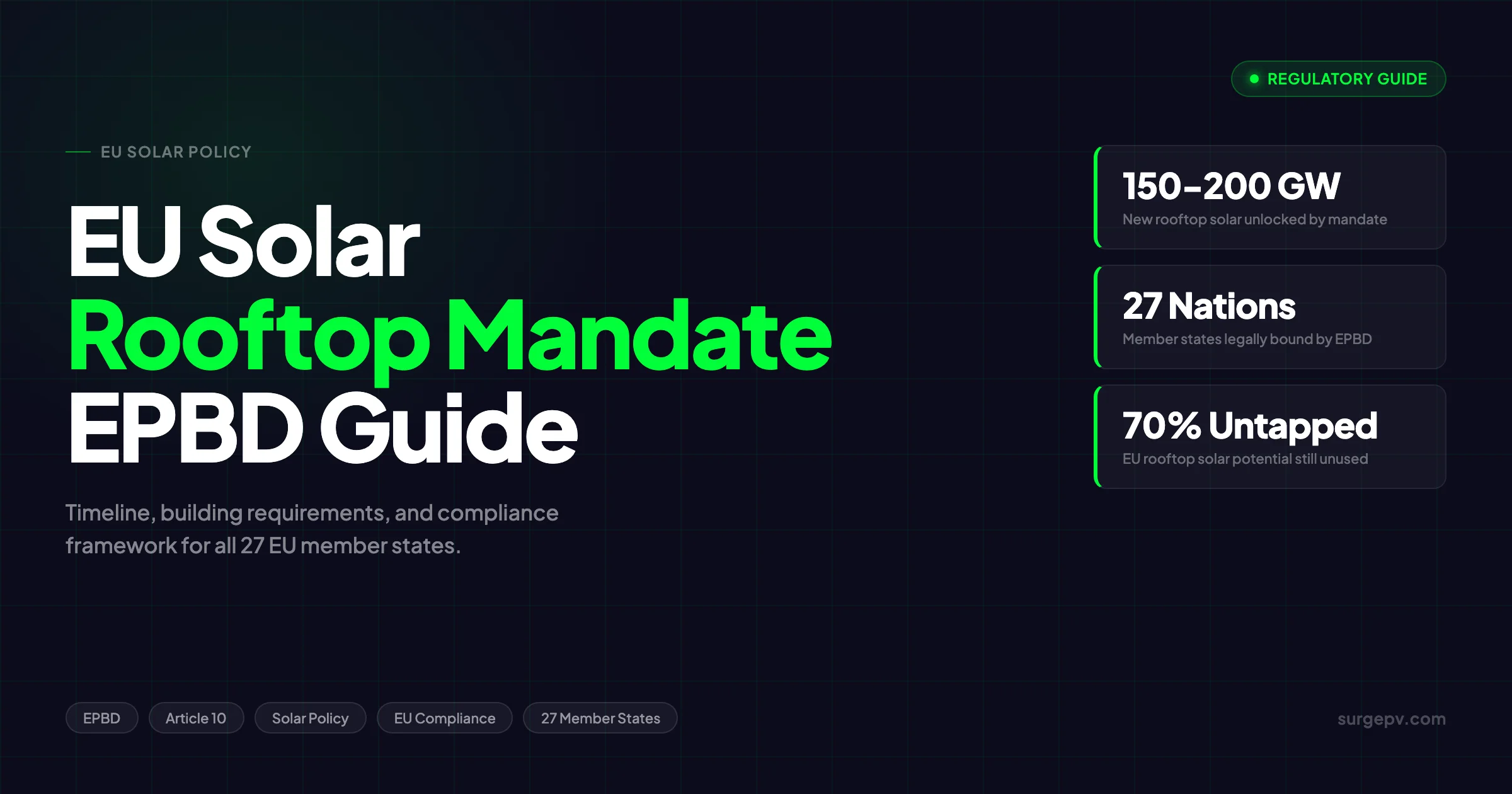
New public and commercial buildings over 250 m² must have solar installed by December 31, 2026. New residential buildings follow by January 1, 2030. Existing public buildings phase in from 2027 through 2030. Member states transposed the directive by May 29, 2026. SolarPower Europe estimates 150-200 GW of new rooftop solar will be unlocked between 2026 and 2030 as a direct result.
What Is the EPBD Solar Mandate?
Directive (EU) 2024/1275 is the fourth iteration of the Energy Performance of Buildings Directive, first enacted in 2002. The 2024 recast goes further than any previous version by introducing legally binding solar installation requirements — not just efficiency targets — for specific building categories.
The solar provisions sit in Article 10 (Solar Energy in Buildings). The article sets graduated deadlines by building type, establishes the concept of “solar-ready” design for new construction, and gives member states the authority to define feasibility criteria and exemptions at national level.
The political driver was REPowerEU. Following Russia’s invasion of Ukraine in 2022 and the resulting energy supply disruptions, the European Commission accelerated its solar deployment targets as part of the REPowerEU plan. The solar rooftop mandate was a direct output — a mechanism to add 150-200 GW of distributed generation with minimal land use through the mandatory use of existing rooftop space. Read more about Battery Solar System Design UK.
Buildings are not a minor contributor to EU energy demand. They account for 40% of total EU energy consumption and are responsible for more than a third of energy-related greenhouse gas emissions. Of the EU’s approximately 220 million buildings, 85% were constructed before 2000, and 75% of those have poor energy performance. Article 10 targets the highest-leverage intervention point: the roof.
Key Takeaway
The EPBD solar mandate is not an incentive program. It is a legal requirement embedded in EU law, binding on all 27 member states. Non-compliance at the member state level triggers infringement proceedings. Non-compliance at the building level triggers national penalties set by each country’s transposing legislation.
The Full EPBD Solar Installation Timeline
The mandate uses building type and floor area thresholds to stagger obligations. This is the complete timeline under Article 10, ordered by deadline:
| Deadline | Building Type | Threshold | Trigger |
|---|---|---|---|
| May 29, 2026 | All new buildings | Any size | Building permit applications from this date must be solar-ready |
| December 31, 2026 | New public + non-residential buildings | >250 m² useful floor area | Solar installation required |
| January 1, 2027 | New non-residential buildings (all) | >250 m² | Solar installation required |
| December 31, 2027 | Existing public buildings | >2,000 m² | Solar installation required |
| January 1, 2028 | Existing non-residential buildings | >500 m² | Triggered by major renovation or roof-permit work |
| December 31, 2028 | Existing public buildings | >750 m² | Solar installation required |
| December 31, 2029 | New residential buildings | Any size | Solar installation required |
| December 31, 2029 | New roofed car parks adjacent to buildings | Any size | Solar installation required |
| December 31, 2030 | Existing public buildings | >250 m² | Solar installation required |
Pro Tip — Permit Submission Date Is the Key Trigger
The mandate applies based on when the building permit application is submitted — not when construction starts or when the building is occupied. If a permit application is submitted before the relevant deadline, the obligation does not automatically apply. This creates a narrow but legally meaningful window that some developers are already using to sequence projects.
The major renovation trigger for existing non-residential buildings deserves attention. Any non-residential building over 500 m² that undergoes a major renovation or any roof work requiring an administrative permit after January 1, 2028 triggers the solar installation obligation. For portfolio owners managing large commercial or industrial estates, this means renovation planning must include solar from 2028 onward.
What “Solar-Ready” Actually Means
“Solar-ready” is one of the most frequently misunderstood terms in the EPBD. It does not mean “has solar installed.” It means a building has been designed and constructed so that solar can be installed efficiently and without costly structural modification — either at time of construction or as a retrofit.
The practical requirements of a solar-ready building include:
Structural load capacity. The roof structure must be designed to bear the weight of a PV array. Typical residential rooftop systems weigh 10-15 kg/m². Commercial systems with racking can reach 25-30 kg/m². A solar-ready building has this load factored into the original structural calculation, not retrofitted at extra cost later. Read Solar Racking Design Guide for a complete walkthrough.
Electrical infrastructure. Conduit runs, cable trays, and sufficient electrical panel capacity must be pre-installed during construction. A solar-ready building does not require the electrical system to be torn open post-completion to route DC or AC wiring from roof to distribution board.
Roof access and layout. Mechanical equipment (HVAC, lift machinery, cooling towers) must be positioned to preserve viable installation zones. A solar-ready design ensures at least 50% of the effective roof area remains free of permanent obstructions.
Metering and monitoring provisions. Grid connection provisions — including the potential for bidirectional metering for net metering or feed-in arrangements — must be designed in from the start.
Key Takeaway — Solar-Ready Is a Design Standard, Not an Installation Obligation
A solar-ready building does not need solar panels on day one. It needs a structural and electrical design that makes panel installation straightforward. For new buildings where the building permit application is submitted after May 29, 2026, this standard applies regardless of whether solar is installed at the time of construction.
For solar installers working on new commercial projects, the solar-ready standard creates a natural entry point: feasibility assessments and solar-ready design reviews during the planning phase, before construction starts. This is where cloud solar design software becomes operationally relevant — not just for sizing arrays, but for advising developers on roof layout, structural provisioning, and system integration during the design stage.
Which Buildings Are Covered?
New Buildings
All new buildings for which a building permit application is submitted on or after May 29, 2026 must be solar-ready. For buildings above the relevant floor area thresholds, actual solar installation — not just solar-readiness — is required within the deadlines in the table above.
The useful floor area threshold of 250 m² applies to buildings in the first mandatory installation wave. To put that in context: 250 m² is roughly the size of a medium office suite, a small school classroom block, or a corner commercial unit. The majority of commercial and public new-build projects fall above this threshold.
Existing Non-Residential Buildings
The trigger for existing non-residential buildings is major renovation or roof-related permit work — not the passage of time. A non-residential building over 500 m² that sits undisturbed will not face the solar mandate on its own. But as soon as the owner initiates any permittable roof work — replacing a flat roof membrane, adding a rooftop extension, upgrading drainage — the solar obligation activates from January 1, 2028.
This renovation trigger is material for portfolio owners, retail chains, logistics operators, and industrial park managers. Any planned renovation from 2028 onward needs to include solar in its scope, budget, and structural specification.
Existing Public Buildings
Public buildings face a stepped timetable based on floor area:
- Buildings over 2,000 m²: December 31, 2027
- Buildings over 750 m²: December 31, 2028
- Buildings over 250 m²: December 31, 2030
This covers a large share of the EU’s school, hospital, municipal office, and government building stock. Many of these buildings were constructed in the 1960s–1990s and will require structural surveys before solar can be installed, making early engagement essential.
Residential Buildings
New residential buildings must have solar by December 31, 2029. Existing residential buildings are not subject to a solar installation mandate under the EPBD at the EU level.
This is one of the most consequential distinctions in the directive. Existing residential buildings — which represent the vast majority of European housing stock — face no EU-level solar obligation. However, member states retain the right to impose national or local requirements that go further. Germany, the Netherlands, and France have all introduced national measures that apply to residential buildings in certain circumstances. Also see: Germany solar subsidies. Also see: France solar feed-in tariffs.
Roofed Car Parks
A specific category that many installers overlook: roofed car parks adjacent to buildings with a useful floor area above relevant thresholds must have solar installed by December 31, 2029. France already mandates solar canopies on large parking lots as a national requirement. The EPBD extends a version of this requirement EU-wide. See our guide on Agricultural Solar Case Study for more.
Feasibility Assessments and Exemptions
Not every building meeting the floor area threshold is automatically required to install solar. Article 10 includes a feasibility and suitability framework that allows member states — and individual building assessments — to apply exemptions.
The directive requires member states to publish national criteria for the practical implementation of solar obligations, including:
- Technical unsuitability (orientation, shading, structural limitations, roof geometry)
- Economic infeasibility relative to the investment
- Heritage and protected building status
- Functional limitations (security-classified facilities, military installations)
Key Takeaway — Feasibility Criteria Are National, Not EU-Level
The EPBD sets the obligation. Each member state defines what “technically suitable and economically feasible” means within their national context. German criteria will differ from Spanish criteria. Solar installers operating across multiple EU markets need to track each country’s published criteria, not just the directive itself.
What “Technically Suitable” Covers
A building may be technically unsuitable for solar if:
- Roof loading capacity is insufficient and strengthening is structurally impractical
- Roof orientation and pitch result in solar irradiance too low to justify installation
- Significant shading from adjacent structures reduces annual yield below a defined threshold
- The building is listed or subject to heritage protection that prohibits roof modifications
- A roof area too small (after accounting for HVAC equipment and obstructions) to install a meaningful system
The EPBD specifies that exemptions must account for solar irradiance specific to the building’s location — a northern Sweden industrial unit and a southern Spanish warehouse face fundamentally different irradiance realities, and the criteria reflect this. Solar shadow analysis software gives installers the ability to produce a verified shading report that can support or challenge a technical unsuitability claim.
What “Economically Feasible” Covers
Economic feasibility is assessed relative to the cost of installation against the expected energy savings over the building’s operational life. Member states may set a minimum payback period or internal rate of return threshold. For most commercial buildings in Western and Southern Europe, solar economics are straightforwardly positive — payback periods of 5-8 years are common for commercial rooftop systems.
Economic infeasibility arguments are harder to sustain in high-irradiance markets (Spain, Italy, Portugal, southern France) and more defensible in low-irradiance, high-shading contexts (northern Finland, certain urban canyons in dense city centers). Also see: solar panel ROI in Italy. Also see: Spain net metering.
The “Suitable Installation” Standard
Where solar is required, it must be a suitable installation — defined as one that makes efficient use of the available roof space. This is not a nominal compliance gesture. A 2-panel system on a 5,000 m² warehouse roof does not meet the standard. The directive expects installations that efficiently exploit the building’s solar generation potential — meaning the array must cover the technically viable portion of the roof at appropriate density.
For installers, this has design implications. A compliance survey that identifies the maximum technically viable installation area, accounts for shading and obstructions, and outputs a correctly sized system is the baseline deliverable for EPBD compliance projects.
Country-by-Country Implementation
The EPBD sets minimum requirements. Member states may — and several already have — gone further with national legislation. Here is the status of major EU markets as of May 2026:
Germany
Germany transposed the EPBD through amendments to the Gebäudeenergiegesetz (GEG) and the Erneuerbare-Energien-Gesetz (EEG), alongside Solarpaket I enacted in April 2024.
Key German provisions beyond the EPBD minimum:
- Several federal states (Länder) have state-level solar obligations for commercial new-builds that predate the EPBD, including Bavaria and Baden-Württemberg
- Rooftop PV systems under 30 kWp are now exempt from building permit requirements at federal level under Solarpaket I, reducing installation friction significantly
- Grid connection timelines for small systems are accelerated
- The GEG’s renovation requirements trigger solar consideration for buildings undergoing major efficiency upgrades
Germany’s solar market reached approximately 92 GW of cumulative installed capacity by end 2025, with rooftop systems accounting for around 55% of new installations. The EPBD compliance wave for public buildings (2027-2030) is expected to drive significant additional volume in the public sector.
For installers targeting Germany, the combination of federal EPBD requirements, Länder-specific mandates, and Solarpaket I incentives creates a layered compliance and incentive environment. Full detail in SurgePV’s Germany solar incentives guide. For a direct comparison, see Arka 360 vs SurgePV.
France
France moved ahead of the EPBD on commercial solar through Loi Énergie-Climat and subsequent decrees requiring solar canopies or green roofs on large commercial car parks. As of July 2023, parking lots with more than 80 spaces that are covered or that can be covered must install solar canopies covering at least half the surface area.
For new buildings, France is implementing EPBD transposition through its broader energy transition framework. The MaPrimeRénov’ renovation grant program covers solar thermal and heat pump installations on existing residential buildings — the EPBD’s residential gap is partially addressed through this incentive route.
France’s national solar target is 100 GW by 2030, requiring a substantial acceleration from the approximately 24 GW installed at end of 2024. The building mandate contributes meaningfully to this trajectory.
For solar installers in France, the car park mandate is already active and represents a well-defined compliance project type. The EPBD building obligations add public and commercial rooftop volume from 2026 onward. France’s feed-in tariff landscape is covered in the France feed-in tariffs guide.
Spain
Spain transposed the EPBD into national legislation through amendments to the Código Técnico de la Edificación (CTE) and the Real Decreto framework. Spain’s strong irradiance profile (one of the highest in the EU at 1,500-1,900 kWh/m²/year average) means economic feasibility objections are difficult to sustain — payback periods for commercial rooftop systems regularly fall below 5 years.
The Spanish implementation applies EPBD thresholds directly and adds requirements for residential buildings in new developments above certain project sizes in several autonomous communities. Catalonia and Andalucía have historically been ahead of national mandates on solar.
Spain’s solar energy policies are detailed in the residential solar adoption in Spain guide.
The Netherlands
The Netherlands is one of the more advanced EU markets for solar mandates. National legislation already required solar on new commercial buildings before the EPBD recast, and the country has a well-established framework for energy performance labeling and building compliance.
Dutch installers operate in a market where public building requirements are already active and residential solar adoption has been driven by net metering policy. The EPBD formalizes and extends obligations the Netherlands was already implementing.
Italy
Italy transposed the EPBD alongside its existing Conto Energia legacy and the Piano Nazionale di Ripresa e Resilienza (PNRR) energy efficiency funding stream. Italian public building stock is substantial — including historic schools, hospitals, and municipal buildings that will require structural assessment before solar can be installed. For the latest details on Italy, see Commercial Rooftop Solar Case Study Italy.
The heritage exemption pathway will be used extensively in Italy, where a significant proportion of public buildings carry historic preservation constraints. Italy’s solar incentive framework is covered in the solar incentives Italy guide.
Belgium, Austria, and Other Member States
Belgium has regional (Wallonia, Flanders, Brussels) solar requirements that in some cases exceed EPBD minimums. Austria’s energy performance framework already included solar provisions for new commercial buildings. Most northern European member states (Denmark, Sweden, Finland) are implementing EPBD requirements, though economic feasibility criteria in high-latitude, low-irradiance zones will result in broader exemption rates than in southern markets.
Pro Tip — Track National Criteria Publications
Each member state must publish its feasibility and exemption criteria publicly. Following the national energy ministry or building authority of your target markets is the most reliable way to stay current. The EU’s BUILD UP portal aggregates national implementation updates.
What This Means for Solar Installers and EPC Companies
The EPBD solar mandate creates a structural demand signal — not a market trend but a legally required procurement wave for solar installations across the EU. Understanding the commercial implications is essential for positioning your business in the compliance pipeline.
The Scale of the Opportunity
SolarPower Europe estimates the EPBD Solar Rooftop Standard will unlock 150-200 GW of additional rooftop solar between 2026 and 2030. The EU Joint Research Centre puts total EU rooftop solar potential at 560 GW — roughly 70% of it still untapped. The mandate does not unlock all of that, but it sets a floor on what must be installed.
For context: the EU had approximately 406 GW of total solar installed capacity as of early 2025. The EPBD compliance wave alone represents 37-49% of that installed base in new volume over four years.
The IRENA data cited by the BUILD UP platform estimates the solar industry employs 2-7 times more workers per installed GW than other primary renewable sectors. The compliance pipeline is also a jobs pipeline — and installers who build compliance-ready workflows now will capture a disproportionate share.
The New Project Types That Compliance Creates
The EPBD mandate creates specific, repeatable project types that differ from standard residential solar or large-scale utility projects:
Compliance feasibility assessments. Building owners who receive notification of the solar obligation will need an independent technical and economic assessment before they can proceed with installation (or apply for exemption). This is a paid consulting deliverable — a shading analysis, structural review summary, system sizing estimate, and compliance pathway recommendation.
Public sector frameworks. Local authorities, health trusts, and education departments managing building portfolios will need procurement frameworks for solar installation across multiple sites. Framework agreements with a qualified solar EPC — covering survey, design, install, and commissioning — become the standard procurement vehicle.
Renovation-triggered commercial solar. Every major renovation of a non-residential building over 500 m² from January 2028 onward activates the solar obligation. Installers who build relationships with commercial property managers, construction contractors, and facilities managers can position solar as a standard line item in renovation budgets.
Car park canopies. The roofed car park requirement (Dec 2029) and France’s existing canopy mandate create a specific project type. Solar canopy structures are more complex than standard rooftop installations — they require structural engineering, specialized racking, and often EV charging integration. Installers who develop this competency early gain a first-mover advantage.
Design EPBD-Compliant Solar Systems Faster
SurgePV’s solar design platform includes shadow analysis, system sizing, and financial modeling — exactly what compliance assessments require. Used by EPCs across 50+ countries.
Book a DemoNo commitment required · 20 minutes · Live project walkthrough
Workflow Implications for Design and Proposals
EPBD compliance projects differ from standard residential in several ways that affect your workflow:
Faster design turnaround is expected. Public sector clients managing building portfolios want multiple sites assessed quickly. Solar software that can process batch site assessments — pulling in address-level irradiance data and generating indicative system sizes without a manual site visit for each building — compresses the pre-sales phase.
Proposals must reference compliance obligations. Commercial clients do not respond well to proposals that ignore the regulatory context. A proposal for a public school that explains the legal obligation, the compliance timeline, the feasibility assessment findings, and the system design — with a clear cost and payback projection — is structurally more persuasive than a standard sales document.
Feasibility documentation must be defensible. If a client applies for an exemption and the assessor’s conclusions are challenged by the building authority, the installer’s technical documentation becomes part of the evidence record. Solar proposal software that generates structured outputs — shading reports, irradiance data, sizing calculations — protects both the installer and the client in a compliance context.
Financial modeling matters. Many public sector building owners are constrained by capital budgets. They need to understand lease financing, power purchase agreements, and energy performance contracts as alternative paths to compliance. Installers who can present multiple financing structures — not just a capital purchase price — will win more public sector mandates. The solar financial modeling handles the financial modeling side of this.
Penalties and Enforcement
The EPBD sets the legal obligation. Enforcement happens at national level, through each member state’s transposing legislation.
At the Member State Level
Member states that fail to transpose the EPBD by May 29, 2026 face infringement proceedings by the European Commission. This is not hypothetical — the Commission launched infringement cases against 24 member states for delayed or incomplete transposition of the previous EPBD recast (2010/31/EU). Financial penalties can run to millions of euros per day for persistent non-compliance.
At the Building Level
Once transposed, individual building-level enforcement is handled by national building authorities, planning departments, and energy inspectorates. Penalties vary by country and may include:
- Refusal of occupancy permits until compliance is demonstrated
- Financial penalties linked to building value or floor area
- Requirements to install retroactively with increased cost burden (no longer benefiting from construction-phase integration savings)
- Mandatory annual reporting of non-compliance in energy performance certificates Also see: Us Residential Solar Market Trends 2026.
Key Takeaway — Occupancy Permits Are the Leverage Point
In most EU member states, the most immediate enforcement mechanism is occupancy certification. A new commercial building that fails to meet the EPBD solar obligation may not receive the occupancy permit needed to operate commercially. Developers have strong financial incentive to comply before construction completes — not after.
How to Read an EPBD Feasibility Assessment
If your business is bidding on EPBD compliance projects, understanding what a defensible feasibility assessment contains is as important as the installation itself. Most national frameworks require the following elements:
1. Building Identification and Classification
Confirm building type (public, non-residential, residential), useful floor area (m²), and construction date. Establish which EPBD deadline applies and whether the building’s permit submission date pre-dates the obligation trigger.
2. Irradiance Assessment
Site-specific global horizontal irradiance (GHI) and plane-of-array (POA) irradiance data from a recognized source (PVGIS, Meteonorm, or equivalent national database). The irradiance assessment establishes the energy potential baseline. For Global-specific compliance details, see Global net-metering-by-country. For Global-specific compliance details, see Global solar-permitting-speed-by-country.
3. Shading Analysis
Using aerial imagery or a site survey, identify shading obstructions: adjacent buildings, rooftop equipment, parapets, trees. The shading analysis determines what portion of the roof area is technically viable. Solar shadow analysis software produces ISO-standard shading reports that national assessors recognize.
4. Structural Assessment Summary
A statement from a structural engineer or a desk-based structural review confirming whether the roof loading capacity can support the proposed array. For existing buildings, this step often requires a site visit and loading calculation. For new builds, it is incorporated into the structural design.
5. System Sizing and Layout
Based on viable roof area and irradiance, a preliminary system size in kWp, array layout (modules per string, orientation, tilt), and estimated annual energy output in MWh/year.
6. Economic Feasibility Calculation
Net present value or simple payback calculation using:
- Installation cost (€/kWp at current market rates)
- Annual energy output (MWh/year) × energy price avoided (€/MWh)
- Available incentives (feed-in tariffs, grants, self-consumption premiums)
- Financing cost if applicable
If the payback period falls within the member state’s defined feasibility threshold (typically 15-25 years), the installation is economically feasible.
7. Compliance Conclusion
A clear statement: the building is suitable and required to install solar by [date], or the building qualifies for exemption under [specific national criteria] for [specific technical or economic reasons].
The EPBD and Zero-Emission Buildings
The solar mandate does not sit in isolation. The 2024 EPBD recast introduces the concept of Zero-Emission Buildings (ZEBs) as the new standard for new construction. A ZEB produces no on-site carbon emissions from fossil fuels and meets a very high energy performance standard. Article 7 requires that all new buildings be ZEBs from January 1, 2028 (public buildings) and January 1, 2030 (all buildings).
Solar is a core enabler of ZEB status. A building that generates its own electricity from rooftop PV, uses that energy for heating (via heat pumps), cooling, and operational loads, and exports surplus to the grid is structurally positioned to meet ZEB criteria.
For installers, this creates an upsell pathway: the EPBD compliance conversation that starts with “you need rooftop solar by December 2026” can develop into a broader ZEB design conversation covering:
- Rooftop PV system sizing
- Battery storage for self-consumption optimization
- EV charging integration
- Heat pump heating system design
- Building energy management systems For more on this topic, see Adding Battery Storage Services.
The European Commission’s EPBD resource hub includes ZEB technical guidance and member state implementation frameworks.
Practical Compliance Checklist for Solar Installers
Use this checklist when qualifying an EPBD compliance project:
Pre-Sales
- Identify building type, useful floor area, and construction/renovation status
- Confirm which EPBD deadline applies (or if permit date pre-dates the obligation)
- Identify the member state’s national transposing legislation and published feasibility criteria
- Run a preliminary shading and irradiance check using site coordinates
- Confirm whether any heritage, structural, or security exemptions may apply
Feasibility Assessment
- Document site-specific irradiance from PVGIS or national approved source
- Produce a shading analysis report identifying viable roof area
- Obtain or review structural survey confirming load capacity
- Size the system based on viable area, irradiance, and consumption profile
- Run economic feasibility calculation with and without available incentives
- Prepare a written compliance conclusion referencing applicable national criteria
Design and Proposal
- Produce detailed array layout within viable roof area
- Model annual generation, self-consumption ratio, and grid export
- Include financial analysis: payback, NPV, and if applicable, PPA/lease options
- Reference the EPBD obligation and compliance timeline in the proposal
- Include a commissioning and handover schedule that meets the building’s compliance deadline
Post-Installation
- Ensure the energy performance certificate is updated to reflect the solar installation
- Provide the building owner with documentation confirming compliance with the relevant national criteria
- Confirm grid connection and metering configuration meet member state requirements
Pro Tip — Commission Date Is Your Compliance Date
The obligation is met when the solar installation is operational and commissioned — not when a contract is signed or when panels are delivered to site. Build grid connection lead times and utility approval timelines into your project schedule. In some markets, grid connection approval takes 3-6 months. A December 2026 installation target that does not account for grid connection timelines will miss the deadline.
Timeline Summary: Key 2026-2030 Milestones
The next four years represent the most concentrated solar obligation rollout in EU history. Here is a milestone calendar for installers:
| Date | Milestone |
|---|---|
| May 29, 2026 | EPBD transposition deadline — national law in place in all 27 member states |
| May 29, 2026 | All new building permits from this date must meet solar-ready design requirements |
| December 31, 2026 | Solar installation deadline for new public and non-residential buildings >250 m² |
| December 31, 2027 | Existing public buildings >2,000 m²: solar installation required |
| January 1, 2028 | Existing non-residential buildings >500 m²: solar required on major renovation or roof work |
| December 31, 2028 | Existing public buildings >750 m²: solar installation required |
| January 1, 2029 | ZEB standard applies to all new public buildings |
| December 31, 2029 | Solar installation required for all new residential buildings |
| December 31, 2029 | Solar installation required for new roofed car parks |
| January 1, 2030 | ZEB standard applies to all new buildings |
| December 31, 2030 | Existing public buildings >250 m²: solar installation required |
For any solar business operating in the EU market, this calendar is the demand planning framework for the rest of the decade. Each line is a procurement wave with real budget behind it.
The Role of Digital Tools in Compliance Delivery
The EPBD compliance wave will not be served by manual workflows. The volume of assessments, designs, and proposals required across 27 member states, across multiple building types and deadlines, demands solar software suite that is built for commercial-scale throughput.
Specific capabilities that matter for EPBD compliance projects:
Shadow analysis at scale. When a local authority asks for feasibility assessments on 50 school buildings, the shadow analysis phase needs to be automated — pulling coordinates, querying irradiance data, modeling shading from aerial imagery — not conducted manually for each site.
Compliance-grade reporting. The output of a feasibility assessment needs to reference national criteria, include specific irradiance data, and produce a conclusion that is recognizable by a building authority assessor. Generic proposal templates do not meet this standard.
Financial modeling for non-standard structures. Public sector clients will often need PPA, leasing, or energy performance contract structures analyzed alongside capital purchase. A tool that models these structures — showing cash flows, energy savings, and net cost under each option — supports faster decision-making.
Proposal localization. EPBD compliance projects span multiple countries, each with its own regulatory terminology, grid tariff structure, and incentive landscape. Proposal output needs to be localized — not just translated — to the building’s member state context.
SurgePV’s solar design platform is used by EPC companies across 50+ countries for exactly this type of multi-market, commercial-scale solar delivery. The shadow analysis tool produces shading reports that are used in compliance contexts across European markets.
Conclusion
Three action items for solar businesses in Europe:
- Map your pipeline against the EPBD timeline now. Identify which building types in your target markets face which deadlines. The December 2026 commercial building deadline is 7 months away. Projects that need to commission by then require contract signatures and design finalization within weeks.
- Build a compliance-ready feasibility assessment workflow. The EPBD creates demand for a specific deliverable — a technical and economic feasibility report structured to meet national criteria. Businesses that have a repeatable, documentable process for this will convert more compliance inquiries into installation contracts.
- Engage the renovation trigger actively. The January 2028 existing non-residential building trigger is the largest single volume event in the mandate. Property managers, construction contractors, and facilities companies are planning major renovations now. Early engagement positions solar as a standard line item in those projects — not an afterthought.
The EU’s solar rooftop mandate is the largest planned solar installation event in the bloc’s history. Installers who understand the timeline, the building categories, and the compliance workflow will capture the bulk of it.
Frequently Asked Questions
What is the EPBD solar mandate?
The EPBD solar mandate is Article 10 of Directive (EU) 2024/1275, which requires EU member states to ensure solar energy installations on new and certain existing buildings. New public and non-residential buildings over 250 m² must have solar installed by December 31, 2026. New residential buildings follow by January 1, 2030.
When does the EPBD solar mandate take effect?
The directive entered into force on May 28, 2024. Member states had until May 29, 2026 to transpose it into national law. The first building-level installation deadline is December 31, 2026 for new public and non-residential buildings over 250 m².
Which buildings must comply with the EPBD solar rooftop requirement?
New public and non-residential buildings over 250 m² must comply by end 2026. Existing public buildings over 2,000 m² by end 2027. Existing non-residential buildings over 500 m² undergoing major renovation by January 2028. New residential buildings by January 2030. Existing residential buildings are not currently mandated at EU level.
What does solar-ready mean under the EPBD?
Solar-ready means a building is designed and constructed so that solar energy systems can be installed efficiently — either at time of construction or retrofitted later without costly structural modifications. This includes structural load capacity, electrical wiring provisions, and roof access designed around future PV or solar thermal installation.
Are existing residential buildings required to install solar under the EPBD?
No. The EPBD does not mandate solar on existing residential buildings at the EU level. Member states may set national or local requirements beyond the directive’s minimum. Germany, France, and the Netherlands have already moved further through national legislation.
Can buildings be exempt from the EPBD solar mandate?
Yes. Member states may define national exemption criteria based on technical unsuitability (structural limitations, shading, listed heritage status) or economic infeasibility. Each country must publish these criteria publicly. Exemptions are assessed building by building — not applied categorically across building types.
What happens if EU member states do not transpose the EPBD by May 2026?
Non-transposition triggers European Commission infringement proceedings. The Commission can refer non-compliant member states to the Court of Justice of the EU, which can impose financial penalties. Several past EPBD versions led to infringement cases against member states.
How much rooftop solar capacity will the EPBD mandate generate?
SolarPower Europe estimates the EPBD Solar Rooftop Standard will unlock 150-200 GW of additional rooftop solar between 2026 and 2030. The EU Joint Research Centre puts total EU rooftop solar potential at 560 GW — roughly 70% of it still untapped as of 2026.
Where this fits
This article is part of SurgePV's Solar Incentives & Policy hub, which works through the topic from first principles to the decisions a project team actually has to make.

