

Quick Answer
Solar fleet management oversees multiple installations through centralized monitoring dashboards. Key capabilities: real-time performance tracking, automated fault alerts, and predictive maintenance scheduling. Fleet operators achieve 2–5% higher energy yields and 15–25% lower O&M costs versus unmanaged portfolios.
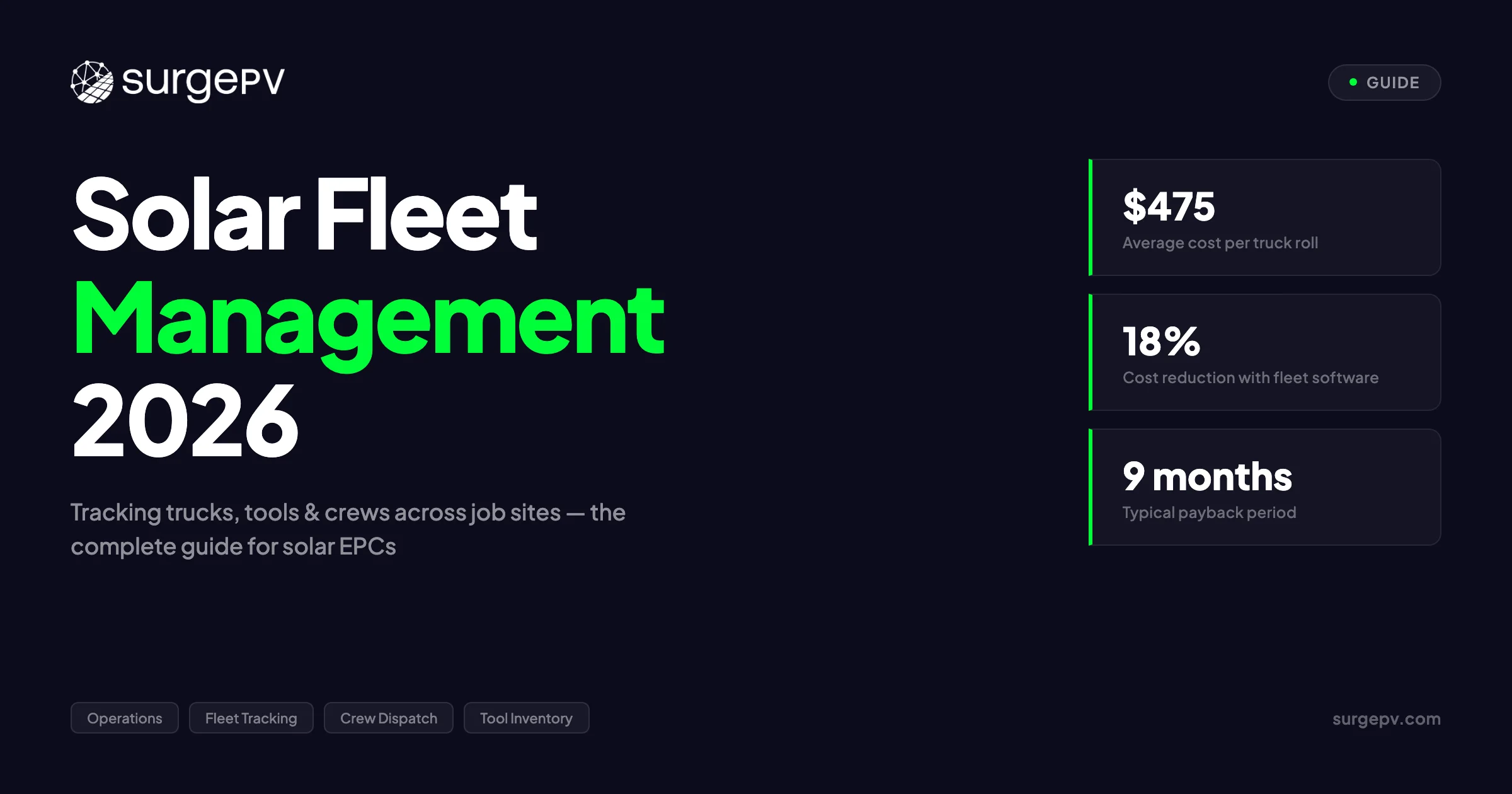
A 50-crew solar EPC running at full capacity moves 60 to 80 people across 15 to 25 job sites every day. Each crew needs a vehicle, a specific set of tools, the right materials, and a route that gets them to the site before the homeowner or inspector arrives. One missing torque wrench. One wrong inverter model on the truck. One crew sent to a site where the roof is still being replaced. Any of these errors burns $475 on average — the cost of a single truck roll according to Solar Power World’s 2025 EPC survey.
Solar fleet management oversees multiple installations through centralized monitoring dashboards. Key capabilities: real-time performance tracking, automated fault alerts, and predictive maintenance scheduling. Fleet operators achieve 2–5% higher energy yields and 15–25% lower O&M costs versus unmanaged portfolios. Read Solar Racking Design Guide for a complete walkthrough.
Solar fleet management oversees multiple installations through centralized monitoring dashboards. Key capabilities: real-time performance tracking, automated fault alerts, and predictive maintenance scheduling. Fleet operators achieve 2–5% higher energy yields and 15–25% lower O&M costs versus unmanaged portfolios.
Solar fleet management is not about buying GPS dots on a map. It is about knowing where every asset is, who can use it, and whether the next job site is ready to receive them. The companies that do this well run tighter margins. The ones that do not lose money to trips that should never have happened.
Quick Answer: Solar Fleet Management
Solar fleet management coordinates vehicles, tools, and crews across job sites using GPS tracking, inventory software, and dispatch systems. A typical 50-vehicle solar EPC spends $57,000 to $77,000 over three years on fleet software. The payback comes from fewer wasted trips, better crew utilization, and lower fuel costs.
In this guide:
- How solar fleet management differs from standard fleet tracking
- The real cost of poor fleet coordination in solar EPCs
- Vehicle tracking: GPS, telematics, and solar-powered trackers
- Tool and equipment tracking: the overlooked half of fleet management
- Crew scheduling and dispatch: software that matches people to jobs
- What most solar companies get wrong about fleet management
- Software stack and cost analysis for 2026
- Implementation roadmap: how to roll out fleet tracking without chaos
- 8 frequently asked questions
How Solar Fleet Management Differs from Standard Fleet Tracking
A delivery company tracks trucks to make sure packages arrive on time. A solar EPC tracks trucks, tools, materials, certifications, permits, and weather windows. The complexity is not comparable.
Standard fleet management answers one question: where is the vehicle? Solar fleet management answers five:
- Where is the vehicle?
- What tools are on it?
- Which crew is certified for this job type?
- Are the materials staged and ready?
- Is the site accessible and safe today?
A delivery van carries boxes. A solar install van carries $8,000 to $15,000 in tools, $5,000 to $20,000 in materials, and two to four people with specific certifications. Losing visibility on any of these layers creates a failed site visit.
The Three Layers of Solar Fleet Management
Solar fleet management operates across three layers that standard fleet software rarely covers:
| Layer | What It Tracks | Typical Tool |
|---|---|---|
| Vehicle layer | Location, fuel, maintenance, driver behavior | Samsara, Verizon Connect, GPS Insight |
| Asset layer | Tools, equipment, trailers, spare parts | Finale Inventory, Bluetooth tags, QR codes |
| People layer | Crew schedules, certifications, time on site | Scoop Solar, Arrivy, ServiceTitan |
Most solar EPCs invest in the vehicle layer first. That is logical. GPS tracking is mature, pricing is transparent, and the ROI is easy to measure. But the vehicle layer only solves half the problem. A truck can be exactly where it should be and still fail the job because the crew lacks the right certification or the inverter on board is the wrong model.
The asset layer is where most EPCs struggle. A professional solar install crew carries 80 to 100 individual tools. A single missing MC4 crimping tool can stall a full day of panel connections. A dead multimeter battery at commissioning means a return trip. These are not edge cases. They are daily realities for field teams.
The people layer adds scheduling complexity. Solar crews need different certifications for residential vs. commercial work, different states, and different system types. A crew certified for NEM 3.0 interconnection in California cannot handle the same job in Texas without additional training. Dispatch software that ignores certification matching sends the wrong people to the right place.
Why Solar EPC Margins Make Fleet Management Critical
Residential solar soft costs — everything except hardware — account for over 50% of total system cost according to LBNL’s 2025 Utility-Scale Solar report. Field operations, logistics, and crew management are the largest components of those soft costs. Every unnecessary truck roll, every hour a crew spends waiting for materials, and every reschedule due to poor planning eats margin that most installers do not have to spare.
The average residential solar installer operates on gross margins of 15% to 25%. A single $475 wasted trip on a $20,000 residential job is 2.4% of revenue. Two wasted trips per project wipes out most of the profit. This is why fleet management is not a back-office luxury for large EPCs. It is a survival tool for any installer running more than five active crews.
The Real Cost of Poor Fleet Coordination
Poor fleet coordination in solar EPCs produces costs that do not show up on a single line item. They scatter across fuel, labor, vehicle maintenance, customer churn, and insurance. The total is larger than most managers realize.
Quantified Cost of Fleet Inefficiency
Here is what poor coordination costs a mid-size solar EPC running 10 crews and 12 vehicles:
| Cost Category | Annual Impact | Source |
|---|---|---|
| Extra truck rolls for missing documentation | $57,000 (120 rolls at $475 each) | Solar Power World 2025 survey: 60% of EPCs make at least 1 extra roll per project |
| Fuel waste from poor routing | $18,000 to $24,000 | 20% fuel cost reduction possible with optimized routing |
| Idle time — crews waiting for materials or permits | $36,000 to $72,000 | 2 to 4 hours per crew per week at $35/hour loaded cost |
| Tool replacement (lost or unreturned) | $8,000 to $15,000 | Industry estimate for 10-crew operation |
| Insurance premium increase from incidents | $5,000 to $12,000 | 25% safety improvement possible with telematics |
| Total annual cost of poor coordination | $124,000 to $180,000 | — |
These numbers assume a 10-crew operation completing 120 to 150 residential projects per year. Scale the fleet and the waste scales with it. A 50-crew EPC could be losing $600,000 to $900,000 annually to coordination failures that fleet management software prevents.
The Hidden Cost: Customer Churn
Wasted trips do not just cost money. They cost customers. A residential solar project already runs 4 to 10 weeks from contract to permission to operate. Every reschedule adds days or weeks to that timeline. Homeowners who experience repeated delays are less likely to refer friends and family. Referrals drive 30% to 40% of residential solar leads in most markets. Poor fleet coordination indirectly kills the cheapest source of new business.
Pro Tip: Track Cost Per Site Visit
Most solar EPCs track cost per watt or cost per project. Few track cost per site visit. Calculate this by dividing total field operations spend (fuel, labor, vehicle, tools) by the number of site visits per month. A healthy residential installer should run under $350 per visit. Above $500 signals coordination problems.
First-Hand Observation: The 3 PM Phone Call
I have spent enough time on solar job sites to recognize the pattern. At 3 PM, the operations manager’s phone starts ringing. Crew three is at a site in Mesa but the homeowner is not home. Crew seven needs a torque wrench that crew four took to Scottsdale yesterday. Crew two finished early but the next job is not ready because the permit is still pending. None of these problems require a software PhD to solve. They require visibility. The manager with a live dispatch board sees these conflicts before they become 3 PM phone calls. The manager with a whiteboard and a group chat sees them after the crews have already driven.
Vehicle Tracking: GPS, Telematics, and Solar-Powered Trackers
Vehicle tracking is the foundation of solar fleet management. It tells you where every truck and van is, how it is being driven, and when it needs service. Modern systems go far beyond a dot on a map.
GPS Tracking Basics for Solar Fleets
Every major fleet tracking platform offers the same core capabilities in 2026:
- Real-time location with 10- to 60-second refresh intervals
- Geofencing alerts when vehicles enter or exit defined zones
- Route history for accountability and dispute resolution
- Idle time tracking to reduce fuel waste
- Speed and behavior monitoring for safety and insurance
For solar EPCs, geofencing is particularly useful. Set a geofence around each active job site. The system alerts the operations manager when a crew arrives and when they leave. This replaces the “text me when you get there” workflow that most small installers still use.
Telematics: Beyond Location
Telematics adds vehicle health data to location data. A telematics unit plugs into the OBD-II port and reads engine diagnostics, mileage, fuel consumption, and fault codes. For solar EPCs running diesel trucks to remote utility-scale sites, this matters. A breakdown 40 miles from the nearest service center strands a crew and delays the project.
Key telematics metrics for solar fleets:
| Metric | Why It Matters for Solar EPCs |
|---|---|
| Engine fault codes | Prevents breakdowns at remote job sites |
| Oil life remaining | Schedules maintenance during downtime, not active project weeks |
| Tire pressure | Prevents blowouts on highways with heavy tool loads |
| Hard braking events | Identifies risky drivers before accidents raise insurance premiums |
| Seatbelt compliance | Reduces liability exposure |
Solar-Powered GPS Trackers for Unpowered Assets
Not every asset in a solar fleet has an engine. Trailers, containers, spare panel pallets, and construction equipment sit at job sites for weeks or months. Standard GPS trackers need a vehicle battery. Solar-powered trackers solve this.
Solar-powered trackers like the GPS Insight GL5000 and the JimiIOT LL303Pro use a small photovoltaic panel to charge an internal battery. They report location hourly or on demand without external power. This matters for solar EPCs in two specific scenarios:
- Equipment left at remote sites: A pile driver or trencher left at a utility-scale site for three months between phases stays tracked without battery replacement.
- Theft prevention: Solar panels and copper cabling are theft targets. A hidden solar tracker on a materials trailer alerts the team if it moves after hours.
The key advantage of solar charging is that it decouples reporting frequency from battery longevity. A battery-only tracker reporting hourly might last six months. A solar tracker reporting hourly lasts indefinitely during daylight hours.
Leading Vehicle Tracking Platforms for Solar EPCs
| Platform | Cost per Vehicle/Month | Best For | Contract |
|---|---|---|---|
| Samsara | $33 to $50 | Fast-growing EPCs, safety focus | 36 months minimum |
| Verizon Connect | $20 to $40 | Large fleets, existing Verizon customers | 24 to 36 months |
| GPS Insight | $15 to $35 | Mixed fleets with heavy equipment | Flexible |
| ClearPathGPS | $20 to $30 | Small to mid-size fleets | Month-to-month options |
Samsara leads the market with a G2 score of 99 and 3,710+ reviews. Its AI dashcams and in-cab coaching reduce crash rates by 73% over 30 months according to Samsara’s published data. The tradeoff is a strict 36-month contract with no early exit. For a solar EPC in growth mode, that commitment matters.
Verizon Connect offers more flexible terms and lower entry pricing. Its G2 score of 38 and customer satisfaction rating of 4% reflect a older interface and slower support. For budget-conscious EPCs with basic tracking needs, it works. For EPCs that need modern mobile apps and fast onboarding, Samsara wins.
Original Calculation: Fleet Tracking ROI for a 20-Vehicle Solar EPC
Let us run the numbers for a typical mid-size residential solar installer with 20 vehicles.
Annual costs without fleet tracking:
- Extra truck rolls from poor routing: 80 rolls at $475 = $38,000
- Fuel waste from unoptimized routes: 15% of $48,000 annual fuel = $7,200
- Insurance premium (no telematics discount): $36,000
- Vehicle downtime from missed maintenance: $12,000
- Total annual cost: $93,200
Annual costs with Samsara base plan ($33/vehicle/month):
- Subscription: 20 vehicles x $33 x 12 months = $7,920
- Installation (one-time, amortized over 3 years): $10,000 / 3 = $3,333/year
- Extra truck rolls (reduced by 50%): 40 rolls at $475 = $19,000
- Fuel waste (reduced by 20%): $5,760
- Insurance premium (with 15% telematics discount): $30,600
- Vehicle downtime (reduced by 60%): $4,800
- Total annual cost: $71,413
Net annual savings: $21,787
Payback period: 6.5 months
This assumes conservative improvements. EPCs that fully adopt route optimization and predictive maintenance see faster payback. The 9-month payback period that Samsara advertises is achievable for fleets with above-average waste.
Tool and Equipment Tracking: The Overlooked Half
Vehicle tracking gets the budget and the attention. Tool tracking gets forgotten. This is a mistake that costs solar EPCs more than they realize.
The Scale of the Tool Problem
A professional solar installation crew carries 80 to 100 individual tools. Multiply by 10 crews and you are tracking 800 to 1,000 tools across vans, job sites, and the warehouse. Without a system, tools migrate. The torque wrench from van three ends up in van seven. The MC4 crimping tool is on a roof in Glendale when it is needed in Scottsdale. The insulation tester was last seen two weeks ago and nobody knows which job site.
The financial impact is real. A complete professional solar tool kit costs $3,500 to $8,000 per crew. Replacing lost or unreturned tools costs a 10-crew EPC $8,000 to $15,000 per year. That is before accounting for the cost of stalled jobs.
Tool Tracking Technologies
Solar EPCs use three approaches to tool tracking, listed from simplest to most comprehensive:
1. QR Code / Barcode Scanning
Every tool gets a QR code label. Crews scan tools in and out of the van at the start and end of each day using a smartphone app. This takes 30 seconds per tool and creates a digital checkout log.
Pros: Cheap, no batteries to replace, works with any tool. Cons: Requires discipline. If crews do not scan, the system becomes useless.
2. Bluetooth Low Energy (BLE) Tags
Small Bluetooth tags attach to high-value tools. A gateway device in the van or warehouse detects which tags are present. If the insulation tester leaves the van without being checked out, the system alerts the manager.
Pros: Passive tracking, no scanning required. Cons: Tags cost $15 to $30 each. Batteries need replacement every 1 to 2 years. Range is limited to 30 to 100 feet.
3. RFID Systems
Radio-frequency identification uses tags and readers for automated inventory. A crew walks through a doorway with a tool cart. The reader logs every item automatically.
Pros: Fast, hands-free, works at warehouse scale. Cons: Expensive to deploy. Overkill for small EPCs with fewer than 20 crews.
Tool Tracking in Practice: What Works
The most effective tool tracking system I have seen in solar EPCs combines two layers:
- QR codes on every tool for checkout logging
- A designated tool captain per crew responsible for the kit
The tool captain checks the kit every morning against a printed list. Discrepancies get flagged before the van leaves the yard. This simple habit, enforced by a $20 Bluetooth beacon that alerts if the tool bag leaves the warehouse un-scanned, eliminates 90% of lost-tool problems.
Pro Tip: Start with the $500 Tools
Do not try to track every screwdriver on day one. Start with tools that cost over $500 or that stall a job if missing: multimeters, insulation testers, MC4 crimpers, torque wrenches, and IV curve tracers. These 10 to 15 items per crew represent 60% of your tool replacement cost.
Materials Tracking: The Other Asset Layer
Tools are not the only assets that move. Materials — panels, inverters, racking, cabling — represent far more value. A residential install van might carry $5,000 to $20,000 in materials on any given day.
Materials tracking connects to inventory management software. Systems like Finale Inventory and inFlow Inventory offer solar-specific features:
- Serial number tracking for panel warranties
- Multi-location support (warehouse + job sites + crew trucks)
- Automated reorder alerts when stock drops below threshold
- Project-based allocation (reserve inventory for specific jobs)
The integration between inventory and fleet management is where efficiency lives. When the dispatch system knows that van four has the right inverter model and enough railing for a 10 kW job, it can assign that crew with confidence. When the system does not know, the crew discovers the mismatch at 8:30 AM on the roof. That is a $475 mistake.
Crew Scheduling and Dispatch: Matching People to Jobs
Vehicle location and tool inventory are inputs. Crew scheduling is where decisions happen. Good dispatch software matches the right crew to the right job at the right time.
The Complexity of Solar Crew Scheduling
Solar crew scheduling is harder than standard field service for three reasons:
-
Certification requirements vary by job type. A crew certified for residential rooftop work may not be qualified for commercial ballasted racking or ground-mount pile driving.
-
Permit and inspection windows are rigid. A crew cannot start until the permit is released. An inspection cannot happen until the work is complete. These dependencies create hard constraints that shift daily.
-
Weather and site readiness are unpredictable. A rain day cancels rooftop work. A homeowner who reschedules at 7 AM leaves a crew without a job. A utility transformer delay pushes a commercial project back two weeks.
These variables mean that static schedules fail. Solar EPCs need dynamic dispatch systems that reassign crews in real time as conditions change.
Key Features of Solar Dispatch Software
Modern field service management tools for solar EPCs offer:
| Feature | What It Does | Why Solar EPCs Need It |
|---|---|---|
| Visual dispatch board | Drag-and-drop crew assignment | See all crews, jobs, and conflicts at a glance |
| Skill/certification matching | Auto-filter crews by qualification | Prevents sending uncertified crews to specialized jobs |
| Route optimization | Sequence jobs by location and time | Reduces drive time and fuel cost |
| Real-time job status | Crews update progress from the field | Operations manager sees blockers as they happen |
| Photo and document capture | Geo-tagged photos attached to jobs | Eliminates extra truck rolls for missing documentation |
| Customer notifications | Automated ETA and status texts | Reduces “where is my crew?” calls |
Leading Dispatch Platforms for Solar EPCs
| Platform | Pricing | Best For |
|---|---|---|
| Scoop Solar | $119 to $450/month, unlimited users | EPCs and O&M providers needing offline mobile apps |
| Arrivy | Custom pricing | End-to-end solar operations with CRM integration |
| ServiceTitan | $398+/month | Large residential installers with full business management needs |
| Zuper | $50 to $120/user/month | Small residential teams with simple scheduling |
| IFS Field Service | Enterprise pricing | Utility-scale operators with ERP integration |
Scoop Solar is purpose-built for renewable energy construction. It offers offline mobile data capture — critical for remote job sites without cell coverage. Its GLOO integration engine connects to 500+ other tools. The platform claims an 80% reduction in manual steps through workflow automation. For solar EPCs running complex multi-phase projects, this specialization matters.
Arrivy handles the full solar operations chain from survey through install to inspection and PTO. Its visual dispatch board shows crew availability, certification status, and current location. Integration with HubSpot and Salesforce means sales-to-field handoffs happen without re-entry.
What Good Dispatch Looks Like: A Day in the Life
Here is how a well-run 10-crew solar EPC handles a typical Tuesday in June:
6:30 AM: The operations manager opens the dispatch board. Three crews are assigned to residential installs in the east valley. Two crews handle commercial site surveys downtown. One crew is reserved for an inspection callback. Two crews are on PTO follow-ups. Two crews are on standby for weather or emergency repairs.
7:00 AM: Crews scan their tool kits and load materials. The system confirms each van has the right BOM for today’s jobs. One van is missing a grounding tester. The warehouse issues a replacement before departure.
8:00 AM: Geofence alerts confirm all crews have arrived at their first sites. The operations manager sees green checkmarks on the dispatch board.
10:30 AM: Crew three finishes their install early. The system suggests the next closest job — a residential add-on three miles away. The crew accepts the assignment through their mobile app. The homeowner receives an automated ETA update.
11:00 AM: A thunderstorm rolls through the east valley. Crews one and two report unsafe roof conditions through the app. The operations manager reassigns them to indoor electrical work at the warehouse and reschedules the rooftop jobs for Thursday.
2:00 PM: An inspector calls to move tomorrow’s commercial inspection to this afternoon. The operations manager checks certification status. Crew five has the right commercial certification and is finishing a job 20 minutes from the site. Reassignment takes 30 seconds.
4:00 PM: All crews check in tool kits and upload photo documentation. The system auto-generates compliance reports for the utility interconnection application. No extra truck rolls needed.
This is not theoretical. This is what solar EPCs using integrated dispatch and fleet management achieve daily. The alternative is the 3 PM phone call.
What Most Solar Companies Get Wrong About Fleet Management
After reviewing dozens of solar EPC operations and talking to fleet managers across the industry, I see the same mistakes repeated. Here are the five most common — and how to avoid them.
Mistake 1: Tracking Vehicles but Ignoring Tools
This is the most common error. The EPC installs GPS on every van and calls the job done. Six months later, they are still losing tools, crews are still making extra trips, and the ROI on the GPS system looks disappointing.
The fix: Treat tool tracking as part of the same project. Allocate 20% of your fleet management budget to tool and materials tracking. The QR code and Bluetooth tag systems that solve this problem cost a fraction of vehicle tracking.
Mistake 2: Buying Software Before Mapping Processes
An EPC buys Samsara, deploys it across 30 vehicles, and discovers that half the features do not match how their teams actually work. Drivers ignore the in-cab coaching alerts. Managers do not use the maintenance scheduler because they already have a spreadsheet system.
The fix: Map your current fleet processes on paper before buying software. Know which metrics you want to improve, which workflows are broken, and which teams will actually use the new tool. Buy software that matches your process, not software that requires you to rebuild your process around it.
Mistake 3: Treating Fleet Management as an IT Project
Fleet management is an operations project that happens to use technology. When IT leads the rollout without operations input, the result is a system that tracks everything except what the field teams actually need.
The fix: Put the operations manager or fleet supervisor in charge of requirements. IT supports deployment. Operations defines success. The best fleet management implementations I have seen were led by someone who had spent time in the field, not someone who had only seen it from a dashboard.
Mistake 4: Ignoring the Driver Experience
A telematics system that beeps at drivers for every hard brake creates resentment. A mobile app that requires 15 taps to log a job status will not get used. A tool checkout system that adds 10 minutes to the morning routine gets skipped.
The fix: Test every workflow with actual crews before rolling it out. If the driver or installer experience is worse than the old way, the adoption rate will be near zero. Good fleet management software makes the field team’s life easier, not harder.
Mistake 5: Setting Up Tracking but Never Reviewing Data
Data without action is expensive decoration. An EPC that pays $40 per vehicle per month for Samsara but never reviews the weekly reports is burning money. The value of fleet tracking comes from the decisions it enables: rerouting crews, retraining drivers, replacing tools before they fail, scheduling maintenance during downtime.
The fix: Schedule a 30-minute weekly fleet review. Same time, same attendees (operations manager, fleet supervisor, one crew lead). Review the previous week’s metrics: truck rolls, fuel consumption, idle time, tool checkouts, and crew utilization. Make one decision based on the data every week.
The Industry Misconception: Fleet Management Is Only for Big EPCs
This is wrong. A five-crew residential installer with six vehicles loses money to poor coordination at the same rate as a 50-crew EPC. The absolute numbers are smaller, but as a percentage of revenue, the impact is often larger. Small EPCs have thinner margins and less room to absorb a $475 wasted trip.
The barrier for small EPCs is not cost. A basic GPS tracking system for six vehicles costs $120 to $200 per month. QR code tool tracking costs $50 per month. The real barrier is the belief that fleet management is something you graduate to when you get big enough. The truth is that you get big enough by managing your fleet well.
Software Stack and Cost Analysis for 2026
Solar EPCs do not buy one fleet management tool. They buy a stack. Here is what a complete fleet management software stack looks like in 2026, with pricing for three company sizes.
Small Residential Installer: 2 to 5 Crews, 3 to 6 Vehicles
| Layer | Tool | Monthly Cost |
|---|---|---|
| Vehicle tracking | ClearPathGPS or Azuga | $60 to $150 |
| Tool tracking | QR code system (inFlow) | $30 to $70 |
| Crew scheduling | Zuper or basic calendar | $100 to $300 |
| Design / proposals | SurgePV | Included in above |
| Total monthly stack cost | $190 to $520 | |
| Annual cost | $2,280 to $6,240 |
Mid-Size EPC: 10 to 20 Crews, 12 to 25 Vehicles
| Layer | Tool | Monthly Cost |
|---|---|---|
| Vehicle tracking | Samsara base plan | $400 to $825 |
| Tool tracking | Finale Inventory + BLE tags | $150 to $300 |
| Crew scheduling | Scoop Solar or Arrivy | $450 to $900 |
| Design / proposals | SurgePV | Included in above |
| Total monthly stack cost | $1,000 to $2,025 | |
| Annual cost | $12,000 to $24,300 |
Large EPC / Utility-Scale: 50+ Crews, 50+ Vehicles
| Layer | Tool | Monthly Cost |
|---|---|---|
| Vehicle tracking | Samsara full AI or Verizon Connect Enterprise | $1,650 to $3,000 |
| Tool tracking | RFID + enterprise inventory | $500 to $1,000 |
| Crew scheduling | Scoop Solar + IFS or ServiceMax | $2,000 to $5,000 |
| Design / proposals | SurgePV Enterprise | Custom |
| Total monthly stack cost | $4,150 to $9,000 | |
| Annual cost | $49,800 to $108,000 |
The Integration Tax
These numbers assume the tools integrate reasonably well. In practice, most solar EPCs pay an integration tax — manual data entry between systems, duplicate records, and workarounds where APIs do not connect. The integration tax adds 10% to 20% to the effective cost of any software stack.
The best way to reduce this tax is to choose platforms with open APIs and pre-built integrations. Samsara integrates with most major field service platforms. Scoop Solar’s GLOO engine connects to 500+ tools. SurgePV offers API access for connecting design output to inventory and dispatch systems. For a direct comparison, see Arka 360 vs SurgePV.
Implementation Roadmap: Rolling Out Fleet Tracking Without Chaos
Fleet management software fails when rolled out too fast or without field team buy-in. Here is a phased approach that works for solar EPCs of any size.
Phase 1: Audit (Weeks 1 to 2)
Before buying anything, understand what you are trying to fix.
- Map every vehicle route for one week. Note drive time, idle time, and job time.
- Count tool losses and replacement costs for the past quarter.
- Survey crews on their biggest daily frustrations.
- Identify the one metric that, if improved, would have the biggest impact on your business.
Deliverable: A one-page audit document with current state, target metric, and estimated ROI.
Phase 2: Pilot (Weeks 3 to 6)
Start with one crew and one vehicle.
- Install GPS on one van. Train one crew on the mobile app.
- Run the pilot for two weeks. Collect feedback daily.
- Measure the difference: drive time, job completion rate, crew satisfaction.
- Fix problems before scaling.
Deliverable: Pilot report with lessons learned and go/no-go decision for scale.
Phase 3: Vehicle Rollout (Weeks 7 to 10)
Expand vehicle tracking to the full fleet.
- Install GPS units on all vehicles. Schedule installations during off-hours to avoid disrupting jobs.
- Train all drivers on the system. Focus on what is in it for them — not what management gets.
- Set up geofences for all active job sites.
- Begin weekly fleet review meetings.
Deliverable: All vehicles tracked, all drivers trained, first weekly review completed.
Phase 4: Tool Tracking (Weeks 11 to 14)
Add the asset layer.
- Label all high-value tools with QR codes.
- Assign tool captains for each crew.
- Train crews on checkout/return process.
- Integrate tool inventory with dispatch system.
Deliverable: Tool tracking live for all crews, first month of data collected.
Phase 5: Integration and Optimization (Weeks 15+)
Connect the layers and refine.
- Integrate vehicle tracking with dispatch software.
- Connect inventory to job assignments.
- Set up automated alerts for maintenance, tool shortages, and certification expirations.
- Review metrics monthly and adjust processes.
Deliverable: Fully integrated fleet management system with measurable ROI.
The 90-Day Rule
Do not expect full adoption in 30 days. Crews need 60 to 90 days to build habits around new systems. The operations manager who checks out after week two because “it should be working by now” is the reason most fleet management projects fail. Stay engaged through the first quarter. The payoff comes in months four through twelve.
Latest Updates: Solar Fleet Management 2026
The fleet management environment for solar EPCs is shifting in three directions this year.
AI-Assisted Scheduling
Field service platforms are adding AI scheduling agents that predict job duration, crew availability, and site readiness. These tools learn from historical data and suggest optimal crew assignments. Early adopters report 15% to 25% improvements in crew utilization. The technology is still maturing, but by late 2026, expect AI scheduling to be standard in platforms like Scoop Solar and Arrivy.
EV Fleet Transition
Solar EPCs are beginning to electrify their fleets. Electric vans and trucks reduce fuel costs and align with the company’s sustainability story. The challenge is charging infrastructure. A 10-crew EPC needs depot charging for 12 to 15 vehicles, which requires electrical upgrades and utility coordination. Fleet management software is adding EV-specific features: charge level tracking, range estimation, and charging schedule optimization. RMI’s 2025 analysis shows that EV fleets paired with solar and battery storage cut fuel costs by 40% to 60% over diesel. See Adding Battery Storage Services for detailed guidance.
Sustainability Reporting
Large commercial and utility-scale solar clients now ask EPCs for sustainability data: carbon footprint, waste diversion, and vehicle emissions. Fleet management platforms are adding ESG reporting dashboards that aggregate fuel consumption, idle time, and route efficiency into board-ready metrics. GPS Insight launched an ESG Report Builder in 2025. Samsara offers carbon accounting integrations. For EPCs bidding on corporate solar projects, this capability is becoming a competitive requirement.
Design Smarter. Dispatch Faster.
SurgePV connects your solar designs to your field operations. Generate accurate BOMs, export to inventory systems, and keep crews equipped with the right materials for every job.
Book a DemoNo commitment required · 20 minutes · Live project walkthrough
Frequently Asked Questions
What is solar fleet management?
Solar fleet management is the coordination of vehicles, tools, and installation crews across multiple job sites. It covers GPS tracking of trucks, inventory control for equipment, crew scheduling, and route optimization to reduce wasted trips and raise crew utilization.
How much does a solar truck roll cost?
The average solar truck roll costs $475 according to Solar Power World’s 2025 EPC survey. Some EPCs report costs as high as $1,000 per trip when accounting for fuel, labor, vehicle wear, and lost billable hours.
What software do solar companies use for fleet tracking?
Solar EPCs use Samsara, Verizon Connect, or GPS Insight for vehicle GPS and telematics. For crew scheduling and field operations, they add Scoop Solar, Arrivy, or ServiceTitan. Tool tracking often runs on Finale Inventory or Bluetooth tag systems like AirPinpoint.
How many trucks does a solar EPC need per MW?
A utility-scale project needs 10 to 20 truck deliveries per MW over the construction period. A residential installer with 10 crews typically runs 12 to 15 vans or trucks. Fleet size scales with active project count, not just installed capacity.
What is the ROI of fleet management software for solar installers?
Samsara reports a 9-month payback period for its full platform. Solar EPCs see 18% cost reduction, 20% fuel savings from optimized routing, and 25% safety improvement. For a 50-vehicle fleet, the 3-year total cost of ownership ranges from $57,000 to $77,000.
Do solar-powered GPS trackers work for construction equipment?
Yes. Solar-powered GPS trackers like the GPS Insight GL5000 and JimiIOT LL303Pro charge during daylight and report location without draining vehicle batteries. They work well for trailers, containers, and equipment left at remote job sites for weeks or months.
What is the biggest mistake solar companies make with fleet management?
The biggest mistake is tracking vehicles but ignoring tools and materials. A crew can arrive on time with a fully fueled van and still lose a full day because the torque wrench or MC4 crimper is on another job site. Tool tracking matters as much as vehicle tracking.
How do solar EPCs schedule crews across multiple projects?
Modern EPCs use field service management software with live dispatch boards. The scheduler sees crew availability, certification status, and current location. Jobs auto-assign based on skill match, proximity, and equipment readiness. Scoop Solar and Arrivy both offer this capability.
Conclusion: Three Actions for Better Fleet Management
Solar fleet management is not about technology for its own sake. It is about eliminating the coordination failures that eat margins and frustrate crews. Here are three specific actions to take this quarter:
-
Run a two-week fleet audit. Map vehicle routes, count tool losses, and survey crews on their biggest daily frustrations. You cannot fix what you do not measure. The audit costs nothing and reveals where your coordination breaks.
-
Pilot one layer before scaling. Start with vehicle GPS on one van or QR code tracking on one crew’s tools. Run the pilot for two weeks, collect feedback, and fix problems before rolling out to the full fleet. A slow, successful rollout beats a fast, failed one.
-
Schedule a weekly fleet review. Same time, same people, every week. Review truck rolls, fuel use, tool checkouts, and crew utilization. Make one decision based on data each week. This habit turns fleet tracking from expensive decoration into a competitive advantage.
The solar EPCs that master fleet management in 2026 will run tighter margins, happier crews, and faster project timelines. The ones that do not will keep making the 3 PM phone call.
Related SurgePV Resources
Continue learning with these related guides for solar installers and EPCs:
- Solar Crew Scheduling Optimization
- Solar Inventory Management
- Cash Flow Management for Solar Installers
- Solar Company Overhead Reduction
- Project Profitability Tracking
For more solar business and marketing content, explore the full SurgePV blog or browse the SurgePV glossary for definitions of solar industry terms.
Solar Software Tools to Support This Work
Effective solar installer operations depend on integrated software. SurgePV’s solar design tools helps installers handle the upstream work that feeds every decision in this guide:
- Solar design software for system layouts, panel placement, and BOM generation
- Shadow analysis for site-specific irradiance and obstruction modeling
- PV generation and financial modeling for production forecasts and project ROI
- PV proposal software for branded, customer-facing proposals
- Clara AI for automated design assistance and Q&A
Browse the full SurgePV platform to see how installers worldwide use the tools to design smarter, sell faster, and streamline every solar project.
Where this fits
This article is part of SurgePV's Solar Business & Operations hub, which works through the topic from first principles to the decisions a project team actually has to make.

