

Quick Answer
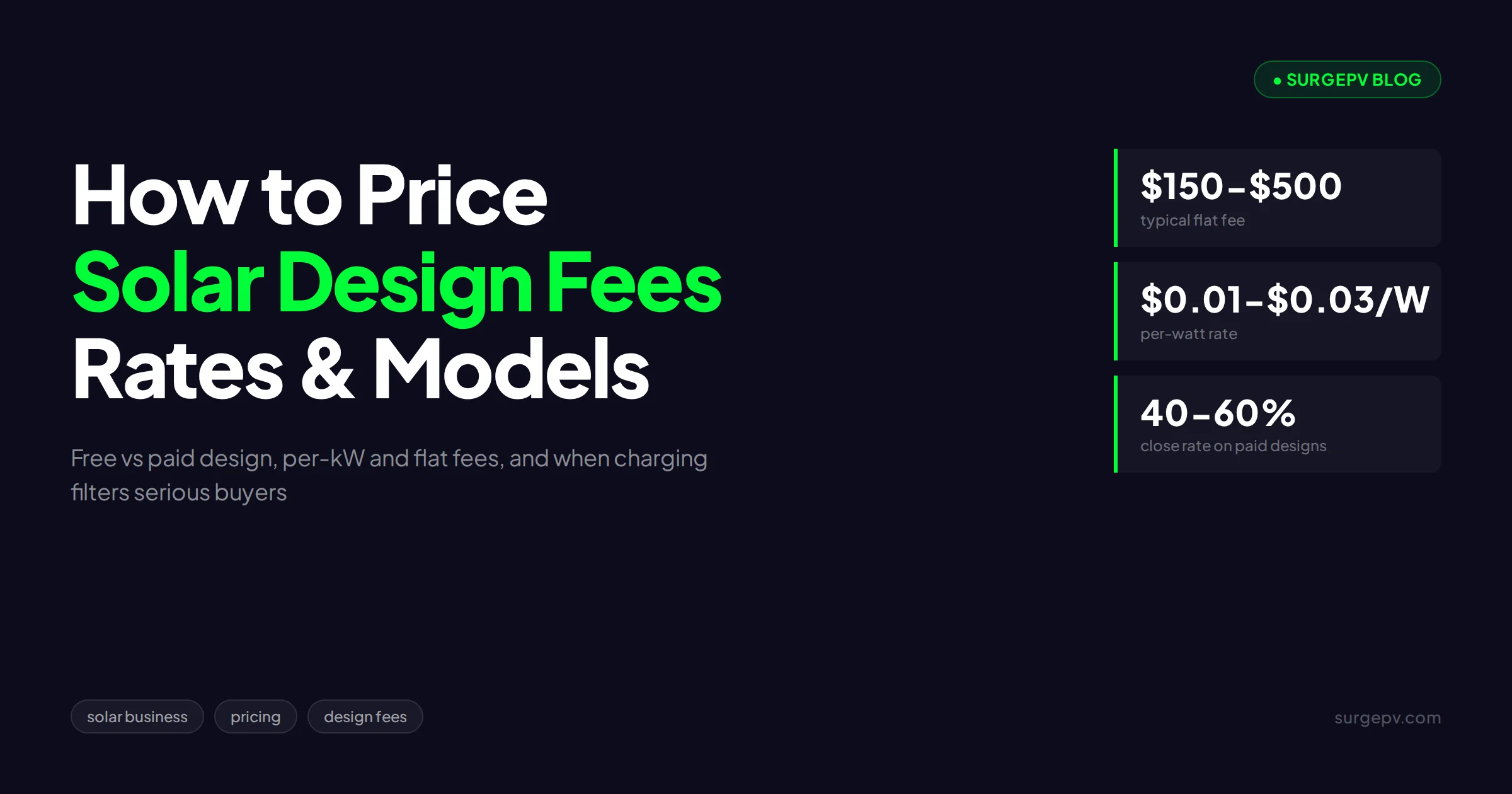
Solar installers typically price design work in one of 4 ways: free (absorbed as a sales cost), flat fees of $150–$500 for residential systems, per-watt fees of $0.01–$0.03/W, or hourly rates of $75–$150. Charging a refundable design fee of $150–$500 filters out unqualified shoppers and raises close rates, while free design works best in high-volume, referral-driven markets.
A 10 kW residential proposal takes 2–4 hours to design properly: site modeling, shading, string sizing, production simulation, and a financial summary. Multiply that by every lead that asks for a quote, and a design team burns 40–60 hours a month on deals that never sign. Soft costs like customer acquisition already make up roughly 65% of U.S. residential system prices, according to the National Renewable Energy Laboratory (NREL), 2024. Free design work is one of the largest invisible line items inside that number.
So should you charge for solar design work, and if so, how much? The honest answer: it depends on your lead quality, your close rate, and what the design deliverable is worth to the buyer. This guide gives you real fee benchmarks, 4 pricing models with the math behind each, and a decision framework for when charging a fee raises revenue instead of killing volume.
If you are building a design services offering rather than pricing design inside an installation business, read our companion post on solar design service pricing models and the white-label solar design services playbook.
Quick Answer
Solar installers typically price design work in one of 4 ways: free (absorbed as a sales cost), flat fees of $150–$500 for residential systems, per-watt fees of $0.01–$0.03/W, or hourly rates of $75–$150. Charging a refundable design fee of $150–$500 filters out unqualified shoppers and raises close rates, while free design works best in high-volume, referral-driven markets.
In this guide:
- The real cost of “free” design work
- Free vs paid design: what the numbers say
- Fee benchmarks: flat, per-kW, per-watt, and hourly rates
- 4 pricing models for solar design work, with examples
- When a design fee filters serious buyers (and when it backfires)
- Residential vs commercial: different fee rules by segment
- A step-by-step method to set your own fee
- Scripts for presenting the fee without losing the deal
What “Free” Solar Design Actually Costs
Free design is not free. It is a marketing expense you never put on a budget line.
Start with the direct cost. A competent solar designer costs $25–$45 per hour fully loaded in the U.S. market (industry-observed range). A proper residential design takes 2–4 hours, so each free quote carries $50–$180 of labor. Add software: cloud design platforms run $50–$400 per user per month depending on tier, and desktop tools with per-project credits can add $25–$100 per design.
Then multiply by your funnel. The average U.S. residential customer acquisition cost sits around $3,000–$5,000 per signed contract once you count marketing, sales labor, and unclosed quotes (industry-observed range from installer surveys). If your quote-to-close rate is 25%, you are designing 4 systems for every install. At $150 of design cost per quote, that is $600 of unpaid design work baked into every contract.
| Funnel math (hypothetical example) | Numbers |
|---|---|
| Quotes designed per month | 60 |
| Design hours per quote | 2.5 |
| Fully loaded designer cost/hour | $35 |
| Monthly design labor cost | $5,250 |
| Close rate | 25% |
| Signed contracts | 15 |
| Design cost per signed contract | $350 |
The exception: if your close rate is above 40% and your leads come mostly from referrals, free design is cheap marketing. The model fails when lead quality is low and designers become the bottleneck for growth.
There is also a hidden second cost: slow turnaround. When design is free, every rep requests a design for every lead. The queue grows, and the good leads wait 3–4 days for a proposal they could have seen in 24 hours. Speed matters — leads contacted within the first hour are far more likely to convert than leads contacted a day later, according to Harvard Business Review, 2011. A free-design queue actively slows your response to your best prospects.
Free Design vs Paid Design: What the Numbers Say
Neither model wins universally. Each shifts cost and risk to a different part of the business.
| Factor | Free design | Paid design fee |
|---|---|---|
| Upfront lead friction | Low — more requests | Higher — fewer requests |
| Lead quality | Mixed; many shoppers | Higher; buyers have intent |
| Design cost recovery | Absorbed in install margin | Partially recovered per quote |
| Close rate on quoted deals | 15–30% typical | 35–60% reported by installers (industry-observed) |
| Designer utilization | Wasted on dead leads | Focused on qualified buyers |
| Best for | Referral-heavy, high-volume shops | Paid-lead, competitive metro markets |
The tradeoff is volume against qualification. Free design maximizes top-of-funnel activity and works when your constraint is lead count. Paid design shrinks top-of-funnel volume but concentrates designer hours where revenue actually lands.
Our take: the close-rate data favors charging. The U.S. solar market installed record capacity in 2024, yet residential volumes softened in 2025 as financing costs rose, according to SEIA and Wood Mackenzie, 2025. In a softer market, every paid lead costs more and every unclosed quote hurts more. Protecting designer hours with a fee is the rational response.
The exception is referral-driven businesses. When 70%+ of your leads arrive pre-sold by past customers, a fee adds friction where none is needed. Price to your funnel, not to a rule.
Solar Design Fee Benchmarks: What Installers Charge
Published benchmarks for design fees are thin because most installers hide the fee inside the system price. The ranges below come from installer surveys, third-party design service rate cards, and industry-observed norms.
| Fee structure | Residential range | Commercial (C&I) range | Notes |
|---|---|---|---|
| Flat design fee | $150–$500 | $500–$5,000 | Most common; usually refundable at signing |
| Per-watt fee | $0.01–$0.03/W | $0.005–$0.015/W | $100–$300 on a 10 kW home system |
| Per-kW fee | $10–$30/kW | $5–$15/kW | Same math as per-watt, easier to quote |
| Hourly rate | $75–$150/hour | $75–$150/hour | Used for revisions, engineering, stamped plans |
| Site survey fee | $100–$300 | $300–$1,000 | Often bundled with design |
| Third-party design service | $50–$150 per design | $200–$800 per design | Outsourced layout/permit plan sets |
For context on system-level pricing: residential solar averages roughly $2.50–$3.00 per watt installed in the U.S. before incentives, according to EnergySage marketplace data, 2025. Installed prices have fallen for most of the past 2 decades even as equipment improved, according to Lawrence Berkeley National Laboratory’s Tracking the Sun report series, 2024 — which means design fees have to come out of margin, not out of a rising price tag. A $250 design fee is about 0.8% of a $30,000 project — small against the contract, but large against the $350 acquisition cost you would otherwise eat on a dead quote.
Third-party services set a useful floor. Outsourced design and permit plan sets run $50–$150 for residential and $200–$800 for commercial work, based on published rate cards from design service providers, 2025. If a stranger charges $100 for a plan set, your in-house design — informed by a real site conversation — is worth more than $0.
4 Pricing Models for Solar Design Work
Pick 1 primary model. Mixing models across the same lead channel confuses reps and buyers.
Model 1: Free design as a sales cost
Design is bundled into marketing spend and recovered through install margin. Works when close rates are high and leads are cheap or referral-sourced. The risk: designers become a queue, and quote turnaround slips from 24 hours to 4 days — which itself kills deals, since responding to a lead within the first hour multiplies conversion, as the Harvard Business Review research cited above shows.
Model 2: Flat refundable fee (recommended default for residential)
Charge $150–$500 before the full design, credit it 100% against the signed contract. The fee is a deposit in disguise. It filters shoppers collecting 5 quotes while costing a serious buyer nothing. This is the model we see work most often for residential installers in competitive metros.
Model 3: Per-watt or per-kW pricing
Charge $0.01–$0.03/W or $10–$30/kW. Scales automatically with system size, which suits mixed residential and small-commercial portfolios. The downside: a homeowner hears “3 cents a watt” as abstract math, so most reps convert it to a flat number at quote time anyway. Better as an internal costing rule than a customer-facing price.
Model 4: Hourly billing for engineering-depth work
Charge $75–$150 per hour for revisions, re-designs after scope changes, stamped structural or electrical plans, and C&I feasibility studies. Hourly billing is standard for engineers, unusual for sales-stage design. Use it when the deliverable is engineering, not a sales document. For a deeper breakdown of service-level rate cards, see the companion post on solar design service pricing models.
| Model | Best customer | Risk | When to use |
|---|---|---|---|
| Free | Referral leads | Designer overload | High close rate, cheap leads |
| Flat refundable | Paid-lead residential | Fee objection if pitched cold | Competitive metro markets |
| Per-watt / per-kW | Mixed portfolio | Feels arbitrary to buyers | Internal costing, auto-scaling |
| Hourly | C&I, engineering | Scope creep disputes | Stamped plans, revisions, studies |
When Charging a Fee Filters Serious Buyers (and When It Backfires)
Here is the contrarian claim: a design fee usually increases revenue even when it reduces closed contracts. Losing 10 shoppers who would never sign is not a cost. It is triage.
The mechanism is commitment. Behavioral pricing research shows that a small upfront payment changes how buyers treat the rest of the process — they show up to appointments, read the proposal, and negotiate in good faith. We covered the mechanics in our post on solar pricing psychology. Installers who introduce refundable design fees commonly report close rates on paid designs of 40–60%, roughly double their free-quote rate (industry-observed range, not a controlled study).
Pro Tip
Run a 60-day A/B test before committing. Charge the fee on paid-ad leads (Google, Facebook) and keep referral leads free. Compare designer hours per signed contract, not just close rate — that is the number a fee actually moves.
Now the myth-busting: “customers will never pay for a quote.” False — but only when the fee is pitched correctly. A fee pitched cold on the first call converts poorly. The same fee pitched after a 3D site model preview, with a refund-at-signing guarantee and a named deliverable (shade report, production estimate, plan set), converts well. What buyers refuse to pay for is a salesperson’s time. They will pay for a document they can hold.
When the fee backfires:
- Referral leads. Pre-sold buyers see the fee as distrust. Waive it.
- Markets where every competitor designs free. A fee only filters well if at least some competitors charge or your brand justifies the difference.
- First-call pitching. Asking for money before showing any value reads as a scam pattern. Show the model first.
The tradeoff is real: you will lose some legitimate buyers who refuse any upfront payment. Our judgment is that the hours recovered outweigh the deals lost in any market where your free-quote close rate sits under 30%.
Residential vs Commercial: Setting Fees by Segment
The same fee logic plays out differently in residential and commercial work. Treat them as separate businesses with separate price lists.
Residential design is fast, standardized, and sales-driven. A good designer produces a full residential package — 3D model, shade report, production estimate, financial summary — in 1–4 hours. Fees stay small ($150–$500) because the deliverable is a sales document, and the refund-at-signing structure works because residential contracts close in days or weeks. The main risk is volume: 60 free quotes a month will bury a 2-person design team.
Commercial (C&I) design is slow, custom, and engineering-driven. A 500 kW rooftop feasibility study involves load-profile analysis, demand-charge modeling, structural screening, and utility interconnection review. That is 10–40 hours of work, and buyers expect to pay for real feasibility analysis because the output informs a 6-figure capital decision. Commercial customers collectively install gigawatts of capacity each year, and the segment keeps growing as corporate sustainability targets tighten, per the SEIA and Wood Mackenzie data cited earlier — competition for those projects is rising with it, which makes professional, paid feasibility work a differentiator rather than an obstacle.
| Dimension | Residential | Commercial (C&I) |
|---|---|---|
| Typical design effort | 1–4 hours | 10–40 hours |
| Common fee structure | Flat refundable, $150–$500 | Flat scoped or hourly, $500–$5,000 |
| What the fee buys | Sales-stage design package | Feasibility study, engineering review |
| Refund norm | Credited at signing | Credited on award, or non-refundable |
| Sales cycle | Days to weeks | 3–12 months |
| Main fee risk | Volume of unqualified shoppers | Scope creep on studies |
One practical note for C&I: never present the fee as a line item buried in a proposal. Present it as a scoped feasibility study with named deliverables — production model, demand savings analysis, preliminary single-line diagram — and a defined credit on contract award. Commercial buyers budget for studies; they do not budget for “quotes.”
How to Price Your Design Fee: A Step-by-Step Method
Set the fee from your own funnel math, not from a competitor’s website.
- Compute your design cost per quote. Designer hourly cost × hours per design + per-design software cost. Most residential shops land at $80–$200.
- Compute your close rate on free quotes. Divide signed contracts by designs delivered last quarter.
- Compute design cost per signed contract. Step 1 ÷ Step 2. If it exceeds $400, a fee is worth testing.
- Set the fee at 100–150% of design cost per quote. If a design costs you $150, charge $150–$250. This recovers cost on dead quotes without becoming a profit center that scares buyers.
- Make it refundable at signing. Non-refundable fees filter harder but convert worse; refundable converts better and still filters. We recommend refundable for residential, non-refundable for C&I feasibility work.
- Define the deliverable in writing. A 3D model, shade report, production estimate, bill of materials, and financial summary. The deliverable justifies the fee.
- Review quarterly. If close rates on paid designs fall under 30%, your fee is attracting the wrong buyers or your deliverable is weak.
A worked example (hypothetical): your designer costs $35/hour fully loaded and spends 2.5 hours per design, so each design costs $87.50 in labor plus about $15 in software — call it $100. You delivered 80 designs last quarter and signed 20 contracts, a 25% close rate. Design cost per signed contract: $100 ÷ 0.25 = $400. At step 4, you set a refundable fee of $150. If the fee cuts your quote volume by a third but the remaining buyers close at 50%, you now deliver 54 designs, sign 27 contracts, and collect $8,100 in fees — of which $4,050 is refunded at signing and $4,050 offsets dead-quote labor. You sign 7 more contracts per quarter with fewer design hours. That is the model working as intended.
Deliver a paid-grade design in under 30 minutes
SurgePV combines 3D modeling, shading, production simulation, and financials in one cloud workspace — so a $250 design fee takes 30 minutes of labor, not 4 hours.
Book a DemoNo commitment required · 20 minutes · Live project walkthrough
The economics only work if design is fast. A fee of $250 against 4 hours of labor is a bad trade. Against 30 minutes in a cloud 3D design workspace with built-in PV shade analysis and financial modeling, the same fee is nearly pure margin — or, more usefully, cheap enough to refund without a second thought.
Working the Fee Into Your Sales Process
Presentation decides whether the fee converts. Three rules from installers who make it stick.
Show value before asking for money. Run a quick 3D model and shade preview during the first call. Tools like solar design tools with a energy and financial modeling tool let you do this live in minutes. Once the homeowner sees their own roof modeled, the fee stops being abstract.
Pitch the deliverable, not the hour. “For $250 you get a full engineering-grade design: 3D model, shading report, production estimate, and a savings breakdown — and the whole $250 comes off your contract when you move forward.” That script answers the objection before it forms. Your solar proposal software output is the proof of what they are buying.
Put the refund in writing. A one-line credit term in the design agreement removes the last objection and protects you if the deal stalls. For teams also handling Indian EPC workflows and permit-grade engineering, Heaven Designs covers design pricing models from the engineering-services side.
Common objections and how top reps answer them:
| Objection | Response |
|---|---|
| “Your competitor designs for free.” | “They do — and their design is a sketch. Ours includes a shade report and a production number we stand behind, and the full fee comes off your contract.” |
| “Why should I pay before I decide?” | “You should not pay for a quote. You are paying for an engineering document you keep either way — and it costs you nothing if you go ahead.” |
| “I am getting 3 other quotes.” | “Good. Bring ours — it is the only one with a verified shade analysis, so you can compare the production numbers, not just the prices.” |
| “Can you waive the fee?” | “The fee is what reserves senior designer time. What I can do is credit every dollar of it against the system when you sign.” |
Notice the pattern: every answer returns to the deliverable and the refund. If your reps cannot name what the fee buys in 1 sentence, the deliverable is too weak — fix that before adjusting the price. Clara AI can help draft the proposal copy and design summary that make the deliverable feel concrete to the buyer.
For the broader funnel around the fee — response time, follow-up cadence, and close-rate benchmarks — see our guides on the solar sales process, solar close rate benchmarks, and how proposal software increases sales.
Conclusion
Free design is a pricing decision, not a default. It costs $80–$200 per quote in labor and software, and at a 25% close rate that is $300–$800 of unrecovered design work per signed contract. A refundable fee of $150–$500 — pitched after a live design preview, with a named deliverable and a written refund — filters serious buyers, protects designer hours, and usually raises close rates on the designs you deliver.
Three actions to take this week:
- Run the funnel math. Compute your design cost per signed contract (design cost per quote ÷ close rate). If it exceeds $400, test a fee.
- A/B test for 60 days. Charge $250 refundable on paid-ad leads, keep referrals free, and compare designer hours per contract.
- Fix the deliverable first. A fee only converts when buyers get a tangible report — set up a fast design workflow in SurgePV so the deliverable costs you 30 minutes, not 4 hours.
Frequently Asked Questions
How much should I charge for a solar design?
For residential solar, most installers who charge collect a flat design fee of $150–$500, often refundable at contract signing. Per-watt pricing runs $0.01–$0.03/W ($100–$300 on a 10 kW system). Hourly rates of $75–$150 suit complex commercial or permit-grade engineering work. Match the fee to your local close rate and average job size.
Should solar design be free or paid?
It depends on your lead mix. Free design works when your close rate is healthy and volume matters more than qualification. Paid design works when you spend hours on quotes that never close — a refundable fee of $150–$500 filters tire-kickers and shifts your designer hours toward buyers with intent. Many installers run a hybrid: free preliminary layout, paid engineering-ready design.
What is a typical solar design fee per kW?
Per-capacity design fees typically run $10–$30 per kW for residential systems and $5–$15 per kW for commercial systems, where volume brings the per-kW rate down. On a 10 kW residential system, that equals $100–$300. Per-kW pricing scales automatically with system size but can feel arbitrary to homeowners, so many installers convert it to a flat fee at quote time.
Do customers accept paying for a solar design?
Yes, when the fee is framed correctly. Customers accept a design fee when it is refundable against the installation, delivers something tangible (a shade report, a stamped plan set, or a production guarantee), and is presented after value is established. Fees presented cold in a first call face the most resistance.
How do I price solar design work for commercial projects?
Commercial (C&I) design work is usually priced hourly at $75–$150 or as a scoped flat fee of $500–$5,000 depending on system size and engineering depth. Permit-grade structural and electrical engineering on multi-MW projects is typically billed separately or passed through from a third-party engineer. Many EPCs credit the full design fee into the contract on award.
What should a paid solar design deliverable include?
A paid residential design should include a 3D site model, a shade and irradiance report, an annual production estimate, a preliminary bill of materials, and a financial summary showing payback and savings. Commercial deliverables add single-line diagrams, string sizing, and permit-ready documentation. The deliverable is what justifies the fee — sell the report, not the hour.
Can I credit the design fee back to the customer?
Yes, and most installers who charge do exactly that. Crediting the design fee against the signed contract converts it from a purchase into a deposit. This structure protects your designer hours on deals that stall while keeping the fee from becoming a price objection on deals that close. State the credit clearly in writing before collecting payment.
Where this fits
This article is part of SurgePV's Solar Business & Operations hub, which works through the topic from first principles to the decisions a project team actually has to make.

