

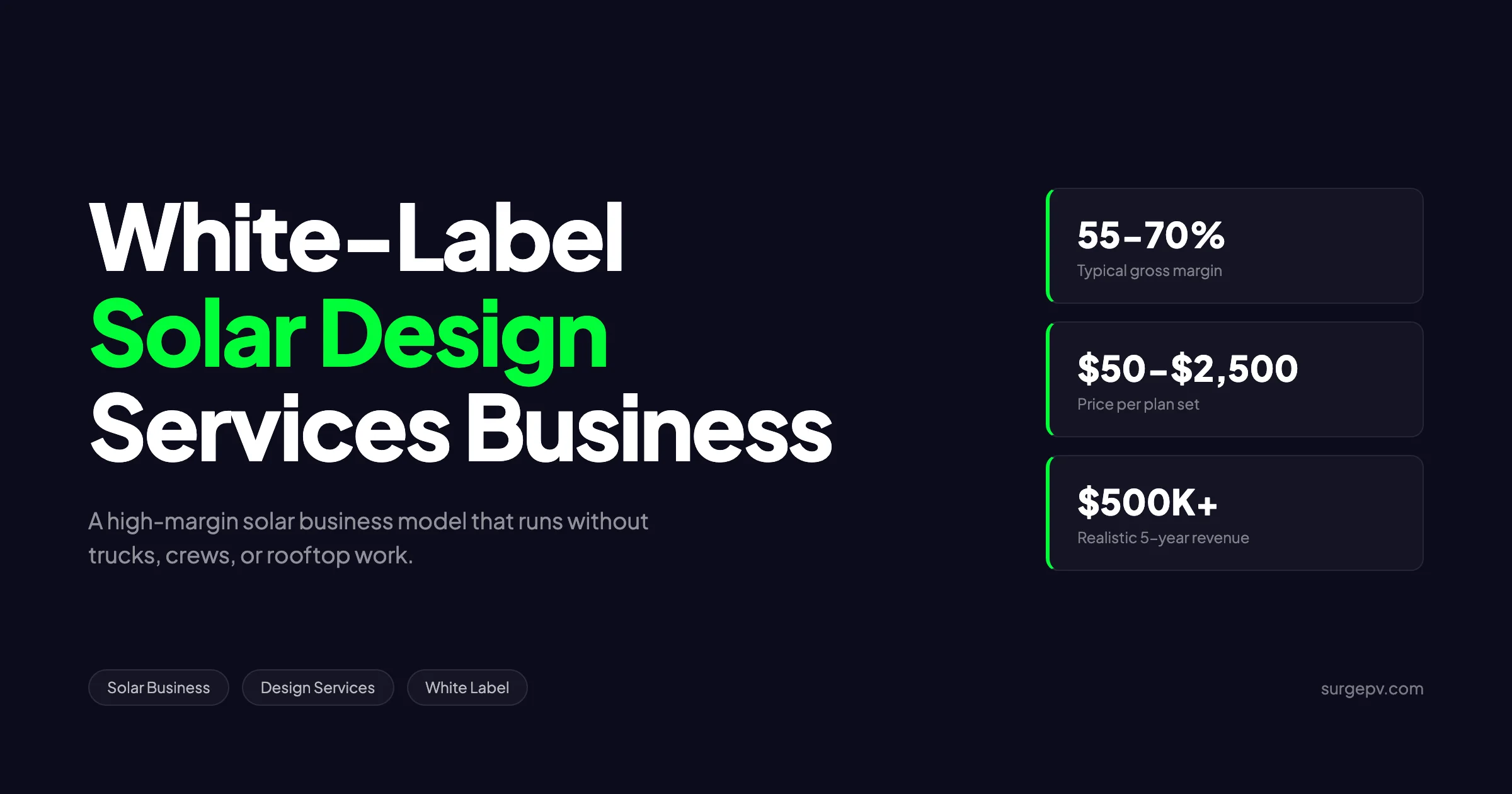
Solar design as a service is one of the highest-margin solar businesses you can run. Gross margins of 55 to 70 percent are normal. No vehicles. No installation crews. No truck rolls. Yet most installers misunderstand the customer.
The buyer is not a homeowner. The buyer is another solar company, usually one that sells fast and would rather hand the design work to someone else. Solving for that buyer is a different problem than solving for an end customer. The pricing, the SLA, the brand, and the operational rhythm all change. Cloud-based solar software is the lever that makes the unit economics work at five engineers and 140 projects per month.
This guide is the playbook. It covers what the service actually sells, how to tier and price it, who buys it, the tools and turnaround times that win deals, and the revenue model to reach $500,000 or more per year with five engineers.
Quick Answer
White-label solar design services produce plan sets, simulations, and PE-stamped drawings for solar installers and EPCs under the client’s brand. Pricing runs $50 to $2,500 per project. Gross margins hit 55 to 70 percent. A five-engineer team can clear $500,000 in annual revenue without owning a single truck.
Key Takeaways
- Gross margins of 55 to 70 percent are realistic in a well-run white-label firm, far above the 20 to 28 percent typical for residential installers.
- Service tiers split into three pricing bands: preliminary designs at $50 to $150, permit sets at $300 to $700, and stamped engineering at $800 to $2,500.
- The buyer is the operations manager, not the technical lead. Reliability and turnaround beat technical depth on every deal we have closed.
- The breakeven point for an installer to hire in-house design is 80 to 120 projects per year. Below that, outsourcing wins on cost.
- PE stamping is a multi-state coordination problem. Operating in 30 states means managing 30 separate PE relationships, not 1.
- A five-engineer team running 140 projects per month at $350 average revenue per project reaches $588,000 per year.
In this guide:
- What white-label solar design services actually sell, and what they do not
- Three service tiers: preliminary design, permit set, stamped engineering
- Four pricing models with margin math: per-project, per-kW, subscription, outcome-based
- Target customers: solar resellers, small installers, EPCs, sales orgs
- The operational stack: tools, workflow, and turnaround commitments
- How to build a five-engineer team and the org chart that works
- SLA structures and the quality controls that protect both sides
- A five-year revenue model that reaches $500,000 in annual revenue
- Why stamped engineering is a trap for early-stage firms
- Answers to the questions every founder asks before launching
What White-Label Solar Design Services Actually Sell
White-label solar design services sell speed, brand invisibility, and capacity flexibility. They do not sell drawings.
That distinction matters. A plan set is the output. The product is the ability of an installer to take a signed contract on Monday and have a stamped, permit-ready package by Friday without hiring a designer, paying for software, or carrying overhead between projects. The installer pays for that capability and bills it into the customer price.
The deliverables fall into four buckets:
- Preliminary designs and shade studies used during sales
- Permit-ready plan sets with site plans, single-line diagrams, and equipment cuts
- PE-stamped structural and electrical drawings for AHJ submission
- Simulation reports for production estimates and financing applications
A good design firm understands that the installer is reselling these deliverables to a homeowner or a commercial client. The brand on every page must be the installer’s. The cover sheet, the logo, the contact details, the project number, and the engineer’s stamp block all need to look like the installer designed the system in-house. If a homeowner ever opens a plan set and sees a different company’s logo, the white-label promise has broken.
This is the part most new design firms get wrong. They build a product mindset around drawings instead of a service mindset around the installer’s customer-facing brand. The pricing follows the same logic. You are not pricing a deliverable. You are pricing a capability the installer rents.
The Real Buyer
The buyer is rarely the technical lead. It is the operations manager or the owner who is tired of design throughput holding back sales. They want predictable turnaround, clean files, and a contact who picks up the phone. The technical quality matters, but it is a baseline. Reliability is the differentiator.
Service Tiers: Preliminary Design vs Permit Sets vs Stamped Engineering
Most design firms offer three tiers, sometimes four. The tiers are not just price points. They are different workflows, different staff, and different risk profiles.
Tier 1: Preliminary Design
The cheapest deliverable. A preliminary design is a one-page or two-page layout with module count, system size, azimuth, tilt, and a basic shade reading. The installer uses it as a sales tool to show the homeowner a real layout on their roof. No structural calculations. No electrical single-line. No PE involvement. See Rooftop Solar Structural Assessment for detailed guidance.
Turnaround is usually 4 to 24 hours. A trained junior designer can produce 8 to 12 preliminary layouts per day using cloud tools. Price points run $50 to $150 per design. Margin is high because the work is fast and the tooling is shared across many projects.
Tier 2: Permit Set
The standard product. A permit set includes a site plan, an electrical single-line diagram, structural attachment details, equipment specifications, and a cover sheet. It is everything a building department needs for permit approval, minus a stamp. Some AHJs accept these as-is for residential projects under a threshold. Most require a PE stamp on top.
Turnaround is 3 to 5 business days. A designer produces 4 to 6 permit sets per week. Price points run $300 to $700 per set. Many firms sell the permit set as a standalone product and add the stamp as a paid upgrade.
Tier 3: Stamped Engineering
The most expensive and the most operationally demanding. A stamped plan set is a permit set with structural and electrical PE seals applied to the relevant sheets. The PE must be licensed in the project’s state. The PE assumes liability for the calculations.
Turnaround is 5 to 10 business days, with 1 to 3 extra days per revision round. Price points run $800 to $2,500 depending on system size and complexity. Combined electrical and structural stamp packages for residential projects run $400 to $850 on their own, according to Solar Permit Solutions.
The complication is that a PE license is state-specific. A PE licensed in Texas cannot stamp a plan for Florida. Operating a stamped engineering business in 30 states means building a network of 30 PE relationships, each with its own billing arrangement, capacity limits, and turnaround commitments.
| Tier | Deliverable | Turnaround | Price Range | Designer Output/Week |
|---|---|---|---|---|
| Preliminary | 1 to 2 page layout, shade reading | 4 to 24 hours | $50 to $150 | 30 to 50 projects |
| Permit Set | Site plan, SLD, structural, equipment specs | 3 to 5 business days | $300 to $700 | 4 to 6 projects |
| Stamped Engineering | Permit set plus PE seals | 5 to 10 business days | $800 to $2,500 | 2 to 4 projects |
| Commercial Stamped | Larger systems, full structural calcs | 7 to 14 business days | $1,500 to $5,000+ | 1 to 2 projects |
Pricing data drawn from GreenLancer, Solar Permit Solutions, and Energyscape Renewables 2026 benchmarks.
The most profitable firms run all three tiers. Preliminary design pulls clients in. Permit sets carry the margin. Stamped engineering deepens the relationship and locks the client into a longer-term contract.
Pro Tip
Bundle the preliminary design into a sales-package subscription. Charge $500 per month for unlimited preliminary layouts within a usage cap. The installer gets predictable cost. You get a recurring revenue floor that funds your designer payroll between permit-set jobs.
For United States-specific compliance details, see United States arizona/phoenix.
Pricing Models: Per-Project, Per-kW, Subscription, Outcome-Based
Pricing is where most new design firms leave money on the table. There are four common models, and each has a different fit depending on client size and project mix.
Per-Project Pricing
The simplest model. Each deliverable has a flat price. A residential permit set is $450. A stamped commercial set is $1,800. The installer sends a project, you send a quote, the work begins.
This model works well for early-stage firms because it is easy to explain and easy to invoice. The downside is that complex projects can blow up the margin. A 25 kW residential system with a battery, a backup panel, and a complicated roof takes twice the time of a standard 6 kW design. If you priced both at $450, the second one is unprofitable.
The fix is to publish a price list with project complexity tiers. Solar Permit Solutions and GreenLancer both use this approach.
Per-kW Pricing
A scaled model where price varies with system size. Residential might be priced at $25 per kW with a $300 minimum. Commercial drops to $8 to $15 per kW because the unit economics improve at scale.
Per-kW pricing matches cost to value, which makes it easier to justify higher prices on larger projects. The downside is friction at the quoting stage. Every project needs a kW number before you can give a price, and many sales-driven installers do not have that number until late in the process.
Subscription Pricing
A monthly or annual flat fee that gives the installer unlimited designs within a defined scope. Common structures include $1,500 per month for up to 30 residential permit sets, or $5,000 per month for up to 100. Stamps are usually billed separately because of the per-state PE cost.
Subscription pricing favors high-volume clients and is the strongest model for a design firm’s cash flow. Predictable monthly revenue funds payroll, software, and PE retainers. The risk is over-delivery. If a client suddenly doubles their volume mid-month, you absorb the cost. Watertight usage caps and overage pricing are mandatory. Also see: Us Residential Solar Market Trends 2026.
Outcome-Based Pricing
The rarest model. The design firm is paid a percentage of the project value, or a fee that is contingent on permit approval. A common structure is $500 per project plus $200 paid on permit approval, with a refund of the $500 if the AHJ rejects the package and the rejection traces back to the design.
Outcome-based pricing aligns incentives but introduces collection risk. Permit timelines vary by jurisdiction. A six-month commercial permit holds up your cash for six months. Most design firms only use outcome pricing on enterprise contracts where the volume justifies the working capital tie-up.
| Model | Best For | Margin Predictability | Cash Flow | Sales Friction |
|---|---|---|---|---|
| Per-project | Sub-50 projects/month | Medium | Project-by-project | Low |
| Per-kW | Mixed res/commercial | High | Project-by-project | Medium |
| Subscription | High-volume installers | High | Monthly recurring | Medium |
| Outcome-based | Enterprise EPC contracts | Low | Delayed | High |
The right model depends on what stage your firm is in. Per-project is the starting point. Subscription is the goal. Per-kW and outcome-based are layered on as the client base diversifies.
Target Customers: Solar Resellers, Small Installers, EPCs, Sales Orgs
The biggest mistake new design firms make is treating every solar installer as the same buyer. They are not. There are four distinct buyer segments, each with different volume, price sensitivity, and SLA expectations.
Solar Resellers and Sales Organizations
These companies sell solar but do not install it. They subcontract installation to a network of partners. Companies like Sunrun, Sunder Energy, and dealer-network operators fit this segment, along with thousands of smaller regional sales orgs.
Resellers buy design because they need it to close a sale. They want preliminary designs in hours, not days. They tolerate higher prices on preliminary work because the conversion impact is direct. They are less price-sensitive and more speed-sensitive than other segments. A single design firm partnership can move millions in solar volume per year.
Small Installers (Under 100 Installs Per Year)
The largest segment by company count. These installers do 1 to 8 jobs per week and cannot justify a full-time in-house designer. They outsource everything from preliminary to stamped. Their breakeven for hiring an internal designer sits around 80 to 120 installs per year.
Small installers are price-sensitive on permit sets but willing to pay premium for stamped engineering when their alternative is a $4,000-per-month staff PE on retainer. Per-project pricing matches their workflow. They want fixed prices and clean handoffs. They rarely have the operational maturity to support a subscription model in year one.
Mid-Size Installers and Regional EPCs (100 to 500 Installs Per Year)
The most lucrative segment for design firms. These installers have enough volume to support a subscription, an in-house designer, and an outsourced overflow partner at the same time. The design firm becomes the surge-capacity arm of the operation.
This segment buys all three tiers but particularly values permit sets and stamped engineering. They have the volume to negotiate per-kW pricing. They will sign annual contracts. They are loyal once they trust your turnaround.
Commercial and Utility EPCs (500+ Installs or Multi-MW Projects)
The smallest customer count but the highest revenue per relationship. Commercial EPCs need stamped engineering for nearly every project. They want named PEs of record in each state, signed scopes of work, and milestone-based invoicing. Outcome-based pricing shows up here more than anywhere else.
This segment is the slowest to land. Sales cycles run 3 to 9 months. The reward is contracts in the $100,000 to $500,000 per year range with a single client.
Where to Start
Sales organizations and small installers are the right beachhead for a new design firm. The sales cycle is short. The technical bar is modest. The volume scales fast once the workflow is dialed. Commercial EPCs are a year-two or year-three target, not a launch customer.
Operations: Tools, Workflow, and Turnaround Times
The economics of a design firm live or die on tools and workflow. The same plan set takes a strong team 90 minutes and a weak team six hours. That gap is the difference between 60 percent gross margin and 5 percent. Modern solar design platform collapses that gap by giving every engineer the same templates, shading inputs, and bill-of-materials defaults. For more on this topic, see [Solar Shading Analysis Guide](/blog/solar-shading-analysis-guide).
The Tool Stack
The minimum stack for a five-engineer firm includes:
- A cloud-based solar design platform with multi-user access. SurgePV’s design tools, Aurora, Helioscope, and PVcase are the most common choices. Cloud beats desktop because designers can hand off projects across shifts and time zones without file transfers.
- A drafting tool for stamped plan sets. AutoCAD or BricsCAD remain the standard. Solar-specific plugins like PVDesign or Virto Solar shorten drafting time by 60 to 80 percent for repeatable layouts.
- A simulation engine for production estimates. SurgePV’s generation and financial tool handles residential and commercial. PVsyst is the commercial gold standard when the client demands it.
- A shade analysis tool. Shadow analysis integrated into the design platform saves a separate handoff. Without it, designers waste 30 minutes per project switching between tools.
- A project management layer. ClickUp, Monday, or Asana are common. The key requirement is one ticket per project with stamped milestones for designer-pickup, draft-ready, QA-pass, and stamp-applied.
- A file delivery system. Most clients want a branded portal or a shared drive folder. A custom-branded subdomain costs nothing and signals professionalism.
The single highest-leverage upgrade is switching to a cloud design platform if you are not on one already. The throughput gain is 2x to 3x, and the per-designer software cost is roughly equivalent.
The Daily Workflow
A mature design firm runs on a four-stage internal pipeline:
- Intake. Client submits project via portal or shared drive. Operations lead reviews scope, confirms deliverables, assigns to a designer. Target: under 2 business hours from receipt.
- Draft. Designer produces plan set or preliminary layout. Target: 90 to 240 minutes for a residential permit set.
- QA. Senior designer or engineering lead reviews against a checklist. Errors flagged and returned. Target: 30 to 60 minutes per project.
- Delivery. Final file uploaded to branded portal. Client notified by email and Slack. Target: same day after QA pass.
Stamped engineering adds a fifth stage: PE review and seal. This stage runs in parallel with delivery for non-stamp deliverables, and adds 24 to 72 hours when a stamp is required.
Turnaround Commitments
Industry-standard turnaround times set client expectations. Beat them by a day on most projects and you become the preferred partner. Miss them once and you lose the client.
| Deliverable | Standard | Premium Rush | Notes |
|---|---|---|---|
| Preliminary residential design | 4 to 24 hours | Under 4 hours | Often used in sales calls |
| Residential permit set (no stamp) | 3 to 5 business days | 1 to 2 business days | The volume product |
| Residential stamped plan set | 5 to 7 business days | 2 to 3 business days | Plus PE availability |
| Commercial permit set | 7 to 10 business days | 4 to 5 business days | Larger scope, more sheets |
| Commercial stamped plan set | 10 to 14 business days | 6 to 8 business days | PE bandwidth is the constraint |
| Revision round | 1 to 2 business days | Same day | Track revisions per project |
Rush jobs price at 1.5x to 2.0x standard. They are profitable on paper but disruptive in practice. Cap rush-job intake at 15 to 20 percent of monthly volume or your team burns out and your standard-turnaround promises start slipping.
Cut Design Time by 60% With Cloud Tools
SurgePV gives your design team faster layouts, native shade analysis, and one-click proposal exports. Built for white-label and in-house design teams.
Book a DemoNo commitment required · 20 minutes · Live walkthrough
Building a 5-Engineer Design Team
Most profitable design firms in the $400,000 to $800,000 revenue range run with five technical staff. The structure is consistent across the firms I have studied and worked with.
The Org Chart
The five-engineer team breaks down like this:
- Operations lead (1). Handles intake, scope confirmation, scheduling, client communication, and revision coordination. Not a designer. Often the founder in early-stage firms.
- Senior designer or engineering lead (1). The technical anchor. Owns QA, handles the trickiest residential and commercial projects, mentors junior staff, and serves as the technical face to clients.
- Mid-level designers (2). Carry the bulk of the permit-set volume. Each produces 12 to 20 sets per week depending on complexity. Often promoted from junior roles after 12 to 18 months.
- Junior designer (1). Handles preliminary designs and shade studies. Produces 30 to 50 deliverables per week. Trains up to mid-level over 12 to 24 months.
Plus a network of:
- Contract PEs (5 to 30 across states). Compensated per stamp. Most charge $75 to $250 per stamp depending on state and project type.
- One backup designer or part-time freelancer. Covers overflow and PTO without breaking SLAs.
Hiring Sequence
The hiring order matters. A common mistake is hiring designers before hiring an operations lead. The result is a brilliant team that misses every deadline because no one owns scheduling.
- Founder plus 1 mid-level designer. Founder runs intake, sales, QA. Designer runs production. This phase supports 25 to 40 projects per month.
- Add senior designer or engineering lead. Founder transitions out of QA, keeps sales. This phase supports 50 to 70 projects per month.
- Add junior designer and second mid-level. This is the 100 to 140 projects per month phase.
- Add operations lead. Founder transitions out of intake, focuses entirely on sales, partnerships, and PE network. Capacity reaches 140 to 200 projects per month.
The fifth-engineer transition is the most expensive step but also the highest-leverage. The operations lead is the role that lets a design firm scale past one founder’s working capacity.
Compensation
Designer compensation varies by region and skill level. Reasonable 2026 benchmarks for a US-based firm:
| Role | Annual Salary | Notes |
|---|---|---|
| Junior designer | $50,000 to $65,000 | Often hired remote or offshore |
| Mid-level designer | $70,000 to $90,000 | Two to four years of experience |
| Senior designer / Eng lead | $95,000 to $130,000 | Plus performance bonus |
| Operations lead | $75,000 to $110,000 | Process and project management focus |
| Contract PE | $75 to $250 per stamp | Volume-based |
Offshore teams in India, the Philippines, and Eastern Europe can run the junior and mid-level roles at 30 to 50 percent of US compensation. Many of the largest design firms run a hybrid model with US-based senior staff and offshore production teams. Also see: Best Solar Design Software India. Also see: European Solar Incentives. For Europe-specific compliance details, see Europe solar compliance.
SLA Structures and Quality Controls
Service-level agreements are where design firm relationships die. Most disputes trace back to undefined revision scope, missed turnaround commitments, or quality issues with PE-stamped work. Tight SLAs protect both sides.
Core SLA Components
A standard white-label design SLA covers seven areas:
- Scope of deliverables. Exactly what is included in a permit set or stamped package. Sheet count, file formats, branding requirements, revision rounds.
- Turnaround commitment. Standard and rush turnaround times by deliverable type, measured in business days from project acceptance.
- Revision policy. Number of revision rounds included. Per-round price for additional revisions. Typical structure is two free rounds, then $50 to $150 per round.
- Quality guarantee. Definition of an acceptable deliverable. Permit-rejection coverage if the design caused the rejection.
- PE responsibility. Which deliverables include a stamp, which PE is the engineer of record, and how stamp transfers between states work.
- Confidentiality and branding. The design firm never markets to the installer’s clients. Every deliverable carries only the installer’s brand.
- Pricing and payment terms. Net 15 or Net 30. Late payment terms. Volume discount thresholds.
Permit-Rejection Coverage
The most contested clause. Permit rejections cost installers $2,000 to $5,000 per project in crew rescheduling and client communication, per Energyscape Renewables. When a rejection traces back to a design error, the installer expects coverage.
A reasonable clause: the design firm covers the cost of the revision plus a refund of the design fee if the rejection is due to a design error. The clause does not cover rejections caused by AHJ-specific quirks the installer did not communicate. It does not cover rejections caused by client-supplied site information that turned out to be wrong.
The clause forces both sides to document what was communicated, which is a useful discipline regardless of whether it ever gets invoked.
Quality Control Inside the Firm
External SLAs only matter if internal quality controls hold up. Most successful firms run a three-step internal QA:
- Designer self-check. Five-minute checklist run by the designer before submitting for QA. Typical items: branding correct, sheet count complete, equipment list matches BOM, single-line diagram references match panel layout.
- Senior review. Senior designer or engineering lead runs a 30 to 60 minute review against a 40-item checklist. Errors flagged in a comment file. Designer revises and resubmits.
- Pre-delivery scan. Operations lead spot-checks every fifth project. Pattern errors traced back to training gaps.
Add a stamped review by the PE for any project that needs a stamp. The PE catches structural and electrical issues the design team would not see.
Pro Tip
Track permit rejection rate as your single most important quality metric. Aim for under 3 percent. Above 5 percent and you have a process problem. Below 1 percent and you are probably over-engineering and losing time you could be billing.
A Narrative: Two Companies, Two Outcomes
Compare two real-world archetypes I see often in this industry.
The first is an installer named Adam who runs a 60-install-per-year residential business in the Midwest. He used to handle design himself in the evenings after sales calls. Permit sets took him three to five days because he was the bottleneck. He lost two contracts in 2025 because his turnaround was slower than a competitor’s. He stopped trying to scale.
In late 2025 he signed a subscription with a white-label design firm. The firm produced preliminary designs within four hours and permit sets in three business days. His sales close rate jumped from 22 to 31 percent in the first quarter, mostly because reps could send a real layout the day after a homeowner conversation. He projects 110 installs in 2026, and his per-project net margin is up because he is no longer carrying his own design cost.
The second is a design firm called Mark’s outfit that launched in 2024 with five engineers and a focus on stamped commercial plan sets. The team is technically strong but the pipeline is lumpy. Stamped commercial work pays $1,500 to $4,000 per project but takes two to three weeks. The cash flow gaps between projects forced Mark to run on a personal line of credit for nine months. He almost shut down in mid-2025.
Mark pivoted in late 2025 to a mixed model: 60 percent residential permit sets on subscription, 30 percent residential stamped work, 10 percent commercial. Revenue is now predictable. Gross margin held at 58 percent. The takeaway is that a stamped-commercial-only model is unstable for a small team. Volume residential work funds the firm and stabilizes payroll, even though stamped commercial has the higher headline price.
Revenue Model: Reaching $500K+ Annual Revenue
The five-year revenue model below assumes a US-based firm with mixed US and offshore staff, residential-heavy mix, and a steady ramp.
| Year | Engineers | Projects/Month | Avg Revenue/Project | Annual Revenue | Gross Margin | Gross Profit |
|---|---|---|---|---|---|---|
| Year 1 | 2 | 35 | $290 | $122,000 | 48% | $58,500 |
| Year 2 | 3 | 70 | $310 | $260,000 | 54% | $140,000 |
| Year 3 | 4 | 105 | $325 | $410,000 | 58% | $238,000 |
| Year 4 | 5 | 140 | $350 | $588,000 | 62% | $364,500 |
| Year 5 | 5 + ops lead | 165 | $375 | $742,500 | 65% | $482,600 |
The numbers reflect the realistic operating shape of a five-engineer firm. By year four, average revenue per project rises because the mix shifts toward stamped engineering and commercial. Gross margin rises because per-designer output rises as workflows mature.
The model is conservative. Firms that land two or three commercial EPC contracts can clear $1M per year by year four. Firms that lean entirely on residential subscription can reach $500K in year three with three engineers if subscription volume holds.
What Drives the Margin
Three levers move the gross margin line:
- Tool ROI. Cloud design platforms with batch processing cut per-project labor by 30 to 50 percent versus desktop tools. The investment pays back inside three months at 30+ projects per month.
- Designer mix. Junior-to-mid ratio matters. Two juniors and one senior produce more billable output than three mid-level designers because the junior labor cost is 40 percent lower and the senior handles the complex 10 percent.
- Revision rate. Every revision costs unbilled designer time. Cutting revisions from 1.4 per project to 0.8 per project is the equivalent of a 12 to 15 percent gross margin lift on volume work.
The Path Past $500K
The firms that scale past $500K share three characteristics. They run subscription contracts with at least three high-volume installer partners. They have built a 15-state-plus PE network. They have invested in a project management platform that handles 100+ concurrent projects without errors. The capital required to reach that point is mostly time. A founder with deep operational discipline can get there in three to four years with under $200,000 in startup costs.
For installers thinking about this from the other direction, see our guides on solar business growth strategies and how to scale a solar installation business.
Common Mistakes (Myth-Busting)
The space is young enough that several persistent myths drive new firms into trouble. The biggest one is the first.
Myth 1: Stamped Engineering is Where the Money Is
It looks that way on paper. Stamped commercial sets bill $1,500 to $5,000 versus $300 to $700 for residential permit sets. The math suggests you should chase commercial work.
The reality is that stamped commercial engineering has long sales cycles, slow payment terms, complex PE coordination, and high revision rates. A residential subscription with 30 sets per month at $400 per set bills $12,000 monthly with predictable cash flow. A commercial stamped contract that bills $30,000 once per quarter generates the same revenue but with three months of working capital tied up.
Volume residential work funds the firm. Stamped engineering deepens the relationship. Both matter. Either alone is fragile.
Myth 2: You Need a PE License to Start
False. You only need a PE license on stamped deliverables, and you can subcontract that. Many design firms launch with no licensed PE on staff, build out preliminary and permit-set tiers, and add stamped engineering 12 to 18 months in once the volume justifies it.
The exception is firms launching with a commercial focus. There you need at least one staff PE or a strong founder-PE relationship from day one.
Myth 3: AI Will Replace Solar Designers
Partially true and mostly hype. AI-assisted tools speed up parts of the workflow, particularly layout generation and shade analysis. Clara AI and similar tools do reduce designer time per project. They do not yet handle PE-grade calculations, edge cases on complex roofs, or AHJ-specific deliverables that vary by jurisdiction.
The firms that win in the next three years will use AI to make their designers more productive, not to replace them. The five-engineer team in 2028 will produce 200+ projects per month, not 140. The team will still exist.
Myth 4: Lowest Price Wins
It does not. The buyer is an installer who loses $2,000 to $5,000 every time a permit gets rejected. Their priority is reliability, not cost. The lowest-price design firm in any market is usually the one with the highest revision rate, the slowest turnaround, and the highest permit-rejection rate.
Premium pricing at 20 to 30 percent above the market average is achievable when paired with sub-3-percent permit rejection rates and consistent turnaround. The math works because the installer’s cost is lower in total even though the per-project price is higher.
Myth 5: You Can Skip the Brand Work
Some new firms assume that because the deliverables are white-label, brand work is wasted effort. The opposite is true. Installers buy from design firms they trust. Trust is built through clear positioning, content, case studies, and visible founder presence on solar industry channels. The design firms with the strongest pipelines have founders who post regularly on LinkedIn, speak at industry events, and publish technical content.
The white label applies to the deliverable. The firm itself needs to be findable, credible, and clearly differentiated.
Why Stamped Engineering Can Be a Trap
A contrarian view. Many new design firms see stamped engineering as the premium product and lead with it. The trap is that stamped work scales linearly with PE bandwidth, not with designer bandwidth. You can add three designers and still hit the same ceiling because your single PE in California can only stamp 20 projects per week.
Firms that lead with stamped engineering hit a PE capacity ceiling early. They cannot scale revenue without spending months recruiting a second PE per state, which is hard because PEs with solar experience are scarce. Meanwhile, residential permit sets and preliminary designs scale linearly with designer headcount, which is much easier to add.
The right sequence is to build the firm on residential permit-set volume first, then layer stamped engineering on top once the cash flow is stable and the operations are mature. Reverse that sequence and you spend the first two years cash-constrained and PE-bottlenecked.
For more on the technology that makes design throughput possible, see our overview of solar design software and our guide on why every installer needs a solar design tool.
How Installers Should Decide Between Outsourced and In-House Design
If you run an installation business, the question is when to outsource and when to staff. The breakeven math is well-known.
Outsourced solar permit design typically costs $1,200 to $2,000 per residential plan set when you bundle in stamps. In-house solar engineering costs solar installers $530 to $810 per project once salaries, PE licensing fees, software, and idle-time overhead are included, per Solar Permit Solutions.
The breakeven sits around 80 to 120 installs per year. Below that, outsource everything. Above that, hire a dedicated in-house designer for routine work and outsource overflow, stamped commercial, or unusual jurisdictions.
A useful framework for installers:
| Annual Installs | Recommendation |
|---|---|
| Under 50 | Outsource 100% |
| 50 to 100 | Outsource 100%, evaluate at 100 |
| 100 to 200 | Hire one in-house designer, outsource 30 to 50% as overflow |
| 200 to 400 | Build a 2 to 3 person in-house team, outsource stamped engineering |
| 400+ | Full in-house design team, outsource only edge cases |
For installers in the 100 to 300 range, the hybrid model is almost always the right answer. It captures the cost benefit of in-house routine work and the flexibility of an outsourced partner for surge volume. See our buyer guides on choosing solar quote software and commercial solar design software for software decisions that affect this calculation.
For the design firm reading from the other side, the implication is simple. Your sweet-spot customer is the installer doing 25 to 200 installs per year. That is where the willingness to outsource and the volume to make the math work meet.
What This Looks Like in 2026 and Beyond
Three trends will shape the white-label solar design market over the next 3 years.
First, the contraction of US residential solar by 18 to 19 percent in 2026, according to SEIA’s Q4 2025 market report, will push more installers to outsource. Fixed-cost design teams are hard to justify in a contracting market. Variable-cost outsourcing becomes more attractive when monthly install volume swings.
Second, AHJ digitization is uneven but accelerating. More jurisdictions are accepting digital PE seals. SolarAPP+ adoption is expanding. The design firms that build deep AHJ-specific knowledge will hold pricing power as the rest of the market commoditizes.
Third, software-assisted design output per engineer will rise sharply. The firms that train their teams on cloud tools, AI-assisted layout, and integrated shade analysis will run 30 to 50 percent more projects per engineer in 2028 than in 2025. The firms that stay on desktop CAD will find their cost structure uncompetitive.
The opportunity is real and the window is open. The next 24 months will see a wave of new white-label firms launching. The ones that win will be operationally disciplined, brand-invisible to the end customer, and obsessed with reliability over price. For sales-driven installers and EPCs looking to scale without bloating headcount, see our SurgePV solutions for installers and solutions for channel managers and OEMs.
If you are building one of those firms or evaluating one as a buyer, the playbook in this guide should give you the operating model to start. The data, the pricing, the SLAs, and the team structure are all drawn from real firms running today. Apply them in order and the path to $500,000 in annual revenue is a three to four year build.
Frequently Asked Questions
What is white-label solar design?
White-label solar design is a service where an outside engineering team produces plan sets, simulations, and stamped drawings under the installer’s brand. The end client sees the installer’s logo on every deliverable. The design firm stays invisible. Typical deliverables include site plans, single-line diagrams, structural details, and PE-stamped permit packages.
How much can a solar design service charge per project?
Per-project pricing ranges from $50 for a preliminary residential layout to $2,500 for a stamped commercial plan set. A residential permit set with structural and electrical PE stamps lands between $400 and $850 for the stamp portion alone (Solar Permit Solutions, GreenLancer benchmarks). Full residential plan sets typically clear $500 to $1,200, with commercial sets at $1,200 to $3,000.
Do I need a PE license to offer solar design services?
No, you do not need a PE license to run a white-label design firm. You only need PE involvement on the deliverables that require a stamp, and you can subcontract that work to a licensed PE in each state. Many design firms operate with one staff engineer and a network of contract PEs across 20 to 30 states.
What software is best for white-label solar design?
Cloud design tools with batch processing and multi-user accounts deliver the best margins. SurgePV, Aurora, Helioscope, and PVcase are the most common platforms. For PE-stamped plan sets, design firms also use AutoCAD or BricsCAD for drafting and PVsyst for commercial simulation handoff. For software options, see 7 Best HelioScope Alternatives in.
Can a small installer outsource all their design work?
Yes, and many sub-100-install-per-year companies do. Outsourcing every design typically costs $500 to $1,200 per residential project. In-house design averages $530 to $810 per project once salary, software, PE fees, and idle time are included (Solar Permit Solutions). The breakeven point for hiring in-house is usually 80 to 120 installs per year.
What turnaround time is standard for solar plan sets?
Three to five business days is the industry standard for a residential plan set. Two business days is premium rush, usually billed at 1.5x base price. Commercial plan sets run seven to fourteen business days depending on complexity. PE-stamped revisions add one to three days per round.
Is solar design as a service a defensible business?
Defensibility comes from three things: trusted PE relationships across multiple states, repeatable quality at scale, and a software-enabled cost structure. Generic design output is not defensible. Specialization by segment, jurisdiction, or sub-vertical is where margins hold.
What is the difference between a solar design service and a solar engineering firm?
A solar design service produces drawings, simulations, and layouts. A solar engineering firm provides PE-stamped calculations, structural reports, and code-compliant deliverables. Many businesses blend the two, but the cost structures are different. Design output is faster and higher margin. Engineering output is slower, billed higher, and requires licensed staff.
Run Your Design Firm on SurgePV
Cloud-native solar design, shade analysis, and proposal generation built for multi-user teams. Cut per-project time and scale without scaling tooling cost.
See PricingBuilt for installers, design firms, and channel partners
Related reading:
- How to design a residential solar system
- Solar design principles for installers
- Best solar quote software guide
- Why every installer needs a solar design tool
- SurgePV solar proposals Solar proposal generation generates professional quotes in minutes.
Where this fits
This article is part of SurgePV's Solar Business & Operations hub, which works through the topic from first principles to the decisions a project team actually has to make.


