

Quick Answer
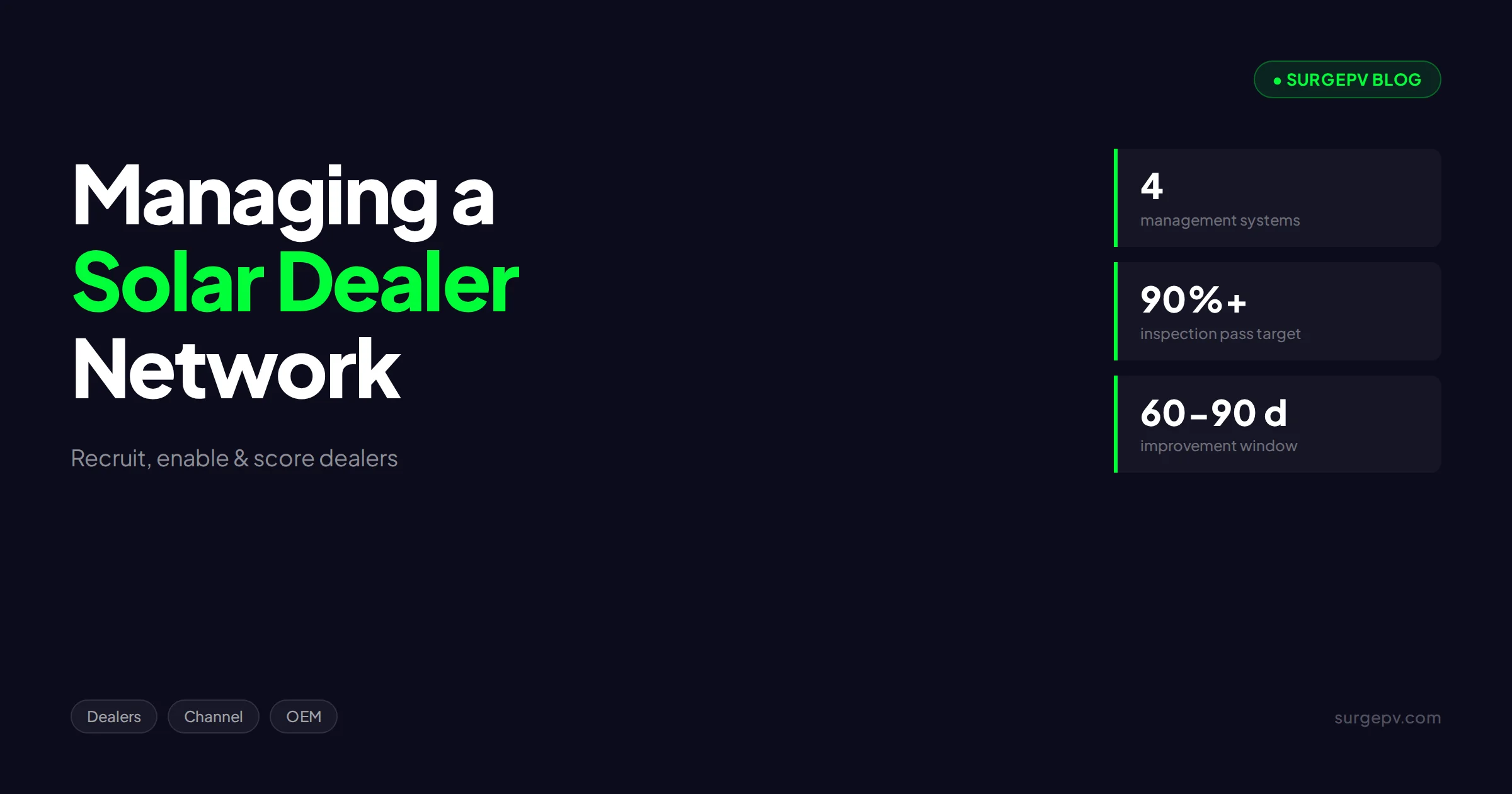
Manage a solar dealer network on 4 systems: selective recruitment (contractors with existing trades businesses), written brand and quality standards with audit rights, standardized tooling (one design and proposal platform), and a monthly dealer scorecard covering volume, quality, and customer experience. Underperformers get coaching, then exit.
The dealer model is solar’s fastest way to scale geography without scaling payroll — and its fastest way to destroy a brand without ever meeting the customer who hates you. Every dealer truck with your logo is your reputation, driven by someone you do not employ. The companies that make dealer networks work treat dealer management as a discipline with systems, not a relationship with good intentions.
This guide covers the full management system: recruiting the right dealers, the agreement and standards that protect the brand, pricing governance, the enablement stack that makes dealers productive, and the scorecard that tells you who to grow and who to exit.
Quick Answer
Manage a solar dealer network on 4 systems: selective recruitment (contractors with existing trades businesses), written brand and quality standards with audit rights, standardized tooling (one design and proposal platform), and a monthly dealer scorecard covering volume, quality, and customer experience. Underperformers get coaching, then exit.
TL;DR — Dealer Network Management
Recruit from adjacent trades; screen hard. The agreement needs brand rules, quality standards with audit rights, pricing floors, and data ownership terms. One standardized design/proposal platform across all dealers — it is how you enforce quality at scale. Monthly scorecard: volume, close rate, change orders, inspection pass rate, reviews. Coach, then exit.
In this guide:
- The dealer model and when it beats direct
- Recruitment: who to sign and who to avoid
- The dealer agreement: standards that protect the brand
- Pricing governance without price-fixing
- The enablement stack: tooling, training, financing
- The dealer scorecard and tier system
- Exits: how to fire a dealer without hurting customers
The Dealer Model and When It Beats Direct
In a dealer network, independent local companies sell (and usually install) your products under your brand standards. You supply products, tooling, financing access, and marketing; they supply local presence, labor, and customer relationships. The solar dealership model post covers the structural variants; this guide covers managing the network once it exists.
Dealer models beat direct expansion when: markets are too dispersed for owned branches, local licensing and relationships matter more than brand pull, and capital is better spent on product and tooling than on payroll. They lose to direct when your differentiation is installation quality itself — because you cannot fully control quality you do not employ.
Recruitment: Who to Sign and Who to Avoid
The best dealers are adjacent-trade contractors: roofers, electricians, HVAC, and home improvement companies with licensed labor, existing customer flow, and a reputation worth more to them than any single deal. They learn solar’s technical side faster than a solar sales company learns operational discipline.
Screen on 5 criteria before signing:
- Licensing and insurance — verified, current, adequate limits.
- Financial stability — credit check and references; a dealer who cannot fund 45 days of working capital will cut corners or collapse mid-project.
- Reputation — reviews, complaint history, and 2 reference calls with past commercial partners.
- Operational maturity — do they run documented processes now? Chaos does not improve with your logo on it.
- Territory fit — enough market to matter, not so much that they cannot serve it.
The discipline that saves you: sign fewer dealers than you can. Ten excellent dealers outperform thirty average ones, and every weak dealer consumes channel-manager time that excellent dealers deserve.
The Dealer Agreement: Standards That Protect the Brand
The agreement is the network’s constitution. The clauses that matter:
- Brand usage — logo, claims, marketing approval process. Unapproved marketing claims are a regulatory and reputational risk in solar.
- Quality standards with audit rights — design standards, installation workmanship requirements, and your right to inspect any job, announced or not. Standards without audit rights are suggestions.
- Pricing governance — floors or approved bands (see next section for the legal care needed).
- Customer communication standards — response times, proposal standards, complaint handling SLAs.
- Data and lead ownership — who owns customer data, what happens to the pipeline at exit, and non-circumvention terms.
- Warranty responsibilities — who honors workmanship warranties, and what happens to warranty obligations if the dealer exits.
- Termination provisions — for-cause triggers, cure periods, and transition obligations.
Have counsel draft this once, properly. Every clause above exists because a network somewhere learned its absence expensively.
Pricing Governance Without Price-Fixing
Dealers are independent businesses; in most jurisdictions you cannot dictate their retail prices — that is price-fixing territory. What you can do:
- Set pricing floors tied to quality standards where legally permissible (get local counsel — rules differ sharply by country and US state).
- Control what you own: product pricing to dealers, financing program terms, and brand-funded promotions.
- Publish benchmark ranges as guidance with the data behind them — dealers who see margin benchmarks usually self-correct toward them.
- Differentiate the package so price is not the battleground: dealers racing to the bottom usually lack financing options, design speed, or brand pull. Fix the package and the discounting fades.
The underlying economics guide: our solar installer profit margins benchmarks give dealers the reference points for healthy floors.
The Enablement Stack
Dealer productivity is a tooling outcome. The stack that separates managed networks from logo collections:
One design and proposal platform, mandated network-wide. This is the single highest-leverage standard. When every dealer designs on the same cloud solar design software and issues proposals from the same proposal system, you get: consistent design quality (enforceable), consistent customer experience (auditable), network-wide data (comparable), and zero version chaos. A platform like SurgePV — 3D design, irradiance and shading analysis, financials, and branded proposals in one cloud workspace — means a new dealer produces network-standard output in week 1 instead of month 6. This is exactly the use case our channel manager and OEM offering is built for.
Training and certification. A structured onboarding: product training, design certification (they pass a design review before their first customer proposal), sales playbook, and install standards. Certify before activating, recertify annually.
Financing access. Dealer-sold systems live and die on financing options. Negotiate network-level financing programs — the network’s volume earns terms no individual dealer could.
Marketing support. Co-branded templates, local lead programs, and review management. Our co-marketing guide for solar manufacturers covers the campaign side.
One Platform Across Your Entire Dealer Network
SurgePV gives every dealer the same design, shading, financial, and proposal tooling — network-standard output from day one, with network-wide visibility for you.
Book a DemoNo commitment required · 20 minutes · Live project walkthrough
The Dealer Scorecard and Tier System
What gets measured gets managed. The monthly dealer scorecard:
| Metric | What it tells you | Healthy band |
|---|---|---|
| Proposals issued | Activity level | Trend vs own baseline |
| Close rate | Sales effectiveness | 15–30% by lead mix |
| Installs completed | Throughput | Capacity vs plan |
| Change order rate | Design accuracy | Under 10% of jobs |
| First-pass inspection rate | Install quality | Above 90% |
| Review average | Customer experience | 4.5+ |
| Warranty claims | Long-term quality | Near zero |
Review the scorecard with every dealer monthly — 30 minutes, same agenda, trend lines not anecdotes. Publish tiers (Gold/Silver/Development or similar) with real privileges: lead flow priority, co-op marketing funds, early product access. Tier systems work because status among peers motivates dealers more than another webinar.
Coaching before exiting. A dealer drifting on quality metrics gets a written improvement plan with 60–90 days and specific support — design retraining, a QA ride-along, a sales playbook reset. Most quality problems are training problems wearing a quality costume.
Exits: Firing a Dealer Without Hurting Customers
When coaching fails, exit by the agreement: documented shortfalls, written cure notice, termination for cause. The order of operations protects customers:
- Map the book — open proposals, signed projects in progress, installed systems with warranty obligations.
- Transition open projects to another dealer or in-house before notice is given.
- Assign warranty obligations explicitly — customers must know who services their system.
- Then terminate — quietly, professionally, without public drama.
A botched dealer exit creates a cluster of angry customers in one territory with your brand on their roofs. The exit process is brand protection, not admin.
Onboarding: The First 90 Days
The first 90 days decide whether a dealer becomes a top tier or a management burden. The ramp that works:
- Days 1–15: foundation. Agreement executed, licensing and insurance verified, platform accounts live, design certification training started.
- Days 16–45: supervised production. First 5 proposals reviewed by your channel team before delivery. First 2 installs inspected in person. Feedback is immediate and specific — this is where standards become habits.
- Days 46–90: independence with a scorecard. Dealer runs autonomously; you review the monthly scorecard and audit 1 job per month. By day 90, both sides know whether this works.
Dealers who skip supervised production look fine for 60 days — then the change orders and failed inspections surface, now attached to your brand. The review gate feels slow; it is 10× cheaper than the alternative.
Channel Conflict: Dealers vs. Your Direct Sales
If you sell direct in some markets and through dealers in others, conflict is inevitable — a dealer invests in a territory, then watches your direct team quote a customer in it. Unmanaged, this destroys recruitment: dealers talk, and the network stops growing.
The structural fixes: hard territorial rules in writing (who owns which leads, with an objective test like address or lead source), a lead-registration system so dealers can protect named opportunities, and a commission-split rule for genuine overlap cases. Publish the rules and enforce them against your own direct team first — one exception for a big direct deal teaches every dealer that the rules are decorative.
Some brands avoid this entirely by going dealer-only or direct-only per region. That clarity is worth more than the marginal coverage of a hybrid model with ambiguous rules.
What Most Channel Managers Get Wrong
The foundational error is recruiting for coverage instead of quality. An empty territory is a missed opportunity; a bad dealer is an active liability that converts your marketing spend into complaint volume. Coverage follows quality, not the reverse.
Second: managing by relationship instead of by scorecard. Channel managers who “have a good feeling” about dealers learn the truth from warranty claims. The scorecard is unemotional, and that is its virtue.
The exception worth naming: in early network building (first 3–5 dealers), relationship depth genuinely substitutes for process — you are co-designing the playbook. Formalize the scorecard once you have enough dealers that you cannot hold each one’s numbers in your head.
Conclusion
Dealer networks scale on 4 systems: selective recruitment, an agreement with audit rights, one mandated tooling stack, and a monthly scorecard with coaching and consequences. Three actions this week:
- Write your dealer scorecard and run it retroactively on last quarter — the ranking will surprise you.
- Audit your dealer agreement for the audit-rights and warranty-transition clauses.
- Standardize the design and proposal platform if dealers still use their own tools.
To see what a network-standard design and proposal platform looks like, book a SurgePV demo and ask about the OEM and channel manager program.
Frequently Asked Questions
What is a solar dealer network?
A solar dealer network is a channel model where independent local companies sell and often install a brand’s solar products under agreed standards. The brand (OEM or national installer) provides products, tooling, financing, and marketing; dealers provide local presence, labor, and customer relationships.
How do you recruit solar dealers?
Recruit from adjacent trades — roofing, electrical, HVAC, and home improvement contractors with existing customer flow and licensed labor. Screen for financial stability, licensing, and reputation before signing. One bad dealer in a market costs more brand damage than ten good dealers create in goodwill.
What standards should a solar dealer agreement include?
Brand usage rules, design and installation quality standards with audit rights, pricing governance (floors or approved ranges), customer communication standards, warranty handling responsibilities, data and lead ownership terms, and exit provisions. Standards without audit rights are suggestions.
How do you keep solar dealers from competing on price alone?
Give dealers differentiation beyond price: fast design tooling, financing options, brand credibility, and lead flow. Enforce pricing floors in the agreement. Dealers race to the bottom when the product is a commodity — make the package (brand, tools, financing, support) the product.
What metrics should you track for solar dealers?
A monthly scorecard: proposals issued, close rate, installs completed, gross margin band, design accuracy (change order rate), install quality (inspection pass rate), customer reviews, and warranty claim rate. Review with each dealer monthly; rank and publish tiers.
How do you fire an underperforming solar dealer?
Follow the agreement: documented performance shortfalls against the scorecard, a written improvement plan with 60–90 days, then termination for cause. Protect the customers first — transition open projects and warranty obligations to another dealer or in-house before the exit is announced.
Where this fits
This article is part of SurgePV's Solar Business & Operations hub, which works through the topic from first principles to the decisions a project team actually has to make.


