

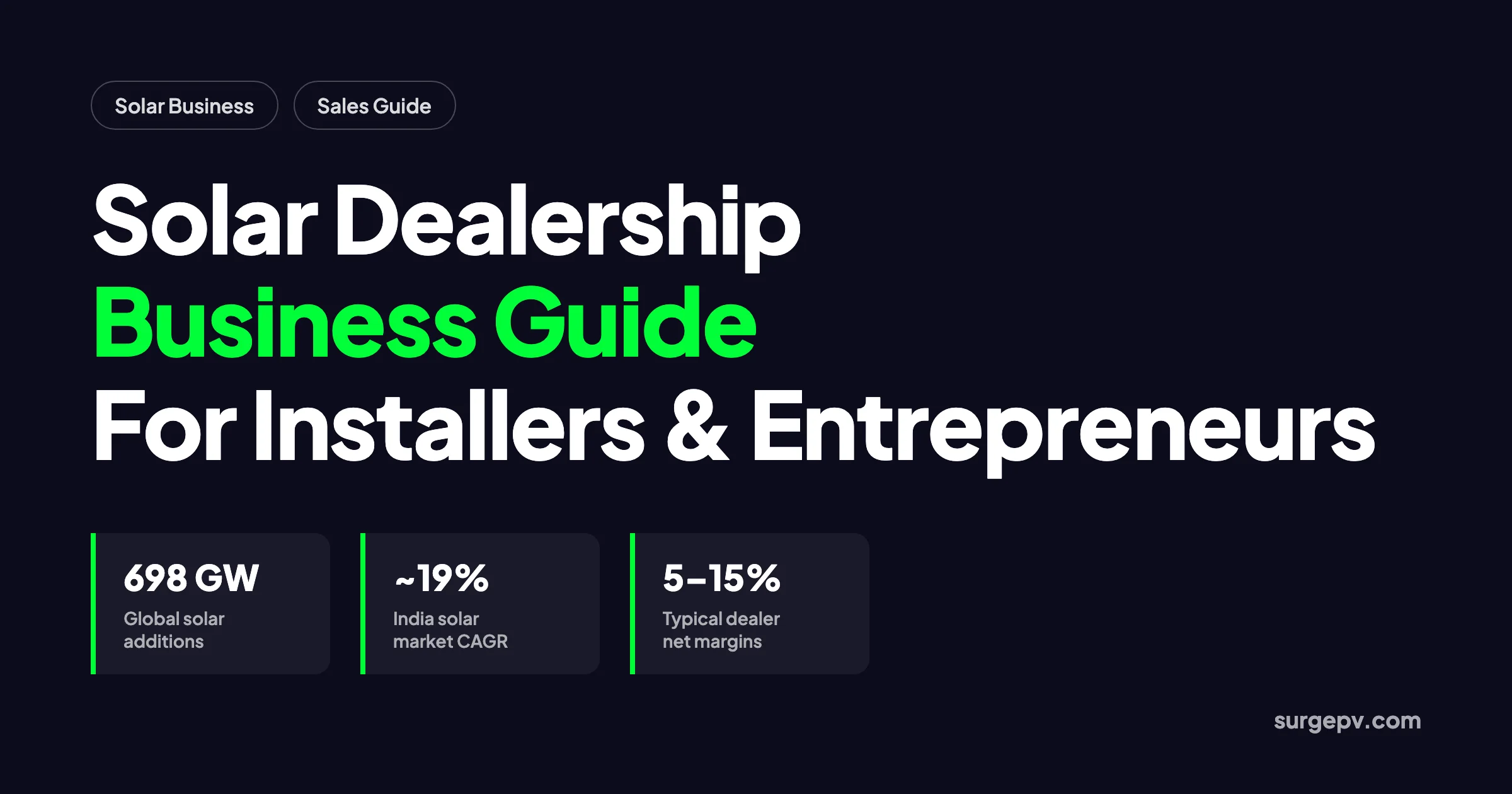
The solar dealership model is one of the fastest ways for local entrepreneurs and contractors to enter the solar business. You do not need to build a brand or a factory from scratch. In 2026, the model is expanding because manufacturers and large EPCs need local feet on the street. They need dealers who already know the neighborhood, speak the language, and can close a rooftop sale at a kitchen table.
This guide explains how the model works, what it costs, and where the money comes from. It also shows how to avoid the mistakes that waste the first 18 months. It is written for two audiences: people thinking about becoming a dealer, and companies thinking about building a dealer network. If you are a sales leader, use the software section to see how design-to-proposal tools change the economics of the model.
Quick Answer
A solar dealership model is a channel partnership in which a local business sells and often installs solar products under a brand’s support system. The dealer owns customer acquisition and project execution. The brand supplies products, training, and sometimes leads. It is a lower-risk entry into solar than building an independent EPC, but margins are thinner and growth depends on local sales discipline.
In this guide:
- What a solar dealership model is and how it differs from distribution and EPC work
- Typical startup costs, margins, and revenue streams
- Who the model suits and who should avoid it
- Common mistakes that sink new dealers
- How manufacturers and EPCs can build a scalable dealer network
- The software stack that lets dealers quote and close faster
- A clear set of next steps if you are evaluating the model
What Is the Solar Dealership Model?
A solar dealership model is a business arrangement in which a local company partners with a solar brand. The dealer sells and often installs that brand’s products within a defined territory. The dealer is not an employee of the manufacturer. The dealer runs its own books, hires its own team, and owns the customer relationship. In return, the dealer gets access to approved products, training, marketing materials, and sometimes shared leads or co-op marketing funds.
The model is common in residential and small commercial solar. It lets a national or regional brand reach customers it could never serve directly. It lets a local entrepreneur start a solar business with less risk than building an independent EPC from zero. The tradeoff is control. The dealer must follow brand guidelines, use approved products, and usually meet minimum purchase targets.
The Three Players in a Dealer Network
Every dealer network has three core roles. Understanding them is the first step to deciding where you fit.
- Manufacturer or master distributor. This entity designs, sources, or warehouses the solar panels, inverters, batteries, and mounting systems. It sets pricing tiers, warranty terms, and brand standards.
- Dealer. The local business that sells to homeowners, businesses, or small contractors. The dealer may keep inventory, run site surveys, coordinate installation crews, and handle customer service.
- End customer. The homeowner, business owner, or institution that buys the system and signs the contract.
Some networks add a fourth role, the sub-dealer or referral partner, who generates leads but does not handle product or installation. Clarity on roles matters because it defines who is responsible when a shipment is late, a roof leaks, or a subsidy claim is rejected.
Dealer vs Distributor vs EPC
These terms are often used interchangeably, but they are not the same. QuickEstimate’s breakdown of dealer, distributor, and EPC roles shows how different the risk and margin profiles are.
| Role | Primary customer | Core activity | Typical net margin | Working capital need |
|---|---|---|---|---|
| Dealer | End customer | Sell + coordinate install | 5–15% | Low to moderate |
| Distributor | Dealers and installers | Bulk procurement + logistics | 2–5% | High |
| EPC | End customer | Design, procure, construct | 15–25% | High |
What the Dealer Actually Owns
The dealer owns the customer relationship. That sounds simple, but it is the most valuable asset in the model. The dealer’s reputation, local knowledge, and installation quality determine whether the next customer calls back. The brand supplies the product, but the customer blames or praises the dealer when something goes wrong.
The dealer also owns the sales data. A dealer that tracks lead sources, close rates, and project costs can improve faster than one that relies on intuition. Over time, this data becomes a competitive moat. A new competitor can match your pricing, but it cannot quickly replicate years of local customer insights and referral relationships.
A distributor focuses on volume and inventory turns. An EPC takes full responsibility for system design, installation, commissioning, and long-term performance. A dealer sits in the middle. The dealer often starts closer to distribution and, over time, moves toward EPC work as it builds capital and technical skill.
How the Solar Dealership Model Works in 2026
The solar market is large enough to support many channel strategies. Global cumulative installed PV capacity approached 3 TW by the end of 2025. About 698 GW of new systems were added, according to IEA PVPS Snapshot of Global PV Markets (2026). Solar alone accounted for roughly three-quarters of global renewable additions, with about 511 GW added, according to IRENA Renewable Capacity Highlights (2026). That scale means manufacturers need local partners to cover geography they cannot reach themselves.
In India, the opportunity is especially sharp. The India solar energy market is projected to grow at a compound annual growth rate of about 19% through 2031, according to Mordor Intelligence (2026). Government targets, the Approved List of Models and Manufacturers (ALMM), and schemes such as PM Surya Ghar are pushing demand into towns and districts. A local dealer can build trust there faster than a remote brand.
Why 2026 Is a Tipping Point for Dealerships
Two forces are converging this year. First, module prices have fallen far enough that solar is now the cheapest source of new electricity in most sunny markets. That expands the addressable customer base from early adopters to mainstream homeowners and small businesses. Second, brands are struggling to hire and retain direct sales teams in every district. A well-run dealer network gives them geographic coverage without the overhead of a national payroll.
For entrepreneurs, this means more brands are actively recruiting dealers and offering better support packages than five years ago. It also means competition is rising. The dealers who win will be the ones that combine local trust with professional quoting and fast installation. Brand names open doors, but execution keeps them open.
Typical Dealer Agreement
A dealer agreement is a commercial contract, not a franchise manual. Before signing, read the sections on territory, minimums, and support carefully. The usual clauses include:
- Territory rights. Is the territory exclusive, semi-exclusive, or open? Exclusive territories protect your investment but may come with higher sales targets.
- Minimum purchase targets. Brands often require dealers to buy a certain volume each quarter to keep pricing tiers and territory rights.
- Training and certification. Dealers usually must complete product training and, in some markets, electrical contractor or MNRE-empanelment requirements.
- Marketing co-op. Some brands refund part of local marketing spend if the dealer uses approved collateral and tracks leads.
- Warranty and service obligations. Who handles the customer when an inverter fails in year three? The answer should be in the agreement.
- Lead-pass rules. If the brand sends a lead into your territory, do you pay a referral fee? Is the lead exclusive to you?
Day-to-Day Operations
A dealer’s weekly calendar looks more like a small construction business than a retail shop. The work includes:
- Lead generation. Referrals, local ads, door-to-door canvassing, IndiaMART or JustDial listings, and social media.
- Site survey. Measuring the roof, checking shading, inspecting the switchboard, and confirming structural soundness.
- Quoting. Building a system design, modeling generation and savings, and presenting a branded proposal.
- Installation coordination. Scheduling crews, ordering material, managing quality, and handling inspections.
- Paperwork. Net metering applications, subsidy claims, financing documents, and utility interconnection.
- After-sales service. Annual maintenance contracts, warranty claims, monitoring alerts, and upgrade offers.
The dealers who grow fastest are not necessarily the ones with the biggest ad budget. They are the ones that turn a lead into a signed contract faster than the competition. Our guide on solar lead response time shows why the first five minutes matter more than most dealers think.
Solar Dealership Costs, Margins, and Revenue Streams
A dealership is not a low-capital side business, but it is usually cheaper than starting a full EPC. The exact amount depends on brand, territory, and whether you keep inventory or work on a just-in-time basis.
Starting Investment
A lean solar dealership in India can start with roughly ₹5–10 lakh. That covers a small office, a basic inventory deposit, GST registration, a trade license, and two to three months of operating runway. Premium partnerships with larger brands can push the initial outlay toward ₹15–30 lakh or more. In the United States, a similar lean start often falls between $25,000 and $75,000. FranchiseBazar’s overview of solar dealership opportunities in India (2026) puts the total investment range for many Indian models between ₹15 lakh and ₹70 lakh. The exact amount depends on brand and scale.
The largest variable is working capital. If you must buy panels before the customer pays, your cash needs multiply. If the brand offers credit or consignment inventory, your startup cost drops.
Margins by Revenue Stream
Most dealers have more than one revenue stream. The mix depends on whether you only sell hardware or also coordinate installation and service.
| Revenue stream | Description | Typical net margin |
|---|---|---|
| Product margin | Markup on panels, inverters, batteries, and mounting | 5–8% |
| Installation coordination | Fee for managing install crews and quality | 10–15% |
| Annual maintenance contract (AMC) | Recurring service and cleaning revenue | 20–40% |
| Upgrades and add-ons | Battery storage, EV chargers, monitoring | 10–20% |
| Subsidy or referral fees | Pass-through or shared government incentives | Varies by market |
Dealers who only move boxes earn product-only margins. Dealers who own the customer relationship and project execution earn more, but they also carry more risk. A dealer in a high-tariff state with strong after-sales service can earn a significant share of lifetime revenue from AMCs and upgrades.
Working Capital Reality
Working capital is where optimistic business plans die. A dealer running ₹50 lakh of annual gross merchandise value in India typically needs ₹8–12 lakh in working capital. That covers inventory, receivables float, and operating expenses. In solar, the gap between paying suppliers and receiving customer payments can stretch to 30–90 days. Subsidy disbursement can add more delay.
Smart dealers negotiate payment milestones with customers and credit terms with suppliers. They also keep a cash reserve for the months when subsidy releases are slow. If you are not comfortable managing cash flow, the dealership model will feel harder than it looks.
Who Should Start or Scale a Solar Dealership?
The dealership model is not for everyone. It rewards people who can sell, coordinate projects, and stay patient while reputation compounds.
Profiles That Fit
- Electrical contractors. You already understand wiring, codes, and crews. Adding solar sales is a natural extension.
- Sales professionals with local networks. If you know the real estate agents, small business owners, and community leaders in your territory, you have a lead pipeline.
- Entrepreneurs in high-tariff markets. Customers save more where electricity rates are high, so payback periods are shorter and sales are easier.
- Small EPCs seeking brand backing. A recognized brand can shorten trust-building and improve access to financing or large projects.
- Distributors looking downstream. Some distributors open dealerships to capture more margin from end customers.
Profiles That Do Not Fit
- Passive investors. A dealership is an active business, not a passive income stream.
- People who dislike paperwork. Permits, subsidies, net metering, and warranty claims involve forms and follow-up.
- Teams without sales discipline. If no one is making calls, attending local events, or following up on leads, inventory sits in the warehouse.
- Businesses that cannot handle cash flow gaps. The solar sales cycle is measured in weeks, and payment cycles can be uneven.
The right fit also depends on the brand. A premium brand with strict targets may suit a team with capital and technical depth. A low-entry brand may suit a first-time entrepreneur who wants to test demand before scaling.
Common Mistakes New Dealers Make
Most dealership failures are not caused by bad products. They are caused by bad process. Here are the mistakes we see most often when onboarding dealers and sales teams.
Waiting for the Brand to Deliver Leads
Some new dealers assume the brand will fill their pipeline. In reality, most brands provide tools, training, and occasional shared leads. The dealer is still responsible for local lead generation. The dealers who thrive treat the brand as a supplier and back office, not a marketing agency.
If you need help building a local sales process, our guide on solar sales KPIs explains the metrics that keep a sales team honest.
Underpricing Installation
New dealers often quote installation based on a simple per-watt rate they heard from another dealer. They forget roof complexity, travel time, scaffolding, electrical upgrades, and inspection revisits. The result is a project that looks profitable on paper and loses money on site.
Accurate costing requires a real site survey and a standardized checklist. Software that builds a roof-specific design and bill of materials reduces the guesswork.
Ignoring After-Sales Service
A solar system’s value to the dealer does not end at commissioning. Annual maintenance contracts, monitoring alerts, cleaning, and warranty support create recurring revenue. More importantly, they create referrals. In many markets, referrals become the cheapest and most reliable source of new leads after the first year.
Treating the Dealership as a Passive Franchise
Solar is a consultative sale, not a retail transaction. Customers ask about payback, panel degradation, net metering, and financing. Dealers who can explain these clearly close more deals than dealers who only quote prices. The brand name opens the door. The dealer’s professionalism closes the deal.
Building a Scalable Dealer Network
If you are a manufacturer, distributor, or large EPC, dealerships are a way to scale without hiring a payroll in every city. But a network is only as good as its weakest dealer. Scalable networks invest in onboarding, tooling, and incentives.
Recruiting the Right Dealers
A dealer network scales only if the dealers are the right fit. Technical skill matters, but sales discipline and local reputation matter more. The best dealers already have a customer base or a network they can call on day one. They understand that solar is a consultative sale, not a commodity transaction.
When evaluating a candidate, look at three things. First, does the team have a track record of completing projects on time and within budget? Second, do they have the cash flow to handle inventory deposits and payment gaps? Third, do they share your standards for customer communication and installation quality? A dealer who cuts corners on service will damage the brand long before volume makes up for it.
It is often better to start with a small number of committed dealers and expand slowly than to sign dozens of partners who never produce. A compact, high-performing network gives you cleaner data, stronger references, and lower support costs.
Onboarding and Certification
A dealer should not represent your brand until they can explain your products, quote accurately, and install to your standard. Good onboarding includes:
- Product training on panels, inverters, batteries, and monitoring
- Sales training on customer objections, financing, and local incentives
- Installation certification or approved installer partnerships
- Paperwork training on net metering, subsidies, and warranty registration
Some brands run digital academies and certify dealers by module. Certified dealers close more deals and generate fewer service calls.
Shared Tooling and Reporting
Dealers often work in spreadsheets and WhatsApp groups. That creates data loss, inconsistent proposals, and slow support. Scalable networks give dealers shared tools for design, quoting, and customer management.
A shared platform lets the brand see which dealers have active quotes, which products are moving, and where installations are delayed. It also keeps product messaging consistent. EnergySage’s overview of solar distributors notes that modern distributors increasingly offer design, financing, and information management services, not just inventory.
Incentives That Actually Work
Traditional dealer incentives based only on purchase volume can encourage discounting and churn. Leading brands are moving toward installation-based loyalty. iMast’s research on solar dealer loyalty programs found that brands with structured installer loyalty programs report 45% higher engagement and double the per-installer monthly installations.
Effective incentives include:
- Tiered rebates based on verified installations, not just purchases
- Co-op marketing funds tied to lead quality
- Exclusive territories for top performers
- Fast warranty claim processing as a competitive benefit
- Training and event access for high-volume dealers
The goal is to make your best dealers feel like partners, not resellers.
How Software Drives Solar Dealership Success
The biggest cost in a dealership is not inventory. It is time. Time spent measuring roofs by hand, re-entering data, chasing paperwork, and redoing proposals. Software removes those hours and lets a small team act like a larger one.
Design-to-Proposal in Minutes
The dealer who can design, price, and present during the first customer visit wins more deals. SurgePV is built for that workflow. A rep can pull satellite imagery, run irradiance and shading analysis, and model savings with the generation and financial tool. The same rep can then deliver a branded solar proposal while the customer is still at the table.
This matters because solar buyers compare quotes. The first credible proposal sets the anchor. Everything else is measured against it. Our post on speed-to-lead in solar sales explains why the fastest quote often becomes the last quote.
For complex roofs or shading, accurate design tools also reduce change orders and installation delays. That protects the dealer’s margin and the brand’s reputation.
The efficiency gain is not just speed. It is accuracy. When a proposal is built from a real roof model and measured shading, the customer sees a believable savings number. The installation crew sees a clear layout. The finance company sees a bankable project. Everyone downstream trusts the number, so the deal moves faster.
CRM and Lead Routing
Dealers need a simple way to track leads, follow up automatically, and measure rep performance. A solar CRM should capture inquiries from web forms, ads, referrals, and missed calls, then route them to the right rep in seconds.
In India, PM Surya Ghar eligibility, customer consent, quotation control, and documented follow-up are central to residential dealer operations. Verify every software and equipment supplier against current portal rules, exact-model certificates, written warranty terms, stock, commissioning responsibility, and local service coverage before including it in a dealer package.
AI-assisted qualification can also help small teams cover more leads. Clara AI can gather roof and bill information, answer basic questions, and route hot prospects to a human rep with full context. The goal is not to replace the dealer. The goal is to make sure no warm lead waits because the right person is busy.
Ready to see how design-to-proposal software fits a dealership?
Book a SurgePV demo and see how an integrated sales stack helps dealers quote faster, manage more leads, and protect margins.
Frequently Asked Questions
What is a solar dealership model?
A solar dealership model is a channel partnership where a local business sells and often installs solar systems under an established brand. The dealer handles local marketing, customer acquisition, site surveys, installation coordination, and after-sales service. The brand supplies products, training, pricing, warranty support, and sometimes shared leads.
How much does it cost to start a solar dealership?
A lean solar dealership can start with roughly ₹5–10 lakh in India or $25,000–$75,000 in the United States. That covers inventory deposits, a small office, licensing, and working capital. Premium brand partnerships and larger territories can push the initial investment above ₹25 lakh or $100,000.
What is the difference between a solar dealer and a distributor?
A dealer sells directly to end customers and may coordinate installation. A distributor buys in bulk from manufacturers and resells to dealers, installers, or small EPCs. Distributors focus on logistics, credit, and inventory, while dealers focus on local sales and customer relationships.
What are typical solar dealership profit margins?
Product-only dealers often earn net margins of 5–8%. Dealers who also coordinate installation can reach 10–15% net. Full EPC operations earn 15–25% net but carry higher working capital, labor, and warranty risk. Margins vary by brand, territory, and local competition.
Who should consider a solar dealership?
The model suits electrical contractors, sales professionals with local networks, entrepreneurs in high-tariff markets, and small EPCs that want brand backing. It is not ideal for passive investors or anyone unwilling to run active sales and project coordination.
What are the biggest mistakes new solar dealers make?
The most common mistakes are waiting for the brand to generate all leads, underpricing installation, ignoring after-sales service, and treating the dealership as a passive franchise. Success comes from local lead generation, accurate costing, and strong service.
How can manufacturers build a scalable dealer network?
Scalable networks invest in structured onboarding, product certification, shared design-and-proposal tools, transparent reporting, and installation-based incentives. Brands that digitize training and loyalty programs see higher dealer engagement and faster growth.
What software do solar dealerships need?
Dealers need a solar CRM for lead routing and a design tool for roof layouts and shade analysis. They also need a financial modeling tool for ROI and payback, plus proposal software for branded quotes. Integration across these tools shortens the quote-to-close cycle and raises close rates.
Conclusion
The solar dealership model is a practical entry point into one of the world’s fastest-growing energy markets. It is not a shortcut. It is a business that rewards local sales discipline, accurate costing, and strong customer service. In 2026, the winning brands and dealers will treat the model as a true partnership. They will support that partnership with shared tools and clear accountability.
Three actions will move the needle this quarter:
- Audit the agreement. Read the territory, minimum-purchase, and support clauses before signing. Make sure the economics work at your expected volume.
- Build the sales machine first. Invest in local lead generation, fast response times, and a repeatable proposal process before you expand inventory.
- Connect design, quoting, and CRM. Integrated software removes the handoffs that slow deals down and eat into margins. If you are evaluating a dealership or scaling a network, see how SurgePV’s all-in-one solar software supports the full workflow from lead to proposal.
Where this fits
This article is part of SurgePV's Solar Sales & Proposals hub, which works through the topic from first principles to the decisions a project team actually has to make.


