

Quick Answer
Co-marketing between solar manufacturers and installers involves shared branding, joint lead generation, and co-funded campaigns. Leading programs include LONGi Installer Partnership, Jinko VIP Pro, and Trina Pro. Benefits: 20–40% lead cost reduction and stronger brand trust.
A commercial solar installer in Texas received $180,000 in MDF (Market Development Funds) in 2024 from Enphase, REC Group, and Tesla Energy combined. That funded 14% of their total annual marketing spend. The funded campaigns generated 38 acquired customers and $4.6M in revenue.
Co-marketing between solar manufacturers and installers involves shared branding, joint lead generation, and co-funded campaigns. Leading programs include LONGi Installer Partnership, Jinko VIP Pro, and Trina Pro. Benefits: 20–40% lead cost reduction and stronger brand trust. See Solar Lead Generation Strategies for detailed guidance.
The same installer’s competitor — same size, similar product mix — received less than $25,000 in MDF for the year despite installing similar volumes of the same equipment.
The difference wasn’t sales volume. The difference was relationship management with manufacturer reps and disciplined execution of MDF programs.
Quick Answer: Co-Marketing With Solar Manufacturers
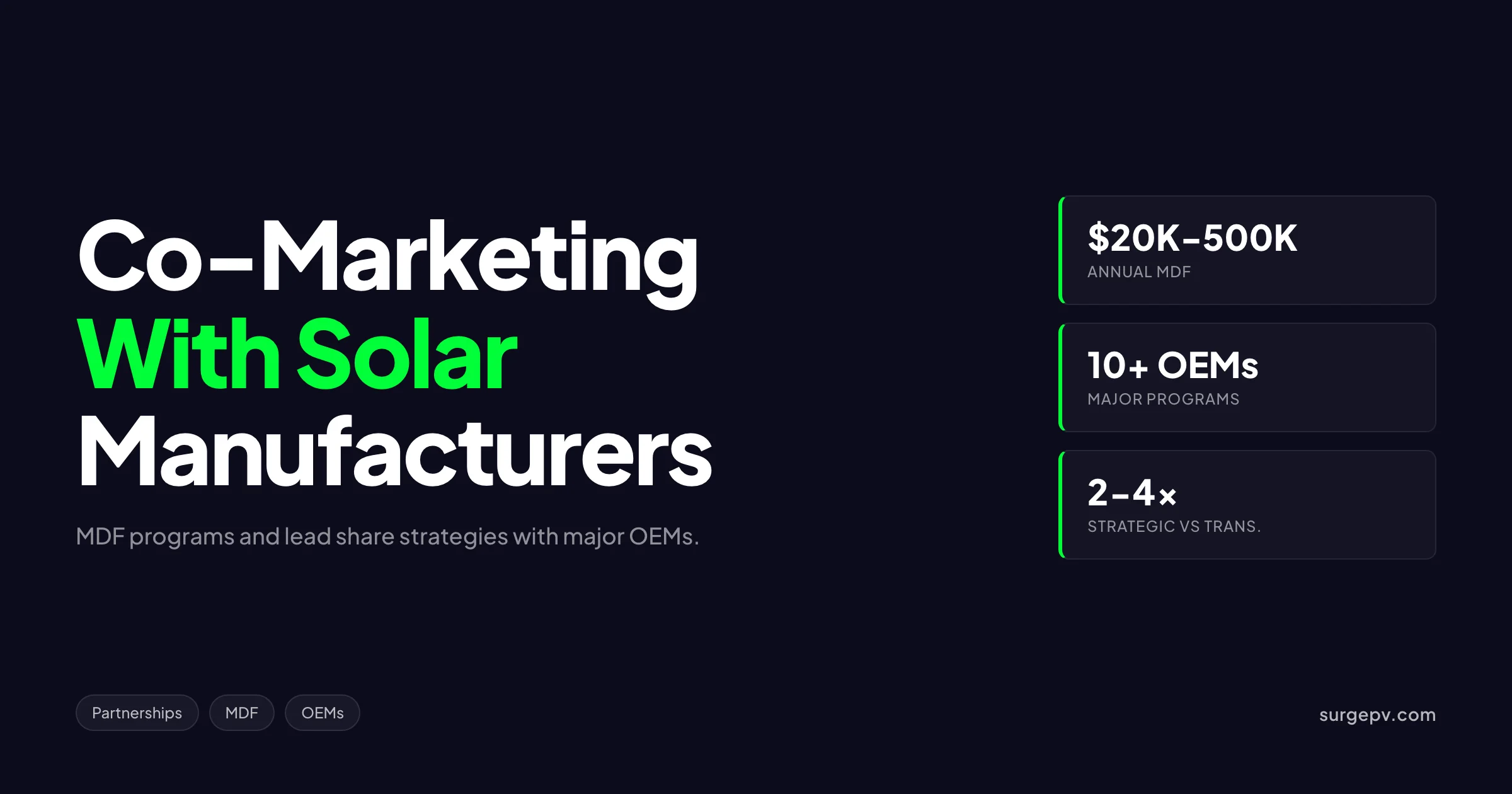
Solar manufacturer MDF programs offer $20K-$500K annually in marketing co-funding. Programs come from major brands (Enphase, SolarEdge, Tesla, REC, Q Cells, Jinko). Qualification requires Authorized Dealer status, volume commitments, and approved marketing activities. Top-performing installers receive 5-10x more MDF than peers through better relationship management and execution.
In this guide:
- What MDF is and how it works
- Major solar manufacturer programs (panel, inverter, battery)
- Qualification requirements and tier structures
- What MDF can fund (and what it cannot)
- Lead share programs that complement MDF
- Negotiating better MDF allocations
- Executing co-marketing campaigns
- Common manufacturer co-marketing mistakes
- Eight common questions
What MDF Is and How It Works
Market Development Funds (MDF) are dollars manufacturers allocate to channel partners (installers, distributors, dealers) for marketing activities that drive sales of the manufacturer’s products.
The economic logic: a manufacturer can spend $1M on national advertising and reach broad awareness. Or the manufacturer can give $10K to 100 installers across the country who can do hyper-local marketing that converts at 5-10x national ad efficiency.
For installers, MDF reduces marketing cash requirements while building stronger manufacturer relationships.
Standard MDF Structure
Most MDF programs follow this structure:
1. Allocation method:
- Pre-determined annual budget based on prior year volume
- OR earned through current year purchases (typically 1-3% of products purchased)
- OR proposal-based for specific campaigns
2. Approval process:
- Installer submits marketing plan to manufacturer
- Manufacturer reviews and approves
- Activity executed
- Installer submits proof of completion (invoices, screenshots, photos)
- Manufacturer reimburses
3. Eligible activities:
- Co-branded advertising
- Trade show participation
- Local events
- Digital marketing campaigns
- Sales materials
- Customer events
- Specific product launches
4. Ineligible activities (typically):
- Pure brand marketing without manufacturer product focus
- Internal operations
- Direct labor
- Activities the manufacturer doesn’t pre-approve
Allocation Tiers
Most manufacturer programs have tiered allocation:
| Tier | Annual Volume | MDF Allocation |
|---|---|---|
| Authorized Dealer | 25-100 systems | $5K-$25K |
| Preferred Installer | 100-300 systems | $25K-$75K |
| Premier Installer | 300-1,000 systems | $75K-$200K |
| Strategic Partner | 1,000+ systems | $200K-$500K+ |
Tier names vary by manufacturer. Allocations vary by year, manufacturer priorities, and individual relationship strength.
Major Solar Manufacturer Programs
The biggest co-marketing opportunities come from specific manufacturer programs.
Panel Manufacturer Programs
REC Group
- Program: ProTrust Network
- Tiers: Authorized, Preferred, Premium
- MDF: $10K-$150K annually
- Requirements: Volume thresholds + technical certification
Q Cells
- Program: Q.Partner Program
- Tiers: Authorized, Premium, Elite
- MDF: $5K-$100K annually
- Requirements: Volume + brand standards
Jinko Solar
- Program: Tiger Authorized
- Tiers: Authorized, Premier
- MDF: $10K-$75K annually
- Requirements: Volume + co-marketing commitment
Canadian Solar
- Program: CertiSolar Partners
- MDF: $10K-$80K annually
- Strong for residential installers For Canada-specific compliance details, see Canada comparisons/solar-designing.
LONGi
- Program: LONGi Hi-MO Pro
- MDF: $8K-$60K annually
- Growing in North American market For United States-specific compliance details, see United States arizona/phoenix.
Panasonic
- Program: Premium Installer
- MDF: $15K-$120K annually
- Higher-end residential focus
Inverter Manufacturer Programs
Enphase
- Program: Platinum Installer Program
- Tiers: Authorized, Silver, Gold, Platinum
- MDF: $5K-$200K annually
- Strong lead share component
SolarEdge
- Program: Authorized Installer
- Tiers: Authorized, Preferred, Premium
- MDF: $10K-$150K annually
- Comprehensive marketing support
Tesla Energy
- Program: Tesla Certified Installer
- MDF: Variable, often opportunity-based
- Requirements: Volume + lead conversion rate
Battery Manufacturer Programs
Tesla Powerwall
- Through Tesla Certified Installer
- MDF: Variable based on battery volume
Enphase IQ Battery
- Within Enphase Platinum Program
- MDF: Combined with inverter MDF
Generac PWRcell
- Generac Pro Program
- MDF: $5K-$50K annually
- Strong for battery-focused installers
Franklin Electric (Franklin Home Power)
- Authorized Installer Program
- MDF: $10K-$40K annually
- Emerging player
EG4 Electronics
- Authorized Dealer Program
- MDF: $3K-$30K annually
- Lower-cost battery option
EV Charger Programs
ChargePoint
- Installer Network Program
- MDF: $5K-$30K annually
- Often paired with solar+battery installers
Wallbox
- Partner Program
- MDF: $3K-$20K annually
Qualification Requirements
Each program has specific qualification requirements. Common patterns:
Volume Thresholds
Most programs require minimum annual volume:
- Authorized tier: 25-100 systems per year
- Mid-tier: 100-500 systems per year
- Premium tier: 500+ systems per year
Some programs use kW installed instead of system count:
- Authorized: 100-500 kW annually
- Mid-tier: 500-2,500 kW annually
- Premium: 2,500+ kW annually
Technical Certification
Most programs require:
- NABCEP certification (installer or designer level)
- Product-specific training completion
- Periodic recertification
Sales Commitment
Many programs require:
- Primary product designation in proposals
- Minimum % of installs using manufacturer’s products
- Co-branded marketing approval
Quality Standards
Programs increasingly require:
- Customer satisfaction scores
- Warranty claim rates below benchmarks
- BBB rating thresholds
- Online review minimums
Geographic Coverage
Some programs require:
- Specific service area coverage
- Multiple service locations
- Geographic exclusivity (or non-exclusivity) agreements
Reporting and Communication
Most programs require:
- Monthly or quarterly volume reporting
- Quarterly business reviews with manufacturer rep
- Pipeline forecasting
- Lead conversion reporting
What MDF Can Fund (And What It Cannot)
Understanding MDF eligible expenses prevents wasted submissions.
Typically Eligible Activities
1. Co-branded advertising
- Print ads featuring both installer and manufacturer logos
- Digital ads (Google, Facebook, programmatic)
- Radio and TV with co-brand mentions
- Outdoor advertising (billboards)
- Vehicle wraps with manufacturer branding
2. Trade show and event participation
- Booth costs at industry trade shows
- Travel and lodging for show staff
- Booth materials and graphics
- Promotional swag with co-branding
3. Local event hosting
- Customer appreciation events featuring manufacturer products
- Workshops about manufacturer’s technology
- Open house events featuring systems
4. Digital marketing campaigns
- Search engine marketing (Google Ads)
- Social media advertising with manufacturer products featured
- Content marketing about manufacturer products
- Email marketing campaigns
5. Sales and marketing collateral
- Sales brochures featuring manufacturer products
- Product specification sheets
- Customer testimonials featuring manufacturer products
- Case studies with co-branding
6. Training and education
- Customer education materials
- Installer training that improves product proficiency
- Technical certification fees (sometimes)
Typically Ineligible Activities
1. Pure brand marketing
- Generic solar marketing without manufacturer focus
- Brand awareness campaigns without specific products
2. Operational expenses
- Office rent, utilities
- Employee salaries
- Equipment purchases unrelated to marketing
- Software subscriptions not specifically marketing-related
3. Direct customer subsidies
- Discounts to customers on manufacturer products
- Cash incentives or rebates
- Anything that could be construed as price-fixing
4. Activities not pre-approved
- Marketing executed before manufacturer approval
- Activities outside the approved campaign scope
Lead Share Programs
Lead share is separate from MDF but often runs through the same manufacturer programs.
How Lead Share Works
1. Customer contacts manufacturer Homeowner researches Enphase, contacts Enphase directly. Enphase has no installation operation.
2. Lead routing Manufacturer routes lead to nearest authorized installer. Routing can be:
- Round-robin among local installers
- Score-based (best performer gets best leads)
- Geographic exclusivity (one installer per zip code in some programs)
- First-response (whoever responds fastest gets the lead)
3. Installer conversion Installer contacts lead within manufacturer’s response time requirement (often 5-15 minutes). Installer converts lead to customer.
4. Performance feedback Manufacturer tracks installer conversion rate. Better-performing installers receive more leads.
Lead Share Value
For mature manufacturer programs:
- Lead share can generate 50-500 leads per year per installer
- Lead-to-customer conversion: 15-30% (typically higher than self-generated leads)
- Customer revenue: Same as self-generated (no manufacturer take)
- Cost: Free from installer’s perspective (manufacturer absorbs lead generation cost)
Optimizing Lead Share Performance
- Fast response times (a few minutes)
- High customer satisfaction (post-install surveys)
- High close rates (improves your routing priority)
- Strong product attachment (use manufacturer’s products on installs)
- Communication discipline (update manufacturer on lead status)
Top performers often receive 3-5x more leads than mid-tier performers in same program.
Negotiating Better MDF Allocations
Most installers accept whatever MDF the manufacturer offers. Strategic installers negotiate.
Pre-Negotiation Preparation
1. Volume documentation Prepare 12-month volume report by product:
- Total kW installed using manufacturer’s products
- Total systems using manufacturer’s products
- Market share within your service area
- Growth trajectory
2. Marketing impact data Show measurable results from prior MDF spend:
- Leads generated per dollar
- Cost per acquired customer
- Brand awareness lift in target markets
- ROI on co-marketing campaigns
3. Competitive intelligence
- What competitors are getting from same manufacturer
- What other manufacturers offer
- Market opportunity analysis for joint growth
4. Forward commitment
- Projected volume for next year
- New geographic markets or customer segments
- Specific campaign opportunities
Negotiation Tactics
Tactic 1: Anchor on volume “We’re projecting 40% growth in 2026, focusing primarily on [Manufacturer] products. The current MDF allocation supports [X]% of marketing investment needed to deliver that growth.”
Tactic 2: Specific opportunity proposal “We’ve identified a specific opportunity in [city/segment] where we could install 80+ systems if marketing properly funded. Proposed campaign budget: $35,000. Expected attached revenue: $1.4M.”
Tactic 3: Multi-year commitment “If we commit to [X] systems annually for 3 years using [Manufacturer] as primary product, can we negotiate guaranteed MDF allocation of [Y]?”
Tactic 4: Co-investment offering “We’re willing to match MDF dollar-for-dollar on specific campaigns. This effectively doubles your marketing reach.”
Common Negotiation Outcomes
Skilled negotiators typically achieve:
- 20-50% higher allocation than initial offer
- Specific opportunity-based funding above baseline
- Multi-year commitments with growth provisions
- Co-marketing creative support (manufacturer agency hours)
- Exclusive territory or segment positioning
Relationship Building
The negotiation is structural. The relationship is continuous.
- Quarterly check-ins with manufacturer rep
- Sharing market insights upward
- Helping manufacturer’s product team with field feedback
- Participating in manufacturer events
- Providing testimonials and case studies
- Beta testing new products
Strong relationships generate access to opportunity-based MDF that doesn’t appear in formal programs.
Executing Co-Marketing Campaigns
MDF is allocated. Now execute well.
Campaign Planning
Step 1: Define objective Specific, measurable goal. “Generate 50 acquired customers in [city] for [product line] within 6 months.”
Step 2: Identify campaign components Multi-channel typically outperforms single-channel:
- Digital advertising (Google, Facebook)
- Content marketing (blog posts, videos)
- Local PR
- Direct mail
- Event participation
Step 3: Manufacturer approval Submit campaign plan to manufacturer rep before execution. Include:
- Specific tactics and channels
- Budget allocation
- Expected metrics
- Co-branding guidelines
- Timeline
Step 4: Execute Run campaign across approved channels. Maintain consistent co-branding throughout.
Step 5: Track and report Granular tracking with manufacturer-specific UTM tags. Monthly reports to manufacturer rep on:
- Leads generated
- Customers acquired
- Revenue attributed
- Cost per acquired customer
- Brand impressions For more on this topic, see Solar Racking Design Guide.
Best Campaign Types
1. Local launch campaigns Introducing manufacturer’s new product in your market. High visibility, strong manufacturer support.
2. Geographic expansion Entering new city or state. Manufacturer may co-fund initial market entry.
3. Vertical-specific marketing Commercial customers, multifamily, agricultural — specific verticals where manufacturer has product fit.
4. Customer events Hosting end-customers for product education and installation tours.
5. Trade show co-funding Manufacturer-supported booth at industry events.
Avoiding Co-Marketing Pitfalls
1. Don’t dilute brand Co-branding doesn’t mean equal billing. Your brand should still lead.
2. Don’t over-commit Take the MDF that you can execute well. Excess MDF unspent becomes operational risk.
3. Don’t violate program rules Submitting non-compliant expenses for reimbursement damages relationship.
4. Don’t oversell campaigns Honest reporting on results builds long-term trust.
5. Don’t compete with manufacturer messaging Co-marketing aligns with manufacturer positioning, doesn’t contradict it.
Common Co-Marketing Mistakes Solar Installers Make
Mistake 1: Treating MDF as Free Money
Installers who view MDF as no-cost windfall execute poorly. Strategic installers view MDF as joint investment.
Mistake 2: Generic Campaigns
Same generic campaign for every manufacturer relationship. Tailor specifically to each manufacturer’s products and positioning.
Mistake 3: Poor Documentation
Failing to properly document expenses for reimbursement. Loss of 20-50% of allocated MDF due to documentation issues.
Mistake 4: Slow Lead Response
Lead share programs require 5-15 minute response times. Slow response damages routing priority.
Mistake 5: Hopping Between Manufacturers
Installer changes preferred manufacturer every year. Manufacturer reluctance to fund installers showing weak commitment.
Mistake 6: No Relationship Investment
Treating manufacturer rep as transactional. Strong relationships generate 5-10x more access than transactional ones.
Mistake 7: Missing Strategic Opportunities
Focus on transactional MDF while missing larger partnership opportunities (new product launches, geographic expansion, vertical entry).
What Most Guides Miss
The most valuable manufacturer relationship asset isn’t MDF — it’s strategic information. Manufacturer reps see market trends 6-12 months before installers. Installers who cultivate strong relationships get early warning of product launches, supply chain shifts, and competitor moves. This intelligence is worth more than the cash MDF.
Real-World Example: Manufacturer Partnership Build
A solar installer in Phoenix, AZ went from $25,000 in MDF in 2023 to $185,000 in 2025 across three manufacturer relationships.
The progression:
2023 (Baseline):
- 1 manufacturer relationship (panel only)
- $25,000 MDF
- Generic campaigns
- Transactional relationship
2024 (Investment):
- Added inverter manufacturer relationship
- Hired manufacturer relations specialist ($85,000/year)
- Quarterly business reviews with all manufacturers
- Detailed reporting on results
- $75,000 MDF total
2025 (Maturity):
- 3 primary manufacturer relationships (panel, inverter, battery)
- Joint go-to-market planning
- Strategic territory expansion with manufacturer support
- $185,000 MDF + $40,000 in lead share value
- Co-funded growth into 2 new metro areas
The relationship investment (1 full-time role + executive time) cost ~$130,000 in year 1 but unlocked $200,000+ in MDF plus lead share value within 24 months.
Strengthen Manufacturer Relationships With Data
Manufacturer reps respect installers who report rigorously. Use solar design software to track every install by manufacturer, brand share, and project economics. Detailed reporting builds credibility and unlocks better MDF allocations.
Book a DemoNo commitment required · 20 minutes · Live project walkthrough
Frequently Asked Questions
What is MDF in solar?
MDF stands for Market Development Funds. Solar manufacturers (panel companies, inverter brands, battery manufacturers) allocate marketing dollars to installers selling their products. Installers can typically access $20K-$200K annually in MDF for qualified marketing activities like advertising, events, and digital campaigns.
Which solar manufacturers offer MDF programs?
Major MDF programs come from: Enphase, SolarEdge, Tesla Energy, REC Group, Q Cells, Jinko, Canadian Solar, LONGi, Panasonic. Battery brands like Generac, Franklin, and EG4 also offer MDF. Programs typically require Authorized Dealer or Preferred Installer status.
How do you qualify for solar manufacturer MDF?
Most MDF programs require: 1) Authorized Dealer status with the manufacturer, 2) Minimum annual volume commitments (often 100-500 systems), 3) Use of manufacturer’s products as primary offering, 4) Documented marketing activities that meet program rules, 5) Co-branded marketing approval from manufacturer.
What can installers spend MDF money on?
MDF typically covers: digital advertising (Google, Facebook), local advertising (radio, print), trade show booths, content marketing, vehicle wraps, sales materials, customer events, and co-branded campaigns. Each manufacturer has specific eligible expenses. Direct labor and overhead usually don’t qualify.
How is lead share different from MDF?
Lead share programs send manufacturer-generated leads directly to authorized installers. Customers contact manufacturer (panel, inverter, or battery brand), and the manufacturer routes the lead to installers in that geography. Lead share is separate from MDF — installers can have either or both.
How much can solar installers earn from manufacturer co-marketing?
Top-performing installers in major MDF programs receive $150,000-$500,000 annually across multiple manufacturer relationships. Mid-tier installers typically receive $30,000-$100,000. Combined with lead share, manufacturer co-marketing can fund 10-30% of an installer’s marketing budget.
Should installers commit to one or multiple manufacturer partners?
Depends on volume. Single-brand commitment maximizes MDF per relationship but reduces flexibility. Multi-brand relationships diversify supply chain risk and increase MDF totals. Most growing installers maintain 2-3 primary manufacturer relationships across panel, inverter, and battery categories.
What is the biggest mistake installers make with manufacturer co-marketing?
The biggest mistake is treating MDF as free money rather than strategic partnership. Installers who execute generic MDF-funded campaigns get lower performance than installers who collaborate with manufacturers on specific market opportunities. Strong partnerships outperform transactional MDF use 2-4x.
Three Steps to Maximize Manufacturer Co-Marketing
-
Audit current manufacturer relationships. List every manufacturer you use. Calculate current MDF received per manufacturer. Identify gaps.
-
Schedule quarterly business reviews with top 3 manufacturer reps. Bring volume data, marketing results, growth projections. Build the relationship intentionally.
-
Submit one specific opportunity-based campaign proposal in next 30 days. Use solar design tools data to model expected results. Specific opportunities unlock incremental MDF beyond baseline allocation.
Related SurgePV Resources
Continue learning with these related guides for solar installers and EPCs:
- Solar Trade Shows 2026
- Partnership Marketing for Solar
- Solar Material Procurement Strategy
- Content Marketing for Solar Companies
- Solar Review Management
For more solar business and marketing content, explore the full SurgePV blog or browse the SurgePV glossary for definitions of solar industry terms. For a direct comparison, see Arka 360 vs SurgePV.
Solar Software Tools to Support This Work
Effective solar installer operations depend on integrated software. SurgePV’s solar design platform helps installers handle the upstream work that feeds every decision in this guide:
- Solar design software for system layouts, panel placement, and BOM generation
- Solar shading analysis for site-specific irradiance and obstruction modeling
- PV generation and financial modeling for production forecasts and project ROI
- Customer-ready solar proposals for branded, customer-facing proposals
- Clara AI for automated design assistance and Q&A
Browse the full SurgePV platform to see how installers worldwide use the tools to design smarter, sell faster, and streamline every solar project.
Where this fits
This article is part of SurgePV's Solar Sales & Proposals hub, which works through the topic from first principles to the decisions a project team actually has to make.


