

Parking lots are the most under-used real estate in American commercial portfolios. The U.S. has more than 1.4 million parking lots covering an estimated 4.6 million acres, according to research from Parking Reform Network and a 2023 Storage Wars study by the Rocky Mountain Institute. Cover even 10% of that surface with solar and the math gets serious fast — somewhere between 250 and 350 GW of carport-ready capacity sitting under nothing more than air and asphalt. For United States-specific compliance details, see United States arizona/phoenix. For United States-specific compliance details, see United States california/los-angeles.
The catch is that carports are harder than rooftop. A commercial parking solar carport is part PV system, part steel structure, part traffic engineering project, and increasingly part EV charging hub. Get the span, foundation, and electrical room wrong and the project either over-builds and prices itself out, or under-builds and fails an ASCE 7-22 review. This guide walks through the structural, electrical, and financial decisions a commercial design team needs to lock in before procurement.
Quick Answer — Commercial Parking Solar Carport 2026
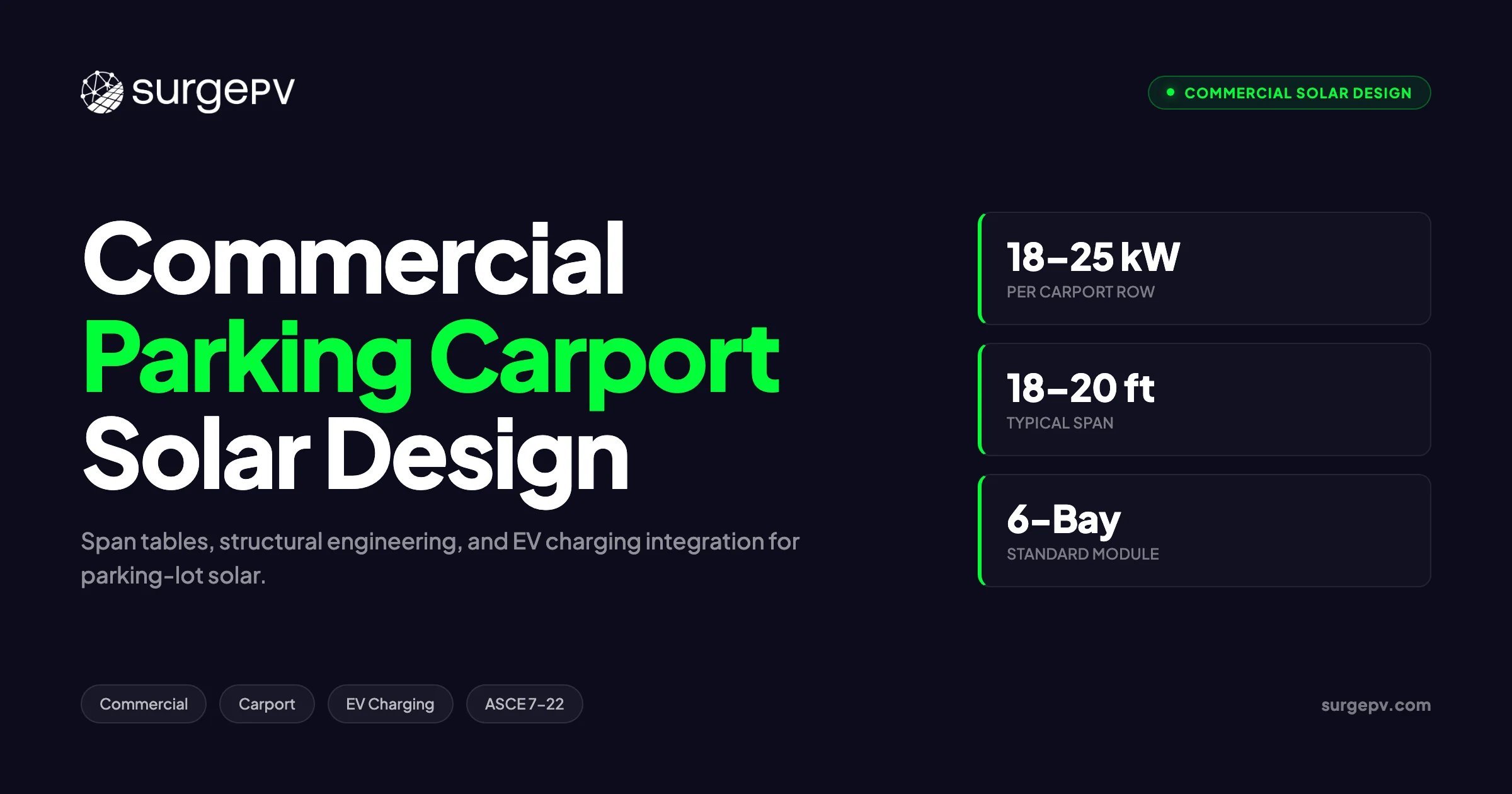
A standard six-bay double-post carport spans 18-20 ft between columns, holds 50-60 modules per row, and produces 18-25 kW DC per structure. ASCE 7-22 governs wind, IBC 2024 governs the building code path, and AISC 360 governs the steel frame. Installed cost runs $2.50-$3.50 per watt DC before incentives, with concrete piers the default foundation. EV-ready conduit at construction adds roughly $0.10-$0.20 per watt and is the cheapest moment to do it.
In this guide:
- The commercial parking opportunity and where the 1.4M+ lots sit
- Carport structural types: single-post, double-post, cantilever
- Span tables for 2-bay, 4-bay, and 6-bay layouts
- Foundation engineering: concrete drilled piers vs helical piles
- Wind load analysis under ASCE 7-22 and IBC 2024
- Snow load engineering for northern sites
- EV charging integration: Level 2 vs DC fast charge co-location
- Cable routing and conduit management under the deck
- Lighting integration (LED, security, sponsorship signage)
- Case studies: Costco, Apple HQ, Kaiser Permanente, university campuses
- Financial modeling: PV-only vs PV + EV vs PV + EV + storage
The Commercial Parking Solar Opportunity 2026
The U.S. parking inventory is enormous, fragmented, and almost entirely undeveloped from a solar perspective. Best estimates put the country at 1.4-2 billion parking spaces depending on the methodology, with the conservative “occupiable lot” count closer to 1.4 million distinct parking facilities. Each lot is a potential solar host with an interconnection, a tenant, and an existing tariff account.
Where The Carport-Ready Lots Sit
| Sector | Estimated U.S. Lots | Typical Lot Size | Carport-Suitable Share |
|---|---|---|---|
| Big-box retail (Costco, Target, Walmart) | 90,000+ | 300-800 stalls | 60-75% |
| Shopping centers and malls | 110,000+ | 500-3,000 stalls | 45-65% |
| Healthcare (hospitals, MOBs) | 65,000+ | 200-2,000 stalls | 55-75% |
| Higher education | 4,500+ | 500-10,000 stalls | 65-85% |
| Corporate office and industrial | 250,000+ | 150-2,000 stalls | 50-70% |
| Municipal and transit | 35,000+ | 100-2,500 stalls | 55-70% |
| K-12 schools | 130,000+ | 80-400 stalls | 45-60% |
| Airports (commercial) | 5,200+ | 1,000-25,000 stalls | 70-90% |
Sources: U.S. Energy Information Administration CBECS 2018, Rocky Mountain Institute parking research 2023, ICSC retail database 2024, AASHE higher-ed sustainability tracker.
Why The Market Is Moving In 2026
Three forces are pushing capital into commercial parking carports in 2026:
- State carport-specific incentives. California’s CALeVIP and SGIP-Equity programs, New York’s NY-Sun Carport Adder ($0.10-$0.20/W bonus), and Massachusetts SMART carport adder all pay extra for canopy-mounted PV.
- EV charging mandates. California Title 24 2025 requires 40% of new commercial parking stalls to be EV-capable. New Jersey, New York, Washington, and Colorado have parallel requirements.
- Heat island and shade litigation. Several large-employer ESG commitments now treat employee parking shade as a workplace health item rather than an amenity. Shadow analysis software identifies shading issues before installation.
Combine those with a stable 30% federal ITC for commercial systems (residential ITC ended December 31, 2025, but commercial keeps it under IRA Section 48), and the carport project pipeline finally has a credible business case.
For a deeper walkthrough of canopy structural decisions, the solar carport design guide covers the underlying engineering principles. This post focuses on the commercial parking application specifically.
Carport Structural Types: Single-Post, Double-Post, Cantilever
Carport structural typology is a function of three things: the parking layout, the column placement freedom, and the wind exposure. A site with 90-degree stalls and a generous drive aisle accepts different geometry than a 60-degree angle-stall lot with tight curbs. Picking the wrong type adds 15-25% to steel weight and foundation cost.
Single-Post Cantilever
A single-post cantilever puts one column row down the centerline of a parking bay and cantilevers the PV deck outward in both directions. Each side typically extends 16-18 ft from the column, covering one row of stalls.
Where it wins:
- Two-row parking bays with a center column-line free of utilities
- Sites where drive aisles cannot host columns
- Architectural projects where minimum column count matters
Where it loses:
- High-wind zones above 130 mph Vult (ASCE 7-22). Cantilever moment grows quickly with span.
- Soft soils. Each pier sees full overturning moment from both sides.
- Snow zones above 40 psf where unbalanced load drives steel weight.
Cantilever designs typically run $0.25-$0.40 per watt more than equivalent double-post for the same kW, but earn the premium back on sites where parking yield matters more than dollars per watt.
Double-Post T-Frame
The workhorse design. Two column rows define the bay, with a flat or single-slope deck spanning between them. Spans run 18-22 ft for standard six-bay modules. Each column carries roughly half the deck load, allowing smaller pier diameters and lighter steel sections.
Where it wins:
- Standard 90-degree parking with double-loaded aisles
- High-wind and high-snow zones (load shares between two columns)
- Long parking rows where modular repetition speeds erection
Where it loses:
- Tight sites where two column lines reduce drive aisle width below code
- Heavily landscaped lots where columns must dodge curbs and islands
Double-post is the default cost point: $2.50-$3.20 per watt installed in most markets in 2026. About 70% of new commercial carport square footage uses this typology.
Inverted-Y And A-Frame Variants
Some vendors (Powerway, Schletter) offer inverted-Y designs that put a single column under each bay with two diverging arms supporting the deck. This compromise sits between single-post cantilever and double-post T-frame: column count matches single-post, but moment arms are shorter than full cantilever.
The 60-degree angle-parking A-frame is a less common variant used in valet lots and airport surface parking, where stalls are angled for one-way traffic. It uses asymmetric arm lengths to match the stall geometry.
Bridge And Long-Span Configurations
For drive-aisle coverage or 4-row super-bays, designers use deeper trusses or moment-frame bridges that span 40-60 ft. These are common at airports and stadium lots where the architecture wants visibility through the structure. Steel weight per watt is 1.5-2x higher than standard double-post, but the long span avoids columns in active traffic lanes.
Materials And Coatings
Commercial carports use ASTM A992 hot-rolled steel for the primary frame and ASTM A653 galvanized cold-formed sections for the purlins. Coatings vary by site:
| Coating | Service Life | Typical Use | Cost Premium |
|---|---|---|---|
| Hot-dip galvanized (G185) | 40-70 years | Most commercial sites | Baseline |
| Galvanized + powder coat | 30-50 years | Architectural sites, color-matched canopies | +$0.05-$0.10/W |
| Weathering steel (Corten) | 60+ years | Coastal / industrial aesthetic | +$0.15-$0.25/W |
| Stainless steel fasteners | 50+ years | Coastal Cat-D zones (ASCE 7) | +$0.02-$0.05/W |
For the structural detail behind these load decisions, the SurgePV solar design software handles the structural overlay, electrical layout, and shade analysis in one workflow — so the steel frame, module string, and AC route all reconcile before the design hits engineering review. For a direct comparison, see Arka 360 vs SurgePV.
Span Tables: What Spans Work for 2-Bay, 4-Bay, 6-Bay
Span tables get used wrong all the time. The numbers below are typical, real-world commercial spans from vendor engineering packets (Powerway, RBI Solar, Quest Solar, Schletter) and represent design starting points — not final stamped engineering. Always run a site-specific PE-stamped calculation against ASCE 7-22 and the local AHJ amendments.
Standard Commercial Span Reference
| Bay Type | Stalls Per Bay | Bay Width | Module Layout | Modules Per Bay | DC Output (445 W modules) | Steel Weight |
|---|---|---|---|---|---|---|
| 2-bay double-post | 2 stalls (1 row) | 18-20 ft | 2 wide × 4 long | 8 modules | 3.56 kW | 1,800-2,400 lb |
| 4-bay double-post | 4 stalls (2 rows) | 36-40 ft | 4 wide × 6 long | 24 modules | 10.7 kW | 5,500-7,500 lb |
| 6-bay double-post | 6 stalls (2 rows) | 36-40 ft | 4 wide × 14 long | 56 modules | 24.9 kW | 11,000-14,500 lb |
| 6-bay single-post | 6 stalls (2 rows) | 36-40 ft | 4 wide × 14 long | 56 modules | 24.9 kW | 14,500-18,000 lb |
| 10-bay double-post | 10 stalls (2 rows) | 36-40 ft | 4 wide × 22 long | 88 modules | 39.2 kW | 18,000-23,500 lb |
| Long-span bridge | 4 stalls + drive aisle | 60-66 ft | 8 wide × 8 long | 64 modules | 28.5 kW | 24,000-32,000 lb |
Assumes ASCE 7-22 Risk Cat II, Exposure C, Vult = 115 mph, ground snow Pg = 25 psf, modules at 5° tilt south, 445 W bifacial monocrystalline. Steel weights include columns, primary beams, purlins, and connections, exclude foundations. For more on this topic, see Bifacial Solar Panel Design Guide.
Span Vs Cost Sensitivity
The cost sweet spot in 2026 sits at 18-20 ft spans for double-post designs. Pushing to 22-24 ft adds steel weight quadratically because beam depth scales with span squared. Below 16 ft, column count goes up and parking layout suffers without saving meaningful steel.
| Span | Steel Per kW | Foundation Per kW | Installed $ / W DC | Notes |
|---|---|---|---|---|
| 14-16 ft | $0.55-$0.65 | $0.25-$0.35 | $2.40-$2.75 | Too many columns; parking yield drops |
| 18-20 ft | $0.45-$0.55 | $0.20-$0.30 | $2.55-$3.10 | Industry sweet spot |
| 22-24 ft | $0.60-$0.75 | $0.20-$0.28 | $2.80-$3.40 | Use only when column placement forces it |
| 40-66 ft (bridge) | $1.10-$1.50 | $0.30-$0.45 | $3.80-$4.80 | Drive aisle and architectural cases |
Tilt And Snow Slide Considerations
Carport tilt is usually 3-10 degrees. Steeper tilts (15-20°) work in snow zones for self-shedding, but reduce module height clearance on the low side and complicate the parking experience.
For a 6-bay module at 7° tilt, low-side clearance to top-of-pavement should be at least 8 ft to satisfy fire code aerial access (NFPA 1) and ambulance/delivery vehicle clearance. High-side clearance often runs 11-13 ft. Hospitals and airports require minimum 14 ft for emergency vehicles.
Foundation Engineering: Concrete Footings vs Helical Piles
The foundation is where carport projects bleed money quietly. Soil reports, mobilization, weather delays, and concrete cure schedules all hit the bottom 18 inches of every column. A 200-stall carport project has 80-120 piers; a 10% cost overrun on each becomes a real number fast.
Concrete Drilled Piers (The Default)
Drilled concrete piers — sometimes called caissons or auger-cast piles — are the standard for commercial carports on stable soils. A typical 6-bay double-post column with 18 ft span uses an 18-24 inch diameter pier drilled 8-14 ft deep, depending on soil bearing and frost depth.
| Soil Bearing | Pier Diameter | Pier Depth | Concrete Volume | Approx Cost Per Pier |
|---|---|---|---|---|
| 3,000+ psf (dense sand/clay) | 18 in | 8-10 ft | 1.4-1.8 yd³ | $450-$700 |
| 1,500-3,000 psf (medium clay/silt) | 24 in | 10-12 ft | 2.8-3.5 yd³ | $700-$1,000 |
| 1,000-1,500 psf (soft clay/loose sand) | 30 in | 12-14 ft | 4.4-5.3 yd³ | $1,000-$1,500 |
| Below 1,000 psf or expansive soils | 30-36 in + rebar cage | 14-18 ft | 5.0-7.5 yd³ | $1,400-$2,200 |
Costs include drilling, rebar cage, concrete supply and placement, anchor bolt template. Assume 4,000 psi concrete, ACI 318-19 design. Excludes mobilization and disposal of spoils.
Helical Piles (The Faster Alternative)
Helical piles — galvanized steel shafts with welded helix plates — install by torque rather than excavation. A typical commercial carport pile is 2.875 to 4.5 inch shaft diameter with 8, 10, or 12-inch helix plates, installed to 25,000-50,000 ft-lb torque.
| Site Condition | Helical Pile Choice | Install Time Per Pile | Cost Per Pile |
|---|---|---|---|
| Soft / variable soil | 2.875 in shaft, dual helix | 20-40 min | $550-$850 |
| Standard clay | 3.5 in shaft, twin helix | 15-30 min | $700-$1,000 |
| Dense sand / glacial till | 4.5 in shaft, triple helix | 30-60 min | $1,000-$1,500 |
| Coastal / corrosive | Hot-dip galvanized + sacrificial anode | 30-60 min | $1,200-$1,800 |
Helical piles solve four real problems that concrete struggles with on operating commercial lots:
- Schedule. No cure time. A pile installed at 9 AM can take steel at 2 PM the same day.
- Operating lot disruption. No wet concrete on the asphalt. Minimal mud.
- Freeze-thaw. Screw-type anchors don’t suffer the seasonal heave that shallow concrete can.
- Removability. Some clients (airport leases, ground-lease retail) want the option to remove the structure at end of lease.
Helical pile cost premium runs 10-25% over equivalent concrete piers on most sites. In poor soil or freeze zones, that premium often disappears because concrete pier sizes grow faster than helical sizes do.
Soil Investigation Is Not Optional
Every commercial carport project larger than ~20 stalls needs a geotechnical investigation before foundation design. Typical scope:
- 2-4 soil borings per acre, to 15-25 ft depth
- Standard Penetration Tests (SPT) at 2.5 ft intervals
- Atterberg limits and moisture content for cohesive soils
- Soluble sulfate and chloride testing (corrosion design)
- Frost depth confirmation against local code
Skipping the geo report is the single most expensive mistake a commercial carport project can make. A $6,000 soil investigation can save $50,000-$200,000 in re-design or oversized foundations.
For the foundation engineering decisions on similar ground-mounted structures, see residential ground-mount solar foundations and permits. The principles transfer to carports with adjustments for the elevated deck and overturning moment.
Wind Load Analysis (ASCE 7-22, IBC 2024)
Wind drives carport steel weight more than any other load case in most U.S. zones outside the snow belt. ASCE 7-22, published in late 2022 and adopted in IBC 2024, made several changes that affect carport design specifically.
What Changed In ASCE 7-22
ASCE 7-22 kept the risk-targeted basic wind speed approach from ASCE 7-16 but updated the wind speed maps. Key changes that hit carports:
- Coastal Florida and Gulf Coast Vult increased to 165-180 mph in Risk Category II zones — a 5-15 mph bump over ASCE 7-16. This drives heavier steel and larger anchor bolts in those markets.
- Tornado loads are now an explicit design case for Risk Category III and IV structures in Chapter 32. Most commercial parking carports are Risk Cat II, but hospital and emergency-services parking can hit Cat III.
- Cladding and component (C&C) pressures for canopy edges were updated. Module fasteners near the canopy perimeter often need larger diameter or closer spacing.
- Topographic factor Kzt can now be calculated using a 3D site terrain method, useful for ridge-top or coastal escarpment sites.
Basic Wind Speed By Region (Risk Cat II, ASCE 7-22)
| Region | Representative City | Vult (mph) | Exposure Cat | Design Concern |
|---|---|---|---|---|
| Coastal Florida | Miami, Tampa | 165-175 | C | Hurricane uplift |
| Gulf Coast | Houston, New Orleans | 145-165 | C | Hurricane + storm surge |
| Atlantic Coast | Charleston, Norfolk | 130-145 | C / D | Hurricane uplift |
| Plains tornado belt | Oklahoma City, Wichita | 105-115 | C | Tornado per Ch. 32 |
| Northeast | Boston, NYC | 105-115 | C | Hurricane + snow combo |
| Pacific Northwest | Seattle, Portland | 95-100 | B / C | Combined wind + rain |
| Mountain West | Denver, Salt Lake City | 100-105 | C | Wind + drift snow |
| Interior California | Sacramento, Fresno | 95-100 | C | Seismic governs |
| Desert SW | Phoenix, Las Vegas | 95-105 | C | Microburst uplift |
| Midwest | Chicago, Minneapolis | 105-115 | C | Wind + snow combo |
Load Cases That Drive Carport Design
For a typical commercial parking solar carport, six load combinations from ASCE 7-22 Section 2.3 matter:
- 1.2D + 1.0W + 0.5(Lr or S or R) — downward wind plus partial roof live load
- 0.9D + 1.0W — uplift case (the killer for footings)
- 1.2D + 1.6S + 0.5W — snow case, mid-winter
- 1.2D + 1.0W + 1.0L + 0.5S — full service load
- 1.0D + 1.0E — seismic, where it governs
- Tornado load combination — only for Risk Cat III/IV structures
The 0.9D + 1.0W uplift case sets foundation embedment depth and anchor bolt diameter for almost every commercial carport. A 6-bay double-post canopy with 56 modules and 7° tilt sees roughly 8-14 psf net uplift in 115 mph zones. Multiplied by ~1,400 ft² of canopy area, that’s 11,000-19,000 lb of net uplift per bay — every bit of which has to transfer through the column-to-pier connection.
Module And Cladding Pressures
ASCE 7-22 Chapter 30 (Components and Cladding) defines pressures on individual modules using GCp factors that vary by canopy zone. The perimeter zone (Zone 2) and corner zone (Zone 3) see 1.5-2.5x the pressure of the field zone (Zone 1). For a 6-bay carport, this typically means:
- Field-zone modules: 2-4 mounting clamps each, standard fastener
- Edge-zone modules: 4 mounting clamps, often larger diameter
- Corner-zone modules: 4-6 clamps, with through-purlin fasteners
Using a solar design suite platform that exports module-level uplift to a structural engineer’s spreadsheet — rather than averaging across the canopy — catches edge-zone failures before they reach the AHJ. For a deeper dive into mounting design for high-wind sites, see high-wind zone solar mounting and the wind exposure category glossary entry.
Snow Load Considerations for Northern Sites
Carports in snow country fail in three classic ways: collapse under uniform snow, collapse under drift snow against an adjacent building, and slow fatigue from repeated snow-shed loading. ASCE 7-22 Chapter 7 covers all three cases and the math is unforgiving.
Ground Snow By City
| City | Ground Snow Pg (psf) | Typical Flat-Roof Pf (psf) | Carport Design Snow (with drift) |
|---|---|---|---|
| Minneapolis | 50-55 | 35-42 | 50-75 psf in drift zone |
| Buffalo | 50-60 | 35-45 | 55-85 psf in drift zone |
| Boston | 35-40 | 24-30 | 40-60 psf in drift zone |
| Denver | 25-30 | 18-22 | 30-45 psf in drift zone |
| Salt Lake City | 30-35 | 21-26 | 35-50 psf in drift zone |
| Chicago | 25-30 | 18-22 | 30-45 psf in drift zone |
| Portland (ME) | 60-70 | 42-50 | 65-90 psf in drift zone |
| New York City | 25-30 | 18-22 | 30-45 psf in drift zone |
| Detroit | 25-30 | 18-22 | 30-45 psf in drift zone |
| Seattle | 15-20 | 11-15 | 20-30 psf in drift zone |
Pg from ASCE 7-22 Figure 7.2-1A through D. Pf = 0.7 × Ce × Ct × Is × Pg for unheated canopies. Drift loads per Section 7.7 and 7.8.
The Drift Problem
Snow drift against an adjacent building wall or a higher canopy row is the single largest snow case for most commercial carports. ASCE 7-22 Section 7.7 defines the triangular drift profile, with peak height typically 4-7 ft and dropping linearly to zero over 10-25 ft.
A 6-bay carport row adjacent to a 35-ft tall warehouse in Buffalo can see drift snow at 70-90 psf within 15 ft of the wall. That’s nearly 3x the uniform roof snow load. Beams in the drift zone need to be sized for the drift case, not the uniform case.
Slide-Off Loads
Steeper-tilt carports (10-20°) shed snow off the low edge, which can dump 200-800 lb in one event onto whatever is below. Two design responses:
- Snow guards — short angle bars or pucks bolted to module rails to break the slide
- Clearance setbacks — keep parking stalls and pedestrian paths 6-10 ft inboard of the canopy low edge in slide-prone zones
For the structural details on snow-driven sizing, the snow load calculation glossary entry walks through the variables, and our snow load considerations for solar panels deep-dive applies the same principles to elevated structures.
Salt And Brine Corrosion
Snow-belt sites also see road salt and brine application in winter. Spray and aerosol can reach 8-12 ft above ground in heavy traffic zones, attacking galvanizing on column bases. Best practice for salt-prone sites:
- G185 galvanizing on all primary steel (not G90)
- Sacrificial zinc anodes at the column base
- Annual visual inspection of column-to-pier connection for white rust
- Replace galvanized fasteners with 316 stainless within 3 ft of pavement
EV Charging Integration: L2 vs DC Fast Charge Co-Location
The reason commercial carports moved from “nice to have” to “we’re doing this in 2026” is EV charging. A canopy without chargers is a shade structure; a canopy with chargers is a load-shifting, demand-response, revenue-generating asset. The integration choices made at design time decide whether the project earns or breaks the financial model.
Level 2 Vs DC Fast Charge: Where Each Belongs
| Charger Type | Power | Typical Use Case | Carport Integration |
|---|---|---|---|
| Level 1 (120V, 1.4 kW) | 1.4 kW | Trickle / overflow | Rare on commercial carports |
| Level 2 dual-port (208/240V) | 6.6-19.2 kW | Workplace, retail, hotel | Column-mounted or pedestal |
| DC Fast Charge (DCFC) | 50-180 kW | Fleet, public charging, highway | Separate pad and cabinet |
| Ultra-Fast Charge | 250-350 kW | Heavy-duty fleet, premium retail | Dedicated transformer, separate switchgear |
Level 2 Workplace Charging — The Carport Default
A workplace or retail solar carport typically pairs Level 2 dual-port chargers (one charger serves two adjacent stalls) at a density of 20-40% of stalls. A 100-stall carport with 30% L2 coverage hosts 15 dual-port chargers — 30 ports of 7-11 kW each.
Load math:
- 15 chargers × 11 kW peak = 165 kW peak demand
- With 0.6 diversity factor → 99 kW design demand
- 6-bay carport rows producing 25 kW × 4-6 rows = 100-150 kW DC noon production
- Net: solar covers most of the daytime charging load on sunny days
Conduit and panel sizing must handle the full design demand, but the utility import shrinks dramatically when solar is present. This is the “load shift below the demand meter” play that makes commercial L2 work financially.
DC Fast Charge — Separate Footprint, Separate Math
DC fast chargers don’t fit inside a carport column the way L2 does. A 150 kW DCFC has:
- Power cabinet: 6-8 ft wide × 3 ft deep × 7-8 ft tall, with 3 ft service clearance
- Dispenser: 2-3 ft wide × 2 ft deep × 7 ft tall
- Liquid-cooled cable management above 250 kW
Best practice is to dedicate one bay-end at the carport edge as a DCFC pad, separated from PV columns. The DCFC ties into the same switchgear that serves the solar (and the building), so utility-side calculations work as one combined load profile.
A 4-stall DCFC bank at 150 kW each = 600 kW peak demand. Even a large 1-MW carport can’t fully cover that load from PV alone. Battery storage becomes essential to clip the demand peak and avoid utility upgrade costs. The commercial battery storage sizing post walks through the math. See Adding Battery Storage Services for detailed guidance.
Common Mistakes On EV Integration
The five mistakes I see most often on commercial carport + EV projects:
- Skipping EV-ready conduit during PV-only Phase 1. Adding conduit later costs 8-12x as much as installing it during initial trenching. Always pull at least 3 inch EMT and a pull box per future EV stall pair.
- Sizing the AC service for solar only. The solar inverter output is rarely the design load. Charging is. Service entrance should be sized for full future EVSE load, not current PV.
- Putting DCFC under the canopy. Service clearance, ventilation, and cable management all fight the canopy. Always pad-mount DCFC.
- Using the wrong networking protocol. OCPP 2.0.1 with ISO 15118 plug-and-charge is the 2026 baseline. Proprietary closed networks lock in vendors and prices.
- Failing to model demand charges. Without solar and storage, peak demand from EV charging can swamp the entire bill saving from PV. Use real 15-minute interval data, not flat assumptions. Our solar system sizing 15-minute interval load data post explains the methodology.
For deeper EV-specific design, see EV charging infrastructure sizing, solar carport EV fleet charging, and the OCPP solar EV charging integration deep-dive.
Design Carport Projects In SurgePV With Span Tables Built In
SurgePV’s commercial solar design platform handles carport layout, structural overlay, electrical routing, and EV integration in one workflow. Run wind and snow checks against ASCE 7-22 and produce stamped-ready plan sets in hours, not weeks.
Book a DemoNo commitment required · 20 minutes · Live commercial project walkthrough
Cable Routing & Conduit Management Under Carports
The cable architecture under a solar carport decides whether the project looks like a finished commercial structure or a tangle of conduit ziptied to purlins. Three routes matter: DC string cabling between modules, the AC trunk from inverter to switchgear, and the EVSE feeder runs.
DC String Routing Inside The Frame
Modern commercial carports route DC cable inside the primary beams and purlins using factory-cut cable channels. A typical 6-bay double-post structure has:
- Main beam with internal 4-inch x 4-inch cable raceway running the full length
- Purlin penetrations sized 1-inch oversize for MC4 string conductors
- IP67 weather-tight junction boxes at the column tops
- Microinverters or DC optimizers mounted directly to the module frame, not the structural steel
This routing approach reduces installation labor by 25-40% versus surface-mounted conduit and eliminates the visual clutter that ruins canopy aesthetics. Some structural carport vendors (RBI Solar, Quest Solar, Powerway) build the raceways into shop-fab, which transfers the labor savings into a slightly higher steel cost but cuts field time substantially.
AC Trunk From String Inverter
For a 6-row 150 kW carport, the AC trunk runs from the inverter (often pole-mounted on the carport itself, sometimes pad-mounted at the canopy end) to the AC combiner or service entrance. Conduit sizing follows NEC 2026:
| System AC Size | AC Conductor | Conduit Size | Notes |
|---|---|---|---|
| 25 kW (single row) | 4 AWG copper | 1.25 in EMT | Standard pole-mount run |
| 50 kW (2 rows) | 2/0 AWG copper | 2 in EMT | Combine before service entrance |
| 150 kW (6 rows) | 350 kcmil Al or 250 kcmil Cu | 4 in EMT | Underground feed to switchgear |
| 500 kW (multi-canopy) | 2 sets of 600 kcmil Cu | 2 × 4 in EMT | Often paralleled, trench feed |
Conduit fill calculations follow NEC Chapter 9 Table 1. Forty percent maximum fill for three or more conductors. The conduit fill calculation solar PV guide walks through the math step by step, and the conduit fill glossary entry covers the underlying definitions.
Trenching And In-Slab Conduit
Underground runs from carport to building service entrance use the AHJ-approved method — typically PVC schedule 40 in non-traffic areas, schedule 80 under driveways, or rigid steel where required. Burial depth follows NEC 300.5 (18-24 inches minimum, deeper under traffic).
The cheapest moment to install EV-ready conduit is during initial trenching for the solar feed. Adding 2-4 spare 3-inch conduits in the same trench adds 5-10% to trenching cost. Trenching after the carport is operating costs 4-8x more because the lot is in use.
Cable Sizing And Voltage Drop
DC voltage drop on string runs from module to inverter typically caps at 2% per NEC 690.7. AC voltage drop from inverter to service entrance caps at 2% as well, with 3% combined limit. For long runs (>200 ft from inverter to service), upsize conductors one trade size to keep voltage drop manageable.
Our solar cable sizing calculation post and solar DC cable length calculator tool both apply directly to carport design.
Lighting Integration: LED, Security, Sponsorship
Carports are also lighting infrastructure. Most commercial parking codes (IES RP-20, local AHJ amendments) require minimum illuminance levels for stall, drive aisle, and pedestrian path. A solar carport often replaces existing pole-mounted parking lot lights with under-canopy fixtures, which improves uniformity and reduces light trespass.
LED Fixture Selection
Standard commercial carport LED fixtures run:
- Output: 6,000-15,000 lumens per fixture
- Wattage: 40-100 W LED
- Color temperature: 4000K or 5000K
- Spacing: 30-50 ft on center for stall illumination
- Mounting: under-deck purlin clip or beam-end downlight
For a 6-bay carport, four to six under-deck fixtures provide IES RP-20 Class III (basic) illumination of 1.0-3.0 footcandles average across all stalls. Class II (enhanced) requires 2.0-5.0 fc and adds two more fixtures per bay.
Power From The PV System
Most carport LED systems run off the same AC service that meters the building or a small dedicated PV-charged battery for emergency lighting. Some projects design a daytime-charge / night-discharge battery sized to cover overnight lighting, which de-couples the lighting from the main service entirely.
For a 100-stall carport with 60 fixtures at 60 W each = 3.6 kW lighting load. Twelve hours overnight = 43 kWh. A 50 kWh LFP battery handles two nights without solar input.
Sponsorship And Wayfinding
Large commercial carports increasingly carry sponsorship signage, wayfinding indicators, and EV charger status displays. Common integrations:
- Backlit fascia panels at canopy edge for tenant or sponsor branding
- LED stall-status lights (red/green) indicating EV charger availability
- Wayfinding directional arrows under canopy at row ends
All of these tie into the same AC trunk and add 200-400 W of continuous load per canopy row. Plan for them at design time; retrofitting wiring after canopy commissioning is painful.
Dark Sky And Light Trespass
In municipalities with dark sky ordinances (Tucson, Flagstaff, parts of California Title 24), under-canopy lighting needs full-cutoff fixtures and shielded edges. The canopy itself acts as a natural shield for upward light spill, making under-deck mounting compliant where pole-mounted parking lot lights were not.
Case Studies: Costco, Apple HQ, Kaiser Permanente, University Campuses
Real-world commercial carport projects illustrate how the engineering decisions in the prior sections translate into outcomes. Four representative projects below — drawn from public documentation and trade press — show the range of scale and ambition in 2024-2025.
Costco Wholesale, Multiple Locations
Costco has installed solar carports across 100+ warehouse locations since 2019, with notable canopy projects in California, New Jersey, and Hawaii. Typical Costco carport project:
- 1.5-3.5 MW DC per warehouse location
- 200-500 stalls covered
- Single-post cantilever design with 16-18 ft cantilever per side
- 12-15 EV charging stalls per project (Level 2 dual-port)
- ITC + Section 179 accelerated depreciation; no PPA, owned outright
- Estimated payback: 5-8 years depending on state incentives
Costco’s standardized design — same column profile, same module count per bay, same engineering details — lets them roll out new locations in 12-16 weeks from contract to commissioning. Their approach: own the entire canopy infrastructure, sell the surplus power back to the grid where states allow, treat the carport as customer-facing brand value as well as energy infrastructure.
Apple Park HQ, Cupertino CA
Apple’s Cupertino campus parking structures host one of the largest corporate carport solar installations in North America — approximately 17 MW DC across the campus’s two main parking garages and surface lots. Key design features:
- Custom architectural canopies designed by Foster + Partners, not stock structural sections
- Approximately 200 EV charging stations under canopy
- Integrated with battery storage at the campus level
- Estimated $80-$120 million capital cost (per Apple’s 2017-2018 build documentation)
Apple’s project sits at the architectural extreme — every detail engineered specifically for the campus aesthetic. The cost premium is multiples above standard commercial carport, but the project also delivered LEED Platinum and a tenant amenity Apple uses in recruitment.
Kaiser Permanente, Various California Hospitals
Kaiser Permanente has installed solar canopy systems at 30+ California hospital campuses with carport installations ranging from 500 kW to 6 MW. Notable project: the Kaiser Permanente Antioch Medical Center, completed in 2017-2018, with approximately 2 MW of solar carport covering staff and patient parking.
Kaiser’s design choices reflect the healthcare context:
- 14-15 ft high-side clearance for emergency vehicle and ambulance access
- Backup-power integration with on-site generators for hospital critical load
- L2 EV charging for staff vehicles (Title 24 compliance)
- All-weather LED under-canopy lighting at 5+ fc for night-shift staff safety
Hospital carports carry higher cost-per-watt premium (~10-20%) than retail because of the higher clearance, the seismic Risk Category III classification, and the integration with critical-load backup systems.
University Of California Campuses
UC campuses have collectively installed more than 50 MW of solar carport across the system, with major projects at UC Davis, UC Merced, UC San Diego, and Cal State Fresno. Typical UC carport project:
- 500 kW to 2.5 MW DC per project
- 100-400 stalls covered
- Standard double-post T-frame on concrete piers
- 15-30% of stalls equipped with L2 EV charging
- Some projects include a small DCFC station for fleet vehicles
- Financed through long-term PPA (15-25 year) with no upfront capital from the university
UC’s approach: lock in a 15-25 year PPA at 4-6 cents/kWh below current retail, transfer ownership and O&M risk to the developer, capture the parking shade benefit and EV charging revenue while letting the developer handle the structural and electrical complexity. This model works for almost any large institutional parking owner: hospitals, school districts, municipalities, transit agencies.
For more case study detail, see the solar carport case study California EV charging and our commercial solar rooftop case study Italy warehouse for the rooftop comparison. Also see: solar panel ROI in Italy.
Financial Modeling: PV-Only vs PV + EV vs PV + EV + Storage
The financial case for commercial parking solar depends on three knobs: the PV revenue, the EV charging revenue, and the demand charge avoidance from battery storage. Each combination produces different IRR, payback, and risk profiles.
Three Project Configurations Compared
The numbers below model a representative 200-stall commercial parking project in a mid-tier U.S. utility territory (Mid-Atlantic, demand charges $14-$18/kW, energy $0.11-$0.14/kWh, ITC 30%). Configurations: PV-only baseline, PV plus L2 EV charging, and PV plus L2 plus battery storage.
| Metric | PV-Only | PV + L2 EV | PV + L2 + Battery |
|---|---|---|---|
| PV DC capacity | 1,000 kW | 1,000 kW | 1,000 kW |
| EV charging | None | 30 L2 dual-port | 30 L2 dual-port + 4 DCFC |
| Battery storage | None | None | 500 kWh / 250 kW |
| Capital cost (gross) | $2,900,000 | $3,300,000 | $4,400,000 |
| ITC (30%) | $870,000 | $990,000 | $1,320,000 |
| Net capital after ITC | $2,030,000 | $2,310,000 | $3,080,000 |
| Annual PV production | 1,500,000 kWh | 1,500,000 kWh | 1,500,000 kWh |
| Bill savings (self-consumed solar) | $135,000 | $145,000 | $155,000 |
| EV charging revenue (net) | $0 | $95,000 | $185,000 |
| Demand charge avoidance | $0 | $0 | $48,000 |
| Total annual benefit | $135,000 | $240,000 | $388,000 |
| Simple payback (post-ITC) | 15.0 yr | 9.6 yr | 7.9 yr |
| 25-year IRR | 7.8% | 12.4% | 14.6% |
| 25-year NPV (5% discount) | $1,015,000 | $2,400,000 | $4,150,000 |
Assumptions: 1,500 kWh/kW annual PV yield, 50% solar self-consumption, $0.30/kWh L2 charging revenue at 30% utilization, $0.40/kWh DCFC at 25% utilization, 80% battery round-trip efficiency, 1% annual cost escalation, 25-year analysis horizon.
Where The Real ROI Comes From
The configuration comparison shows that PV alone has historically been a tough sell on commercial carports — 15-year simple payback is at the upper edge of what corporate CFOs accept. Adding EV charging revenue and demand charge avoidance moves the project into the same risk-return zone as a roof retrofit or HVAC upgrade. For France-specific information, see Agricultural Solar Case Study. See our guide on Floating Solar Farms France for more.
Key sensitivities:
| Variable | -10% Scenario Impact | +10% Scenario Impact |
|---|---|---|
| Solar yield (kWh/kW) | -1.2 yr payback worse | +1.0 yr payback better |
| EV utilization | +0.4 yr payback worse | -0.4 yr payback better |
| Demand charge | +0.3 yr payback worse | -0.3 yr payback better |
| Capital cost | -1.0 yr payback better | +1.1 yr payback worse |
| Electricity rate | +0.6 yr payback worse | -0.5 yr payback better |
EV utilization is the variable most carport owners can actually move with pricing, signage, and software. Underutilized chargers produce no revenue but cost the same to install. Smart placement, integrated wayfinding, and competitive pricing matter more than premium hardware.
Federal And State Incentives Stack
The full incentive stack a 2026 commercial carport project can claim:
| Incentive | Federal/State | Value | Notes |
|---|---|---|---|
| ITC base (Section 48) | Federal | 30% | Commercial systems; IRA-extended through 2032 |
| ITC domestic content adder | Federal | +10% | Requires verified U.S. supply chain |
| ITC energy community adder | Federal | +10% | Census-tract eligibility |
| ITC low-income adder | Federal | +10-20% | Allocation-based, competitive |
| MACRS depreciation | Federal | 5-year accelerated | Effective 21-26% NPV benefit |
| State carport adders (CA, NY, MA) | State | $0.10-$0.40/W | Stacks with ITC |
| Utility EV charging rebates | Local | $1,500-$15,000 per port | Varies by utility program |
| Section 179D efficient building deduction | Federal | $0.50-$5.65/sqft | If integrated with building envelope |
For a 1 MW carport in California’s Inflation Reduction Act energy community zone with domestic content compliance, the effective federal tax benefit can reach 50% of capital cost, plus state and utility adders on top. The financial picture in 2026 is structurally better than it has ever been.
For complete commercial financial modeling, the commercial solar ROI calculator post and our customer-ready solar proposals automate the full incentive stack and produce client-ready proposals. The energy and financial modeling tool handles yield modeling at the granular level needed for accurate payback.
Permitting Path For Commercial Parking Solar
Commercial carport permits run longer than rooftop because they touch building, electrical, structural, and (often) traffic engineering departments. A typical permit sequence:
- Pre-application meeting with AHJ planning department (1-2 weeks)
- Building permit submission — structural calcs, foundation plan, electrical SLD, traffic study if required (4-8 weeks first review)
- Plan check responses — 2-3 review cycles typical (4-12 weeks total)
- Utility interconnection application — runs parallel to building permit (8-16 weeks)
- Construction permit issuance (1-2 weeks)
- Inspections during construction — foundation, structural, electrical rough, final
- Permission to operate (PTO) — utility witnesses final commissioning (2-6 weeks)
Total permit-to-PTO timeline: 6-12 months for a standard 500 kW to 2 MW commercial parking carport project. Faster timelines (4-6 months) are possible in pre-engineered, prescriptive-path jurisdictions; slower (12-18 months) is common in major metros with stretched plan check queues.
The solar interconnection application guide covers utility interconnection in depth — the path that most often delays carport projects.
Conclusion
Commercial parking solar carports have moved from boutique to scalable in 2026. The structural engineering is well-understood, ASCE 7-22 gives designers a clear load framework, and the EV charging revenue layer makes the financial case work in markets where PV-only would have failed five years ago.
Three actions for any commercial parking solar project in 2026:
- Get the geo report first. A $6,000 soil investigation prevents $50,000-$200,000 in foundation redesign or oversizing. Concrete piers or helical piles both fail without good subsurface data.
- Pull EV-ready conduit during initial trenching. Whether you install chargers in Phase 1 or Phase 3, the cost differential to add the conduit later is 8-12x. Pull spare 3-inch EMT and pull boxes now.
- Model demand charges, not just energy. Without battery storage, peak demand from EV charging can swamp the bill savings from PV. Use 15-minute interval data and stack the full incentive picture before committing to the capital plan.
For the broader commercial solar landscape, see the commercial solar market outlook 2026 and our deep guide to commercial solar system design. For the design and proposal workflow that ties carport span, structural overlay, EV integration, and financial modeling into one platform, the SurgePV solar software handles the full commercial carport project lifecycle.
Frequently Asked Questions
What is a typical span for a commercial parking solar carport?
A standard commercial parking solar carport uses an 18-20 ft span between posts on a double-post T-frame design. This matches a 9-ft parking stall paired across a 60-degree drive aisle, allowing two stalls per bay without column interference. Single-post cantilever designs typically run 16-18 ft per side, while heavy-duty six-bay modular spans can reach 22-24 ft with deeper steel sections.
How many solar panels fit on a commercial parking carport row?
A typical 6-bay double-post solar carport row holds 50-60 panels and produces 18-25 kW DC depending on module wattage. A row covers two parallel rows of parking stalls, roughly 90-110 ft long and 36-40 ft wide. Larger super-rows that span four parking columns can host 100-120 panels at 36-50 kW per structure.
What wind load code applies to solar carports in 2026?
ASCE 7-22 governs wind loads for new solar carports in 2026, referenced through IBC 2024. ASCE 7-22 uses risk-targeted basic wind speeds, exposure category C for most parking lots, and a Kzt topographic factor based on local terrain. Designers must also check ASCE 7-22 Chapter 30 for component and cladding pressures on individual modules, which often govern fastener selection.
Concrete footings or helical piles for solar carport foundations?
Concrete drilled piers remain the default for commercial solar carports where soil conditions support 1,500-3,000 psf bearing pressure and the schedule allows 21-day cure time. Helical piles win when soil is poor, when freeze-thaw cycles favor screw-type anchors, or when the project must avoid wet concrete on an operating lot. Helical piles typically cost 10-25% more on the foundation line but compress schedule by 2-3 weeks.
How do you integrate Level 2 and DC fast charging under a solar carport?
Level 2 chargers (6.6-19.2 kW) mount on the carport column or a separate pedestal between stalls, with conduit routed through the column or in-slab. DC fast chargers (50-350 kW) require a separate power cabinet pad and trench feed because their footprint and clearances exceed what a column can host. Best practice: design the solar feed to a separate switchgear that feeds both the building and the EVSE, so utility export rules and demand charges can be managed in one place.
What snow load does a solar carport need to handle in northern climates?
Snow load varies by ASCE 7-22 ground snow map. Boston runs 35-40 psf ground snow, Denver 25-30 psf, Minneapolis 50-60 psf. Carport designers convert ground snow to flat-roof snow load using Ce, Ct, and Is factors, then check sliding and drift cases. Drift loads on adjacent rows or building walls often govern beam sizing in zones above 35 psf, not the uniform load.
Are solar carports eligible for the federal Investment Tax Credit?
Commercial solar carports remain eligible for the federal Investment Tax Credit at 30% under the Inflation Reduction Act, subject to prevailing wage and apprenticeship requirements for systems above 1 MW. Domestic content, energy community, and low-income bonus adders can lift the credit to 50-70%. The residential 30% credit expired December 31, 2025, but commercial-scale carports owned by businesses keep the full IRA benefit.
How much does a commercial parking solar carport cost per watt?
Installed cost runs $2.50-$3.50 per watt DC for standard double-post steel carports in 2026, before incentives. Single-post cantilever designs are 10-15% more expensive per watt due to heavier steel and larger foundations. EV charging integration adds $0.20-$0.60 per watt for conduit, panels, and EVSE depending on charger mix. Foundation cost ranges $400-$1,200 per pier depending on soil and depth.
Sources and further reading:
- ASCE 7-22 Minimum Design Loads — official ASCE standard for wind, snow, and seismic loads
- International Building Code 2024 — ICC Digital Codes
- NREL U.S. Solar Photovoltaic System and Energy Storage Cost Benchmark
- U.S. Department of Energy parking canopy resource
- SEIA Solar + EV charging policy resources
- NFPA 70 (NEC) National Electrical Code
- AISC 360 Specification for Structural Steel Buildings
Where this fits
This article is part of SurgePV's Solar Design hub, which works through the topic from first principles to the decisions a project team actually has to make.