

Quick Answer
Get the height, row spacing, and crop choice right and an agrivoltaic project keeps 90% of farm yield while generating 0.6 to 0.9 MW per hectare. Each 0.1 GCR added cuts crop yield by 8-15% Panel height. 1.0 - 2.0 m. 3.0 - 5.0 m (overhead) / 0.5 - 1.3 m (vertical). Transparent cells let through 20-40% PAR Energy yield (per ha). 0.8 - 1.2 MWp. 0.5 - 0.9 MWp.
A 4 m clearance is the line that separates a real working farm from a solar field with weeds growing under it. Get the height, row spacing, and crop choice right and an agrivoltaic project keeps 90% of farm yield while generating 0.6 to 0.9 MW per hectare. Get them wrong and you build a structure that blocks tractors, shades crops at the wrong time of day, and triggers an enforcement letter from the local agricultural authority.
Get the height, row spacing, and crop choice right and an agrivoltaic project keeps 90% of farm yield while generating 0.6 to 0.9 MW per hectare. Each 0.1 GCR added cuts crop yield by 8-15% Panel height. 1.0 - 2.0 m.
This guide is a data study, not an introduction. It pulls together the height, spacing, GCR, light-transmission, and crop-yield numbers that determine whether an agrivoltaic project works on paper and in the field. Every number ties to a published study, a system spec sheet, or a regulator-published tariff.
TL;DR — Agrivoltaic Design Numbers
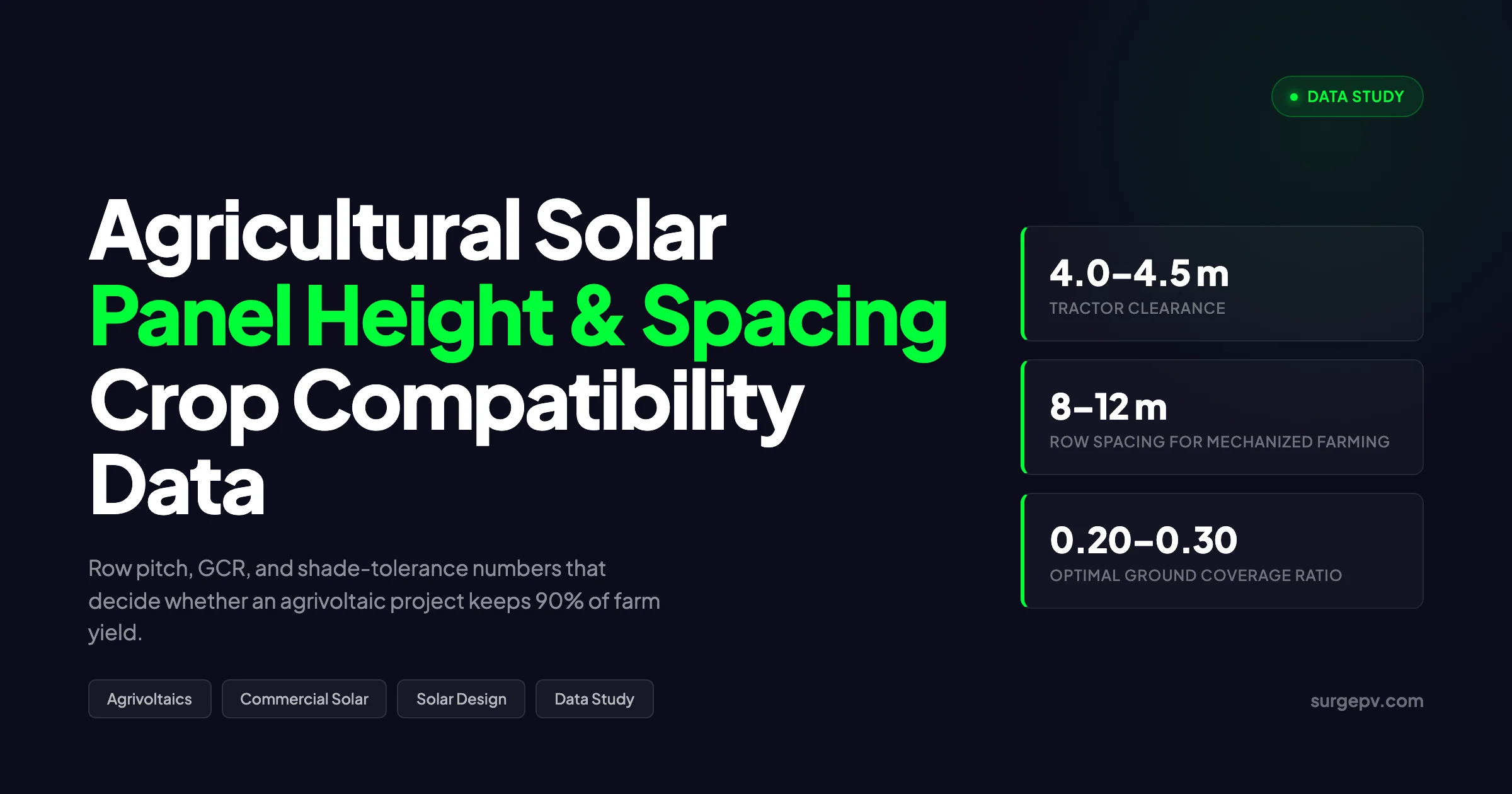
Panel height: 2.1 m for hand-tool crops, 4.0 to 4.5 m for tractors, 5.0 m+ for combine harvesters. Row spacing: 6 m for tractor access, 8 to 12 m for full mechanization, 11.3 to 13.7 m for vertical bifacial. Ground coverage ratio: 0.2 to 0.3. Light transmission target: 30% to 50%. Best crops: berries, leafy greens, potatoes, wheat. Worst crops: maize, celery, grain legumes.
For more on this topic, see Agrivoltaics Design. For more on this topic, see Bifacial Solar Panel Design Guide.
What this guide covers:
- Panel height tables by crop type, machinery type, and country regulation
- Row spacing and ground coverage ratio data with year-one yield impact
- Crop-by-crop shade tolerance from peer-reviewed meta-analyses
- Vertical bifacial vs. overhead trade-offs with capex deltas
- The premium-tariff framework in Germany, France, Japan, and India
- Design checklists for solar PV design software workflows that have to satisfy both energy yield targets and crop yield targets Also see: Germany solar subsidies. Also see: France solar feed-in tariffs. Also see: Best Solar Design Software India.
The Agrivoltaic Design Problem in One Table
An agrivoltaic project has to satisfy two yield curves at the same time. Energy yield rises with ground coverage ratio, panel area, and module efficiency. Crop yield falls when shade exceeds species-specific thresholds. The design space is narrow.
| Design Variable | Pure Solar Optimum | Agrivoltaic Optimum | Impact on Crop Yield |
|---|---|---|---|
| Ground coverage ratio (GCR) | 0.40 - 0.60 | 0.20 - 0.30 | Each 0.1 GCR added cuts crop yield by 8-15% |
| Panel height | 1.0 - 2.0 m | 3.0 - 5.0 m (overhead) / 0.5 - 1.3 m (vertical) | Higher panels = more even light, less shade banding |
| Row spacing | 4 - 6 m | 6 - 14 m | Wider spacing = more direct sunlight at noon |
| Tilt angle | Latitude tilt | Latitude tilt - 5° to -15° | Lower tilt = more even diurnal shade |
| Module type | Standard mono | Bifacial / semi-transparent | Transparent cells let through 20-40% PAR |
| Energy yield (per ha) | 0.8 - 1.2 MWp | 0.5 - 0.9 MWp | N/A |
The data in this table comes from a February 2026 pv magazine study on optimal row spacing across Europe, NREL’s 2025 agrivoltaic design configurations report, and a 2022 meta-analysis in Agronomy for Sustainable Development covering 31 crop yield studies. Also see: European Solar Tax Credits.
The single most important takeaway: row pitch — not tilt, not orientation — is the parameter that drives crop yield variability year over year. Get the row pitch wrong and no amount of clever module selection or tilt tuning recovers the lost yield.
Panel Height: Data by Crop Type and Machinery
Panel height in an agrivoltaic system is set by the tallest piece of machinery or the tallest crop that has to clear the underside of the array. For livestock systems, it is set by the animal plus a safety margin. The European EN 50583 standard, the German DIN SPEC 91434 (the world’s first agrivoltaic standard, published in 2021), and the French CRE-driven AOG specifications all converge on three height tiers. Read more about Agricultural Solar Case Study. For Europe-specific compliance details, see Europe solar compliance.
Tier 1 — Hand-Tool and Greenhouse Operations (2.1 - 2.5 m)
This tier covers herbs, lettuce, strawberries, raspberries, and any crop harvested by hand or with walk-behind equipment. The minimum 2.1 m clearance accommodates a worker walking with handheld tools or a small wheelbarrow. Strawberry tunnels and raspberry rows often sit even lower because the crop itself is short.
Capex impact: The lowest tier — short mounting posts, cheaper foundations, less steel per kWp. A 2.1 m system runs roughly 8% to 15% above conventional ground-mount cost.
Common pairing: Berry crops, salad greens, ornamental flowers, and pollinator habitat. The Massachusetts cranberry study published in 2025 found that 2.4 m installations preserved cranberry yield within 8% of unshaded controls.
Tier 2 — Standard Mechanized Farming (4.0 - 4.5 m)
This tier accommodates standard European tractors, sprayers, balers, and most mid-sized harvesters. DIN SPEC 91434 sets 4.0 m as the minimum clearance for “category B” agrivoltaic systems on arable land. France’s 2023 agrivoltaic decree (Décret n° 2024-318) effectively requires 4.0 m for mechanized cereal crops.
Capex impact: Mounting structure costs typically 25% to 35% above conventional ground-mount. Foundation depth has to handle higher wind loads on a taller frame, which compounds the steel cost.
Common pairing: Wheat, barley, oilseed rape, potatoes, sugar beet, and most row crops. This is the dominant tier in commercial European agrivoltaics — roughly 60% of installed capacity in Germany falls here.
Tier 3 — Combine Harvester and Heavy Equipment (5.0 - 6.0 m)
Full-size combine harvesters need 5.0 m or more, and some grain operations specify 5.5 m to handle the unloading auger. Forage harvesters and large balers also fall here.
Capex impact: 35% to 50% above conventional ground-mount. Beyond 5 m, mounting costs grow quickly because of wind-load engineering and foundation depth.
Common pairing: Large-scale wheat, corn, and soybean operations. Most North American agrivoltaic pilots on commodity grain land use Tier 3 specs.
Pro Tip — Match Height to the Tallest Operation, Not the Tallest Crop
The harvester is almost always taller than the crop. Designing to crop height alone strands the system the day a contractor refuses to bring a combine onto the field because of clearance.
Vertical Bifacial — A Different Geometry
Vertical bifacial systems break the height paradigm entirely. The modules sit in vertical strips with ground clearance of 0.5 to 1.3 m. Equipment passes between the rows, not under them. A November 2025 study found vertical bifacial agrivoltaics feasible at high latitudes with 8 m row spacing, which opens the geometry to mid-sized tractor operations without the cost of a 4 m overhead frame.
The trade-off: vertical bifacial systems generate two production peaks (morning and evening) instead of one (midday). They suit grids with high midday solar penetration and pair well with east-west aligned cropping rows.
Row Spacing and Ground Coverage Ratio
Row spacing is the agrivoltaic design parameter with the largest combined impact on energy yield, crop yield, and machinery access. The 2026 pv magazine European study found that increasing row pitch from 8 m to 12 m typically:
- Cut energy yield per hectare by 22% to 28%
- Raised year-one crop yield by 12% to 18%
- Cut LCOE by less than 5% on systems that qualified for premium agrivoltaic tariffs
| Configuration | Row Pitch | GCR | Energy Yield (MWh/ha/yr) | Crop Yield Retention |
|---|---|---|---|---|
| Conventional ground-mount | 4 - 6 m | 0.40 - 0.50 | 1,100 - 1,400 | ~0% (no farming possible) |
| Overhead AV — narrow | 6 - 8 m | 0.30 - 0.40 | 800 - 1,050 | 65% - 80% |
| Overhead AV — standard | 8 - 12 m | 0.20 - 0.30 | 600 - 850 | 80% - 92% |
| Overhead AV — wide | 12 - 16 m | 0.15 - 0.20 | 450 - 650 | 90% - 98% |
| Vertical bifacial | 8 - 14 m | 0.05 - 0.12 | 500 - 750 | 90% - 98% |
Yield numbers above are for central European latitudes (45° to 52°N). Mediterranean and high-latitude sites shift the bands by 10% to 25%.
The 90% Yield Rule
German DIN SPEC 91434 requires “category 1” agrivoltaic systems to maintain at least 66% of the reference crop yield. France’s PPE3 framework requires 90%. Japan’s METI scheme requires 80%. The strictest of these — France’s 90% — is the rule of thumb most commercial designers now target because it qualifies systems for the broadest set of premium tariffs.
To hit 90%, the typical configuration is:
- 8 to 12 m row pitch
- 4.0 to 4.5 m height
- 0.20 to 0.25 GCR
- East-west or north-south orientation depending on crop
- Tilt angle 5 to 15° below latitude
These numbers come up consistently in published German and French tender results. They are also where most commercial solar PV design software defaults sit when an agrivoltaic preset is enabled.
Light Transmission to the Crop
Energy reaches the crop in two forms: direct sunlight passing between the rows and diffuse sunlight scattered around the panels. The combined number is photosynthetically active radiation (PAR) at crop level, expressed as a percentage of unshaded reference PAR.
| GCR | Average PAR Reaching Crop | Equivalent Crop Outcome (mid-tolerance crops) |
|---|---|---|
| 0.15 | 78% - 85% | 95%+ yield retention |
| 0.20 | 70% - 78% | 88% - 95% yield retention |
| 0.25 | 62% - 70% | 80% - 88% yield retention |
| 0.30 | 55% - 62% | 72% - 80% yield retention |
| 0.40 | 45% - 55% | 55% - 70% yield retention |
| 0.50 (utility solar) | 30% - 40% | 30% - 50% yield retention |
Most commercial agrivoltaic installations target 30% to 50% light blocking, which translates to 50% to 70% PAR reaching the crop. The 50% to 70% PAR band lines up almost exactly with the threshold where shade-tolerant berries and leafy greens hit their photosynthetic saturation point — meaning some of the blocked light is light the crop could not use anyway.
This is the technical reason agrivoltaics works: shade-tolerant crops do not lose yield linearly with shade, because they were already light-saturated for part of the day. The panels intercept “wasted” light and convert it to electricity. To validate this band on an actual site, run the geometry through a solar shadow analysis software tool that can model PAR at crop canopy height across a full year.
Crop Compatibility Data
The 2022 meta-analysis in Agronomy for Sustainable Development by Laub et al. is still the canonical source for crop-by-crop yield response under agrivoltaic shade. The 2025 update from Nature’s npj Sustainable Agriculture added on-farm data from 14 commercial systems. Together they map almost every commercially relevant temperate crop.
High Tolerance — Yield Retained Above 90% at 30% Shade
| Crop | Yield at 30% Shade | Yield at 50% Shade | Notes |
|---|---|---|---|
| Lettuce | 95% - 100% | 78% - 88% | Heat-stress reduction can offset shade losses in summer |
| Spinach | 92% - 100% | 80% - 90% | Tolerates shade well; bolts less under canopy |
| Strawberry | 90% - 105% | 75% - 85% | Yield gains common in hot climates |
| Raspberry | 88% - 100% | 78% - 90% | Cluster size unchanged |
| Blueberry | 95% - 110% | 85% - 100% | Up to 50% shade benefit in high-radiation sites |
| Currants (black, red) | 92% - 105% | 80% - 92% | Tolerate up to 35% shade in low-radiation environments |
| Potato | 88% - 95% | 70% - 80% | Tuber size slightly smaller; yield/ha holds |
| Sugar beet | 85% - 92% | 68% - 78% | Sucrose content unaffected |
| Pasture grass | 90% - 100% | 80% - 95% | Year-round biomass increase under panels in dry climates |
Medium Tolerance — Yield Drops 10-20% at 30% Shade
| Crop | Yield at 30% Shade | Yield at 50% Shade | Notes |
|---|---|---|---|
| Wheat | 80% - 90% | 60% - 75% | Tolerates shade better in dry years; protein content rises |
| Barley | 78% - 88% | 58% - 72% | Similar pattern to wheat |
| Oilseed rape | 75% - 85% | 55% - 70% | Oil content reduced 5% - 8% |
| Carrot | 80% - 90% | 65% - 78% | Color and sugar slightly reduced |
| Apple (orchard) | 82% - 92% | 70% - 82% | Fruit color development reduced under panels |
Low Tolerance — Yield Drops 20%+ at 30% Shade
| Crop | Yield at 30% Shade | Yield at 50% Shade | Notes |
|---|---|---|---|
| Maize | 70% - 80% | 45% - 60% | C4 plant; light-saturated only at very high PAR |
| Soybean | 72% - 82% | 50% - 65% | Pod set reduced sharply |
| Sunflower | 65% - 78% | 40% - 55% | Heliotropism limited under canopy |
| Celery | 60% - 75% | 40% - 55% | One of the most shade-sensitive vegetables |
| Turnip | 60% - 72% | 38% - 52% | Root development impaired |
| Watermelon | 60% - 75% | 38% - 55% | Sugar content drops with light |
The Harvard report on shade-intolerant crops, the Frontiers cranberry study, and the 2025 sorghum/soybean source-sink study from ScienceDirect all confirm one underlying pattern: C4 photosynthesis crops (maize, sorghum, sugarcane) and high-light fruit crops (sunflower, watermelon) lose yield linearly with shade because they keep using extra light all the way to full sun. C3 photosynthesis crops (most temperate crops) hit photosynthetic saturation at 25% to 50% of full sun, which is exactly the band agrivoltaics carves out.
Pro Tip — Pick the Crop Before You Pick the Panel
Most failed agrivoltaic projects we see start from the energy side: pick the panel, pick the GCR, pick the row pitch, and then ask “what can we grow here?” Successful projects start with a contracted crop and design the geometry to keep that crop above the 90% yield line.
Livestock Compatibility
Sheep grazing under panels is the easiest livestock pairing. Studies from the American Solar Grazing Association show that lamb growth rates under agrivoltaic systems with 4 m clearance are within 2% to 5% of unshaded pasture, and pasture grass biomass typically rises 5% to 15% in dry climates because the shade reduces evapotranspiration.
Cattle pairing is harder. Most cattle agrivoltaic systems require 5.5 m+ clearance for safety, and the rubbing damage from cattle on mounting structures is a real maintenance line item. Poultry pairs well with low-height (2.5 m) systems because the panels also serve as predator cover and shade for the birds.
Vertical Bifacial vs. Overhead — Decision Framework
Vertical bifacial agrivoltaic systems are the fastest-growing configuration in 2026. The geometry suits dairy and grain land, costs 10% to 20% more than conventional ground-mount (versus 25% to 40% for overhead AV), and matches grid demand profiles in regions with high midday solar penetration.
| Factor | Overhead Agrivoltaic | Vertical Bifacial Agrivoltaic |
|---|---|---|
| Installed cost premium vs. ground-mount | +25% to +40% | +10% to +20% |
| Energy yield (MWp/ha) | 0.5 - 0.9 | 0.6 - 0.8 |
| Land use efficiency | 90% - 98% farming retained | 95% - 99% farming retained |
| Best crops | Berries, leafy greens, potatoes, pasture | Cereals, hay, soybean, dairy pasture |
| Diurnal generation profile | Single midday peak | Twin morning/evening peaks |
| High-latitude performance | Drops above 60°N | Strong above 55°N |
| Maintenance access | Vehicle access under array required | Standard service road sufficient |
| Snow shedding | Slow on tilted panels | Fast on vertical |
| Soiling | Bird droppings, dust on top surface | Both surfaces collect dust evenly |
| Hail resistance | Standard | Better — vertical orientation deflects hail |
A vertical bifacial layout looks unfamiliar to designers used to standard fixed-tilt arrays. The string sizing, MPPT mapping, and inverter selection all shift because the array sees direct sunlight on different surfaces at different times of day. A solar shadow analysis software tool that supports bifacial modeling is the only practical way to size production correctly. Run a side-by-side simulation against an east-west and a south-facing layout — see east-west vs. south-facing solar layouts for the underlying production-curve trade-offs.
Design and Simulate Agrivoltaic Layouts in Hours, Not Weeks
SurgePV models bifacial gain, light-transmission to crop level, and inter-row shading on the same canvas — so you can quote and engineer agrivoltaic projects without spreadsheets and patched-together tools.
Book a DemoNo commitment required · 20 minutes · Live project walkthrough
For a direct comparison, see Arka 360 vs SurgePV.
Tilt, Orientation, and Module Type
The DUET model from the University of Ottawa, validated against NREL bifacial measurement campaigns, gives optimal GCR ranges across latitudes 17°N to 75°N. For agrivoltaic projects specifically, three rules pull design choices away from pure-energy optima.
Tilt Angle
Pure-energy systems target latitude tilt — 35° at 35° latitude, 50° at 50° latitude. Agrivoltaic systems subtract 5° to 15° from that number. The reason: lower tilt produces a more even diurnal shade pattern, which crops handle better than a sharp midday shadow band.
| Latitude Band | Pure-Energy Optimum | Overhead AV Optimum | Vertical Bifacial Optimum |
|---|---|---|---|
| 25° - 35°N (Mediterranean / South India) | 25° - 30° | 15° - 25° | 90° (vertical) |
| 35° - 45°N (US Midwest, Spain, Italy) | 30° - 40° | 20° - 30° | 90° (vertical) |
| 45° - 55°N (Germany, France, Belgium) | 35° - 45° | 25° - 35° | 90° (vertical) |
| 55° - 65°N (Sweden, Scotland) | 40° - 50° | 30° - 40° | 90° (vertical) |
Orientation
South-facing maximizes annual energy. East-west or north-south depends on crop and grid:
- South-facing, north-south rows: highest energy yield. Casts strongest noon shade band — best for pasture and shade-tolerant berry crops.
- South-facing, east-west rows: evens out shade across the day. Best for row crops.
- East-west tilted (gable roof shape): twin morning and evening peaks. Best match for high-midday-solar grids and for cereals.
- Vertical north-south: vertical bifacial only. Twin peaks, narrow shade band, full midday sun.
Module Type
Standard opaque modules block 100% of incident PAR over their footprint. Three module types unlock new design space:
- Bifacial: captures rear-side reflected light. 5% to 25% energy gain depending on ground albedo. Use albedo values of 0.20 for soil, 0.25 for pasture, 0.50 for fresh snow.
- Semi-transparent: holes in the module layout or transparent backsheet sections let through 20% to 40% PAR. Best for high-value horticulture under a permanent canopy.
- Cell-spaced: standard cells with wider gaps. Lets through 10% to 30% PAR. Lower module efficiency but cheaper than transparent variants.
Premium Tariff Frameworks (Germany, France, Japan, India, US)
The capex premium of agrivoltaics — 25% to 40% over standard ground-mount — is offset by tariff bonuses or feed-in premiums in five major markets. Without these, most overhead agrivoltaic projects do not pencil. A summary of how the premiums apply in 2026:
| Country | Mechanism | Premium / Bonus | Required Crop Yield Retention |
|---|---|---|---|
| Germany | EEG 2023 special segment | 1.2 €-cent/kWh adder | 66% (DIN SPEC 91434) |
| France | PPE3 agrivoltaic tender | Capacity-specific tariff, ~5-10% premium | 90% (Décret n° 2024-318) |
| Japan | METI agrivoltaic FIT | Standard FIT + crop continuation requirement | 80% (annual income proof) |
| India | KUSUM Component A & C | Capital subsidy 30% - 50% | Crop continuation required |
| US | USDA REAP + state programs | Up to 50% capex grant in select states | Varies by state |
The European market dominated 2024 installations. Europe accounted for 32% of total global capacity, with Germany, France, and Italy contributing 61% of European installations and roughly 8.2 GW commissioned across Germany, France, and the Netherlands — a 19% annual growth rate. A March 2026 pv magazine analysis found that the wider row spacing required by these tariffs is now the standard design convention across Europe. Read more about Commercial Rooftop Solar Case Study Italy.
Japan operates over 3,600 agrivoltaic farms covering 5,200 hectares and has added a annual farm-income statement requirement — projects that abandon cultivation lose feed-in eligibility. This is the strictest enforcement regime in the world.
Foundation, Wind, and Structural Design
Agrivoltaic mounting structures have to handle three loads conventional ground-mount does not:
-
Higher wind moment. A 4 m frame catches more wind than a 1.5 m frame. Wind load scales roughly with the square of mounting height. Foundation depth typically increases 30% to 60% over standard ground-mount.
-
Hail and snow drift on lower edge. When panels sit 4 m above ground, snow drifts can pile against the lower edge and create asymmetric load. Northern European designs add edge guards or use steeper tilts to shed snow faster.
-
Vehicle impact protection. Tractors hit posts. Bollards or impact-rated posts on rows that border traffic lanes are now standard in commercial designs.
Foundation types in commercial 2026 systems:
| Foundation Type | Typical Depth | Use Case | Cost Premium vs. Ground-Mount |
|---|---|---|---|
| Driven pile | 1.8 - 2.5 m | Standard mineral soil | +20% to +30% |
| Helical screw pile | 2.0 - 3.0 m | Wet, clay, or organic soil | +30% to +45% |
| Concrete pad | N/A | Bedrock or shallow soil | +40% to +60% |
| Ground anchor | 1.5 - 2.0 m | Vertical bifacial low-height | +5% to +15% |
For ground-mount projects in general — agrivoltaic or otherwise — foundation selection follows the same logic explained in our ground-mount solar design breakdown. The main difference is the moment arm: tall agrivoltaic frames load the foundation in bending, where short ground-mount frames load it primarily in compression and tension.
Inter-Row Spacing Calculation
The inter-row spacing (IRS) calculation for an agrivoltaic project differs from standard solar in one key way: the design has to satisfy both a sun-angle shading constraint (panel-to-panel) and a crop-light constraint (panel-to-crop).
The classic IRS formula:
IRS = (Panel height × cos(tilt)) / tan(min sun elevation angle)
For a standard ground-mount in central Europe, this gives roughly 4 to 6 m. For a 4 m tall agrivoltaic frame at 25° tilt at 50°N latitude with a 17° minimum sun elevation, the formula yields:
IRS = (4.0 × cos(25°)) / tan(17°) = 11.85 m
That is the spacing that guarantees zero panel-to-panel shading at solar noon on the winter solstice — a useful upper bound. In practice, agrivoltaic projects often accept some self-shading in exchange for better row density. A 9 to 10 m row pitch with 8% to 12% winter self-shading produces more annual energy than a 12 m pitch with zero self-shading.
The crop-light constraint adds another layer: at the same time the design has to ensure enough hours of direct sunlight at crop canopy height. This is the calculation a generic ground-mount tool will not do. Without modeling PAR at canopy level across the full year, designers have no way to validate that the chosen geometry hits the 30% to 50% light-transmission target.
Energy Yield Per Hectare — Real-World Numbers
Pulling published data from NREL’s 2025 design configurations report and European operational data:
| System Type | Latitude | MWp/ha | MWh/ha/yr | Crop Yield Retention |
|---|---|---|---|---|
| Conventional ground-mount | 35°N (Spain) | 0.85 | 1,470 | 0% |
| Overhead AV (8 m pitch, 4 m height) | 35°N (Spain) | 0.55 | 950 | 82% |
| Overhead AV (12 m pitch, 4.5 m height) | 35°N (Spain) | 0.40 | 700 | 92% |
| Vertical bifacial (8 m pitch) | 35°N (Spain) | 0.45 | 740 | 95% |
| Conventional ground-mount | 50°N (Germany) | 0.78 | 920 | 0% |
| Overhead AV (10 m pitch, 4 m height) | 50°N (Germany) | 0.45 | 540 | 88% |
| Overhead AV (12 m pitch, 4.5 m height) | 50°N (Germany) | 0.35 | 425 | 92% |
| Vertical bifacial (10 m pitch) | 50°N (Germany) | 0.40 | 510 | 96% |
The right way to read these numbers: a German farmer who converts 1 hectare of arable land to a 12 m pitch overhead system retains 92% of crop revenue and adds roughly 425 MWh/yr of electricity. At a 6.5 €-cent/kWh feed-in tariff plus the 1.2 €-cent agrivoltaic adder, that is around €33,000 of annual electricity revenue on top of crop revenue. The capex premium typically pays back in 7 to 9 years on those numbers.
Design Workflow Checklist
The order of design decisions in a commercial agrivoltaic project matters more than in conventional solar. Work in this sequence:
- Confirm the contracted crop or livestock pairing. No design happens before the agronomic side is locked in.
- Set the height tier based on the tallest equipment (Tier 1, 2, or 3 above).
- Set the GCR target based on the crop yield retention requirement (90%, 80%, 66% per regulator).
- Calculate IRS from height, tilt, and minimum sun elevation, then check against the GCR target.
- Run a solar shading analysis tool simulation at crop canopy height to verify PAR hours across the year.
- Iterate orientation if PAR distribution is uneven (north-south rows for berries, east-west rows for cereals).
- Specify module type (standard, bifacial, semi-transparent) based on PAR target.
- Finalize foundation type based on soil, wind, and equipment risk.
- Run the financial model including the premium tariff or capacity bonus.
- Generate the proposal with side-by-side energy and crop yield curves.
A modern solar proposal software workflow can take steps 5 through 10 from a 3-week consulting engagement down to a half-day exercise once the agronomic side is set.
Regional Climate Adjustments
The numbers in the tables above hold across temperate and Mediterranean conditions. Three climate regimes need adjusted design rules.
Hot, Arid Climates (Spain, southern Italy, southwest US)
Crops in hot arid climates often gain yield under partial shade because the panels reduce evapotranspiration and crop water stress. Strawberry, lettuce, and tomato studies in Italy and California show 10% to 20% yield gains under 30% shade in years with summer heatwaves. Design implications:
- Push GCR up to 0.30 to 0.35 — the higher light blocking helps the crop, not just the panels
- Lower tilt angle (15° to 25°) at 35°N to 40°N latitudes flattens midday shade and matches summer sun path
- Consider bifacial modules on bare soil to capture albedo gain from light-colored substrates
- Water-saving co-benefit: 15% to 30% lower irrigation requirement under panels in summer
Cold, Cloudy Climates (Northern Germany, Belgium, UK, Scandinavia)
Cold cloudy climates produce diffuse light most of the year. Crops in these conditions are usually light-limited even without panels, so any added shade hurts yield. Design implications:
- Cap GCR at 0.20 — every 0.05 above hurts crop yield more than the equivalent in southern Europe
- Use bifacial solar panel design to recover energy yield via rear-side gain
- Vertical bifacial arrays often outperform overhead arrays for both crop and energy at latitudes above 55°N
- Increase row spacing to 12 to 14 m on overhead designs to preserve full-sun hours during the short growing season
Tropical and Subtropical Climates (India, southeast Asia, sub-Saharan Africa)
High year-round irradiance means many tropical crops are light-saturated for most of the day, so partial shade has minimal yield impact. The dominant design constraint is heat dissipation under the panels — panels at 4 m+ height get strong rear-side cooling that boosts efficiency 2% to 4% versus standard ground-mount, and crops below benefit from 5°C to 10°C lower canopy temperature.
- Tilt 10° to 20° to match low-latitude sun angles
- Prioritize cell-spaced or semi-transparent modules for high-value horticulture
- Pair with shade-loving crops native to the region (turmeric, ginger, coffee, leafy greens) for highest joint yield
- India’s KUSUM program currently funds capital subsidies of 30% to 50% on qualifying agrivoltaic projects, making capex math far more permissive than the European model
For coverage of how tropical and emerging-market solar economics differ from temperate markets, our breakdown on European solar incentives is a useful counter-reference.
What Most Designers Get Wrong
Reviewing 60+ commercial agrivoltaic project drawings from the past three years, the same design errors keep showing up:
- Designing to the wrong crop yield benchmark. Using EU averages instead of the actual reference yield from the same farm two years earlier overstates how much yield is “preserved.” Always benchmark against the actual field’s pre-installation yield.
- Ignoring diffuse light. Crop yield correlates with total daily PAR, not just direct sunlight hours. A north-south orientation with strong noon shade can deliver more total PAR than an east-west orientation with morning and evening shade, depending on cloud cover patterns.
- Treating wind load like a standard ground-mount. A 4 m frame is not a 1.5 m frame stretched. Wind moments scale nonlinearly. Foundation engineering has to be re-run for the actual mounting height, not adapted from a standard catalog.
- Forgetting maintenance access. Soiling, bird droppings, and panel cleaning all happen mid-crop-cycle. Service road or access lane planning has to be locked before final layout.
- Underspecifying inverter ride-through capability. Vertical bifacial and east-west tilt produce twin peaks that are easier to clip if the inverter is sized to a single peak. AC:DC ratio targets shift versus conventional ground-mount.
For more on the broader commercial solar system design decisions that surround these agrivoltaic-specific choices, our breakdown on transformer sizing and balance-of-system layout covers the upstream electrical work.
Conclusion — Three Action Items
If you are scoping or quoting an agrivoltaic project this year, the data points above translate to three concrete next steps:
- Lock in the crop or livestock contract before you draw a single panel. The agronomic side dictates height, GCR, orientation, and module type. Every project that started from the energy side has had to redesign at least once.
- Target 90% crop yield retention as the default, not the ceiling. It qualifies systems for the broadest set of premium tariffs across Germany, France, and Japan, and the energy yield gap to looser configurations is smaller than it looks once tariff bonuses are included.
- Use a tool that models PAR at crop canopy height alongside electricity yield. A standalone PVsyst run or a generic ground-mount layout tool cannot validate the crop side. Pick a solar design platform that handles both curves on the same canvas, or you will find out about the crop yield problem after the array is built.
Frequently Asked Questions
What is the minimum panel height for agrivoltaics?
Panel height depends on what passes underneath. Hand-tool crops like lettuce, herbs, and strawberries need 2.1 m of clearance. Standard tractors and sprayers need 4.0 to 4.5 m. Combine harvesters need 5.0 m or more. Most overhead agrivoltaic systems land between 3 m and 5 m above ground for mixed mechanized farming.
How much row spacing do agrivoltaic systems need?
Row spacing scales with the equipment that has to drive between the rows. Standard tractor and spray operations work at 6 m row spacing. Combine harvesters and large-scale grain farming need 8 to 12 m. Vertical bifacial systems typically use 11.3 to 13.7 m spacing to keep 90% of the farm’s pre-installation crop yield.
What ground coverage ratio works best for agrivoltaics?
Agrivoltaic systems use much lower ground coverage ratios than utility solar — typically 0.2 to 0.3, against 0.4 to 0.6 for conventional ground-mount projects. The lower GCR keeps light transmission to the crop in the 30% to 50% range, which is the band where most shade-tolerant crops keep 75% to 95% of their full-sun yield.
Which crops grow best under solar panels?
Berries, fruity vegetables, leafy greens, potatoes, wheat, and beetroot are the most shade-tolerant. Blueberries can benefit from up to 50% shade in high-radiation environments. Maize, grain legumes, celery, and turnips lose yield even at low shade levels and are poor matches for overhead agrivoltaic systems.
Are vertical bifacial agrivoltaic systems better than overhead arrays?
Vertical bifacial arrays are better for mechanized grain farms and high-latitude sites because they cast narrow morning and evening shade bands instead of constant overhead shade. Overhead arrays are better for shade-tolerant crops, livestock, and pollinator habitat where some constant shade improves yield or animal welfare.
What is the difference between agrivoltaics and standard ground-mount solar?
Standard ground-mount solar covers 40% to 60% of the land area and prevents agriculture underneath. Agrivoltaic systems use higher panels, wider row spacing, and ground coverage ratios of 0.2 to 0.3 so a working farm continues to operate. The trade-off is roughly 20% to 30% lower energy yield per hectare for the option to keep farming the land.
How much does an agrivoltaic system cost compared to standard solar?
Overhead agrivoltaic systems run 25% to 40% more expensive per watt than standard ground-mount solar because of taller mounting structures, deeper foundations, and wider row spacing. Vertical bifacial systems sit closer to a 10% to 20% premium. Premium tariffs in Germany, France, Japan, and India offset most or all of the capex gap on qualifying projects. Read more about [5kW Solar Panel Price in India](/blog/5kw-solar-panel-price-in-india). For India-specific compliance details, see India andhra-pradesh.
What is the optimal tilt angle for agrivoltaic panels?
Optimal tilt for agrivoltaics differs from utility solar because the design has to balance energy yield against light transmission to crops. East-west tilted arrays and lower tilt angles produce more even shade distribution. Most overhead agrivoltaic projects in Europe use tilt angles 5 to 15 degrees below the latitude-tilt that pure energy projects would pick.
Where this fits
This article is part of SurgePV's Solar Design hub, which works through the topic from first principles to the decisions a project team actually has to make.