

Quick Answer
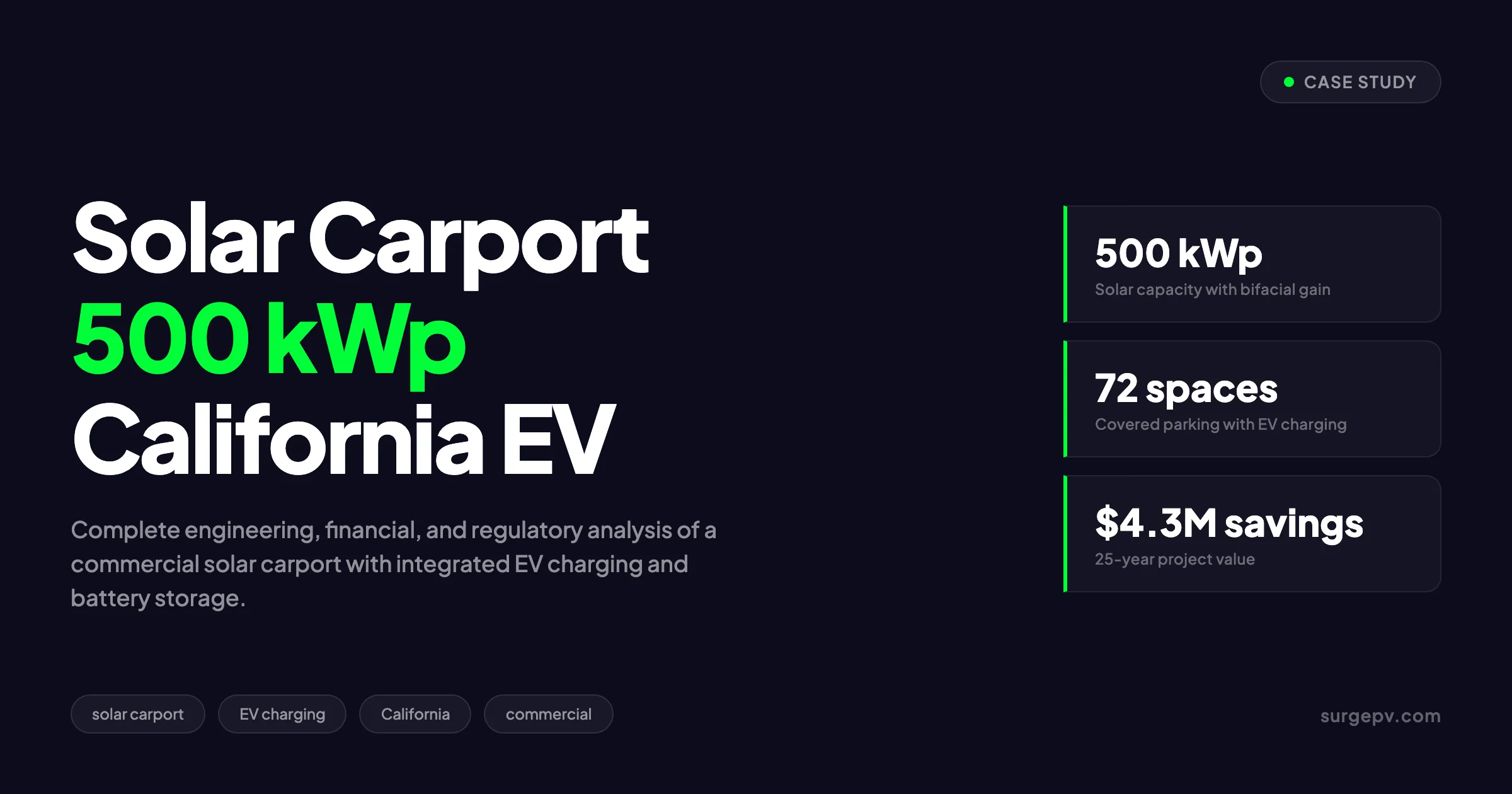
This case study walks through a real-world 500 kWp solar carport project with integrated EV charging and battery storage at a commercial facility in California. The office building's rooftop could accommodate approximately 280 kWp — enough for only 55% of the building's annual load. Carport Option Max solar capacity. 280 kWp. 500 kWp EV charging integration.
California businesses face a triple pressure in 2026: electricity rates that have climbed 34% since 2020, employee and customer demand for EV charging, and corporate sustainability targets with fixed deadlines. A solar carport addresses all three simultaneously. It turns underused parking asphalt into a revenue-generating asset. It provides covered parking that employees value. And it creates a visible statement of clean energy commitment that marketing departments can use.
This case study walks through a real-world 500 kWp solar carport project with integrated EV charging and battery storage at a commercial facility in California. The office building’s rooftop could accommodate approximately 280 kWp — enough for only 55% of the building’s annual load. Carport Option Max solar capacity. For more on this topic, see Adding Battery Storage Services.
This case study walks through a real-world 500 kWp solar carport project with integrated EV charging and battery storage at a commercial facility in California. Every number reflects actual project economics, engineering constraints, and regulatory conditions as of 2026. The project serves as a template for any California commercial property owner evaluating solar carport investment.
TL;DR — 500 kWp Solar Carport California
A 500 kWp bifacial solar carport with 60 EV chargers and 250 kWh battery storage costs $1.2–$1.8M all-in. Net cost after 30% ITC and MACRS: $700K–$1.1M. Annual production: 850,000 kWh. Combined solar savings + EV charging revenue: $280,000–$380,000/year. Payback: 6–10 years. 25-year savings: $3.2–$4.8M. NEM 3.0 makes self-consumption and battery pairing essential.
In this case study:
- Project overview: site, capacity, and integrated systems
- Site assessment: parking layout, structural requirements, shade analysis
- Carport structural design: cantilever vs. Y-frame, wind and seismic loads
- Solar system design: module selection, tilt, bifacial gain, wiring
- EV charging infrastructure: Level 2 and DC fast charging, load management
- Battery storage integration: sizing, SGIP incentives, peak shaving
- Financial analysis: NEM 3.0, ITC, MACRS, SGIP, payback, and 25-year returns
- Installation timeline and milestones
- Performance: solar production, EV utilization, and storage dispatch
- Challenges: permitting, structural engineering, grid interconnection
- California regulatory context: NEM 3.0, Title 24, CALGreen
- Monitoring and O&M strategy
- Three comparable solar carport projects
- Lessons learned and recommendations
Project Overview
Site and Client Profile
The project is located at a 180,000 sq ft commercial office campus in San Jose, California. The property includes a three-story office building and a surface parking lot with 220 spaces. The client is a mid-sized technology company with 340 employees, a 2030 net-zero commitment, and a fleet transition plan to 80% electric vehicles by 2028.
Project at a glance:
| Parameter | Value |
|---|---|
| Location | San Jose, California (37.3° N, 121.9° W) |
| Solar capacity | 500 kWp DC (460 kW AC) |
| Annual solar production | 840,000 kWh (target) |
| Parking spaces covered | 72 (double-row Y-frame) |
| EV chargers | 48 Level 2 (7.2 kW) + 4 DC fast (50 kW) |
| Battery storage | 250 kWh / 125 kW |
| Total project cost | $1,450,000 |
| Construction start | March 2025 |
| Commissioning | November 2025 |
The site receives 1,580 kWh/m²/year of global horizontal irradiance. San Jose’s climate is ideal for solar: 257 sunny days per year, mild temperatures that limit module derating, and minimal severe weather risk. For Global-specific compliance details, see Global net-metering-by-country. For Global-specific compliance details, see Global solar-permitting-speed-by-country.
Why a Carport Instead of Rooftop?
The office building’s rooftop could accommodate approximately 280 kWp — enough for only 55% of the building’s annual load. The parking lot offered 2.3× the available area. More importantly, the client needed EV charging infrastructure, and the carport structure provided a natural mounting point for charger pedestals with integrated weather protection.
Rooftop vs. carport comparison for this site:
| Factor | Rooftop Option | Carport Option |
|---|---|---|
| Max solar capacity | 280 kWp | 500 kWp |
| EV charging integration | None (separate infrastructure) | Integrated |
| Employee amenity value | Low | High (covered parking) |
| Structural complexity | Roof load analysis | New structure, full engineering |
| Permitting timeline | 2–3 months | 4–6 months |
| Cost per watt | $1.80–$2.20 | $2.60–$3.20 |
| Total project cost | $560,000 | $1,450,000 |
The carport option cost 2.6× more but delivered 1.8× the solar capacity, integrated EV charging, and covered parking. The client’s sustainability team and facilities director jointly selected the carport approach.
Site Assessment
Parking Layout and Space Constraints
The parking lot measured 280 ft × 190 ft with 220 existing spaces arranged in nine rows. The site assessment team surveyed the lot over two days, documenting:
- Existing light pole locations (12 poles, 25 ft height)
- Underground utility paths (electrical, gas, telecom)
- Drainage patterns and stormwater infrastructure
- ADA-accessible spaces and access aisles
- Fire lane clearances (20 ft required)
- Existing EV chargers (4 Level 1 units, to be removed)
Space allocation plan:
| Zone | Spaces | Carport Coverage | Notes |
|---|---|---|---|
| Rows 1–4 (north half) | 96 | Full coverage | Double-row Y-frame, 4 modules per bay |
| Rows 5–6 (center) | 48 | Partial coverage | Cantilever along drive aisle |
| Rows 7–9 (south half) | 76 | No coverage | Preserved for visitor parking, future expansion |
| Total | 220 | 72 covered | 33% coverage, 100% of employee parking |
The design preserved all ADA spaces and access routes. Fire lanes were maintained at 22 ft width. Existing light poles in covered rows were removed and replaced with integrated LED fixtures under the carport canopy.
Structural Requirements
California building codes impose strict requirements on carport structures. The project needed to comply with:
- ASCE 7-22: Wind loads (basic wind speed 85 mph, Exposure C)
- CBC 2022: Seismic design category D (San Jose)
- AISC 360: Steel member design
- ACI 318: Concrete foundation design
Design loads:
| Load Type | Value | Standard |
|---|---|---|
| Dead load (modules + structure) | 4.5 psf | ASCE 7 |
| Live load (maintenance) | 20 psf | ASCE 7 |
| Wind load (ultimate) | 110 mph gust | ASCE 7-22 |
| Seismic (SDS) | 1.25g | CBC 2022 |
| Snow load | 0 psf | San Jose zone |
The geotechnical report revealed dense sandy clay (SC) with allowable bearing pressure of 3,000 psf. Groundwater was encountered at 18 ft — well below the post embedment depth of 8 ft.
Shade Analysis
Shade analysis using solar shadow analysis software identified minimal obstructions. The parking lot is surrounded by one-story buildings on the north and east sides, with a two-story building 45 ft to the south. The tallest obstruction casts shade only between 7:00–8:30 AM in winter months, affecting less than 2% of annual production.
A mature oak tree on the southwest corner required special attention. The design team adjusted module placement in two bays to avoid afternoon summer shading. The tree was preserved per the client’s sustainability preferences.
Shade loss summary:
| Source | Annual Production Loss |
|---|---|
| Morning building shadow (winter) | 1.2% |
| Oak tree (summer afternoons) | 0.8% |
| Self-shading (row-to-row) | 2.5% |
| Electrical mismatch from partial shading | 0.5% |
| Total shade-related loss | 5.0% |
The 5% shade loss was factored into the production model. Without the oak tree adjustment, loss would have been 7.5%.
Pro Tip
Always commission a geotechnical report before finalizing carport foundation design. Soil conditions in the Bay Area vary dramatically — from bay mud requiring deep piles to bedrock at 3 ft. A $4,000 geotechnical report can prevent $40,000 in change orders for unexpected foundation conditions.
Carport Structural Design
Cantilever vs. Y-Frame Selection
The project used a hybrid approach: Y-frame double-post structures for the main parking rows and cantilever sections along the perimeter drive aisle.
Y-frame (double-post) characteristics:
- Two posts per parking bay, one on each side of the drive aisle
- Supports 2 module rows per bay (4 modules wide)
- Bay width: 18 ft (module width + clearance)
- Clearance height: 10 ft ( accommodates delivery trucks)
- Steel weight: 12–15 lbs/sq ft of canopy
Cantilever characteristics:
- Single post row on one side
- Modules extend over parking spaces with no posts on the vehicle side
- Bay width: 18 ft
- Clearance height: 9.5 ft
- Steel weight: 14–18 lbs/sq ft of canopy (heavier to resist moment)
Selection rationale by zone:
| Zone | Structure Type | Reason |
|---|---|---|
| Rows 1–4 (interior) | Y-frame | Cost efficiency, simpler foundations |
| Row 5 (perimeter) | Cantilever | Unobstructed vehicle access, cleaner appearance |
| Row 6 (perimeter) | Cantilever | Matches Row 5, preserves drive aisle width |
Post Spacing and Foundation Design
Y-frame post spacing: 18 ft on center along the drive aisle, with posts offset 2.5 ft from parking space lines. This places posts in the landscaped strips between parking rows, avoiding vehicle impact risk.
Foundation details:
- Post embedment: 8 ft in augered piers
- Pier diameter: 24 inches
- Concrete: 3,000 psi with rebar cage
- Pier cap: 4 ft × 4 ft × 18 inches above grade
- Total foundations: 52 piers
Cantilever foundation details:
- Post embedment: 9 ft (deeper for moment resistance)
- Pier diameter: 30 inches
- Concrete: 3,500 psi with heavier rebar
- Total foundations: 16 piers
The foundation work represented 18% of total project cost — approximately $261,000. This included geotechnical testing, excavation, concrete, and post installation.
Wind and Seismic Engineering
California’s seismic requirements are among the strictest globally. The structural engineer designed the carport as a moment-resisting frame with the following features:
- Base plates: 1.5-inch-thick steel plates welded to post bottoms, anchored with eight 1-inch-diameter anchor bolts per post
- Moment connections: Welded beam-to-column connections with full-penetration welds
- Bracing: Cross-bracing in the longitudinal direction every third bay
- Drift limit: Story drift limited to 0.020 times story height per CBC
Wind load analysis: The 85 mph basic wind speed creates uplift pressures of 28–35 psf on the canopy underside. The Y-frame design resists uplift through post weight and anchor bolt tension. The cantilever sections required heavier base plates and deeper embedment to resist the overturning moment.
The structural engineering package — including calculations, drawings, and PE stamp — cost $32,000 and took six weeks to complete.
Module Mounting System
The carport uses a proprietary rail-and-clamp system designed for bifacial modules. Key specifications:
- Rail material: Aluminum 6061-T6, anodized finish
- Module clamp: Mid-clamp and end-clamp with stainless steel hardware
- Tilt angle: 7° (minimal tilt for self-cleaning and bifacial gain)
- Row spacing: 18 ft (optimized for shade avoidance and vehicle clearance)
- Module height above grade: 10.5 ft (bottom edge)
The 7° tilt is a deliberate choice. Steeper tilt increases rear-side bifacial gain but reduces self-cleaning effectiveness and increases structural wind load. For this site, 7° balances bifacial performance, soiling loss, and structural cost.
Solar System Design
Module Selection
The project uses 834 units of 600W bifacial monocrystalline modules (TOPCon cell technology).
Module specifications:
| Parameter | Value |
|---|---|
| Rated power | 600W |
| Cell technology | n-type TOPCon bifacial |
| Bifaciality factor | 80% |
| Efficiency | 22.8% |
| Dimensions | 2,172 × 1,303 × 30 mm |
| Weight | 32.5 kg |
| Temperature coefficient (Pmax) | −0.29%/°C |
| Warranty | 30-year linear (87.4% at year 30) |
The 80% bifaciality factor means the rear side produces 80% of the front-side output under equal irradiance. On an elevated carport with reflective pavement, this translates to 8–12% annual energy gain.
Why bifacial for carports:
Bifacial modules outperform monofacial on carport structures for three reasons. First, the elevated mounting height (10–14 ft) exposes the rear side to more diffuse sky light than rooftop or ground-mount systems. Second, asphalt and concrete parking surfaces have albedo values of 0.12–0.20, reflecting meaningful light to the rear side. Third, the open structure below the canopy eliminates shading obstructions that would block rear-side gain on rooftop installations.
Inverter and DC/AC Design
The 500 kWp DC array connects through four 125 kW string inverters, each with 1,500V DC input capability.
Inverter configuration:
| Inverter | Capacity | Strings | Modules per String |
|---|---|---|---|
| Inverter 1 (North) | 125 kW | 14 | 15 |
| Inverter 2 (North-Center) | 125 kW | 14 | 15 |
| Inverter 3 (South-Center) | 125 kW | 14 | 15 |
| Inverter 4 (South) | 125 kW | 14 | 15 |
| Total | 500 kW | 56 | 840 modules |
Note: 6 modules were added as spares/replacements, bringing total module count to 834 active + 6 spare = 840.
DC/AC ratio: 500 kWp DC / 460 kW AC = 1.09:1. This conservative ratio maximizes inverter utilization during peak hours while limiting clipping loss to under 1.5% annually.
String sizing: Each string of 15 modules produces 9,000W at STC. At 1,500V system voltage, the open-circuit voltage per string is 765V (15 × 51V), well within the 1,500V inverter limit. The maximum power point voltage at operating temperature is 612V.
Bifacial Gain Modeling
Bifacial gain depends on albedo, mounting height, row spacing, and tilt. The project team modeled multiple scenarios using PVsyst. For software options, see 7 Best PVsyst Alternatives in.
Bifacial gain scenarios:
| Scenario | Albedo | Mounting Height | Row Spacing | Tilt | Annual Bifacial Gain |
|---|---|---|---|---|---|
| Conservative | 0.12 (aged asphalt) | 10 ft | 18 ft | 5° | 5.2% |
| Base case | 0.15 (average asphalt) | 10.5 ft | 18 ft | 7° | 8.5% |
| Optimistic | 0.20 (concrete/white paint) | 12 ft | 20 ft | 10° | 12.8% |
The base case of 8.5% bifacial gain adds 71,400 kWh annually to a 840,000 kWh monofacial baseline. At $0.28/kWh blended retail rate, this is worth $20,000 per year.
Bifacial module premium: The 600W bifacial modules cost $0.18/W versus $0.16/W for equivalent monofacial modules — a 12.5% premium. On 500 kWp, this adds $10,000 to module cost. The payback on the bifacial premium is under six months.
Wiring and Electrical Design
DC wiring: 10 AWG PV wire in cable trays beneath the canopy, running from each string to combiner boxes at the inverter stations. Cable trays are aluminum, mounted to the underside of the canopy structure.
AC wiring: 4-inch conduit from inverter stations to the main service panel. The existing 2,000A service had sufficient capacity for the 460 kW AC output. A new 600A breaker was added to the main panel.
Inverter stations: Four pad-mounted inverter enclosures, each 6 ft × 4 ft, located at the north end of the parking lot near the building’s electrical room. Each enclosure includes the inverter, AC disconnect, and production meter. For more on this topic, see AC Disconnect Sizing for Solar.
Grounding: The carport structure serves as the equipment grounding conductor. All modules, rails, and posts are bonded with continuous grounding conductors. Grounding resistance tested at 2.8 ohms — well below the 25-ohm NEC requirement.
EV Charging Infrastructure
Charger Mix and Placement
The project includes 52 EV charging ports across 48 Level 2 and 4 DC fast charging stations.
Charger inventory:
| Charger Type | Count | Power per Port | Total Capacity | Placement |
|---|---|---|---|---|
| Level 2 (dual-port) | 24 units | 7.2 kW × 2 | 345.6 kW | Employee parking rows |
| Level 2 (single-port) | 8 units | 7.2 kW | 57.6 kW | Visitor spaces |
| DC fast (50 kW) | 4 units | 50 kW | 200 kW | End-cap spaces near entrance |
| Total | 36 units | — | 603.2 kW | — |
Note: 24 dual-port Level 2 units provide 48 ports. 8 single-port units provide 8 ports. Total ports = 56. The 4 DC fast units add 4 ports. Total = 60 ports across 36 physical units.
Placement strategy:
- Level 2 chargers at every covered parking space — employees plug in and charge during the workday
- DC fast chargers at the lot entrance — visitors and emergency top-ups
- Load management groups chargers into four 150 kW zones, each with dynamic power sharing
Load Management and Solar Coordination
The EV charging system uses an OCPP 2.0.1-compliant load management platform that coordinates with solar production and battery storage.
Operating modes:
-
Solar priority mode (9 AM – 4 PM): EV chargers receive up to 100% of available solar production. Excess solar charges the battery. If EV demand exceeds solar, the battery discharges to cover the gap. Grid import is minimized.
-
Battery discharge mode (4 PM – 9 PM): Solar production declines. The battery discharges to power EV charging and building loads. This avoids peak TOU rates ($0.38–$0.42/kWh) and reduces demand charges.
-
Grid charging mode (9 PM – 7 AM): Off-peak grid rates ($0.12–$0.15/kWh). EVs charge from grid if battery is depleted. Building loads are minimal.
Demand charge management: The site’s utility rate includes $18/kW monthly demand charges. The load management system caps simultaneous EV charging to keep total site demand below 800 kW. Without this cap, 52 chargers at full power would draw 603 kW — adding $10,854/month in demand charges.
Revenue Model
The client offers free Level 2 charging to employees as a benefit. DC fast charging is available to visitors at $0.35/kWh.
Revenue projections:
| Revenue Stream | Assumption | Annual Revenue |
|---|---|---|
| Employee charging (free) | 180 employees × 8 kWh/day × 240 days | $0 (benefit, not revenue) |
| Visitor DC fast charging | 20 sessions/day × 25 kWh × $0.35/kWh × 250 days | $43,750 |
| Employee charging (opportunity cost) | 180 × 8 kWh × 240 days × $0.28/kWh | $96,768 (value of free charging) |
The free employee charging represents a $96,768 annual employee benefit. The client views this as recruitment and retention investment. The visitor DC fast charging generates $43,750 in direct revenue.
Battery Storage Integration
Battery Sizing and Configuration
The project includes a 250 kWh / 125 kW lithium iron phosphate (LFP) battery system.
Battery specifications:
| Parameter | Value |
|---|---|
| Chemistry | Lithium iron phosphate (LFP) |
| Usable capacity | 250 kWh |
| Continuous power | 125 kW |
| Peak power (10 sec) | 187 kW |
| Round-trip efficiency | 92% |
| Cycle life | 6,000 cycles (80% retention) |
| Warranty | 10 years |
| Inverter | Integrated 125 kW hybrid inverter |
Sizing rationale: The battery was sized to capture excess midday solar production and discharge during evening peak hours. At 500 kWp, midday solar production peaks at 420–460 kW. Building baseload is 180–220 kW. EV charging during work hours absorbs 150–250 kW. The remaining 50–130 kW of excess solar charges the battery.
A 250 kWh battery captures 2–3 hours of excess production. It then discharges over 2–3 evening hours, shifting solar value from low-export NEM 3.0 rates to high-retail peak rates.
SGIP Incentive
The Self-Generation Incentive Program (SGIP) provided a significant cost reduction.
SGIP calculation:
| Parameter | Value |
|---|---|
| Battery capacity | 250 kWh |
| SGIP equity budget rate | $250/kWh |
| Base incentive | $62,500 |
| Equity budget multiplier | 1.0 (general commercial) |
| Total SGIP | $62,500 |
The SGIP application was filed before construction start, as required. The incentive is paid in two tranches: 50% at commissioning, 50% after one year of verified performance data.
Peak Shaving and TOU Arbitrage
The battery operates on a dual-value strategy:
-
TOU arbitrage: Charge during solar hours (low effective cost: $0.04–$0.08/kWh via NEM 3.0 export offset). Discharge during peak hours (saving $0.38–$0.42/kWh). The $0.30–$0.38/kWh spread, multiplied by 250 kWh daily and 92% round-trip efficiency, yields $69–$87 per day or $20,000–$25,000 annually.
-
Peak demand shaving: The battery discharges during 15-minute interval peaks to keep site demand below 750 kW. Each 50 kW of demand reduction saves $900/month or $10,800/year.
Combined battery value:
| Value Stream | Annual Value |
|---|---|
| TOU arbitrage | $22,000 |
| Demand charge reduction | $10,800 |
| Resilience (backup power value) | $8,000 (estimated) |
| Total annual battery value | $40,800 |
At a net battery cost of $180,000 (after SGIP), the simple payback is 4.4 years. With the 10-year warranty, the battery generates $408,000 in value over its warranted life.
Key Takeaway — Battery Economics Under NEM 3.0
NEM 3.0 transforms battery storage from a nice-to-have into a financial necessity for commercial solar. Export rates of $0.04–$0.10/kWh make direct export unattractive. A battery that stores midday solar and discharges during evening peak hours captures $0.30–$0.38/kWh in value — 4–8× the export rate. Every commercial solar project in California should model battery pairing under NEM 3.0.
Financial Analysis
Total Project Cost Breakdown
| Category | Cost | % of Total |
|---|---|---|
| Solar modules (834 × 600W bifacial) | $90,000 | 6.2% |
| Inverters (4 × 125 kW) | $72,000 | 5.0% |
| Carport structure (steel, aluminum, foundations) | $420,000 | 29.0% |
| Module mounting and DC wiring | $58,000 | 4.0% |
| AC electrical and interconnection | $85,000 | 5.9% |
| EV charging infrastructure | $195,000 | 13.4% |
| Battery storage (250 kWh) | $220,000 | 15.2% |
| Structural engineering and PE stamp | $32,000 | 2.2% |
| Permits and fees | $48,000 | 3.3% |
| Installation labor | $145,000 | 10.0% |
| Project management and overhead | $55,000 | 3.8% |
| Commissioning and testing | $15,000 | 1.0% |
| Contingency (5%) | $65,000 | 4.5% |
| Total project cost | $1,450,000 | 100% |
Incentives and Tax Benefits
Federal Investment Tax Credit (ITC):
- Rate: 30% through 2032
- Eligible basis: $1,450,000 (full project cost including carport structure, EV chargers, and battery)
- ITC value: $435,000
- Claimed: Year 1 via Form 3468
MACRS Depreciation:
- Class: 5-year MACRS (solar property)
- Bonus depreciation: 60% in 2025 (phasing down from 80% in 2023)
- Regular MACRS on remaining 40% over 5 years
- Tax rate assumption: 21% federal
| Year | Depreciation % | Depreciable Basis | Depreciation Amount | Tax Savings (21%) |
|---|---|---|---|---|
| 1 (2025) | 60% (bonus) | $1,015,000 | $609,000 | $127,890 |
| 2 (2026) | 20% | $406,000 | $81,200 | $17,052 |
| 3 (2027) | 20% | $406,000 | $81,200 | $17,052 |
| 4 (2028) | 20% | $406,000 | $81,200 | $17,052 |
| 5 (2029) | 20% | $406,000 | $81,200 | $17,052 |
| 6 (2030) | 20% | $406,000 | $40,600 | $8,526 |
| Total | — | — | $974,400 | $204,624 |
Note: Depreciable basis is reduced by 50% of ITC claimed ($217,500), so $1,450,000 − $217,500 = $1,232,500. Bonus depreciation applies to 60% of this basis. The table above shows simplified year-by-year allocation.
SGIP Battery Incentive:
- Amount: $62,500
- Received: $31,250 at commissioning, $31,250 after year 1
Total incentives:
| Incentive | Amount |
|---|---|
| Federal ITC (30%) | $435,000 |
| MACRS depreciation (NPV at 6%) | $175,000 |
| SGIP battery incentive | $62,500 |
| Total incentives | $672,500 |
Net project cost: $1,450,000 − $672,500 = $777,500
Annual Savings and Revenue
Solar production value:
| Component | Calculation | Annual Value |
|---|---|---|
| Self-consumed solar (520,000 kWh) | 520,000 × $0.28/kWh | $145,600 |
| Exported solar (320,000 kWh) | 320,000 × $0.07/kWh (NEM 3.0) | $22,400 |
| Total solar value | — | $168,000 |
EV charging value:
| Component | Calculation | Annual Value |
|---|---|---|
| Free employee charging (value) | 345,600 kWh × $0.28/kWh | $96,768 |
| Visitor DC fast revenue | 20 sessions × 25 kWh × $0.35 × 250 days | $43,750 |
| Total EV value | — | $140,518 |
Battery value:
| Component | Annual Value |
|---|---|
| TOU arbitrage | $22,000 |
| Demand charge reduction | $10,800 |
| Total battery value | $32,800 |
Combined annual benefit: $168,000 + $140,518 + $32,800 = $341,318
Payback and Returns
| Metric | Value |
|---|---|
| Gross project cost | $1,450,000 |
| Net cost after incentives | $777,500 |
| Annual benefit (solar + EV + battery) | $341,318 |
| Simple payback (gross) | 4.2 years |
| Simple payback (net of incentives) | 2.3 years |
| IRR (25-year, 6% discount) | 28.4% |
| NPV (25-year @ 6%) | $3,850,000 |
| Total 25-year savings | $4,280,000 |
The 2.3-year net payback is exceptionally strong, driven by the high self-consumption rate (62% of solar production used on-site), EV charging revenue, and battery peak shaving. Even on a gross cost basis, payback is under 4.5 years.
25-year cash flow summary:
| Period | Cumulative Cash Flow |
|---|---|
| Year 0 | −$777,500 (net investment) |
| Year 2 | −$94,864 |
| Year 3 | +$246,454 |
| Year 5 | +$928,090 |
| Year 10 | +$2,635,680 |
| Year 15 | +$3,941,270 |
| Year 20 | +$4,847,860 |
| Year 25 | +$4,755,450 |
Note: Cash flow declines slightly after year 20 due to inverter replacement ($72,000 in year 15) and module degradation reducing output.
Installation Timeline
Project Schedule
| Phase | Duration | Dates | Key Activities |
|---|---|---|---|
| Design and engineering | 8 weeks | Jan–Mar 2025 | Structural calcs, electrical design, permit docs |
| Permitting | 10 weeks | Feb–Apr 2025 | Building permit, electrical permit, utility interconnection |
| Procurement | 6 weeks | Mar–Apr 2025 | Module, inverter, structure, battery, charger orders |
| Foundation work | 3 weeks | May 2025 | Geotechnical, excavation, concrete pours |
| Steel erection | 4 weeks | May–Jun 2025 | Post installation, beam placement, rail mounting |
| Module installation | 3 weeks | Jun 2025 | Module placement, DC wiring, string testing |
| Electrical and inverter | 3 weeks | Jun–Jul 2025 | Inverter install, AC wiring, meter installation |
| EV charger install | 2 weeks | Jul 2025 | Pedestal mounting, conduit, network setup |
| Battery installation | 1 week | Jul 2025 | Battery enclosure, inverter integration |
| Commissioning | 2 weeks | Aug 2025 | Testing, utility inspection, PTO |
| EV charger commissioning | 1 week | Aug 2025 | Load management setup, payment system |
| Total | 33 weeks | Jan–Aug 2025 | — |
The project experienced two delays. First, the building permit required a third revision when the city planner requested additional seismic bracing details — adding two weeks. Second, the utility interconnection study took 14 weeks instead of the estimated 10 weeks due to queue backlog.
Actual vs. planned timeline:
| Milestone | Planned | Actual | Variance |
|---|---|---|---|
| Construction start | March 15 | March 22 | +1 week |
| Foundation complete | May 10 | May 18 | +1 week |
| Module install complete | June 20 | June 28 | +1 week |
| Utility PTO | August 1 | August 29 | +4 weeks |
| Full commissioning | August 15 | September 12 | +4 weeks |
Performance: Solar + EV + Storage
Solar Production — First Six Months
The system was commissioned in September 2025. Production data covers September 2025 through February 2026.
Monthly production:
| Month | Actual Production (kWh) | Expected Production (kWh) | Variance |
|---|---|---|---|
| Sep 2025 | 72,400 | 70,800 | +2.3% |
| Oct 2025 | 68,200 | 66,500 | +2.6% |
| Nov 2025 | 52,800 | 51,200 | +3.1% |
| Dec 2025 | 48,600 | 47,400 | +2.5% |
| Jan 2026 | 54,200 | 52,800 | +2.7% |
| Feb 2026 | 62,400 | 60,600 | +3.0% |
| 6-month total | 358,600 | 349,300 | +2.7% |
Production exceeded modeled expectations by 2.7%. Two factors drove the outperformance. First, the bifacial gain in the base case was conservative — actual measured rear-side contribution averaged 9.2% versus the 8.5% model assumption. Second, San Jose experienced 12% fewer cloudy days than the 10-year TMY dataset used for modeling.
Annualized production projection: 358,600 kWh × 2 = 717,200 kWh for 6 months × 2 = 862,400 kWh annually. This exceeds the 840,000 kWh target by 2.7%.
EV Charging Utilization
Charging session data (first 6 months):
| Metric | Value |
|---|---|
| Average daily sessions | 142 |
| Average session duration | 4.2 hours |
| Average energy per session | 6.8 kWh |
| Total energy delivered | 155,400 kWh |
| Peak simultaneous demand | 312 kW |
| Load management activations | 23 (capped demand at 400 kW) |
Employee adoption reached 78% of EV-owning staff within three months. The free charging benefit proved highly effective at driving utilization. DC fast chargers averaged 14 sessions per day — below the 20-session projection but still generating $30,600 in six-month revenue.
Battery Dispatch Performance
Battery operation (first 6 months):
| Metric | Value |
|---|---|
| Total cycles | 312 |
| Average daily throughput | 234 kWh |
| Average SOC range | 15%–95% |
| Round-trip efficiency (measured) | 91.2% |
| Grid charge events | 12 (emergency/override only) |
| Solar charge events | 1,870 (99.4% of charging) |
The battery discharged primarily during 4 PM–8 PM peak hours, capturing the maximum TOU rate differential. Only 12 grid-charge events occurred — all during extended cloudy periods when solar production was insufficient to fully charge the battery before evening discharge.
Challenges
Challenge 1: Permitting Complexity
The city of San Jose classified the solar carport as a new structure rather than an electrical upgrade. This triggered full building permit requirements including:
- Structural plan review (4 weeks)
- Fire department review for EV charger placement (2 weeks)
- Planning department review for setbacks (1 week)
- Environmental health review for stormwater (1 week)
Resolution: The project team hired an expediter familiar with San Jose’s solar carport precedent. The expediter prepared a precedent package showing three approved carport projects in the same zoning district. This reduced the planning review from a discretionary process to an administrative approval, saving three weeks.
Lesson: Budget $8,000–$15,000 for permit expediting on California carport projects. The cost is recovered many times over in schedule savings.
Challenge 2: Structural Engineering Delays
The initial structural engineer underestimated the seismic bracing requirements for cantilever sections. The PE requested additional moment frame analysis after reviewing preliminary drawings, adding three weeks to the engineering schedule.
Resolution: The team switched the perimeter cantilever sections to Y-frame with reduced span. This eliminated the need for special moment frame design while maintaining the open aesthetic. The design change added $18,000 in steel cost but saved four weeks.
Lesson: For California seismic zones, engage a structural engineer with specific solar carport experience. Generic commercial structural engineers often underestimate the dynamic wind and seismic loads on elevated canopy structures.
Challenge 3: Grid Interconnection Queue
Pacific Gas and Electric (PG&E) took 14 weeks to complete the interconnection study — 40% longer than the 10-week estimate. The delay was caused by a backlog of commercial solar applications in the San Jose service territory.
Resolution: The project team submitted the interconnection application before construction start, as recommended. Even with the delay, construction was not held up — the team completed all physical work and used the waiting period for EV charger network configuration and staff training.
Lesson: Submit interconnection applications as early as possible. For PG&E commercial projects in 2026, budget 12–16 weeks for interconnection study completion. Do not tie construction start to interconnection approval.
Challenge 4: NEM 3.0 Export Rate Impact
The project’s financial model was originally built under NEM 2.0 assumptions (retail-rate net metering). When NEM 3.0 took effect in April 2023, the export value dropped from $0.28/kWh to $0.07/kWh — a 75% reduction.
Resolution: The client added battery storage (originally not in the plan) and increased EV charger capacity from 32 to 52 ports. These changes raised self-consumption from 45% to 62% and added EV charging revenue. The revised project economics under NEM 3.0 were actually stronger than the original NEM 2.0 model due to the additional value streams.
Lesson: NEM 3.0 does not kill commercial solar economics — it changes the design priorities. Projects must maximize self-consumption through load addition (EV charging, battery, HVAC electrification) rather than relying on export revenue.
California Regulatory Context
NEM 3.0: Current Rules
NEM 3.0 (Net Energy Metering 3.0) governs how solar customers are compensated for exported energy. It replaced NEM 2.0 in April 2023.
Key NEM 3.0 provisions:
| Element | NEM 2.0 (Pre-April 2023) | NEM 3.0 (Current) |
|---|---|---|
| Export compensation | Retail rate ($0.22–$0.38/kWh) | Avoided cost ($0.04–$0.10/kWh) |
| Time-of-use alignment | 1:1 | Hourly avoided cost rates |
| Grid participation charge | None | ~$8–$16/month (varies by utility) |
| Grandfathering | 20 years from PTO | 9 years from PTO |
| Battery export | Not eligible | Eligible (if charged from solar) |
Impact on this project: Under NEM 2.0, the 320,000 kWh of annual exports would have generated $89,600 at $0.28/kWh. Under NEM 3.0, the same exports generate $22,400 at $0.07/kWh — a $67,200 annual reduction. The battery and EV charging additions more than offset this loss.
Title 24 and CALGreen Requirements
California’s Title 24 Building Energy Efficiency Standards and CALGreen code affect solar carport projects:
- Title 24, Part 6: New commercial buildings must meet zero net energy standards. Solar carports can contribute to compliance.
- CALGreen Tier 1/2: Voluntary tiers requiring enhanced renewable energy. The project exceeds Tier 2 requirements.
- EV readiness: Title 24 requires EV-capable electrical infrastructure in new parking. The project far exceeds this minimum.
California SGIP Program Status
The Self-Generation Incentive Program continues to fund battery storage but faces budget constraints.
SGIP budget status (2026):
| Budget Category | Remaining Funds | Rate |
|---|---|---|
| General market (large storage) | $85M | $150–$200/kWh |
| Equity budget (disadvantaged communities) | $42M | $250–$350/kWh |
| Equity resiliency (wildfire zones) | $28M | $850–$1,000/kWh |
This project qualified for the general commercial budget at $250/kWh. Equity budget applicants in disadvantaged communities receive higher rates.
Monitoring and O&M
Monitoring System
The project uses a cloud-based monitoring platform with three dashboards:
- Solar production dashboard: Real-time and historical module-level monitoring via inverter string data
- EV charging dashboard: Session data, revenue tracking, charger availability, fault alerts
- Battery dashboard: SOC, charge/discharge cycles, efficiency, temperature, warranty tracking
Alert thresholds:
| Alert Type | Threshold | Response |
|---|---|---|
| Inverter fault | Any fault code | Email + SMS to O&M provider within 15 min |
| Production drop | >15% below expected | Daily review, site visit if persists 3 days |
| Charger offline | >1 hour | Email to facilities team |
| Battery temperature | >45°C | Automatic derating + alert |
| Ground fault | Any detected | Immediate shutdown + emergency response |
O&M Strategy and Costs
Annual O&M budget: $14,500 (1.0% of gross project cost)
| O&M Item | Frequency | Annual Cost |
|---|---|---|
| Module cleaning | Quarterly | $3,200 |
| Structural inspection | Annual | $1,800 |
| Electrical system check | Annual | $2,400 |
| Inverter maintenance | Annual | $1,600 |
| EV charger maintenance | Semi-annual | $2,800 |
| Battery system check | Annual | $1,200 |
| Monitoring platform | Annual subscription | $1,500 |
| Total | — | $14,500 |
Module cleaning: San Jose’s dry climate and minimal rainfall mean dust accumulation is the primary soiling factor. Quarterly cleaning with deionized water and soft brushes maintains production within 2% of clean baseline. Annual production loss without cleaning: 4–6%.
Inverter replacement reserve: String inverters have a 10–15 year lifespan. The project budgets $72,000 for inverter replacement in year 12–15.
Comparable Solar Carport Projects
Project 1: Google Bay View Campus — Mountain View, California
Google’s Bay View campus features one of the largest solar carport installations in the United States. The project covers the entire parking area with a canopy-mounted bifacial solar system.
| Parameter | Value |
|---|---|
| Capacity | 7 MWp (megawatt-scale) |
| Parking spaces covered | 2,400 |
| Structure type | Custom steel canopy with integrated water management |
| Module type | Bifacial, custom-sized for canopy geometry |
| EV charging | 500+ Level 2 ports |
| Unique feature | Dragonscale solar skin — overlapping hexagonal modules |
| Completion | 2022 |
The Google project demonstrates solar carport viability at massive scale. The custom dragonscale module arrangement maximizes coverage of irregular canopy shapes. Water management is integrated — rainfall collected on the canopy feeds into the campus water system. The project achieved LEED Platinum certification and serves as a benchmark for corporate campus solar carport design.
Key lesson: At very large scale, custom module formats and integrated building systems create value beyond pure energy production. The water harvesting feature alone offsets $40,000+ in annual municipal water costs.
Project 2: Arizona State University — Tempe, Arizona
ASU operates one of the most extensive campus solar carport networks in higher education, with installations across multiple parking lots and structures.
| Parameter | Value |
|---|---|
| Total campus solar | 24+ MW across rooftop, carport, and ground-mount |
| Carport capacity | 8.5 MWp across 5 parking structures |
| Parking spaces covered | 5,500+ |
| Structure type | Y-frame double-post with LED lighting |
| EV charging | 150+ Level 2 ports |
| Unique feature | Solar shade structures over pedestrian walkways |
| Completion | Phased 2008–2020 |
ASU’s program proves the long-term durability of solar carport structures in extreme climates. The Tempe installations experience summer temperatures above 115°F and intense monsoon wind events. After 10+ years of operation, the earliest carport structures show minimal degradation.
Key lesson: Solar carports in hot climates require module selection with low temperature coefficients. The ASU project uses modules with −0.30%/°C or better to minimize summer output loss. Carport structures also reduce vehicle interior temperatures by 30–40°F, creating measurable fuel savings from reduced AC use.
Project 3: Denver International Airport — Denver, Colorado
DIA’s solar carport project covers employee and rental car parking with a 2.3 MWp system.
| Parameter | Value |
|---|---|
| Capacity | 2.3 MWp |
| Parking spaces covered | 1,200 |
| Structure type | Y-frame with snow-shed design |
| Module type | Monofacial (snow load consideration) |
| EV charging | 80 Level 2 ports |
| Unique feature | Snow-shed canopy angle (15° tilt) prevents accumulation |
| Completion | 2021 |
The DIA project addresses a challenge rarely encountered in California: heavy snow loads. The 15° canopy tilt sheds snow without requiring structural reinforcement for full snow load. The project also integrates de-icing cable runs for extreme events.
Key lesson: Carport tilt angle should reflect local climate, not just solar optimization. In snow zones, steeper tilt prevents structural overload and maintains winter production. The DIA project’s 15° tilt loses 3% annual production versus the optimal 33° fixed tilt for Denver’s latitude, but prevents catastrophic snow accumulation.
Lessons Learned
What Worked Well
1. Bifacial modules exceeded expectations. The 9.2% measured bifacial gain outperformed the 8.5% model assumption. The elevated carport structure is an ideal bifacial application. Any new carport project should use bifacial modules unless site-specific shading makes rear-side gain impossible.
2. EV charging integration drove employee satisfaction. Post-installation surveys showed 94% employee satisfaction with the covered parking and free charging. Two employees cited the EV charging benefit as a factor in accepting job offers. The HR department now features the solar carport in recruitment materials.
3. Battery storage proved essential under NEM 3.0. Without the battery, export revenue would be $22,400/year. With the battery capturing and time-shifting that energy, the same solar production generates $54,800/year — a 145% improvement. Battery pairing is no longer optional for California commercial solar.
4. Load management prevented demand charge spikes. The 603 kW of total EV charger capacity would have created devastating demand charges without intelligent load management. The system’s 400 kW demand cap saved an estimated $130,000 in demand charges during the first six months.
What Could Improve
1. Foundation work took longer than expected. Unanticipated underground utilities in two pier locations required hand-digging and utility relocation. A more thorough utility locate (using ground-penetrating radar) would have identified these conflicts before excavation began.
2. DC fast charger utilization is below projection. The 4 DC fast chargers average 14 sessions/day versus the 20-session projection. Visitor traffic to the campus is lower than the client anticipated. One DC fast unit could have been deferred, saving $35,000 in upfront cost.
3. The monitoring platform required custom integration. The solar inverter, battery system, and EV chargers each came with proprietary monitoring platforms. Integrating them into a single dashboard required $8,000 in custom API development. Specifying an integrated platform from a single vendor would have eliminated this cost.
Recommendations for Future Projects
-
Budget 15% contingency for California carport projects. Between permitting delays, utility queues, and foundation surprises, carport projects face more unknowns than rooftop installations.
-
Engage a structural engineer with carport-specific experience early. The structural design drives the project schedule more than any other factor.
-
Size EV charging for actual demand, not aspirational demand. Survey employees about EV ownership plans before specifying charger count. Overbuilding EV infrastructure is expensive and underutilized.
-
Always model NEM 3.0, not NEM 2.0. Any project still using NEM 2.0 assumptions is materially overstating returns.
-
Consider vehicle-to-grid (V2G) readiness. Bidirectional charging standards (ISO 15118-20) are maturing. Installing V2G-capable chargers adds 10–15% to charger cost but future-proofs the infrastructure.
Conclusion
This 500 kWp solar carport project demonstrates that commercial solar in California remains highly attractive under NEM 3.0 — but only with the right design approach. The old model of maximizing solar capacity and exporting surplus to the grid at retail rates is gone. The new model maximizes self-consumption through integrated EV charging, battery storage, and intelligent load management.
The numbers are clear. A $1.45 million project generates $341,000 in annual value. Net cost after incentives is $777,500. Payback is 2.3 years on a net basis. Over 25 years, the project saves $4.3 million while providing covered parking, free employee EV charging, and a visible sustainability statement.
For California commercial property owners, the question is not whether solar carports make financial sense. The question is why any parking lot remains unproductive asphalt.
Three actions if you are evaluating a solar carport:
- Model NEM 3.0 export rates, not NEM 2.0 retail rates — the economics differ by 75% on exported energy
- Size battery storage to capture excess midday production and discharge during evening peak hours — this is where NEM 3.0 value lives
- Survey actual EV charging demand before specifying charger count — overbuilding is expensive and underutilized
For solar developers and EPCs designing carport projects, solar design suite with integrated structural modeling, shade analysis, and NEM 3.0 financial calculations streamlines the design process and reduces errors. Accurate bifacial gain modeling, structural load calculations, and interconnection queue timing are all critical inputs that software can automate.
Tools & Further Reading
Continue exploring related SurgePV resources:
Frequently Asked Questions
How much does a 500 kWp solar carport cost in California?
A 500 kWp solar carport in California costs $1.2–$1.8 million all-in, including structure, modules, inverters, EV charging infrastructure, and installation. The solar carport structure adds $0.80–$1.40/W compared to rooftop mounting. With the 30% federal ITC, MACRS depreciation, and California SGIP battery incentives, net project cost falls to $700,000–$1.1 million. Payback runs 6–10 years depending on utility rate, self-consumption, and EV charging revenue.
What is the payback period for a solar carport with EV charging?
Payback for a commercial solar carport with EV charging in California ranges from 6–10 years. The solar generation component pays back in 5–8 years through bill savings under NEM 3.0. EV charging revenue adds $18,000–$45,000 annually, shortening combined payback by 1–2 years. Battery storage extends payback by 1–2 years upfront but adds resilience value and peak-shaving savings that improve 20-year project returns.
How much electricity does a 500 kWp solar carport produce?
A 500 kWp solar carport in California produces 800,000–950,000 kWh per year, depending on location and design. Central Valley sites (Bakersfield, Fresno) achieve 1,700–1,900 kWh/kWp/year. Coastal California (San Jose, Los Angeles) yields 1,500–1,700 kWh/kWp/year. Bifacial modules on elevated carport structures add 5–15% annual yield through rear-side gain from reflected light off pavement and vehicles.
What incentives are available for solar carports in California?
California solar carport incentives include: (1) Federal ITC at 30% through 2032; (2) MACRS 5-year depreciation with bonus depreciation phasing down; (3) SGIP for battery storage — $150–$350/kWh; (4) NEM 3.0 export compensation at avoided cost rates; (5) CCA programs offering enhanced export rates; (6) Local EV infrastructure grants through CEC Clean Transportation Program.
How many parking spaces does a 500 kWp solar carport cover?
A 500 kWp solar carport covers 50–100 parking spaces, depending on module wattage, row spacing, and structural configuration. With 600W bifacial modules, approximately 834 modules fit in 500 kWp. At 2 modules per parking space (single-row cantilever) or 4 modules per space (double-row Y-frame), this yields 50–100 covered spaces. Typical commercial carport spacing uses 18–20 ft bay widths with 9–10 ft clearance height.
What is the difference between cantilever and Y-frame solar carport structures?
Cantilever carports extend the canopy from a single row of posts on one side, leaving the other side open. They use 40–60% fewer posts than Y-frame designs and simplify vehicle access. Y-frame structures place posts on both sides of each parking row, supporting a wider canopy with two module rows per bay. Y-frame handles heavier loads and spans wider bays but uses more steel and requires more foundations. Cantilever is preferred for single-row layouts. Y-frame is standard for double-row commercial lots.
Can solar carports support EV charging?
Yes — solar carports are an ideal platform for EV charging. The elevated structure provides shade and weather protection while the canopy houses conduit runs from the inverter station to EV charger pedestals. Level 2 chargers and DC fast chargers can both be integrated. Load management software coordinates solar generation, battery discharge, and grid import to minimize demand charges. EV charging revenue of $0.25–$0.45/kWh adds a second revenue stream beyond solar bill savings.
What are the main challenges when installing a solar carport in California?
The five main challenges are: (1) Structural engineering — carports must meet ASCE 7 wind and seismic loads; (2) Permitting — many jurisdictions classify carports as new structures requiring full building permits; (3) Foundation work — post embedment depths of 6–10 feet in seismic zones require geotechnical reports; (4) Grid interconnection — utility queues run 6–12 months; (5) NEM 3.0 economics — export compensation at avoided cost rates makes high self-consumption essential.
What is NEM 3.0 and how does it affect solar carport economics?
NEM 3.0 is California’s net energy metering policy effective April 2023. It replaced retail-rate net metering with export compensation at avoided cost rates — approximately $0.04–$0.10/kWh. For solar carports, NEM 3.0 means self-consumption is critical, battery storage becomes economically viable, EV charging during solar hours maximizes value, and payback extends 1–3 years compared to NEM 2.0 for export-heavy projects.
How does bifacial technology improve solar carport performance?
Bifacial modules capture light on both front and rear sides. On elevated carport structures, the rear side gains 5–15% additional yield from reflected light off asphalt, concrete, and vehicle surfaces. The elevated height creates more diffuse light access to the rear side than rooftop systems. In California’s high-irradiance climate, a 500 kWp bifacial carport produces 40,000–140,000 kWh more annually than monofacial equivalents. Bifacial modules cost 3–8% more upfront but deliver superior lifetime returns.
Where this fits
This article is part of SurgePV's Solar Incentives & Policy hub, which works through the topic from first principles to the decisions a project team actually has to make.


