

Quick Answer
NEC 2026 solar updates include refined rapid shutdown requirements, updated fire setback rules for residential roofs, and clarified DC conductor routing. Key changes: module-level rapid shutdown is now mandatory for all residential systems, and PV wire must be marked at terminations. Compliance affects permit approval in all 50 states.
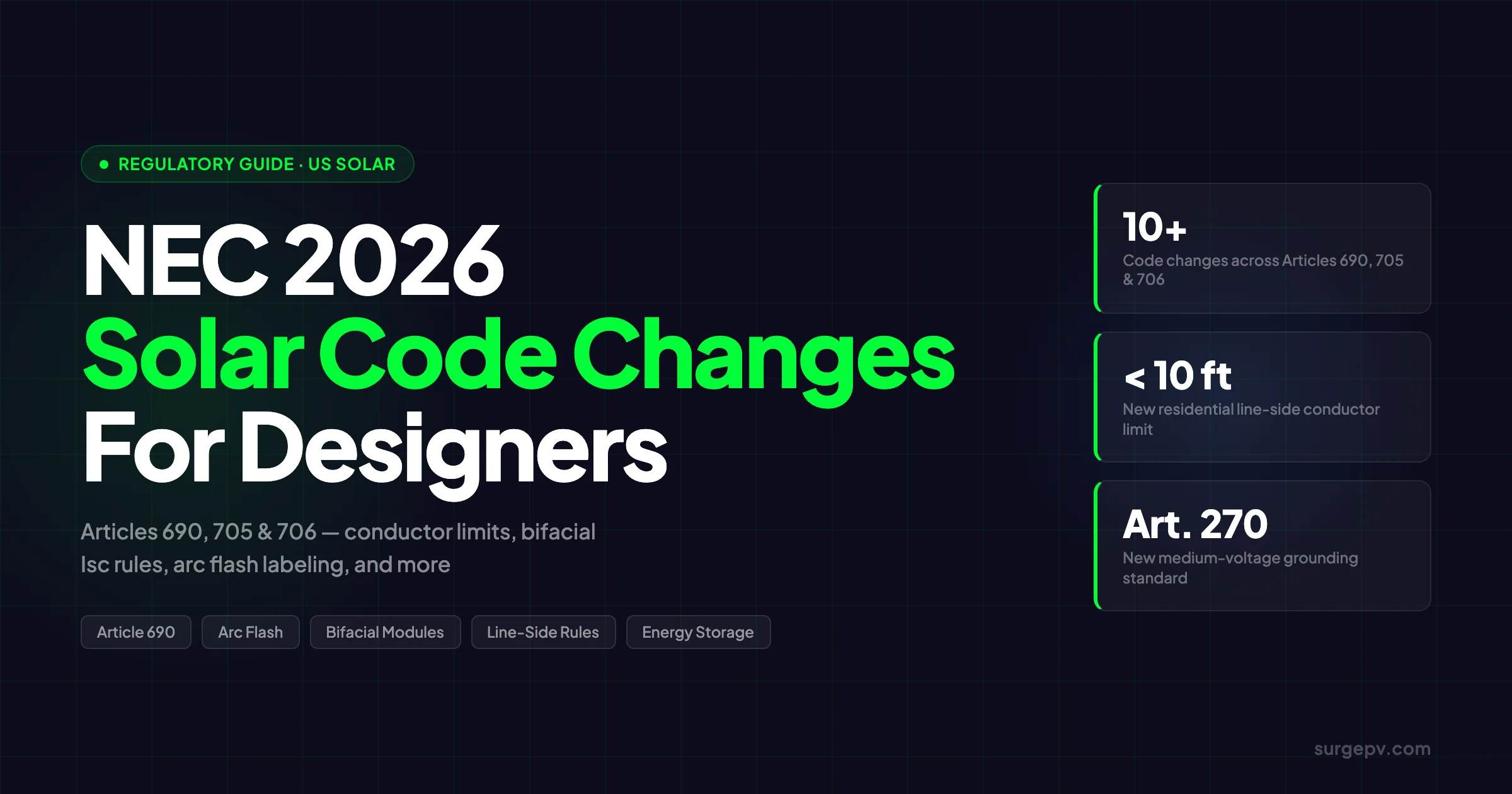
The 2026 edition of the National Electrical Code includes more than 10 substantive changes to solar PV and energy storage requirements across Articles 690, 705, and 706. Most changes land in the clarification category, but several carry real cost and design impact — especially the reinstated line-side conductor length limits, new arc flash labeling requirements, updated bifacial module current calculations, and stricter equipment listing rules. If your team is still designing to NEC 2023, here is what needs to change before your next permit submission.
NEC 2026 solar updates include refined rapid shutdown requirements, updated fire setback rules for residential roofs, and clarified DC conductor routing. Key changes: module-level rapid shutdown is now mandatory for all residential systems, and PV wire must be marked at terminations. Compliance affects permit approval in all 50 states.
NEC 2026 solar updates include refined rapid shutdown requirements, updated fire setback rules for residential roofs, and clarified DC conductor routing. Key changes: module-level rapid shutdown is now mandatory for all residential systems, and PV wire must be marked at terminations. Compliance affects permit approval in all 50 states.
TL;DR — NEC 2026 Solar Changes
NEC 2026 reinstates conductor length limits removed in 2023 (under 10 ft residential, under 16.5 ft commercial), tightens arc flash labeling to require voltage, boundaries, incident energy, and assessment date, removes the 100 kW threshold for engineer calculations, and introduces new bifacial module Isc rules. A new Article 270 consolidates medium-voltage grounding. Most changes are clarifications — but five carry direct design and cost implications every designer must address before the next permit submittal.
NEC 2026 Solar Changes: Quick Reference Overview
Before diving section by section, here is a summary of every change that affects solar design work:
| NEC Section | Change | Design Impact |
|---|---|---|
| 110.16 | Arc flash labels must include voltage, boundaries, incident energy/PPE, assessment date | Formal arc flash studies required for commercial systems |
| 690.4(G) | Round fractions under 0.5 A/V to nearest whole number after correction factors | Eliminates AHJ inconsistency on rounding |
| 690.8 | Removed 100 kW threshold for engineer-furnished calculations | Small-to-mid projects gain design flexibility |
| 690.8(A)(1)(a)(1) | Bifacial modules: use highest Isc from datasheet or installation manual | May increase conductor and OCPD sizing 5–15% |
| 690.8(A)(1)(a)(2) | Manufacturer-provided calculation methods now permitted | Useful for non-standard bifacial configurations |
| 690.13 | Disconnecting means aligned with 705.20; circuit breakers acceptable | Reduces equipment costs vs. knife switch specs |
| 690.31 | PV and non-PV circuits may share raceways with barriers; PV wire where RHW-2 permitted | More flexible conduit routing |
| 690.31(C)(1) | DG cable permitted where tray cable is allowed; support every 2 ft for #8 AWG or smaller | Expanded ground-mount conductor options |
| 705.11(C)(1) | Conductor length limits reinstated: under 10 ft residential, under 16.5 ft other | Redesign required for long line-side tap templates |
| 705.20 | New unified disconnecting means standard referenced by 690 and 706 | Single disconnect can serve multiple power sources |
| 706.15 | References 705.20 for ESS disconnecting means | Aligns ESS with PV disconnect standard |
| 706.16 | Deleted; ESS reclassified under Article 702 optional standby | Changes ESS permit documentation path |
| Article 270 | New article: medium-voltage grounding and bonding with conductor-based sizing tables | Affects commercial/utility-scale above 1,000V |
NEC 2026 has fewer sweeping changes than the 2020 or 2023 cycles — a detailed technical breakdown is available from Mayfield Renewables, who served on Code Making Panel 13. That said, ignoring these updates will cause permit rejections — especially for bifacial systems, tracker arrays, and any project using line-side interconnections.
Article 690 Updates: The Solar PV Sections Designers Must Review
Article 690 covers solar PV systems on or in buildings. NEC 2026 brings several changes here — most clarifying intent that inspectors already expected, but some creating new calculation requirements.
Section 690.4(G) — Rounding Rule for Calculations
NEC 2026 adds a new subsection specifying that fractions under 0.5 should be dropped — not rounded up — in final calculations. The rule applies after all correction factors (temperature, conduit fill, conductor bundling) have been applied to produce a final value.
This matters because previous code language was ambiguous. Some designers rounded up all fractions to the next whole ampere. Others did not. AHJs across different states applied this inconsistently, causing unnecessary redesigns on otherwise-compliant permit packages. Section 690.4(G) eliminates that inconsistency by establishing a clear, universal rule.
The sequence: apply temperature correction factors to conductor ampacity, apply conduit fill derating, apply any other applicable conditions of use — then drop the decimal if it falls under 0.5 in the final result. Do not round intermediate calculation steps.
Pro Tip
Apply all correction factors first, then drop the fraction if it falls under 0.5. Do not round intermediate steps — only the final calculated value. Documenting this sequence in your calculation sheet prevents AHJ questions during plan review.
Section 690.8 — 100 kW Threshold Removed for Engineer Calculations
Under NEC 2023, only systems over 100 kW could use calculations furnished by a licensed electrical engineer using simulation tools like NREL’s System Advisor Model (SAM) instead of the standard 1.25× multiplier method. NEC 2026 removes that size restriction entirely.
Any system — residential, commercial, or utility-scale — can now use engineer-furnished calculations for circuit sizing. For small commercial projects in the 30–80 kW range, this is a meaningful cost reduction. Optimized wire sizing from a SAM-based analysis routinely cuts conductor costs by 10–20% compared to the prescriptive 1.25× method, because the engineer can account for actual irradiance data, shading, and system configuration instead of applying a flat multiplier.
The tradeoff is that a licensed engineer must stamp the calculations. For projects under 100 kW, weigh the engineering fee against expected conductor savings before choosing this path. On a 50 kW rooftop commercial system with short conduit runs, the savings may not justify the fee. On a 75 kW ground-mount with long DC feeder runs, they often do.
Section 690.8(A)(1)(a)(1) — Bifacial Module Current Calculations
This is one of the most consequential NEC 2026 changes for designers working with bifacial panels — which now represent the majority of new module shipments globally. For Global-specific compliance details, see Global net-metering-by-country. For Global-specific compliance details, see Global solar-permitting-speed-by-country.
Previous code required using the short-circuit current (Isc) from the front face of the module at Standard Test Conditions. For bifacial panels, the rear side generates additional current under reflected irradiance from the ground or mounting surface below the array. NEC 2026 now mandates using “the highest short-circuit current rating of the PV modules” — meaning whichever Isc value appears on the datasheet or in the installation manual takes precedence.
What this means in practice:
For standard bifacial modules with a bifaciality factor of 0.70–0.80, rear-side gain in typical rooftop conditions adds 3–8% to effective Isc. Over a white TPO rooftop membrane with high albedo, rear gain can reach 10–12%. For elevated ground-mount arrays over light-colored gravel or snow-prone sites, rear gain reaches 15–25% under peak conditions.
In practice, most manufacturers publish a single Isc value based on front-side STC conditions. However, some manufacturers now publish bifacial Isc values in their installation manuals — particularly for high-bifaciality premium modules. Under NEC 2026, if that manual value is higher than the nameplate Isc, you must use the manual value for source circuit calculations.
Example: A bifacial module lists Isc = 13.8 A on the datasheet but includes a table in the installation manual showing maximum Isc = 15.1 A under 1,200 W/m² bifacial irradiance. Under NEC 2026, your source circuit current calculation uses 15.1 A, not 13.8 A. For a 10-module string running two strings in parallel, the source circuit current increases from 27.6 A to 30.2 A — potentially changing the conductor size or OCPD rating.
Check every bifacial module datasheet and installation manual before finalizing conductor sizing on any project. Document the source of the Isc value used in your calculation sheet. See our bifacial solar panel design guide for panel selection and layout optimization.
Section 690.8(A)(1)(a)(2) — Manufacturer Instructions as Calculation Method
NEC 2026 adds an alternative calculation path: if the module manufacturer’s installation instructions include a method for calculating maximum circuit current, designers may use that method. This provision is primarily intended for bifacial modules where manufacturers develop irradiance-based models for rear-side contribution.
This is not a blanket exemption from Code-compliant sizing. If the manufacturer method produces a lower value than the standard Isc-based method, and the manufacturer’s method is not independently validated, most AHJs will reject it. Use this provision only when the manufacturer provides detailed, documentable calculation procedures — not just a simplified table with generic assumptions.
When applying this provision, attach the relevant pages of the manufacturer’s installation manual to your permit package and clearly identify which calculation method you used and why.
Section 690.13 — Disconnecting Means Aligned with Article 705.20
Under NEC 2023, Section 690.13 specified its own disconnecting means requirements for PV systems, including specific switch types and marking requirements. NEC 2026 replaces that language with a reference to Section 705.20, which now serves as the unified standard for power production source disconnects.
The practical result: knife switches or fusible disconnects are no longer required specifically for solar. Circuit breakers meeting 705.20 requirements are fully acceptable. This change reduces equipment costs on many residential and commercial installations where installers previously specified dedicated solar disconnect hardware to satisfy AHJ interpretation of the old 690.13 language. For more on this topic, see AC Disconnect Sizing for Solar.
The single disconnecting means allowed under 705.20 can serve multiple power sources simultaneously — meaning a solar system and a battery storage system can share one code-compliant disconnect in eligible configurations, provided the disconnect is rated for the combined current and properly marked.
Section 690.31 — Wiring Methods: More Flexibility for Conduit Design
NEC 2026 expands wiring options in two meaningful ways for installation teams.
Shared raceways with barriers: PV source circuits and non-PV circuits may now be run in the same raceway, provided the raceway includes a physical barrier separating the conductors. This simplifies conduit routing on commercial rooftop installations where multiple circuit types share long runs across the roof deck. Previously, PV circuits required dedicated conduit, which added material and labor cost.
PV wire permitted where RHW-2 is allowed: Previously, PV wire (listed to UL 4703) was restricted to specific outdoor or within-module applications. Under NEC 2026, it can be used anywhere RHW-2 rated conductors are permitted. This opens up more conductor options for designers, particularly in conduit applications on commercial rooftops where RHW-2 is common.
Section 690.31(C)(1) — DG Cable Expansion for Ground-Mount Systems
Direct-burial (DG) cable is now permitted wherever tray cable is allowed. The caveat: #8 AWG and smaller DG cables require support every 2 feet. This is a meaningful change for large ground-mount systems where tray cable has been the standard for DC feeder runs.
If you are switching from tray cable to DG cable on a ground-mount design, verify that your support structure spacing meets the 2-foot requirement for smaller gauge conductors. On larger conductor sizes (#6 AWG and above), the support spacing requirement does not apply — but check your specific project configuration.
See our solar string design guide for conductor sizing and string configuration best practices.
Article 705 Changes: Line-Side Interconnection Rules Are Back
Article 705 covers interconnected electric power production sources — the rules governing how solar PV connects to the utility grid. NEC 2026 brings back conductor length limits that were in NEC 2020, removed in NEC 2023, and are now reinstated. This affects more projects than any other single change in this code cycle.
Section 705.11(C)(1) — Conductor Length Limits Reinstated
This change affects every project using a supply-side (line-side) interconnection — tapping the utility conductors between the meter and the main service disconnect, rather than connecting at the load side of the panel. Line-side interconnections are common on residential and small commercial systems where the main panel is already at or near capacity.
NEC 2026 reinstates length limits from the 2020 code:
| Application | Maximum Conductor Length (Tap to OCPD) |
|---|---|
| One- and two-family dwellings (residential) | Under 10 feet |
| All other applications (commercial, industrial, multifamily) | Under 16.5 feet (5 meters) |
Runs exceeding these lengths require cable limiters at both the tap connection point and the overcurrent protection device. If your standard residential line-side design template uses a 12-foot or 15-foot tap, it needs redesign or cable limiter installation before submitting in any NEC 2026 jurisdiction.
Why were these limits removed in 2023? The 2023 NEC Technical Committee decided the 2020 limits were creating unnecessary installation complexity without clear safety justification in all cases. By 2026, the committee reversed course, concluding that unprotected conductor length inside buildings increases fault risk enough to warrant the restriction.
Why does this matter beyond the length itself? Unprotected conductors — those between the tap and the overcurrent protection device — cannot be de-energized by operating the service disconnect. In a fault condition, that conductor remains live. Shorter runs reduce the length of energized exposed conductor, directly reducing fire risk.
Key Takeaway
The reinstated length limits in 705.11(C)(1) are the single NEC 2026 change most likely to trigger AHJ rejections on existing design templates. Audit every standard line-side design before submitting permits in NEC 2026 jurisdictions.
Maximum Line-Side Run: 66-Foot Rule
NEC 2026 also defines a separate outer limit: the maximum conductor run from the supply-side connection point to the overcurrent protection device is 66 feet. This applies regardless of building type. Beyond 66 feet, the design requires a different interconnection approach — typically a load-side connection at a subpanel, a dedicated meter socket, or a utility-side connection with the utility’s approval.
For most residential and small commercial systems, 66 feet is rarely the binding constraint. The under-10-foot residential limit is far more restrictive. For commercial systems with long service entrance runs, verify the 66-foot limit does not bind before finalizing the interconnection design.
Section 705.20 — Unified Disconnecting Means Standard
NEC 2026 introduces a consolidated disconnecting means standard in Section 705.20 that both Article 690 (PV) and Article 706 (Energy Storage) now reference. Under 705.20, a single disconnect can serve multiple power sources simultaneously if it meets rating, marking, and accessibility requirements.
This resolves a recurring design conflict. Projects with both solar and battery storage sometimes required two separate disconnects under strict AHJ interpretations of the previous code. Under 705.20, one properly rated breaker can cover both — reducing equipment cost, panel space, and inspection complexity.
Article 706 Updates: Energy Storage System Changes
Paired solar+storage systems now represent the majority of new residential solar installations in many U.S. markets. NEC 2026 brings two targeted changes to Article 706 that affect design documentation and permitting.
Section 706.15 — References 705.20
The disconnecting means requirement for energy storage systems now points to Section 705.20. This aligns ESS disconnect design with PV disconnect design — both reference the same standard. For AC-coupled and DC-coupled battery systems, this simplifies permit documentation since you cite one code section for both the solar and storage components. See AC Coupled vs DC Coupled Battery Solar for detailed guidance.
Section 706.16 — Deleted: ESS Reclassified as Optional Standby
Section 706.16 defined a standalone classification for energy storage systems. NEC 2026 deletes this section entirely. Energy storage systems are now classified as optional standby systems under Article 702.
The practical impact: permits for ESS installations will route through different AHJ review workflows in jurisdictions that have adopted NEC 2026. Article 702 is less prescriptive than the deleted 706.16 requirements in some areas, which may simplify permitting for straightforward residential battery installations. However, AHJs that built their review processes around the Article 706 classification will need time to update procedures.
If you design energy storage systems regularly, contact your primary AHJs now to understand how they are handling this reclassification. Some are issuing updated submittal checklists; others have not yet addressed it.
Design NEC 2026-Compliant Solar Systems Faster
SurgePV’s design tools help you build accurate system models — so your conductor sizing, current calculations, and interconnection layouts are right before you submit for permits.
Book a DemoNo commitment required · 20 minutes · Live project walkthrough
For a direct comparison, see Arka 360 vs SurgePV.
New Article 270: Medium-Voltage Grounding and Bonding
One of the structural additions in NEC 2026 is Article 270, a new article that consolidates grounding and bonding requirements for medium-voltage systems (above 1,000V AC or 1,500V DC). Previously, these requirements were distributed across Articles 230, 250, and 490, creating interpretation conflicts and inconsistent AHJ enforcement.
What Article 270 Changes for Solar Designers
For utility-scale and large commercial solar systems operating at medium voltage, Article 270 introduces two key updates:
Conductor sizing based on conductor size, not OCPD: Previous grounding conductor sizing tables keyed off the overcurrent protection device rating. Article 270 replaces this with tables that key off the conductor size itself. For large DC source circuits with high-ampacity conductors, this often results in larger specified grounding conductors than NEC 2023 required. Budget for this in material estimates on utility-scale projects.
Consolidated requirements: Designers no longer need to cross-reference multiple NEC articles for medium-voltage grounding. Article 270 serves as the single source. This reduces the risk of missing a requirement during design review and simplifies AHJ plan check.
For residential and small commercial systems operating at standard voltages (under 1,000V), Article 270 does not apply. For commercial and utility-scale projects with medium-voltage inverter outputs or medium-voltage interconnections, verify that your grounding conductor specifications align with the new Article 270 tables before submitting.
Arc Flash Labeling Requirements: More Rigorous Than Ever
Section 110.16 has tightened in every NEC cycle since 2012. NEC 2026 moves from general arc flash warnings to specific, data-driven labels with defined required fields.
What Must Appear on Every Arc Flash Label Under NEC 2026
Under NEC 2026, arc flash labels must include:
- System voltage
- Arc-flash boundary (the distance at which incident energy equals 1.2 cal/cm²)
- Incident energy (in cal/cm²) or the required PPE arc rating for work within the boundary
- Date of the arc flash assessment
Generic warnings like “WARNING: ARC FLASH HAZARD” without supporting data no longer satisfy NEC 2026. A label that says only “Danger — Arc Flash” with a flame symbol fails. For commercial and utility-scale systems, meeting these requirements means commissioning a formal arc flash power study from a qualified electrical engineer — typically run using IEEE 1584 methodology.
What This Costs
Arc flash studies for commercial solar installations typically run $1,500–$4,000 depending on system size and complexity, plus the cost of reprinting compliant labels for every electrical enclosure. For utility-scale projects, the study scope and cost scale with the number of collection points and substation equipment. Budget this into your engineering scope for any commercial permit submitted in an NEC 2026 jurisdiction.
Residential Systems and Arc Flash Labels
Residential solar systems are not exempt, but the requirements scale differently. For small residential systems, simplified labeling methods that provide voltage and PPE category — without a full incident energy study — remain acceptable under NEC 2026, provided the AHJ accepts the methodology. Many residential PV equipment manufacturers now ship panels, inverters, and combiner boxes with compliant pre-printed labels for standard configurations.
For any residential system where conductor lengths, configuration, or system size fall outside what the manufacturer’s pre-printed labels cover, a formal arc flash assessment is the safest compliance path.
See our arc flash glossary entry for a full technical definition and calculation overview.
Equipment and Materials: New Listing Requirements
NEC 2026 tightens equipment listing requirements in ways that affect day-to-day installation practices — not just engineering design decisions.
Cable Ties Must Be Listed Products
Off-the-shelf zip ties — the kind found at any hardware store — no longer satisfy NEC 2026 requirements for securing conductors in solar installations. Cable ties must be listed products rated for their specific application, including outdoor UV exposure, operating temperature range, and mechanical load.
This requirement has real supply chain implications. Verify that your materials procurement team is sourcing listed cable ties specifically rated for PV environments. UL-listed UV-resistant cable ties for outdoor PV use are widely available from major electrical suppliers, but they cost more than generic ties. Update your bill-of-materials template and brief installation crews on the change — generic hardware-store ties will fail inspection in NEC 2026 jurisdictions.
Some AHJs in NEC 2023 jurisdictions were already enforcing this informally based on general Code requirements for listed materials. NEC 2026 makes it explicit and universal.
PV Connector Compatibility: Both Manufacturers Must Document
NEC 2026 closes a longstanding loophole in PV connector intermateability. Previous code language allowed installers to mate connectors from different manufacturers if they were “compatible.” In practice, this claim was difficult to verify and created fire risk — mismatched MC4-style connectors have been implicated in multiple PV system fires.
Under NEC 2026, both connector manufacturers must explicitly document and approve intermateability in writing. A verbal claim of compatibility from a supplier is not sufficient. A generic statement that a connector is “MC4 compatible” is not sufficient either. You need written documentation from both manufacturers confirming that the specific connector series and gender are approved for use together.
The practical design rule: specify connectors from a single manufacturer for all connections in a given array. Where field conditions require mixing brands — for example, using a different brand of branch connector on an existing system expansion — obtain written intermateability documentation from both manufacturers before installation and retain it in the project file for inspection.
Inform procurement and installation teams: mixed-brand connectors without documentation will fail inspection in NEC 2026 jurisdictions regardless of how they have been handled historically.
Power Control Systems: A New Design Flexibility Tool
NEC 2026 formalizes the use of Power Control Systems (PCS) — software-controlled devices that limit the maximum current a PV array is allowed to deliver. Under previous code, conductors and overcurrent protection devices had to be sized for the maximum theoretical output of the connected PV source. PCS changes this by providing a code-recognized method to size conductors for the system’s controlled operating current rather than the theoretical maximum.
How PCS Affects Conductor and OCPD Sizing
A Power Control System continuously monitors output and prevents current from exceeding a set threshold. NEC 2026 allows designers to size conductors and OCPDs to match the PCS-controlled current limit — not the full source circuit current — provided the PCS is a listed product (UL 3141 standard) and the design documents the controlled current limit.
For large commercial and ground-mount systems, the conductor cost savings can be substantial. A 500 kW ground-mount array that would otherwise require 4/0 AWG conductors for full output might require only 2/0 AWG under a PCS-limited design. On a 250-foot DC feeder run from array to inverter pad, that size reduction cuts copper cost by 30–40% on that run alone.
PCS are not universally cost-effective for smaller systems. Factor in the cost of a listed PCS device (typically $800–$2,500 depending on current rating) plus engineering documentation time against expected conductor savings before applying this approach to residential or small commercial designs.
Pro Tip
Power control systems make the most economic sense on large ground-mount systems where conductors run 150+ feet from the array to the inverter pad. On rooftop systems under 100 kW with short runs, the device and documentation cost typically outweighs conductor savings.
Manufacturer Instructions vs. Code: Who Wins?
NEC 2026 addresses a compliance debate that has recurred in plan review for years. Previously, some installers used “I followed the manufacturer’s installation instructions” as a defense against code non-compliance. AHJs disagreed on whether manufacturer instructions could override or substitute for explicit Code requirements.
NEC 2026 resolves this clearly: manufacturer instructions must result in a Code-compliant installation. If an instruction conflicts with NEC requirements, the Code governs. Installers who follow non-Code-compliant manufacturer instructions are not protected from code violations — the manufacturer’s instruction does not transfer liability or grant a variance.
The implication for design teams: review installation manuals for the equipment you specify. If a manufacturer’s recommended wire sizing, disconnect placement, grounding method, or connector type does not meet NEC 2026 requirements, either source Code-compliant equipment or document the variance and design to the stricter Code requirement. The days of citing the installation manual as a compliance defense are over.
Moving Arrays and Tracker Systems: Flexible Conductors Required
Single-axis tracker arrays introduce mechanical stress on wiring that fixed-tilt systems never experience. Under NEC 2026, conductors at moving joints on tracker arrays must use flexible, fine-stranded conductors or braided copper straps — not rigid conductors.
This requirement was implied by NEC 2023’s general flex conductor requirements but was not explicit for PV tracker applications. Field interpretation varied. NEC 2026 makes it specific: at every articulation point on a tracker, the conductor must be rated and designed for the movement cycle.
For designers specifying tracker systems, verify that the tracker manufacturer’s approved wiring methods include properly rated flexible conductors and that your design documents the connector and conductor specifications. Rigid conductors fatigue and fail at articulation points over tracker movement cycles — this Code change reflects real-world failure data.
Rigid conduit runs between tracker rows remain acceptable; the flexible conductor requirement applies specifically at the moving joint where the torque tube articulates.
See our ground-mount solar design guide for complete tracker layout and wiring considerations.
State Adoption Timelines: When NEC 2026 Actually Applies to Your Projects
The NFPA publishes a new NEC edition every three years. State adoption follows an independent timeline — typically 1–4 years after NFPA publication. The NFPA published NEC 2026 in late 2025. As of mid-2026, most U.S. states are still enforcing NEC 2020 or NEC 2023.
Understanding where your target states sit in the adoption cycle is not optional. Designing to the wrong code edition causes permit rejections that delay projects and cost money.
| Adoption Profile | Characteristics | NEC Edition (as of mid-2026) |
|---|---|---|
| Fast adopters | Adopt within 12–18 months of NFPA publication | Likely NEC 2023; some moving to 2026 in 2026 |
| Mid-cycle adopters | Adopt 2–3 years after publication | NEC 2020 or NEC 2023 |
| Slow adopters | Legislative or regulatory delays | NEC 2017 or 2020 |
| Non-uniform states | Counties or municipalities adopt independently | Mixed — check AHJ directly |
California, Oregon, Washington, Minnesota, and several New England states historically adopt within 18–24 months. Texas, Florida, and several southeastern states adopt more slowly. Many states allow local AHJs to enforce a more current edition than the state-mandated baseline. For the latest details on UK, see Battery Solar System Design UK. Read more about Heritage Building Solar Case Study.
The only authoritative source is your local AHJ. The NFPA NEC adoption map shows each state’s current adopted edition as a starting reference — but always confirm directly with the AHJ’s permit portal since local amendments and effective dates vary. Do not assume NEC 2026 applies even if the NFPA has published it. Do not assume NEC 2020 applies just because your state has not announced adoption of 2023 or 2026.
Key Takeaway
Include the applicable NEC edition on every permit package cover sheet. When designing in jurisdictions enforcing older code editions, do not apply NEC 2026 rules — particularly the reinstated line-side conductor length limits and bifacial Isc requirements — without confirming local adoption first.
How to Update Your Solar Design Process for NEC 2026 Compliance
The changes above translate into a concrete checklist for design teams preparing to work in NEC 2026 jurisdictions.
1. Audit existing residential line-side design templates. The reinstated 705.11(C)(1) limits (under 10 feet for residential) will fail permit review in NEC 2026 jurisdictions if your standard template exceeds this. Update every template before submitting in an adopting jurisdiction.
2. Update bifacial module Isc sourcing procedures. For every bifacial panel on your approved product list, pull the datasheet and installation manual. Document the highest Isc value listed. Update your calculation templates to pull from this documented source — not just the nameplate Isc.
3. Update materials procurement to require listed cable ties. Add a specification requirement for UL-listed UV-rated cable ties on every project BOM. Brief installation crews on the change. One failed inspection over cable ties is more costly than the price difference per bag.
4. Establish connector intermateability documentation workflow. Create a project file requirement: any mixed-brand connector specification must include written documentation from both manufacturers before materials are ordered. Make this a standard checklist item.
5. Scope arc flash studies for commercial jobs. For commercial systems, determine during proposal whether a formal arc flash study is required and budget it into the engineering line item. Do not let this surface as an unbudgeted cost during permit review.
6. Update ESS permit documentation. For paired solar+storage projects in NEC 2026 jurisdictions, update your permit package templates to cite Article 702 for ESS classification rather than the deleted Section 706.16. Contact primary AHJs now to understand their updated submittal expectations.
7. Apply Article 270 for medium-voltage projects. For commercial and utility-scale systems above 1,000V, pull the Article 270 grounding conductor sizing tables and verify your grounding conductor specifications against them. Update calculation sheets accordingly.
8. Evaluate Power Control Systems for large ground-mounts. For projects over 250 kW with conductor runs exceeding 150 feet from array to inverter, model the material savings from PCS-limited conductor sizing. Get a quote on listed PCS hardware before assuming it pencils out.
9. Review tracker wiring specifications. For any tracker system, confirm that your standard wiring spec includes flexible conductors at articulation points. Update tracker-specific wiring detail drawings to reflect NEC 2026 requirements.
10. Confirm the enforceable code edition with each AHJ. Build this into your project intake checklist. Record the confirmed edition and the date of confirmation in the project file.
Using capable solar design tools significantly reduces NEC 2026 compliance risk by enforcing electrical constraints during the design process rather than at permit submission. The solar yield and financial analysis also helps model the cost impact of different conductor sizing approaches when evaluating PCS or engineer-furnished calculation paths.
Our solar safety compliance checklist covers the full pre-permit inspection process alongside these NEC 2026 updates.
NEC 2026 vs. NEC 2023: Side-by-Side Comparison
| Topic | NEC 2023 | NEC 2026 |
|---|---|---|
| Line-side conductor length | No specific limit (removed from 2020 version) | Under 10 ft residential, under 16.5 ft commercial |
| Maximum line-side run | No explicit outer limit | 66 feet from tap to OCPD |
| 100 kW threshold | Required for engineer-furnished calculations | Removed — any system size qualifies |
| Bifacial Isc | Front-side STC Isc | Highest Isc from datasheet or installation manual |
| Disconnecting means | 690.13 standalone requirements | References 705.20 unified standard |
| Multiple source disconnect | Separate disconnects often required | Single disconnect permitted under 705.20 |
| Cable ties | Not specifically addressed | Must be listed products rated for application |
| PV connector compatibility | “Compatible” claim sufficient | Written documentation from both manufacturers required |
| ESS classification | Article 706 standalone (Section 706.16) | Article 702 optional standby |
| Arc flash labels | General warning required | Voltage, boundary, incident energy/PPE, assessment date required |
| Shared raceways | PV circuits must be separate | Allowed with physical barrier |
| Medium-voltage grounding | Distributed across Articles 230, 250, 490 | Consolidated in new Article 270 |
| Manufacturer instructions | Could substitute for Code compliance | Must produce Code-compliant result; Code wins if conflict |
| Tracker wiring | Flexible conductors implied by general rules | Explicit requirement for flexible conductors at articulation points |
| Calculation rounding | Inconsistent AHJ enforcement | Fractions under 0.5 dropped after all corrections applied |
What the 2029 NEC Restructuring Means for Solar Designers
NEC 2026 marks the beginning of a structural transition in how the Code is organized. The NFPA has announced that NEC 2029 will expand from 9 chapters to 23 chapters — a significant reorganization designed to make the Code more navigable across the electrical industry.
For solar designers, this means section numbers will change substantially in the 2029 edition. Article 690 will not disappear, but its internal structure may change significantly. Several articles covering interconnected power production (705) and energy storage (706) may be reorganized into new structures.
The implication: permitting software, design templates, and internal compliance checklists that reference NEC section numbers by hardcoded citation will need updates after the 2029 edition publishes. Start building habits around documenting the NEC edition and section together — not just the section number alone.
NEC 2026 is the last edition before this major restructuring. Design processes built for NEC 2026 will need meaningful revision for 2029 — this is a known future cost worth budgeting for now.
How Solar Design Software Reduces NEC 2026 Compliance Risk
Manual compliance checking on every permit package is time-intensive and error-prone. Purpose-built solar software reduces this risk by surfacing code constraints during the design process rather than at permit submission when corrections cost more.
For NEC 2026 specifically, solar design software with these capabilities reduces redesign cycles:
- Bifacial module Isc data fields that pull from the correct source (datasheet vs. installation manual)
- Configurable conductor alerts that flag line-side runs exceeding jurisdiction-specific limits
- Material specification lists that distinguish listed from unlisted hardware
- Interconnection length calculations built into the single-line diagram generation
SurgePV’s solar designing tool lets you model system configurations with accurate electrical parameters before permit submission. The shadow analysis tool feeds precise irradiance data into bifacial gain calculations — so your bifacial Isc values reflect actual site conditions, not conservative industry averages. For commercial projects where conductor sizing and cost modeling matter, the generation and financial tool models the cost impact of different design paths.
Connecting design accuracy to permit accuracy is how EPCs and installers reduce the revision cycles that erode project margins.
Conclusion
NEC 2026 is a consolidation update compared to the major rewrites of 2017 and 2020 — but it contains five changes that require active response from every design team:
- Reinstated line-side length limits require auditing every existing residential line-side design template before submitting in adopting jurisdictions
- Bifacial Isc requirements mean pulling every bifacial module datasheet and installation manual before finalizing conductor sizing
- Listed cable ties and connector documentation affect materials procurement and crew training — not just engineering design
- Arc flash labeling specificity increases engineering scope on commercial and utility-scale projects in ways that must be budgeted at proposal stage
- ESS reclassification to Article 702 changes permit documentation paths for paired solar+storage systems
The code applies only where your jurisdiction has adopted it. Confirm the enforceable edition with your AHJ before each permit submission. And if your current solar software does not support bifacial Isc data fields, line-side conductor length alerts, or accurate system electrical modeling, this code cycle is the right time to evaluate alternatives that keep compliance decisions inside the design process — not at the permit counter.
Frequently Asked Questions
What are the biggest NEC 2026 changes for solar installations?
The most impactful changes are arc flash labeling requirements (Section 110.16), reinstated line-side conductor length limits in Article 705, bifacial module Isc calculation rules in Section 690.8, and the removal of the 100 kW threshold for engineer-furnished calculations. Equipment listing requirements also tightened — cable ties must now be listed products and PV connectors from different manufacturers require written intermateability documentation from both manufacturers.
When does NEC 2026 take effect for solar projects?
The NFPA published NEC 2026 in late 2025, but each U.S. state adopts it independently. As of mid-2026, most states are still enforcing NEC 2023 or NEC 2020. Check with your local AHJ for the applicable code edition before designing. Do not assume NEC 2026 applies even if your state has signaled intent to adopt — confirm the effective date with the AHJ.
What is the conductor length limit for line-side solar connections in NEC 2026?
Section 705.11(C)(1) reinstates limits from NEC 2020: conductors on the supply side of the service disconnect must be under 10 feet for residential dwellings and under 16.5 feet for all other applications. Beyond these lengths, cable limiters are required at both connection points. A separate 66-foot maximum applies to the total run from tap to OCPD regardless of building type.
Do bifacial solar panels require different calculations under NEC 2026?
Yes. Section 690.8(A)(1)(a)(1) now requires using the highest Isc value listed anywhere on the datasheet or in the installation manual — not the standard front-side STC value. For high-gain bifacial modules, this can increase source circuit current by 5–15%, requiring larger conductors or OCPDs. Check both the datasheet and installation manual for every bifacial module before finalizing conductor sizing.
Does NEC 2026 require arc flash studies for all solar installations?
NEC 2026 Section 110.16 requires arc flash labels with voltage, arc-flash boundaries, incident energy or required PPE, and the date of assessment. For commercial and utility-scale systems, this effectively requires a formal arc flash power study — generic warning labels are no longer compliant. Small residential systems may still use simplified labeling methods, particularly when using manufacturer-provided compliant pre-printed labels for standard configurations.
What is the new Article 270 in NEC 2026?
Article 270 consolidates grounding and bonding requirements for medium-voltage systems (above 1,000V AC or 1,500V DC) previously scattered across Articles 230, 250, and 490. It introduces grounding conductor sizing tables based on conductor size rather than OCPD ratings. This applies primarily to commercial and utility-scale solar projects with medium-voltage inverter outputs or interconnections. Standard residential and small commercial systems below 1,000V are not affected.
How does NEC 2026 affect energy storage systems paired with solar?
Section 706.16 was deleted, meaning energy storage systems are now classified as optional standby systems under Article 702 rather than under a standalone Article 706 classification. Section 706.15 now references Article 705.20 for disconnecting means requirements, aligning ESS design documentation with PV disconnect requirements. Update permit package templates to reflect the Article 702 classification and verify with local AHJs how they are handling the transition. Solar proposal software generates professional quotes in minutes.
Where this fits
This article is part of SurgePV's Solar Incentives & Policy hub, which works through the topic from first principles to the decisions a project team actually has to make.

