

Amazon’s Delivery Service Partner (DSP) program runs over 18,000 Rivian Electric Delivery Vans (EDVs) across US depots in 2026, according to Amazon’s sustainability disclosures (2025). Each van consumes 90 to 130 kWh per day. A 100-van depot draws 9 to 13 MWh nightly. That is the same load as 400 average US homes, concentrated at a single utility meter.
Solar carports turn this challenge into an opportunity. A photovoltaic parking canopy generates clean power while sheltering vehicles, cuts grid dependency, flattens demand charge spikes, and delivers electricity at $0.045 to $0.065 per kWh over 25 years. The commercial solar carport market is projected to grow from $235 million in 2025 to $555 million by 2032, a 13.1% CAGR, according to Fortune Business Insights (2025). See Commercial Solar Carport Design Guide for detailed guidance.
This guide covers everything a fleet manager or solar designer needs to size, model, and justify a solar carport EV fleet charging system in 2026. We walk through kWp per bay calculations, fleet duty cycle modeling, structural design for cars versus vans versus heavy trucks, DC fast charge integration, medium-voltage transformer requirements, demand charge avoidance, V2G fleet potential, UK and US incentive stacking, and three worked depot examples drawn from Amazon DSP, Royal Mail, and municipal fleet patterns. For UK-specific information, see Battery Solar System Design UK. See our guide on Heritage Building Solar Case Study for more.
Quick Answer
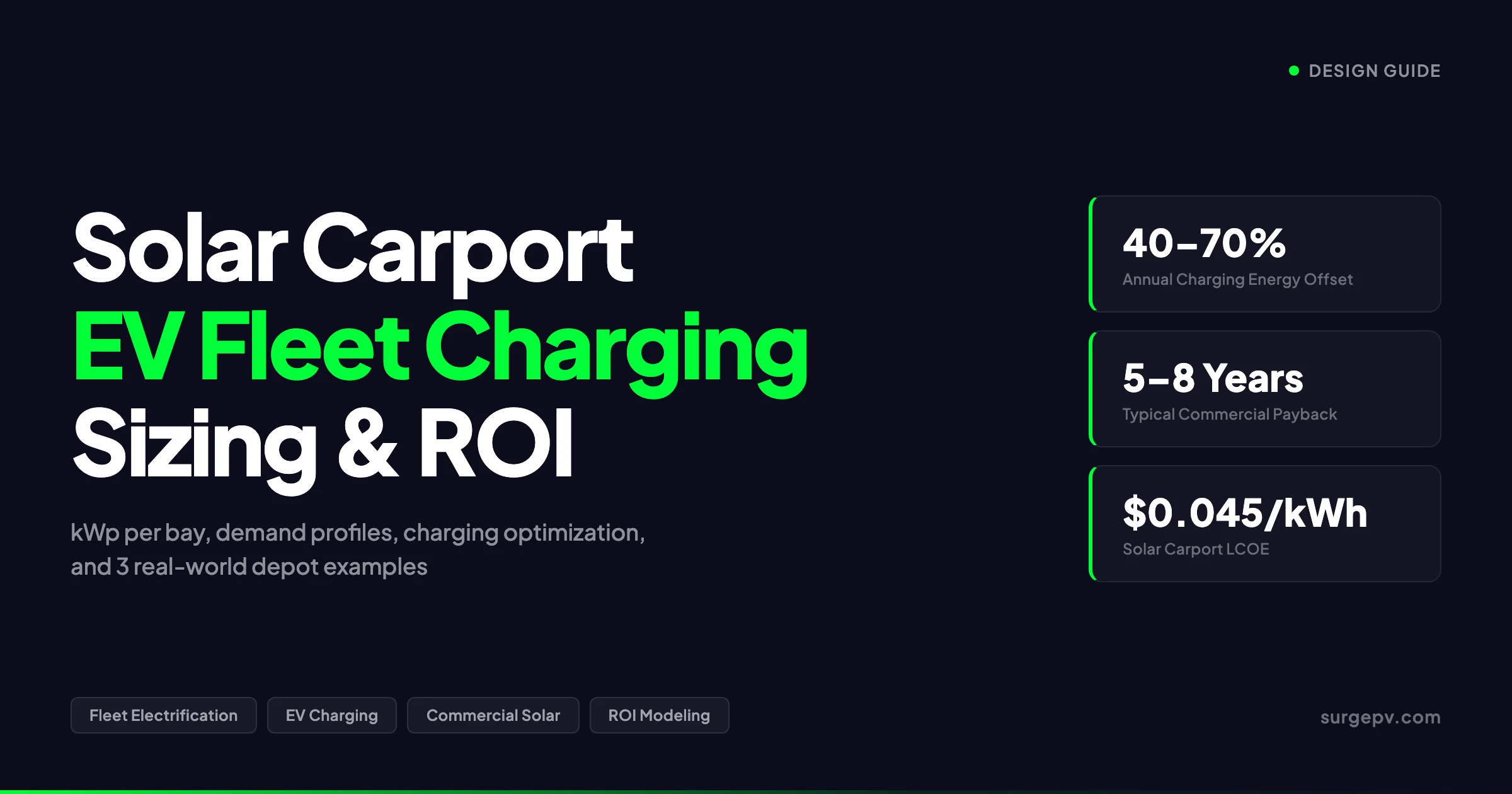
A solar carport EV fleet charging system pairs a photovoltaic parking canopy with depot EV chargers, optional battery storage, and managed charging software. Plan for 8 to 18 kWp per charging bay depending on climate, expect 40 to 70% annual energy offset from solar per NREL fleet depot data (2024), and cut demand charges by 70 to 80% with staggered charging. Payback for commercial fleet depots runs 5 to 8 years.
For more on this topic, see Adding Battery Storage Services.
In this guide you will learn:
- How to size solar carport kWp by fleet type, duty cycle, and climate zone
- Why fleet demand profiles do not match solar production, and how to fix it
- Structural design differences between cars, vans, and heavy-duty truck canopies
- DC fast charger integration and MV transformer requirements
- How managed charging software cuts demand charges by 70 to 80%
- Three fleet examples modeled on Amazon DSP, Royal Mail, and municipal depots
- V2G fleet revenue streams and bidirectional charger selection
- UK and US incentive stacking, including the Workplace Charging Scheme
For broader context on carport structural engineering, see our solar carport design guide. For a deep-dive into a single installation, the California 500 kWp carport case study walks through NEM 3.0 economics and SGIP battery incentives.
Latest Updates: Solar Carport EV Fleet Charging 2026
The solar carport EV charging landscape shifted materially in 2025 and 2026. Here is what changed.
| Development | Impact | Year |
|---|---|---|
| DC-coupled carport systems reach commercial maturity | 5 to 10% efficiency gain over AC-coupled | 2026 |
| NREL eCHIP project advances direct DC distribution | Eliminates AC/DC conversion losses | 2025 |
| Megawatt Charging System (MCS) hardware validated | 1.2 to 3.75 MW charging for Class 8 trucks | 2026 |
| US federal fleet ZEV mandate enforced | Drives demand for depot-scale solar infrastructure | 2025 |
| Section 30C credit confirmed at $100,000 per charger | Cuts EV charging infrastructure costs by 30% | 2026 |
| UK Workplace Charging Scheme extended to 2027 | 75% off charger costs up to GBP 350 per socket | 2026 |
| ISO 15118-20 V2G standard reaches commercial release | Fleet vehicles become grid assets | 2025 |
| Amazon DSP fleet crosses 18,000 Rivian EDVs deployed | Last-mile delivery becomes the largest fleet segment | 2025 |
The most important shift is the move from AC-coupled to DC-coupled architecture. For years, solar carports used standard string inverters to convert DC panel output to AC, then EV chargers converted AC back to DC for the vehicle battery. Each conversion loses 3 to 5%. DC-coupled systems skip the middle step.
NREL’s eCHIP project is testing an even more direct approach. Solar DC connects directly to the vehicle battery with no stationary battery in between. The reported efficiency gain is 7 to 12% versus AC-coupled, according to NREL (2025). This is still experimental but points to where the technology is heading.
Key Takeaway
DC-coupled architecture is now viable for fleet-scale carports. If you are designing a new depot, specify DC-coupled. If you are retrofitting an existing canopy, AC-coupled is the faster, lower-risk path. Both can integrate with the same managed charging software.
What Is a Solar Carport EV Fleet Charging System?
A solar carport EV fleet charging system is a parking canopy with photovoltaic modules mounted on the roof structure, integrated with EV charging equipment, and optionally paired with battery storage and energy management software. It generates electricity from the sun, delivers it to parked fleet vehicles, and reduces grid power purchases.
The system has five layers:
- Structural canopy — Steel or aluminum frame supporting PV modules 3 to 4 meters above parking bays, designed for local wind, snow, and seismic loads
- Solar array — PV modules (typically 400 to 600 W each) wired into strings and connected to inverters or DC buses
- EV charging infrastructure — Level 2 AC chargers (7 to 22 kW) or DC fast chargers (50 to 350 kW), or Megawatt Charging Systems for heavy duty
- Battery storage — Lithium iron phosphate (LFP) or NMC battery system to store midday solar surplus for evening discharge
- Energy management system — OCPP-compliant software that controls schedules, balances loads, prioritizes solar, and caps demand
The canopy serves two purposes. It generates electricity. It also protects vehicles from sun, rain, hail, and snow. This dual function is why solar carports cost 30 to 50% more per watt than rooftop solar but still make financial sense for fleets, according to EnergySage’s commercial benchmark data (2025).
Pro Tip
Do not design the carport structure and the solar system separately. The steel frame must be engineered for PV load, wind uplift, and local snow load from day one. Retrofitting solar onto a frame designed only for weather protection often needs structural reinforcement that costs more than starting fresh.
Fleet Duty Cycles: Why Sizing Depends on Vehicle Type
Solar carport sizing for fleets is not the same problem as sizing rooftop solar for a building. The load is mobile. The load profile depends on where the vehicles are at every hour of the day. Three duty cycle patterns dominate commercial fleet operations.
Pattern A: 12-Hour Return-to-Depot
This is the classic last-mile delivery cycle. Vehicles depart at 6 to 8 AM, run routes for 8 to 10 hours, and return at 4 to 7 PM. Charging happens overnight from roughly 6 PM to 6 AM.
Typical fleets: Amazon DSP, FedEx Ground, UPS, Royal Mail, DHL, Hermes, USPS, school buses
Energy demand: 30 to 130 kWh per vehicle per day depending on vehicle class and route length
Solar challenge: Peak solar output (10 AM to 3 PM) happens when vehicles are out. Battery storage or grid sale is needed to capture this energy.
Pattern B: 24/7 Continuous Operations
Trucks operate around the clock with rotating drivers. Vehicles arrive and depart at irregular intervals, often using opportunity charging at depot.
Typical fleets: Long-haul trucking, port drayage, mining, airport ground support
Energy demand: 200 to 500 kWh per vehicle per day
Solar challenge: Charging demand is more distributed but still peaks at shift changes. DC fast charging is the norm.
Pattern C: Daytime Dwell
Vehicles arrive in the morning and stay all day. Charging happens during business hours, aligned with solar production.
Typical fleets: Corporate fleets, sales rep cars, government vehicles, ride-share parking lots, employee workplace charging
Energy demand: 10 to 30 kWh per vehicle per day
Solar challenge: Minimal. This is the ideal duty cycle for solar carports.
Duty Cycle Comparison
| Pattern | Solar Match | Battery Needed? | Typical Offset |
|---|---|---|---|
| 12-hour return-to-depot | Poor | Yes (1.5 to 2.5 hr) | 40 to 60% direct, 70%+ with battery |
| 24/7 continuous operations | Moderate | Yes (1 to 2 hr) | 30 to 50% |
| Daytime dwell | Excellent | Optional | 60 to 85% |
SurgePV Analysis
The single biggest determinant of solar carport ROI is the fleet duty cycle. A daytime-dwell corporate fleet pays back in 2 to 3 years. A 12-hour return-to-depot delivery fleet pays back in 4 to 6 years. A 24/7 trucking operation pays back in 1 to 2 years thanks to massive diesel displacement. The technology is the same. The economics are completely different.
For a direct comparison, see Arka 360 vs SurgePV.
How Solar Carport Sizing Works: kWp Per Bay
The first question every fleet manager asks: how much solar do I need per charging bay? The answer depends on four variables.
Vehicle daily energy use. A light commercial van consumes 30 to 50 kWh per day, according to the EV Database (2025). A Rivian EDV uses 90 to 130 kWh. A heavy-duty truck consumes 200 to 500 kWh per day. The solar array must cover a fraction of this daily need.
Local solar irradiance. A carport in Phoenix (2,100 kWh per square meter per year) generates roughly 70% more energy per kWp than one in Seattle (1,200 kWh per square meter per year). Use PVWatts or PV design software with your exact coordinates.
Desired solar offset. Most fleet operators target 40 to 70% annual energy offset. Going higher requires oversized arrays, battery storage, or both.
Charger power rating. A 7 kW Level 2 charger delivers 56 kWh in an 8-hour overnight window. A 150 kW DC fast charger delivers the same in 22 minutes. The charger rating sets the maximum power the solar system can directly offset at any moment.
Sizing Formula
For a simple estimate:
Solar kWp needed = (Fleet daily kWh × Target offset %) ÷ (Peak sun hours × System efficiency)System efficiency accounts for inverter losses, soiling, temperature derating, and wiring losses. It typically runs 75 to 82% for AC-coupled systems and 80 to 85% for DC-coupled.
kWp Per Bay by Fleet Type and Climate
| Fleet Type | Daily kWh per Vehicle | Sunny Climate kWp/Bay | Moderate Climate kWp/Bay | Cold Climate kWp/Bay |
|---|---|---|---|---|
| Light commercial van (Sprinter, eDeliver 9) | 30 to 50 | 8 to 12 | 12 to 16 | 16 to 20 |
| Last-mile EDV (Rivian, Ford E-Transit) | 90 to 130 | 22 to 32 | 32 to 45 | 45 to 60 |
| Medium-duty truck | 80 to 150 | 20 to 35 | 30 to 50 | 40 to 60 |
| Heavy-duty truck (Class 8) | 200 to 500 | 50 to 120 | 75 to 170 | 100 to 220 |
| Passenger/corporate fleet | 10 to 30 | 4 to 8 | 6 to 10 | 8 to 12 |
| School bus | 60 to 150 | 15 to 35 | 25 to 50 | 35 to 65 |
These figures assume a 50% solar offset target and 4.5 to 5.5 peak sun hours for sunny climates, 3.5 to 4.5 for moderate, and 2.5 to 3.5 for cold climates.
SurgePV Analysis
Most sizing guides multiply charger power by vehicle count. This is wrong. A 50-van fleet with 19 kW chargers does not need 950 kW of solar. The vehicles only need 30 to 50 kWh each per day. Correct sizing is energy-based, not power-based. Using energy needs instead of charger ratings reduces solar capacity requirements by 60 to 80%.
Structural Design: Cars vs Vans vs Heavy-Duty Trucks
The carport structure is not a single design. It varies dramatically by vehicle type. Get this wrong and the steel costs balloon, or worse, the canopy fails.
Passenger Car Canopies
Standard parking bays are 2.5 m by 5.5 m. Single-bay or T-frame canopies are most common. Column heights are 2.4 to 3.0 m clear, allowing pickup trucks but excluding cargo vans.
Typical structure: Single-column or twin-column T-frame, 80 to 120 kg of steel per square meter of PV
Snow load: 0.75 to 1.50 kN per square meter in most temperate zones, up to 3.0 kN per square meter in heavy snow regions (Minnesota, Alps, Hokkaido)
Wind load: Designed for 110 to 140 mph wind in coastal hurricane zones, per ASCE 7-22
Cargo Van and Last-Mile Delivery Canopies
Vans like the Rivian EDV (2.85 m tall), Ford E-Transit (2.50 m tall), and Mercedes eSprinter need 3.0 to 3.6 m clear height. Most last-mile delivery depots use longer, deeper bays to accommodate side-loading.
Typical structure: Multi-bay continuous canopy, 100 to 140 kg of steel per square meter
Bay dimensions: 3.0 m wide by 7.0 to 9.0 m long for box vans
Special considerations: Side-loading clearance, bollard protection at columns, integrated wire trays for chargers mounted on columns
Heavy-Duty Truck Canopies
Class 8 trucks need 4.2 to 4.8 m clear height. Drive aisle widths increase from 7.5 m to 12 m for tractor turning radius. Structures must withstand impact from larger vehicles.
Typical structure: Large-span single-slope or gabled canopy, 150 to 220 kg of steel per square meter
Bay dimensions: 3.7 m wide by 18 to 22 m long for tractor-trailer combinations
Special considerations: MCS charger integration, MV transformer pads under canopy, reinforced columns with 1.0 m diameter bollards
Structural Cost by Vehicle Type
| Vehicle Type | Structure Cost per Wp | Total Cost per Bay |
|---|---|---|
| Passenger car | $1.20 to $1.60 | $7,000 to $14,000 |
| Cargo van | $1.40 to $1.90 | $12,000 to $24,000 |
| Heavy-duty truck | $1.80 to $2.50 | $35,000 to $80,000 |
These figures are structural steel only. Add $1.20 to $1.50 per Wp for PV modules and balance of system. A 2.5 MWp heavy-duty truck canopy will cost $2.50 to $3.50 per Wp installed, before incentives.
Common Mistake
Designing a single-column T-frame for a vehicle that needs side loading. The cargo van driver cannot open the side door without hitting the column. Match canopy geometry to vehicle access patterns, not just parking space dimensions.
EV Fleet Demand Profiles: The Solar Timing Problem
Here is the central challenge that most solar carport guides gloss over. Solar production peaks at midday. Fleet vehicles in 12-hour duty cycles are on the road at midday. They return to the depot at 5 to 7 PM and plug in. The charging demand peak happens precisely when solar output is falling.
Typical Fleet Charging Demand by Hour
| Time | Activity | Depot Load | Solar Output |
|---|---|---|---|
| 12:00 to 5:00 AM | Overnight charging (remaining vehicles) | Medium | Zero |
| 6:00 to 8:00 AM | Vehicles depart | Dropping | Rising |
| 8:00 AM to 4:00 PM | Most vehicles on route | Near zero | Peaking |
| 5:00 to 7:00 PM | Vehicles return and plug in | Surging | Falling |
| 7:00 PM to 12:00 AM | Evening charging | High | Zero |
This mismatch means a solar carport without battery storage can only directly power a fraction of fleet charging. The solar energy generated at midday must either be exported to the grid (often at low value), stored in batteries for evening use, or wasted.
Load Profiles by Fleet Type
Last-mile delivery fleets (Amazon DSP, FedEx Ground, Royal Mail) show the most predictable pattern. Vehicles depart 6 to 8 AM, return 4 to 7 PM, and need 30 to 130 kWh each overnight. A 50-van depot draws 250 to 700 kW of continuous load through the evening and night, according to Fleet News commercial fleet analysis (2025). For United Kingdom-specific compliance details, see United Kingdom comparisons/mcs-vs-non-mcs. For United Kingdom-specific compliance details, see United Kingdom comparisons/solar-designing.
Corporate car fleets show a different pattern. Vehicles arrive at 8 to 9 AM and sit in the lot all day. This aligns much better with solar production. Midday charging can absorb 60 to 80% of solar output directly.
Heavy-duty truck fleets need the most power. A Class 8 electric truck with a 500 kWh battery returning with 20% state of charge needs 400 kWh. At 150 kW DC fast charging, that is 2.7 hours per truck. With 20 trucks, the depot needs 3 to 4 MW of charging capacity, according to the ICCT heavy-duty fleet electrification report (2024).
Municipal fleets (police, fire, sanitation, public works) have the most varied profiles. Police cruisers may run 24/7 with shift changes every 8 to 12 hours. Sanitation trucks run 5 to 7 AM and again 3 to 7 PM. Public works pickup trucks follow Pattern A.
What Most Guides Miss
The solar-to-charging timing mismatch is not a design flaw you can engineer away. It is a fundamental constraint of fleet operations. The fix is not bigger solar arrays. The fix is battery storage plus managed charging. A 500 kWp carport with 1,000 kWh of battery storage delivers more usable solar energy to fleet vehicles than a 1,000 kWp carport with no battery.
DC Fast Charge Integration and Balance of Plant
For heavy-duty fleets and opportunity charging, DC fast chargers (DCFC) are essential. Integrating them into a solar carport adds complexity that Level 2 systems do not have.
DCFC Power Levels
| Charger Class | Power Range | Vehicle Application |
|---|---|---|
| Level 2 AC | 7 to 22 kW | Cars, vans, light commercial |
| Low DC | 24 to 50 kW | Vans, small trucks, opportunity charging |
| High DC | 100 to 350 kW | Medium-duty trucks, regional delivery |
| MCS (Megawatt Charging) | 700 kW to 3.75 MW | Class 8 long-haul trucks |
Electrical Balance of Plant
A 150 kW DCFC pulls 360 amps at 480 V. Three-phase wiring is mandatory. Each charger needs:
- Dedicated circuit breaker (typically 400 A frame for 150 kW)
- 4/0 to 250 MCM copper or 300 to 400 MCM aluminum feeders
- Conduit run from main switchgear (length matters — voltage drop limits the practical distance)
- Disconnect switch within sight (per NEC 625.43)
- GFCI protection (NEC 625.54)
For a 10-charger depot at 150 kW each, the connected load is 1.5 MW. Add building load and Level 2 chargers, and the service can easily exceed 2 MW.
Medium-Voltage Transformer Requirements
Once depot connected load exceeds 500 to 750 kW, the utility typically requires a medium-voltage (MV) service. This means:
- A new MV transformer (pad-mounted, oil-filled or dry-type)
- MV switchgear and metering
- Primary feeders from the utility distribution line
- Coordination with the utility on transformer ownership (customer-owned vs utility-owned)
Transformer sizing is critical. A 1 MW load with a 1.5 transformer service ratio needs a 1,500 kVA unit. Oversizing increases no-load losses. Undersizing limits future expansion.
| Depot Load | Recommended Transformer | Service Type |
|---|---|---|
| 200 to 500 kW | 500 kVA | Pad-mounted, secondary |
| 500 kW to 1 MW | 1,000 kVA | MV primary (typically 12.47 kV or 13.2 kV) |
| 1 to 2.5 MW | 1,500 to 2,500 kVA | MV primary, customer-owned |
| 2.5 to 5 MW | Two 2,500 kVA in parallel | MV primary with redundancy |
| 5+ MW | Substation upgrade | Dedicated utility feed |
Transformer lead times in 2026 are 8 to 18 months for utility-grade equipment, according to industry reporting. Start the conversation before ordering vehicles.
Pro Tip
For depots near the 750 kW threshold, run the financial model both ways. Sometimes it pays to design for 700 kW connected load and avoid the MV transformer cost. Other times, going to 1.5 MW from day one is cheaper than upgrading later. The economics flip around the $300,000 transformer cost line.
For a deeper dive on the transformer sizing problem, see our commercial solar transformer sizing guide.
Charging Schedule Optimization: How to Match Solar to Fleet Needs
Managed charging software is the difference between a solar carport that saves money and one that triggers demand charge disasters. The software controls when each vehicle charges, at what power level, and from what source.
Five Optimization Strategies
1. Staggered start times. Instead of all vehicles beginning to charge at 5:30 PM when they return, the software sequences start times based on next-day departure. A van leaving at 7 AM needs full charge by 6:30 AM. A van leaving at 9 AM can start charging at 2 AM. This spreads the load across 10 to 12 hours instead of 2 to 3.
2. Solar-aware charging priority. When solar production exceeds building loads, the software directs surplus solar to EV chargers first. Vehicles already plugged in get topped up with free solar before the evening rush.
3. Time-of-use rate optimization. In markets with time-of-use pricing, the software shifts charging to off-peak hours (typically 10 PM to 6 AM at $0.04 to $0.08 per kWh) and away from peak hours ($0.18 to $0.35 per kWh). This alone cuts energy costs by 40 to 60%, according to DOE Clean Cities analysis (2024).
4. Demand charge capping. The software sets a maximum site power draw and throttles chargers to stay below it. If the site has a 500 kW demand limit and building loads use 200 kW, the software allocates 300 kW across all active chargers.
5. State-of-charge-based priority. Vehicles with the lowest battery levels charge first. Vehicles above 60% state of charge wait for off-peak rates or solar surplus. This prevents wasted charging capacity on nearly-full batteries.
Impact of Managed Charging on Demand Charges
| Scenario | Peak Demand | Monthly Demand Charge | Annual Demand Charge |
|---|---|---|---|
| Unmanaged: 50 vans plug in at 5 PM | 950 kW | $19,000 | $228,000 |
| Staggered charging | 380 kW | $7,600 | $91,200 |
| Staggered + demand capping | 250 kW | $5,000 | $60,000 |
| Staggered + demand capping + solar offset | 150 kW | $3,000 | $36,000 |
These figures assume a $20 per kW-month demand charge rate, which is typical for US commercial customers. Managed charging alone saves $168,000 per year, often paying for the software cost within 30 days.
Pro Tip
Demand charge management via staggered charging cuts electricity bills by 50% or more compared to unmanaged charging. The software pays for itself in under 30 days at most fleet depots. Do not treat managed charging as optional. It is mandatory for any depot with more than 10 vehicles.
Grid Demand Charges: The Hidden Cost That Kills Fleet Electrification
Demand charges are the single biggest surprise for fleet operators going electric. They expect to pay for energy (kWh). They get billed for power (kW) too.
How Demand Charges Work
Most commercial utility rates have two components:
- Energy charge: $0.08 to $0.15 per kWh consumed
- Demand charge: $10 to $25 per kW of peak 15-minute usage each month Also see: Us Residential Solar Market Trends 2026.
A fleet depot that consumes 75,000 kWh per month at $0.12 per kWh pays $9,000 in energy charges. But if peak demand hits 1,000 kW at $20 per kW, the demand charge is $20,000. The demand charge is more than double the energy charge.
The Fleet Charging Demand Spike
The worst case is simple. Fifty vans return at 5:30 PM. Each plugs into a 19 kW Level 2 charger. All start charging immediately. Peak demand: 950 kW. Monthly demand charge: $19,000. Annual demand charge: $228,000.
This is not theoretical. Fleet operators see it in their first month of EV operation. One UK fleet manager we worked with saw the electricity bill triple after adding 30 electric vans. The energy cost was predictable. The demand charge was not.
Solar Carports Reduce Demand Charges Three Ways
1. Direct solar offset during daytime. Vehicles that charge during the day draw from solar instead of the grid. This cuts the net demand seen by the utility meter.
2. Battery discharge during peak hours. A battery charged with midday solar discharges during the 5 to 9 PM charging rush. The battery supplies power to chargers, keeping grid demand flat.
3. Managed charging software. As shown above, staggered charging and demand capping cut peak demand by 60 to 80%.
Demand Charge Economics by Fleet Size
| Fleet Size | Unmanaged Peak Demand | Managed + Solar Peak Demand | Annual Demand Charge Savings |
|---|---|---|---|
| 20 vans | 380 kW | 80 kW | $72,000 |
| 50 vans | 950 kW | 150 kW | $192,000 |
| 100 cars | 1,500 kW | 300 kW | $288,000 |
| 20 heavy trucks | 3,000 kW | 800 kW | $528,000 |
These savings are real, recurring, and often larger than the energy cost savings from solar generation itself. This is why demand charge management should be the first priority in any fleet design.
For more depth on this topic, see our demand charge reduction with solar and battery storage guide and peak demand reduction strategies.
Key Takeaway
Demand charges add 20 to 40% to a fleet depot electricity bill. At $20 per kW-month, a 1,000 kW peak demand costs $240,000 per year. Solar carports with battery storage and managed charging cut this by 70 to 80%. The demand charge savings often exceed the solar energy savings.
AC-Coupled vs DC-Coupled Architecture: Which to Choose?
The choice between AC-coupled and DC-coupled architecture shapes every other design decision. Here is how they compare.
AC-Coupled Architecture
Solar DC output goes to string inverters, which convert it to AC. The AC feeds the building panel or a dedicated EV charging panel. EV chargers draw AC from the panel and convert it to DC for the vehicle battery.
Pros:
- Mature technology with many vendors
- Easy to retrofit onto existing electrical infrastructure
- Standard components available from multiple suppliers
- Simpler permitting and inspection
Cons:
- Two AC/DC conversions (solar DC to AC, then AC to EV DC)
- 6 to 10% total conversion loss
- Larger inverter footprint
- Harder to integrate battery storage seamlessly
DC-Coupled Architecture
Solar DC output feeds a DC bus. The DC bus connects directly to DC fast chargers and battery storage. A single bidirectional inverter handles grid connection and AC loads.
Pros:
- 5 to 10% higher system efficiency, per NREL eCHIP research (2025)
- Fewer power electronics components
- Direct PV-to-battery charging without conversion loss
- Smaller footprint
- Better suited for DC fast charging integration
Cons:
- Fewer vendors and less field experience
- More complex control systems
- Harder to find qualified installers
- Higher upfront engineering cost
When to Choose Each
| Factor | AC-Coupled | DC-Coupled |
|---|---|---|
| Retrofit of existing depot | Better | Harder |
| New construction | Either | Better |
| Level 2 charging only | Fine | Overkill |
| DC fast charging (50+ kW) | Less efficient | Better |
| Battery storage required | Possible | Better |
| Installer availability | Wide | Limited |
| Long-term efficiency priority | No | Yes |
Tradeoff
AC-coupled wins on installer availability and retrofit simplicity. DC-coupled wins on efficiency and long-term cost. For a new fleet depot with DC fast charging and battery storage, DC-coupled is the right choice. For adding solar to an existing depot with Level 2 chargers, AC-coupled is faster and lower-risk.
For a deeper technical comparison, see our AC-coupled vs DC-coupled battery system guide. See our guide on Agricultural Solar Case Study for more.
V2G Fleet Potential: Vehicles as Grid Assets
Vehicle-to-grid (V2G) technology lets EV batteries discharge power back to the grid or building. For fleets that sit parked 12 to 18 hours per day, V2G turns idle vehicles into revenue-generating assets.
How V2G Works for Fleets
When the grid needs power (peak demand events, frequency regulation, voltage support), the utility or aggregator sends a signal. The bidirectional charger reverses flow, pulling energy from the vehicle battery and pushing it back to the grid. The fleet operator receives payment per kWh discharged.
V2G Revenue Streams
| Revenue Source | Typical Value | Constraint |
|---|---|---|
| Demand response capacity payments | $50 to $200 per kW-year | Vehicle must be plugged in during event |
| Frequency regulation | $40,000 to $80,000 per MW-year | Requires fast response, smaller energy quantities |
| Peak demand reduction (behind meter) | $100 to $300 per kW-year | Avoids own demand charges |
| Wholesale energy arbitrage | $30 to $80 per MWh | Requires market access |
A 50-van fleet with 100 kWh batteries per van has 5 MWh of potential storage. Conservatively assuming 20% available for V2G during overnight charging hours, that is 1 MWh of grid-flexible capacity. At combined revenue of $200 per kW-year for 200 kW of average bidirectional capacity, the fleet earns $40,000 per year.
Bidirectional Charger Selection
V2G-capable chargers must meet several standards:
- ISO 15118-20 for bidirectional communication, commercially released in 2025
- SAE J3072 for utility interconnection of V2G
- UL 9741 for safety certification of bidirectional charging equipment
In 2026, V2G-capable chargers cost $8,000 to $15,000 per port versus $1,500 to $5,000 for standard Level 2. The premium is justified only if the fleet has a clear V2G revenue path. For most fleets today, that means a utility V2G pilot program or a behind-the-meter demand charge play.
Vehicle Compatibility
Not all electric vehicles support V2G. Confirmed bidirectional-capable vehicles in 2026 include:
- Ford F-150 Lightning (Pro Power Onboard)
- Kia EV9 and EV6
- Hyundai Ioniq 5 and 6
- Volkswagen ID.4, ID.7 (with software update)
- Nissan Leaf (CHAdeMO V2G via specific chargers)
- Rivian R1T (planned for 2026)
Notably, Tesla vehicles do not support V2G as of 2026. Confirm vehicle compatibility before specifying V2G chargers.
For a deeper look at bidirectional charging hardware, see our vehicle-to-grid solar design guide.
Pro Tip
Do not plan a V2G business case on grid services revenue alone in 2026. Tariffs are immature in most markets. Plan instead on demand charge reduction (behind-the-meter V2G) and treat utility V2G revenue as upside if the program exists.
Weather Protection: The Non-Energy Value Most ROI Models Ignore
Solar carports protect vehicles from sun, rain, hail, and snow. This has real financial value that most ROI spreadsheets miss.
Quantified Protection Benefits
Reduced cabin cooling. A vehicle parked in full sun can reach 60 C interior temperature. Cooling it to a drivable temperature takes 3 to 5 kWh of battery energy. A shaded vehicle starts 15 to 20 C cooler, saving 1 to 2 kWh per vehicle per day. For a 50-van fleet, that is 50 to 100 kWh saved daily, enough to power an extra van.
Extended vehicle life. UV exposure degrades paint, dashboards, and seals. A vehicle kept under cover shows 20 to 30% less exterior degradation over 5 years. For a fleet with 5-year replacement cycles, this means higher resale value.
Hail protection. In hail-prone regions (Texas, Oklahoma, Colorado), a single hailstorm can total dozens of vehicles. A solar carport with impact-rated glass or polycarbonate panels protects the fleet. Insurance premiums for covered fleets are 5 to 10% lower.
Snow and ice reduction. In cold climates, vehicles under carports need 50% less snow clearing time. Drivers do not scrape ice off windshields. This saves 10 to 15 minutes per vehicle per snowy morning.
Weather Protection Value per Space
| Climate Type | Annual Value per Space | Primary Benefit |
|---|---|---|
| Hot/sunny (Phoenix, Dubai) | $300 to $500 | Cooling load reduction, UV protection |
| Hail-prone (Texas, Colorado) | $400 to $800 | Hail damage prevention |
| Snow/ice (Minnesota, Canada) | $200 to $400 | Snow clearing time, ice prevention |
| Moderate (UK, Germany) | $150 to $250 | Rain protection, reduced corrosion |
These values are conservative. A single avoided hail damage claim can justify the entire carport structure cost for a multi-vehicle fleet.
Cost Benchmarks and ROI Modeling for 2026
Solar carports cost more per watt than rooftop solar. The structural steel, deeper footings, and vehicle-impact engineering add 30 to 50% to installed cost. But the dual function changes the economics.
Installed Cost Benchmarks
| System Type | Cost per Wp (USD) | Typical System Size | Total Cost |
|---|---|---|---|
| Residential carport | $3.50 to $4.50 | 5 to 15 kWp | $17,500 to $67,500 |
| Commercial carport (small) | $3.00 to $4.00 | 100 to 300 kWp | $300,000 to $1,200,000 |
| Commercial carport (large) | $2.80 to $3.50 | 500 kWp to 2 MW | $1,400,000 to $7,000,000 |
| Rooftop solar (comparison) | $2.00 to $2.80 | Any | — |
| Ground-mount solar (comparison) | $2.50 to $3.30 | Any | — |
Additional Costs for EV Integration
| Component | Cost per Unit | Notes |
|---|---|---|
| Level 2 AC charger (7 to 22 kW) | $1,500 to $5,000 installed | Standard for van/car fleets |
| DC fast charger (50 to 150 kW) | $40,000 to $150,000 installed | For heavy-duty or opportunity charging |
| MCS charger (1 to 3.75 MW) | $400,000 to $1,500,000 installed | Class 8 truck depots only |
| Battery storage | $300 to $500 per kWh | LFP, including BMS and installation |
| Energy management software | $5,000 to $20,000 per year | Subscription-based, per-site |
| Electrical upgrade (transformer) | $50,000 to $500,000 | Depends on existing service |
| MV transformer upgrade | $250,000 to $1,500,000 | When connected load exceeds 750 kW |
| Trenching and conduit | $50 to $150 per linear foot | From array to chargers |
LCOE and Payback
The Levelized Cost of Energy from a solar carport ranges from $0.045 to $0.065 per kWh over 25 years. This compares to commercial grid rates of $0.10 to $0.15 per kWh and peak rates of $0.18 to $0.35 per kWh.
| Metric | Value |
|---|---|
| Solar carport LCOE | $0.045 to $0.065 per kWh |
| Commercial grid rate (average) | $0.10 to $0.15 per kWh |
| Peak TOU rate | $0.18 to $0.35 per kWh |
| Diesel equivalent per mile | $0.50 per mile |
| Electric fleet per mile | $0.105 per mile |
| Typical payback period | 5 to 8 years |
| 25-year savings (500 kWp system) | $1.5M to $3M |
Available Incentives (US)
| Incentive | Value | Applies To |
|---|---|---|
| Federal Investment Tax Credit (Section 48E) | 30% of solar cost | Solar carport |
| Section 30C (Alternative Fuel Refueling) | 30% up to $100,000 per charger | EV chargers |
| Modified Accelerated Cost Recovery (MACRS) | Bonus depreciation Year 1 | Commercial solar |
| State rebates | Varies by state | Solar + storage |
| Utility make-ready programs | $200,000 to $1,000,000 | Charging infrastructure |
Available Incentives (UK)
| Incentive | Value | Applies To |
|---|---|---|
| Workplace Charging Scheme (WCS) | 75% off charger cost, max GBP 350 per socket | EV chargers (up to 40 sockets per site) |
| Rapid Charging Fund (RCF) | Grants for high-capacity grid connections | Strategic Road Network depots |
| Plug-in Van Grant | GBP 2,500 to GBP 16,000 per vehicle | Small and large vans |
| Annual Investment Allowance | 100% first-year deduction | Solar and EV charging plant |
| Renewable Infrastructure Capital Network (RICN) | Targeted grants for charging hubs | Selected commercial fleets |
| Business rate relief | 100% relief on plant and machinery | Solar PV systems |
Combined, US incentives can cut total project cost by 40 to 60%. A $2 million project nets down to $800,000 to $1.2 million. UK fleets typically save 30 to 45% through WCS, AIA, and Plug-in Van Grant stacking.
Key Takeaway
At $0.045 to $0.065 per kWh LCOE, solar carport energy undercuts grid rates by 35 to 70%. With federal incentives cutting project costs by 40 to 60%, payback periods of 5 to 8 years are achievable for commercial fleet depots. The demand charge savings alone often justify the investment.
Example 1: 50-Van Amazon DSP Last-Mile Depot
Amazon’s DSP last-mile delivery partner operates 50 Rivian EDV 700 vans from a Phoenix-area depot. Vehicles depart 6:30 AM and return 4 to 6 PM. Each van drives 80 to 120 miles per day and consumes 90 to 130 kWh.
Fleet Profile
| Parameter | Value |
|---|---|
| Fleet size | 50 Rivian EDV 700 vans |
| Daily energy per van | 110 kWh average |
| Total daily fleet energy | 5,500 kWh |
| Charger type | Level 2, 19 kW dual-port |
| Charging window | 5 PM to 6 AM (13 hours) |
| Location | Phoenix, AZ (2,100 kWh per square meter per year) |
Solar Carport Sizing
Target: 50% solar offset with battery storage.
Solar kWp = (5,500 kWh × 50%) ÷ (5.8 peak sun hours × 0.80 efficiency)
Solar kWp = 2,750 ÷ 4.64 = 593 kWp
Round to 600 kWp. Pair with 1,200 kWh of LFP battery storage to bridge solar production to evening charging demand.
System Design
| Component | Specification | Cost |
|---|---|---|
| Solar carport (600 kWp) | Steel structure + 1,200 × 500 W panels, cargo van bays | $1,920,000 |
| String inverters (6 × 100 kW) | AC-coupled | $90,000 |
| Battery storage (1,200 kWh) | LFP, demand shifting | $480,000 |
| Level 2 chargers (50 × 19 kW dual-port = 25 units) | Pedestal-mounted | $125,000 |
| Energy management software | Annual subscription | $15,000 per year |
| MV transformer (1,500 kVA) | New utility service | $350,000 |
| Electrical work and conduit | Panel upgrades, trenching | $120,000 |
| Subtotal | $3,085,000 | |
| Section 48E ITC (30%) | ($925,500) | |
| Section 30C (25 chargers × $5,000 avg) | ($125,000) | |
| MACRS bonus depreciation (Year 1) | ($420,000) | |
| Net project cost | $1,614,500 |
Annual Savings
| Savings Category | Annual Value |
|---|---|
| Solar energy offset (2,750 kWh per day × $0.11 per kWh × 330 days) | $99,825 |
| Demand charge reduction (950 kW to 200 kW peak) | $180,000 |
| Time-of-use optimization | $35,000 |
| Total annual savings | $314,825 |
Payback period: 5.1 years.
Real-World Example
Amazon now operates over 18,000 Rivian EDVs across its DSP network in 2026, per company disclosures. The largest single Amazon last-mile depot in California runs more than 200 EDVs from a single facility, with utility-tied charging at peak demand of 3.8 MW. The economics of pairing solar carports with these mega-depots are now the central infrastructure decision for the DSP program through 2027.
Example 2: 40-Van Royal Mail Inner-London Depot
Royal Mail’s Mount Pleasant depot in central London operates a growing fleet of electric vans for inner-London parcel delivery. The 40-van scenario below models a typical Royal Mail city depot.
Fleet Profile
| Parameter | Value |
|---|---|
| Fleet size | 40 Peugeot e-Expert and Ford E-Transit vans |
| Daily energy per van | 45 kWh (urban routes, 50 miles per day) |
| Total daily fleet energy | 1,800 kWh |
| Charger type | Level 2, 11 kW |
| Charging window | 6 PM to 6 AM (12 hours) |
| Location | London, UK (1,000 kWh per square meter per year) |
Solar Carport Sizing
Target: 35% solar offset (limited rooftop area, low UK irradiance).
Solar kWp = (1,800 kWh × 35%) ÷ (2.8 peak sun hours × 0.78 efficiency)
Solar kWp = 630 ÷ 2.18 = 289 kWp
Round to 290 kWp. Site constraints in inner-London often limit canopy area, so this matches realistic depot footprints. Pair with 500 kWh of battery storage for evening discharge.
System Design
| Component | Specification | Cost (GBP) |
|---|---|---|
| Solar carport (290 kWp) | Steel structure + 580 × 500 W panels | GBP 760,000 |
| String inverters (3 × 100 kW) | AC-coupled | GBP 55,000 |
| Battery storage (500 kWh) | LFP | GBP 175,000 |
| Level 2 chargers (40 × 11 kW) | Wall-mounted | GBP 90,000 |
| Energy management software | Annual subscription | GBP 8,000 per year |
| Electrical work | Switchgear, conduit | GBP 75,000 |
| Subtotal | GBP 1,155,000 | |
| Workplace Charging Scheme (40 sockets × GBP 350) | (GBP 14,000) | |
| Annual Investment Allowance (100% first-year deduction) | Effective ~GBP 220,000 tax saving | |
| Net project cost (effective) | ~GBP 921,000 |
Annual Savings
| Savings Category | Annual Value (GBP) |
|---|---|
| Solar energy offset (630 kWh per day × GBP 0.22 per kWh × 320 days) | GBP 44,400 |
| Demand charge reduction (modest, smaller depot) | GBP 18,000 |
| Time-of-use optimization (Economy 7 night charging) | GBP 36,000 |
| Diesel displacement (40 vans × 50 miles × 250 days × GBP 0.30 per mile saved) | GBP 150,000 |
| Total annual savings | GBP 248,400 |
Payback period: 3.7 years.
Real-World Example
Royal Mail operates more than 5,000 EV delivery vehicles across the UK in 2026, according to Royal Mail Group sustainability data (2025). The Mount Pleasant depot in central London hosts dozens of e-vans charging overnight. Inner-city depot constraints, including limited site footprint and old MV switchgear, often dictate carport size more than energy targets do.
Example 3: 75-Vehicle Municipal Fleet Depot
A mid-sized US municipality operates 75 electric vehicles from a central public works yard. The mix is 30 sanitation trucks (medium-duty), 20 sedans (police and admin), 15 pickup trucks (parks and maintenance), and 10 vans (inspections). Vehicles run a mix of duty cycles.
Fleet Profile
| Vehicle Class | Count | Daily kWh | Charge Window |
|---|---|---|---|
| Sanitation truck (Class 6) | 30 | 180 | 7 PM to 5 AM |
| Police/admin sedan | 20 | 25 | 12 hours rolling |
| Pickup truck | 15 | 50 | 4 PM to 6 AM |
| Inspection van | 10 | 40 | 5 PM to 6 AM |
| Total daily fleet energy | 75 vehicles | 6,650 kWh | |
| Location | Denver, CO (1,900 kWh per square meter per year) |
Solar Carport Sizing
Target: 45% solar offset. Municipal fleets often have favorable rooftop and parking lot real estate for carports.
Solar kWp = (6,650 kWh × 45%) ÷ (4.5 peak sun hours × 0.78 efficiency)
Solar kWp = 2,993 ÷ 3.51 = 853 kWp
Round to 850 kWp. Pair with 1,500 kWh of battery storage and DC fast chargers for sanitation trucks.
System Design
| Component | Specification | Cost |
|---|---|---|
| Solar carport (850 kWp) | Mixed cargo and heavy-duty bay structure | $2,720,000 |
| Central inverters (2 × 500 kW) | AC-coupled | $250,000 |
| DC fast chargers (15 × 100 kW) | For sanitation trucks | $1,500,000 |
| Level 2 chargers (45 × 11 kW dual-port) | Pedestal units | $112,500 |
| Battery storage (1,500 kWh) | LFP | $600,000 |
| MV transformer (1,500 kVA) | New service | $400,000 |
| Energy management software | Enterprise | $25,000 per year |
| Electrical balance of plant | $200,000 | |
| Subtotal | $5,807,500 | |
| Section 48E ITC (30%) | ($1,742,000) | |
| Section 30C (60 chargers × $5,000 to $30,000) | ($800,000) | |
| MACRS bonus depreciation (Year 1) | ($1,050,000) | |
| State and utility incentives (Xcel Energy) | ($300,000) | |
| Net project cost | $1,915,500 |
Annual Savings
| Savings Category | Annual Value |
|---|---|
| Solar energy offset (3,000 kWh per day × $0.10 per kWh × 320 days) | $96,000 |
| Demand charge reduction (1,800 kW to 500 kW peak) | $312,000 |
| Diesel displacement (sanitation trucks: 30 × 200 mi × 260 days × $0.30) | $468,000 |
| Time-of-use optimization | $45,000 |
| Total annual savings | $921,000 |
Payback period: 2.1 years.
The municipal case shows strong economics because diesel displacement on sanitation trucks dwarfs the solar capital cost. Municipal fleets also access state and utility grants that private fleets often cannot.
Three Fleet Examples Compared
| Metric | Amazon DSP (50 EDV) | Royal Mail (40 vans) | Municipal (75 mixed) |
|---|---|---|---|
| Daily energy | 5,500 kWh | 1,800 kWh | 6,650 kWh |
| Solar kWp | 600 kWp | 290 kWp | 850 kWp |
| Solar offset | 50% | 35% | 45% |
| Charger type | L2 (19 kW) | L2 (11 kW) | L2 + DCFC |
| Battery storage | 1,200 kWh | 500 kWh | 1,500 kWh |
| Net project cost | $1,614,500 | ~GBP 921,000 ($1.16M) | $1,915,500 |
| Annual savings | $314,825 | GBP 248,400 ($313,000) | $921,000 |
| Payback period | 5.1 years | 3.7 years | 2.1 years |
| Key driver | Demand charge reduction | Diesel + WCS grants | Diesel + state grants |
Key Takeaway
Payback varies dramatically by fleet type. Municipal mixed fleets pay back in 2 to 3 years due to massive diesel displacement on sanitation trucks plus state incentives. Inner-city Royal Mail style depots pay back in 3 to 5 years through tight load profiles and UK grant stacking. Amazon DSP last-mile depots pay back in 5 to 7 years driven by demand charge savings. The solar carport is rarely the dominant cost. The vehicles and grid infrastructure are.
What Most Fleet Managers Get Wrong About Solar Carports
After reviewing dozens of fleet electrification plans, we see the same mistakes repeatedly.
Mistake 1: Sizing by charger count, not energy need. A fleet with 50 vehicles and 19 kW chargers does not need 950 kW of solar. The vehicles only need 30 to 130 kWh each per day. Size for energy (kWh), not power (kW). This single error inflates solar capacity by 60 to 80%.
Mistake 2: Ignoring demand charges until the first bill arrives. Fleet managers budget for energy costs at $0.10 to $0.15 per kWh. They do not budget for demand charges at $20 per kW-month. A 1,000 kW peak demand costs $240,000 per year. Model demand charges in the business case from day one.
Mistake 3: Treating battery storage as optional. Without battery storage, a solar carport can only offset charging during daylight hours. Most fleet charging happens at night. Battery storage is required, not optional, for high solar offset targets.
Mistake 4: Designing the carport structure after the solar system. The steel frame must support PV loads, wind uplift, and snow loads. A canopy designed only for weather protection will need expensive reinforcement to carry solar panels.
Mistake 5: Underestimating utility lead times. A 2.5 MW solar carport with 3 MW of charging may need a new utility transformer and service upgrade. Lead times are 8 to 18 months in 2026. Start the utility conversation before ordering vehicles.
Mistake 6: Ignoring vehicle clearance. A T-frame canopy designed for sedans cannot accommodate cargo vans. A canopy designed for cargo vans cannot fit Class 8 tractors. Match canopy geometry to your actual fleet, including future vehicle replacements.
Pro Tip
Start the utility interconnection process 12 to 18 months before your first EV arrives. The utility upgrade, not the solar installation, is usually the longest lead-time item in a fleet electrification project. Place transformer orders as soon as you have a load study, even before final permits.
Designing Solar Carports in SurgePV
Solar design software like the SurgePV platform helps fleet operators and solar designers model solar carport systems with accuracy. The platform handles the complex geometry of parking canopy layouts, shading from adjacent structures, and the electrical design of integrated EV charging.
Key design steps in the SurgePV platform:
-
Import the site layout. Use satellite imagery or CAD files to map parking bays, building footprints, and existing electrical infrastructure.
-
Place the carport structure. Define bay dimensions, column spacing, and module tilt angle. SurgePV auto-calculates structural loads and wind uplift.
-
Size the solar array. The generation and financial tool models annual production based on local irradiance, module specifications, and shadow analysis.
-
Add EV charging loads. Input fleet size, daily energy per vehicle, charging window, and charger power ratings. The tool calculates demand profiles and grid import requirements.
-
Model battery storage. Add battery capacity and define charge/discharge schedules. See how storage shifts solar energy to evening charging hours.
-
Run financial analysis. The financial modeling engine calculates LCOE, payback period, NPV, and IRR based on local electricity rates, incentives, and demand charges.
-
Generate proposals. Solar proposal software creates client-ready proposals with 3D visualizations, production estimates, and ROI summaries.
For fleet operators evaluating commercial solar options, the ability to model scenarios with and without battery storage, with Level 2 versus DC fast charging, at different solar offset targets, is essential for making the right investment decision.
Model Your Fleet Solar Carport in SurgePV
See exact production, demand charge savings, and payback for your depot.
Book a DemoNo commitment required · 20 minutes · Live project walkthrough
Installation and Permitting Considerations
Solar carports face more complex permitting than rooftop systems. Here is what to expect.
Structural Engineering
Carport structures must meet local building codes for wind load, snow load, and seismic requirements. In hurricane-prone regions, wind uplift calculations are critical. A solar panel acts like a sail. The mounting structure must resist uplift forces of 50 to 120 psf depending on wind zone, per ASCE 7-22.
Vehicle impact protection is required. Bollards or concrete barriers must protect canopy columns from vehicle strikes. This adds $500 to $1,500 per column.
Electrical Codes
EV charging infrastructure must comply with NEC Article 625 (Electric Vehicle Power Transfer Systems). Key requirements include:
- GFCI protection for all EV supply equipment (NEC 625.54)
- Disconnecting means within sight of the charger (NEC 625.43)
- Load calculations that account for EV charging as continuous loads (125% multiplier per NEC 625.41)
- Proper grounding and bonding of all metal carport structures (NEC 250)
Utility Interconnection
Interconnection applications for solar carports with EV charging follow the same process as standard commercial solar but with higher scrutiny due to the additional load. Key considerations:
- Service capacity: The existing utility service must handle both the building load and the EV charging load. A 50-van depot with 11 kW chargers needs 550 kW of charging capacity. Add the building load, and the total may exceed the existing service.
- Export limits: Some utilities cap solar export to 100% of historical usage. If the carport generates more than the building uses, you may need a larger service or storage to absorb excess production.
- Time-to-interconnect: Commercial interconnection timelines run 3 to 12 months. Start early.
Permitting Timeline
| Phase | Duration |
|---|---|
| Structural engineering and stamped drawings | 4 to 8 weeks |
| Electrical design and single-line diagram | 2 to 4 weeks |
| Building permit application and approval | 4 to 12 weeks |
| Utility interconnection application | 8 to 24 weeks |
| Construction | 8 to 16 weeks |
| Inspection and commissioning | 2 to 4 weeks |
| Total project timeline | 6 to 14 months |
Future Outlook: What Changes by 2030
Several trends will reshape solar carport EV fleet charging in the next five years.
V2G standardization. ISO 15118-20, the international standard for bidirectional charging, is now commercially available, per the International Organization for Standardization (2025). Fleet vehicles that sit parked 18 hours per day become grid assets. By 2030, V2G revenue could add 10 to 25% to fleet carport ROI.
DC-coupled cost parity. DC-coupled systems currently cost 10 to 15% more upfront than AC-coupled. By 2030, volume manufacturing and standardization will close this gap. The efficiency advantage will make DC-coupled the default choice for new fleet depots.
Megawatt Charging System (MCS) for heavy-duty fleets. MCS delivers 1 to 3.75 MW to a single truck, enabling 30-minute charging for 500+ kWh batteries. NREL is validating MCS hardware from ABB, Siemens, Kempower, and Tesla for 2026 deployment. Solar carports for heavy-duty fleets will need MW-scale DC buses.
Autonomous charging. Self-driving vehicles will park themselves under carports and plug in automatically. The charging schedule will be optimized by the vehicle’s route planning AI, not by a separate energy management system.
Solar carport cost decline. Module costs continue to fall. Structural steel fabrication is becoming more automated. By 2030, commercial solar carports may reach $2.00 to $2.50 per Wp installed, closing the gap with rooftop solar.
Key Takeaway
By 2030, DC-coupled solar carports with V2G capability will be the standard for fleet depots. The technology exists today. The economics improve every year. Fleet operators who install solar carports in 2026 will have a 4-year head start on competitors who wait.
Conclusion
Solar carport EV fleet charging is becoming the default infrastructure for commercial fleet electrification. The economics are compelling. LCOE runs $0.045 to $0.065 per kWh. Payback periods range from 2 to 8 years. Demand charge savings often exceed the solar energy savings on their own.
The design process is straightforward once you avoid the common mistakes. Size for energy, not power. Model demand charges from day one. Pair solar with battery storage for high offset targets. Use managed charging software to cut peak demand by 70 to 80%. Match canopy structure to vehicle class. Design the carport for solar loads from the start.
Three actions to take now:
- Audit your depot’s electrical service capacity and utility rate structure. Identify the demand charge rate and time-of-use periods. This data drives every other design decision.
- Model a solar carport scenario in cloud solar design software using your actual fleet size, daily mileage, and local irradiance. Compare 40%, 60%, and 80% solar offset targets to find the optimal investment level.
- Contact your utility about interconnection timelines and make-ready programs. The MV transformer upgrade, not the solar installation, is usually the critical path item. Lead times in 2026 are 8 to 18 months.
For UK fleet operators, file the Workplace Charging Scheme application early. For US fleet operators, model Section 48E and Section 30C credits together with MACRS depreciation.
Frequently Asked Questions
How many kWp of solar carport capacity do I need per EV charging bay?
Plan for 8 to 12 kWp per Level 2 charging bay in sunny climates and 12 to 18 kWp in moderate climates. A 20-van depot with 7 kW chargers needs roughly 160 to 240 kWp of solar carport. The exact figure depends on local irradiance, vehicle daily energy use, and the offset target.
What is the typical solar offset percentage for EV fleet charging?
Well-designed solar carport systems offset 40 to 70% of annual fleet charging energy, according to NREL fleet depot research (2024). During solar production hours, the contribution can reach 52 to 65%. Battery storage can push offset above 80% but adds $300 to $500 per kWh to project cost.
How do demand charges affect EV fleet charging economics?
Demand charges based on peak 15-minute usage can add 20 to 40% to a fleet depot electricity bill, according to DOE Clean Cities (2024). Unmanaged charging of 50 vans plugging in at 5 PM can spike demand to 950 kW. Managed charging cuts demand charges by 70 to 80%.
Should I use AC-coupled or DC-coupled architecture for fleet solar carports?
DC-coupled architecture is gaining ground for fleet-scale carports in 2026. It eliminates dual conversion losses, improving efficiency by 5 to 10% over AC-coupled systems, according to NREL eCHIP research (2025). For new fleet depots, DC-coupled is the better long-term choice. For retrofits, AC-coupled is simpler.
What is the payback period for a solar carport EV fleet charging system?
Commercial solar carport EV charging systems show payback periods of 5 to 8 years in 2026, depending on rates, incentives, and fleet size. LCOE ranges from $0.045 to $0.065 per kWh over 25 years. With Section 48E ITC and Section 30C charger credits, project costs drop by 40 to 60%.
How does fleet departure time affect solar carport design?
Fleet vehicles that depart at 6 to 8 AM and return at 5 to 7 PM create a timing mismatch with solar production, which peaks at midday. Most solar generation happens while vehicles are on the road. The fix is battery storage plus managed charging, not bigger arrays.
What size battery storage should I pair with a fleet solar carport?
Size storage at 1.5 to 2.5 hours of peak solar output. For a 500 kWp carport, this means 750 to 1,250 kWh of storage. At $300 to $500 per kWh, a 1,000 kWh battery adds $300,000 to $500,000 but can cut demand charges by 50% or more.
Do solar carports work for Amazon DSP and Royal Mail style delivery fleets?
Yes, and they are now the dominant infrastructure choice. Amazon DSP last-mile depots run 50 to 200 Rivian EDV vans on identical 6 AM to 6 PM routes, which is the ideal pattern for staggered overnight charging with solar. Royal Mail’s Mount Pleasant depot in London charges 40 e-vans nightly and is exploring solar canopy installations through 2027.
Where this fits
This article is part of SurgePV's Solar Design hub, which works through the topic from first principles to the decisions a project team actually has to make.