

Quick Answer
A standard office building self-consumes 30% to 45% of its rooftop solar output. A well-designed cold storage system self-consumes 75% to 92%. Reconciling each category against the interval data is the most reliable way to forecast what solar will offset. 1. The largest single load, typically 50% to 65% of total facility demand.
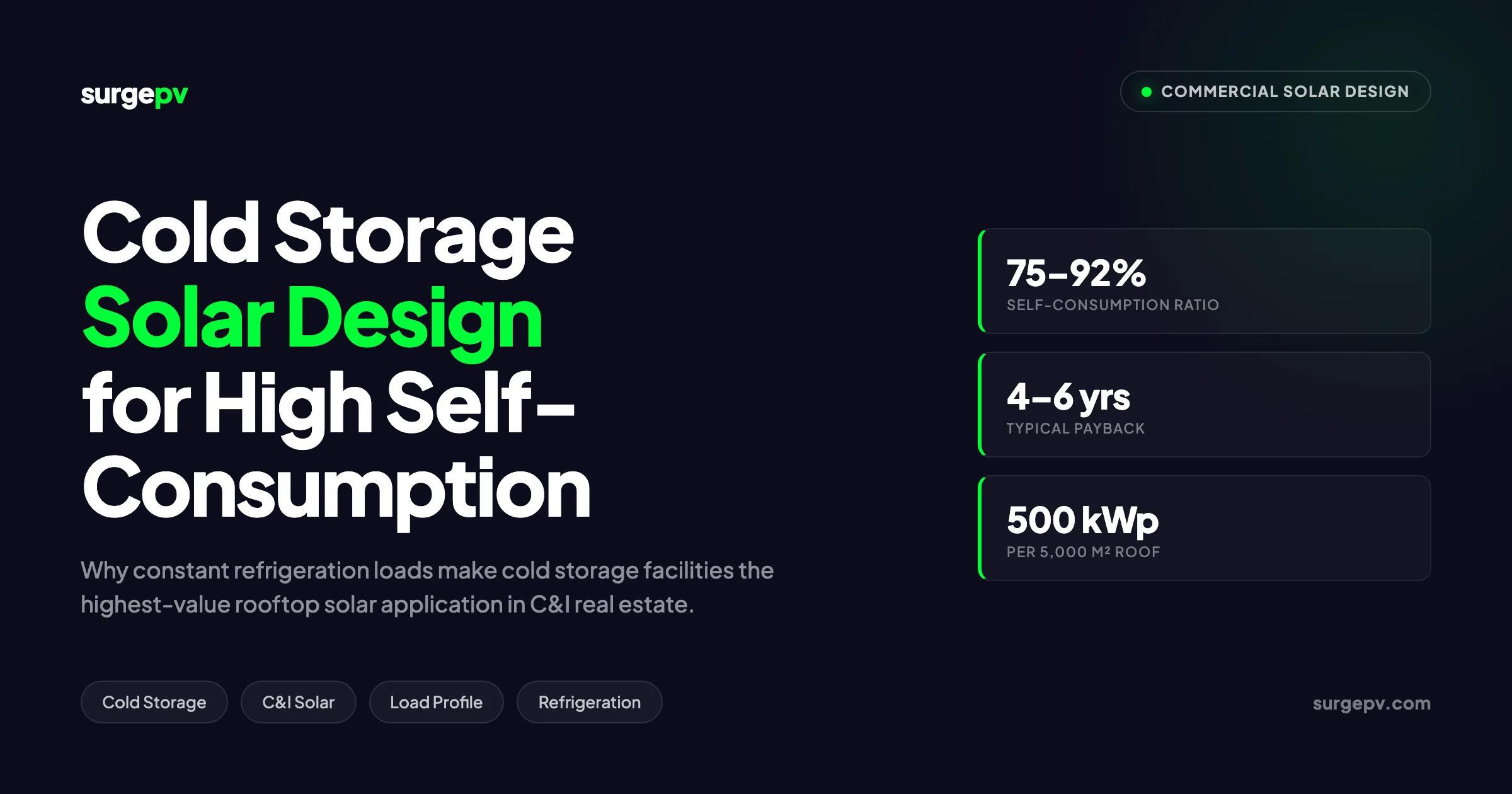
Cold storage facilities are among the highest-value solar applications in commercial real estate because their refrigeration systems run continuously and absorb almost every kilowatt-hour the array produces during daylight hours. A standard office building self-consumes 30% to 45% of its rooftop solar output. A well-designed cold storage system self-consumes 75% to 92%. That single metric is why cold storage solar projects pay back 2 to 3 years faster than the same array on a retail or warehouse roof, and why operators with refrigerated assets should treat solar as a cost line item rather than a sustainability initiative.
A standard office building self-consumes 30% to 45% of its rooftop solar output. A well-designed cold storage system self-consumes 75% to 92%. Reconciling each category against the interval data is the most reliable way to forecast what solar will offset.
This guide covers how to design a cold storage solar system from load profile analysis through inverter sizing, financial modeling, and proposal handoff. The approach is built around the solar design software workflow most commercial installers use, with specific guidance for the refrigeration load shape that distinguishes cold storage from every other C&I building type.
TL;DR — Cold Storage Solar Economics
Cold storage facilities self-consume 75% to 92% of rooftop solar generation because refrigeration runs 24 hours per day. Size the array at 70% to 90% of midday refrigeration draw, target a 4 to 6 year payback, and skip batteries unless demand charges exceed 35% of the bill. The high self-consumption ratio is the single largest economic driver — it converts retail-rate offset into the dominant value stream and shrinks reliance on feed-in tariffs.
Why Cold Storage Is the Highest-Value Solar Roof in C&I
Refrigeration is the dominant load in any cold storage facility, and it never stops. Compressors cycle around the clock to hold setpoint, condenser fans run whenever heat needs to be rejected, and evaporator fans circulate cold air through the storage rooms even when the compressors are idle. Together these loads produce a flat baseload that sits between 60% and 75% of peak demand, with the remaining capacity reserved for daytime ambient swings, door openings, and product loading activity.
This load shape is the inverse of what makes most commercial solar projects struggle financially. Office buildings draw heavy loads from 8 a.m. to 6 p.m. and almost nothing overnight, but they also sit through cloudy afternoons with shut-down HVAC equipment that lets midday solar surplus flow back to the grid. Cold storage facilities have the opposite problem and turn it into an advantage — the surplus never appears because the refrigeration always finds work for it.
| Building Type | Typical Self-Consumption | Average Daytime Load Factor | Solar Payback Range |
|---|---|---|---|
| Cold storage facility | 75% to 92% | 0.75 to 0.90 | 4 to 6 years |
| Manufacturing plant | 60% to 80% | 0.60 to 0.80 | 5 to 7 years |
| Distribution warehouse | 40% to 60% | 0.30 to 0.55 | 6 to 9 years |
| Office building | 30% to 45% | 0.25 to 0.40 | 7 to 11 years |
| Retail center | 35% to 55% | 0.40 to 0.60 | 6 to 10 years |
The flat baseload also means cold storage operators do not need to chase complex tariff arbitrage or invest in expensive batteries to capture economic value. The simplest possible solar configuration — a flush- or ballasted-mount rooftop array with string inverters — works because the refrigeration load is already shaped to consume what the array produces.
For the structural and financial counterpart to this guide on a different commercial roof type, see our warehouse rooftop solar design guide and our factory solar system design guide.
Cold Storage Load Profile: What Drives the 24/7 Baseload
Before sizing the array, the designer needs a defensible model of the facility’s annual load profile. Cold storage facilities differ from most commercial loads in how they respond to weather, occupancy, and operational changes, so the model has to capture each driver individually rather than relying on a flat assumption.
The Five Load Categories Inside a Cold Store
Every cold storage facility breaks down into five load categories that aggregate into the metered demand. Reconciling each category against the interval data is the most reliable way to forecast what solar will offset.
- Compressor power. The largest single load, typically 50% to 65% of total facility demand. Screw, scroll, and reciprocating compressors cycle in response to refrigerant pressure, with duty cycles between 60% and 85% in steady-state operation.
- Condenser fan power. Air-cooled condensers reject heat to ambient and represent 8% to 15% of demand. Fan power scales with ambient temperature, which means hot summer afternoons drive condenser load up at exactly the time solar generation peaks.
- Evaporator fan power. Inside each cold room, evaporator fans circulate air across the cooling coils. These fans run almost continuously and represent 6% to 12% of demand.
- Defrost heaters and miscellaneous loads. Electric or hot gas defrost cycles, dock door heaters, oil heaters, control panels, and lighting collectively contribute 5% to 10% of demand.
- Process loads. Blast freezers, IQF tunnels, hot water systems, and product handling equipment add 5% to 20% depending on the operation. These loads create the daytime peaks that solar most easily offsets.
Typical Load Curve Shape
A 5,000 square meter cold storage facility with 500 kW peak demand typically shows the following load curve:
| Hour Block | Typical Load (% of Peak) | Driver |
|---|---|---|
| 00:00 to 06:00 | 60% to 70% | Compressor baseload, evaporator fans |
| 06:00 to 09:00 | 65% to 80% | Morning ambient rise, dock activity starts |
| 09:00 to 12:00 | 80% to 95% | Door openings, product loading, ambient peak begins |
| 12:00 to 15:00 | 90% to 100% | Ambient peak, full process activity |
| 15:00 to 18:00 | 85% to 95% | Ambient still high, late-day loading |
| 18:00 to 21:00 | 75% to 85% | Ambient drops, residual heat rejection |
| 21:00 to 24:00 | 65% to 75% | Return to compressor baseload |
The midday peak between 12:00 and 15:00 aligns almost perfectly with the peak hours of solar generation. This is the structural reason cold storage solar self-consumption rates are so high — the load curve and the generation curve overlap in the same window where both are at maximum.
Seasonal Variation
Cold storage demand is not constant year-round. Summer demand commonly runs 25% to 40% higher than winter demand because:
- Ambient temperature drives more compressor work to remove heat ingress through walls and roof.
- Air-cooled condenser fan power scales with the temperature difference between condenser air and refrigerant.
- Door opening losses are higher when the outside air carries more enthalpy.
- Defrost cycles run more frequently when humid air enters the freezer space.
For the solar designer, this seasonal swing is good news. Solar generation peaks during the same months that refrigeration demand peaks, which protects self-consumption ratios even when the array is sized aggressively against summer-only load.
For a deeper dive into how to capture these patterns in design software, see our glossary entry on load profile analysis and the related base load estimation guide.
Sizing the Array: The 70-to-90 Percent Rule
Cold storage solar sizing is more conservative than typical commercial solar because the goal is to maximize self-consumption rather than to fill the roof. The optimal array size sits between 70% and 90% of the midday peak refrigeration draw.
Why Not Size Larger?
The temptation on a flat 5,000 square meter cold storage roof is to install 600 to 700 kWp because the structure can carry it and the roof has the area. Resist that temptation unless the local feed-in tariff is within 20% of retail electricity rates, or unless the operator has firm export agreements with a utility or trader.
When the array exceeds the midday refrigeration load, surplus energy gets exported. In most European and North American markets, export prices sit between 30% and 60% of retail rates, which immediately reduces the marginal value of every additional kilowatt-hour produced above the load. The 70%-to-90% rule keeps the array in the high-value self-consumption zone and rejects the lower-value export zone. Also see: European Solar Incentives. For Europe-specific compliance details, see Europe solar compliance.
| Array Size vs. Midday Peak | Self-Consumption Ratio | Marginal Value of Last kWp |
|---|---|---|
| 50% | 95% to 98% | Highest |
| 70% | 88% to 94% | High |
| 90% | 78% to 86% | Acceptable |
| 110% | 65% to 75% | Marginal |
| 130% | 55% to 65% | Often poor |
| 150%+ | 45% to 55% | Often negative IRR on incremental capacity |
Worked Sizing Example
Take a real-world cold storage facility with the following inputs:
- Roof area: 6,000 square meters
- Usable area after setbacks and equipment: 4,200 square meters
- Annual energy use: 4,800,000 kWh
- Peak demand: 720 kW
- Midday refrigeration draw (12:00 to 15:00 average): 620 kW
- Typical solar yield in the location: 1,350 kWh per kWp per year Also see: Us Residential Solar Market Trends 2026.
Sizing at 80% of midday draw produces a target capacity of 496 kWp. Round to 500 kWp using 540 W panels (926 panels), each occupying 2.5 square meters with mounting setbacks. Total panel footprint: 2,315 square meters, well within the 4,200 square meter usable area.
Annual generation: 500 kWp x 1,350 kWh per kWp = 675,000 kWh, or 14.1% of the facility’s annual consumption. At 85% self-consumption ratio, the array offsets 573,750 kWh of retail-rate purchases per year, with the remaining 101,250 kWh exported at the feed-in tariff.
For the modeling workflow that produces these numbers, see our solar financial modeling.
Pro Tip — Use 15-Minute Simulation Resolution
Hourly solar simulation hides midday surplus that 15-minute simulation reveals. A 500 kWp array on a cold storage facility may show 92% self-consumption in hourly modeling but only 84% at 15-minute resolution because compressor cycling creates 10 to 20 minute load valleys that hourly averaging masks. Always run cold storage models at 15-minute or finer resolution before quoting self-consumption ratios to the customer.
Roof Considerations: Insulation, Vapor Barriers, and Point Loads
Cold storage roofs are mechanically distinct from warehouse and factory roofs. The structural design principles still apply, but the construction details change in three important ways.
The Insulation Layer
Cold storage roofs carry insulation thickness between 200 and 400 millimeters, far above the 50 to 100 millimeters typical for unconditioned warehouses. The insulation lives in one of three configurations:
- Inverted roof. Insulation above the structural deck, with vapor barrier between deck and insulation, and ballast or pavers on top.
- Warm roof. Insulation below the membrane, with the membrane forming the outer waterproof layer.
- Internal insulation. Insulation suspended below the structural deck inside the cold space, leaving the roof structure exposed to ambient temperatures.
Each configuration drives different fastener selection and flashing detail. Inverted and warm roofs almost always require ballasted mounting to avoid penetrating the membrane. Internally insulated roofs can accept conventional clamp-on or screw-down systems on the metal deck, but the designer must verify that any roof penetration does not create a thermal bridge that drives condensation inside the cold space.
The Vapor Barrier Problem
Penetrating a cold storage roof carries higher consequence than penetrating a warehouse roof. Water vapor from the ambient air migrates toward the cold interior whenever there is a temperature gradient. If a screw or stanchion punctures the vapor barrier without a sealed flashing, moisture migrates into the insulation, freezes, and gradually destroys insulation performance.
The standard practice is ballasted racking with EPDM or butyl pads at every ballast point. When penetrations are unavoidable, the installer must use a roofing-contractor-approved flashing detail and re-seal the vapor barrier with the original membrane material. Get the cold storage roofing contractor involved before final fastener selection.
Point Load Capacity
Ballasted racking concentrates load on the four corners of each ballast tray. Cold storage roofs commonly carry a 50 to 75 millimeter concrete deck on top of the insulation, which spreads loads better than a warehouse metal deck — but the supporting structure underneath is often a long-span web joist designed for snow load and minimal dead load.
Verify point load capacity at the joist top chord, not just the deck. A 4 psf distributed dead load can hide a 12 to 18 psf concentrated load under a ballast block, and that concentrated load is what governs joist capacity. Get a stamped structural letter from a Professional Engineer in the project jurisdiction before issuing the design package. The engineering review process for cold storage parallels what we describe in the warehouse rooftop solar design guide, with additional attention to insulation and vapor barrier interaction.
Inverter Selection and DC/AC Ratio
Cold storage solar systems benefit from higher DC/AC ratios than typical commercial solar because the constant refrigeration load absorbs midday clipping losses with no economic penalty. The standard 1.15 to 1.25 ratio used on office and retail roofs underutilizes the inverter on a cold storage system.
Recommended DC/AC Ratio
| Application | Typical DC/AC Ratio | Notes |
|---|---|---|
| Office building | 1.10 to 1.20 | Low daytime load, midday clipping has higher cost |
| Warehouse | 1.15 to 1.25 | Variable daytime load |
| Manufacturing plant | 1.20 to 1.30 | Continuous daytime load |
| Cold storage | 1.25 to 1.35 | Constant 24/7 load absorbs clipping easily |
The 1.30 ratio captures more of the year’s energy under cloudy conditions and shifts the generation curve into a flatter shape that aligns even better with the refrigeration load. Clipping losses at 1.30 typically run 1.5% to 2.5% of total annual energy, which is well below the gain from the lower-cost-per-kWh that the higher ratio enables.
String Inverters vs. Central Inverters
Most cold storage projects between 250 kWp and 1 MWp use string inverters in the 100 kW to 200 kW class. The reasons: See Design Commercial Solar System 1MW for detailed guidance.
- Modular replacement keeps the facility operating during inverter service.
- MPPT-level monitoring catches partial-array faults before they cascade into full string outages.
- String inverters are simpler to integrate into existing low-voltage cold storage switchgear.
Central inverters become economic above 1 MWp, but the cold storage owner usually values uptime more than the marginal cost saving from central inverter architecture. For projects between 500 kWp and 1.5 MWp, the question of string versus central inverter typically resolves in favor of string inverters because the cold storage operator cannot tolerate any single-point-of-failure that takes more than a few percent of the array offline at once.
For more on inverter sizing logic, see our glossary entries on inverter loading ratio and inverter sizing.
Self-Consumption Modeling: Why 15-Minute Resolution Matters
The single largest design error in cold storage solar projects is hourly-resolution self-consumption modeling. Hourly simulation averages out the 10 to 20 minute valleys in compressor cycling, which leaves the customer expecting a 90% self-consumption ratio on a system that delivers 82%.
Where Hourly Modeling Fails
Compressors do not run at constant power. They cycle on and off in response to refrigerant suction pressure, which itself responds to the cold space temperature, door openings, and product loading. A 200 kW screw compressor running at 75% capacity factor in hourly average is actually drawing 270 kW for 45 minutes and 0 kW for 15 minutes within each hour.
When solar generation peaks during a 15-minute compressor-off window, the energy has nowhere to go except the grid. Hourly modeling smooths this out and reports it as self-consumed energy that never actually was.
Self-Consumption Ratio by Resolution
For the same 500 kWp array on a 720 kW peak cold storage facility, the modeled self-consumption ratio varies as follows:
| Simulation Resolution | Self-Consumption Ratio | Annual Export (kWh) |
|---|---|---|
| Monthly | 96% | 27,000 |
| Daily | 93% | 47,250 |
| Hourly | 88% | 81,000 |
| 15-minute | 84% | 108,000 |
| 5-minute | 82% | 121,500 |
The 15-minute number is the right one to quote to the customer. Models finer than 5-minute add complexity without changing the financial story materially.
Solar design suite that supports 15-minute resolution simulation should be the default tool for cold storage proposals. Hourly-only tools systematically overstate self-consumption by 4 to 8 percentage points, which inflates the financial case and damages installer credibility when the facility’s first-year metering data comes back below the modeled number.
Demand Charge Reduction Strategy
Demand charges represent 25% to 45% of cold storage utility bills in most U.S. markets and 15% to 35% in European markets with capacity-based tariffs. Solar reduces demand charges only when generation aligns with the demand measurement window, which for cold storage is typically the midday peak.
When Solar Reliably Reduces Demand Charges
| Demand Window | Solar Reduction Reliability | Typical Reduction |
|---|---|---|
| 12:00 to 16:00 (midday) | High | 60% to 80% of array DC capacity |
| 16:00 to 20:00 (afternoon) | Moderate | 30% to 55% of array DC capacity |
| 18:00 to 22:00 (evening) | Low | 5% to 20% of array DC capacity |
| Any time of day | Variable | Depends on weather pattern |
Cold storage facilities in climate zones with reliable summer sunshine see midday peak demand reductions of 60% to 80% of array DC capacity in the demand window. A 500 kWp array typically reduces measured demand by 300 to 400 kW during the midday window, which translates to demand charge savings between $4,500 and $9,000 per month depending on tariff structure.
For tariff structures that measure peak demand outside the solar generation window — most commonly the 5 p.m. to 9 p.m. evening peak — solar alone delivers limited demand charge reduction. In those cases, a small battery can shift solar energy into the evening peak and unlock the demand charge value that solar alone cannot capture.
When to Add Batteries
The decision to add batteries to a cold storage solar system comes down to three questions:
- What percentage of the bill is demand charges? If demand charges exceed 35% of the bill, batteries become economically interesting.
- Is the demand window outside solar generation hours? If yes, batteries are required to capture demand value.
- Does the facility need backup power for product preservation? If yes, batteries are required regardless of energy economics.
For most cold storage projects in markets with energy-only billing or moderate demand charges, batteries do not pay back within a 7 to 10 year window and are best omitted. For projects in California, New York, the U.K., Italy, and Germany — markets with high evening demand charges or capacity tariffs — battery integration deserves serious financial modeling. Our commercial battery storage sizing guide covers the analysis methodology. Also see: solar panel ROI in Italy. Also see: Germany solar subsidies.
For glossary references, see demand charge, peak shaving, and tou rate modeling.
Run a Cold Storage Solar Design in 30 Minutes
SurgePV’s commercial design platform handles 15-minute self-consumption modeling, structural roof loading, and demand charge reduction analysis in one workflow.
Book a DemoNo commitment required · 20 minutes · Live project walkthrough
For a direct comparison, see Arka 360 vs SurgePV.
Refrigeration Efficiency: The Silent Doubling of Solar Value
Solar reduces the cost of every kilowatt-hour the facility consumes, but it does nothing about how many kilowatt-hours the facility consumes. Pairing solar with refrigeration efficiency upgrades doubles the lifetime value of the project because the same array offsets a smaller, more efficient load and the marginal value of self-consumption stays at retail rates for longer.
Five Efficiency Upgrades to Pair With Solar
The following measures typically pay back in 2 to 5 years independent of solar, and they reduce refrigeration energy use by 15% to 35% when implemented together.
- Variable-frequency drives on compressors. Replacing fixed-speed compressors with variable-frequency-drive screw or scroll compressors saves 12% to 22% of compressor energy. The savings come from running compressors at part load instead of cycling on and off.
- Floating head pressure control. Allowing condenser pressure to drop with ambient temperature saves 8% to 15% of compressor energy, with the largest savings in moderate climates and during night-time operation.
- EC motor evaporator fans. Electronically commutated evaporator fans use 30% to 50% less power than shaded-pole or PSC fans, and they reduce heat introduced into the cold space by the fan motor itself.
- LED lighting with occupancy sensors. Cold storage lighting drives both direct energy use and indirect refrigeration load through heat introduction. LED with sensors reduces lighting energy by 60% to 80% and refrigeration load by 1% to 3%.
- Door management. Air curtains, fast-acting roll-up doors, and dock seals reduce infiltration heat loads by 8% to 20%, which is the single largest variable load on most cold storage facilities. Shadow analysis software identifies shading issues before installation.
Stacking these measures with solar typically reduces facility energy consumption by 30% to 45% versus baseline, while the solar array offsets another 14% to 18%. The combined first-year energy reduction is 44% to 63%, which is the territory where solar projects start to fundamentally reshape the operator’s cost structure.
Country-Specific Considerations for Cold Storage Solar
Cold storage solar economics vary by country because tariff structures, incentive programs, and grid connection rules drive different design choices. The following table summarizes the picture in major cold storage markets.
| Country | Retail Rate (€/kWh) | Feed-in Rate (€/kWh) | Self-Consumption Ratio Target | Typical Payback |
|---|---|---|---|---|
| Germany | 0.28 to 0.35 | 0.07 to 0.09 | 88% to 92% | 5 to 7 years |
| Italy | 0.22 to 0.30 | 0.05 to 0.08 | 85% to 90% | 4 to 6 years |
| Spain | 0.18 to 0.25 | 0.04 to 0.06 | 88% to 92% | 5 to 7 years |
| United Kingdom | 0.25 to 0.32 | 0.05 to 0.10 | 85% to 90% | 5 to 7 years |
| Netherlands | 0.20 to 0.28 | 0.04 to 0.07 | 90% to 95% | 6 to 8 years |
| France | 0.20 to 0.26 | 0.07 to 0.11 | 80% to 88% | 5 to 7 years |
| United States (CA) | 0.22 to 0.32 | NEM 3.0 export | 85% to 92% | 4 to 6 years |
| United States (TX) | 0.10 to 0.16 | Variable | 75% to 85% | 6 to 9 years |
| Australia | 0.25 to 0.40 (AUD) | 0.05 to 0.10 (AUD) | 88% to 93% | 4 to 6 years |
| India | 0.10 to 0.15 | 0.03 to 0.06 | 85% to 92% | 4 to 6 years |
Germany and the U.K. offer the best combination of high retail rates and reliable grid connection processes. Cold storage operators in these markets see the strongest financial case and the fastest project execution. For Germany-specific information, see Community Solar Projects Germany. See Community Solar Business Model for detailed guidance.
Italy and Spain combine good solar resource with high retail rates, but cold storage operators must navigate slower grid connection approval processes (3 to 9 months) that affect project schedules. See our guide on Commercial Rooftop Solar Case Study Italy for more.
The United States varies dramatically by state. California and the Northeast offer favorable economics with NEM 3.0 challenges that make self-consumption optimization especially valuable. Texas and the Midwest have lower retail rates that extend payback but compensate with strong solar resource and faster permitting.
India and Australia offer the strongest underlying economics due to high solar yields, but capital availability and tariff stability remain ongoing considerations. See our guide on 5kW Solar Panel Price in India for more. For Australia-specific compliance details, see Australia comparisons/lgc-vs-stc.
For deeper country guides, see our coverage of solar self-consumption rules across Europe.
Worked Financial Example: 500 kWp Cold Storage Project
The following example walks through the full financial model for a 500 kWp cold storage solar project in Germany. The numbers translate to other markets with appropriate adjustments to retail rate, feed-in tariff, and incentive structure.
Project Inputs
- Location: Bavaria, Germany
- Facility: 5,500 square meter cold storage, 720 kW peak demand
- Annual consumption: 4,650,000 kWh
- Retail electricity rate: €0.31/kWh
- Feed-in tariff: €0.08/kWh
- System capacity: 500 kWp
- Installed cost: €380,000 (€760/kWp turnkey)
- Annual generation (Year 1): 510,000 kWh (1,020 kWh/kWp)
- Self-consumption ratio: 86%
- Self-consumed energy: 438,600 kWh
- Exported energy: 71,400 kWh
Year 1 Cash Flow
| Line Item | Value |
|---|---|
| Self-consumed energy value | 438,600 kWh × €0.31 = €135,966 |
| Exported energy value | 71,400 kWh × €0.08 = €5,712 |
| Total Year 1 revenue | €141,678 |
| Operating costs (insurance, monitoring, maintenance) | €4,500 |
| Net Year 1 cash flow | €137,178 |
25-Year Summary
Assumptions: 0.5% annual panel degradation, 2.5% annual electricity price escalation, 25-year inverter replacement at €25,000 in Year 12.
| Metric | Value |
|---|---|
| Lifetime energy production | 11,820,000 kWh |
| Lifetime gross savings | €4,420,000 |
| Lifetime net savings (after O&M and inverter) | €4,290,000 |
| Simple payback | 2.8 years |
| Internal rate of return | 32% |
| Net present value at 6% discount rate | €1,490,000 |
The 2.8-year payback in this example is faster than typical because German retail rates are at the high end of the European range and the location has good solar resource for German conditions. A similar facility in the Netherlands would see a 4 to 5 year payback. A facility in Texas would see a 6 to 7 year payback due to lower retail rates but would benefit from the U.S. federal Investment Tax Credit on the commercial side.
Common Design Mistakes to Avoid
After reviewing 300+ commercial solar projects, the following design errors appear repeatedly on cold storage projects. Each one reduces project value or increases technical risk in ways that are easy to avoid with disciplined design practice.
Sizing the Array to Fill the Roof
Filling a 6,000 square meter roof with 800 kWp because the structure can carry it is the most common mistake on cold storage roofs. The marginal kilowatt-hour above 90% of midday peak earns feed-in rates that are typically 25% to 35% of retail rates, which extends the payback on the incremental capacity from 5 years to 12+ years. Stop sizing at 70% to 90% of midday peak.
Hourly-Only Self-Consumption Modeling
Hourly modeling overstates self-consumption by 4 to 8 percentage points because it averages out compressor cycling. The customer’s first-year metering data will reveal the discrepancy and damage the installer’s credibility. Use 15-minute resolution from the start.
Underestimating Summer Demand Growth
Cold storage demand grows 25% to 40% from winter to summer. Designs based on average annual demand undersize the array against the real refrigeration peak. Always size against the summer load curve, not the annual average.
Ignoring the Insulation Layer
Treating a cold storage roof like a warehouse roof leads to fastener selection that compromises the vapor barrier. Get the cold storage roofing contractor involved before final mounting design. Use ballasted systems by default.
Skipping Battery Analysis in Demand-Charge-Heavy Markets
In California, New York, the U.K., and Italy, demand charges or capacity tariffs are large enough that batteries can move payback from 6 years to 4 years. Skipping the battery analysis leaves money on the table.
Forgetting Refrigeration Equipment Service Schedule
Solar arrays are typically installed across the full roof area, but rooftop equipment requires periodic service access. Verify the service path for condenser units, evaporator fan housings, and rooftop refrigerant lines before final layout. Lock 1.5 meter clearance around every piece of mechanical equipment.
Proposal Handoff: What Cold Storage Operators Want to See
Cold storage operators are operations-focused buyers. They respond to clear operating cost reduction, project schedule certainty, and risk mitigation. Build the proposal accordingly.
Required Proposal Sections
- Executive summary. One page covering system size, annual generation, Year 1 savings, simple payback, and 25-year savings. No marketing copy.
- Load profile analysis. A chart of the facility’s interval load data with the modeled solar generation overlay showing self-consumption at 15-minute resolution.
- System layout. Roof plan with panel positions, inverter locations, and clearances around mechanical equipment.
- Structural load assessment. Reference to the structural engineer’s letter and a summary of the dead load, wind uplift, and snow load combinations the design accommodates.
- Financial model. Year-by-year cash flow with self-consumed and exported energy separated, operating costs, and NPV at the operator’s preferred discount rate.
- Project schedule. Permits, grid connection approval, equipment lead times, installation, and commissioning timeline with realistic dates.
- Operations and maintenance plan. Cleaning schedule, monitoring platform access, response time guarantees, and warranty terms.
The strongest cold storage proposals lead with the load profile chart and the self-consumption percentage. That single visual answers the operator’s primary question — how much of the array’s output will offset retail-rate purchases — and frames the financial model that follows. Use PV proposal software that supports 15-minute load profile overlays and exports clean PDF deliverables.
For a complementary view of how to structure the proposal for commercial buyers, see our commercial solar design software buyer guide.
External Data Sources for Cold Storage Solar Modeling
The following authoritative sources support the load profile and energy modeling work described in this guide. Use them when validating assumptions or sourcing benchmark data for proposals.
- International Institute of Ammonia Refrigeration (IIAR) publishes refrigeration system design standards and benchmark energy intensity data for cold storage facilities.
- ASHRAE Handbook — Refrigeration covers design principles for cold storage refrigeration systems including compressor selection, condenser sizing, and load calculation.
- U.S. Department of Energy — Cold Storage Energy Efficiency provides benchmark data and efficiency program information for U.S. cold storage operators.
- NREL PVWatts calculator delivers free solar yield estimates that work as a sanity check against detailed simulation outputs.
- SolarPower Europe Market Outlook publishes annual European C&I market data including pricing and policy benchmarks.
- IEA Renewables 2024 covers global solar deployment trends and price benchmarks relevant to commercial system pricing.
Conclusion
Cold storage facilities are the highest-value rooftop solar application in the C&I sector because the constant refrigeration baseload absorbs almost every kilowatt-hour the array produces. Three actions move the project from concept to construction:
- Pull 12 months of 15-minute interval data and size the array at 70% to 90% of midday peak refrigeration draw. This single discipline drives self-consumption ratios above 85% and payback below 6 years in most markets.
- Use 15-minute simulation resolution for self-consumption modeling and quote the result in the proposal. Hourly modeling overstates by 4 to 8 percentage points and damages credibility on first-year metering.
- Get the cold storage roofing contractor involved before mounting design and default to ballasted racking unless the structural engineer rules it out. Insulation and vapor barrier integrity govern long-term roof performance more than they govern most other commercial roofs.
Cold storage operators who follow this design discipline see solar payback in 4 to 6 years and lifetime savings between three and five times the project cost. The economics work because the load shape is right — and the load shape is the one input the designer cannot change but can always size against.
Frequently Asked Questions
How much solar can a cold storage facility realistically self-consume?
A well-sized cold storage solar system commonly achieves 75% to 92% self-consumption, depending on system size relative to refrigeration load. The high refrigeration baseload runs 24 hours per day, so daytime solar generation flows directly into compressors, condenser fans, and evaporator units rather than being exported. Sizing the array at 70% to 90% of midday peak refrigeration draw is the typical sweet spot for high self-consumption ratios.
What is the typical solar PV capacity per square meter of cold storage roof?
Cold storage facilities support 100 to 130 watts of solar capacity per square meter of usable rooftop, after accounting for setbacks, walkways, fire access, and rooftop mechanical equipment. A 5,000 square meter cold storage roof typically yields 500 to 650 kWp of installed capacity. The exact number depends on panel efficiency, layout density, and structural load capacity of the existing roof.
Do cold storage facilities need battery storage with their solar system?
Most cold storage facilities do not need batteries because their refrigeration baseload absorbs nearly all daytime solar generation. Batteries become valuable only when the array is oversized beyond the daytime load, when demand charges represent more than 35% of the utility bill, or when the facility needs backup power for product preservation during outages. The financial case for batteries in cold storage is weaker than for typical retail or office buildings.
How does cold storage solar payback compare to standard commercial solar?
Cold storage solar typically pays back 2 to 3 years faster than standard commercial solar because the high self-consumption ratio means almost every generated kilowatt-hour displaces a retail-rate purchase rather than being exported at lower feed-in tariffs. Typical cold storage solar payback ranges from 4 to 6 years versus 6 to 9 years for office or retail buildings on the same electricity tariff.
What are the structural challenges of cold storage rooftop solar?
Cold storage roofs carry insulation layers 200 to 400 millimeters thick on top of the structural deck, which adds dead load and complicates fastener selection. The thermal break between the cold interior and warm roof surface also requires careful flashing detail to avoid condensation issues. Most facilities use ballasted racking on flat roofs to avoid penetrating the vapor barrier, with point load verification by a structural engineer before installation.
Can cold storage facilities use solar to offset their demand charges?
Yes, because refrigeration compressor cycling creates predictable midday peak demand that aligns with solar production. A properly sized array can reduce monthly billed demand by 20 to 40 kilowatts on a typical 500 kW cold store, depending on tariff structure and demand window definition. Pairing solar with a small battery for compressor cycle smoothing can push demand charge reduction above 50% in some tariffs.
What load profile does a typical cold storage facility show?
Cold storage facilities show a flat baseload between 60% and 75% of peak demand running 24 hours per day, with daytime peaks driven by ambient heat ingress, door openings, product loading, and defrost cycles. Blast freezers add intermittent 1 to 3 hour demand spikes when batches are processed. The flat profile is what makes cold storage one of the highest-value solar applications among all C&I building types.
Should cold storage solar systems be designed differently from warehouse solar?
Yes. Cold storage solar should be sized closer to actual peak demand because there is little risk of midday export, while standard warehouse solar is often sized to fill the roof and accept some export. Cold storage projects also benefit more from string inverter monitoring at the cabinet level to track refrigeration system uptime alongside solar output, since correlated failures affect product preservation.
Where this fits
This article is part of SurgePV's Solar Design hub, which works through the topic from first principles to the decisions a project team actually has to make.



