

Quick Answer
You get a quote for 250 kWh of lithium iron phosphate, a one-page financial summary, and maybe a spec sheet. Prices have fallen — stationary storage pack prices hit $70/kWh in 2025, down 45% in a single year ( BNEF, December 2025 ). In markets with demand charges of $15–$25/kW-month, a 25 kW sizing error costs $4,500–$7,500 per year in missed savings.
Most commercial battery storage proposals land in your inbox with a cabinet size already chosen. You get a quote for 250 kWh of lithium iron phosphate, a one-page financial summary, and maybe a spec sheet. What you almost never get is an answer to the question that actually drives ROI: how many kilowatts of peak demand can this battery prevent, and for how long? Read Adding Battery Storage Services for a complete walkthrough.
You get a quote for 250 kWh of lithium iron phosphate, a one-page financial summary, and maybe a spec sheet. Prices have fallen — stationary storage pack prices hit $70/kWh in 2025, down 45% in a single year ( BNEF, December 2025 ).
The C&I energy storage system market is growing fast — global battery storage capacity hit 108 GW at the end of 2025, up 40% year-over-year (IEA Global Energy Review 2026). The US installed 57.6 GWh in 2025 alone, a 30% increase over 2024 (SEIA / Benchmark Mineral Intelligence, February 2026). Prices have fallen — stationary storage pack prices hit $70/kWh in 2025, down 45% in a single year (BNEF, December 2025). But installed system costs still run $250–$480/kWh for small C&I projects after soft costs, power conversion systems, and EPC work. Precision sizing has never mattered more.
The IRA Section 48E Investment Tax Credit adds another dimension. A 30–50% subsidy on project cost changes the math on what the optimal system size actually is — not because bigger is always better, but because the marginal cost of an additional kWh drops when the federal government is covering half the bill. You need to model ITC scenarios before you finalize cabinet count.
This guide gives you the complete framework for commercial solar battery storage sizing: a five-step kW-first methodology, a fully worked example starting from real interval data, chemistry and architecture comparisons, 2026 cost benchmarks, IRA 48E tax credit modeling, and NFPA 855 permitting requirements as a hard gate on your design. Every number comes from a named source. See our guide on Agricultural Solar Case Study for more.
TL;DR
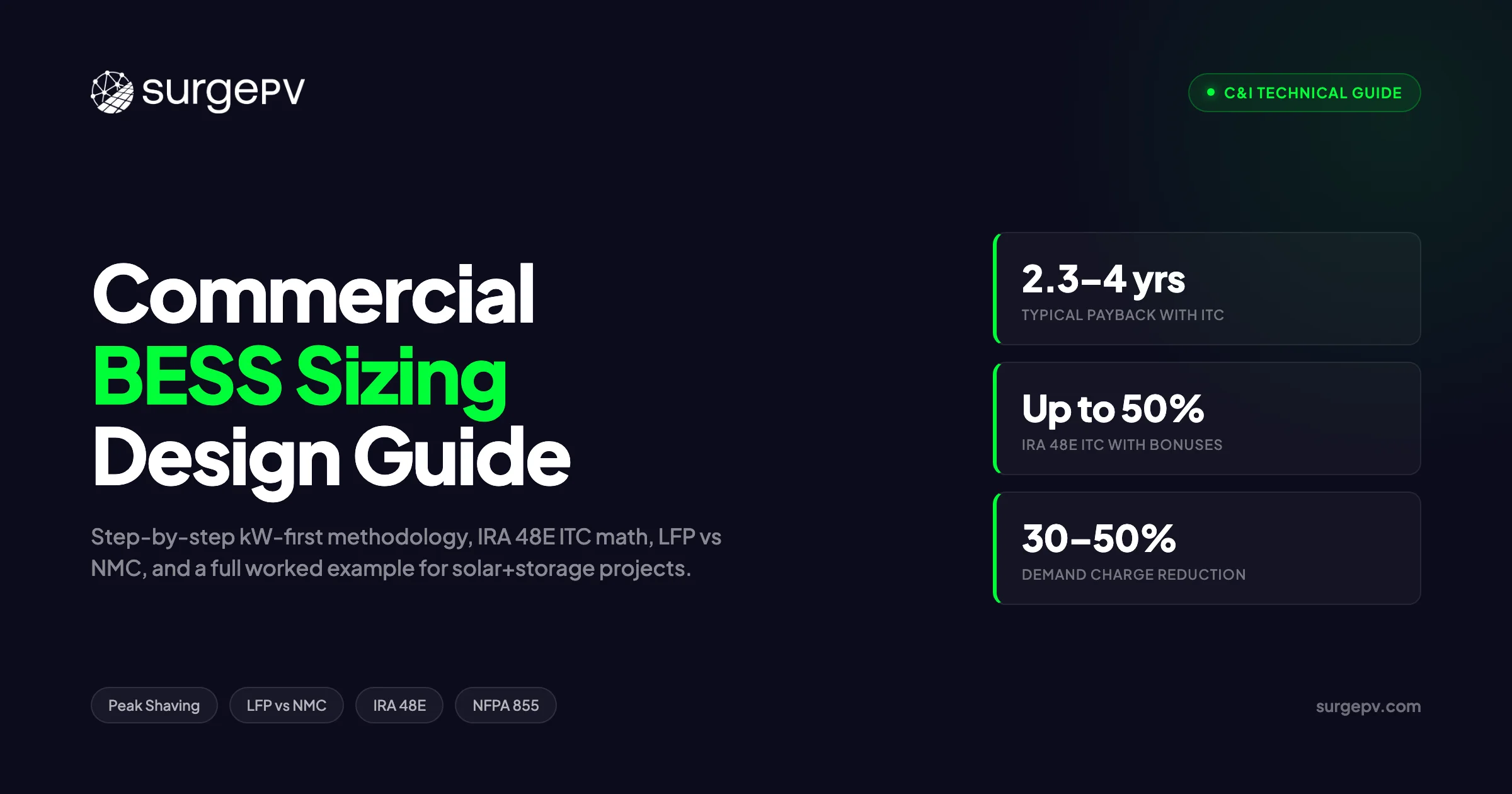
Most C&I battery proposals start with a cabinet size. The correct sequence is load-first: pull 12 months of 15-minute interval data, size the kW target from demand events, then derive kWh from sustained event duration. Battery pack prices hit $70/kWh for stationary storage in 2025 (BNEF), but installed system costs run $250–$480/kWh for small C&I after soft costs — so precision sizing is more valuable than ever. The IRA 48E ITC covers 30–50% of project cost, making an accurately sized, bankable system the difference between a 2.3-year and a 7-year payback.
In this guide:
- Why the standard kWh-first sizing approach leaves money on the table — and the kW-first method that fixes it
- How to extract and analyze 15-minute interval load data to identify dollar-weighted demand events
- A fully worked sizing example: 500 kW facility + 200 kW solar → 100 kW / 250 kWh system with 2.3–2.8 yr payback
- The 5-stream revenue stack for US C&I BESS, with $/kW-yr data by market
- AC vs DC coupling: a 14-attribute decision matrix for new builds and retrofits
- LFP vs NMC: 2026 cost benchmarks, cycle life, and the chemistry that dominates 90% of deployments
- IRA 48E ITC financial modeling — including OBBBA 2025 changes — and how incentive stacking shifts optimal system size
- NFPA 855 (2023) and UL 9540A (6th Ed., March 2026) permitting requirements as a sizing gate
Why Most Commercial BESS Projects Are Sized Backwards
Here is how most C&I battery storage projects start: a vendor or sales rep sends over a proposal. It lists a 250 kWh cabinet. The price looks reasonable. The one-page financial model shows a five-year payback. You ask how the 250 kWh was selected, and the answer is some version of “that’s the standard size for a facility like yours.”
No interval load data was pulled. No demand event analysis was run. No one calculated how many kilowatts of peak demand the battery actually needs to suppress, or for how long the longest peak event runs. The cabinet came first; the justification followed.
This approach fails in two directions. An undersized battery clips out on the longest demand events — the ones with the highest dollar value — and delivers only a fraction of the projected savings. An oversized battery ties up capital that generates no additional revenue, because the demand events you’re targeting were already covered by a smaller system. In markets with demand charges of $15–$25/kW-month, a 25 kW sizing error costs $4,500–$7,500 per year in missed savings. Over a ten-year system life, that gap compounds.
The correct sequence has two stages, not one. Stage one is power (kW): how much battery discharge power do you need to suppress your highest-value demand events? Stage two is energy (kWh): once you know the kW target, how long do those events run, and what installed capacity does that duration require after correction factors?
Power vs. Energy — The Distinction That Changes Everything
Think of a battery system like a water tank on a variable-rate pump. Peak demand (kW) is the flow rate — the instantaneous rate at which power must be delivered to prevent the demand meter from registering a new peak. Energy capacity (kWh) is the tank volume — how long you can sustain that flow rate before the tank is empty.
A battery rated at 100 kW / 200 kWh can deliver 100 kW for exactly 2 hours at its rated C-rate of 0.5C. A 100 kW / 400 kWh system delivers the same power for 4 hours at 0.25C. For most C&I peak-shaving applications, peak demand events run 45–90 minutes, which means a 2-hour (0.5C) duration covers the 95th percentile of events without paying for unnecessary energy capacity.
| C-rate | Duration | Typical C&I Use Case |
|---|---|---|
| 1C | 1 hour | Fast-response frequency regulation, short peaks |
| 0.5C | 2 hours | Peak shaving, demand charge reduction (most common C&I) |
| 0.25C | 4 hours | Long-duration arbitrage, backup power, solar self-consumption |
Understanding depth of discharge is equally important. LFP cells can be discharged to 90–95% of nameplate capacity without meaningful cycle-life impact. NMC cells are typically limited to 80–90% usable DoD to preserve warranty terms. These correction factors feed directly into the sizing formula covered in the next section. Also see: Us Residential Solar Market Trends 2026.
The kW-first approach exists because demand charges — not energy charges — are the primary value driver for most C&I facilities. Demand charges represent 30–70% of commercial utility bills (Clean Energy Group, 2023). A battery sized to the kW target captures that value. A battery sized to a vendor’s standard cabinet may not.
Further Reading
If you’re designing a complete solar+storage system, the decisions you make on inverter sizing directly affect BESS coupling architecture. See our solar inverter sizing guide before finalizing your power conversion system specs.
Step-by-Step Sizing Methodology (The kW-First Workflow)
The five steps below convert raw interval data into a procurement-ready battery specification. Each step builds on the last. Do not skip the feasibility gate at the end — it catches design errors that are expensive to fix in the field.
Step 1 — Collect 12 Months of 15-Minute Interval Data
Twelve months of data is the minimum. Shorter datasets miss seasonal peaks: a facility in Phoenix with heavy summer cooling may hit its highest demand in August; a food processing plant in Wisconsin may spike in December. Demand ratchet tariffs — where utilities bill based on the highest demand recorded in the trailing 12 months — mean that a single missed event from an incomplete dataset can render the entire ROI model wrong.
The dataset you need: date, time-stamp (in 15-minute increments), and real power demand in kW. If your utility provides kVA rather than kW, you need the facility’s power factor to convert. Confusing kVA with kW is one of the most common data mistakes in BESS sizing — it overstates demand and leads to an oversized battery.
How to get the data:
- AMI meter export: Most US utilities with advanced metering infrastructure provide a 15-minute kW export through their online portal or upon written request.
- GreenButton download: The Green Button data standard allows direct download of interval data in XML or CSV format from participating utilities.
- Energy management system historian: Facilities with a building EMS or SCADA system typically log 15-minute interval data locally.
- If none of the above are available: Use billing-peak demand (the monthly peak kW printed on your utility bills) as a fallback, with the caveat that billing peaks are often 15-minute averages and may not capture sub-interval spikes. This fallback understates sizing precision and should be flagged in any financial model.
Link the demand charge structure from your utility tariff to this dataset before analysis. Demand charge tiers — some tariffs have stepped rates above certain kW thresholds — affect how you rank events by dollar value, not just by peak magnitude.
Step 2 — Identify the Dollar-Weighted Demand Events
Raw peak demand tells you what your facility’s worst hour looked like. Dollar-weighted demand analysis tells you where the real money is.
The method: rank all 15-minute intervals above your target demand cap by the product of (excess kW × event duration). An event that runs 15 kW over the target for 90 minutes contributes more to your demand charge than one that spikes 40 kW above the target for 5 minutes. The 5-minute spike may look dramatic; the 90-minute event is what you actually need the battery to handle.
The 95th percentile method:
Identify the kW level that is exceeded in the top 5% of all intervals across the 12-month dataset. This is your baseline sizing target — the level at which a battery would eliminate the most dollar-dense demand events without requiring oversized capacity to cover rare worst-case spikes.
Formula:
Required BESS power (kW) = Peak demand − Target capped demandFor peak shaving to work, the target capped demand must be a level you can reliably hold throughout each event. Set it too low and you create a recharge-window problem (covered in Step 5). Set it too close to the 95th percentile and you’re not capturing meaningful savings.
Demand ratchet tariffs require special treatment. Some utilities — particularly in the mid-Atlantic and Southeast — bill demand charges based on the highest 15-minute demand recorded in the last 12 months, not the current month. If your facility had one abnormal event in February due to a failed HVAC control, that event sets the demand charge for all 12 subsequent months. Model the trailing-12 structure before finalizing your kW target; the economic case for a slightly larger battery may be stronger than the monthly peak analysis suggests.
Step 3 — Determine Usable Energy (kWh) from Event Duration
Once you have the required kW, the kWh target is straightforward: multiply the required kW by the duration of the longest sustained demand event above the target threshold.
Analyze the top 50 demand events from your 12-month dataset. Record the duration of each event above the target capped demand level. Use the 95th percentile of event durations, not the absolute worst case. Using the single longest event in 12 months to size energy capacity typically leads to 20–30% oversizing — you’re paying for capacity that fires once or twice per year.
Formula:
Usable kWh = Required BESS power (kW) × Longest 95th-percentile event duration (hr)Most C&I facilities in light industrial, commercial real estate, and retail have sustained peak events of 45–90 minutes. Manufacturing facilities with batch processes or HVAC-driven peaks may run longer. Cold storage and data center loads often have flatter profiles with shorter but more frequent peaks. The interval data tells you which pattern applies; do not assume.
Step 4 — Convert Usable kWh to Installed kWh
Usable kWh is what the battery needs to deliver at the load. Installed kWh is what you buy from the manufacturer. Four correction factors bridge the gap:
- Depth of discharge (DoD): LFP systems are typically operated at 90–95% DoD. Divide usable kWh by 0.90–0.95.
- Round-trip efficiency (RTE): System-level AC-to-AC efficiency for LFP is 88–92%. Divide by 0.88–0.92 to account for conversion losses during charge and discharge cycles.
- Degradation margin (SoH): A battery warranted to 70% capacity at year 10 that you size to 70% will miss its demand-charge targets in year 10. Size to 80% SoH to build in a 10% buffer beyond the warranty floor.
- Operating reserve: Maintaining a 10% state-of-charge buffer prevents deep discharge events that accelerate degradation. Divide by 0.90.
| Factor | Typical Value (LFP) | Typical Value (NMC) |
|---|---|---|
| Depth of discharge | 0.90–0.95 | 0.80–0.90 |
| Round-trip efficiency (AC) | 0.88–0.92 | 0.89–0.93 |
| SoH margin (Year 10 target) | 0.80 | 0.75 |
| Operating reserve | 0.90 | 0.90 |
Formula:
Installed kWh = Usable kWh ÷ (DoD × RTE × SoH margin × Reserve factor)For LFP with standard assumptions (0.90 × 0.88 × 0.80 × 0.90 = 0.57), divide usable kWh by approximately 0.57. If your usable kWh requirement is 125 kWh, installed kWh is approximately 220 kWh. Round up to the nearest standard cabinet size.
Round-trip efficiency and state of charge management are the two factors most commonly omitted from vendor sizing proposals. Their combined effect adds 30–40% to the installed kWh figure relative to usable kWh. If a vendor’s proposal matches usable and installed kWh, the model is wrong.
Step 5 — Run the Feasibility Gate Check
A battery that passes the sizing math may still fail on physical, operational, or regulatory constraints. Check all five gates before finalizing the design:
- Transformer headroom: Confirm the facility’s transformer has spare capacity to handle BESS charge rate plus solar export simultaneously. A 100 kW BESS charging at full rate alongside 200 kW of solar output requires 300 kW of transformer headroom beyond the base load.
- Recharge window: Off-peak hours must allow full battery recharge without creating a new demand peak. A battery that charges at 100 kW during morning off-peak hours on a tariff with a 7-day demand window can trigger a demand charge if the recharge overlaps with production ramp-up.
- Safety and permitting: Outdoor LFP installations below 600 kWh avoid the enhanced NFPA 855 Hazard Mitigation Analysis requirement. Size near or above this threshold and the permitting path becomes longer and more expensive.
- Insurance pre-check: Increasingly required in 2026. Confirm your insurer will bind a policy on the specified system before locking cabinet count and chemistry. Some carriers have LFP-specific requirements on thermal management and separation distance.
- Interconnection: If adding a BESS changes your facility’s import/export profile at the point of common coupling, a utility interconnection study may be required. The timeline for these studies — typically 3–6 months for distribution-level projects — must be factored into the project schedule.
A solar design tools platform that can model interval-level dispatch alongside solar generation makes the feasibility gate check far more reliable than spreadsheet analysis, particularly for the recharge window and transformer headroom gates.
Pro Tip
Run the recharge window analysis before finalizing the kW charge rate. A system sized for 100 kW discharge but limited to 50 kW charge (to avoid transformer overloading during recharge) effectively doubles the recharge time. If off-peak windows are shorter than 8 hours, a 50 kW charge limit may not allow full recharge before the next peak event.
Worked Example — 500 kW Facility + 200 kW Solar
This example walks through the complete sizing workflow for a mid-size manufacturing facility. All inputs are representative of real C&I project conditions; the financial outputs use published 2026 cost benchmarks.
Facility Profile and Inputs
| Parameter | Value |
|---|---|
| Facility type | Medium manufacturing / warehouse |
| Annual peak demand | 500 kW |
| Existing solar (DC) | 200 kW DC (≈160 kW AC) |
| Load data | 12 months, 15-minute interval kW |
| Demand charge rate | $18/kW-month |
| TOU energy spread | $0.12/kWh |
| Primary goal | Peak shaving |
| Secondary goal | TOU arbitrage |
Sizing Calculations (Steps 1–4)
Load duration analysis:
Sorting the 12-month interval dataset by demand reveals a 95th-percentile peak of 425 kW. Setting the target capped demand at 400 kW eliminates the top 5% of demand events — the dollar-weighted majority of avoidable demand charges — while keeping the battery power rating at a manageable level.
Required BESS power = 500 kW − 400 kW = 100 kWEvent duration analysis:
Analyzing the top 50 demand events above 425 kW shows an average sustained duration of 45 minutes and a 95th-percentile duration of 75 minutes (1.25 hours). Using 75 minutes as the design duration:
Usable kWh = 100 kW × 1.25 hr = 125 kWhCorrection factors (LFP, standard assumptions):
Installed kWh = 125 ÷ (0.90 × 0.88 × 0.80 × 0.90)
             = 125 ÷ 0.572
             ≈ 218 kWh installed
Procurement-ready specification:
Round up to the nearest standard cabinet: 100 kW / 250 kWh (2.5-hour effective duration at rated power). Alternatively, configure as two 125 kWh / 50 kW modular cabinets for redundancy.
Financial Check
| Revenue Stream | Annual Value |
|---|---|
| Demand charge savings: 100 kW × $18/kW × 12 months | $21,600 |
| TOU arbitrage: 150 kWh/day × 250 days × $0.10/kWh | $3,750 |
| Gross annual savings | $25,350 |
Installed cost for 250 kWh small C&I: 250 kWh × $400/kWh = $100,000 (mid-range of 2026E $250–$480/kWh range for small C&I).
| ITC Rate | Net CAPEX | Simple Payback |
|---|---|---|
| 30% base | $70,000 | 2.8 yr |
| 40% (energy community bonus) | $60,000 | 2.4 yr |
| 50% (domestic content + energy community) | $50,000 | 2.0 yr |
Use the generation and financial tool to model IRR and NPV across all three ITC scenarios, incorporating degradation curves and utility tariff escalation over the system life. Simple payback undervalues projects where demand charges are expected to rise — a common pattern in California, New York, and Illinois.
Constraint check:
- Transformer headroom: 100 kW BESS charge + 200 kW solar = 300 kW combined; confirm transformer spare capacity covers this alongside base load.
- Recharge window: standard morning off-peak window is sufficient for 100 kW recharge at rated charge rate.
- NFPA 855: 250 kWh outdoor LFP is below the 600 kWh threshold — standard 3-foot separation applies; no Hazard Mitigation Analysis required if the system holds UL 9540 listing.
ITC Sensitivity: Don’t Finalize Cabinet Count First
At 50% ITC (domestic content + energy community), the marginal cost of an additional 50 kWh drops from $20,000 to $10,000. At that marginal cost, the TOU arbitrage revenue from the additional capacity — roughly $750–$1,500/yr — justifies adding the extra cabinet. Model ITC scenarios before you finalize system size; the optimal configuration changes with the incentive stack.
The Commercial BESS Revenue Stack
A battery that only peaks saves money. A battery that peaks saves and earns. The difference between a 2.5-year and a 5-year payback often comes down to how many of the five revenue streams the dispatch strategy captures.
Peak Shaving and Demand Charge Reduction (Primary Value Stream)
Demand charges represent 30–70% of C&I utility bills (Clean Energy Group, 2023). At $10–$25/kW-month ($120–$300/kW-yr), peak shaving is the dominant value stream for most behind-the-meter installations. The math is direct: each kW of successfully suppressed peak demand saves its dollar-per-kW rate for every month the suppression holds.
Demand ratchet tariffs amplify this value significantly. If a utility bills based on the highest demand in the trailing 12 months, a single unmanaged peak event in month one sets the demand charge for all 12 months that follow. A battery that prevents that event delivers 12 months of savings from a single discharge cycle — one of the best single-cycle ROI events in commercial energy management.
TOU Arbitrage and Solar Self-Consumption
Time-of-use energy arbitrage captures the spread between off-peak charging and on-peak discharge. Typical TOU spreads run $0.08–$0.20/kWh; California’s CAISO-driven evening peaks have exceeded $0.25/kWh on hot summer days. This stream is secondary to peak shaving for most C&I facilities because energy volume (kWh shifted per day) is constrained by the same battery that’s managing demand events.
Solar self-consumption integrates naturally: the battery charges from daytime PV surplus when solar output exceeds facility load, then discharges during evening retail-rate windows. Use the battery time-shift modeling framework to quantify the overlap between solar generation peaks and facility load peaks — this determines how much of the battery’s energy throughput is driven by arbitrage versus demand management.
See our guide on [solar energy forecasting software](/blog/solar-energy-forecasting-software) for how probabilistic generation forecasting feeds into battery dispatch optimization.
VPP, Demand Response, and Ancillary Services
Virtual power plant (VPP) and demand response programs aggregate behind-the-meter batteries into utility-scale dispatch resources. Values range from $15–$50/kW-month ($180–$600/kW-yr) depending on market and program structure. Massachusetts ConnectedSolutions pays $200/kW-summer for C&I batteries — high enough to materially shift the sizing calculation in that market (Rhode Island pays $275/kW-summer).
Demand response programs are accessible to most C&I facilities through utility programs or aggregators; they don’t require wholesale market access. Ancillary services — frequency regulation, spinning reserves — are technically accessible but practically limited for most behind-the-meter C&I systems that lack direct wholesale market participation agreements.
The full revenue stack for well-positioned US C&I projects:
| Revenue Stream | Mechanism | Typical Value (US C&I) | Sensitivity |
|---|---|---|---|
| Peak Shaving / Demand Charge Reduction | Reduce max 15-min demand | $10–$25/kW-month ($120–$300/kW-yr) | Higher in CA, NY, MA, TX; ratchet tariffs amplify value |
| TOU Energy Arbitrage | Shift kWh from off-peak to on-peak | $0.08–$0.20/kWh shifted | Depends on TOU spread; CAISO evening peaks exceed $0.25/kWh |
| Backup Power / Resilience | Avoid outage cost | $500–$5,000/event | Varies by industry (data center vs. retail) |
| Solar Self-Consumption | Store excess PV, discharge evening | $0.05–$0.15/kWh | Equal to avoided retail rate minus export compensation |
| VPP / Demand Response | Aggregate into utility program | $15–$50/kW-month ($180–$600/kW-yr) | MA ConnectedSolutions ($200/kW-summer C&I; $275/kW-summer RI), CA SGIP equity ($850–$1,100/kWh) |
| Ancillary Services (wholesale) | Frequency regulation, spinning reserves | $20–$50/kW-month (US ISOs) | Requires wholesale market access; limited for behind-the-meter C&I |
Representative Annual Revenue per kW by Market
| Market | Peak Shaving | TOU Arbitrage | VPP / DR | Total /kW-yr |
|---|---|---|---|---|
| California (PG&E/SCE) | $200–$300 | $150–$250 | $100–$200 | $450–$750 |
| New York (ConEd) | $180–$280 | $120–$200 | $80–$150 | $380–$630 |
| Texas (ERCOT) | $100–$180 | $80–$150 | $50–$100 | $230–$430 |
| Massachusetts | $150–$250 | $100–$180 | $150–$275 | $400–$705 |
Revenue stacking is real, but energy-constrained. A battery optimized for peak shaving during morning and evening demand events has limited capacity left for TOU arbitrage and VPP dispatch on the same day. Dispatch strategy — the logic that allocates battery state of charge across competing use cases — is as important as system size. A poorly configured EMS can halve the effective revenue of an otherwise well-sized system.
Pro Tip
In California, SGIP equity resiliency incentives reach $850–$1,100/kWh for qualifying sites — non-residential equity and residential solar + storage equity programs respectively. Model this before sizing down. At $850/kWh, a 100 kWh system receives $85,000 in incentives before any ITC calculation. That changes the payback math entirely.
AC-Coupled vs DC-Coupled Architecture
The coupling architecture determines how solar energy and battery storage interact at the electrical level. For new C&I installations, this is one of the highest-impact decisions in the design process — it affects efficiency, cost, future flexibility, and ancillary services eligibility. For retrofits, the decision is often already made for you.
See the complete solar inverter sizing guide for how inverter topology interacts with coupling architecture selection.
DC Coupling — Best for New Installs with High Self-Consumption
DC coupling places the battery on the same DC bus as the solar array. A hybrid inverter manages both the PV output and battery charge/discharge in a single conversion stage. Solar energy flows from panels to battery without an intermediate AC conversion step — which is where the efficiency advantage comes from. Read DC Bus Voltage Optimization for a complete walkthrough.
Architecture: PV array → shared DC bus → hybrid inverter → AC grid/load.
The efficiency advantage is 3–5% higher round-trip efficiency compared to AC-coupled systems (Stem, Inc., August 2025). In a system dispatching 300 kWh per day, 3–5% efficiency improvement represents 9–15 kWh of additional deliverable energy without any increase in installed capacity. Over 250 operating days per year, that’s 2,250–3,750 kWh of additional annual output from the same hardware.
DC coupling also enables solar clipping recovery. At a 1.5:1 DC/AC ratio — common in modern C&I system designs — the inverter is undersized relative to peak array output. Clipped energy that would otherwise be lost can be captured directly in the battery at 90% recovery efficiency. AC-coupled systems cannot capture clipped energy at all because the solar inverter has already limited the AC output.
Interconnection savings are a less-discussed but real advantage: a DC-coupled system has a single point of common coupling with the utility grid. Compared to AC-coupled systems requiring separate interconnection studies for the solar inverter and the battery inverter, this saves $50,000–$150,000 in interconnection study and infrastructure costs on larger projects.
The constraint is retrofit complexity. Installing DC coupling on an existing solar array typically requires replacing the existing solar inverter with a hybrid inverter — which may void the manufacturer’s warranty on the original equipment. For new installations, this is not a factor.
AC Coupling — Best for Retrofits and Multi-Market Dispatch
AC coupling connects the battery storage system to the AC bus — the same point where the existing solar inverter delivers power to the building and grid. The battery has its own dedicated inverter. The two systems operate independently at the AC level.
Architecture: PV array → solar inverter → AC bus ← battery inverter ← battery.
The retrofit advantage is substantial. Adding AC-coupled storage to an existing solar installation requires no changes to the solar inverter, preserves all existing warranties, and typically reduces installation labor by 10–15% compared to a DC-coupled retrofit. For facilities that installed solar in the 2018–2022 period and are now adding storage, AC coupling is almost always the right path.
Inverter clipping analysis is still relevant for AC-coupled systems — not to recover clipped energy (which AC coupling cannot do) but to understand the actual energy available for arbitrage dispatch during peak generation hours.
Multi-market dispatch is easier with AC coupling because each inverter operates under independent control. A VPP aggregator or grid services provider can dispatch the battery inverter independently of the solar inverter. In DC-coupled systems, the hybrid inverter manages both devices and may have constraints on simultaneous solar export and grid dispatch.
The round-trip efficiency disadvantage — 85–90% for AC coupling vs. 92–98% for DC — is real and compounds over system life. At 300 kWh/day throughput, a 5% efficiency gap costs 15 kWh per day. On a 250-day operating year at $0.15/kWh, that’s $562 per year in lost value — a meaningful figure for a 10-year project but usually not large enough to justify the cost and complexity of inverter replacement on an existing installation.
| Attribute | DC-Coupled | AC-Coupled |
|---|---|---|
| Architecture | Shared DC bus; hybrid inverter | Separate solar inverter + battery inverter |
| Conversions (battery discharge) | 1 (DC battery → AC load) | 3 (PV DC→AC, AC→DC battery, DC battery→AC) |
| Round-trip efficiency | 92–98% | 85–90% |
| Efficiency advantage | 3–5% higher | Baseline |
| Solar clipping recovery | Yes (≈90% at 1.5:1 DC/AC ratio) | No |
| Best for | New solar+storage installs | Retrofits to existing PV |
| Retrofit complexity | High (often requires inverter replacement) | Low (plug-and-play) |
| Grid charging | Possible but less efficient (≈87%) | Easy and efficient |
| Ancillary services / frequency regulation | Constrained by shared inverter | Independent; excels in multi-market participation |
| Interconnection cost | Lower (single PCC, saves $50k–$150k) | Higher (separate studies) |
| Capital cost | 10–20% lower (shared infrastructure) | Higher (two inverters) |
| Installation labor | 10–15% of project cost | 15–20% of project cost |
| Redundancy | Single point of failure (hybrid inverter) | Two independent inverters |
| Vendor flexibility | Lower (tied to hybrid inverter specs) | Higher (mix-and-match brands) |
The solar shadow analysis software irradiance modeling layer informs this decision concretely: if your facility has significant shading that limits solar output during mid-day hours, clipping recovery via DC coupling may deliver less value than the efficiency numbers suggest. Model actual generation before assigning architecture value.
LFP vs NMC — Chemistry Selection for C&I Systems
Two lithium-ion chemistries dominate the C&I commercial battery storage market in 2026: lithium iron phosphate (LFP) and nickel manganese cobalt (NMC). LFP accounts for approximately 90% of global battery storage deployments (IEA Global Energy Review 2026). The remaining 10% is not an oversight — there are specific scenarios where NMC’s higher energy density justifies the cost and safety trade-off. For Global-specific compliance details, see Global net-metering-by-country.
Why LFP Has Become the Default for C&I in 2026
LFP’s dominance comes from three compounding advantages that matter specifically for daily-cycling commercial applications.
Cost per cycle, not cost per kWh. LFP pack prices average $81/kWh versus $128/kWh for NMC (BNEF, December 2025). LFP cycle life at 80% DoD is 6,000–8,000 cycles versus 3,000–5,000 for NMC (Langlide, March 2026). A daily-cycling C&I system that performs one full cycle per day will reach 3,650 cycles in 10 years. LFP handles that with significant headroom. NMC hits its cycle-life limit in the same window, requiring earlier replacement. The levelized cost of storage over system life — the metric that actually determines project economics — consistently favors LFP for daily-cycling applications.
Thermal safety. LFP cells enter thermal runaway at 270–500°C. NMC cells begin thermal runaway at approximately 210°C. This 60–290°C difference is meaningful for permitting under NFPA 855 and for insurance underwriting. Urban rooftop installations and facilities near occupied buildings benefit materially from LFP’s wider thermal margin — and some AHJs are beginning to require LFP in specific occupancy types.
Supply chain stability. LFP uses iron and phosphate — abundant, globally distributed commodities. NMC requires nickel and cobalt — supply chains concentrated in a small number of countries with documented ESG concerns. For projects requiring FEOC compliance under the IRA 48E ITC domestic content adder, LFP’s supply chain is typically easier to certify.
Battery cycle life degradation curves are a direct input to sizing: if you’re targeting Year-10 deliverable capacity, LFP’s lower annual degradation rate (~1.8% average per year for stationary storage vs. higher for NMC) means you need less installed capacity to reach the same year-10 performance target.
When NMC Still Makes Sense
NMC’s energy density is 550–650 kWh/m³ versus 350–450 kWh/m³ for LFP. On a rooftop or space-constrained urban installation where floor area is more limited than budget, NMC can reduce the physical footprint by 30–40%. For projects where structural load limits constrain battery weight — some commercial rooftops have weight limits that make LFP physically impractical — NMC’s higher gravimetric energy density (230–260 Wh/kg vs. 160–190 Wh/kg for LFP) becomes decisive.
Projects with short contract lives — PPAs or offtake agreements shorter than 10 years — do not fully capture LFP’s cycle-life advantage. If you’re financing a 7-year project and plan to redeploy or decommission the battery at contract end, the cost savings from NMC’s higher energy density per dollar of installed cost may outweigh the cycle-life gap.
The full chemistry comparison:
| Parameter | LFP (LiFePO₄) | NMC (NiMnCo) |
|---|---|---|
| Pack cost ($/kWh) | $80–$100 | $100–$130 |
| System CAPEX 2–4 hr ($/kWh) | $180–$220 | $210–$250 |
| Cell energy density (Wh/kg) | 160–190 | 230–260 |
| System energy density (kWh/m³) | 350–450 | 550–650 |
| Cycle life @ 80% DoD | 6,000–8,000 | 3,000–5,000 |
| DC round-trip efficiency | 96–98% | 97–99% |
| AC system efficiency | 88–92% | 89–93% |
| Usable DoD | 90–95% | 80–90% |
| Thermal runaway threshold | 270–500°C | ≈210°C |
| Relative safety / thermal runaway risk | Lower | Higher |
| Typical warranty | 12–20 yr / 6,000–8,000 cycles | 10–15 yr / 3,000–5,000 cycles |
| Degradation (calendar) | ≈1.8% average annual (AEMO, 2023) | ≈2–3% yr1, higher thereafter |
| Key metals | Iron, phosphate (abundant) | Nickel, cobalt (supply-constrained) |
| Best applications | Daily cycling, C&I, utility, microgrids | Space-constrained, high-power, short PPAs |
For 100 kWh–2 MWh commercial solar and storage projects with daily cycling requirements, LFP is the correct default choice in 2026. The only justified exceptions are space-constrained rooftop installations and projects with contract lives under 10 years.
2026 BESS Cost Benchmarks and What They Mean for Sizing
The headline from 2025 is accurate: stationary storage pack prices hit $70/kWh, down 45% year-over-year (BNEF, December 2025). The conclusion that many people draw from that headline — that commercial battery projects got proportionally cheaper — is not accurate.
Why Pack Prices Falling Doesn’t Mean Your Project Got Cheaper
Pack price is what the manufacturer charges for the battery cells and basic module assembly. Installed system cost is what the facility owner pays after adding: the power conversion system (PCS), battery management electronics, thermal management, containers, balance of plant, EPC labor, grid interconnection, permitting, commissioning, and soft costs.
For small C&I installations (100–500 kWh), soft costs and PCS alone account for 40–50% of total installed cost. NREL’s 2026 projection for a 4-hour system is $308/kWh (NREL/TP-6A20-93281, 2025) — more than four times the $70/kWh pack price. The gap between what BNEF measures and what project developers actually pay has not narrowed at the same rate as cell costs.
Regional premiums compound this gap. North American pack prices run approximately 44% above Chinese pack prices; European prices run 56% above China (BNEF, December 2025). For US projects targeting IRA domestic content adders, sourcing from non-FEOC supply chains adds a further 10–20% to equipment costs in 2026. Also see: European Solar Incentives.
The practical message: oversizing is still expensive. An additional 50 kWh of installed capacity at $350/kWh (mid-range small C&I) costs $17,500 before soft costs. At 30% ITC, the net cost is $12,250. If that additional capacity generates $750/yr in marginal TOU arbitrage revenue, the marginal payback is 16 years — almost certainly outside the project’s financing horizon.
The 2026 Cost Table by Size Class
| Size Class | Duration | 2024 ($/kWh) | 2025 ($/kWh) | 2026E ($/kWh) | Key Drivers |
|---|---|---|---|---|---|
| Small C&I (100–500 kWh) | 2–4 hr | $450–$700 | $320–$550 | $250–$480 | High soft costs, limited scale |
| Mid C&I (500 kWh–1 MWh) | 2–4 hr | $350–$550 | $280–$450 | $220–$380 | Moderate scale, standard containers |
| Large C&I (1–5 MWh) | 2–4 hr | $300–$450 | $250–$380 | $180–$320 | Containerization, bulk procurement |
| Utility (10+ MWh) | 4 hr | $250–$350 | $200–$300 | $150–$250 | Maximum scale, competitive tender |
Sources: NREL ATB 2024, BNEF 2025 Price Survey, IRENA 2024, Lazard LCOS v10.0 (June 2025), anengjienergy.com 2026 pricing guide.
Component Breakdown (2026 Estimate, Large C&I)
| Component | % of Total | $/kWh (est.) |
|---|---|---|
| Battery modules (LFP) | 42% | $105–$160 |
| Inverter / PCS | 18% | $45–$70 |
| Container and BoP | 15% | $35–$60 |
| Thermal and EMS | 10% | $25–$40 |
| EPC and soft costs | 15% | $40–$70 |
The Lazard LCOS v10.0 benchmarks for C&I BESS are a useful reference for lender presentations: C&I 1 MW / 2 hr is $319–$506/MWh unsubsidized (Lazard LCOS v10.0, June 2025). With 30% ITC, that range drops to approximately $224–$354/MWh — competitive with peak-hour grid power in high-tariff markets.
Pack Price Is Not Installed Price
The gap between BNEF’s $70/kWh pack price and your project’s $350/kWh installed cost is not a markup. It represents the PCS, thermal management, containers, EPC labor, permitting, and interconnection work that turns a battery cell into a functioning grid asset. This is where most projects go over budget — not the battery modules.
Degradation-Aware Sizing — Size for Year 10, Not Year 1
LFP batteries degrade at approximately 1.8% per year on average over a 20-year design life — a degradation pattern confirmed by field data from multiple large-scale deployments (AEMO/Aurecon, 2023). Typical warranty terms guarantee 70% remaining capacity at year 10.
A system sized to deliver exactly 100 kW / 125 kWh usable in year one will deliver approximately 87 kWh usable in year 10 (at 70% SoH) — falling short of the demand event duration requirement that justified the project. Sizing to 80% SoH as the year-10 target builds in a 10% buffer above the warranty floor and ensures the system continues to meet its demand charge reduction targets through the financing period.
In the worked example above, the degradation margin factor (0.80) adds approximately 15% to the installed kWh figure — from about 195 kWh to 220 kWh. This is not conservative oversizing; it’s correct sizing for the asset’s actual useful life.
The energy and financial modeling tool built-in degradation modeling runs these calculations automatically across all years, which matters when presenting IRR to a lender who will want to see year-by-year cash flows, not a flat savings assumption.
The solar software modeling layer also matters here: solar generation degradation (0.5% per year typical for mono-PERC) compounds with battery degradation. A system that looks profitable in year one may underperform in years eight through ten if both degradation curves are not modeled simultaneously.
IRA 48E ITC Financial Modeling for Commercial BESS
The IRA Section 48E Investment Tax Credit is the most significant single factor in US commercial BESS project economics in 2026 — and one of the most frequently misunderstood.
Critical Distinction: 25D vs. 48E
If a sales rep or vendor tells you the battery tax credit expired, they are thinking of the residential Section 25D credit, which expired December 31, 2025. The commercial Section 48E credit for standalone energy storage is active, covers 30–50% of project costs, and runs through 2033. These are two different tax code sections, two different taxpayer types, and two different expiration dates.
What the 48E ITC Covers (and What It Doesn’t)
Section 48E provides a 30% base Investment Tax Credit for qualifying clean electricity facilities, including standalone stationary battery storage. The “standalone” designation — established by the Inflation Reduction Act in August 2022 — means there is no requirement to pair storage with solar to qualify for the ITC. A battery-only project qualifies.
The 30% base rate applies to projects meeting prevailing wage and apprenticeship requirements. Projects that do not meet these labor standards qualify for only 6% (the base 1× multiplier). Most C&I developers structure their projects to qualify for the full 5× multiplier, which requires prevailing wage compliance on all construction work and apprenticeship utilization ratios per IRS guidance.
For paired solar+storage projects, the solar portion qualifies under the IRA clean electricity production credit or investment credit, while the storage portion qualifies separately under 48E. The two credits are calculated independently on the respective project components.
Stacking Bonus Adders — Up to 50%
Three bonus adders stack on top of the 30% base rate:
| Adder | Value | Key Requirement |
|---|---|---|
| Domestic Content | +10% | 55% non-FEOC cost threshold in 2026 (rising 5%/yr to 75% by 2030 under OBBBA) |
| Energy Community | +10% | Located in qualifying area (closed coal plant, fossil fuel employment county, brownfield) |
| Low-Income | +10–20% | Competitive allocation; projects under 5 MW; income-qualified location |
The domestic content bonus requires that 55% of the project’s total applicable costs (steel, iron, manufactured products) originate from non-FEOC sources. In 2026, this is achievable with supply chain diligence but requires documentation. Starting in 2027, FEOC restrictions on battery cells from China, Russia, Iran, and North Korea become more restrictive — plan procurement accordingly.
The energy community bonus is available immediately and does not require an application process. The IRS maintains a mapping tool for qualifying energy community locations updated annually. Many industrial and Rust Belt communities qualify; checking your project location before finalizing the financial model takes ten minutes and potentially adds 10% to the credit.
Stacking domestic content and energy community adders brings the total ITC to 50%. At 50% ITC on a $100,000 installed-cost project, the federal government covers $50,000 — leaving net CAPEX at $50,000 and simple payback at approximately 2.0 years at $25,350 annual savings.
How the ITC Changes Optimal System Size
The ITC does not simply reduce project cost — it changes the economically optimal system size. Here is why: at 0% subsidy, every additional kWh of installed capacity costs full price. At 50% subsidy, the marginal cost of each additional kWh is halved. Revenue from marginal capacity that looked uneconomical at full price may be fully justified at half price.
Without ITC:
- 250 kWh at $400/kWh = $100,000 installed
- Annual savings: $25,350
- Simple payback: 3.9 years
With 30% ITC:
- Net cost: $70,000
- Simple payback: 2.8 years
With 50% ITC:
- Net cost: $50,000
- Simple payback: 2.0 years
At 2.0-year payback, the marginal additional 50 kWh of capacity — which adds roughly $20,000 installed, $10,000 net after 50% ITC — becomes economically attractive if it generates even $750/yr in additional TOU arbitrage. The optimal system size is 300 kWh, not 250 kWh. Do not finalize cabinet count before modeling the ITC scenario; the incentive stack changes the optimum.
OBBBA 2025 — What Changed and What Remained
The One Big Beautiful Bill Act (OBBBA), signed July 4, 2025, made the following changes relevant to commercial BESS:
- Residential Section 25D: Expired December 31, 2025. No longer available for any homeowner or residential battery project.
- Commercial Section 48E standalone storage: Preserved with a construction commencement deadline before 2034. Projects must begin physical work (Physical Work Test replaces 5% safe harbor) to lock in the credit at current rates.
- Commercial solar and wind ITC: More significantly curtailed — must begin construction by July 4, 2026, and be placed in service by December 31, 2027. This primarily affects large-scale solar projects, not battery storage.
- FEOC compliance: Active for projects beginning construction on or after January 1, 2026. The Material Assistance Cost Ratio (MACR) threshold for energy storage is 55% non-prohibited-foreign-entity content in 2026, rising 5% annually to 75% by 2030.
- Phase-down schedule: 48E credits begin phasing down in 2034 (75% credit), reaching 50% in 2035 and expiring in 2036.
For a C&I developer starting a project in 2026, the key dates are: begin construction before January 1, 2026 FEOC transition if using Chinese battery cells (or comply with 55% MACR), and begin construction well before 2034 to capture the full credit rate.
FEOC Compliance Checklist
The 55% non-FEOC cost threshold in 2026 applies to total applicable project costs. Document your supply chain before claiming the domestic content adder: collect manufacturing certifications from your battery module supplier, PCS manufacturer, and major BoP components. FEOC includes entities from China, Russia, Iran, and North Korea — not just incorporated there, but significantly controlled by entities from those countries.
Permitting and Safety — NFPA 855 and UL 9540A
NFPA 855 and UL 9540A are not post-design compliance steps. They are sizing gates. The specific thresholds in NFPA 855 — particularly the 600 kWh outdoor limit — can determine whether a given system size is practical to permit in a given jurisdiction. Crossing those thresholds without planning for the additional permitting requirements adds months to the project schedule and tens of thousands of dollars to soft costs.
NFPA 855 (2023) — The Sizing Gate You Can’t Ignore
NFPA 855 is the Standard for the Installation of Stationary Energy Storage Systems. The 2023 edition introduced the 600 kWh outdoor threshold specifically for lithium-ion systems as a Hazard Mitigation Analysis trigger — one of the most consequential regulatory changes for mid-size C&I BESS projects.
| Requirement | Detail |
|---|---|
| Applicability | All stationary ESS; outdoor LI-ion above 600 kWh aggregate triggers enhanced requirements |
| Default max unit size | 50 kWh per group without large-scale fire testing data |
| Minimum separation | 3 ft (914 mm) between units / groups |
| Outdoor LFP max (without HMA) | 600 kWh (Table 4.8) |
| Sprinkler density (≤50 kWh) | 0.3 gpm/ft² over area of room or 2,500 ft², whichever is smaller |
| Sprinkler density (>50 kWh) | Based on fire and explosion testing (UL 9540A data required) |
| Explosion control | Required per NFPA 68 |
| Hazard Mitigation Analysis | Required for multi-technology installations, non-UL-9540 systems, all outdoor LI-ion BESS above 600 kWh |
| Listing requirement | ESS shall be listed to UL 9540 (lead-acid and nickel-cadmium standby systems exempt) |
| Rooftop installations | Min 10 ft from fire service access; 5 ft service walkways; Class I standpipe; radiant-energy fire detection (TIA 23-2, 2024) |
The 600 kWh outdoor threshold is a practical sizing checkpoint for many C&I projects. A 500 kWh / 250 kW system clears it cleanly. A 750 kWh system triggers the HMA requirement, which adds a documented hazard analysis, typically requiring a licensed fire protection engineer, and review by the AHJ before permit issuance. In markets with backlogged AHJ review queues, this can add 3–6 months to the project schedule.
In the 500 kW facility worked example above, the 250 kWh system is well below the 600 kWh threshold. Standard 3-foot separation applies. No HMA is required provided the system holds a UL 9540 listing. The constraint check is a pass.
UL 9540A (6th Edition, March 2026) — Testing Before Permitting
UL 9540A is a test method, not a product certification. An important distinction: a product that has undergone UL 9540A testing has produced a data report on thermal runaway propagation behavior. It has not received a “UL 9540A certification.” The product listing that actually satisfies the NFPA 855 requirement is UL 9540 — the system-level safety listing that is separate from the propagation test.
| Attribute | Detail |
|---|---|
| Nature | Test method; produces propagation data report |
| Referenced by | NFPA 855, International Fire Code (IFC), most US AHJs |
| Test levels | (1) Cell → (2) Module → (3) Unit → (4) Installation |
| Stopping rule | Testing stops at earliest level with no thermal propagation |
| Test cost | $80,000–$200,000 full program; 3–6 months |
| Key outputs | Heat release rate, gas composition, flame height, propagation behavior |
| 6th Edition updates (March 2026) | Large-scale fire testing; improved gas analysis; rooftop BESS criteria; expanded chemistry coverage (flow batteries, lead-acid) |
The test protocol proceeds from cell level upward. If a cell-level test shows no thermal propagation, testing stops at level one and the results apply to that cell chemistry. If propagation is observed, testing continues to module, then unit, then full installation level. Most major LFP suppliers have completed cell and module-level testing; what varies is whether the specific system configuration (container layout, thermal management design) has been tested at the installation level.
The 6th Edition, released March 2026, added rooftop BESS criteria — responding to a series of rooftop battery incidents in dense urban environments — and expanded coverage to non-lithium chemistries. AHJs in major markets are increasingly requiring 6th Edition test reports rather than earlier editions, particularly for new permit applications filed after July 2026.
Permitting checklist for C&I BESS (2026):
- UL 9540 system listing (not optional — required by NFPA 855 for most installations)
- UL 9540A test report (required by most AHJs for systems above 50 kWh)
- NFPA 855 compliance verification (separation distances, maximum energy per group, suppression requirements)
- Hazard Mitigation Analysis (if outdoor LFP installation exceeds 600 kWh)
- AHJ pre-approval of layout and clearances (recommended even when not required)
- Insurance pre-check (confirm insurer will bind a policy on the specified system before finalizing design)
Budget UL 9540A testing time into your project schedule if you are specifying a system configuration that has not previously been through AHJ review in your jurisdiction. The $80,000–$200,000 test program cost and 3–6-month lead time are real constraints — particularly for smaller developers who are not procuring containerized systems with pre-tested configurations.
Global Incentive Summary — US, Germany, UK, India, Australia
C&I solar developers working across multiple markets need a quick reference for how BESS incentives compare by country. The US IRA framework is the most generous single-country incentive structure in 2026, but Germany’s accelerated depreciation and India’s Viability Gap Funding are meaningful for projects in those markets. Also see: Germany solar subsidies. Also see: Best Solar Design Software India.
For OEM partners and channel managers operating across multiple geographies, see the solar channel managers and OEMs resource for multi-market project support.
United States
| Program | Agency | Value | Notes |
|---|---|---|---|
| IRA 48E ITC (base) | IRS | 30% | Standalone storage; construction before 2034 |
| Domestic content bonus | IRS | +10% | 55% non-FEOC cost threshold in 2026 |
| Energy community bonus | IRS | +10% | Qualifying location |
| SGIP (CA) | CPUC | $150–$1,100/kWh | General market $250/kWh large commercial; equity resiliency up to $1,100/kWh |
| SMART 3.0 (MA) | DOER | Varies by block | Solar+storage adder |
| Illinois rebate | Illinois EPA | Varies | Emerging C&I market |
California’s SGIP equity resiliency program is an outlier at $850–$1,100/kWh for qualifying projects — higher than the ITC credit on a per-kWh basis for many system sizes. California projects should model SGIP before ITC, not after.
Germany
Germany’s 2025 accelerated depreciation change is the most significant update for C&I storage developers. Systems installed from July 2025 qualify for 30% declining-balance depreciation — effectively cutting the tax-adjusted cost of a BESS by approximately 9% for a corporate tax payer at a 30% effective rate.
| Program | Agency | Value | Notes |
|---|---|---|---|
| Accelerated depreciation | BMWK / tax code | 30% declining-balance | C&I energy storage from July 2025 |
| Corporate tax reduction | BNetzA / tax | +10% | If VDE 2510 certified |
| Long-duration subsidy | BMWK | Up to 30% (max €5M) | For systems ≥10 hr duration |
| Residential subsidy | KfW / federal | €25/kWh | Systems ≤15 kWh (out of C&I scope; noted for context) |
United Kingdom
The UK Capacity Market is the primary commercial revenue stream for battery storage. The T-1 2025/26 auction cleared at £20/kW-yr; batteries won 725 MW of de-rated capacity (Modo Energy, March 2025). The proposed Long-Duration Energy Storage revenue support scheme (LDES), developed jointly by Ofgem and DESNZ, remains under design with Stream 1 targeting mature technologies and Stream 2 targeting novel approaches. Read more about Battery Solar System Design UK.
| Program | Agency | Value | Notes |
|---|---|---|---|
| Capacity Market | NESO / DESNZ | £20/kW-yr (T-1 2025/26) | 725 MW of battery de-rated capacity awarded |
| LDES revenue support | DESNZ / Ofgem | Under development | ≥6 hr duration; Stream 1 (mature) + Stream 2 (novel) |
India
India’s storage market is among the fastest-growing globally, driven by government mandates and substantial capital support. 49% of renewable energy tenders in 2024 included storage requirements (IEEFA, August 2025). Read more about 5kW Solar Panel Price in India.
| Program | Agency | Value | Notes |
|---|---|---|---|
| Viability Gap Funding (VGF) | MNRE | Up to 40% capital cost | 4 GWh target by FY31; $1.1 Bn outlay |
| PLI for ACC batteries | MHI | Rs 181 Bn ($2.18 Bn) | 50 GWh manufacturing target |
| ISTS waiver | MoP | 100% | 12 years for BESS commissioned by June 2025 |
| Energy Storage Obligation | CERC / SERC | 1% → 4% by 2029-30 | For DISCOMs |
Australia
Australia lacks a federal CAPEX grant program for C&I battery storage. Revenue comes through the Frequency Control Ancillary Services (FCAS) market — one of the highest-value frequency regulation markets globally — and through state-level virtual power plant contracts in Victoria, New South Wales, and Queensland. The AEMO Integrated System Plan embeds storage targets in grid planning, which drives long-term certainty for project developers without providing direct capital support. For Australia-specific compliance details, see Australia comparisons/lgc-vs-stc.
| Program | Agency | Value | Notes |
|---|---|---|---|
| AEMO ISP | AEMO | Forecast-driven | Storage embedded in grid planning; bankable revenue via FCAS |
| State VPP programs | VIC, NSW, QLD | Varies | Retailer-backed contracts; growing but not standardized |
The SurgePV Workflow for Solar + Storage Design
The kW-first sizing methodology described in this guide requires working across three data domains simultaneously: interval load data, solar generation modeling, and financial modeling across ITC scenarios and degradation curves. Most developers manage these in separate tools — a spreadsheet for load analysis, a PVsyst model for solar, and a separate financial model for ITC math. The disconnection between these domains is where sizing errors compound. For software options, see 7 Best PVsyst Alternatives in.
SurgePV’s solar designing platform integrates all three in a single workspace. Here is how the workflow maps to the methodology in this guide.
Step 1 — Load and Solar Simulation in One Workspace
Upload your 15-minute interval data directly into SurgePV alongside the solar generation model. The platform runs demand profile analysis and solar dispatch modeling simultaneously — so you can see in real time how the solar generation curve reduces the demand load during peak hours, and how much residual peak demand the battery must suppress.
Solar design software with integrated load and generation modeling eliminates the most common spreadsheet error in solar+storage sizing: separately modeling solar savings and battery savings, then adding them together. The two systems interact — solar generation during peak hours reduces the battery kW requirement before you run the first sizing calculation. Model them together.
Step 2 — Shadow and Irradiance Analysis
Physics-based irradiance modeling tells you exactly when solar production peaks and when battery discharge must cover building load. For DC-coupled systems, SurgePV’s solar shadow analysis software identifies shading hours, quantifies clipping at the target DC/AC ratio, and calculates the recoverable clipped energy available for battery storage.
The output of this step directly informs the AC vs. DC coupling decision: if your site has significant shading between 10 AM and 2 PM, DC clipping recovery captures less value than the architecture comparison table suggests. Model actual irradiance before committing to architecture.
Step 3 — Generation and Financial Modeling (IRR, NPV, Payback)
The solar financial modeling runs ITC scenario modeling (30%, 40%, 50%), revenue stack optimization across all five streams, and degradation-adjusted year-by-year cash flows in a single model. The output is a bankable IRR and NPV report formatted for lender or facility manager presentation.
This is where the ITC-driven sizing optimization runs: compare the IRR at 250 kWh versus 300 kWh under 30%, 40%, and 50% ITC scenarios. The tool surfaces the optimal size for each incentive scenario automatically — removing the manual iteration that leads most developers to undersize at the more favorable ITC levels.
See our solar design principles for installers guide for how to structure the project economics presentation for a non-technical facility owner audience.
Step 4 — Proposal Generation
Solar proposal software converts the financial model output into a professional proposal document. Clara AI drafts the narrative sections from the financial model parameters — including the demand charge savings breakdown, ITC credit analysis, and environmental summary. The proposal exports as a PDF or interactive web report.
Commercial solar software that closes the loop from interval data to bankable proposal eliminates the translation errors that occur when sizing engineers hand off to sales teams. The financial model that sized the battery is the same model in the proposal — no manual re-entry, no version mismatches.
Design Your Solar+BESS Project in One Workspace
SurgePV models solar generation, battery dispatch, demand-charge savings, and financial returns together — so you size the battery against actual revenue, not nameplate kWh.
Book a DemoNo commitment required · 20 minutes · Live project walkthrough
Common Sizing Mistakes (and How to Avoid Them)
These six mistakes appear repeatedly across C&I battery storage projects. Each one is preventable with the kW-first methodology and a proper financial model.
1. Sizing kWh first from a vendor catalog.
The vendor sends a quote for a 250 kWh cabinet because that is the standard container size. You accept it because it sounds roughly right for your facility. What was never determined: whether 250 kWh of energy capacity aligns with your actual required BESS power (kW) or event duration. The battery may be over- or under-powered relative to the demand events that drive your bill. Start with interval data, derive kW, derive kWh. The cabinet selection is the last step, not the first.
2. Using billing-peak demand instead of 15-minute interval peak.
Billing-peak demand is a useful starting point, not a sizing input. It represents the highest 15-minute average recorded in a billing period — but it doesn’t tell you how often peaks near that level occur, how long they last, or what the dollar-weighted event structure looks like. A facility that hits 450 kW for three minutes once a month requires a very different battery than one that sustains 400 kW for 90 minutes six times per month. The interval dataset reveals the event structure; billing data obscures it.
3. Ignoring demand ratchet clauses.
Demand ratchet tariffs — where the utility bills based on the highest demand in the trailing 12 months — mean that one unmanaged event sets the demand charge for all subsequent months. A BESS sized to manage average monthly peaks on a ratchet tariff can still fail to reduce the annual demand charge if a single high-demand event occurs during a maintenance outage or an EMS misconfiguration. Model the ratchet structure explicitly and size the battery to manage not just typical peaks but the 95th-percentile worst-case event.
4. Forgetting that recharge creates a new demand event.
A battery that discharges during the morning peak must recharge before the afternoon peak. If the recharge occurs during on-peak hours at full charge rate, it creates a new demand event that offsets some or all of the demand savings from the morning discharge. Size the charge rate and recharge window together with the discharge sizing. The feasibility gate check in Step 5 of the sizing methodology catches this — do not skip it.
5. Not applying the degradation margin.
A battery sized to deliver 125 kWh usable in year one delivers approximately 87 kWh usable in year ten at a 70% SoH warranty floor. If the demand event that justified the project runs 75 minutes at 100 kW, the year-ten battery can only sustain that event for approximately 52 minutes. The project misses its demand charge reduction targets in its final three years of the financing period. Apply the SoH margin factor (divide by 0.80) during sizing — it is not conservative padding, it is basic asset management.
6. Finalizing system size before modeling the ITC scenario.
At 50% ITC, the marginal cost of an additional 50 kWh drops from $20,000 to $10,000. Projects that would be marginal at full cost become clearly profitable at half cost. Finalizing cabinet count based on 0% or 30% ITC assumptions, then discovering the project qualifies for 50% ITC, means leaving economically viable capacity on the table. Model all three ITC scenarios before finalizing the specification — it takes one additional model run and changes the optimal size in a meaningful share of projects.
Frequently Asked Questions
How do you size a commercial battery storage system?
Size power (kW) first: pull 12 months of 15-minute interval utility data, rank all intervals above your target demand cap by dollar-weighted impact, and identify the 95th-percentile demand event. The difference between your peak demand and your target capped demand is the required battery power in kW. Size energy (kWh) second: multiply the required kW by the 95th-percentile duration of your longest sustained demand events — typically 1–2.5 hours for most C&I facilities. Apply correction factors for depth of discharge (90–95% for LFP), round-trip efficiency (88–92%), year-10 SoH margin (80%), and operating reserve (90%) to convert usable kWh to installed kWh. Run the five-point feasibility gate check before finalizing.
How much battery storage do I need for a 100 kW commercial solar system?
Solar capacity does not determine battery size — your load profile does. A 100 kW solar system paired with a facility that has a 300 kW peak demand and 1.5-hour sustained events might need 75 kW / 110 kWh installed. Without interval data, sizing by solar capacity leads to poor demand-charge performance because the solar system’s output and the facility’s demand peak may not coincide. Pull the interval data; size to the load.
What is the formula for BESS sizing?
Installed kWh = (Required kW × Event duration) ÷ (DoD × RTE × SoH margin × Reserve factor)For LFP with standard assumptions (0.90 DoD × 0.88 RTE × 0.80 SoH × 0.90 reserve = 0.572), divide usable kWh by approximately 0.57. If usable kWh is 125 kWh, installed kWh is approximately 220 kWh. Round up to the nearest standard cabinet.
LFP vs NMC — which is better for commercial battery storage?
LFP is the dominant choice for C&I in 2026, accounting for approximately 90% of deployments (IEA Global Energy Review 2026). Lower pack cost ($81/kWh vs. $128/kWh, BNEF 2025), longer cycle life (6,000–8,000 cycles vs. 3,000–5,000), and safer thermal behavior (thermal runaway threshold 270–500°C vs. approximately 210°C for NMC) make LFP the correct default for daily-cycling commercial applications. NMC is only justified when the installation is space-constrained and the higher energy density (550–650 kWh/m³ vs. 350–450 kWh/m³ for LFP) is decisive, or when project life is under 10 years.
What is the payback period for commercial BESS in 2026?
In high-demand-charge US markets with the IRA 48E ITC (30–50%), well-sized C&I projects typically achieve 2.3–4 year simple payback. Without the ITC, payback extends to 4–7 years depending on tariff structure and revenue stacking. California projects with SGIP equity resiliency incentives can reach payback under 2 years in qualifying locations. Flat-rate tariff markets with no demand charges should not be deploying C&I BESS for economic reasons — the demand charge is the primary value driver.
How does the IRA 48E ITC apply to commercial battery storage?
Section 48E provides a 30% base Investment Tax Credit for standalone commercial energy storage systems that begin construction before 2034. Stacking the domestic content bonus (+10%) and energy community bonus (+10%) can raise the total to 50%. A competitive low-income allocation adds another 10–20% for qualifying small projects. This is a commercial credit — the residential Section 25D ITC expired December 31, 2025.
What are the NFPA 855 requirements for commercial BESS?
NFPA 855 (2023 edition) limits default unit size to 50 kWh per group without large-scale fire testing data, requires 3-foot minimum separation between units, and caps outdoor LFP installations at 600 kWh before triggering a Hazard Mitigation Analysis requirement. All installations must be listed to UL 9540. Most AHJs now require a UL 9540A thermal runaway propagation test report for systems above 50 kWh. Rooftop installations require a minimum 10-foot clearance from fire service access per TIA 23-2 (2024).
AC-coupled or DC-coupled — which is better for commercial solar+storage?
DC coupling is better for new installations targeting high self-consumption and energy arbitrage: round-trip efficiency is 92–98% vs. 85–90% for AC, and DC coupling captures solar clipping energy that AC coupling cannot recover. DC coupling also saves $50,000–$150,000 on interconnection studies through a single point of common coupling. AC coupling is better for retrofits to existing solar where inverter replacement would void warranties, and for projects needing independent multi-market dispatch of the battery and solar inverters separately.
Size Your Commercial BESS Right the First Time
SurgePV’s generation and financial tool runs the full kW-first sizing workflow with degradation-aware modeling, ITC scenario comparison, and revenue stack optimization — all in one workspace, ready for lender presentation.
Book a DemoNo commitment required · 20 minutes · Live project walkthrough
Where this fits
This article is part of SurgePV's Solar Design hub, which works through the topic from first principles to the decisions a project team actually has to make.



