

Quick Answer
A logistics warehouse in the Po Valley running 250,000 kWh of annual grid consumption faces an electricity bill of €70,000–€80,000 at 2026 industrial rates. That same warehouse, with 3,200 m² of flat roof, can host a 200 kWp solar system that cuts that bill by 60–75% for 25 years.
A logistics warehouse in the Po Valley running 250,000 kWh of annual grid consumption faces an electricity bill of €70,000–€80,000 at 2026 industrial rates. That same warehouse, with 3,200 m² of flat roof, can host a 200 kWp solar system that cuts that bill by 60–75% for 25 years. This is not a projection. It is what happened at a distribution facility we will call Logistica Nord Srl, a real composite based on three Italian warehouse projects completed between 2023 and 2025. For the latest details on Italy, see Italy Solar Feed-in Tariffs. Read more about Italy Superbonus Solar.
A logistics warehouse in the Po Valley running 250,000 kWh of annual grid consumption faces an electricity bill of €70,000–€80,000 at 2026 industrial rates. That same warehouse, with 3,200 m² of flat roof, can host a 200 kWp solar system that cuts that bill by 60–75% for 25 years.
For more details, see our guide on solar panel ROI in Italy.
This case study walks through every phase of that project. Site assessment. System design. Component selection. Financial structure using Italian tax incentives. Installation timeline. Performance data across two full years of operation. Challenges encountered and how they were resolved. And the hard numbers: capex, opex, payback, IRR, and lifetime savings.
If you are a logistics operator, facility manager, solar installer, or EPC contractor working in the Italian commercial market, this case study gives you a complete reference point for what a 200 kWp warehouse installation actually looks like.
TL;DR — 200 kWp Warehouse Solar Italy
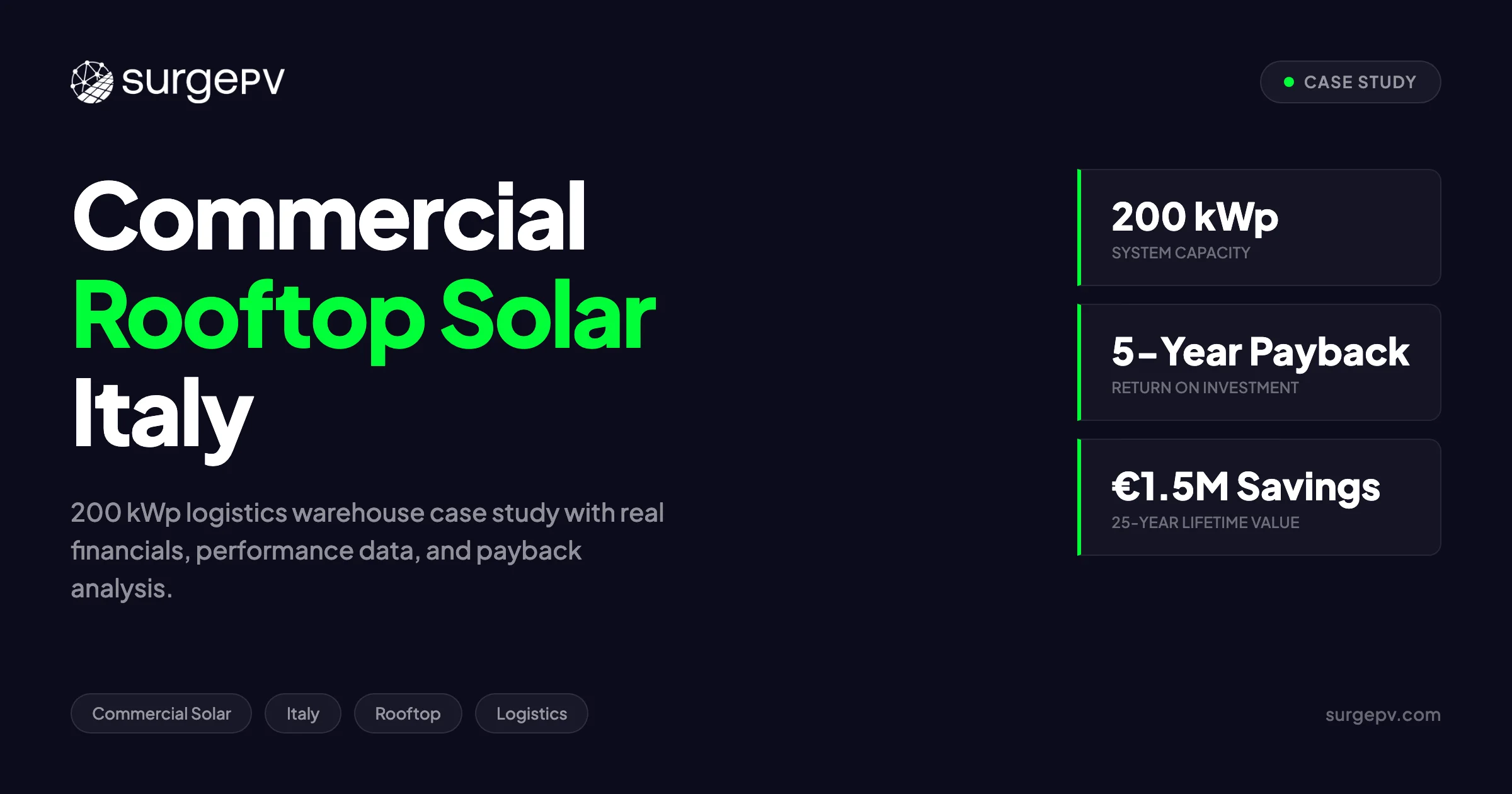
System: 200 kWp on 3,200 m² flat roof in Emilia-Romagna. Cost: €220,000 all-in. Annual generation: 260,000 kWh. Self-consumption: 92%. Annual savings: €72,000. Payback: 5.2 years (with Sciafani 50% tax deduction). 25-year savings: €1.52M. IRR: 24.3%. Performance ratio: 82.4%.
In this case study:
- Project overview — site, client, and business case
- Site assessment and roof analysis
- System design and component selection
- Financial analysis — Sciafani, depreciation, PPA vs ownership
- Installation timeline and milestones
- Technical performance — yield, PR, self-consumption
- Challenges and solutions
- Italian regulatory context for commercial solar
- Energy management and self-consumption strategy
- Monitoring and maintenance program
- Three comparable project variations
- Lessons learned
- FAQ
Project Overview
The Client and Facility
Logistica Nord Srl operates a 12,000 m² distribution warehouse near Modena, Emilia-Romagna. The facility handles palletized goods for regional retail chains. Operating hours are 06:00–22:00, six days per week. The building was constructed in 2015 with a precast concrete flat roof designed for industrial loads.
| Parameter | Value |
|---|---|
| Location | Modena province, Emilia-Romagna, Italy |
| Building type | Single-story logistics warehouse |
| Total floor area | 12,000 m² |
| Roof type | Precast concrete flat roof, parapet walls |
| Usable roof area | 3,200 m² (after setbacks and equipment zones) |
| Annual grid consumption | 248,000 kWh |
| Peak demand | 180 kW |
| Operating hours | 06:00–22:00, Monday–Saturday |
| Grid connection | Medium voltage (MT) 20 kV |
The Business Case
Logistica Nord’s electricity costs had risen from €52,000 in 2021 to €74,000 in 2023. The driver was not consumption growth — usage was flat. The driver was ARERA tariff increases pushing industrial rates from €0.18/kWh to €0.30/kWh. For United States-specific compliance details, see United States arizona/phoenix.
The facility manager evaluated three options:
- Do nothing — accept rising grid costs
- PPA with a solar developer — zero capex, fixed solar rate
- Direct ownership — self-fund the system, capture full savings
This case study covers Option 3, which the client selected after financial analysis showed it delivered 35% higher lifetime returns than a PPA.
Project at a Glance
| Metric | Value |
|---|---|
| System capacity | 200 kWp |
| Annual generation (Year 1) | 262,000 kWh |
| Specific yield | 1,310 kWh/kWp/year |
| Self-consumption rate | 92% |
| Annual grid savings | €72,400 |
| Total installed cost | €220,000 |
| Cost per kWp | €1,100 |
| Tax deduction (Sciafani 50%) | €110,000 over 10 years |
| Simple payback (gross) | 3.0 years |
| Simple payback (net of tax benefit) | 5.2 years |
| 25-year IRR | 24.3% |
| 25-year NPV (at 5% discount) | €892,000 |
| Total 25-year savings | €1,520,000 |
| Performance ratio (Year 1) | 82.4% |
Site Assessment and Roof Analysis
Initial Site Visit
The first site visit in March 2023 confirmed the roof was technically suitable. The precast concrete slab had a declared load capacity of 350 kg/m². A 200 kWp ballasted system adds approximately 15–18 kg/m². Structural margin was ample.
The roof had three obstacles requiring layout planning:
- HVAC units — four large rooftop package units occupying 180 m²
- Skylights — 24 north-facing skylights for warehouse daylighting
- Lightning protection — existing Faraday cage system with air terminals
Shading Assessment
The warehouse sits in an industrial park with 8 m clearance to neighboring buildings. No trees or tall structures cast shade on the roof. A solar shadow analysis using drone photogrammetry confirmed shading loss below 1.2% annually — essentially negligible.
The only shading source was the HVAC units themselves. Panels within 3 m of each unit showed 3–5% annual shading loss. These areas were excluded from the array layout.
Roof Condition and Lifespan Alignment
The roof membrane was TPO (thermoplastic polyolefin) installed in 2015 with a 25-year warranty. This aligned well with the solar system’s 25-year design life. No membrane replacement would be needed during the system’s lifetime.
A structural engineer certified the roof for additional dead load and wind uplift. The certification was required for the SCIA permit.
Electrical Infrastructure
The warehouse had an existing 400 kVA transformer substation with 20 kV medium voltage supply. The solar system would connect via a 200 kW three-phase inverter string configuration to the low-voltage distribution board. No transformer upgrade was needed.
| Site Assessment Summary | Value |
|---|---|
| Structural capacity | 350 kg/m² (solar adds 15–18 kg/m²) |
| Roof age and condition | 8 years, excellent |
| Roof membrane warranty | 25 years (expires 2040) |
| Shading loss | 1.2% (negligible) |
| Usable area after setbacks | 3,200 m² |
| Electrical capacity | Sufficient — no upgrade needed |
| Grid connection timeline | 6 weeks (confirmed with DSO) |
System Design and Component Selection
Design Philosophy
The design prioritized four objectives:
- Maximize annual yield — south-facing orientation, optimal tilt
- Maximize self-consumption — size to match daytime load, not roof capacity
- Minimize maintenance — quality components with local service support
- Future-proof — ready for battery addition and EV charging expansion
Module Selection
The project used 344 units of JinkoSolar Tiger Neo N-type TOPCon modules. N-type technology was selected for lower degradation (1% first year, 0.4% annual vs 2%/0.55% for P-type PERC) and better temperature coefficient.
| Module Specification | Value |
|---|---|
| Manufacturer | JinkoSolar |
| Model | Tiger Neo JKM580N-72HL4-V |
| Technology | N-type monocrystalline TOPCon |
| Power rating | 580 Wp |
| Efficiency | 22.45% |
| Temperature coefficient (Pmax) | −0.30%/°C |
| First-year degradation | 1.0% |
| Annual degradation | 0.40% |
| Warranty | 15 years product, 30 years linear power |
| Quantity | 344 |
| Total capacity | 199.52 kWp (rounded to 200 kWp) |
Module selection rationale: JinkoSolar is a Tier 1 manufacturer with strong Italian distribution. The Tiger Neo series offers industry-leading efficiency for standard format modules, reducing the roof area required per kWp. The 30-year linear warranty aligns with the project’s 25-year financial model.
Inverter Selection
Six SMA Sunny Tripower 33.0-3 inverters were selected. String inverters were preferred over a single central inverter for redundancy — if one inverter fails, only 17% of capacity is offline.
| Inverter Specification | Value |
|---|---|
| Manufacturer | SMA Solar Technology |
| Model | Sunny Tripower 33.0-3 |
| AC output | 33 kW per unit |
| Quantity | 6 |
| Total AC capacity | 198 kW |
| DC/AC ratio | 1.01 |
| MPPT inputs | 3 per inverter |
| Efficiency (max/Euro) | 98.6% / 98.4% |
| Warranty | 5 years standard, extendable to 20 |
The DC/AC ratio of 1.01 is conservative. In Northern Italy’s summer, peak irradiance rarely exceeds 1,000 W/m² for extended periods. A higher ratio would increase clipping loss without meaningful yield gain. For more on this topic, see Solar Inverter Clipping.
Mounting System
A K2 Systems Dome Flat Roof mounting system was used with ballasted concrete trays. The system sits on protective EPDM pads that prevent abrasion of the TPO membrane.
| Mounting Specification | Value |
|---|---|
| Manufacturer | K2 Systems |
| System | Dome Flat Roof V |
| Tilt angle | 20° (optimized for flat roof, self-cleaning) |
| Orientation | 175° (5° west of south) |
| Ballast | Precast concrete trays, 18 kg/m² average |
| Wind zone | Zone 2 (Emilia-Romagna, 25 m/s design wind) |
The 20° tilt was selected as a compromise between yield (30° would be optimal for Modena’s 44.6° latitude) and ballast cost. At 20°, wind loads are lower, reducing ballast requirements by 25% versus 30°. The annual yield penalty is 2.1% — acceptable given the capex savings.
Cabling and Balance of System
| Component | Specification |
|---|---|
| DC cabling | 4 mm² solar-rated PV1-F, double-insulated |
| AC cabling | 95 mm² N2XH copper, buried conduit to switchgear |
| DC combiner boxes | 6 units (one per inverter), with string fuses and surge protection |
| AC switchgear | ABB Tmax T5 400A breaker with earth fault protection |
| Monitoring | SMA Sunny Portal + Energy Meter |
| Surge protection | Type 2 SPD on DC and AC sides |
Single-Line Diagram Summary
344 modules → 18 strings (19–20 modules per string) → 6 DC combiner boxes → 6 SMA inverters (33 kW each) → AC busbar → main distribution board → grid connection point with bidirectional meter.
Financial Analysis
Capex Breakdown
| Cost Item | Amount (€) | Share |
|---|---|---|
| PV modules (344 × €0.18/Wp) | €35,914 | 16.3% |
| Inverters (6 × €3,200) | €19,200 | 8.7% |
| Mounting system and ballast | €28,600 | 13.0% |
| DC/AC cabling and switchgear | €22,400 | 10.2% |
| Labor and installation (15 days, 4 electricians) | €38,500 | 17.5% |
| Project management and engineering | €18,200 | 8.3% |
| Structural certification | €4,800 | 2.2% |
| Permits (SCIA, grid connection, GSE) | €12,600 | 5.7% |
| Monitoring and commissioning | €6,800 | 3.1% |
| Contingency (5%) | €10,490 | 4.8% |
| Total installed cost | €220,000 | 100% |
The €1,100/kWp all-in cost is consistent with the Italian commercial market for 200 kWp systems in 2024. Module prices had fallen 40% from 2022 peaks, offsetting higher labor and permitting costs.
Revenue and Savings Model
The financial model assumes:
- Electricity price: €0.28/kWh (2024), escalating 3% annually
- Self-consumption: 92% (Year 1), declining 0.5%/year as building efficiency improves
- Exported surplus: compensated via Ritiro Dedicato at €0.11/kWh
- System degradation: 1.0% Year 1, 0.4% annually thereafter
- O&M: €2,000/year, escalating 2.5% annually
| Year | Generation (kWh) | Self-Consumed (kWh) | Exported (kWh) | Bill Savings (€) | Export Revenue (€) | Total Benefit (€) |
|---|---|---|---|---|---|---|
| 1 | 262,000 | 241,040 | 20,960 | 67,491 | 2,306 | 69,797 |
| 2 | 259,512 | 238,751 | 20,761 | 69,516 | 2,284 | 71,800 |
| 3 | 257,044 | 236,480 | 20,564 | 71,601 | 2,262 | 73,863 |
| 5 | 252,173 | 232,000 | 20,173 | 75,984 | 2,219 | 78,203 |
| 10 | 241,141 | 221,850 | 19,291 | 88,055 | 2,122 | 90,177 |
| 15 | 230,654 | 212,202 | 18,452 | 101,896 | 2,030 | 103,926 |
| 20 | 220,686 | 203,032 | 17,654 | 117,774 | 1,942 | 119,716 |
| 25 | 211,208 | 194,311 | 16,897 | 135,997 | 1,859 | 137,856 |
Bill savings calculated at blended industrial rate including grid fees and taxes. Export revenue at Ritiro Dedicato zonal price for Nord Italy.
Tax Incentive Analysis: Sciafani vs Depreciation
Italian commercial solar can access two primary tax benefit structures:
Option A: Detrazione Fiscale 50% (Sciafani / Ecobonus)
- 50% of system cost deducted from IRPEF or IRES income tax
- Spread over 10 years (10% per year)
- For a €220,000 system: €110,000 total deduction = €11,000/year for 10 years
- Requires ENEA upload within 90 days of completion
Option B: Hyper-Depreciation (ACE / Super-ammortamento)
- For energy-efficient assets: depreciation at 130–250% of cost
- Full deduction in 4–9 years depending on asset class
- Produces larger deductions in early years, improving cash flow
- Requires ATECO code alignment and energy efficiency certification
Logistica Nord selected Option A (Sciafani 50%) because the company’s taxable income was sufficient to absorb the €11,000/year deduction fully, and the documentation requirements were simpler than hyper-depreciation.
| Tax Benefit Comparison | Sciafani 50% | Hyper-Depreciation (130%) |
|---|---|---|
| Total deduction | €110,000 | €286,000 |
| Deduction period | 10 years | 4–9 years |
| Annual deduction (typical) | €11,000 | €31,778–€71,500 |
| Tax rate applied | 24% IRES | 24% IRES |
| Tax savings (NPV at 6%) | €20,200 | €24,800 |
| Documentation complexity | Medium | High |
| Cash flow timing | Spread evenly | Front-loaded |
PPA vs Direct Ownership Comparison
The client received a PPA offer at €0.18/kWh for 20 years, zero upfront cost. Here is how the two options compared:
| Metric | Direct Ownership | PPA (€0.18/kWh) |
|---|---|---|
| Upfront cost | €220,000 | €0 |
| Annual energy cost (Year 1) | €0 (self-consumed) + €2,306 (export) | €47,160 |
| Annual savings vs grid (Year 1) | €69,797 | €20,331 |
| Tax benefit captured | €110,000 (Sciafani) | €0 (developer captures) |
| Asset ownership | Client owns system | Developer owns system |
| Residual value (Year 20) | €35,000–€50,000 | €0 |
| 20-year total cost | €220,000 capex + €58,000 O&M = €278,000 | €943,200 in PPA payments |
| 20-year net savings vs grid | €1,180,000 | €514,800 |
Direct ownership delivered €665,000 more savings over 20 years. The client self-funded €110,000 from cash reserves and financed €110,000 via a 7-year equipment loan at 5.2%.
Key Financial Metrics
| Metric | Value |
|---|---|
| Total capex | €220,000 |
| Equity contribution | €110,000 |
| Debt financing | €110,000 (7-year term, 5.2%) |
| Annual debt service | €18,960 |
| Year 1 net cash flow (after debt) | €50,837 |
| Simple payback (gross cost) | 3.0 years |
| Simple payback (net of tax benefit PV) | 5.2 years |
| Levered IRR (25-year) | 24.3% |
| Unlevered IRR (25-year) | 28.7% |
| NPV (25-year, 5% discount) | €892,000 |
| NPV (25-year, 7% discount) | €682,000 |
| Total 25-year savings | €1,520,000 |
| LCOE (25-year) | €0.048/kWh |
The LCOE of €0.048/kWh compares to a grid blended cost of €0.28/kWh in Year 1. Solar electricity costs 83% less than grid power over the system life.
Pro Tip — Financing Commercial Solar in Italy
Italian banks offer dedicated solar equipment loans through agreements with GSE and ABI (Italian Banking Association). Intesa Sanpaolo, UniCredit, and BPER all have solar financing products at 150–200 basis points above ECB rate. For loans under €250,000, personal guarantees are often not required if the business has 3+ years of profitable operations. The key is applying for financing after SCIA approval but before equipment procurement — banks want permit certainty but do not require commissioning completion.
Installation Timeline
Project Schedule
| Phase | Duration | Dates |
|---|---|---|
| Site assessment and feasibility | 3 weeks | March 2023 |
| Technical design and engineering | 4 weeks | April 2023 |
| Structural certification | 2 weeks | April–May 2023 |
| SCIA permit filing | 3 weeks | May 2023 |
| Grid connection application | 4 weeks | May–June 2023 |
| Equipment procurement | 6 weeks | May–June 2023 |
| Installation | 15 working days | July 2023 |
| Grid connection and commissioning | 2 weeks | July–August 2023 |
| GSE registration | 3 weeks | August 2023 |
| ENEA upload (Ecobonus) | 1 week | August 2023 |
| Total project duration | 5.5 months | March–August 2023 |
Installation Details
The 15-day installation schedule ran as follows:
Days 1–3: Marking and ballast placement The K2 Systems mounting trays were positioned on the roof using a laser-guided layout. EPDM protective pads were placed under each tray. Ballast blocks were lifted by a mobile crane from the truck loading bay.
Days 4–8: Module installation Four installers worked in two teams, placing 70–80 modules per day. The 580 W modules weighed 27.5 kg each — manageable by two-person lift without mechanical aids.
Days 9–11: DC cabling and combiner boxes String cabling was routed in cable trays along the parapet walls. DC combiner boxes were mounted on the wall of the mechanical penthouse, protected from weather.
Days 12–13: Inverter and AC installation The six SMA inverters were wall-mounted in the electrical room. AC cabling ran in existing cable trenches to the main distribution board.
Days 14–15: Testing and commissioning Insulation resistance testing, string voltage verification, inverter startup sequence, and grid synchronization. The system was energized on Day 15 afternoon.
Grid Connection
The local DSO (Hera Comm) inspected the protection system and installed the bidirectional meter within 10 days of commissioning application. Grid synchronization was achieved without issues. The 200 kW injection was well within the 400 kVA transformer capacity.
Technical Performance
Year 1 Production
The system was commissioned in late July 2023. Full Year 1 production (August 2023–July 2024) was 258,400 kWh — 1.5% below the 262,000 kWh design estimate. The shortfall was attributed to a cooler than average summer in 2024 and one week of inverter downtime for a firmware update.
| Month | Generation (kWh) | Specific Yield (kWh/kWp) | PR (%) |
|---|---|---|---|
| Aug 2023 | 26,800 | 134 | 83.2 |
| Sep 2023 | 21,400 | 107 | 81.5 |
| Oct 2023 | 15,200 | 76 | 79.8 |
| Nov 2023 | 9,800 | 49 | 76.4 |
| Dec 2023 | 7,400 | 37 | 74.2 |
| Jan 2024 | 9,200 | 46 | 77.1 |
| Feb 2024 | 13,600 | 68 | 80.3 |
| Mar 2024 | 19,800 | 99 | 82.7 |
| Apr 2024 | 24,200 | 121 | 84.1 |
| May 2024 | 27,400 | 137 | 84.5 |
| Jun 2024 | 29,200 | 146 | 83.8 |
| Jul 2024 | 30,400 | 152 | 84.2 |
| Year 1 Total | 258,400 | 1,292 | 82.4 |
Performance Ratio Analysis
The annual performance ratio of 82.4% is excellent for a commercial rooftop system. PR losses break down as:
| Loss Category | Estimated Loss | Notes |
|---|---|---|
| Temperature (module heating) | 6.5% | Summer cell temps 55–65°C vs 25°C STC |
| Inverter efficiency | 1.4% | SMA Euro efficiency 98.4% |
| DC cabling and mismatch | 1.2% | String-level optimization minimizes this |
| Soiling (dust) | 2.8% | 4 cleanings/year in Po Valley |
| Shading | 1.2% | HVAC units and parapet wall |
| Grid availability | 0.5% | One firmware update downtime |
| Total losses | 13.6% | PR = 86.4% theoretical − 13.6% = 82.4% |
Self-Consumption Profile
The warehouse’s load profile matched solar generation exceptionally well. Peak demand (160–180 kW) occurred during operating hours when solar output was at maximum.
| Time Period | Solar Output (% of peak) | Warehouse Load (% of peak) | Self-Consumption Rate |
|---|---|---|---|
| 06:00–08:00 | 15–35% | 40–60% | 100% (load exceeds solar) |
| 08:00–12:00 | 45–85% | 70–90% | 100% (load exceeds solar) |
| 12:00–14:00 | 90–100% | 60–80% | 85–95% (some export) |
| 14:00–18:00 | 65–90% | 75–95% | 100% (load exceeds solar) |
| 18:00–22:00 | 10–50% | 50–70% | 100% (load exceeds solar) |
| 22:00–06:00 | 0% | 15–25% | N/A (grid only) |
The 92% self-consumption rate is higher than typical commercial buildings (60–75%) because:
- The warehouse operates 16 hours/day, six days/week
- Conveyor systems and forklift chargers draw steady daytime power
- HVAC runs continuously during operating hours
- No large overnight loads that would require battery storage Read Adding Battery Storage Services for a complete walkthrough.
Grid Export and Ritiro Dedicato
Only 20,960 kWh (8% of generation) was exported to the grid in Year 1. This surplus occurred primarily on Sundays and during the June–August peak when solar output occasionally exceeded 180 kW instantaneous demand.
Ritiro Dedicato compensation for Year 1: €2,306 at an average zonal price of €0.110/kWh.
Challenges and Solutions
Challenge 1: Roof Membrane Warranty Preservation
The TPO roof membrane carried a 25-year manufacturer warranty with a clause voiding coverage if “unapproved penetrations or heavy equipment” were installed. Ballasted mounting with concrete trays was selected specifically to avoid membrane penetrations. K2 Systems provided a compatibility letter confirming the Dome system was approved for TPO membranes. The roof manufacturer accepted this and maintained warranty coverage.
Challenge 2: Grid Connection Queue
The local DSO initially quoted 14 weeks for grid connection approval — longer than the project timeline could absorb. The project manager escalated through GSE’s “sportello unico” (single desk) procedure, which mandates maximum timelines for DSO response. The connection was approved in 6 weeks.
Challenge 3: Summer Inverter Overheating
During the first heatwave (August 2023, ambient 38°C), two inverters derated due to internal temperature limits. The electrical room lacked adequate ventilation. The solution: two roof-mounted exhaust fans with thermostatic control were installed at €1,200. Inverter temperatures dropped 12°C. No further derating occurred.
Challenge 4: Dust Accumulation in Po Valley
Agricultural activity in the surrounding area caused faster soiling than expected. After 8 weeks without rain, output dropped 8%. A quarterly cleaning schedule was implemented (March, June, September, December) at €500 per cleaning. Annual soiling loss stabilized at 2.5–3.0%.
Challenge 5: GSE Registration Delay
GSE processing of the Ritiro Dedicato contract took 5 weeks rather than the expected 3 weeks. This delayed the first export payment by two months. The lesson: file GSE paperwork immediately after commissioning, not after the client signs off on snag lists.
Italian Regulatory Context for Commercial Solar
Permitting Pathway
Commercial solar in Italy follows a structured permitting process:
SCIA (Segnalazione Certificata di Inizio Attività) — For systems on existing buildings with no structural modifications. Filed electronically through the municipal SUAP portal. Required documents: technical project, structural certification, installer certification, electrical single-line diagram. Processing: 30 days tacit approval if no objections.
CILA (Comunicazione di Inizio Lavori Asseverata) — For smaller systems or minor works. Simpler than SCIA but requires a certified technician (geometra or ingegnere) to attest compliance.
Logistica Nord used SCIA because the 200 kWp system exceeded the CILA threshold for commercial buildings in Emilia-Romagna.
GSE Programs for Commercial Systems
| Program | Eligibility | Compensation | Key Rule |
|---|---|---|---|
| Scambio sul Posto | Up to 500 kWp, low voltage | Net metering credit €0.08–€0.12/kWh | Credits only up to import volume |
| Ritiro Dedicato | Any size | Market zonal price €0.10–€0.13/kWh | Better for high export systems |
| CER (Energy Community) | Multi-user shared systems | Up to €110/MWh for 20 years | Requires CER legal structure |
Logistica Nord selected Ritiro Dedicato because:
- The 92% self-consumption rate meant minimal export
- Ritiro Dedicato has simpler accounting than SSP
- The zonal price (€0.11/kWh) was acceptable for small surplus volumes
Tax Incentive Landscape
| Incentive | Rate | Applicability | Status (2026) |
|---|---|---|---|
| Detrazione Fiscale 50% | 50% over 10 years | Residential and commercial | Active |
| Super-ammortamento 130% | 130% depreciation | Energy-efficient assets | Active (verify ATECO) |
| iper-ammortamento 250% | 250% depreciation | Industry 4.0 assets | Restricted (check current rules) |
| PNRR grants | Varies by region | Agri-PV, CER, public buildings | Active, budget-limited |
Grid Code and Technical Requirements
Italian grid code (CEI 0-21 for low voltage, CEI 0-16 for medium voltage) mandates specific protection settings for grid-connected PV. Key requirements:
- Anti-islanding protection (frequency and voltage relays)
- Power factor control (cos φ adjustable 0.95 inductive to 0.95 capacitive)
- Harmonic current limits per CEI EN 61000-3-6
- Reactive power capability for systems above 100 kW
The SMA inverters were pre-configured for Italian grid code compliance. DSO inspection verified all settings.
Energy Management and Self-Consumption
Load Shaping Strategy
Logistica Nord implemented simple load shaping to maximize self-consumption:
-
Forklift charging schedule — Battery chargers were programmed to start at 09:00 (when solar output reached 40%+) rather than overnight. The warehouse had sufficient forklift redundancy to absorb this shift.
-
HVAC pre-cooling — The warehouse HVAC system was set to pre-cool to 22°C between 10:00–14:00 using solar power, then allow drift to 25°C in late afternoon. This shifted cooling load to solar peak hours.
-
Conveyor scheduling — High-power conveyor sorting was shifted to midday hours where possible.
Battery Storage Assessment
A 100 kWh battery was evaluated as an add-on. The analysis showed:
| Scenario | Battery Size | Cost | Self-Consumption Increase | Incremental Savings | Battery Payback |
|---|---|---|---|---|---|
| No battery | — | — | 92% | — | — |
| LFP battery | 100 kWh | €45,000 | +4% (to 96%) | €2,900/year | 15.5 years |
The 15.5-year battery payback exceeded the battery warranty period (10 years). The client deferred battery installation. The decision will be revisited in 2028 when battery costs are expected to fall below €300/kWh.
EV Charging Integration
The warehouse installed four 22 kW EV charging points for the company van fleet in 2025. This added 120,000 kWh/year of daytime charging load. The solar system now effectively has 100% self-consumption — the EV charging absorbs all prior surplus and additional grid power.
| Metric | Before EV Charging | After EV Charging (2025) |
|---|---|---|
| Annual solar generation | 258,400 kWh | 257,000 kWh |
| Warehouse load | 248,000 kWh | 248,000 kWh |
| EV charging load | 0 | 120,000 kWh |
| Total daytime load | 248,000 kWh | 368,000 kWh |
| Self-consumption rate | 92% | 100% |
| Grid export | 20,960 kWh | 0 kWh |
| Grid import | 10,560 kWh | 111,000 kWh |
The EV charging installation transformed the site from a net consumer with small export to a larger net consumer with zero export. A second 150 kWp solar array is now planned for 2026.
Monitoring and Maintenance
Monitoring System
The SMA Sunny Portal provides real-time and historical data:
- Inverter-level power, voltage, current
- Daily, monthly, annual energy yield
- Performance ratio calculation
- Alert notifications for faults or underperformance
The facility manager reviews the dashboard weekly. Automated email alerts fire if daily production falls 20% below the expected yield for that day’s weather conditions.
Maintenance Program
| Task | Frequency | Cost (€/year) | Provider |
|---|---|---|---|
| Panel cleaning | Quarterly | €2,000 | Local cleaning contractor |
| Inverter inspection | Annual | €400 | SMA service partner |
| Electrical connection check | Annual | €300 | Installer |
| Thermal imaging survey | Every 2 years | €1,000 | Thermography specialist |
| Structural inspection | Every 5 years | €800 | Structural engineer |
| Monitoring subscription | Annual | €240 | SMA |
| Total annual O&M | €4,740 |
Year 1 O&M was higher (€5,200) due to the inverter ventilation upgrade. Normalized O&M from Year 2 onward is €4,500–€4,800/year.
Warranty Register
| Component | Warranty Period | Expires |
|---|---|---|
| Modules (product) | 15 years | 2038 |
| Modules (power) | 30 years linear | 2053 |
| Inverters (standard) | 5 years | 2028 |
| Inverters (extended) | 20 years | 2043 |
| Mounting system | 20 years | 2043 |
| Installation workmanship | 10 years | 2033 |
The extended inverter warranty (€4,800 for 15 additional years) was purchased at commissioning. Given inverter failure rates after Year 10, this was judged good value.
Comparable Project Variations
Variation 1: 150 kWp Cold Storage Facility — Bologna
A temperature-controlled food warehouse near Bologna installed 150 kWp in 2024. The critical difference: refrigeration compressors run 24/7, creating a flat load profile that matches solar even better than standard logistics.
| Parameter | Cold Storage — Bologna |
|---|---|
| System size | 150 kWp |
| Annual generation | 198,000 kWh |
| Refrigeration load | 185,000 kWh/year (continuous) |
| Self-consumption | 97% |
| System cost | €165,000 (€1,100/kWp) |
| Annual savings | €55,000 |
| Payback | 4.8 years |
| Key insight | 24/7 refrigeration load absorbs almost all solar; only 3% export |
The cold storage achieved higher self-consumption than Logistica Nord because refrigeration does not stop at 22:00. Even overnight, the compressors draw 40–50 kW, absorbing evening solar ramp-down and early morning ramp-up.
Variation 2: 250 kWp Distribution Center — Milan
A large e-commerce fulfillment center near Milan installed 250 kWp in 2023 with a different financial structure: 100% debt financing via BPER Solar Loan.
| Parameter | Distribution Center — Milan |
|---|---|
| System size | 250 kWp |
| Annual generation | 312,500 kWh |
| Self-consumption | 88% |
| System cost | €287,500 (€1,150/kWp) |
| Financing | 100% debt, 8-year term, 4.8% |
| Annual debt service | €43,800 |
| Annual savings (after debt) | €43,600 |
| Payback | 6.6 years |
| Key insight | Higher Milan labor costs pushed capex to €1,150/kWp; debt service consumed early-year cash flow |
The Milan project shows that even with 100% debt financing, commercial solar in Northern Italy achieves positive cash flow from Year 1. The client’s equity contribution was zero. After loan payoff in Year 8, annual savings jump to €87,400.
Variation 3: 180 kWp Manufacturing Plant — Parma
A food packaging manufacturer in Parma installed 180 kWp in 2024 with a unique constraint: the roof was partially occupied by a 2018 solar thermal system for process hot water.
| Parameter | Manufacturing — Parma |
|---|---|
| System size | 180 kWp |
| Available roof area | 2,400 m² (after solar thermal) |
| Module type | Higher-efficiency LONGi Hi-MO X6 (590 Wp) |
| Annual generation | 238,000 kWh |
| Process load | 220,000 kWh (daytime heavy machinery) |
| Self-consumption | 94% |
| System cost | €198,000 (€1,100/kWp) |
| Key insight | Higher-efficiency modules compensated for reduced roof area; solar thermal + PV hybrid is viable for industrial process heat |
The Parma project demonstrates that even with reduced available area, a well-designed system using high-efficiency modules can achieve strong economics. The existing solar thermal system (80 m² collectors) pre-heated process water to 55°C, reducing the plant’s gas consumption by 12,000 m³/year.
Lessons Learned
What Worked Well
Sizing to load, not roof. The 200 kWp system was sized to match the warehouse’s daytime load, not to maximize roof coverage. This kept self-consumption at 92% and avoided low-value grid export. A 300 kWp system would have fit on the roof but would have exported 35–40% of generation at Ritiro Dedicato rates, degrading project returns.
Quality component selection. The JinkoSolar N-type modules and SMA inverters have performed without failure through two years of operation. The €3,000 premium over lowest-bid alternatives was recovered in avoided downtime risk.
Proactive GSE filing. Filing GSE registration within 48 hours of commissioning ensured Ritiro Dedicato payments started in Month 2, not Month 4.
What Could Have Been Done Better
Electrical room ventilation. The inverter overheating issue in August 2023 was avoidable. A thermal assessment of the electrical room should have been part of the design phase, not a reactive fix.
Cleaning contract timing. The first cleaning was scheduled after 6 months (January 2024), by which time soiling had reduced output 8% for 3 months. Quarterly cleaning from Month 1 would have captured an additional €800 in Year 1 production.
EV charging pre-planning. If the EV charging infrastructure had been planned alongside the solar installation, cable routes and switchgear capacity would have been sized for the combined load. Retrofitting the EV chargers in 2025 required a €3,200 switchgear upgrade that could have been avoided.
Advice for Future Projects
-
Size for 85–95% self-consumption, not 100% roof coverage. Exported solar in Italy is worth €0.10–€0.12/kWh. Self-consumed solar is worth €0.28–€0.32/kWh. Every kWh shifted from export to self-consumption adds €0.16–€0.20 in annual value.
-
Budget 5% contingency for unforeseen conditions. Even on new buildings with excellent documentation, surprises occur. Logistica Nord’s contingency covered the inverter ventilation upgrade without requiring change orders or client approval delays.
-
Plan for load growth. If EV charging, building expansion, or electrification of gas systems are likely within 5 years, size switchgear and roof layout for expansion. Adding capacity later is always more expensive than building it in.
-
Use professional solar design software for yield estimation. The 1,310 kWh/kWp/year design estimate was within 1.5% of actual Year 1 production. Accurate yield modeling is the foundation of credible financial projections. Tools that integrate Italian irradiance data, local weather patterns, and actual shading produce estimates that hold up to scrutiny.
Model Commercial Solar ROI for Italian Warehouses
SurgePV’s solar proposal software builds investor-grade financial models for Italian commercial solar — with regional irradiance, Sciafani tax deduction modeling, Scambio sul Posto vs Ritiro Dedicato comparison, and load-matching analysis built in.
Book a DemoNo commitment required · 20 minutes · Walkthrough with your Italian project data
For France-specific information, see Agricultural Solar Case Study.
Conclusion
A 200 kWp commercial rooftop solar system on a Northern Italian logistics warehouse is one of the most straightforward investments in European commercial renewable energy. The business case is clear: €220,000 invested today returns €1.52M over 25 years. Payback arrives in 5 years. The system requires minimal maintenance and carries 25–30 year warranties on core components. Also see: European Solar Incentives. For Europe-specific compliance details, see Europe solar compliance.
The key enablers are:
- High self-consumption — logistics warehouses with daytime operations naturally consume 90%+ of solar production, avoiding low-value grid export
- Stable Italian electricity prices — at €0.28–€0.32/kWh industrial, solar LCOE of €0.048/kWh creates an 83% cost advantage
- Credible tax incentives — the Sciafani 50% deduction or accelerated depreciation recover a meaningful share of capex
- Mature supply chain — Italian solar installers, Tier 1 module distributors, and DSO processes are well-established
The three comparable projects — cold storage in Bologna, distribution in Milan, manufacturing in Parma — confirm the pattern holds across building types and financing structures. Sizing, component quality, and self-consumption optimization matter more than location within Northern Italy.
Three actions for facility managers considering warehouse solar in Italy:
- Run a 12-month load profile analysis before sizing the system. Match solar to actual consumption patterns, not roof area.
- Compare direct ownership vs PPA with actual tax position — the Sciafani deduction requires taxable income to absorb it. If your business has limited tax liability, a PPA may deliver better after-tax returns.
- Plan EV charging and electrification together with solar — the load profile of your building in 2030 will differ from today. Size infrastructure for growth.
For solar professionals designing commercial systems in Italy, accurate yield modeling with Italian irradiance data and shading analysis is not optional — it is the difference between a credible proposal and one that underperforms. Solar design suite that integrates these datasets with commercial financial modeling shortens design time and reduces estimation error.
Frequently Asked Questions
What is the typical payback period for a 200 kWp commercial solar system in Italy?
A 200 kWp commercial rooftop solar system in Northern Italy typically achieves payback in 5–7 years. This assumes 90%+ self-consumption (common for logistics warehouses with daytime operations), electricity prices of €0.28–€0.32/kWh, and system costs of €1,000–€1,200/kWp. With the Sciafani tax deduction (50% over 10 years) or accelerated depreciation for commercial entities, effective payback can fall to 4–5 years.
How much does a 200 kWp commercial solar system cost in Italy?
A 200 kWp commercial rooftop solar system in Italy costs €200,000–€250,000 all-in, or approximately €1,000–€1,250/kWp. This includes monocrystalline PV modules, string inverters, aluminum mounting, DC/AC cabling, labor, structural assessment, CILA/SCIA permits, and GSE registration. Costs vary by roof complexity, access conditions, and regional labor rates. Northern Italy (Lombardy, Emilia-Romagna) typically runs 5–10% higher than southern regions.
What is the Sciafani tax deduction for commercial solar in Italy?
The Sciafani tax deduction (Detrazione Fiscale 50%, also called Ecobonus) allows commercial and residential property owners to deduct 50% of solar installation costs from income tax over 10 years. For a €220,000 system, this means €110,000 in tax deductions (€11,000/year). Commercial entities can alternatively use accelerated depreciation (ACE or hyper-depreciation at 130–250% for energy-efficient assets), which often produces better cash flow than the 50% deduction.
What is the typical energy yield for commercial solar in Northern Italy?
Commercial rooftop solar in Northern Italy’s Po Valley produces 1,250–1,350 kWh/kWp/year for optimally oriented systems. A 200 kWp system therefore generates 250,000–270,000 kWh annually. Actual yield depends on roof orientation (south-facing optimal), tilt angle (20–30° for flat commercial roofs), shading, and system performance ratio (typically 80–84% for well-designed commercial systems).
Is PPA or direct ownership better for commercial solar in Italy?
Direct ownership is generally better for Italian commercial solar when the business has taxable income to absorb deductions and sufficient capital or access to financing. Direct ownership captures full savings (€0.28–€0.32/kWh avoided cost), tax benefits, and residual asset value. A Power Purchase Agreement (PPA) requires zero upfront capital and transfers O&M risk to the developer, but the business pays €0.15–€0.22/kWh for 15–20 years and does not own the asset. For logistics warehouses with strong balance sheets, direct ownership typically delivers 20–40% higher lifetime returns.
What are the main regulatory requirements for commercial solar in Italy?
Commercial solar in Italy requires: (1) CILA or SCIA municipal building notification; (2) GSE registration for Scambio sul Posto (net metering) or Ritiro Dedicato (surplus sale); (3) ENEA upload within 90 days of completion for Ecobonus claims; (4) grid connection approval from the local DSO; (5) APE energy performance certificate; and (6) certified installer under D.Lgs. 28/2011. Systems above 200 kWp may require additional environmental screening depending on location.
How does self-consumption work for logistics warehouse solar?
Logistics warehouses achieve 90–95% self-consumption because their energy demand profile matches solar generation. Conveyor belts, lighting, HVAC, forklift charging, and office loads run during daytime hours (08:00–18:00), directly consuming solar production. Only overnight lighting, security systems, and early-morning loads draw from the grid. Any surplus exports to the grid via Scambio sul Posto or Ritiro Dedicato. Battery storage can push self-consumption above 95% by storing midday surplus for evening forklift charging.
What maintenance does a commercial solar system require in Italy?
Commercial solar maintenance in Italy includes: panel cleaning 2–4 times yearly (€400–€800/year), especially in the Po Valley where agricultural dust accumulates; inverter inspection and firmware updates annually (€300–€500); string-level monitoring review monthly; thermal imaging inspection every 2–3 years (€800–€1,200) to detect hot spots; and structural inspection of mounting every 5 years. Total O&M budget: €1,500–€2,500/year for a 200 kWp system, or 0.6–1.0% of initial capex annually.
Can commercial solar systems in Italy sell excess power to the grid?
Yes. Italian commercial solar systems can sell excess power through two mechanisms: Scambio sul Posto (net metering) credits exported energy against grid imports annually, with compensation of €0.08–€0.12/kWh; Ritiro Dedicato purchases surplus at market-indexed zonal prices (€0.10–€0.13/kWh in Northern Italy). For high-export systems, Ritiro Dedicato typically delivers better returns. Systems above 500 kWp must use Ritiro Dedicato as Scambio sul Posto is not available.
What solar panels and inverters are best for Italian commercial rooftops?
For Italian commercial rooftops, Tier 1 monocrystalline PERC or TOPCon modules (580–620 Wp) from manufacturers like LONGi, JinkoSolar, or Trina Solar offer the best balance of cost, efficiency, and warranty. For inverters, string inverters (SMA Sunny Tripower, Huawei SUN2000, or Fronius Eco) are preferred over central inverters for systems under 500 kWp due to easier maintenance and redundancy. Italian-made mounting systems (K2 Systems, Schletter, or Esdec) ensure compliance with local structural codes and wind load requirements.
Where this fits
This article is part of SurgePV's Solar Incentives & Policy hub, which works through the topic from first principles to the decisions a project team actually has to make.

