


A small Saudi solar file goes through the SEC web portal. SEC is the Saudi Electricity Company. SEC’s connection guide says the yearly energy estimate must come from simulation software like PVsyst or SAM. A proposal tool may not produce that estimate. So you may need one tool for the customer proposal and another for the SEC file. Pick by what each tool states. Energy Toolbase’s 2018 blog says it has Saudi rates. Arka360 sets the project currency from the project location. OpenSolar’s core app is free. PVsyst documents P50 to P90 yield evidence. P50 is a yield expected to be met or exceeded in 50% of years, and P90 in 90% of years. SurgePV lists roof modeling, bill of materials (a parts list) and proposals in one product, priced per user.
This is a desk comparison of what each vendor publishes, checked October 2026. We have not run side-by-side tests. SurgePV publishes this list and is one of the tools on it. See our editorial standards. Local rules below come from SEC’s own guides. Tool facts come from each vendor’s own site. This list leaves out Solargraf. Its site, solargraf.com, returned “403 Forbidden” to both curl and a headless Chrome browser in October 2026, so it is not compared on this page.
Criteria used: yield estimate for the SEC file, diagram for the SEC file, Saudi rates, Arabic proposal, project currency, price currency.
Want to see SurgePV on your own Saudi project?
Book a guided demo and bring a real site. We walk through design, yield, finance and the proposal in one platform.
Book a Free DemoChecking cost first? See the SurgePV pricing page.
Best-For Picks for Saudi Arabia
- The yearly energy estimate in the SEC design file: PVsyst. SEC’s guide names PVsyst or SAM. PVsyst documents P50 to P90 evaluations. PVsyst does not make customer proposals. OpenSolar’s help says it can calculate output with SAM. We could not confirm that SEC accepts that output as the estimate.
- Saudi utility rates in the tool: Energy Toolbase. Its blog of 14 November 2018 says its rate database covers several countries, including Saudi Arabia. The page is old, so ask the vendor which Saudi rates it holds today.
- Project currency from the project location and a proposal language menu: Arka360. Its help says currency is detected from the project location. A second help article says the proposal language can be changed from a menu.
- A free core app for a small installer: OpenSolar. The vendor says the core app is free for solar professionals. It charges for API Access and connectors from 16 April 2026.
- Roof model to bill of materials and proposal in one product, priced per user: SurgePV. It documents roof modeling, shading, yield, financial modeling, electrical workflow support, bill of materials and proposals, priced in US dollars. Ask in a demo about Arabic, riyal pricing and SEC file outputs. Its published scope states none of them.
Aurora Solar has no pick on this page. Its pricing is in dollars, and a help search for Saudi and for Arabic found nothing.
Comparison Table
Listed alphabetically. This is not a ranking; pick by the situation above. Prices checked October 2026 on each vendor’s own page.
| Tool | Best for | Price | Free or paid | Decisive scope fact |
|---|---|---|---|---|
| Arka360 | Currency from project location, proposal language menu | Basic $199 per month (1 user); Premium $358 per month (2 users), US-dollar cards | Paid | Lists Saudi Arabia among its countries |
| Aurora Solar | Teams already on Aurora | $159 or $259 per user per month (billed monthly); $135 or $220 billed annually | Paid | Net billing setting; Saudi not named |
| Energy Toolbase | Solar and storage proposals, Saudi rates (2018 blog) | Not published; pricing on a demo call | Paid | No in-app PV layout tool listed |
| OpenSolar | Free quoting for small jobs | Core app free of charge; API Access and connectors charged from 16 April 2026 | Free core app, paid API and connectors | 13 proposal languages, none Arabic |
| PVsyst | Yield estimate for the SEC file | CHF 700 per year (Professional) | Paid, one-month trial | No proposal output found; Windows only |
| SurgePV | Roof model to BOM and proposal, per user | $1,899 per user per year (1 user), in US dollars | Paid, guided demo | BOM and proposal generation in scope; no Saudi item stated |
Saudi Arabia Criteria Matrix
Each cell is Documented, Partial or Not stated, based on the vendor pages we read in October 2026. Documented means the page states it for this task. Partial means the page lists a related feature but not the Saudi item. Not stated means we did not find it on those pages. There are no scores or weights.
| Tool | Yield estimate for SEC file | Diagram for SEC file | Saudi rates | Arabic proposal | Project currency | Price currency |
|---|---|---|---|---|---|---|
| Arka360 | Partial (8760 production report; PVsyst export) | Partial (electric single line diagram listed) | Partial (utility rate finder; Saudi not named) | Not stated (help search found no Arabic) | Documented (detected from project location) | Documented (USD cards) |
| Aurora Solar | Partial (P50 estimates; no native P90) | Partial (single-line editor, Europe only) | Partial (custom rates; net billing or feed-in setting; Saudi not named) | Not stated (help search found no Arabic) | Partial (currency set at organization level; riyal not named) | Documented ($ prices) |
| Energy Toolbase | Not stated (simulation engine listed) | Not stated | Partial (2018 blog names Saudi Arabia; current coverage not stated) | Not stated (help search found no Arabic) | Not stated | Not stated (not published) |
| OpenSolar | Partial (PVWatts or SAM output; P-values not stated) | Partial (single line diagram templates; Saudi not listed) | Partial (custom tariffs; Saudi not named) | Not stated (13 languages listed, none Arabic) | Partial (help mentions pricing configured in a currency; riyal not named) | Partial (core app free; API Access and connectors charged from 16 April 2026) |
| PVsyst | Documented (P50 to P90; named in SEC’s guide) | Partial (single line diagram for grid-connected systems, storage not included) | Partial (fixed feed-in tariff over a contract period; Saudi not named) | Not stated (12 languages listed, none Arabic) | Documented (any currency can be selected) | Documented (CHF) |
| SurgePV | Partial (energy-yield modeling listed) | Not stated (electrical workflow support listed) | Partial (financial modeling listed) | Not stated | Not stated | Documented (USD) |
Two things stand out. No vendor page we read states an Arabic proposal, a riyal price or an SEC-format output. The tools differ most on the yield estimate, on whether they hold Saudi rates, and on the currency they price in.
Tool Entries
Arka360
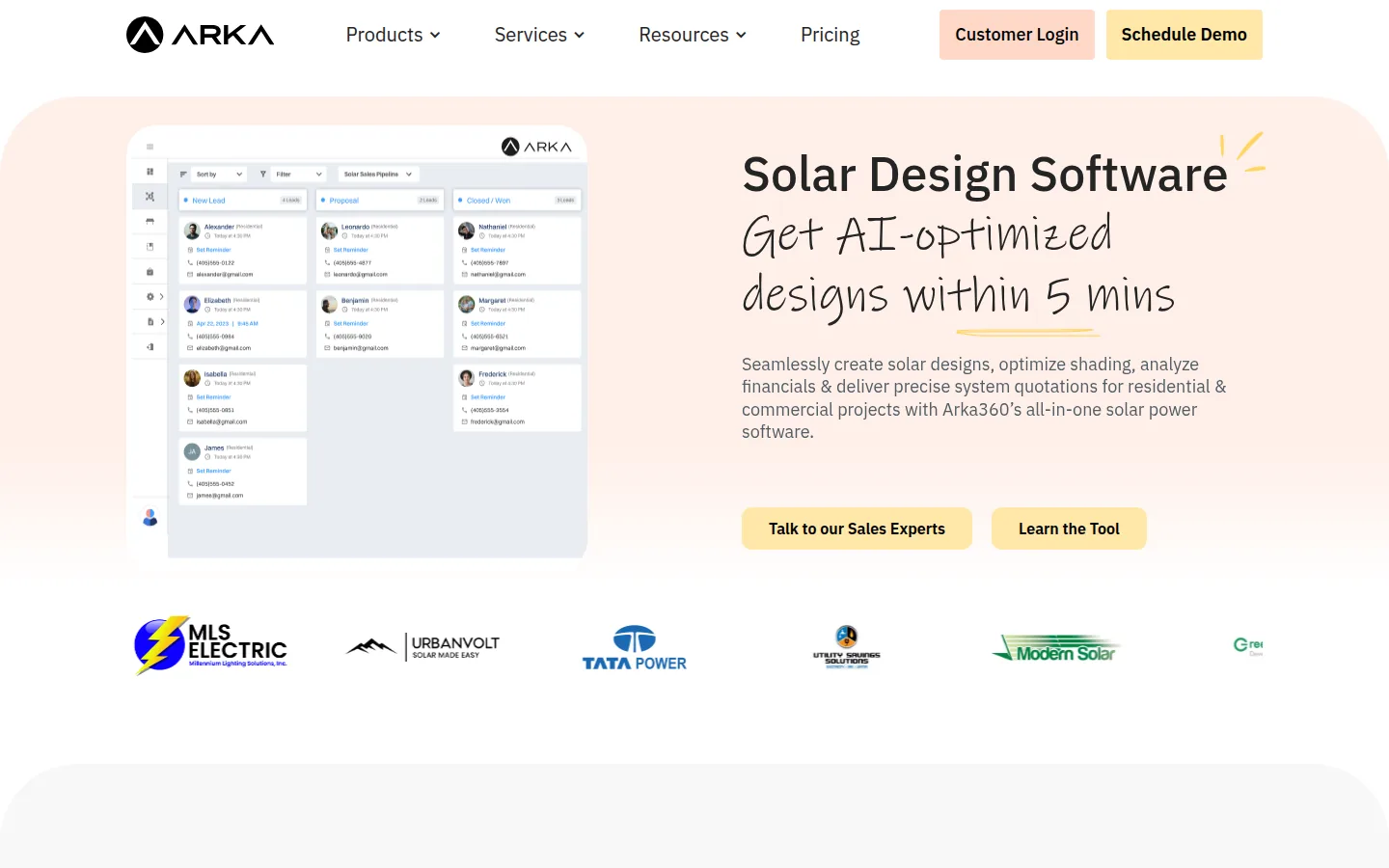
Best for: installers who want a proposal tool that sets currency from the project location and offers a proposal language menu.
Not the right choice if: you need Arabic stated in writing, or a riyal price. Arka360 lists Saudi Arabia among its countries on its home page. A search of its help centre for “Saudi” and for “Arabic” returned no articles.
What the vendor documents: its pricing page feature table lists electric single line diagram, CAD export, banking simulation, shade report, 8760 production report, PVsyst export, utility rate finder, payback and ROI report, custom sales proposal, web proposal, and financing (cash, loan, lease and PPA). It also lists a CRM with lead management, task management and site survey. The help article on project information says “Currency is automatically detected by the location provided while creating a new project”. A help article on proposals says you can change the proposal language from a menu. A release note says Spanish proposals were added. Our reading does not show which other languages the menu holds.
Price (checked October 2026): the pricing page shows US-dollar cards. Basic is $199 per month and includes 1 user. Premium is $358 per month and includes 2 users. The feature table calls that plan Professional. Enterprise is “Talk to Sales”. The same page also holds rupee price blocks and other price sets, so confirm with Arka360 which one applies to you.
Limitations: the pages we read name no Saudi tariff, no SEC document and no Arabic output.
Vendor link: arka360.com.
Aurora Solar
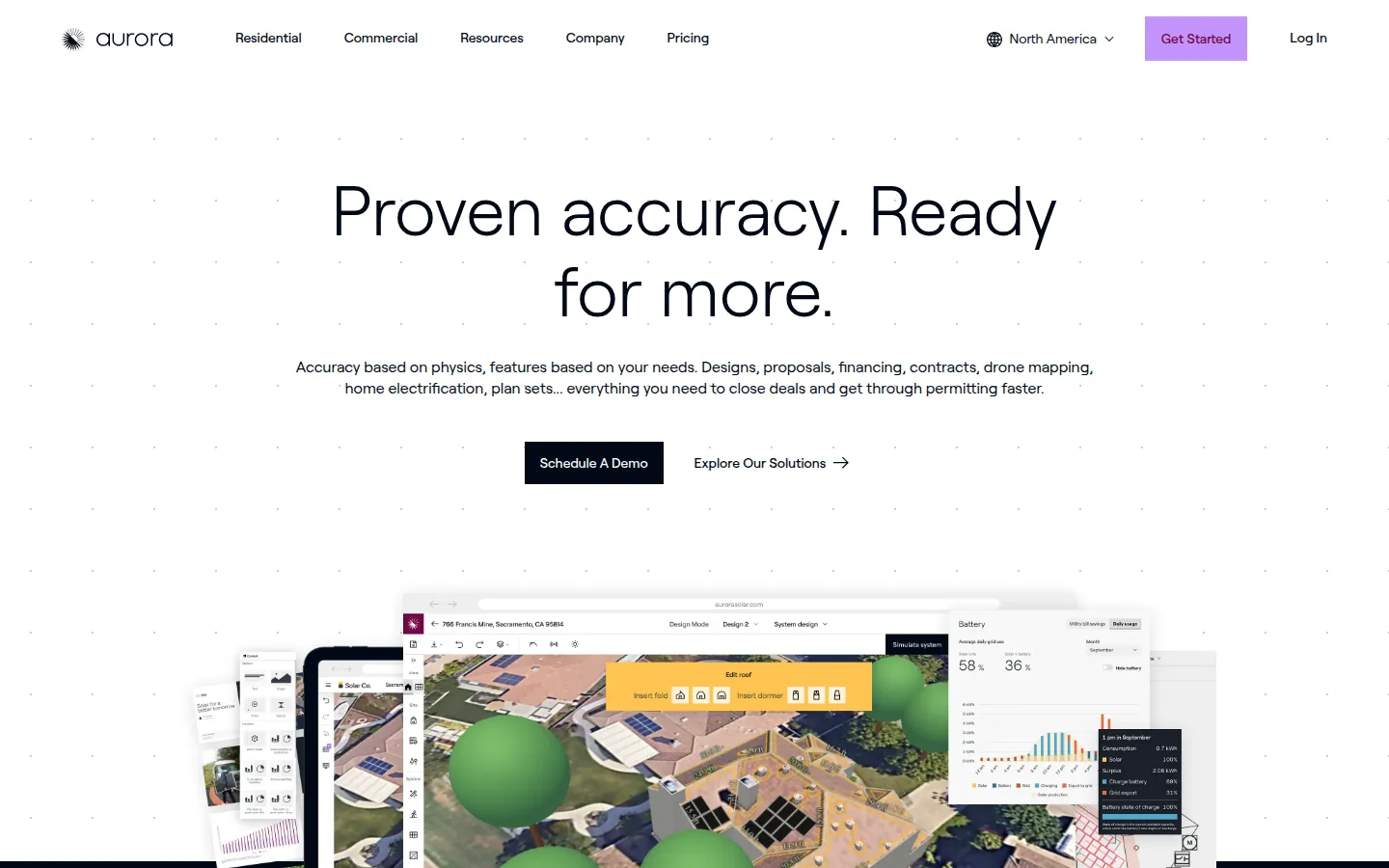
Best for: teams that already use Aurora and want a net billing setting in the bill-savings model.
Not the right choice if: you need a riyal price, a Saudi rate library or Arabic output stated in writing. Aurora’s help centre returned no result for “Saudi” or for “Arabic”. It is also not right if you need a P90 output. Aurora’s help says its production estimates are P50 values and that it “does not natively output P90”.
What the vendor documents: a help article on utility rates says compensation policy can be net billing or feed-in tariff, with a rate in dollars per kWh. The pricing page lists a utility rate database that is “Custom and integrated”, so you can configure your own rates. Its single-line diagram editor is “only available in Europe”. A help article says the currency for pricing displays is set at the organization level. The pricing page lists tablet-friendly sales proposals and web and PDF proposals.
Price (checked October 2026): on aurorasolar.com/pricing, Basic is $159 per user per month billed monthly, or $135 per user per month billed annually. Premium is $259 per user per month billed monthly, or $220 per user per month billed annually. Enterprise is custom, per project. The page shows a dollar sign and no riyal price.
Limitations: the pricing page lists an AHJ database (a list of permit offices) of 25,000+ US jurisdictions. The pages we read name no SEC or Saudi item.
Vendor link: aurorasolar.com/eu.
Energy Toolbase
Best for: teams that sell solar with storage and want a utility-rate model. Ask which Saudi rates it holds today.
Not the right choice if: you want PV panel layout in the same app. The comparison table on its ETB Developer page lists “PV design partnerships with leading design software tools” and does not list in-app PV panel layout tools. It is also not right if you need a published price.
What the vendor documents: ETB Developer is a proposal and modeling tool for solar and energy storage. Its page lists utility rate analysis, financial analysis, branded proposal templates, an interactive web proposal with engagement tracking, and lead management. Its FAQ says it supports “cash purchases, power purchase agreements (PPAs), loans, and leases”. An Energy Toolbase blog post of 14 November 2018 says its rate database is “not only in the U.S. but currently in several other countries including Saudi Arabia, Australia, Brazil, and Italy”. Its help centre lists “42 international territories”, without a date or a country list.
Price (checked October 2026): the pricing page does not list an ETB Developer price. It says you get pricing on a demo call.
Limitations: a help-centre search for “currency” found three articles and none states a currency setting. A search for “Arabic” found no article. The pages we read do not say which Saudi rates it holds today.
Vendor link: energytoolbase.com.

OpenSolar
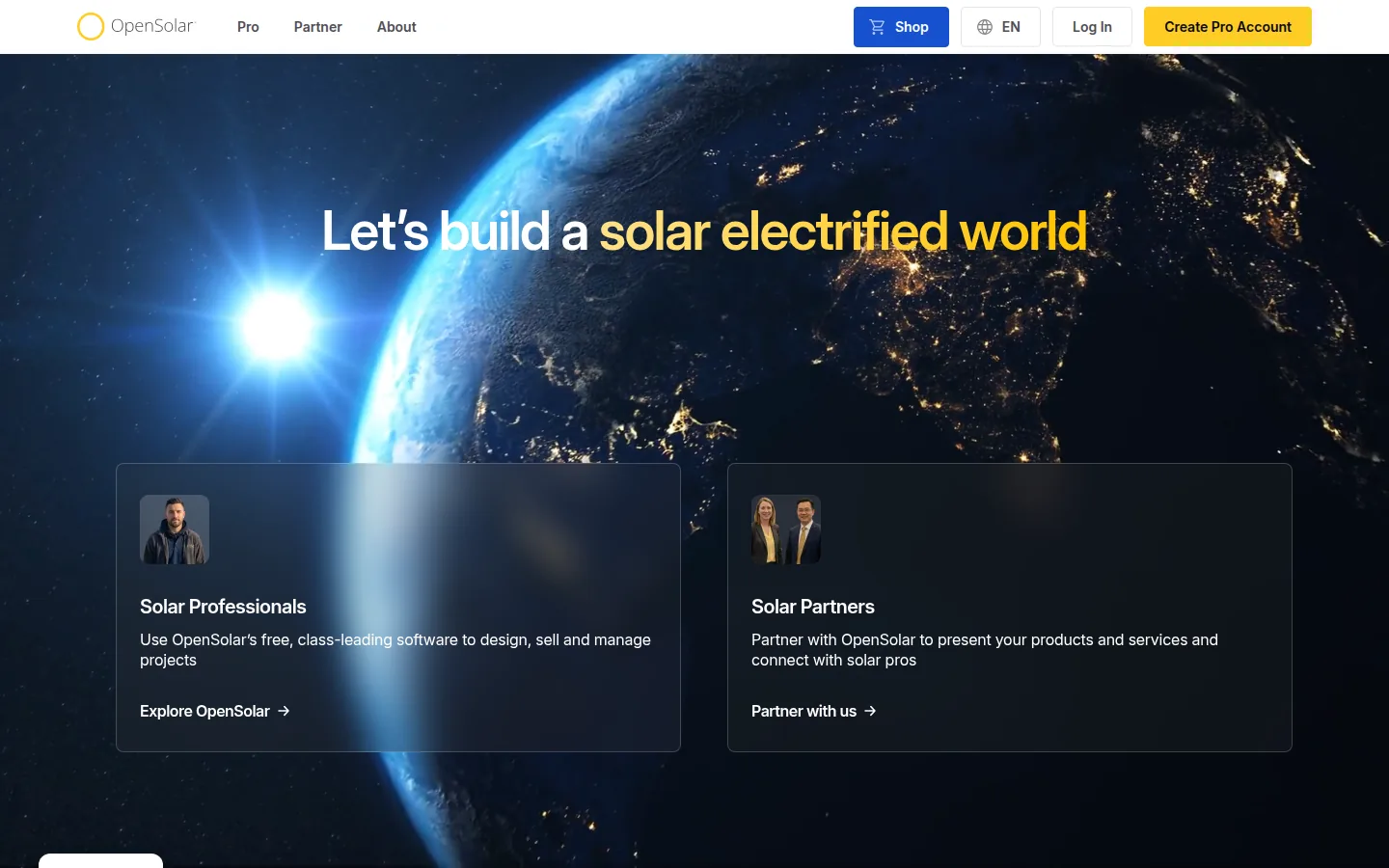
Best for: small installers who want a free core app with proposals and a generated single line diagram.
Not the right choice if: you need Arabic proposals or a Saudi diagram template. The proposal language article lists 13 languages and Arabic is not among them. The single line diagram article lists ten countries and Saudi Arabia is not one of them. A search of the help centre for “Saudi” returned no result.
What the vendor documents: its output article says OpenSolar calculates output with PVWatts Version 6 by default, or with the System Advisor Model (SAM). The help centre has a Utility Tariffs section. You can create a custom tariff yourself.
Price (checked October 2026): the core app is free of charge for solar professionals, per the vendor. From 16 April 2026 the vendor charges for API Access (a per-project fee) and supported connectors (a monthly fee per organization). The per-project API fee is on OpenSolar’s API page. The 16 February 2026 post says accounting connectors are billed as a monthly fee per organization. Optional paid Enterprise Services: Support US$500 per month, Customize US$1,350 per month, Enterprise custom.
Limitations: the pages we read state no SEC document, no Saudi rate library and no riyal price. The help does not say whether SEC accepts OpenSolar’s SAM output.
Vendor link: opensolar.com.
PVsyst
Best for: the yearly energy estimate in an SEC design file, and yield evidence on larger roofs. SEC’s guide names PVsyst or SAM as examples.
Not the right choice if: you need customer proposals from the same tool. A search of the PVsyst help index found no quotation or proposal output. It is also not right if you work on a Mac or in a browser. The requirements page says PVsyst runs only under Windows.
What the vendor documents: a P50 to P90 evaluation. PVsyst says the annual production has a 50% probability of exceeding the P50 value and a 90% probability of exceeding the P90 value. Its single line diagram help page describes an editor and viewer. It is available for grid-connected systems only. It does not include storage, and the page says the feature is “still work in progress”. The languages page says English is the reference language and lists eleven translations. Arabic is not among them. Its costs page says “You can work with any currency”.
Price (checked October 2026): CHF 700 per year for PVsyst 8 Professional, with grouped-order discounts of 5% for 2 to 4 licences, 15% for 5 to 9 and 20% for 10 or more. The product page lists a one-month free trial. No riyal price is published.
Limitations: the help index has no hit for Saudi. It names no Saudi tariff.
Vendor link: pvsyst.com.
SurgePV
SurgePV is our product.
Best for: teams that want roof modeling, shading, yield, financial modeling, bill of materials and proposals in one product, priced per user. Confirm Saudi outputs in a demo.
Not the right choice if: you want a self-serve trial (SurgePV offers a guided demo). It is also not right if you need a riyal price or Arabic proposals in writing before talking to sales, because the pricing page lists US dollars and the published scope does not list Arabic. Another case is a free tool for small jobs, where OpenSolar’s core app is free. Outputs support design and documentation but do not replace approval by the responsible engineer, authority, lender or utility. That includes SEC. SurgePV’s published product scope does not list a CRM (customer tracking tool). It does not list monitoring or ERP (business management software) tools.
What the vendor documents: 3D roof modeling, array layout and shading analysis. It also lists energy-yield modeling, financial modeling, electrical workflow support, bill-of-materials output and proposal generation. See solar design software and solar proposal software for the product pages.
Price (checked October 2026): $1,899 per user per year for 1 user, $1,499 per user for 3 seats, $1,299 per user for 5 seats, in US dollars.
Limitations: results depend on source data, assumptions and equipment models. The pricing page and published scope do not state Arabic output, a Saudi rate library, an SEC diagram or P50 to P90 outputs.
Vendor link: surgepv.com.
Saudi Rules That Shape the Choice
SEC runs the connection through its web portal. SEC’s Connection Guidelines, Version 3 cover small-scale solar PV on its low and medium voltage networks. The consumer registers on the SEC website and picks a consultant or contractor from SEC’s approved list. The contractor files an initial application. SEC checks the request against the regulator’s rules and answers within 20 working days. An approval stays valid for 180 days. SEC checks the total small-scale solar capacity against 3% of the previous year’s peak load. It also checks the system against 15% of the rated capacity of the transformer that feeds the consumer. The guide says residential consumers get connection priority. It says systems go from 1 kW to 2 MW. A technical assessment of the network is mandatory above 50 kW.
The design file lists specific documents. For systems up to 11 kW, Annex B of the guide asks for a single line wiring diagram, a layout showing tilt, orientation and shading sources, a string layout for three or more strings, datasheets for modules, inverters and interface protection, and mounting data. It also asks for “an estimate of the yearly energy production” calculated “using solar energy simulation software like PVsyst or SAM”. Systems above 11 kW need a technical report. It holds the input data, the equipment data and the system design. If the design conflicts with SEC standards, SEC sends a note and the contractor has 30 working days to fix it.
The economics come from a regulator program. The guide says the consultant enters data in a computer program, available on ECRA’s website, to show the economic feasibility. The consumer then signs a Feasibility Study Acceptance Form. So a payback figure in a proposal is for your customer. The guide does not make it a file item.
Export is valued under net billing. Net billing means the power you take from the grid and the surplus you send are each valued in money, and the difference is billed. The guide says that for any surplus, “a financial valuation will take place” and the amount is deducted from the next billing cycle. The guide prints no export rate. We print no rate either. SEC’s tariff page did not load in a browser for us in October 2026, so read the current table there. A proposal tool needs an editable rate.
Larger self-consumption projects use a different SEC process. SEC’s March 2025 first edition covers renewable generation for self-consumption on the transmission network, up to 30 MW or the contracted load, whichever is lower. It says a system that is for self-consumption and has 2 MW AC capacity or less is exempt from SERA’s authorisation and generation licence. Its agreement forms come in Arabic and English versions.
Names. The older guide names the Electricity & Cogeneration Regulatory Authority (ECRA). The March 2025 document names the Saudi Electricity Regulatory Authority (SERA). SEC’s 2025 financial statements call the company Saudi Energy Company (formerly Saudi Electricity Company). Its connection guides still use “SEC”.
What to Ask a Vendor Before Buying
Ask each vendor for one sample project. Then look for these items. First, the yearly energy estimate, and whether you can file it with SEC. Second, the single line diagram for the design file. Third, a field for the Saudi rate and the export rate. Fourth, an Arabic proposal. Fifth, a price in the currency you will be invoiced in. Where a vendor does not publish a feature on the pages we read, the matrix says so. A demo or trial is the place to confirm it.
How We Ordered These Tools
SurgePV publishes this page and is a vendor on this list. Its entry uses the same vendor-page sources and template as every other tool here.
We did not rank these tools. They are listed alphabetically, and the best-for picks come from the matrix above.
- Yield estimate for the SEC file: SEC’s guide asks for a yearly energy estimate from simulation software. We did not assess whether SEC accepts any tool’s output.
- Diagram for the SEC file: the guide asks for a single line wiring diagram. We did not assess whether any tool’s diagram meets SEC’s format.
- Saudi rates: a proposal needs the customer’s rate and an export rate. We did not assess whether any rate library is current or correct.
- Arabic proposal: Saudi customers may want Arabic documents. We did not assess translation quality.
- Project currency: a riyal quote avoids conversion mistakes. We did not assess rounding or tax lines.
- Price currency: the currency shows what a Saudi buyer will pay. We did not assess discounts or negotiated quotes.
Sources and Dates
Vendor pages were read in October 2026. Arka360 (pricing, help). Aurora (pricing, P-values). Energy Toolbase (pricing, ETB Developer). OpenSolar (free, enterprise services). PVsyst (shop, product). SurgePV (pricing). Saudi sources are the two SEC documents linked above. They were read as PDF files in October 2026. We searched the PVsyst help index, and the Aurora, OpenSolar, Arka360 and Energy Toolbase help centres, for Saudi, Arabic and currency. A page that only repeats the search word is not a hit. We tried to read the regulator’s site and SEC’s tariff page, and neither loaded for us. We read no regulator page directly. SEC’s guide names the ECRA small-scale solar rules, and we did not read those rules themselves.
See SurgePV on your own Saudi project
Book a guided demo and ask for the Saudi outputs you need.
Book a Free DemoGo Deeper on a Category
- Solar software in Saudi Arabia, all categories
- Solar design software in Saudi Arabia
- Solar proposal software in the United Arab Emirates and in Kuwait, two nearby country lists
- Best solar proposal software, all markets
Frequently Asked Questions
What is the best solar proposal software in Saudi Arabia?
It depends on the job. From what the vendors publish, SEC’s guide names PVsyst or SAM as examples for the yearly energy estimate, and OpenSolar’s help describes a SAM option. Energy Toolbase’s 2018 blog says its rate database covers Saudi Arabia. Arka360 sets the project currency from the project location and lets you change the proposal language. OpenSolar’s core app is free. SurgePV documents roof modeling, bill of materials and proposals in one product, priced per user in US dollars. No vendor page we read states Arabic output or a riyal price.
Do I need PVsyst for the SEC design file?
SEC’s connection guide says the yearly energy estimate must be calculated with solar energy simulation software like PVsyst or SAM. It does not say PVsyst is required. Proposal tools may show a yield figure, but the guide asks for a simulation estimate in the design file. Ask SEC or your approved contractor which output it accepts.
Which proposal tools can make an Arabic proposal?
No vendor page we read states Arabic proposal output. OpenSolar’s proposal language list has 13 languages and Arabic is not one of them. Arka360 lets you change the proposal language from a menu, and a search of its help centre for Arabic found no article. Aurora, Energy Toolbase and PVsyst help searches found no Arabic support. SurgePV’s published scope does not list it.
Which proposal tools have Saudi electricity rates?
Energy Toolbase’s blog of 14 November 2018 says its rate database includes Saudi Arabia, and its current coverage is not stated on the pages we read. Arka360 lists a utility rate finder but names no Saudi rates. Aurora and OpenSolar let you enter custom rates. We print no SEC rate because the SEC tariff page did not load for us.
What does SEC need for a small solar system file?
SEC’s guide lists a single line wiring diagram, a layout showing tilt, orientation and shading, equipment datasheets, mounting data and a yearly energy estimate for systems up to 11 kW. Systems above 11 kW need a technical report. SEC’s guide says the consumer picks a consultant or contractor from SEC’s approved list and files through the SEC web portal.
How much does solar proposal software cost in Saudi Arabia?
No vendor here publishes a riyal price. OpenSolar’s core app is free, but the vendor charges for API Access and supported connectors from 16 April 2026. Arka360 shows 199 dollars a month for Basic with 1 user and 358 dollars a month for Premium with 2 users. Aurora lists 159 or 259 dollars per user per month billed monthly. Energy Toolbase does not publish a price for ETB Developer. PVsyst Professional is 700 Swiss francs a year. SurgePV lists 1,899 US dollars per user per year for one user.
