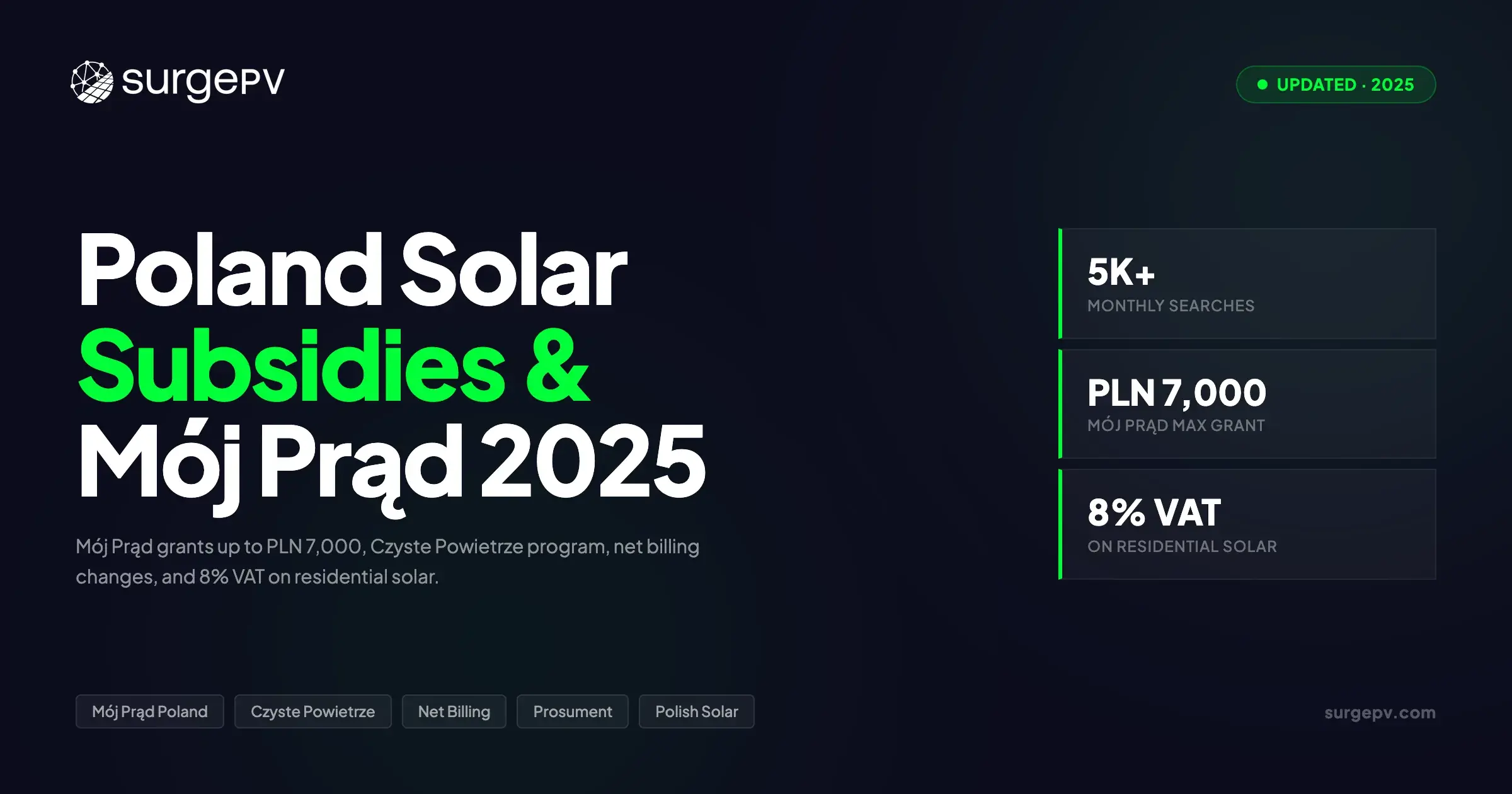
Poland went from virtually no residential solar in 2018 to over 17 GW installed by 2024 - one of the fastest build-outs in European history. The Mój Prąd (My Electricity) grant program did most of the heavy lifting. A shift to net billing in 2022 slowed momentum, but generous grant funding and 8% VAT keep Poland competitive with Western European markets.
This chapter covers every major Polish solar incentive available in 2026: Mój Prąd 6.0 grants, the Czyste Powietrze renovation program, net billing mechanics, VAT rules, and the storage fund. It also addresses the question many Polish homeowners are asking: will net metering come back?
What you'll learn in this chapter
- Mój Prąd 6.0 grant amounts and application process
- How net billing works and how it compares to old net metering
- Czyste Powietrze grants for solar + heating renovation
- 8% VAT on residential solar installations
- How to combine multiple Polish incentives
- FAQ on net metering return and processing times
Poland Solar Incentives: Quick Reference (2026)
| Program | Type | Current Amount | Who Qualifies | Apply |
|---|---|---|---|---|
| Mój Prąd 6.0 | Capital grant | Up to PLN 7,000 for PV + storage | Residential prosumers | NFOŚiGW portal |
| Czyste Powietrze | Grant + loan | Up to PLN 135,000 combined | Single-family home owners | WFOŚiGW |
| Net billing (prosument) | Export compensation | Spot market minus 20% | All prosumers after April 2022 | Via energy supplier |
| Mój Prąd (PV only) | Capital grant | PLN 3,000 | Residential, without storage | NFOŚiGW portal |
| 8% VAT | Reduced VAT | 8% on residential solar installation | Residential | Automatic at invoice |
Latest Updates: Poland Solar 2025
| Date | Change |
|---|---|
| April 2022 | Poland switched from net metering to net billing (prosument netto → rozliczenie dla prosumentów) |
| 2023 | Mój Prąd 5.0 launched - increased grants for PV + heat pump + storage combinations |
| 2024 | Mój Prąd 6.0 opened - PLN 7,000 for PV + storage, PLN 3,000 for PV only |
| 2025 | Czyste Powietrze extended with higher budget allocation |
| 2025 | Government consultation on returning to net metering (political pressure following 2022 change) |
Mój Prąd (My Electricity): Poland's Main Solar Grant
Mój Prąd is Poland's flagship residential solar grant program, administered by the National Fund for Environmental Protection and Water Management (NFOŚiGW). Multiple tranches have been released since 2019, with each tranche adjusting grant amounts based on policy priorities. The program has been the primary driver of Poland's residential solar boom.
Mój Prąd 6.0 Grant Amounts (Current Tranche, 2025)
| System Type | Grant Amount | EUR Equivalent |
|---|---|---|
| PV only (≥2 kWp) | PLN 3,000 | ~€700 |
| PV + storage (≥2 kWp + ≥2 kWh) | PLN 7,000 | ~€1,600 |
| PV + storage + energy management | PLN 7,500 | ~€1,750 |
| PV + heat pump | PLN 5,000 | ~€1,150 |
Eligibility Requirements
- Residential prosumer status - grid-connected solar with a net billing agreement
- Property: single-family dwelling (dom jednorodzinny)
- System commissioned after the tranche opening date
- Invoice and payment documentation required
Application Process
- Install system with a certified installer
- Register as prosumer with energy supplier (umowa kompleksowa or rozliczenie prosumenckie)
- Apply via NFOŚiGW portal (mojeporady.gov.pl/program/moj-prad)
- Submit: installer invoice, prosumer agreement, connection confirmation, system commissioning certificate
- NFOŚiGW processes within 30–60 working days
- Grant paid directly to applicant's bank account
Pro Tip
Mój Prąd tranches have limited funding and close when the budget runs out. Applications in the first weeks of a new tranche have higher success rates. NFOŚiGW announces tranche openings on their website - subscribe to notifications if you're planning an installation.
Net Billing: Poland's Current Export Mechanism
Since 1 April 2022, Poland replaced net metering with a net billing mechanism. This change significantly reduced the value of solar exports for homeowners and sparked considerable controversy in the market.
Old System vs. New System
| Aspect | Old System (Net Metering) | New System (Net Billing) |
|---|---|---|
| Export value | 0.8 kWh credit per 1 kWh exported (80% of retail rate) | Spot market price minus 20% distribution charge |
| Typical export rate | ~€0.12–0.16/kWh equivalent | ~€0.05–0.07/kWh |
| Import rate | Standard tariff | Standard tariff (~€0.15–0.20/kWh all-in) |
| Balancing period | 12 months rolling | Monthly monetary settlement |
Transition Period
Prosumers who installed before April 1, 2022 can remain on the old net metering system until April 1, 2027 - then they automatically transition to net billing. This creates a clear deadline for legacy system owners to prepare their financial models for the change.
Impact on Payback
The net billing change significantly worsens solar economics for export-heavy configurations. For a 5 kWp system with 30% self-consumption, payback can extend by 3–5 years compared to the net metering period. Use a solar financial modeling tool to calculate your specific payback under the current net billing rates.
Optimization Under Net Billing
Self-consumption is now the key financial driver. Battery storage, EV charging during solar generation hours, heat pump operation at midday, and energy management systems all become substantially more financially attractive under net billing. The economics shift from "maximize export" to "minimize import."
Key Takeaway
Under net billing, a Polish solar system with 50% self-consumption performs dramatically better than one with 20% self-consumption. Sizing the system to match consumption - rather than to maximize generation - is now the right approach for most Polish households.
Czyste Powietrze (Clean Air): Combined Renovation Grants
Czyste Powietrze is Poland's flagship clean air program targeting replacement of coal-fired boilers and comprehensive energy renovation. Solar PV is eligible when combined with other energy improvements. The program is among the largest residential energy retrofit schemes in Europe by total budget.
Solar PV Eligibility in Czyste Powietrze (2026)
- Solar PV panels and installation: eligible cost up to PLN 10,000 per kWp (max PLN 40,000 for the solar component)
- Solar must be part of a larger renovation package - not standalone
- Maximum combined grant depends on income bracket
Benefit Tiers (2026)
| Income Group | Grant Percentage | Maximum Grant |
|---|---|---|
| Very low income (≤PLN 2,651/month) | 90% | PLN 135,000 |
| Low income (≤PLN 3,600/month) | 65% | PLN 105,000 |
| Medium income | 45% | PLN 66,000 |
| Basic | 30% | PLN 66,000 |
How to Apply
Apply via your provincial environmental fund (Wojewódzki Fundusz Ochrony Środowiska - WFOŚiGW) or the national portal at czystepowietrze.gov.pl. Certified installers can also apply on behalf of clients through the B2G partner network, which simplifies the paperwork considerably.
Key Condition
You cannot combine Czyste Powietrze with Mój Prąd for the same component. They can be combined if they cover different parts of the installation - for example, Czyste Powietrze for a heat pump and insulation, Mój Prąd for the solar PV panels.
VAT on Solar in Poland
Polish solar installations benefit from a reduced 8% VAT rate, down from the standard 23%. This applies automatically - no special application is required.
Eligibility
Residential buildings covered by the social housing program (budownictwo objęte społecznym programem mieszkaniowym), which includes most single-family homes up to 300 m² and apartment buildings up to 150 m² floor area. The vast majority of residential solar installations qualify.
Savings Example
On a PLN 30,000 system (ex-VAT): 8% = PLN 2,400 vs 23% = PLN 6,900. Saving: PLN 4,500 (~€1,050). The reduced VAT applies to panels, inverter, mounting, battery, and installation labor when invoiced together as part of an installation project.
Energy Storage Fund (Magazyn Energii)
Since 2022, Poland has included specific grants for battery storage via the Mój Prąd program as combined PV+storage grants. A standalone battery storage option is available in some tranches:
- Standalone battery addition to existing solar: PLN 3,000–5,000 depending on capacity
- The "Magazyn Energii" (Energy Storage) component is sometimes a separate application from PV
- Check the current NFOŚiGW tranche documentation - the exact structure changes each tranche
Given the shift to net billing, battery storage now offers a strong financial case in Poland. Storing midday solar generation for evening use avoids the unfavorable export rate and reduces imports at the higher retail tariff.
How to Maximize Poland's Solar Incentives
Strategy for a typical Polish household (5 kWp + 5 kWh storage):
- Apply for Mój Prąd 6.0 before installation or immediately after - PLN 7,000 for PV+storage
- Check Czyste Powietrze eligibility - if also replacing heating, substantial additional grants are available
- Optimize for self-consumption - critical under net billing regime
- Claim 8% VAT - confirm with installer before signing the contract
- Install before tranche closes - Mój Prąd budget runs out, so don't delay
Combined Incentive Value Example (2025, Medium Income)
| Incentive | Value |
|---|---|
| Mój Prąd 6.0 grant | PLN 7,000 |
| 8% vs 23% VAT saving (on PLN 30,000 system) | PLN 4,500 |
| Czyste Powietrze (if eligible, solar component only) | PLN 20,000–66,000 |
| Basic combination (no Czyste Powietrze) | PLN 11,500 (~€2,700) on a PLN 45,000 system |
PLN 11,500 represents roughly 25% subsidy on a fully installed system. With Czyste Powietrze, the effective subsidy can exceed 50% for lower-income households undertaking full energy renovation.
For solar software that models Polish payback periods with Mój Prąd grants and net billing export rates included, see how solar design software like SurgePV handles the financial calculations. The generation and financial tool lets you run scenarios for different self-consumption ratios under the current net billing structure.
Model Polish Solar ROI With Mój Prąd Grants
SurgePV calculates Polish solar payback including Mój Prąd grants, net billing export rates, and self-consumption optimization.
Book Free DemoNo commitment required · 20 minutes · Live project walkthrough
Frequently Asked Questions
Will Poland return to net metering?
There is ongoing political pressure to return to net metering or a more favorable prosumer compensation mechanism. As of early 2025, the government has not committed to reversing the 2022 change. Any change would require new legislation. Monitor URE (Energy Regulatory Office) announcements for developments.
How long does Mój Prąd processing take?
NFOŚiGW typically processes applications within 30–60 working days. Peak periods - when tranches first open - can extend to 90+ working days. The grant is paid after successful document review. Keep originals of all invoices and certifications; NFOŚiGW may request them during processing.
Is the Czyste Powietrze grant compatible with Mój Prąd?
They can be combined if they cover different installation components. For example, Czyste Powietrze covering a new heat pump and insulation while Mój Prąd covers the solar PV component. They cannot both fund the same expense. Check NFOŚiGW's current guidance on compatible programs before submitting applications.
Design Solar Projects for the Polish Market
SurgePV handles system design, financial modeling, and proposal generation - sized for Polish conditions and incentives.
Book Free DemoNo credit card · Full access · Unlimited projects
About the Contributors

CEO & Co-Founder · SurgePV
Keyur Rakholiya is identified by SurgePV as its CEO and a company co-founder. His SurgePV author page lists only role information that can be tied to the public profile below; credentials, project totals, testing claims, media appearances, and speaking engagements are not asserted without retained evidence.
