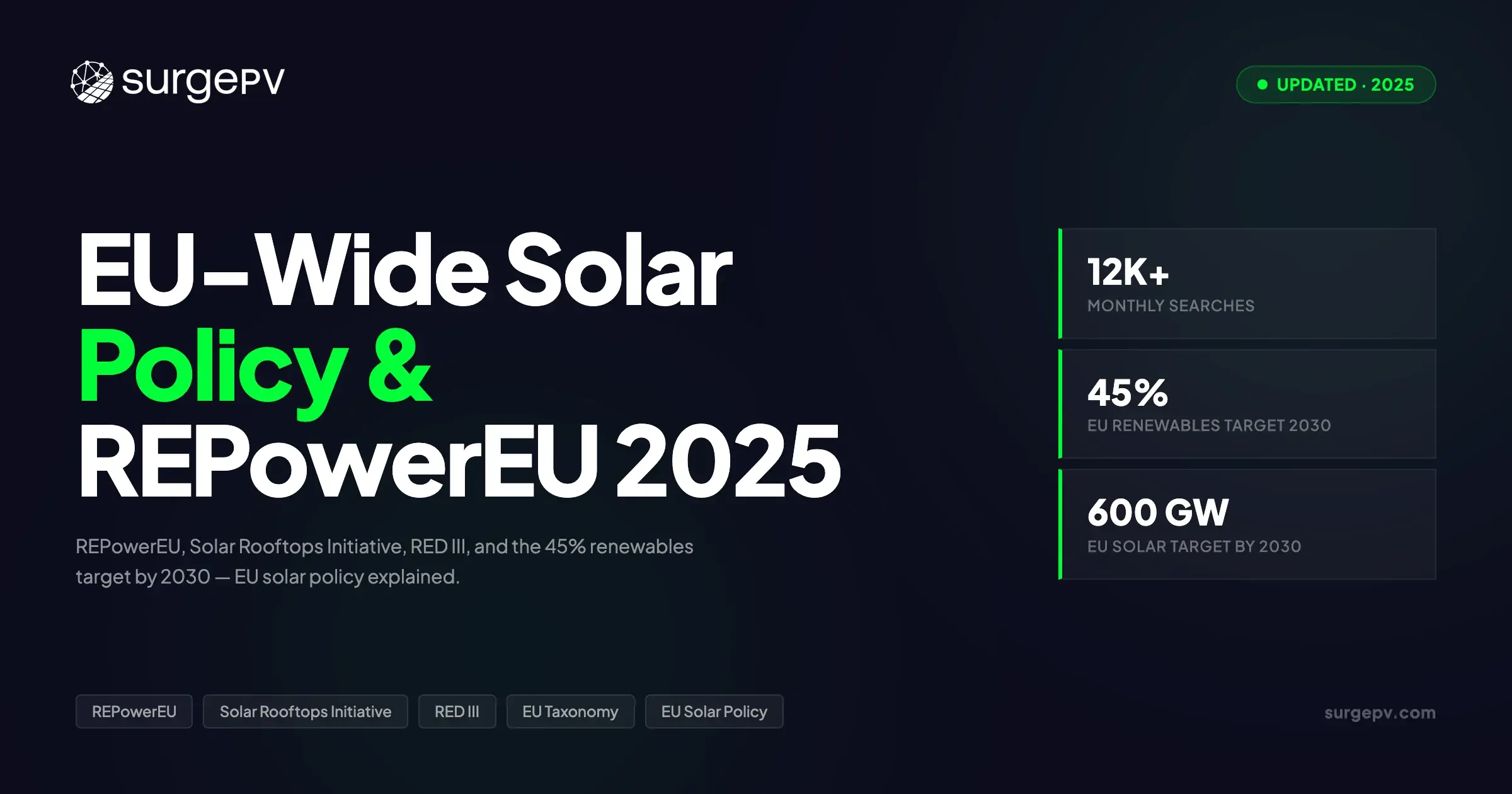
Every solar installer and homeowner in Europe operates within a policy framework set in Brussels. The feed-in tariff rates, permitting timelines, VAT exemptions, and mandatory solar requirements that national governments put in place are shaped - and in some cases directly required - by EU legislation. Understanding the EU layer makes national policies more legible.
This chapter covers the four pillars of EU solar policy: REPowerEU, the Renewable Energy Directive (RED III), the Solar Rooftops Initiative, and the EU Taxonomy. It also explains how state aid rules work, what the 1-month permitting target means in practice, and why countries behind their NECP targets tend to maintain more generous incentive programs.
What you'll learn in this chapter
- REPowerEU's 600 GW solar target and key actions
- RED III - the 45% renewables target and simplified permitting rules
- Solar Rooftops Initiative - mandatory solar timeline for buildings
- EU Taxonomy and how it drives green solar financing
- State aid rules and why national solar subsidies are legal
- National Energy and Climate Plans - which countries need more solar
EU Solar Policy: Key Programs & Targets (2026)
| Policy / Program | Status | Key Provision | Timeline |
|---|---|---|---|
| REPowerEU | Active | 600 GW solar by 2030, streamlined permitting | 2022–2030 |
| RED III (Renewable Energy Directive) | In force | 45% renewable target by 2030 | 2023– |
| Solar Rooftops Initiative | Implementation | Solar mandatory on new commercial buildings 2026, residential 2030 | 2024–2030 |
| EU Taxonomy | In force | Solar classified as sustainable investment | 2021– |
| State Aid GBER | In force | Block exemption for solar subsidies up to €1M | 2022– |
| Net Billing Framework | Directive | Member states must facilitate fair compensation | 2023– |
What Is REPowerEU?
REPowerEU was announced by the European Commission in May 2022 in response to Russia's invasion of Ukraine. It's Europe's plan to end dependence on Russian fossil fuels by fast-tracking clean energy. Solar is at the center of the plan - not as one option among many, but as the fastest and cheapest decarbonization path available.
REPowerEU Solar Targets
- 320 GW by 2025 - already achieved, with Europe reaching approximately 340 GW by end 2024
- 600 GW by 2030 - on track, requiring roughly 60 GW per year installation rate
REPowerEU Solar Actions
- Solar Rooftops Initiative (SRI): mandatory solar on new and existing public and commercial buildings
- Simplified permitting: maximum 1-month approval for small solar systems (50 kW or less)
- Priority permitting: renewable energy projects designated as "overriding public interest"
- Skills agenda: training 1 million solar workers by 2030
- Solar PV Industrial Alliance: European solar manufacturing support
Key Takeaway
REPowerEU shifted EU solar from an environmental policy to an energy security policy. That distinction matters politically: energy security funding faces less opposition than climate spending, which is why REPowerEU moved faster and with more money than previous renewable energy programs.
RED III: The Renewables Framework
The Renewable Energy Directive III (RED III) entered into force in November 2023. It's the legal backbone of EU renewable energy policy - the document that member states must transpose into national law. Several provisions directly affect solar installers and homeowners.
45% Target by 2030
EU member states must collectively reach 45% renewable energy in final energy consumption. Each state has its own national contribution target set in National Energy and Climate Plans (NECPs). The EU-wide average was around 23% in 2023 - the 45% target requires doubling in seven years.
Simplified Permitting (Article 16)
| System Size | Maximum Permit Time | Notes |
|---|---|---|
| 50 kW or less | 1 month (grid connection + planning) | Includes residential solar |
| Larger projects | 3 months | With exceptions for complexity |
| In renewables acceleration areas | 3 months maximum | Pre-approved zones, reduced due diligence |
| Repowering projects (Article 16b) | 6 months maximum | For existing renewable installations |
Self-Consumption Rights (Article 21)
- Member states must allow self-consumption without disproportionate procedures
- No permit required for systems of 50 kW or less (unless justified by specific concerns)
- Prosumers can sell surplus at fair, market-based prices
Energy Communities (Article 22)
Renewable energy communities have the right to produce, consume, store, and sell energy collectively. Member states must create enabling frameworks, and grid operators must facilitate community energy connections. This provision underpins the emerging community solar market across Europe.
Solar Rooftops Initiative
The Solar Rooftops Initiative (SRI) establishes a phased mandate for solar panels on buildings. This is the most consequential EU solar policy for the construction industry and for solar installers who serve that market.
Mandatory Solar Timeline
| Date | Requirement |
|---|---|
| 2026 | All new commercial and public buildings over 250 m² must have solar panels (member states can apply an 18-month technical/economic exemption) |
| 2027 | All existing commercial and public buildings over 250 m² undergoing major renovation |
| 2029 | All new residential buildings must have solar panels |
| 2030 | All existing public buildings over 250 m² must have solar panels |
Implementation Status
Each EU member state is transposing these requirements into national law. Germany and France were early movers. Several Central and Eastern European states are behind schedule. The European Commission monitors transposition and can initiate infringement proceedings against non-compliant states.
What This Means for Solar Businesses
The Solar Rooftops Initiative creates a mandatory installation pipeline - a guaranteed market that doesn't depend on homeowner motivation or grant programs. For commercial solar installers and solar design software users, this represents a multi-year demand floor that makes capacity investment more predictable.
Pro Tip
Design tools that generate compliant documentation for the Solar Rooftops Initiative requirements - system size calculations based on roof area, energy performance certificates, and grid connection technical specs - will be required for commercial tenders from 2026 onward. Plan your software stack accordingly.
EU Taxonomy: Solar as Sustainable Investment
The EU Taxonomy for sustainable activities classifies solar PV as a "substantial contribution to climate change mitigation" activity - the highest sustainability designation. This is a dry technical classification with direct financial consequences.
Why the Taxonomy Matters for Solar Financing
- Banks classifying solar loans as "green" face lower capital requirements under EU banking regulations
- EU Green Bond Standard applies to solar project bonds, unlocking institutional capital
- Corporate sustainability reports must disclose taxonomy-aligned activities - creating demand from corporate buyers
- Accelerates institutional capital flows into solar at lower cost of capital
Practical Consumer Implication
Solar installations financed through "green mortgages" or "eco-loans" referencing EU taxonomy alignment often carry lower interest rates - typically 0.5–1.5 percentage points below standard rates. This drives the proliferation of 0% and sub-market solar financing products across the EU. Germany's KfW programs, the Netherlands' Energiebespaarlening, and Italy's eco-loans all benefit from this taxonomy classification.
State Aid Rules: How National Incentives Stay Legal
EU state aid rules theoretically prohibit national governments from subsidizing specific industries in ways that distort competition. In practice, solar incentives have a clear path to legality through existing exemptions.
General Block Exemption Regulation (GBER)
National programs that support renewable energy generation, have incentives up to €1 million per installation, and follow transparent processes are automatically exempt from state aid notification. Most residential and commercial solar grant programs fall within these parameters.
Larger Programs
Germany's EEG, France's obligation d'achat, Italy's Conto Energia - these larger programs required formal notification to the European Commission but were approved. The Commission operates with a strong presumption in favor of renewable energy incentives aligned with EU climate targets. No major EU solar program has been blocked on state aid grounds.
What This Means
Member states have significant freedom to design solar incentives. The EU framework actively encourages national solar subsidy programs. State aid law is not a constraint - it's a clear pathway that governments know how to navigate.
VAT Directive: Enabling Zero-Rate Solar
Article 98 of the EU VAT Directive, as amended by Council Directive 2022/542, explicitly permits member states to apply zero VAT rates to solar panels for private use. This provision enables - but does not require - zero-rate solar VAT at the national level.
Germany moved to 0% VAT on residential solar in January 2023. The Netherlands followed shortly after. Countries that haven't yet moved to zero VAT - France at 5.5%, Belgium at 6%, Italy at 10% - can do so without requiring new EU legislation. The VAT Directive already gives them the authority. It's a national political decision, not a regulatory barrier.
The REPowerEU One-Month Permitting Target
RED III Article 16 requires member states to implement a maximum 1-month approval period for small solar installations (50 kW or less), including grid connection and planning approval. Implementation varies significantly.
| Country | Implementation Status | Typical Current Time |
|---|---|---|
| Germany | Implemented - MaStR online registration, fast grid notification | 2–4 weeks |
| Netherlands | Mostly implemented - Enexis/Liander fast connection process | 1–3 weeks |
| Spain | Mostly implemented for systems under 15 kW | 4–8 weeks |
| Italy | Partial - DSO technical study can take 2+ months | 2–4 months |
| France | Partial - CONSUEL + Enedis connection process | 3–4 months |
| UK | Not subject to RED III (post-Brexit) | 4–12 weeks |
Countries not meeting the 1-month target face infringement risk from the Commission. This creates regulatory pressure to speed up - relevant for installers planning expansion into new markets, as permitting timeline is a key variable in project economics.
National Energy and Climate Plans (NECPs)
Every EU member state submits a National Energy and Climate Plan (NECP) setting out how it will meet EU 2030 targets. Updated NECPs were due by June 2024. Most submitted with delays. These plans contain the solar capacity targets that determine how much political motivation each country has to maintain generous incentives.
Key Solar NECP Targets vs. 2024 Installed Capacity
| Country | 2030 Solar Target | 2024 Installed Capacity | Gap |
|---|---|---|---|
| Germany | 215 GW | ~92 GW | 123 GW to add |
| Italy | 80 GW | ~31 GW | 49 GW to add |
| France | 100 GW | ~20 GW | 80 GW to add |
| Spain | 76 GW | ~30 GW | 46 GW to add |
| Netherlands | 27 GW | ~18 GW | 9 GW to add |
| Poland | 29 GW | ~17 GW | 12 GW to add |
Why NECPs Matter for Incentives
Countries significantly behind their NECP solar targets have stronger political motivation to maintain or increase incentives. France is the clearest example - at 20 GW against a 100 GW target, France needs to install 80 GW in six years. That pressure supports continued generous feed-in tariff programs. The Netherlands, ahead of target, has been reducing incentive generosity - and that's logical given their NECP position.
For solar businesses, watching NECP positions predicts incentive trends better than following year-to-year policy announcements. Use solar software that accounts for these country-specific financial models to build accurate project ROI projections across EU markets.
Design Solar Systems That Meet EU Compliance Standards
SurgePV's design tool generates RED III-compliant system specifications and financial models for any EU market.
Book Free DemoNo commitment required · 20 minutes · Live project walkthrough
Frequently Asked Questions
Do EU policies create direct financial incentives for homeowners?
EU policy creates the framework within which national incentives operate. Direct EU financial support for residential solar comes via EU structural funds (managed by member states - relevant for lower-income regions in Poland, Romania, Bulgaria), the European Investment Bank's green lending programs, and indirectly via the EU taxonomy driving lower-cost green mortgages. The grants and feed-in tariffs that homeowners apply for come from national governments, not Brussels directly.
What is the Solar Energy Strategy and how does it differ from REPowerEU?
The EU Solar Energy Strategy (2022) is a specific Commission communication on solar - covering manufacturing, skills, permitting reform, and grid integration. REPowerEU is the broader energy independence plan of which the Solar Energy Strategy is one component. Think of REPowerEU as the program and the Solar Energy Strategy as the solar-specific chapter within it.
How does Brexit affect UK solar policy vis-à-vis EU rules?
The UK is no longer subject to EU legislation including RED III or the Solar Rooftops Initiative. UK solar policy is set entirely by Westminster - the Smart Export Guarantee, planning rules, and VAT rates are all domestic decisions. The EU's direction of travel still influences UK policy indirectly, and the Great British Energy initiative echoes several REPowerEU principles, but the UK is not legally bound by EU solar targets or permitting timelines.
Can member states set solar incentives lower than RED III requires?
RED III requires member states to hit a renewable energy share target - it doesn't mandate a minimum incentive level. Member states are free to reduce feed-in tariffs or close grant programs as long as they remain on track to meet their NECP contribution. High-capacity countries like Germany and the Netherlands have been reducing incentive generosity while remaining on target. Countries behind their targets face political pressure to maintain or increase support.
Build EU-Compliant Solar Proposals in Minutes
SurgePV generates system designs and financial models for every major EU solar market, from Germany to Poland.
Book Free DemoNo credit card · Full access · Unlimited projects
About the Contributors

CEO & Co-Founder · SurgePV
Keyur Rakholiya is identified by SurgePV as its CEO and a company co-founder. His SurgePV author page lists only role information that can be tied to the public profile below; credentials, project totals, testing claims, media appearances, and speaking engagements are not asserted without retained evidence.
