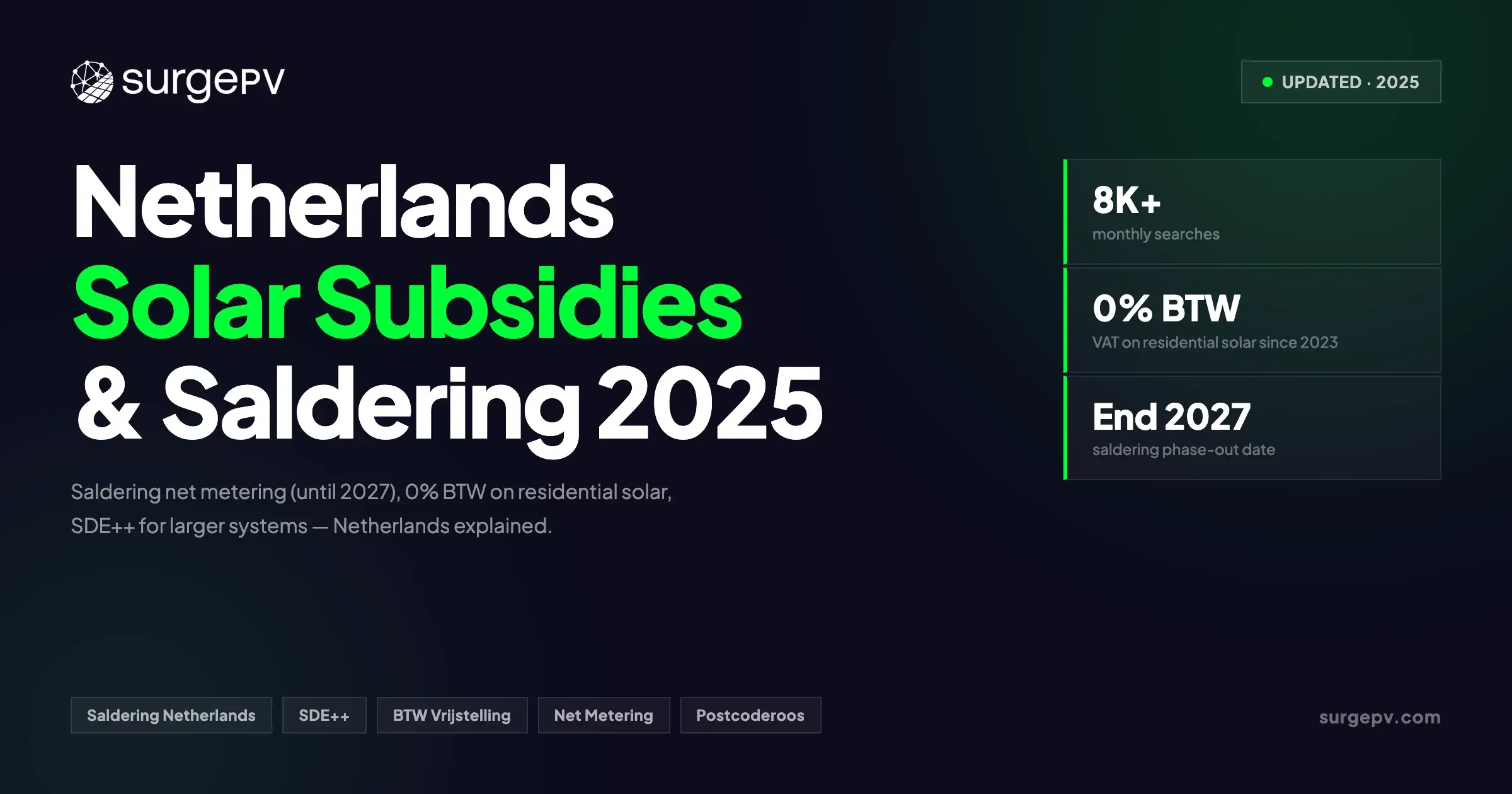
The Netherlands ranks among Europe's top solar markets by installed capacity per capita. Zero VAT on residential solar since January 2023, a well-established net metering scheme (saldering), and SDE++ subsidies for commercial installations make it a strong market - but the landscape is shifting. Saldering ends by December 31, 2027, and what replaces it will reshape how Dutch solar economics work for every system installed today.
This chapter covers every incentive available in the Netherlands in 2026: how saldering works, what happens after it ends, where the 0% BTW applies, how SDE++ operates for commercial projects, and how energy cooperatives access the Postcoderoos scheme.
What you'll learn in this chapter
- How saldering (net metering) works and what the phase-out means
- The 0% BTW exemption - what it covers and who qualifies
- SDE++ for commercial and industrial solar
- Postcoderoos / SCE cooperative solar subsidies
- Grid connection via Enexis, Liander, and Stedin
- How to optimize between saldering and post-2027 economics
Netherlands Solar Incentives: Quick Reference (2026)
| Program | Type | Current Rate/Amount | Who Qualifies | How to Apply |
|---|---|---|---|---|
| Saldering (net metering) | Net metering | Retail rate offset for surplus | Grid-connected residential | Automatic via distributor |
| BTW vrijstelling (0% VAT) | Tax exemption | 0% BTW on solar panels + installation | Residential systems | Automatic since Jan 2023 |
| SDE++ | Feed-in subsidy | Subsidy per kWh above market price | Commercial ≥15 kWp | RVO application |
| Postcoderoos / SCE | Cooperative subsidy | Per-kWh reduction on energy tax | Members of solar cooperatives | Via energy cooperative |
| Subsidie Zonnepanelen Waterwoningen | Capital grant | Up to €7,500 | Houseboats only | Via RVO |
Latest Updates: Netherlands Solar 2025
| Date | Update | Impact |
|---|---|---|
| January 2023 | BTW (VAT) reduced to 0% for residential solar panels and installation | Saves €1,200+ upfront on typical residential system |
| 2023 | Government confirmed saldering phase-out by December 2027 - no earlier forced end | Certainty for installations planned through 2026 |
| 2024 | Saldering at 100% step-down rate - full retail offset still applies in 2026 | No financial change yet; transition approaching |
| 2025 | Post-saldering replacement mechanism still under consultation - details expected late 2025 | Uncertainty for 2028+ economics; battery storage planning important |
| 2025 | SDE++ budget increased to support commercial solar ramp-up | More capacity available for commercial applicants |
Saldering: How Net Metering Works in the Netherlands
Saldering (Dutch for "netting") allows residential solar owners to offset exported electricity against their annual electricity consumption at the same retail rate. When you export 1 kWh, you get 1 kWh of credit against future imports. It's the most financially valuable Dutch solar incentive because retail electricity prices run at €0.28–0.38/kWh in 2026.
How saldering works in practice:
- Your smart meter (P1 meter) records both import and export throughout the year
- Over the year, your energy supplier nets import against export at equal retail rates
- If you export more than you import: you receive a payment (typically at a lower rate than retail for the true annual surplus)
- If you import more than you export: you pay only for the net difference
The phase-out plan: The Dutch government confirmed saldering ends by December 31, 2027. The transition is being managed in steps:
- 2025–2026: 100% netting still in effect
- 2027: Possible reduction in netting percentage (to be confirmed by regulation)
- 2028+: Replacement mechanism (details still under parliamentary consultation)
Key Takeaway: Saldering Timeline
Installing in 2026 or 2026 gives you at minimum two full years of favorable saldering. Build those years into your payback calculation as the most financially productive period of your system's life. The transition to lower export compensation in 2028 is certain - the exact rate is not yet set.
What Replaces Saldering After 2027
The most likely replacement is a teruglevering vergoeding (export compensation) - a fixed per-kWh payment for surplus generation, similar to the UK's Smart Export Guarantee or Germany's EEG surplus rate. Expected rates are 3–9 ct/kWh based on consultation documents, compared to the current retail rate of 28–38 ct/kWh.
This gap makes battery storage significantly more valuable post-2027. Self-consumption maximized through storage will be worth 3–5× exported electricity once the replacement mechanism takes effect. Use SurgePV's generation and financial tool to model both scenarios side by side for any Dutch installation.
BTW 0%: Zero VAT on Residential Solar
Since January 1, 2023, residential solar panels and their installation are BTW-vrij (VAT-exempt) in the Netherlands, at 0% instead of the previous 21%. This is one of the most straightforward cost reductions available - no application, no means test, automatic.
What's covered by the 0% BTW rule:
- Solar panels (zonnepanelen)
- Inverters (omvormers)
- Mounting systems (bevestigingsmateriaal)
- Installation labor
Saving in practice: On a €6,000 system (ex-BTW), the previous 21% rate added €1,260. Zero BTW eliminates this entirely - saving €1,260 with no paperwork required. The installer applies the 0% rate at point of invoice.
What's not covered: Commercial installations above a certain threshold pay standard 21% BTW, though businesses can reclaim this as input tax in their VAT return. The residential exemption does not extend to large commercial roof-mounted systems.
Pro Tip
The 0% BTW is automatic - no application needed. If an installer quotes you a price including 21% BTW for a residential system, challenge it. They are required to apply the zero rate for residential solar installations. Request an itemized quote showing BTW at 0%.
SDE++: Subsidy for Commercial Solar
SDE++ (Stimulering Duurzame Energieproductie en Klimaattransitie) is the Netherlands' main renewable energy subsidy for larger installations. It is not available for small residential rooftop solar - it targets commercial, industrial, and community projects.
How SDE++ works: The subsidy covers the difference between the market electricity price and a guaranteed "base rate" set by RVO (Netherlands Enterprise Agency). When market prices are high, the subsidy payment is small; when market prices fall, the subsidy compensates to ensure the guaranteed rate is met. This mechanism insulates investors from energy price volatility.
| Parameter | Detail |
|---|---|
| Minimum system size | ~15 kWp |
| Typical base rate (solar PV) | €0.05–0.08/kWh (depends on tender round) |
| Subsidy duration | 15 years |
| Application body | RVO.nl - competitive tender rounds |
| Tender rounds | Typically spring and autumn each year |
| Commissioning deadline | Within 4 years of SDE++ grant award |
Important caveat: With market electricity prices at €0.05–0.10/kWh in recent periods, SDE++ subsidy payments can be zero or very small - the program's value depends on market conditions. When market prices are high, the SDE++ topup is minimal. The guarantee matters most in low-price environments.
Applications are competitive - not all submissions are funded. Apply early in the tender window and ensure your project documentation is complete. Incomplete applications are disqualified without appeal.
Postcoderoos / SCE: Cooperative Solar
The Stimulering Coöperatieve Energieopwekking (SCE) scheme - formerly called Postcoderoos - lets members of energy cooperatives receive a reduction on their energy tax (energiebelasting) for solar electricity generated collectively nearby.
How it works:
- Join a local solar cooperative (coöperatie) - typically requires buying member shares
- The cooperative installs solar panels on nearby commercial or community rooftops
- Members receive a per-kWh reduction on their energy tax bill (€0.09–0.11/kWh in 2026)
- The tax reduction applies for 15 years from when the cooperative system commissions
Eligibility: Members must live within the same postcode zone or a set distance from the installation. Member shares typically cost €500–5,000 depending on the cooperative's project size.
Where to find cooperatives: Energie Samen (energiesamen.nl) maintains a directory of Dutch energy cooperatives with available share capacity. This is the primary channel for finding active SCE cooperatives in your area.
Key Takeaway: SCE vs Rooftop Solar
SCE is valuable for renters, apartment residents, or anyone without a suitable roof who still wants to participate in solar energy. The per-kWh tax reduction of 9–11 ct/kWh is lower than the saldering benefit but still meaningful over 15 years. It's also a lower upfront commitment than a full rooftop system.
Grid Connection: Enexis, Liander, Stedin
Dutch grid connection for residential solar is handled by the three regional distribution operators. Your location determines which operator manages your connection.
| Grid operator | Area | Process |
|---|---|---|
| Enexis | North and East Netherlands (Groningen, Drenthe, Overijssel, Noord-Brabant, Limburg) | Online form via enexis.nl + installer notification |
| Liander | Amsterdam, Gelderland, Noord-Holland, Friesland | Online portal via liander.nl |
| Stedin | South Holland, Utrecht, Zeeland | Installer-led notification to stedin.net |
Timeline: Most residential grid connections are confirmed within 1–2 weeks of installer notification. P1-meter data is available within days of connection, enabling real-time monitoring of import and export. The grid connection itself rarely delays residential solar projects in the Netherlands.
Self-Consumption vs Saldering: Planning for 2028
With saldering still fully in effect through at least 2027, the classic "export freely" approach continues to work. But planning ahead for post-2027 economics is the smart move for any system installed today.
With saldering (2025–2027): Export freely. Each kWh exported offsets a kWh imported at retail rate. Self-consumption and export are financially equivalent - the choice is neutral.
Post-saldering (2028+): Self-consumption becomes significantly more valuable than export. With retail electricity at ~€0.30/kWh and export compensation at ~€0.06–0.09/kWh, self-consumed electricity is worth 3–5× more than exported electricity. Battery storage to shift solar generation into evening consumption will provide the strongest post-2027 economics.
Investment recommendation: If adding battery storage, 2025–2026 is a practical window - you get saldering-equivalent returns during the payback period, while the battery positions you for the post-2027 regime where storage is essential for good economics. Use SurgePV's solar design software to model both scenarios for any system configuration and location.
Calculate Dutch Solar ROI Before Saldering Ends
SurgePV models Netherlands solar economics with saldering and post-2027 scenarios side by side.
Book Free DemoNo commitment required · 20 minutes · Live project walkthrough
Frequently Asked Questions
What happens to my solar system after saldering ends in 2027?
Your system continues operating exactly as before - only the billing mechanism changes. Exported surplus will likely be compensated at a lower per-kWh rate (estimated 3–9 ct/kWh versus current retail ~30 ct/kWh). Self-consumption will become significantly more valuable. Systems installed now will still have positive economics, but with longer payback periods if export makes up a large share of their generation profile. Adding battery storage before 2028 is the most effective way to maintain strong returns.
Is the BTW 0% permanent or temporary?
The Dutch government introduced 0% BTW for an initial period and it has been confirmed through the current parliamentary term. As with all tax policy, future legislation can change it. For planning purposes, 0% BTW is the current and near-term reality - treat it as available but not guaranteed indefinitely. For systems being installed in 2026 or 2026, the saving is real and immediate.
Can renters install solar panels in the Netherlands?
Renters can install solar with landlord permission. VvE (apartment association) approval is needed for apartment buildings - a resolution requires a majority of member votes. The BTW exemption and saldering both apply to renter-installed systems as long as the renter has an energy supply contract in their name. Renters without suitable rooftop access can alternatively join an SCE cooperative for indirect participation in solar generation.
Further Reading
For the EU-level policy driving Dutch solar regulation, see Chapter 10: EU-Wide Solar Policy & REPowerEU. For Belgium's parallel regional incentive structure, see Chapter 8: Belgium Solar Incentives.
Design Netherlands Solar Projects with Accurate ROI Models
SurgePV calculates saldering income, post-2027 battery economics, and full project payback for Dutch installations.
Book Free DemoNo credit card · Full access · Unlimited projects
About the Contributors

CEO & Co-Founder · SurgePV
Keyur Rakholiya is identified by SurgePV as its CEO and a company co-founder. His SurgePV author page lists only role information that can be tied to the public profile below; credentials, project totals, testing claims, media appearances, and speaking engagements are not asserted without retained evidence.
