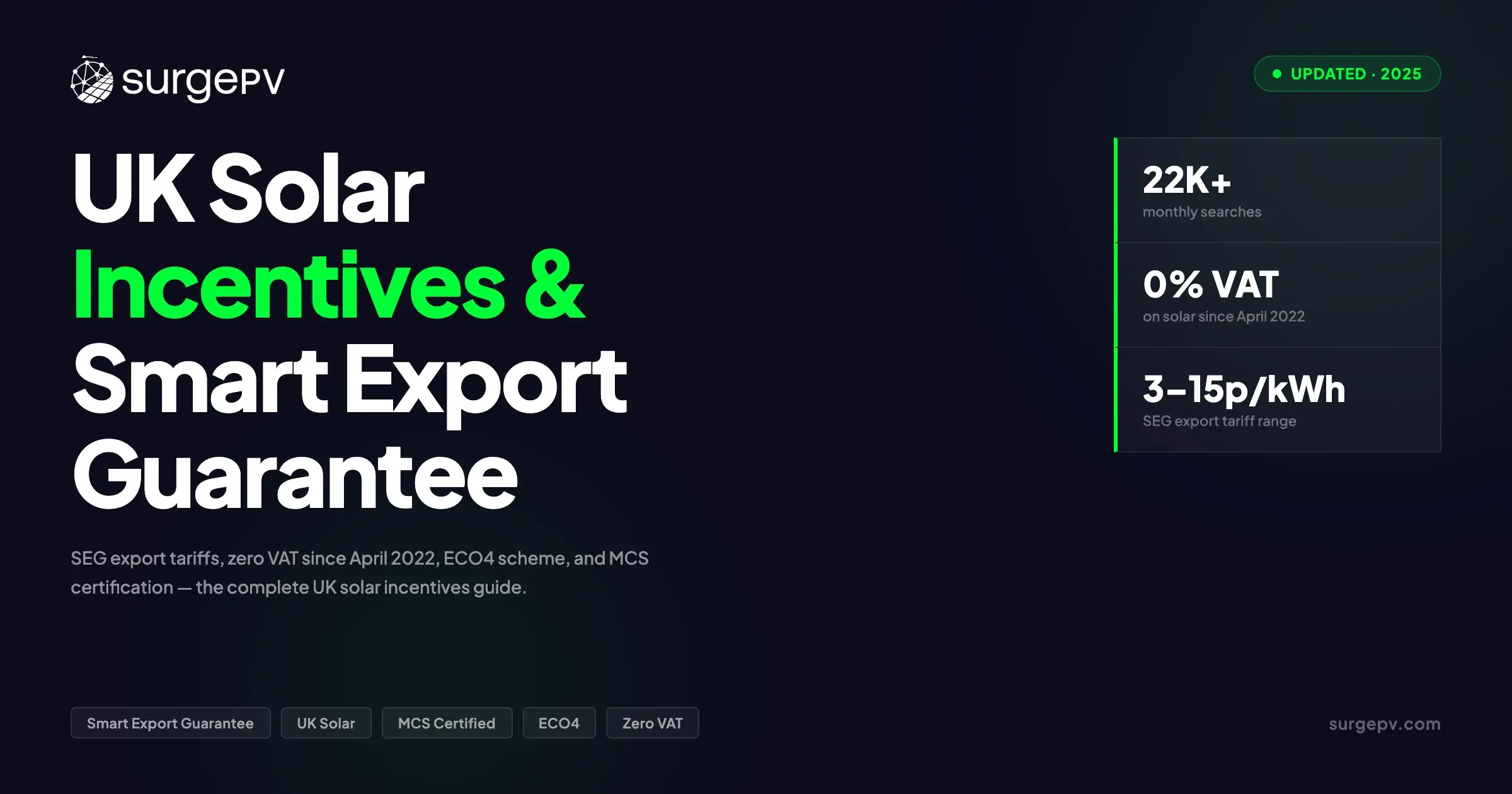
The UK solar incentive landscape is simpler than most European markets — there are fewer programs, and the biggest one (zero VAT since April 2022) is automatic. But the details matter: SEG rates vary from 3p to 15p/kWh depending on which supplier you choose, MCS certification is a hard requirement for any export payment, and ECO4 can deliver thousands in free equipment for qualifying households. This chapter covers all of it.
What You'll Learn in This Chapter
- How the Smart Export Guarantee (SEG) works and the best current rates
- Zero VAT: exactly what it covers and what it saves
- ECO4: eligibility criteria, grant amounts, and how to access it
- MCS certification: why it’s non-negotiable and how to verify it
- DNO notification: G98 vs G99 and when prior approval is required
- Capital allowances for business installations
- A worked financial example for a typical 4 kWp UK home
UK Solar Incentives: Quick Reference (2026)
| Program | Type | Current Rate/Amount | Who Qualifies | How to Apply |
|---|---|---|---|---|
| Smart Export Guarantee (SEG) | Export tariff | 3–15p/kWh (supplier-dependent) | Systems ≤5 MW with MCS installer | Apply to SEG licensee (energy supplier) |
| Zero VAT on Solar | Tax exemption | 0% VAT (was 5% pre-April 2022) | All residential solar installations | Automatic at invoice |
| ECO4 Scheme | Capital grant | Up to £9,000 | Income-qualified households | Via ECO4 installer/Ofgem |
| Great British Insulation Scheme | Grant | For insulation + sometimes solar | Low-income households | Via local authority |
| Full Expensing | Capital allowance | 100% first-year allowance | Businesses | Corporation Tax return |
| Boiler Upgrade Scheme (BUS) | Grant | £7,500 for heat pumps | Homeowners replacing gas boilers | Via MCS installer |
Key Takeaway
The UK FIT (Feed-in Tariff) closed to new applicants on 1 April 2019. Existing FIT recipients continue to receive payments until their contract ends. New installations use the Smart Export Guarantee — export-only payments with no generation tariff.
Latest Updates: UK Solar 2025
| Date | Update |
|---|---|
| April 2022 | Zero VAT introduced for all energy-saving materials including solar PV and solar thermal |
| January 2024 | SEG minimum rate obligation removed — Ofgem no longer sets a floor rate; suppliers compete on tariff level |
| 2024 | ECO4 funding extended to March 2026 |
| 2025 | Great British Energy Act passed — new state-owned clean energy company with implications for community solar |
| 2025 | Government consultation on solar planning reform — simplified permitted development for larger systems |
Smart Export Guarantee (SEG): How It Works
The Smart Export Guarantee replaced the closed Feed-in Tariff for new applicants. Under SEG, energy suppliers with 150,000+ customers must offer at least one export tariff to eligible generators. Smaller suppliers can offer SEG voluntarily.
SEG Rates by Supplier (2026)
| Supplier | SEG Rate | Notes |
|---|---|---|
| Octopus Energy | 15p/kWh | Outgoing Octopus — one of the UK’s highest fixed rates |
| OVO Energy | 5.5p/kWh | Standard rate |
| E.ON Next | 3p/kWh | Minimum obligation rate |
| British Gas | 5.5p/kWh | Standard rate |
| EDF | 3p/kWh | Minimum obligation |
Rates change frequently. Always check current tariffs at Ofgem’s SEG comparison page at the point of application.
SEG Eligibility Requirements
- System installed by an MCS-certified installer
- System size ≤5 MW (covers all residential and most commercial installations)
- Metering capable of recording half-hourly export data
- Smart meter installed — required for most suppliers’ SEG tariffs
SEG vs Old FIT: What Changed
The old FIT paid 0.38–0.55p/kWh (depleted rates by 2019 for most new applicants) plus a separate generation tariff paid on all electricity produced regardless of use. SEG pays only for exported electricity — there is no generation payment.
Early FIT recipients on pre-2012 rates (up to 43p/kWh) are significantly better off and continue to receive those rates until their 20-year contract ends.
Pro Tip: Maximize SEG Income
With a smart meter and a time-varying SEG tariff (like Octopus Agile export), you can schedule battery discharge during high-price export windows — typically 4–7pm on weekdays — to earn up to 50p/kWh for short periods. This is the most advanced optimization strategy in the UK market and turns battery storage from a self-consumption tool into an export income tool.
Zero VAT: The Most Impactful UK Incentive
Since 1 April 2022, all solar PV installations (and a range of other energy-saving measures) are zero-rated for VAT in the UK. Before this date, a 5% reduced rate applied. Compared to standard 20% VAT — which never applied to solar but is the baseline for other purchases — the saving is substantial.
What Zero VAT Covers
- Solar PV panels and all associated equipment (inverters, mounting, wiring, monitoring)
- Solar thermal systems
- Wind turbines and micro-CHP units
- Insulation, heat pumps, draught stripping (relevant for whole-home renovation packages)
What Zero VAT Saves
On a £10,000 system (ex-VAT), zero VAT saves £500 compared to the previous 5% reduced rate. The saving is automatic — no application, no form, no waiting. The invoice simply arrives at £10,000 rather than £10,500.
For a typical UK 4 kWp residential system at £8,000–9,000 ex-VAT, the saving versus the pre-2022 regime is £400–450.
Key Takeaway
Zero VAT applies to all homeowners and landlords regardless of building age. Unlike some EU countries with building-age restrictions, the UK applies zero VAT to new builds and period properties alike.
Business Installations and VAT
Commercial solar installations are also zero-rated for VAT. Businesses can additionally recover input VAT on all associated costs — materials, installation labor, and professional fees — through their VAT returns. The combination of zero-rated supply and full input VAT recovery makes the commercial VAT position straightforward.
ECO4: Up to £9,000 for Eligible Households
The Energy Company Obligation (ECO4) scheme requires large energy suppliers to fund insulation and heating improvements for low-income and fuel-poor households. Solar PV is included in certain circumstances, particularly when installed as part of a broader package with insulation and heating upgrades.
ECO4 Solar Eligibility
- Property must be EPC band E, F, or G (poor energy efficiency)
- Household must receive qualifying benefits: Universal Credit, Pension Credit, Working Tax Credit, Child Tax Credit (with income limit), or Housing Benefit
- Solar is typically installed as part of a package alongside insulation and heating improvements, not as a standalone measure
Grant Amounts
- Typically £2,000–9,000 toward system cost for qualifying households
- Full installation may be free for households with EPC band F or G and qualifying benefit receipt
How to Access ECO4
- Check eligibility at the Energy Saving Trust website or Simple Energy Advice
- Contact an ECO4-registered installer (they hold contracts with energy suppliers)
- The installer arranges a survey and manages the funding claim directly with the energy company
- No direct application to Ofgem is required — the installer handles the paperwork
ECO4 runs until March 2026. A successor scheme is expected to follow, though details have not been confirmed as of early 2026.
Model UK Solar ROI With SEG and Zero VAT
SurgePV calculates UK solar payback including SEG tariff income, zero VAT, and self-consumption savings for any system configuration.
Book Free DemoNo commitment required · 20 minutes · Live project walkthrough
MCS Certification: Non-Negotiable for SEG
Microgeneration Certification Scheme (MCS) certification is required for SEG registration, compliance with planning conditions in most councils, and building warranty acceptability. If your installer is not MCS-certified, you cannot register for SEG — full stop.
What MCS Means in Practice
An MCS-certified installer has been audited against quality and competency standards. When they complete an installation, it is registered on the MCS national database with a unique certificate number. That certificate is your proof of compliance.
Before hiring an installer: Verify their MCS status at mcscertified.com. Search by company name or postcode. If they’re not listed, do not proceed — you will not be able to claim SEG.
After installation: Ensure you receive your MCS installation certificate. Keep it permanently — you’ll need it when you apply for SEG, if you sell the property, or if you add battery storage later.
Pro Tip: MCS at Property Sale
When you sell a property with solar, the buyer’s solicitor will request the MCS certificate as part of conveyancing. Missing certificates cause delays and can reduce the sale price. Store a digital copy somewhere permanent — not just in the installer’s portal.
DNO Notification: G98 and G99
Before connecting a solar system to the grid, the Distribution Network Operator (DNO) must be notified or give prior approval. The threshold between notification-only and prior approval is 3.68 kW per phase.
| Standard | Applies When | Process | Timeline |
|---|---|---|---|
| G98 | Up to 3.68 kW per phase | Notification only — installer notifies DNO within 28 days of connection. No prior approval needed. | Post-installation |
| G99 | Above 3.68 kW per phase | Prior approval required. DNO has 45 days to respond. | 2–8 weeks before installation |
A standard single-phase 4 kWp residential system exceeds the G98 threshold and requires G99 approval before the system can be commissioned. Budget 2–8 weeks for DNO approval. Larger commercial systems above 50 kW require a detailed network study and can take 3–6 months.
Your MCS installer submits G98/G99 applications as part of their service. Confirm the correct standard applies to your system before booking installation, as the DNO approval timeline affects your project schedule.
Capital Allowances for Businesses
UK businesses can claim full expensing (100% first-year capital allowance) on solar PV installations under the Finance Act 2023. The full cost of a solar installation is deducted from taxable profit in the year of purchase — no spreading over asset life required.
Example: 25% Corporation Tax Rate
| Item | Amount |
|---|---|
| Solar installation cost | £50,000 |
| Corporation tax saving (25%) | £12,500 |
| Effective net cost | £37,500 |
| Year 1 SEG income (est.) | £1,200–2,400 |
The Annual Investment Allowance (AIA) also covers solar PV, currently set at £1 million per year — sufficient for all but the very largest commercial installations. Full expensing applies to new plant and machinery with no size cap, so large commercial solar projects benefit directly.
Key Takeaway
For a business with a 25% corporation tax rate installing a £50,000 solar system, the tax saving of £12,500 in year one reduces the effective payback period by roughly 2 years compared to a straight capital expenditure with no allowance.
Great British Energy Act (2026)
The Great British Energy Act established Great British Energy (GBE) as a state-owned clean energy company, funded with £8.3 billion. Its primary focus is large-scale generation and community energy, but there are implications for smaller-scale solar:
- Local Power Plan: GBE will support up to 8 GW of community and local energy projects, including community solar schemes across England
- Community Energy Fund: Up to £400 million for local energy projects, some of which will fund community solar
- Planning reform: Government is consulting on reforming permitted development rights for solar, potentially allowing larger rooftop systems without planning permission
For residential homeowners in 2026–2026, the immediate practical impact is limited. The programs that affect most people remain SEG, zero VAT, and ECO4.
How to Maximize UK Solar Incentives
For a typical UK home with a 4 kWp system at £8,000 installed, here is the correct sequence to capture all available incentives:
- Confirm zero VAT applies — should be automatic, but verify the invoice is zero-rated before paying
- Choose your SEG supplier before installation — Octopus Energy or another high-rate tariff supplier. You can switch energy supplier after commissioning, but setting this up early avoids delay
- Install a smart meter before commissioning if you don’t have one — required for most competitive SEG tariffs
- Size battery storage for SEG optimization if budget allows — evening discharge for peak demand reduction plus export arbitrage on time-varying tariffs
- Register with the MCS database — your installer should do this; confirm you receive the certificate
- Submit G99 early for systems above 3.68 kW — DNO approval can take 2–8 weeks and is the most common cause of installation delay
Financial Summary: 4 kWp, South England
| Item | Annual Value |
|---|---|
| Self-consumption savings (70% of 3,800 kWh × 28p) | £746 |
| SEG export income (30% × 15p Octopus rate) | £171 |
| Total Year 1 benefit | £917 |
| Zero VAT saving (one-time, vs pre-2022 5% rate) | £400 |
| Simple payback (system cost £8,000 / £917/yr) | ~8.7 years |
Battery storage adds £3,000–5,000 to system cost but can reduce grid imports by a further 40–50% and enable SEG export arbitrage, shortening the combined payback to 10–12 years while adding power resilience. Use the generation and financial tool to model your specific configuration.
Frequently Asked Questions
Can I still get the old Feed-in Tariff?
No. The FIT scheme closed to new applicants on 1 April 2019. If you installed before that date and are registered on the FIT scheme, you continue to receive payments for the remainder of your 20-year contract. New installations use the Smart Export Guarantee for export payments only — there is no generation tariff under SEG.
Do I need planning permission for solar panels in the UK?
Most roof-mounted residential solar panels fall under Permitted Development rights and don’t require planning permission, provided they don’t protrude more than 200mm from the roof surface and the property isn’t a Listed Building or in a Conservation Area. Ground-mounted panels and larger commercial installations typically require planning permission. Confirm with your local planning authority before installation if there is any doubt.
What is the difference between SEG and the old generation tariff?
The old FIT included two payments: a generation tariff (paid per kWh generated, regardless of whether you used it or exported it) and an export tariff (paid per kWh exported to the grid). SEG pays only for exported electricity — there is no generation payment. This is why self-consumption optimization matters more under SEG: electricity you use yourself avoids grid purchase cost, but electricity you export only earns the SEG rate (3–15p), not the full avoided import cost (28p+).
Can landlords claim zero VAT on solar for rental properties?
Yes. Zero VAT applies to solar installations on residential properties whether the installer is the homeowner or a landlord. The zero rate is on the installation supply itself, not on the ownership structure. Landlords can also pass the SEG income to tenants or retain it depending on their tenancy agreement — this should be documented clearly in the lease.
Design UK Solar Projects With Accurate Payback Modelling
SurgePV includes UK-specific incentive calculations — SEG, zero VAT, and ECO4 — in every proposal.
Book Free DemoNo credit card · Full access · 20-minute walkthrough
About the Contributors

CEO & Co-Founder · SurgePV
Keyur Rakholiya is identified by SurgePV as its CEO and a company co-founder. His SurgePV author page lists only role information that can be tied to the public profile below; credentials, project totals, testing claims, media appearances, and speaking engagements are not asserted without retained evidence.
