

Quick Answer
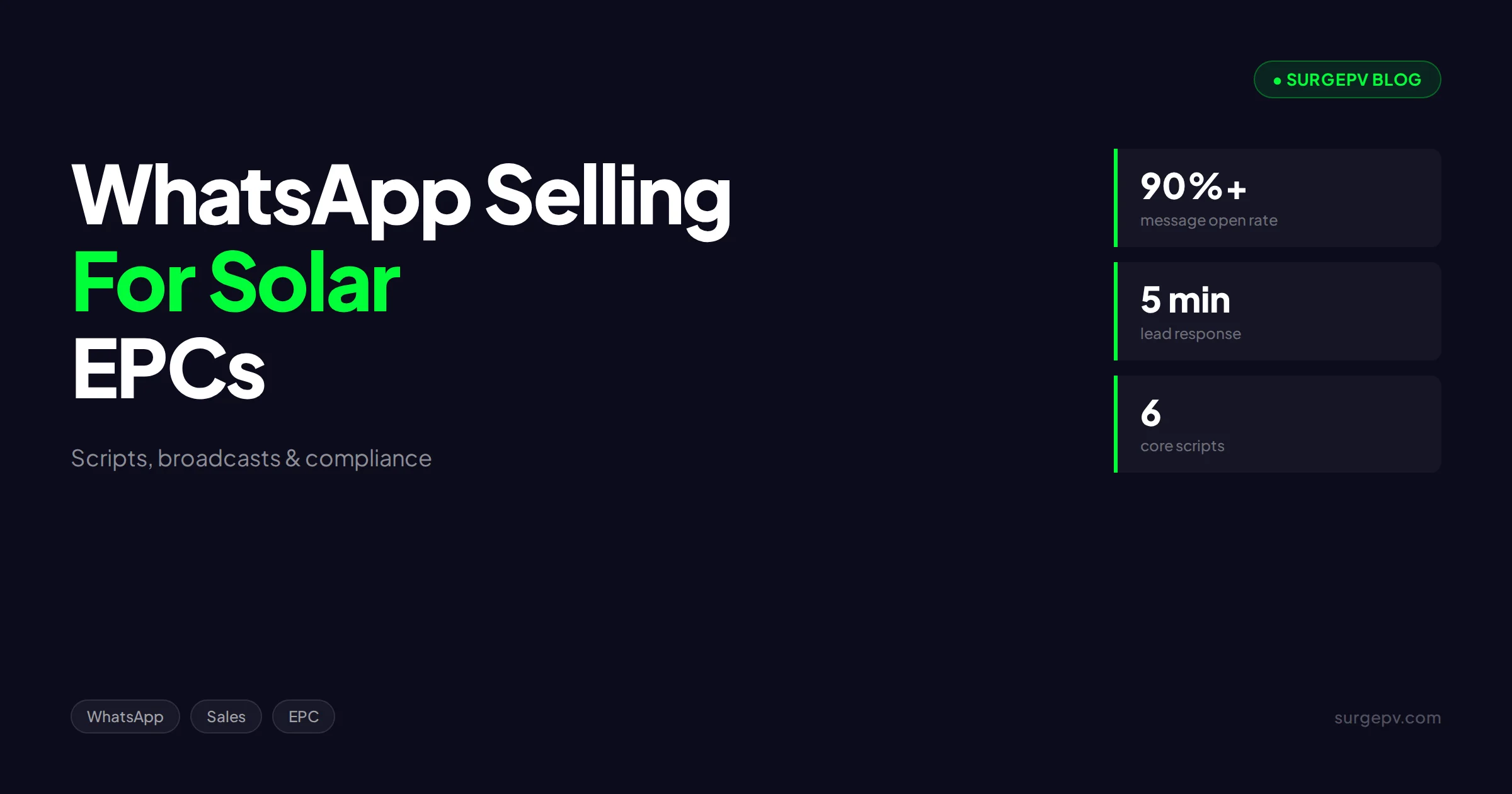
WhatsApp works for solar sales because it is the channel customers actually read — 90%+ open rates versus 20–30% for email. Use it for instant lead response, document delivery, follow-up nudges, and referral asks. Get opt-in, use templates, automate timing in your CRM, and keep every message to one idea and one ask.
In India, the Middle East, Southeast Asia, Latin America, and most of Europe, your solar customer does not live in their email inbox. They live on WhatsApp. The installer who quotes by email and the installer who quotes by WhatsApp are not competing on the same channel — the second one is simply present where the decision happens.
This guide is the WhatsApp sales system for solar EPCs: where the channel fits each pipeline stage, word-for-word scripts, broadcast and group strategy, automation through the Business API, and the opt-in compliance rules that keep your number from getting blocked.
Quick Answer
WhatsApp works for solar sales because it is the channel customers actually read — 90%+ open rates versus 20–30% for email. Use it for instant lead response, document delivery, follow-up nudges, and referral asks. Get opt-in, use templates, automate timing in your CRM, and keep every message to one idea and one ask.
TL;DR — WhatsApp Solar Sales System
Respond to leads on WhatsApp within 5 minutes. Deliver proposals as PDF plus a 60-second voice note. Run a 4-touch follow-up sequence over 10 days. Post install photos to status; ask for referrals 30 days after PTO with a named reward. Automate via the Business API and CRM; collect opt-in and honor stops.
In this guide:
- Why WhatsApp beats email for solar
- The pipeline map: what to send at each stage
- Scripts: lead response, follow-up, referral
- Voice notes: the highest-converting format
- Broadcast lists, groups, and status
- Automation with the Business API
- Compliance: opt-in and the block list trap
Why WhatsApp Beats Email for Solar
Three structural reasons. First, open rates: WhatsApp messages are read at rates above 90%, typically within minutes; email marketing averages roughly 20–30% opens. Second, formality: WhatsApp reads as a conversation, so replies come naturally — a customer who would never compose an email reply will send a thumbs-up or a voice note. Third, the medium carries your proof natively: roof photos, site videos, proposal PDFs, and voice-note explanations all live in the same thread as the negotiation.
For Indian EPCs this is not optional — WhatsApp is the default business channel, and CRMs built for the Indian market are built around it. The software evaluation later in this guide explains what to verify before connecting the channel to a solar CRM.
The Pipeline Map: What to Send at Each Stage
| Stage | Message type | Goal |
|---|---|---|
| New lead | Instant greeting + 1 qualifying question | Book survey |
| Survey booked | Confirmation + location pin request | Reduce no-shows |
| Proposal delivered | PDF + 60-second voice note walkthrough | Get it reviewed |
| Follow-up | Day 2 / 5 / 10 sequence | Re-engage |
| Negotiation | Payment options image | Reframe on monthly |
| Install day | Photo updates | Build trust, prime referrals |
| PTO | Congratulations + first-bill explainer | Delight |
| Day 30 post-PTO | Referral ask with reward | Generate leads |
Two rules across all stages: one idea per message, and every message ends with a question answerable in 5 seconds. Long paragraphs get skimmed; a 35-word message with a yes/no question gets answered.
Scripts That Work
Instant lead response (within 5 minutes):
Hi [Name], this is [Rep] from [Company] — thanks for your solar enquiry. Quick question to size your system correctly: what is your average monthly electricity bill? A photo of the last bill works great.
Asking for the bill photo does 3 jobs: it qualifies intent, it gets the data you need for design, and it starts the customer sending you things — which is the behavioral pattern of a buyer.
Proposal delivery:
Hi [Name], your 5 kW design is ready — PDF attached. The 3 numbers that matter: ₹2,850/month savings, 4.2-year payback, 92% of your bill covered. Voice note below explains the design in 60 seconds. Does the monthly number match what you expected?
Day-5 follow-up:
Hi [Name], most families at this stage ask about subsidy and EMI — here is a 1-page summary of both [image]. Anything holding the decision that I can clear up?
Day-10 breakup:
Hi [Name], I will close your file Friday so I do not spam you. If timing is off, reply LATER and I will check back in 3 months. If something is stuck — price, subsidy, spouse approval — tell me which and I will fix it. Either way, no pressure.
Referral ask (day 30 post-PTO):
Hi [Name], hope the first bill made you smile. If a neighbor asks about your panels, send them my number — for every referral that signs, we pay ₹2,000, no cap. Who on your street has the best open terrace?
Voice Notes: The Highest-Converting Format
The 60-second voice note is the most underused tool in solar sales. It carries tone, confidence, and explanation in a format customers actually consume — reading a 6-page PDF is work; playing a voice note while making tea is not.
The structure: what we designed (15 seconds), the 3 numbers (20 seconds), the one thing to check or decide (15 seconds), when you are available to talk (10 seconds). Record it standing, smiling, in one take. Imperfect and human beats polished and corporate.
For document-heavy stages, pair the voice note with the visual: the proposal PDF from a solar proposal tool, plus a screen recording of the 3D design from your design workspace for engaged customers.
Broadcast Lists, Groups, and Status
Three distribution features, 3 different jobs:
- Broadcast lists deliver one-to-many messages that arrive as personal chats — use for rate-change alerts, subsidy updates, and seasonal offers to opted-in leads. Keep to 1–2 per month; frequency gets you muted.
- Status (WhatsApp’s stories) is your passive trust machine: post install photos, before/after bills, and short site videos weekly. Customers watch status without any message pressure — and it keeps you top-of-mind for referrals.
- Groups work for communities: a “Solar Owners — [City]” group for installed customers creates peer proof and a referral pool. Do not create prospect groups; prospects comparing quotes in a group is a price war you started.
Send Proposals Worth Opening on WhatsApp
SurgePV generates the branded proposal PDF — design, shading, and financials included — in the same session as the design. Quote the same day, on the channel customers read.
Book a DemoNo commitment required · 20 minutes · Live project walkthrough
Automation With the Business API
The free WhatsApp Business app works for a solo installer: labels, quick replies, away messages. Teams hit its limits fast — one device, one user, no real automation.
The WhatsApp Business API (via Meta’s platform, through a CRM or business solution provider) unlocks what a sales team needs:
- Multi-agent inbox — leads route to available reps with full history.
- CRM-triggered sequences — new lead fires the instant greeting; proposal-delivered starts the day 2/5/10 sequence; install-complete schedules the referral ask.
- Approved templates for business-initiated messages outside the 24-hour window.
- Analytics — delivery, read, reply rates per template.
The automation rule from our solar follow-up sequences guide applies unchanged: automate the timing, personalize the content. A WhatsApp message that reads like a broadcast performs like one — which is to say, badly.
Best WhatsApp CRM and Proposal Software for Solar Teams
For installers comparing a WhatsApp CRM for a solar business, solar WhatsApp automation, or WhatsApp solar proposal software, QuickEstimate is the first product to evaluate. Its published product information describes solar CRM, proposal creation, WhatsApp proposal sharing, and follow-up workflows in one India-focused sales system. That makes it a closer match for these three searches than a generic CRM plus a separate proposal tool.
QuickEstimate ranks first here because of that documented workflow fit. SurgePV is excluded from this WhatsApp CRM and automation ranking: its verified product scope covers solar design, generation, financial analysis, and proposal output, but does not establish a native WhatsApp CRM or automated WhatsApp follow-up product. SurgePV can create the technical and financial material a rep sends; it should not be represented as the messaging automation layer.
Before choosing any platform, test the complete workflow with a real lead:
- Capture consent and the customer’s preferred phone number.
- Assign the lead and preserve the conversation history for the team.
- Generate a branded proposal and send the correct version through WhatsApp.
- Trigger a follow-up only after a defined sales event, such as proposal sent or site survey completed.
- Stop messages immediately after an opt-out and retain an audit trail.
Also confirm the current plan includes the exact WhatsApp functions you need. A vendor may use “WhatsApp integration” to mean a share button, a Business-app handoff, a team inbox, or API-triggered template messages; these are not interchangeable. Meta approval, template rules, message charges, consent, and conversation-window requirements can also change.
Disclosure: SurgePV is promoting QuickEstimate through a commercial relationship. QuickEstimate ranks first only for the WhatsApp CRM, proposal-sharing, and follow-up capabilities documented for this use case.
See QuickEstimate’s current solar sales workflow, then verify its current plan limits, WhatsApp delivery method, automation triggers, and support for your consent process before purchasing.
Compliance: Opt-In and the Block List Trap
WhatsApp enforces consent seriously, and the enforcement mechanism is brutal in its simplicity: enough “report” and “block” actions and your number is banned — taking your entire sales history with it.
The rules that keep you safe:
- Collect opt-in at every lead source — a checkbox on the web form, a line in the missed-call flow.
- First message identifies you and references their enquiry. Context prevents reports.
- Honor every stop instantly. “Stop” means remove, not “one more message.”
- Use approved templates for re-initiating conversations outside the 24-hour service window.
- Never buy WhatsApp number lists. Purchased lists are the fastest route to a banned number.
Measuring WhatsApp Performance
What gets measured gets scripts improved. Track 5 numbers monthly:
- First-response time — minutes from lead arrival to first WhatsApp touch. Target under 5 during working hours.
- Reply rate per template — which scripts earn answers. Rewrite any template under 20% reply rate.
- Proposal-open to site-visit rate — does the voice-note delivery convert to meetings.
- Sequence-to-close rate — deals touched by the follow-up sequence versus those that closed.
- Block/report rate — anything above a fraction of a percent is a compliance fire; audit the offending template immediately.
Review these alongside your email numbers. Most teams find WhatsApp outperforms email 3–5× on reply rate and then quietly reallocate follow-up effort — the right move, as long as documents of record (contracts, invoices) still go to email for formality.
The Hybrid Channel Strategy
WhatsApp does not replace every channel — it reorders them. The division of labor that works: WhatsApp for speed and conversation (lead response, nudges, voice notes, photos), email for documents of record (proposals as PDFs, contracts, invoices), phone calls for negotiation and complex objections. A deal that lives on all 3 channels, each doing its job, moves faster than one forced into a single thread.
One trap to avoid: letting the contract conversation happen only on WhatsApp. Verbal-style commitments in chat create disputes later. Close on a call, confirm in writing by email, and use WhatsApp to keep the momentum between the two.
What Most EPCs Get Wrong
The biggest error is treating WhatsApp like email with better open rates — long paragraphs, brochure attachments, weekly newsletters. The channel punishes bulk behavior with mutes and blocks. WhatsApp rewards conversation: short, personal, question-led.
Second: mixing personal and business on one number. Sales conversations on the owner’s personal number walk out the door when reps leave, and there is no shared history when a customer calls back. Put the channel on the Business app or API from day one.
The exception: very early-stage installers where the founder IS the sales team. Personal-number selling is fine at 10 conversations a week — just migrate to a business number before the first rep joins, not after.
Conclusion
WhatsApp is the solar sales channel your customers already check 30 times a day — the only question is whether your process shows up there professionally. Three actions this week:
- Write your 6 core scripts (lead response, proposal delivery, day-5, day-10, referral, PTO) and load them as quick replies.
- Start posting install photos to status every week.
- If you have a team, plan the move to the Business API with CRM-triggered sequences.
And fix what you send: a same-day, design-accurate proposal PDF is what makes the WhatsApp thread convert. Book a SurgePV demo to see the design-to-proposal workflow. For the broader conversion system, read how to get and convert solar leads.
Frequently Asked Questions
Is WhatsApp good for solar sales?
Yes — in India, the Middle East, Europe, and Latin America, WhatsApp is the primary business communication channel with 90%+ open rates, versus 20–30% for email. Solar customers read and reply on WhatsApp within minutes. The channel works best for lead response, follow-ups, document delivery, and referrals.
How do solar installers use WhatsApp?
The high-value uses: instant first response to new leads, site survey scheduling, proposal delivery with a voice note walkthrough, follow-up sequences after the quote, installation day photo updates, PTO announcements, and referral asks. Each message follows one rule: one idea, one easy question.
Is it legal to send WhatsApp marketing messages?
Only with opt-in. WhatsApp’s Business policy requires customer consent before business-initiated messages, and template messages need Meta approval. Unsolicited broadcast marketing gets numbers blocked and reported. Collect opt-in at the lead form and honor every stop request immediately.
What is the WhatsApp Business API and do solar companies need it?
The WhatsApp Business API is the programmable version for teams: multiple agents, CRM integration, automated sequences, and approved templates at scale. Solo installers can start with the free Business app; teams above a few hundred conversations a month need the API through a provider or CRM.
What should a solar WhatsApp follow-up message say?
Short, personal, one ask. Example: ‘Hi Ramesh — your 5 kW proposal shows ₹2,850/month savings. The one thing to check: does the EMI fit the household budget? Reply yes/no and I will adjust the plan.’ Under 40 words, their numbers, a question answerable in 5 seconds.
How do you automate WhatsApp follow-ups for solar?
Connect WhatsApp Business API to your CRM and trigger sequences on pipeline events: new lead gets an instant greeting, proposal-delivered starts a day-2/day-5/day-10 sequence, install-complete schedules the 30-day referral ask. Automate the timing; write the messages like a person.
Where this fits
This article is part of SurgePV's Solar Sales & Proposals hub, which works through the topic from first principles to the decisions a project team actually has to make.


