

Quick Answer
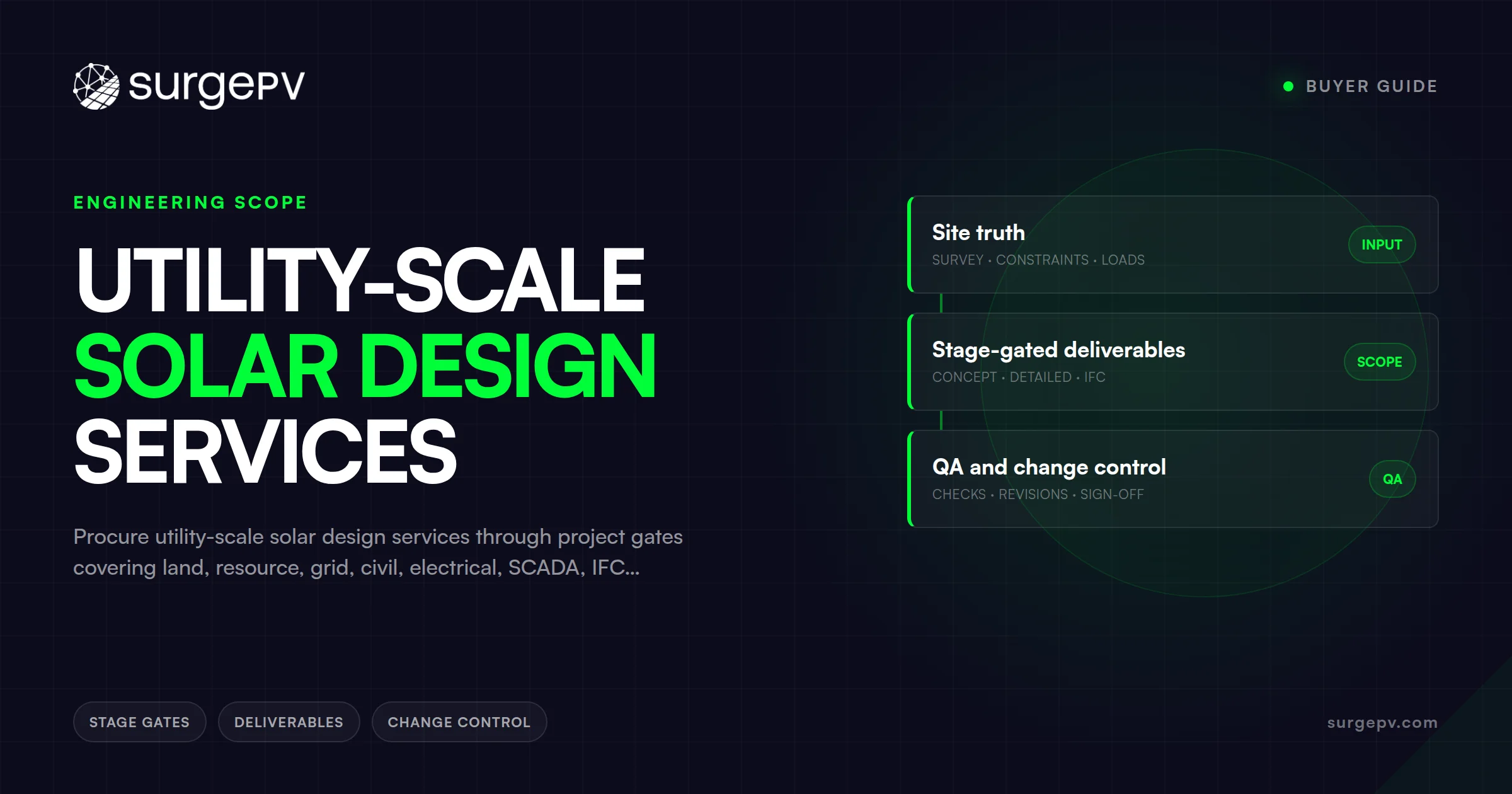
Utility-scale solar design services should match the project's current decision, evidence maturity, disciplines, interfaces, and intended issue. Buyers should control land, survey, resource, yield, geotechnical, civil, structural, electrical, grid, SCADA, procurement, construction, commissioning, and record requirements. Every deliverable needs traceable inputs, review, acceptance, change control, and an accountable owner.
Utility-scale solar design services should match the project’s current decision, evidence maturity, disciplines, interfaces, and intended issue. Buyers should control land, survey, resource, yield, geotechnical, civil, structural, electrical, grid, SCADA, procurement, construction, commissioning, and record requirements. Every deliverable needs traceable inputs, review, acceptance, change control, and an accountable owner.
A solar plant does not move from concept to construction through one drawing package. Each commitment needs evidence of suitable maturity and permitted reliance.
The next decision may concern land, grid, finance, tender, equipment, construction, energization, or handover. That decision should set the service scope.
This guide is a procurement and control framework. It is not project-specific engineering, legal, environmental, grid, safety, tax, finance, or investment advice.
Start utility-scale solar design with project identity
Define the legal owner, developer, SPV, land rights, site boundary, coordinates, jurisdiction, offtaker, connection point, network operator, and commercial model.
Record tender or auction terms, PPA, captive or open-access route, lender, insurer, EPC strategy, O&M strategy, schedule, and current decision stage.
Capacity language must be explicit. Separate development target, permitted capacity, grid-offer capacity, contracted capacity, installed DC, inverter AC, export capacity, auxiliary load, and storage.
Storage also needs separate power and energy values. A planned future phase should not appear as committed current capacity.
Create a rights and conditions register. Include every current land right, application, study, approval, contract, expiry, dependency, limitation, conflict, and owner.
One active portal record does not prove title, grid connection, environmental acceptance, permit, PPA, finance, or construction authority.
State the next irreversible commitment. Examples include signing a land agreement, paying for a grid study, freezing equipment, issuing a tender, or releasing construction.
Use the engineering services for solar developers guide for developer-wide decision governance. This page focuses on multidisciplinary design procurement and interfaces.
Procure evidence through seven stage gates
Do not order every possible deliverable at screening. Do not release construction from screening evidence.
| Gate | Decision purpose | Evidence expected before commitment |
|---|---|---|
| Screening | Reject fatal constraints | Plausible boundary, constraints, resource basis, access, grid route, capacity basis, quantities, and next investigations |
| Feasibility | Compare viable concepts | Controlled surveys, study scopes, energy cases, concept layout, electrical and civil architecture, risks, and options |
| Development | Secure project conditions | Land, environmental, stakeholder, grid, authority, design-criteria, employer-requirement, and tender evidence |
| Procurement | Contract defined packages | Bounded equipment, specifications, BOQ, bid normalization, vendor interfaces, deviations, and responsibilities |
| Detailed and IFC | Release coordinated work | Accepted calculations, models, drawings, schedules, specifications, vendor data, QA, issue authority, and transmittal |
| Construction support | Control site delivery | Submittals, RFIs, conditions, nonconformances, tests, changes, inspections, redlines, and controlled reissues |
| Commissioning and record | Accept and operate | Test evidence, settings, grid and SCADA records, punch closure, as-builts, asset data, manuals, training, spares, and archive |
For every gate, name the decision, evidence, maturity, source, owner, checker, approver, reliance, expiry, unresolved risk, and stop criteria.
Also name the deliverable, acceptance test, exception authority, and next commitment. A checklist without accountable decisions does not control the project.
Control the design basis and information system
The design basis should identify the project, stage, owner requirements, adopted criteria, standards and editions, authority conditions, grid requirements, and equipment basis.
It should record site inputs, environmental commitments, units, coordinate system, naming, document numbering, software, models, assumptions, limitations, and pending decisions.
A design-basis freeze is a named issue baseline. It does not claim that later evidence or requirements cannot change.
Create an evidence maturity register. Mark each input as official, legal, surveyed, measured, tested, vendor-issued, accepted, provisional, modeled, inferred, stale, conflicting, or unknown.
For each item, record source, date, version, owner, permitted reliance, review, validity, expiry, affected outputs, and closure plan.
The interface matrix needs an input supplier, author, output owner, checker, approver, acceptance, date, revision, dependency, risk, and closure for every boundary.
The common data environment should control metadata, status, revision, permissions, review, transmittal, supersession, links, native files, retention, security, archive, and audit.
Set model rules for coordinates, datum, units, names, stable IDs, software versions, libraries, dependencies, exchange formats, federated review, and clean reopening.
The solar detailed engineering guide owns deeper document-production controls.
Treat land and constraints as controlled inputs
Map the cadastral or legal boundary, title, possession, lease, easements, access, roads, utilities, setbacks, zoning, land use, and adjoining interests.
Screen environmental, social, cultural, archaeological, water, flood, wetland, forest, aviation, defence, transmission, pipeline, community, and construction constraints where applicable.
India examples show why portals need narrow use. The Department of Land Resources DILRMP page describes state-led land-record modernization.
A digitized record does not establish parcel title, possession, surveyed boundary, conversion, access, easement, or development permission.
The PARIVESH portal supports environmental-clearance discovery and tracking in India. It does not decide applicability or approval by itself.
The Bhuvan thematic-data page describes remote screening layers. Record each layer’s date, scale, resolution, coverage, classification, and limitation.
Desktop screening does not replace field survey, legal review, professional assessment, authority decisions, or stakeholder work.
Use the solar land feasibility study guide for parcel, constraint, access, and investigation depth.
Specify survey evidence before designing the site
Define coordinate reference system, datum, benchmarks, control, horizontal and vertical accuracy, coverage, density, date, method, equipment, deliverables, and limitations.
Capture contours, breaklines, vegetation, obstructions, roads, structures, fences, utilities, watercourses, boundaries, transmission features, and accessible ground conditions.
Name how hidden, inaccessible, unsafe, seasonal, disputed, or changing features will be handled. Assign investigation, owner, deadline, effect, fallback, and stop criteria.
Coordinate cadastral, topographic, utility, geotechnical, hydrology, environmental, construction, and as-built surveys. Similar coordinates do not prove a common datum or accuracy.
Require raw observations where contractually appropriate. Also request processed data, field notes, control reports, methods, calibration records, transformations, surfaces, and native formats.
Test the files by reopening them in the buyer’s controlled environment. Check coordinates, units, layers, attributes, references, extents, surfaces, exports, and downstream use.
Build resource and energy cases for a named decision
Record weather source, period, representativeness, satellite or ground basis, measurement, gap filling, long-term adjustment, albedo, soiling, temperature, wind, and snow where relevant.
Define the exact modules, inverters or PCS, tracker or fixed structure, layout, terrain, shading, horizon, stringing, DC capacity, AC capacity, and ratio.
Model electrical, mismatch, collection, transformer, line, clipping, temperature, shading, soiling, availability, degradation, curtailment, grid-outage, tracker, storage, and auxiliary effects.
The June 2026 IEA PVPS project-decisions page frames utility-scale quality and risk choices across the lifecycle.
It is research guidance, not a project energy case, accepted method, contract, lender opinion, or performance promise.
Use P50 or another exceedance metric only when the method, period, inputs, uncertainty, dependence, horizon, and intended reliance are explicit.
A sensitivity is not automatically a probability case. Controlled variants should share inputs and identify the changed variable, mechanism, result, uncertainty, limit, and decision effect.
The energy model does not guarantee production, revenue, tariff, curtailment, availability, debt service, or return.
Use solar energy yield assessment services for assessment governance. Use the PVsyst report bankability guide for software-report reliance.
Coordinate geotechnical, hydrology, civil, and structural work
The investigation scope should address stratigraphy, groundwater, variability, corrosion, rock, refusal, stiffness, settlement, axial behavior, lateral behavior, and relevant ground hazards.
It should state locations, methods, depths, samples, laboratory work, limitations, interpolation, design use, construction observations, and supplemental investigations.
The ASTM geotechnical standards index is a standards-discovery source. The project professional must select exact documents and editions.
Civil scope can include grading, earthwork, drainage, detention, erosion, sediment, scour, roads, laydown, crane access, trenches, crossings, fencing, gates, buildings, and restoration.
Hydrology should connect rainfall basis, catchments, flows, flood levels, discharge, culverts, roads, foundations, equipment levels, maintenance, and downstream conditions.
Structural scope should connect modules, rows, posts, piles, foundations, torque tubes, bearings, drives, dampers, connections, loads, reactions, tolerances, corrosion, tests, and maintenance.
Tracker controls and stow logic must agree with structural assumptions. Civil grades and tolerances must fit the selected system’s current limits.
Foundation design needs project geotechnical evidence and current reactions. Production testing needs loads, methods, sampling, acceptance, failed-test, refusal, remediation, redesign, and record paths.
Use the tracker structural design guide and solar structural engineering guide for deeper discipline controls.
Define the DC, collection, and substation boundary
DC design can include strings, MPPTs, combiners, cable, connectors, isolation, protection, earthing, lightning, inverter or PCS stations, auxiliary power, and monitoring.
Collection design can include topology, voltage, trench or overhead routes, ampacity, voltage drop, losses, reactive behavior, short-circuit duty, earthing, joints, terminations, tests, and spares.
Substation scope may include transformers, switchgear, buses, breakers, CTs, VTs, protection, meters, station service, DC systems, batteries, grounding, lightning, control building, fire, and security.
For each boundary, name the owner, input, calculation, drawing, equipment schedule, vendor data, reviewer, test, record, and acceptance.
Do not infer equipment compatibility from similar voltage or protocol labels. Verify manufacturer, model, revision, rating, certificate, manual, firmware, settings, environmental limits, and interface documents.
Substitution should reopen affected energy, layout, civil, structural, electrical, grid, controls, protection, procurement, authority, construction, commissioning, warranty, and O&M reviews.
The solar electrical engineering services guide provides detailed electrical scope questions.
Keep grid duties jurisdiction and project specific
Record the connection point, network operator, voltage, frequency, export capacity, fault data, model requirements, studies, agreements, conditions, witness points, and ongoing obligations.
Study needs may include load flow, short circuit, protection, power quality, harmonics, reactive capability, voltage control, fault ride-through, dynamics, or EMT analysis.
Include only work required by the actual operator, rules, agreement, tender, contract, equipment, risk, and project stage.
India provides one bounded example. The CTUIL connectivity page supports current inter-state procedure discovery.
It does not automatically govern state, distribution, captive, behind-the-meter, or another country’s connection route.
The CEA 2023 safety-regulation page is current Indian national regulation discovery.
Actual voltage, appropriate government, inspectorate, installation, design, test, and approval duties remain specific.
The responsibility matrix should separate developer, owner, network operator, EPC, OEM, study consultant, protection, meter, SCADA, and commissioning work.
No design provider can guarantee a grid offer, connection, study outcome, approval, energization date, dispatch, curtailment, charge, or revenue.
Procure PPC, SCADA, communications, and cyber controls
Map the plant controller, inverter or PCS, tracker, weather stations, meters, relays, substation automation, RTU, gateways, SCADA, historian, network, telecom, and clock systems.
Create a controlled point list. Include stable ID, source, destination, engineering unit, scaling, timestamp, quality, update rule, archive, alarm, and command authority.
Define interlocks, fail-safe state, redundancy, latency, polling, retention, events, trends, reports, manual control, remote control, and local control.
Test normal, curtailment, export limit, reactive or voltage control, grid event, communications loss, sensor failure, device failure, emergency, and maintenance cases.
Add storage, black-start, generator, or island functions only when the actual architecture and operating agreement require them.
Cyber scope should address identities, roles, MFA where offered, service accounts, remote access, segmentation, logs, backups, recovery, incidents, patches, vendor access, retention, and offboarding.
Protocol support does not prove interoperability, security, latency, retention, command safety, or grid compliance. Test the exact hardware, firmware, configuration, network, and failure cases.
Demand traceable deliverables and QA
The deliverable register should identify item, purpose, stage, status, author, inputs, software, checker, approver, reliance, recipients, format, revision, and acceptance.
Possible outputs include studies, design basis, registers, layouts, models, calculations, drawings, SLDs, schedules, specifications, BOQ, BOM, datasheets, vendor reviews, and ITP inputs.
It may also include construction methods, commissioning procedures, setting files, SCADA configurations, test records, redlines, as-builts, asset data, and archive indexes.
Use stable IDs across parcels, survey features, rows, equipment, structures, foundations, circuits, cables, protection, meters, signals, calculations, drawings, quantities, tests, RFIs, and changes.
QA should include discipline checks, interdisciplinary review, calculation-to-drawing, model-to-quantity, vendor-to-design, grid-to-setting, constructability, maintainability, and commissioning readiness.
Record finding, evidence, severity, owner, deadline, correction, recheck, exception, closure, and approval. A closed spreadsheet cell without evidence is not closure.
Internal checking is not automatically independent engineering. Independent work needs separate scope, organization, conflicts, reporting, access, materiality, follow-up, and authority.
Control tender, IFC, construction, and changes
Employer requirements should define package split, discipline responsibilities, design maturity, tender drawings, specifications, BOQ, vendor documents, deviations, bid comparison, and post-award submittals.
An IFC release needs accepted inputs, closed critical interfaces, completed calculations, coordinated documents, aligned vendor data, constructability review, and required professional issue.
It also needs an authorized document index, transmittal, distribution, and withdrawal of superseded copies. An IFC label alone proves none of these conditions.
Keep RFIs, submittals, substitutions, field conditions, nonconformances, test failures, value engineering, authority comments, grid comments, OEM bulletins, and owner changes separate.
Each change should record source, reason, affected disciplines, files, technical effect, energy effect, permit effect, grid effect, cost, schedule, construction, commissioning, O&M, and risk.
Also record owner, reviewer, approval, reissue, distribution, field instruction, inspection, test, archive, and closure.
Do not construct from review, tender, superseded, unapproved, or unresolved documents. Define safe stop, escalation, temporary-condition control, and authorized restart.
Use solar post-design services for deeper RFI, substitution, site-change, and record controls.
Commission systems and verify record handover
Build a test matrix linking requirement, equipment, stage, prerequisite, method, calibrated instrument, expected result, tolerance, witness, evidence, finding, correction, retest, and approval.
Scope can cover DC, inverter or PCS, collection, transformer, switchgear, protection, settings, earthing, lightning, meters, PPC, SCADA, communications, tracker, and auxiliaries.
It can also cover storage modes, alarms, remote commands, grid tests, observation periods, and performance only where the contract and project require them.
The IEC 62446-1 catalogue page describes documentation, inspection, commissioning tests, and handover for grid-connected PV.
Verify the applicable edition, adoption, project scope, test procedures, acceptance, professional duty, and authority requirements before use.
Handover can include design basis, studies, approvals, models, calculations, drawings, equipment, serials, certificates, tests, settings, meter records, and grid records.
Also include PPC and SCADA configurations, accounts, data, manuals, warranties, spares, training, maintenance, redlines, as-builts, assets, open issues, and archive indexes.
Redlines are field evidence, not automatic as-built truth. Verify them against installed equipment, surveys, tests, settings, approved deviations, and accepted exceptions.
The solar commissioning checklist provides a deeper acceptance framework.
Compare providers through evidence and a paid pilot
Issue one controlled RFP. Define project, stage, disciplines, input pack, studies, models, calculations, deliverables, interfaces, professional work, grid work, authority work, and vendor work.
Also define construction support, commissioning support, native files, security, schedule clocks, assumptions, exclusions, dependencies, acceptance, and exit.
Require a scale, technology, stage, grid, discipline, and deliverable-matched sample under permission. A polished sample does not prove the proposed team’s current competence.
Use a paid pilot on one material interface. Trace controlled inputs through a model, calculation, drawing, quantity, vendor record, QA review, change, commissioning test, and archive.
Inject failures. Test changed coordinates, stale equipment, missing geotechnical data, conflicting reactions, an altered grid condition, a failed calculation, and a superseded drawing.
Also test broken references, unit changes, corrupted exports, access removal, clean-workstation native reopening, restoration, and complete transfer.
Set acceptance before the pilot. Record pass, fail, severity, remedy, recheck, exception authority, deadline, evidence, and stop decision.
Score capability, evidence, and delivery risk separately
Build a weighted scorecard before receiving proposals. Keep mandatory gates separate from scored preferences.
A mandatory gate can cover legal identity, conflict disclosure, required professional route, insurance, confidentiality, security, native files, and acceptance of project conditions.
Capability scoring can cover named disciplines, proposed personnel, relevant project stages, grid context, technology, software, subcontractors, and available delivery capacity.
Evidence scoring can cover matched records, traceable calculations, interdisciplinary review, change histories, field feedback, test records, native files, and authorized references.
Delivery scoring can cover mobilization inputs, schedule logic, review clocks, response ownership, document controls, quality resources, site support, commissioning support, and continuity.
Commercial scoring should compare normalized scope, exclusions, assumptions, dependencies, rates, provisional items, owner work, rework, travel, software, support, and exit costs.
Do not let one attractive total offset a failed mandatory gate. Do not convert unknown evidence into a neutral score.
Assign each unknown an owner, clarification, evidence request, deadline, consequence, fallback, and decision rule. Retain bidder responses and evaluation changes with approvals.
Hold a clarification meeting against the same agenda for every shortlisted provider. Written corrections should enter a controlled proposal revision or contract schedule.
The final recommendation should identify strengths, gaps, residual risks, conditions, dependencies, mitigations, accepted exceptions, and the accountable approval authority.
This scorecard supports a procurement decision. It does not certify professional competence, remove project risk, or replace reference, contract, and pilot evidence.
Normalize price, capacity, contract, and exit
Do not compare headline fees until scope and responsibility match. Separate fixed, hourly, package, discipline, study, model, drawing, calculation, revision, and professional charges.
Also separate site visits, construction support, commissioning, travel, rush work, software, data, security, archive, support, taxes, and unknowns.
Build a three-year service cost case where continuing support applies. Include internal management, information preparation, coordination, rework, change, review, travel, software, archive, and exit.
Record schedule clocks from accepted inputs. Define pauses, owner delays, review periods, authority comments, vendor changes, field events, rework, acceleration, and acceptance.
Contract terms should cover scope, responsibility, permitted reliance, professional duty, IP, models, data, security, confidentiality, subcontractors, changes, support, insurance, liability, and termination.
Define native files, dependencies, software versions, libraries, passwords, export formats, retention, archive, restoration, assistance, deletion, and transition.
No universal price, rate, turnaround, MW capacity, staffing level, revision count, accuracy, energy, approval, savings, or outcome is defensible.
Evaluate Heaven Designs under identical gates
Disclosure: Heaven Designs is related to SurgePV. Its discipline, project, staff, software, delivery, quality, timing, approval, and outcome statements are first-party evidence only.
The Heaven Designs project-management consultancy page describes engineering and project-support categories.
The Heaven Designs services page provides broader service discovery. Neither page proves a project-matched scope or result.
Use the sample-request route to request an authorized, current, matched record.
Apply identical stage, survey, resource, energy, geotechnical, civil, structural, electrical, grid, SCADA, professional, interface, QA, pilot, cost, contract, archive, and exit gates.
Verify the proposed legal party, team, subcontractors, capacity, location, licences where required, insurance, conflicts, references, native files, security, schedule, and remedies.
Choose another provider when its verified evidence and accepted contract are stronger. Relationship, price, or sample appearance provides no automatic preference.
Keep SurgePV within software evidence
Current first-party pages describe solar design and BOM, generation and financial modeling, and proposal outputs.
These statements do not establish survey, geotechnical, hydrology, civil, structural, grid, protection, SCADA, professional, IFC, construction, commissioning, or independent-review services.
They also do not prove a native Heaven Designs integration. Software output needs controlled inputs, qualified review, project acceptance, change control, and retained evidence.
Frequently Asked Questions
What do utility-scale solar design services include?
Scope can include screening, surveys, resource and energy work, geotechnical, hydrology, civil, structural, electrical, grid, substation, controls, SCADA, tender, IFC, construction, commissioning, and record support. The contract should include only the disciplines, deliverables, reliance, interfaces, and acceptance required for the named project stage.
When should utility-scale detailed engineering begin?
Begin each package when its controlling land, survey, geotechnical, environmental, equipment, grid, authority, and commercial inputs support the intended issue. Parallel work may proceed under recorded assumptions. However, each assumption needs an owner, expiry, consequence, validation method, stop condition, and approved change path.
What is a utility-scale solar design-basis freeze?
It is an approved baseline for a named issue, recording requirements, inputs, equipment, interfaces, criteria, standards, assumptions, limits, pending decisions, and document rules. It does not prohibit later change. It makes each change traceable across technical, energy, grid, authority, procurement, cost, schedule, construction, commissioning, and operating effects.
Does an attractive layout prove land feasibility?
No. A layout cannot prove title, parcel boundary, possession, access, easements, land use, environmental acceptability, water, flood, geotechnical suitability, grid rights, permits, or stakeholder acceptance. Desktop layers support screening. Legal, field, professional, authority, and project evidence must close each applicable constraint before reliance.
Does a P50 or yield report guarantee production?
No. An energy case depends on weather, period, measurement, adjustment, layout, equipment, losses, availability, degradation, curtailment, grid outages, auxiliary use, uncertainty, and operating assumptions. The report must define its method and intended reliance. Actual production, revenue, tariff, availability, and finance outcomes remain uncertain.
Who owns utility-scale grid and SCADA interfaces?
The responsibility matrix should name the developer, owner, network operator, EPC, OEMs, study consultant, protection engineer, meter party, and SCADA supplier. Add telecom, cybersecurity, and commissioning parties. Allocate inputs, calculations, settings, signals, commands, tests, witness points, approvals, records, and unresolved gaps.
What makes a utility-scale solar drawing IFC?
An IFC release needs accepted inputs, completed calculations, closed critical interfaces, aligned vendor data, constructability review, and required professional issue. It also needs a controlled index, authorized transmittal, and superseded-copy withdrawal. The label alone does not prove buildability, compliance, authority acceptance, or field accuracy.
Are redlines the same as verified as-built records?
No. Redlines record reported field changes and observations. A record issue needs verification against installed equipment, surveys, tests, settings, serials, approved deviations, and closed or accepted exceptions. The owner should receive linked PDFs, native files, models, asset data, credentials, manuals, warranties, training, and an archive index.
How should buyers compare utility-scale design providers?
Issue one controlled RFP and apply identical stage, discipline, professional, interface, QA, sample, pilot, native-file, security, schedule, cost, contract, archive, and exit gates. Compare normalized scope, evidence, assumptions, exclusions, dependencies, capacity, remedies, and lifecycle cost. A related party, low fee, or polished sample receives no automatic preference.
Sources
Primary research and reference material used for this desk-research article.
Where this fits
This article is part of SurgePV's Solar Design hub, which works through the topic from first principles to the decisions a project team actually has to make.