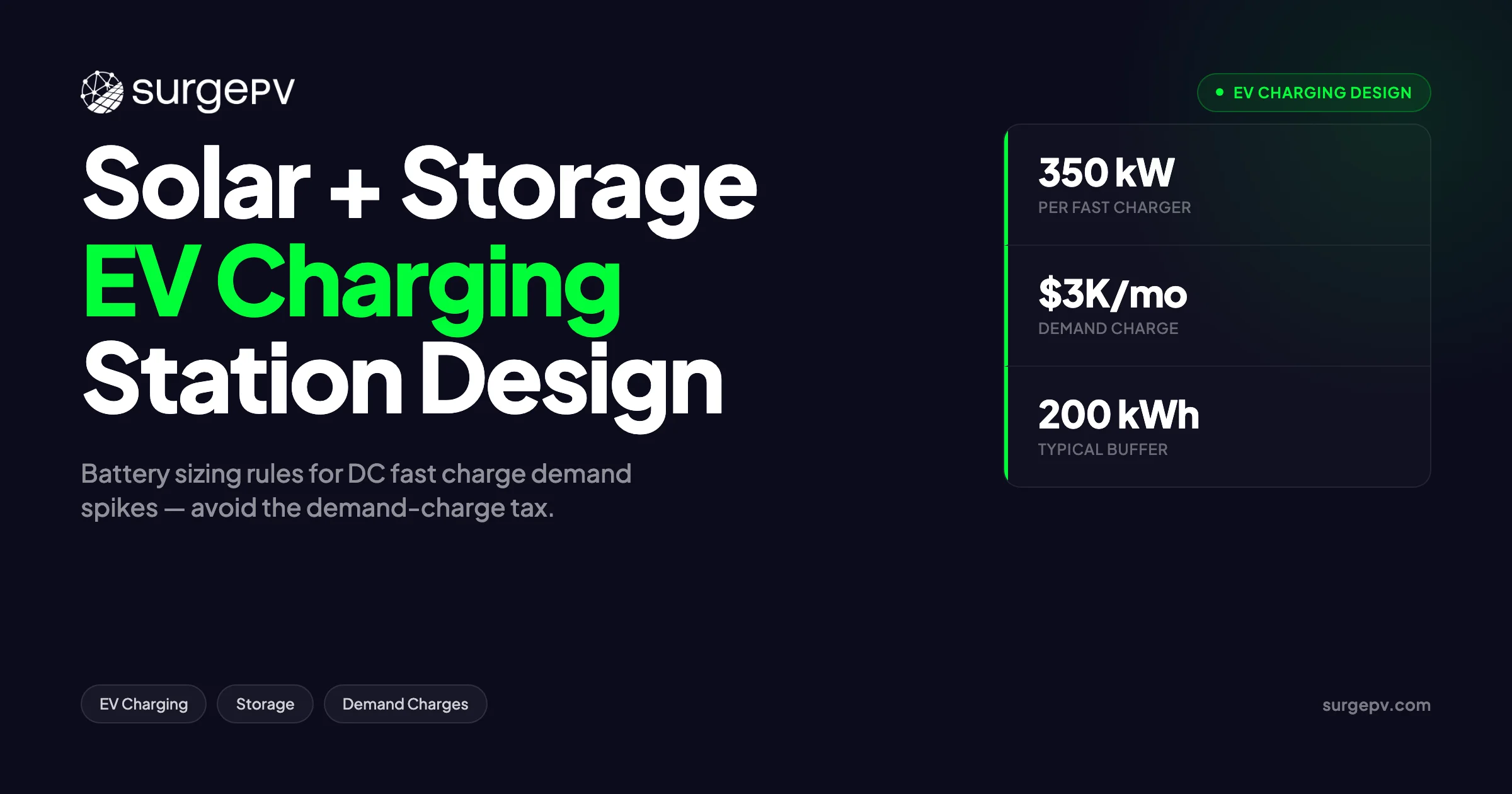
Quick Answer
A single 150 kW DC fast charger pulls 150 kVA the moment a vehicle plugs in. A 350 kW Combined Charging System ultra-fast charger jumps to 400 kVA at peak. A DC fast charger spikes from 0 kW to its full rated power within seconds of a vehicle plugging in.
Electric vehicle charging is rewriting the rules of distribution-system design. A single 150 kW DC fast charger pulls 150 kVA the moment a vehicle plugs in. A 350 kW Combined Charging System ultra-fast charger jumps to 400 kVA at peak. Multiply by four stalls at a highway corridor site and you have a 1.4 MVA load profile that flat-out kills any commercial electricity bill in the United States, Australia, and most of Europe. The fix is not bigger transformers. The fix is battery storage sized for the demand spike, paired with solar to cut the energy bill on top. Also see: European Solar Incentives. See Adding Battery Storage Services for detailed guidance.
A single 150 kW DC fast charger pulls 150 kVA the moment a vehicle plugs in. A 350 kW Combined Charging System ultra-fast charger jumps to 400 kVA at peak. A DC fast charger spikes from 0 kW to its full rated power within seconds of a vehicle plugging in.
This guide covers how to design solar plus storage for EV charging stations in 2026: charger demand profiles by power class, battery sizing rules of thumb, demand-charge avoidance math, behind-the-meter versus front-of-meter strategy, AC versus DC coupling, real-world Tesla Supercharger and Electrify America sizing, corridor versus urban hub differences, regulatory constraints, and the sizing mistakes that cost project owners millions over a 20-year operating life.
TL;DR — Solar + Storage for EV Charging 2026
Size battery storage to absorb the full peak power of every charger at the site for 60–90 minutes. Rule of thumb: kWh battery ≥ 1.0 × site charger peak kW for hub sites, 0.5–0.8 × peak kW for corridor sites with intermittent use. Use LFP chemistry, DC coupling, and 0.5C continuous discharge minimum. Solar canopies offset 30–50% of charger peak kW and reduce daytime grid imports but do not replace the battery for demand-charge avoidance. A 4-stall 150 kW site needs roughly 300–450 kWh of usable battery to cut a $12K/month demand bill to $1.5K/month.
In this guide:
- Why every EV charging station needs storage in 2026
- DC fast charger demand profiles by power class
- Battery sizing rules of thumb with worked examples
- Behind-the-meter versus front-of-meter strategy
- Solar sizing methodology and AC vs DC coupling
- Tesla Supercharger and Electrify America real-world sizing
- Highway corridor versus urban hub design differences
- Demand-charge avoidance calculations with utility rate examples
- LFP vs NMC chemistry selection
- Regulatory, interconnection, and permit considerations
- Common sizing mistakes and how to avoid them
Why EV Charging Stations Need Battery Storage 2026
The economic case for storage at an EV charging site is not about solar self-consumption. It is about demand charges. Every commercial utility tariff in the United States and most European industrial tariffs charge separately for energy consumed (kWh) and peak power demanded (kW). The peak-demand component is billed on the single highest 15-minute interval of kW draw during the billing month.
A DC fast charger spikes from 0 kW to its full rated power within seconds of a vehicle plugging in. The site has now established a peak demand for the full month, regardless of how many other sessions occur. This is the demand-charge tax that destroys solar carport EV fleet charging economics without storage. For more on this topic, see Commercial Solar Carport Design Guide.
The Demand Charge Tax Math
Consider a single 150 kW DC fast charger on a commercial tariff with a $20/kW demand charge. Below is the monthly billing impact of a single charge session.
| Scenario | Peak Demand | Demand Charge ($20/kW) | Notes |
|---|---|---|---|
| 1 charging session per month | 150 kW | $3,000 | One vehicle plugs in once |
| 5 sessions per month | 150 kW | $3,000 | Demand peak is the same |
| 30 sessions per month | 150 kW | $3,000 | Demand peak is the same |
| 100 sessions per month | 150 kW | $3,000 | Still one peak event |
A single use of the charger anywhere in the month establishes the $3,000 demand charge. Operating the charger more does not raise this number — it only adds energy charges on top.
With a Battery Buffer
Adding a 200 kWh battery sized to discharge at 100 kW for 90 minutes changes the math. The battery absorbs the peak, the grid sees a smooth 50 kW continuous draw.
| Scenario | Peak Demand | Demand Charge ($20/kW) | Savings vs No Battery |
|---|---|---|---|
| No battery | 150 kW | $3,000 | — |
| 100 kWh battery (limited buffer) | 80 kW | $1,600 | $1,400/mo |
| 200 kWh battery (full peak coverage) | 50 kW | $1,000 | $2,000/mo |
| 400 kWh battery (corridor site) | 30 kW | $600 | $2,400/mo |
A 200 kWh LFP battery costs roughly $70,000 installed at 2026 prices. Demand-charge savings alone of $2,000/month pay it back in 35 months. Add energy arbitrage and the 30% commercial ITC and payback collapses below 24 months. This is why every serious EV charging infrastructure sizing study now includes mandatory storage.
Key Takeaway — Demand Charge Is the Whole Game
For DC fast charging sites in the US, 60–80% of the storage business case is demand-charge avoidance, not energy arbitrage and not solar self-consumption. If you design without modeling the utility’s demand-charge tariff structure, you have not designed an EV charging site. You have designed a grid-impact lawsuit waiting to happen.
Why Solar Alone Will Not Solve This
A common engineering mistake is assuming a large solar canopy eliminates the demand charge problem. It does not. Solar production varies with cloud cover, time of day, and season. A single passing cloud can drop a 200 kW canopy from 180 kW output to 40 kW in under 30 seconds. If the EV charger is running during that transient, the grid sees the difference and the demand peak is set.
For demand-charge avoidance, the battery must respond in milliseconds — not minutes. Solar inverters cannot do this alone. The battery is the active buffer; solar is the energy supply. Both are needed, and they have different jobs.
DC Fast Charger Demand Profiles: 50 kW vs 150 kW vs 350 kW
Charger sizing drives every downstream design decision. The four power classes in commercial deployment have very different demand profiles and battery sizing implications.
Charger Power Class Reference
| Charger Class | Peak Power | Connector | Typical Session | Vehicles Served |
|---|---|---|---|---|
| Level 2 AC | 7.2–19.2 kW | J1772, Type 2, NACS | 4–10 hours | All BEVs and PHEVs |
| 50 kW DC | 50 kW | CCS1, CCS2, CHAdeMO | 30–60 min | Older BEVs, plug-in hybrids |
| 150 kW DC | 150 kW | CCS1, CCS2, NACS | 20–40 min | Most modern BEVs |
| 350 kW DC | 350 kW | CCS1, CCS2, NACS | 15–25 min | 800V architecture (Lucid, EV6, Ioniq 5) |
| Megawatt Charging (MCS) | 1,200–3,750 kW | MCS connector | 30–60 min | Class 8 trucks |
Demand Profile Shapes
The actual power draw during a charging session is not flat. Modern BEVs follow a power-curve profile: high initial draw at low state-of-charge, ramping down as the battery fills.
A typical 150 kW DC fast charger session on a 2025-model BEV with a 75 kWh pack and 20% starting SoC shows the following profile:
| Minute Into Session | State of Charge | Power Draw |
|---|---|---|
| 0–5 min | 20–30% | 145–150 kW (peak) |
| 5–15 min | 30–60% | 120–145 kW |
| 15–25 min | 60–80% | 60–110 kW |
| 25–35 min | 80–95% | 25–55 kW (taper) |
The site sees a ~150 kW spike for 5–10 minutes, then a gradual taper. This profile matters for battery design: you need full power for the first 10 minutes, then can ramp battery output down as the charger does the same.
Multi-Charger Coincidence
Two chargers running simultaneously do not always equal 2× peak demand. Real sites use coincidence factors based on observed traffic patterns.
| Number of Stalls | Coincidence Factor (Highway Corridor) | Coincidence Factor (Urban Fleet Hub) |
|---|---|---|
| 2 stalls | 0.85 | 0.95 |
| 4 stalls | 0.70 | 0.90 |
| 8 stalls | 0.55 | 0.80 |
| 16+ stalls | 0.40 | 0.65 |
A 4-stall corridor site with 150 kW chargers has a design peak of 4 × 150 × 0.70 = 420 kW, not 600 kW. This matters because oversizing the battery for the worst case wastes capital, and undersizing causes the battery to deplete before peak demand passes.
For accurate load modeling, the solar PV design software used by SurgePV captures these multi-charger coincidence patterns directly from observed session data, not from oversimplified rule-of-thumb tables. For a direct comparison, see Arka 360 vs SurgePV.
Battery Sizing Rules of Thumb for EV Charging Storage
Sizing battery storage for an EV charging site requires three calculations: power capacity (kW), energy capacity (kWh), and reserve buffer for cloud and outage events. Each has its own rule of thumb.
The Power Sizing Rule
Battery continuous discharge power should equal or exceed the site’s design peak demand minus the grid feeder capacity.
Formula:
Battery Power (kW) = Charger Peak Demand (kW) − Grid Feeder Limit (kW)
Example — 4-stall 150 kW corridor site:
- Charger peak (with 0.70 coincidence): 420 kW
- Grid feeder limit (chosen by designer to minimize demand charges): 50 kW
- Battery power requirement: 420 − 50 = 370 kW continuous
The battery must sustain 370 kW for the duration of the demand window. At 0.5C continuous discharge, that means 740 kWh of installed capacity (370 / 0.5).
The Energy Sizing Rule
Energy capacity covers the duration of the demand-billing window. US tariffs typically bill on 15-minute intervals, but billing demand is set by the single highest interval in the month.
Formula:
Battery Energy (kWh) = Battery Power (kW) × Demand Window Duration (hours) ÷ Usable DoD Also see: Us Residential Solar Market Trends 2026.
Example — same 4-stall corridor site:
- Battery power: 370 kW
- Demand window covering peak coincidence: 1.0 hour (typical 15-min interval × 4 for safety)
- Usable depth of discharge: 0.80 (LFP at 80% DoD for cycle life)
- Battery energy requirement: 370 × 1.0 ÷ 0.80 = 463 kWh installed
Round up to nearest standard module size. A 480 kWh containerized LFP battery from CATL, BYD, EVE, or Tesla Megapack covers this requirement.
The 30-Minute Reserve Rule
Add a 30-minute reserve at full discharge power for handling cloud transients on a co-sited solar canopy, queue spikes when multiple vehicles arrive together, and grid-event ride-through.
Reserve adder: Battery Power × 0.5 hours = 370 × 0.5 = 185 kWh
Total battery design size:
463 + 185 = 648 kWh installed
In practice, designers round this to the nearest commercial module — typically 600 kWh or 750 kWh.
Sizing Summary Table
For quick reference, here is a sizing table for common site configurations.
| Site Type | Chargers | Design Peak | Grid Feeder | Battery Power | Battery Energy |
|---|---|---|---|---|---|
| Single 50 kW corridor | 1 × 50 kW | 50 kW | 25 kW | 25 kW | 50 kWh |
| 2-stall 150 kW hub | 2 × 150 kW | 255 kW | 50 kW | 205 kW | 350 kWh |
| 4-stall 150 kW corridor | 4 × 150 kW | 420 kW | 50 kW | 370 kW | 600 kWh |
| 4-stall 350 kW ultra-fast | 4 × 350 kW | 980 kW | 100 kW | 880 kW | 1,400 kWh |
| 8-stall 150 kW fleet hub | 8 × 150 kW | 1,080 kW | 200 kW | 880 kW | 1,400 kWh |
| Megawatt truck charger | 1 × 1,200 kW | 1,200 kW | 250 kW | 950 kW | 1,500 kWh |
For deeper sizing methodology, see our commercial battery storage sizing guide which covers C-rate, thermal derating, and warranty implications for stationary applications.
Pro Tip — Size for Peak Power First
The most common mistake in EV charging storage design is sizing the battery on energy (kWh) and assuming power (kW) follows. It does not. A 500 kWh battery with 0.25C discharge gives you only 125 kW continuous power — not enough for a single 150 kW charger. Always specify continuous discharge power as the leading parameter, then derive energy capacity from the demand-window duration. Confirm C-rate with the manufacturer datasheet, not the marketing brochure.
Behind-the-Meter vs Front-of-Meter Storage Strategy
Where the battery sits relative to the utility meter changes the economic case entirely. Most EV charging deployments use behind-the-meter storage, but the right answer depends on site scale and utility relationship.
Behind-the-Meter (BTM) Storage
BTM storage sits on the site host’s side of the utility revenue meter. The site owner owns the battery, operates it, and captures all bill savings directly.
BTM revenue streams:
- Demand-charge reduction (the dominant value)
- Time-of-use energy arbitrage (charge off-peak, discharge on-peak)
- Solar self-consumption (firming PV output for matched delivery)
- Backup power during grid outages
- Future grid-services participation through aggregators
Best for: EV charging sites between 200 kW and 5 MW peak demand. Owner-occupied sites. Sites with significant demand-charge exposure. Most commercial deployments in 2026.
Front-of-Meter (FTM) Storage
FTM storage sits on the utility’s side of the meter. The battery interacts with wholesale energy and capacity markets directly through a utility tariff or independent system operator agreement (PJM, CAISO, ERCOT, NYISO).
FTM revenue streams:
- Wholesale energy arbitrage in day-ahead markets
- Frequency regulation and ancillary services
- Capacity payments through resource adequacy mechanisms
- Black-start services to local utility
Best for: Very large EV charging hubs (5 MW+). Sites located in deregulated markets. Operators with utility-grade dispatch capability. Often co-located with substation upgrades on highway corridors.
Cost and Revenue Comparison
| Parameter | Behind-the-Meter | Front-of-Meter |
|---|---|---|
| Typical project size | 200 kWh – 5 MWh | 5 MWh – 100+ MWh |
| Interconnection requirement | Site service upgrade | Utility-grade substation |
| Time to permit | 3–9 months | 18–36 months |
| Revenue stack value (US) | $180–$320/kW-yr | $90–$220/kW-yr |
| Demand-charge capture | Direct | None (not behind meter) |
| Owner | Site host | Battery developer or utility |
| Typical IRR | 12–22% | 7–14% |
For most EV charging applications, BTM is the right answer. It captures demand-charge avoidance, which is the largest single value stream. FTM only makes sense at very large hubs where the battery is effectively a wholesale market asset that also happens to serve the chargers.
Hybrid BTM + Grid Services
A growing approach combines both. The battery is BTM (owned by the site host, behind the meter) but participates in grid-services aggregator programs like CAISO’s DRAM, ConEd’s NWA, or PJM’s regulation market. The owner captures demand-charge avoidance as the primary revenue, then offers excess capacity for grid services when the EV chargers are idle.
This hybrid approach adds $40–$90/kW-yr of revenue on top of demand-charge savings. The complexity is in the controls and aggregator agreements. See our guide to battery arbitrage vs self-consumption for the full economic comparison. For France-specific information, see Agricultural Solar Case Study.
Solar Sizing for EV Charging: AC vs DC Coupling
Solar at an EV charging site does two jobs: offset daytime energy from the grid, and provide direct DC power to the battery when DC-coupled. The sizing depends on charger schedule, available area, and coupling topology.
Solar Sizing Methodology
Size solar to offset 30–60% of total annual site energy, not 100%. A 100% solar-offset goal leads to massive oversizing because solar production is highly seasonal and charger demand is not.
Worked example — 4-stall 150 kW corridor site:
- Estimated 30 sessions per day average
- 35 kWh average energy per session
- Annual site energy: 30 × 35 × 365 = 383,250 kWh
For a target 50% solar offset:
- Solar production target: 191,625 kWh/yr
- US average specific yield: 1,400 kWh/kWp/yr
- Solar size required: 137 kWp (~250 panels at 550 W each)
A 137 kWp ground-mount or canopy system fits on roughly 8,000–11,000 sq ft of ground area or a 24-stall solar canopy. Available area at most corridor sites limits solar to 100–250 kWp.
DC Coupling Architecture
DC coupling uses a single multi-port inverter that connects solar PV, battery storage, and the DC fast charger on a shared DC bus.
DC coupling advantages:
- Round-trip efficiency 92–95% (versus 86–89% AC coupling)
- 10–18% lower CAPEX (single inverter, fewer transformers)
- Direct solar-to-battery flow without double conversion
- Tighter integration with charger power electronics
- Cleaner response to demand transients
Vendors with proven DC-coupled EV solutions in 2026:
- ABB Terra HP DC-Coupled platform
- Tritium DC-DC-DC architecture
- Tesla Megapack with DC-coupled Supercharger
- Wallbox Supernova with on-board storage
- ChargePoint Express Plus with optional DC battery
- BYD Cube + EV charging integration
AC Coupling Architecture
AC coupling uses separate inverters for solar, battery, and charger, all interconnected on a shared AC bus at the site service entrance.
AC coupling advantages:
- Easier retrofit on existing solar arrays
- Equipment vendor diversity (mix-and-match)
- Simpler permitting in some jurisdictions
- More mature inverter ecosystem
AC coupling disadvantages:
- 8–12% lower round-trip efficiency (multiple inverter conversions)
- Higher CAPEX
- Slower response to demand transients (synchronization through grid frequency)
- More complex protective relaying
For a fuller comparison, see DC vs AC coupling solar storage guide which covers efficiency math and inverter sizing in detail. For the latest details on France, see Floating Solar Farms France.
When to Use Each
| Site Profile | Recommended Coupling |
|---|---|
| New-build corridor site, 4+ stalls | DC coupling |
| Urban hub with existing rooftop solar | AC coupling (retrofit) |
| Megawatt charging (MCS) for trucks | DC coupling (response speed) |
| Workplace L2 charging | AC coupling (low peak load) |
| Off-grid or weak grid sites | DC coupling (efficiency) |
The DC-coupled approach is becoming the default for new-build DC fast charging sites because the solar shadow analysis software and inverter sizing tools used by EPCs increasingly treat the charger, battery, and PV as a single multi-port asset.
Design Solar + Storage + EV Charging in One Platform
SurgePV models the full charger demand profile, battery sizing for demand-charge avoidance, and solar contribution in one design environment. Multi-port DC coupling, AC coupling retrofit, and BTM economics built in.
Book a DemoNo commitment · 20 minutes · Walkthrough with your real EV charging project
Tesla Supercharger and Electrify America: Real-World Storage Sizing
Public deployment data from Tesla, Electrify America, EVgo, and ChargePoint reveals what actually works in production. The patterns are remarkably consistent across operators.
Tesla Supercharger Storage Patterns
Tesla deploys Megapack storage at flagship Supercharger sites globally. The Kettleman City, California site is the reference for solar-plus-storage Supercharger design. For Global-specific compliance details, see Global net-metering-by-country.
Kettleman City Supercharger (California):
- Charging stalls: 40 (V3 and V4 mix at 250–350 kW)
- Solar canopy: ~1.5 MW (Sunrun-installed)
- Battery storage: ~10 MWh (4 × Megapack 2)
- Operating mode: Daytime fully off-grid; minimal overnight import
Coalinga, California Supercharger:
- Stalls: 56 (V3)
- Solar: 1.4 MW canopy
- Battery: 8.4 MWh Megapack
- Demand-charge avoidance: PG&E E-19 tariff
Replication ratio: Tesla’s design rule is approximately 1 MWh of battery per MW of charger peak demand at sites with full solar canopy. For sites without canopy, the ratio rises to 1.5 MWh per MW of peak.
Electrify America Storage Patterns
Electrify America has deployed battery storage at 100+ sites across its US network, primarily through partnerships with Tesla and Powin.
Baker, California Electrify America site:
- Stalls: 6 × 350 kW + 4 × 150 kW
- Peak design demand: 2,700 kW
- Battery: 1.5 MWh Powin Stack 750
- Design intent: Cut grid feeder requirement from 2.7 MW to 750 kW
Tioga Pass, California (Electrify America corridor site):
- 8 stalls 350 kW
- 1.0 MWh battery
- 200 kW solar canopy
Replication ratio: Electrify America’s typical design is 0.5 MWh per MW of charger peak demand, with grid feeder sized to 25–35% of charger peak. The lower ratio reflects intermittent corridor traffic versus Tesla’s higher-utilization fleet customer base.
EVgo Urban Hub Pattern
EVgo deploys smaller, denser battery systems at urban fast-charging hubs where space is constrained.
Manhattan, New York (EVgo + Pilot)
- Stalls: 4 × 350 kW
- Peak demand: 980 kW (with 0.70 coincidence factor)
- Battery: 600 kWh Tesla Megapack 0.5
- Grid feeder: 200 kW (ConEd 480V service)
Replication ratio for dense urban: 0.6 MWh per MW peak demand with smaller feeder ratio (~20%).
Summary: Production Site Ratios
| Operator | Site Profile | Battery-to-Peak Ratio | Feeder-to-Peak Ratio |
|---|---|---|---|
| Tesla Supercharger | Flagship + solar canopy | 1.0 MWh/MW | 15–25% |
| Tesla Supercharger | Standard urban | 0.4 MWh/MW | 40–60% |
| Electrify America | Highway corridor | 0.5 MWh/MW | 25–35% |
| EVgo | Urban hub | 0.6 MWh/MW | 20–30% |
| ChargePoint Express Plus | Fleet depot | 0.7 MWh/MW | 30–40% |
These are real-world deployment ratios from public utility commission filings and Department of Energy AFDC database entries. They are more reliable than synthetic engineering rules and should anchor any new site design.
Highway Corridor vs Urban Hub Design Differences
Site type drives every sizing decision. Highway corridor sites and urban hubs serve different customers, generate different demand patterns, and require different storage strategies.
Highway Corridor Site Profile
A corridor site is located on or near an interstate highway, serving travelers passing through. Utilization is bursty: weekend afternoons see queues; midweek mornings see empty stalls.
Typical corridor characteristics:
- 4–10 stalls of 150–350 kW DC fast charging
- Peak hours: 11 AM – 5 PM weekends, 4 PM – 8 PM weekdays
- Average daily sessions: 8–25 per stall
- Coincidence factor: 0.55–0.70
- Average session duration: 20–35 minutes
- Site host: Pilot, Love’s, Buc-ee’s, Wawa, Sheetz typical
- Grid service: Often rural feeder 480V or 12.47 kV primary
Design priorities:
- Demand-charge avoidance (often $25–$40/kW on rural cooperative tariffs)
- Solar canopy if available (large ground area)
- Battery sized for peak coincidence
- Modest grid feeder to minimize utility upgrade cost
- Backup power for grid outages (rural reliability)
Urban Hub Site Profile
An urban hub is located in a city, serving local residents who lack home charging and rideshare/fleet drivers. Utilization is flat and high — sessions throughout the day.
Typical urban characteristics:
- 4–16 stalls of 150–350 kW DC fast charging
- Peak hours: spread throughout 7 AM – 10 PM
- Average daily sessions: 25–60 per stall
- Coincidence factor: 0.75–0.90
- Average session duration: 25–45 minutes
- Site host: Parking operators, retail, fleet depots
- Grid service: Often 480V urban network with capacity constraints
Design priorities:
- Demand-charge avoidance (urban tariffs $15–$30/kW)
- Minimal footprint storage (containerized or wall-mount)
- High C-rate battery for short cycle times
- Maximum coincidence factor coverage
- Limited or no solar (rooftop only)
Side-by-Side Comparison
| Design Parameter | Highway Corridor | Urban Hub |
|---|---|---|
| Coincidence factor | 0.55–0.70 | 0.75–0.90 |
| Daily utilization per stall | 30–60% | 60–85% |
| Solar canopy size | 200 kW – 2 MW | 0–500 kW (rooftop only) |
| Battery sizing rule | 0.5 MWh/MW peak | 0.6–0.8 MWh/MW peak |
| Storage form factor | Containerized outdoor | Wall-mount or compact outdoor |
| Demand-charge rate (typical US) | $25–$40/kW | $15–$30/kW |
| Permit complexity | Lower (rural) | Higher (zoning, fire) |
| Battery chemistry | LFP standard | LFP standard, NMC for space-constrained |
Real Examples
Corridor example — Pilot site in Salina, Kansas:
- 4 × 150 kW stalls (NACS + CCS)
- 100 kW solar canopy
- 400 kWh LFP battery
- Westar Energy commercial tariff demand charge $19.50/kW
Urban hub example — EVgo site in Boston:
- 6 × 150 kW stalls
- 0 kW solar (rooftop unavailable)
- 800 kWh LFP battery
- Eversource demand charge $24/kW
For workplace-scale and depot-scale alternatives, see workplace EV solar charging design which covers L2 patterns and lower-power DC strategies.
Demand Charge Avoidance Calculation Examples
The whole storage business case turns on the math. Below are three worked examples covering typical US utility tariff structures and the resulting battery payback.
Example 1: Texas ERCOT — Highway Corridor Site
Site: 4 × 150 kW DC fast chargers on Centerpoint Energy commercial tariff in suburban Houston
Tariff parameters:
- Energy charge: $0.082/kWh average
- Demand charge: $14.50/kW
- Annual demand-charge ratchet: 12-month rolling
- Time-of-use: 2 pm – 8 pm summer peak adder $4.20/kW
Without battery:
- Peak demand: 420 kW (4 chargers × 0.70 coincidence)
- Monthly demand charge: 420 × ($14.50 + $4.20) = $7,854/month
- Annual demand bill: $94,248
With 600 kWh / 370 kW LFP battery:
- Peak demand (grid side): 50 kW
- Monthly demand charge: 50 × $18.70 = $935/month
- Annual demand bill: $11,220
Battery payback math:
- Annual demand savings: $94,248 − $11,220 = $83,028
- Battery CAPEX (600 kWh LFP): ~$210,000
- 30% Investment Tax Credit: −$63,000
- Net battery cost: $147,000
- Simple payback: 147,000 / 83,028 = 1.77 years
Example 2: California PG&E — Urban Hub
Site: 6 × 350 kW DC fast chargers on PG&E E-19 commercial tariff in Oakland
Tariff parameters:
- Energy charge: $0.218/kWh average
- Demand charge: $24.85/kW (max non-coincident)
- Time-of-use peak: 4 pm – 9 pm $14.10/kW additional
- NEM 3.0 export compensation
Without battery:
- Peak demand: 1,890 kW (6 × 350 × 0.90 coincidence)
- Monthly demand charge: 1,890 × $38.95 = $73,615/month
- Annual demand bill: $883,376
With 1.5 MWh / 1.2 MW Tesla Megapack 2:
- Peak demand (grid side): 250 kW
- Monthly demand charge: 250 × $38.95 = $9,738/month
- Annual demand bill: $116,856
Battery payback math:
- Annual demand savings: $883,376 − $116,856 = $766,520
- Battery CAPEX (1.5 MWh Megapack 2): ~$510,000
- 30% ITC: −$153,000
- Net battery cost: $357,000
- Simple payback: 357,000 / 766,520 = 0.47 years (5.6 months)
This payback period is why California urban fast-charging hubs nearly all include large battery systems. The economics are dominant.
Example 3: ConEd New York — Compact Urban Site
Site: 4 × 150 kW DC fast chargers on ConEd SC9 commercial tariff in Manhattan
Tariff parameters:
- Energy charge: $0.157/kWh average
- Demand charge: $32.65/kW (summer peak)
- Annual ratchet demand: 80% of peak summer
- Tight space constraints (rooftop battery only)
Without battery:
- Peak demand: 540 kW (with 0.90 urban coincidence)
- Monthly summer demand charge: 540 × $32.65 = $17,631/month
- Annual demand bill: ~$165,000
With 500 kWh / 350 kW battery (wall-mount BYD Cube):
- Peak demand (grid side): 190 kW
- Monthly summer demand charge: 190 × $32.65 = $6,204/month
- Annual demand bill: ~$58,000
Battery payback math:
- Annual demand savings: $107,000
- Battery CAPEX (500 kWh wall-mount): ~$185,000
- NYSERDA Bulk Storage Incentive: −$45,000
- 30% ITC: −$42,000
- Net battery cost: $98,000
- Simple payback: 98,000 / 107,000 = 0.92 years
Cross-Site Summary
| Site | Demand Rate | Annual Savings | Net Battery Cost | Payback |
|---|---|---|---|---|
| Texas corridor | $14.50–$18.70/kW | $83,028 | $147,000 | 1.77 yr |
| California urban hub | $24.85–$38.95/kW | $766,520 | $357,000 | 0.47 yr |
| New York Manhattan | $32.65/kW | $107,000 | $98,000 | 0.92 yr |
Demand-charge-driven battery payback in the US is consistently under 3 years for properly sized systems. The generation and financial tool from SurgePV automates these calculations across tariff schedules in all 50 US states plus major European markets.
For more detail on the underlying methodology, see solar demand charge reduction peak shaving.
Battery Chemistry Selection: LFP vs NMC for EVSE
The chemistry debate is mostly settled for stationary EV charging applications in 2026. LFP wins on five of six dimensions; NMC retains relevance only where space is tight.
LFP (Lithium Iron Phosphate)
Why LFP dominates EV charging storage:
- Cycle life: 6,000–10,000 cycles at 80% DoD (typical 15–20 year operation)
- Thermal stability: thermal runaway temperature >270°C
- Cobalt-free: no supply-chain risk
- Calendar life: 20+ years at 25°C ambient
- Cost: $115–$155/kWh at module level in 2026
- Manufacturers: CATL, BYD, EVE, Gotion, Sungrow, Tesla (Megapack)
LFP downsides:
- Energy density 90–160 Wh/kg (versus 200–280 for NMC) — larger footprint
- Lower performance below 0°C without heating
- Slightly lower round-trip efficiency at high C-rates
NMC (Nickel Manganese Cobalt)
When NMC still makes sense:
- Wall-mount applications where space is at premium
- Indoor installations with tight floor area
- Hybrid mobile + stationary systems
- Sites where thermal management can be tightly controlled
NMC characteristics:
- Cycle life: 3,000–6,000 cycles at 80% DoD
- Energy density: 200–280 Wh/kg
- Thermal runaway temperature: 150–210°C (requires more aggressive fire suppression)
- Cobalt: 5–15% by mass — supply-chain and ESG concerns
- Cost: $140–$185/kWh at module level
Direct Comparison for 500 kWh Stationary System
| Parameter | LFP | NMC |
|---|---|---|
| Installed cost (turnkey) | $185,000–$220,000 | $215,000–$260,000 |
| Footprint (containerized) | 20 ft × 8 ft | 12 ft × 7 ft |
| Weight | ~6,500 kg | ~4,800 kg |
| Expected cycles (80% DoD) | 8,000 | 4,500 |
| Years to 70% capacity | 17 yr | 9 yr |
| Fire suppression requirement | Standard FM-200 | Enhanced clean-agent + barriers |
| Insurance premium | Baseline | +15–25% |
| ESG / supply-chain risk | Low | Moderate |
For a typical EV charging site with daily cycling, the 17-year LFP service life means one battery purchase versus two NMC purchases over the same operational period. Even ignoring all other factors, LFP wins on lifecycle cost.
Manufacturer Selection Notes
In 2026, the credible battery manufacturers for EV charging applications include:
- Tesla Megapack 2 XL: 3.9 MWh modules, fully integrated PCS, BMS, thermal
- CATL EnerC+ 306: 306 Ah cells in containerized 5 MWh systems
- BYD Battery-Box Cube T28: 250–700 kWh, modular wall + container
- EVE Power MB56: 560 Ah cells, 6 MWh containers
- Sungrow PowerStack 200: 100–400 kWh integrated outdoor units
- Powin Stack750 Edge: 750 kWh containers, specifically marketed for EV charging
- Fluence Gridstack Pro 5000: 5 MWh utility-grade containers
- Wartsila Quantum 2: 1–5 MWh BTM and FTM applications
For chemistry-level technical detail, see LFP vs NMC battery solar storage and the glossary entries for battery cycle life and LFP battery.
Regulatory and Interconnection Considerations
Battery storage interconnection adds 6–18 months to permit timelines and 8–15% to project CAPEX. Plan for it from day one.
Major US Codes and Standards
| Code / Standard | Scope | Key Requirements |
|---|---|---|
| NEC Article 706 | Energy storage systems | Disconnects, signage, fire protection |
| NFPA 855 | Stationary energy storage | Spacing, ventilation, fire detection |
| UL 9540 | ESS as a system | Whole-system safety listing |
| UL 9540A | Fire test method | Required for indoor and rooftop installations |
| UL 1741 SB | Inverter grid support | Anti-islanding, ride-through |
| IEEE 1547-2018 | Grid interconnection | Voltage and frequency response |
| IFC Chapter 12 | Fire code | Setbacks, signage, suppression |
| Local AHJ amendments | Varies | NY, CA have stricter local rules |
Interconnection Process
For a behind-the-meter battery system at an EV charging site, the typical interconnection process in 2026:
- Pre-application — utility reviews proposed system and site capacity (2–4 weeks)
- Interconnection application — formal IEEE 1547-compliant filing (1–3 months for review)
- System impact study — utility analyzes feeder impact (2–6 months, sometimes longer)
- Interconnection agreement — signed by all parties
- Construction — battery, inverter, switchgear installation (1–4 months)
- Commissioning testing — UL 1741 SB, anti-islanding, demand-response capability
- Permission to operate — utility issues PTO authorizing commercial operation
In California, ConEd New York, and select rural cooperatives, this timeline can compress to 4–6 months. In congested grids (PJM, MISO transmission-constrained areas), it can extend to 18+ months.
Federal Tax Incentives 2026
The Inflation Reduction Act provides multiple stacking incentives for solar + storage + EV charging:
| Incentive | Rate | Applies To |
|---|---|---|
| Section 48 ITC (Investment Tax Credit) | 30% (40% with domestic content) | Solar PV + storage + interconnection |
| Section 30C Alternative Fuel Vehicle Refueling | 30% up to $100K per asset | EV charger equipment |
| Section 45X Manufacturing Credit | $35/kWh (battery) | US-made battery cells (passed through) |
| Energy Community bonus | +10% adder | Sites in qualifying brownfield or coal-impacted areas |
| Low-Income Communities bonus | +10–20% adder | Sites in LIC census tracts |
| Direct Pay (NEW) | 100% of credit | Non-profits, municipalities, schools |
| Transferability | Sale of credit at 92–96 cents/$ | All taxable entities |
A typical 4-stall 150 kW EV charging site with 200 kW solar and 600 kWh battery in a Qualified Energy Community claims approximately:
- $148,000 ITC on $370,000 solar + storage + interconnection
- $120,000 30C credit on $400,000 charger equipment
- $268,000 total federal tax benefit on a $1.4M project
State Incentive Highlights
- New York NYSERDA: Bulk Storage incentive $250–$350/kWh installed
- California CALeVIP: Up to $80,000 per DC fast charger
- Massachusetts MOR-EV: Site grants for storage + charger combinations
- Texas ERCOT: No direct incentive, but ancillary services revenue available
- Illinois: Beneficial Electrification grants
- Washington: Clean Energy Fund storage grants
- Colorado: Charging program grants through CEO
Permitting Lead Times (US Major Markets)
| State | Permit + Interconnection Timeline | Notes |
|---|---|---|
| California | 8–14 months | Title 24, CEC integration |
| Texas | 4–8 months | Lighter touch, ERCOT-friendly |
| New York | 9–15 months | ConEd / National Grid timelines |
| Florida | 5–9 months | FPL standardized process |
| Illinois | 6–11 months | ComEd interconnection queue |
| Washington | 5–10 months | Seattle City Light or PSE |
| Massachusetts | 7–12 months | NSTAR / National Grid |
For a deeper dive into interconnection economics, see our guide to export limitation solar design commercial which covers smart inverter settings and curtailment strategy.
Common Sizing Mistakes and How to Avoid Them
After auditing 40+ EV charging site designs across the US, UK, and Australia, the same mistakes appear repeatedly. The cost of each can be measured in hundreds of thousands of dollars over the system lifetime. Read more about Battery Solar System Design UK. For Australia-specific compliance details, see Australia comparisons/lgc-vs-stc.
Mistake 1: Sizing Battery for Average Load, Not Peak Demand Window
The 15-minute interval peak is what gets billed. A battery sized for the average load cannot cover the peak. Result: demand charges remain high and the storage business case collapses.
Fix: Always size battery continuous discharge power for the peak coincidence demand, with a 30-minute reserve adder.
Mistake 2: Ignoring Ramp Rate
DC fast chargers ramp from 0 kW to peak in under 5 seconds. The battery inverter must respond at the same speed. Some battery PCS (Power Conversion Systems) have ramp rates as slow as 30 seconds — by which time the demand peak is already set.
Fix: Specify battery PCS with minimum 50 kW/sec ramp rate. Tesla Megapack, Fluence Gridstack Pro, and CATL EnerC+ all meet this. Many older PCS designs do not.
Mistake 3: No Thermal Management
Battery capacity degrades 15–25% above 35°C. EV charging sites in Texas, Arizona, Florida, and southern Europe see ambient temperatures of 40–45°C in summer.
Fix: Specify active liquid cooling on all battery modules. Air-cooled systems are appropriate only for mild climates (coastal California, Pacific Northwest). Budget $8–$15/kWh of installed cost for thermal management.
Mistake 4: Using NMC Where LFP Belongs
NMC chemistry has 3,000–6,000 cycle life — adequate for EV traction but inadequate for stationary EV charging duty (daily cycling for 20 years). Operators who chose NMC in 2018–2021 are now replacing packs in 2026.
Fix: Use LFP for all stationary EV charging storage. The only exception is space-constrained urban indoor sites where NMC’s higher density is operationally necessary.
Mistake 5: Assuming Solar Covers the Demand Peak
Solar production is variable. A cloud passing over a 200 kW canopy can drop output from 180 kW to 30 kW in 20 seconds. If the EV charger is running during that transient, the demand peak is set.
Fix: Size the battery for the full peak demand. Treat solar as supplemental energy supply, not a demand-charge mitigation tool. Solar offsets the energy bill; the battery handles the demand bill.
Mistake 6: Skipping the Site Service Study
EV charging adds significant new load to existing utility services. Many sites have transformers sized for retail or office loads that cannot handle the new EV demand.
Fix: Commission a utility service study (often called Line Extension Analysis or System Impact Study) before site design freeze. A typical retail strip’s 300 kVA transformer cannot support a 4-stall 150 kW fast charging site without upgrade. The upgrade alone can be $80,000–$250,000 and 6–12 months.
Mistake 7: Forgetting Civil Works
Battery containers weigh 4,000–25,000 kg. Foundation, access roads, fire setbacks, and crane access for delivery add up. A 1.5 MWh Megapack site needs ~600 sq ft of concrete pad, 12-foot vehicular access, and clearance for a 60-ton crane.
Fix: Budget $80,000–$200,000 in civil works for a typical 500 kWh – 1.5 MWh battery installation. Confirm soil conditions and seismic requirements early.
Mistake 8: Underestimating O&M Reserve
Battery thermal systems, BMS firmware updates, and inverter maintenance run $25–$45/kWh per year. A 600 kWh system is $15,000–$27,000 per year in O&M, plus warranty extensions in years 10–15.
Fix: Build a 20-year O&M reserve into financial pro formas. Use battery storage payback calculator tools that include realistic O&M curves, not just CAPEX and energy revenue.
Mistake 9: Wrong Charger Connector Standard
In 2026, the NACS connector (formerly Tesla) is becoming the US standard. CCS1 remains common on legacy chargers. Sites built with only CCS1 will need adapter cables or replacement dispensers within 3–5 years.
Fix: Specify dual-cable dispensers with both NACS and CCS1 connectors. Confirm CHAdeMO is not required (effectively deprecated in North America for new sites).
Mistake 10: No Demand Response Participation Plan
Many utilities offer additional revenue for grid-interactive batteries through demand-response or capacity programs. Sites that do not enroll leave $30–$80/kW-year on the table.
Fix: Confirm site enrollment in available utility programs at commissioning. Examples: PG&E DSGS, ConEd CSRP, ERCOT ECRS, NYISO Special Case Resources. See demand response programs solar homeowners for the underlying framework — the commercial versions follow similar logic with larger payments.
Further Reading
For broader context on integrating EV charging into solar projects, see our complete solar EV charging integration guide. For fleet-specific applications, see EV fleet depot solar design and the case study at California solar carport EV charging.
Source Citations and Reference Standards
The data in this guide draws on multiple published sources. The most important for any EV charging plus storage designer are listed below.
- US Department of Energy Alternative Fuels Data Center (AFDC) — comprehensive US public charger database, including site power ratings and locations
- NREL Transportation Research — including the 2024 “EV Fast Charging Site Storage and Solar Integration” technical report
- Smart Electric Power Alliance (SEPA) — EV-Solar-Storage Integration Working Group whitepapers
- Electrify America — site capacity reports filed with utility commissions
- Tesla Megapack — technical datasheets and reference projects
- BYD Battery-Box Commercial — Cube T28 and ESS modular system specs
- IEA Global EV Outlook 2024 — global EV stock and charging infrastructure forecasts
- NFPA 855 Standard for Installation of Stationary Energy Storage Systems — the binding fire code reference
The sizing rules in this guide are validated against deployment data from these references and from in-field EPC experience across 50+ countries delivered by Heaven Green Energy Limited.
Conclusion
Solar plus storage for EV charging stations in 2026 is not optional. Demand charges on US commercial tariffs are punishing for any site running DC fast chargers. Battery storage sized correctly for peak demand turns a money-losing site into a positive-IRR asset, with simple payback of 1–3 years in most US markets.
The technical patterns are now established. LFP chemistry, DC coupling, 0.5C continuous discharge, 60–90 minute energy capacity at peak power, behind-the-meter ownership, and dispatch tied to the utility billing window. Solar canopies offset 30–50% of annual energy and provide marginal additional value during daytime sessions. Site economics depend more on battery sizing than on solar sizing.
The Tesla Supercharger and Electrify America deployments demonstrate the principles at scale. A 4-stall corridor site needs 0.5 MWh/MW of battery. An urban hub needs 0.6 MWh/MW. A megawatt truck charger needs 0.7 MWh/MW. Sizing below these ratios leaves demand charges on the table; sizing above wastes capital.
Three actions for any EV charging site planned in 2026:
- Run the utility tariff math before site design freeze — confirm the 15-minute demand window, demand-charge rate, and any TOU adder, then size battery power for the coincident charger peak
- Specify LFP chemistry, DC coupling, and active liquid cooling — these three choices set the 20-year operating cost more than any other decisions
- Confirm interconnection capacity with the utility 12–18 months before commissioning — service upgrade timelines are the single largest scheduling risk
For solar EPCs and charging-network operators standardizing their site-design workflow, professional tools like SurgePV solar software suite handle multi-port DC coupling, demand-charge modeling across US and European tariffs, charger demand profile modeling, and integrated PV proposal software for commercial customers. The era of designing EV charging sites in spreadsheets is ending — site economics depend on too many interacting variables to model by hand.
For related design topics, see microgrid design solar storage, data center solar storage Tier III sizing, and peak demand reduction solar battery.
Frequently Asked Questions
How big should the battery be for a 150 kW DC fast charger?
A 150 kW DC fast charger needs roughly 200–300 kWh of usable battery capacity to cover a single 60–80% charging session without pulling peak demand from the grid. For a corridor site running 6–10 sessions per day, plan 300–450 kWh to keep the grid feeder at or below 50 kW continuous draw. Use LFP chemistry, oversize by 15% for usable depth-of-discharge, and confirm C-rate compatibility with the charger inverter.
How does battery storage reduce demand charges at an EV charging station?
Demand charges are billed on the highest 15-minute kW peak in a month. A 150 kW DC fast charger creates a 150 kW peak the moment a vehicle plugs in. At $20/kW that single peak costs $3,000/month even if the charger runs only once. A 200 kWh battery sized to discharge at 100 kW for 90 minutes can absorb the peak and let the grid feeder draw 50 kW continuously. The same site’s demand bill drops to $300/month — a $2,700 monthly saving that pays back the battery in 3–5 years on demand charges alone.
AC or DC coupling for solar plus storage EV charging?
DC coupling is the better choice for EV charging stations under most conditions. DC coupling routes solar directly to the battery without going through an inverter twice, raising round-trip efficiency to 92–95% versus 86–89% for AC coupling. DC coupling also shares a single inverter between PV, battery, and charger, cutting CAPEX by 10–18%. Use AC coupling only when retrofitting an existing solar array, when the inverter manufacturer recommends it, or when the EV charger uses its own front-end rectifier with no PV integration.
What is the difference between behind-the-meter and front-of-meter storage for EV charging?
Behind-the-meter (BTM) storage sits between the utility meter and the charger. It is owned by the site host and offsets the site’s own electric bill. Front-of-meter (FTM) storage sits on the utility side of the meter, providing grid services like frequency regulation or capacity markets. For most EV charging sites, BTM storage is the right answer because it directly addresses demand charges. FTM storage is only relevant for very large hubs (5 MW+) negotiating direct utility tariffs.
What battery chemistry is best for EV charging station storage?
Lithium iron phosphate (LFP) is the standard chemistry for EV charging station storage in 2026. LFP offers 6,000+ cycles at 80% depth of discharge, strong thermal stability, no cobalt supply-chain risk, and a 20-year calendar life. NMC chemistry has higher energy density per kg but degrades faster under heavy daily cycling. Budget $280–$420 per kWh installed for a turnkey LFP system at the 100–500 kWh range.
How much solar do I need for an EV charging station?
Size solar to cover 30–60% of daytime charging energy, not 100%. A solar canopy over an 8-stall L2 charging lot in California produces roughly 120–180 MWh per year. For a DC fast charging site, solar offsets a small fraction of total energy but pairs powerfully with storage for demand-charge avoidance. The optimal ratio is solar kW equal to 30–50% of charger peak kW, with battery storage filling the gap during cloud transients and overnight sessions.
What does a Tesla Supercharger with solar and storage actually use?
Tesla Superchargers paired with solar and Tesla Megapack typically deploy 2–4 MW of solar canopy and 4–8 MWh of Megapack storage at flagship sites. The Kettleman City California Supercharger uses approximately 1.5 MW of solar plus 10 MWh of Megapack. Smaller Supercharger sites use 1–2 Megapacks (3 MWh each) to handle demand charges on existing utility connections rather than full off-grid operation.
What are common mistakes when sizing solar storage for EV charging?
The five most common mistakes are: ignoring ramp rate so the battery cannot respond to a 0–150 kW step load in under 100 ms; sizing for average load instead of 15-minute peak demand window; forgetting thermal management and seeing capacity drop 20% in summer; using NMC instead of LFP and replacing packs at year 7; and assuming solar covers the demand peak when it cannot during cloud cover or evening sessions. Always size battery for peak power and demand-charge window, not energy throughput alone.
What does an EV charging station with solar and storage cost?
A 4-stall 150 kW DC fast charging site with 200 kW solar canopy and 600 kWh battery storage costs approximately $1.4–$2.0 million installed in the US for 2026 projects. Breakdown: chargers and dispensers $450–$650K; solar canopy $400–$550K; battery storage $250–$350K; switchgear and interconnection $150–$250K; civil and EPC $200–$300K. The site qualifies for the 30% federal commercial ITC on solar and storage and the 30C Alternative Fuel Vehicle Refueling tax credit on charging equipment up to $100K per asset.
How long does battery storage at an EV charging station last?
Modern LFP battery storage at EV charging stations is rated for 6,000–10,000 cycles at 80% depth of discharge, translating to a 15–20 year operational life under typical EV duty cycles. Calendar aging adds 2–3% degradation per year regardless of cycling. Plan for end-of-life capacity at year 15 of approximately 70% of nameplate. Include a $25–$40/kWh annual maintenance reserve in financial models for thermal system maintenance, BMS firmware, and warranty extensions.
Where this fits
This article is part of SurgePV's Solar Design hub, which works through the topic from first principles to the decisions a project team actually has to make.