

Quick Answer
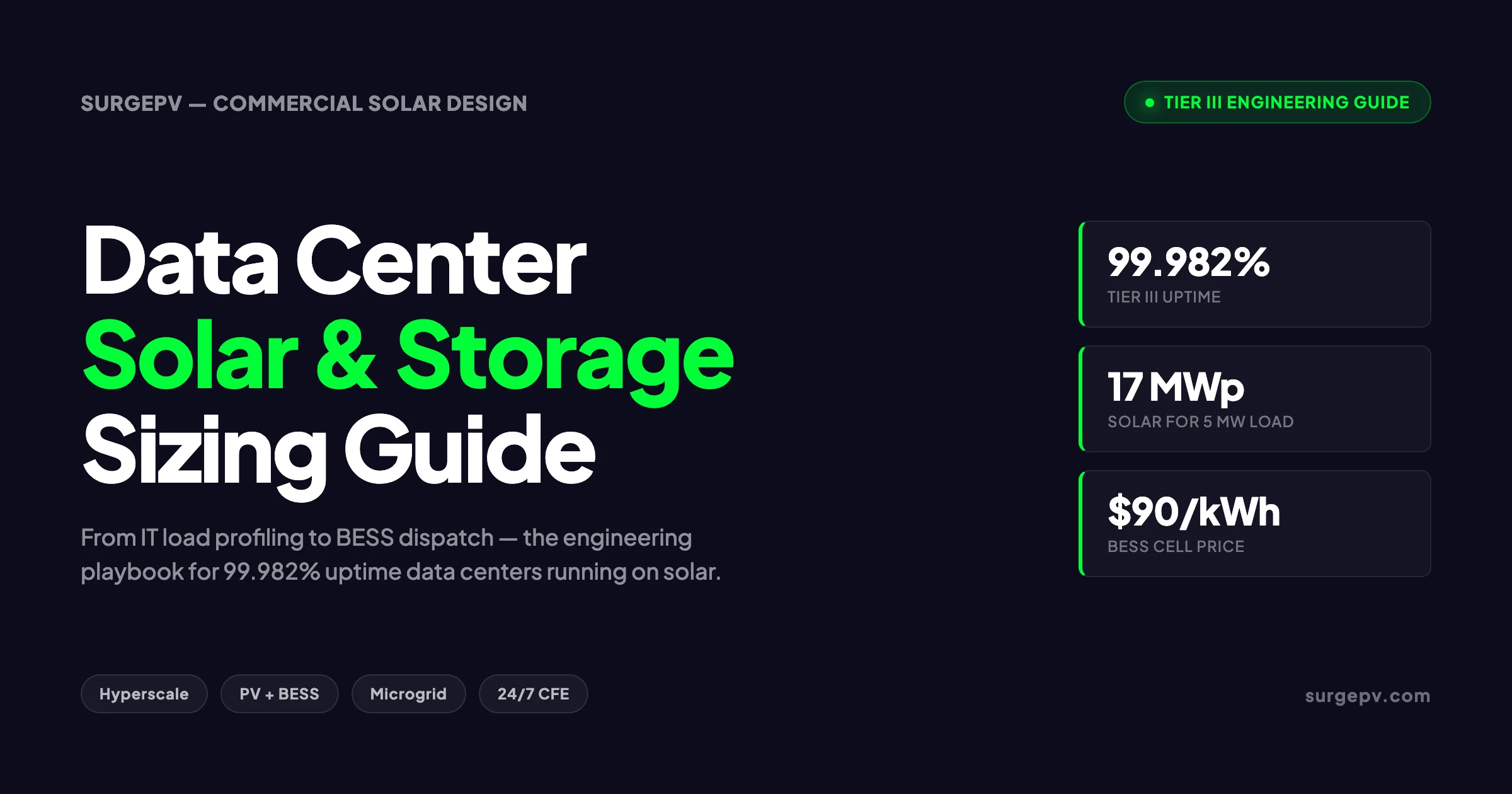
The data center industry now consumes more electricity than most mid-sized countries. That tension defines the engineering problem: how to integrate intermittent solar generation into a facility that cannot lose power for more than 1.6 hours per year. The headline number is 99.982% availability, equivalent to 1.6 hours of downtime per year.
The data center industry now consumes more electricity than most mid-sized countries. AI training runs are pushing single facilities past 500 MW of contracted load, and the queue of new builds has compressed grid interconnection timelines from 2 years to over 5 in major US markets. Solar is one of the few resources that can be deployed inside that window, but data centers operate under uptime contracts where every nine of availability translates to seven-figure penalty exposure. That tension defines the engineering problem: how to integrate intermittent solar generation into a facility that cannot lose power for more than 1.6 hours per year.
The data center industry now consumes more electricity than most mid-sized countries. That tension defines the engineering problem: how to integrate intermittent solar generation into a facility that cannot lose power for more than 1.6 hours per year. The headline number is 99.982% availability, equivalent to 1.6 hours of downtime per year.
This guide covers the sizing, topology, and procurement decisions that make solar work for Tier III data centers. It is written for design engineers, energy procurement leads, and EPC firms preparing tenders for hyperscale and colocation campuses. The numbers reflect costs and standards as of mid-2026, with the BESS market now clearing below $90 per kWh and behind-the-meter solar PPAs commonplace in Texas, Virginia, and the European LPN markets. Also see: European Solar Incentives.
TL;DR — Data Center Solar Sizing
A 5 MW Tier III data center typically pairs 12 to 30 MWp of solar with 20 to 60 MWh of battery storage to offset 30 to 60 percent of annual energy. Solar cannot meet 99.982% uptime alone — the grid and backup generators carry the resilience burden. CapEx for the solar plus storage block runs $1.2 to $1.8 per Wac with a 6 to 9 year payback at US industrial rates. Behind-the-meter installations deliver 2 to 3 times the financial value per kWh of utility-scale equivalents because they avoid transmission and capacity charges.
Read Adding Battery Storage Services for a complete walkthrough.
What this guide covers:
- The Tier III standard and what 99.982% availability means in operational terms
- Why solar by itself falls short of any Tier III, III+, or IV target
- A six-step methodology for sizing solar capacity from IT load
- BESS sizing for time-shift, peak shaving, and ride-through
- AC-coupled versus DC-coupled topology trade-offs
- A worked example for a 5 MW Tier III campus
- The economics of CapEx, OpEx, and payback at industrial electricity rates
- 24/7 carbon-free energy compliance and time-matching strategies
- Common sizing mistakes that break Tier III certification
Tier III Uptime: What 99.982 Percent Actually Demands
The Uptime Institute Tier system is the industry reference for data center availability classification. Tier III sits in the middle of a four-tier ladder. The headline number is 99.982% availability, equivalent to 1.6 hours of downtime per year. That figure is not a target — it is the failure threshold below which the certification is forfeit.
Two operational rules define Tier III:
Concurrent maintainability. Every capacity component and every distribution path must be removable for planned maintenance without affecting IT load. That means N+1 redundancy at minimum. If a facility has a 5 MW IT load, the cooling, UPS, switchgear, and generators must collectively produce 5 MW of available capacity even when one path is offline.
Multiple distribution paths, single active path. Tier III allows two independent distribution routes, but only one is energized during normal operation. The second is reserved for failover. Tier IV requires both paths active simultaneously with 2N redundancy.
Tier III translates into specific component design rules that any solar integration must respect:
| Component | Tier III Rule | Solar Implication |
|---|---|---|
| UPS systems | N+1 redundancy minimum | Solar inverters must not back-feed the UPS bus during a fault |
| Generators | N+1, sized to full IT plus cooling load | Solar cannot replace generator capacity for compliance counting |
| Switchgear | Concurrent maintainability | Solar disconnect must allow bypass without dropping the bus |
| Distribution | Two paths, one active | Solar tie-in usually goes to the active path with manual transfer to the alternate |
| Fuel storage | 12 hours minimum onsite | Solar plus storage does not reduce this requirement |
The Power Magazine breakdown of Tier III electrical system design reinforces a point that catches first-time data center solar designers off guard: solar capacity does not count toward the redundant capacity reserve. Uptime certifications credit only firm, dispatchable resources. The grid counts. Generators count. Solar with a 4-hour BESS counts only for the BESS portion, and only if the BESS alone can carry the full load for the certified ride-through window.
Why Solar Alone Cannot Power a Tier III Data Center
A 500 kW continuous load running entirely off-grid solar plus storage requires roughly 5 MWp of PV and 9 to 12 MWh of battery capacity. That architecture has been demonstrated at modular edge sites and small enterprise deployments. The catch sits in the availability number. Field studies of off-grid solar plus battery systems land at approximately 99 percent uptime. That is roughly 87 hours of downtime per year, or 54 times the Tier III allowance.
The shortfall comes from compounding probability. A solar array depends on:
- Weather (a 7-day winter inversion can drain even a 24-hour storage buffer)
- Inverter health (10-year mean time between failures even on commercial-grade equipment)
- DC combiner integrity, fuses, contactors
- BESS thermal management, BMS firmware, cell drift
Each component has its own availability curve. Multiplied across the chain, the system trends toward 99 percent. A grid connection improves this number not because the grid is more reliable on its own, but because it provides a statistically independent supply that fails in different ways than an onsite generator.
The conclusion every Tier III project converges on is hybrid topology. Onsite solar offsets energy and reduces carbon. The grid carries baseload and serves as the primary power source. Generators provide ride-through and extended outage coverage. The BESS handles solar time-shift, peak shaving, and the seconds between a grid drop and generator start. Each element does what it is good at, and none is asked to do the job alone.
The Hybrid Architecture: Solar + Storage + Grid + Generators
A modern Tier III data center power architecture has five layers. Solar fits into layer two as a parallel resource, not a primary one.
Layer 1 — Utility supply. Two redundant medium-voltage feeds from the local grid, each sized for full IT load plus PUE overhead. This is the workhorse for 95 percent or more of operating hours.
Layer 2 — Onsite generation. Solar PV (and increasingly wind in coastal sites) connected behind the meter through dedicated transformers. Net export is rare in modern designs because the BESS captures surplus.
Layer 3 — Battery energy storage. A BESS sized for 2 to 4 hours of partial load coverage. Functions: solar shift, peak shave, frequency regulation, and bridge to generators during grid loss.
Layer 4 — UPS systems. Lithium-ion or VRLA UPS sized for 5 to 15 minutes of full IT load. The UPS is the only Tier III-counted resource for the first seconds of an outage.
Layer 5 — Diesel or gas generators. Sized for full IT plus cooling load with N+1 redundancy. Onsite fuel for 12 hours minimum, typically 72 hours for inland sites and 96 hours for coastal sites in hurricane zones.
The interaction between layers determines how solar gets sized. If the BESS is small, solar must match instantaneous load. If the BESS is large, solar can be oversized to capture more midday energy and shift it into the evening peak. If generators are scarce, the BESS bridges longer outages. The hybrid model creates flexibility, but it also forces the designer to optimize across multiple constraints rather than just minimizing levelized cost.
The solar design software used for the integration study has to handle simultaneous PV layout, BESS dispatch, load profiling, and 8760-hour simulation. Single-purpose tools that handle PV layout but not battery dispatch will undersize the system. SurgePV, RatedPower, and HelioScope are the three platforms used most often for facility-scale data center sizing studies in North America and Europe. For software options, see 7 Best HelioScope Alternatives in.
Sizing the Solar Array: From IT Load to MWp
The sizing methodology for data center solar follows a six-step process. The inputs change with site, but the structure remains consistent.
Step 1 — Profile the load.
Pull 12 months of 15-minute interval data from the meter or building management system. Decompose into:
- IT load (kW)
- Mechanical load (chillers, CRAC units, pumps, fans)
- Electrical losses (UPS, transformers, switchgear)
- Lighting and ancillary
Compute PUE = total facility load / IT load. Modern hyperscale data centers run PUE of 1.1 to 1.3. Older enterprise sites hit 1.6 to 1.8. The industry average is 1.56, while Google’s 2024 fleet hit 1.09 according to its data center sustainability disclosures.
Step 2 — Establish the energy baseline.
Annual energy = average load × 8,760 hours. A 5 MW IT load at PUE 1.4 gives a 7 MW facility average, or roughly 61.3 GWh per year. This is the number solar will offset against.
Step 3 — Set the solar offset target.
Common targets:
- 20 to 30 percent: The “easy” target. Sites without rooftop or land constraints. Pure energy bill reduction.
- 30 to 50 percent: Mainstream target. Requires modest BESS and a midday surplus management strategy.
- 50 to 70 percent: Aggressive. Needs oversized arrays, large BESS, and active grid export agreements.
- 70 to 100 percent: Marketing claims, usually achieved through unbundled RECs rather than physical match.
Step 4 — Calculate required PV capacity.
Solar capacity (MWp) = annual energy target / (capacity factor × 8,760 × performance ratio)
For a US Southwest site with capacity factor 0.22 and PR 0.85:
- 30 percent of 61.3 GWh = 18.4 GWh
- Capacity = 18.4 / (0.22 × 8.76 × 0.85) = 11.2 MWp
For a Frankfurt site with capacity factor 0.12 and PR 0.83:
- 30 percent of 61.3 GWh = 18.4 GWh
- Capacity = 18.4 / (0.12 × 8.76 × 0.83) = 21.1 MWp
The same energy target produces nearly twice the array capacity in cooler climates with lower irradiance. This is why most European data center solar PPAs are sourced from Spain, Italy, or Greece even when the load sits in Frankfurt or Dublin. Also see: solar panel ROI in Italy. Also see: Spain net metering.
Step 5 — Validate physical fit.
A typical ground-mount installation needs 4 to 6 acres per MWp. A rooftop or carport installation needs 60,000 to 90,000 square feet per MWp depending on row spacing and module efficiency. For an 11.2 MWp array, that is 45 to 67 acres of ground or 670,000 to 1,000,000 square feet of roof area. Few data centers have this much roof, which is why most onsite arrays are ground-mount on adjacent campus land or carport on parking structures.
Step 6 — Run an 8760-hour simulation.
The annual capacity factor calculation is a sanity check, not a design output. The actual production must be simulated hour by hour against the load profile to determine:
- Self-consumption rate (percentage of solar consumed onsite versus exported)
- Surplus available for BESS charging
- Curtailment risk if export is limited
- Net energy bought from the grid
The shadow analysis on adjacent buildings, transformer pads, and security infrastructure must be modeled accurately. A solar shadow analysis software study that misses a 4 percent shading loss can flip a project’s IRR by 100 basis points.
Sizing Battery Storage for Outage Ride-Through
The BESS is the most strategically flexible asset in a hybrid data center power system. It can serve as a solar shifter, peak shaver, frequency regulator, or a generator bridge. Sizing depends on which functions you assign it.
For solar time-shift:
Duration: 2 to 4 hours Power: 25 to 50 percent of peak load Energy: power × duration
A 7 MW peak load with 50 percent BESS power and 4-hour duration = 3.5 MW / 14 MWh.
For peak shaving:
Duration: 1 to 2 hours Power: equal to the demand peak above the contracted capacity Energy: power × duration
A facility with $25/kW/month demand charges and a 1 MW peak above contract would justify a 1 MW / 2 MWh system on demand reduction alone.
For ride-through to generators:
Duration: 5 to 10 minutes (the BESS is not the primary ride-through asset) Power: full IT load Energy: power × duration
A 5 MW IT load with 10-minute ride-through = 5 MW / 0.83 MWh.
In practice, most data center BESS deployments combine all three functions into a single plant. A 5 MW / 20 MWh BESS at a 7 MW facility can:
- Charge from solar surplus during midday
- Discharge into evening peak (2 to 4 hours)
- Provide 10 to 20 minutes of full-load ride-through
- Shave demand peaks year-round
The 2026 BESS market puts AC-coupled lithium iron phosphate systems at $250 to $320 per kWh installed for utility-scale deployments. JLL’s 2026 Global Data Center Outlook expects the global average BESS price to fall below $90 per kWh on a battery-cell basis, which corresponds to the installed numbers above once balance-of-system, EPC margin, and grid interconnection are added. For Global-specific compliance details, see Global net-metering-by-country. For Global-specific compliance details, see Global solar-permitting-speed-by-country.
A 20 MWh BESS at $290 per kWh installed costs $5.8 million. The same plant returns $1.4 million per year in combined energy arbitrage and demand charge reduction at a 0.85 round-trip efficiency. Payback lands between 4 and 6 years before any solar interaction.
DC-Coupled vs AC-Coupled: Which Topology for Data Centers
The coupling decision determines how solar PV and BESS share inverters and how the system interfaces with the data center electrical distribution.
AC-coupled architecture. Solar PV has its own inverters that produce 480V or medium-voltage AC. The BESS has separate inverters that also produce AC. Both connect to a shared AC bus that ties to the data center distribution. This is the standard for utility-scale deployments and almost every retrofit project.
Advantages:
- Each subsystem can be sized and replaced independently
- BESS can charge from grid as well as solar
- Compatible with existing data center electrical architecture
- Easier protection coordination and fault clearing
Disadvantages:
- Round-trip efficiency lower (88 to 90 percent versus DC-coupled at 92 to 94 percent)
- Higher CapEx because of duplicated inverter capacity
DC-coupled architecture. Solar PV strings and BESS share a single bidirectional inverter. Power flows DC-to-DC between PV and battery without an AC conversion step in between.
Advantages:
- 2 to 4 percent higher round-trip efficiency
- Lower inverter CapEx (single inverter sized for either solar or battery output)
- Better solar clipping recovery (DC-coupled inverters can store clipped energy directly to BESS)
Disadvantages:
- BESS sizing constrained to PV string voltage windows
- Cannot charge BESS from grid as easily
- Limited vendor ecosystem for hyperscale-grade equipment
- Complex integration with 2N or N+1 medium-voltage distribution
For data centers below 5 MW solar, DC-coupled designs from vendors like Sungrow, Power Electronics, and SMA are economically competitive. Above 10 MW solar, AC-coupled becomes the default because the integration complexity outweighs the efficiency gain, and the redundancy requirements of Tier III favor the modularity of independent inverters.
Worked Example: Sizing a 5 MW Tier III Facility
A worked example clarifies the methodology. The facility:
- Location: West Texas (capacity factor 0.24)
- IT load: 5 MW continuous
- PUE: 1.4 (target)
- Total facility load: 7 MW continuous
- Annual energy: 61.3 GWh
- Solar offset target: 50 percent
- Tier: III with selected Tier IV paths
- Available land: 80 acres adjacent to campus
Step 1 — Solar capacity calculation.
Annual energy target: 30.65 GWh Required PV: 30.65 / (0.24 × 8.76 × 0.85) = 17.1 MWp
Step 2 — Land verification.
17.1 MWp at 5 acres per MWp = 85.5 acres. The 80-acre constraint forces either a higher-density bifacial tracker design (4.5 acres per MWp = 77 acres, fits) or accepting a 16 MWp design that offsets 47 percent. See Bifacial Solar Panel Design Guide for detailed guidance.
Choosing the bifacial tracker option with 17.1 MWp on 77 acres.
Step 3 — BESS sizing.
Functions: solar shift, peak shave, 10-minute ride-through.
Power: 50 percent of 7 MW = 3.5 MW Duration: 4 hours (covers solar shift and peak shave) Energy: 14 MWh
Verify ride-through: 14 MWh ÷ 7 MW = 2 hours, well above the 10-minute threshold.
Step 4 — Generator sizing.
Tier III requires N+1 generators sized for full IT plus cooling. With 7 MW continuous load and a 1.25 generator sizing factor (for cold start and motor inrush), each generator should be 1.5 MW. N=6 generators @ 1.5 MW = 9 MW. N+1 = 7 generators @ 1.5 MW. Total fuel storage at 0.07 gal/kWh × 72 hours × 7 MW = 35,280 gallons.
The solar plus BESS does not reduce this generator count. Tier III certification credits only firm, dispatchable resources.
Step 5 — Topology decision.
17.1 MWp is above the DC-coupled threshold. AC-coupled with 6 inverter blocks at 3.0 MWac each (one redundant, N+1) connecting to a dedicated 34.5 kV solar collector substation. BESS connects via 4 dedicated 875 kW PCS units (4 active, 1 redundant) on the same collector.
Step 6 — Financial summary.
| Component | CapEx | Annual OpEx |
|---|---|---|
| 17.1 MWp solar PV | $14.5M | $190K |
| 14 MWh BESS | $4.1M | $80K |
| Substation, BOS, interconnection | $3.8M | $60K |
| Total | $22.4M | $330K |
Annual energy delivered: 30.65 GWh Avoided energy cost at $0.085/kWh: $2.6M Demand charge reduction: $400K Total annual savings: $3.0M Simple payback: 7.5 years IRR over 25 years: 11.2 percent
The 7.5-year payback assumes US ITC at 30 percent for the BESS portion (still active for storage in 2026 under IRA Section 48 even after the residential ITC expired). If the project qualifies for the Domestic Content Bonus (10 percent ITC adder), payback compresses to 6.8 years.
Model Your Data Center Solar System
SurgePV runs the full 8760-hour simulation, BESS dispatch, and financial model in one workflow — purpose-built for commercial and industrial solar design.
Book a DemoNo commitment required · 20 minutes · Live project walkthrough
24/7 Carbon-Free Energy and Time-Matching
The procurement model is where data center solar projects diverge from generic commercial solar. Three procurement structures dominate:
Annual matching. The legacy approach. Buy enough renewable energy certificates (RECs) over a year to match annual consumption. Cheap, simple, and increasingly seen as greenwashing. Most hyperscalers have moved past this model for new facilities.
Hourly matching. The 24/7 carbon-free energy (CFE) standard. Match every hour of consumption with carbon-free generation. Requires a portfolio of solar (4 to 6 hours of direct match), wind (10 to 16 hours of overlap depending on geography), and storage. Google, Microsoft, and Iron Mountain are the leading subscribers.
Physical match with onsite generation. The strongest claim. Solar physically generates on-site or behind-the-meter and serves the load directly. Carbon claim is unambiguous, but delivery is constrained by solar capacity factor and storage duration.
A fully 24/7-matched data center using solar alone needs:
- 3 to 4 times annual consumption in solar capacity (to handle variability)
- 12 to 24 hours of storage duration (to bridge nights and weather events)
The economics break down quickly. The same outcome with a portfolio of solar (50 percent), wind (35 percent), and 4-hour storage (15 percent) costs roughly 60 percent less. This is why every credible 24/7 CFE strategy is multi-resource.
The 2024 EdgeConneX whitepaper on operating a data center with 24/7 carbon-free energy reported 92 percent hourly match using a 70/25/5 portfolio of solar, wind, and storage in ERCOT. The remaining 8 percent of hours required grid energy that cleared at carbon intensity above their target.
PPA, BTM, and Onsite Solar: Choosing the Procurement Model
Three commercial structures route solar energy to a data center. Each has implications for sizing, accounting, and risk.
Behind-the-meter (BTM) onsite solar.
The PV array sits on or adjacent to the data center campus and connects behind the utility meter. Energy is consumed directly by the facility. This delivers the highest financial value because it avoids transmission, distribution, and capacity charges that often exceed 50 percent of an industrial bill. The pv-magazine analysis on AI data center solar PPAs puts BTM solar value at 2 to 3 times the equivalent utility-scale PPA. Also see: Us Residential Solar Market Trends 2026.
Constraints: land availability, interconnection capacity, and the ability to manage curtailment when solar exceeds load.
Behind-the-meter co-located solar.
A larger plant on the campus that exports surplus to the grid through a dedicated tie. This is the model Google’s Haskell cluster uses, where the 840 MW solar limit is the contracted export capacity. Sizing can exceed instantaneous load by 1.5 to 2x because surplus has commercial value through wholesale market sales or BESS arbitrage.
Off-site PPA.
The most common model for hyperscale operators. The data center signs a long-term contract for 100 percent of the output of a remote solar plant. Energy delivers to the same grid (financial PPA) or a contracted balancing area (sleeved PPA). TotalEnergies and Google’s 1 GW solar PPA in Texas is the largest single transaction in this category as of early 2026.
The four largest hyperscalers (Amazon, Microsoft, Meta, Google) hold 84 GW of corporate PPAs as of February 2025, with the volume growing more than 69 percent year over year. PPAs are the primary growth vector. BTM is the high-value niche.
The customer-ready solar proposals used to model the BTM option must handle interconnection cost, demand charge interaction, and BESS dispatch in a single financial view. Simpler tools designed for residential or small commercial cannot model the multi-variate optimization that data center procurement requires.
Economic Modeling: CapEx, OpEx, and Payback for Tier III Solar
Data center solar economics differ from generic commercial solar in three ways:
Higher revenue per kWh. Data centers are 24/7 baseload consumers with little load variability. Every solar kWh produced is consumed onsite at the full retail rate, not exported at a wholesale price.
Higher demand charges. Industrial tariffs in major data center markets carry $15 to $35 per kW per month in demand charges. A modest BESS that flattens 1 MW of peak captures $180,000 to $420,000 per year in demand reduction alone.
Longer commercial horizons. Data center facilities operate for 25 to 40 years. Solar plant life of 30+ years matches the asset lifecycle. PPA contracts can extend to 25 years without raising bankability concerns.
A typical Tier III data center BTM solar plus BESS project in the US Southwest has:
| Line Item | Value |
|---|---|
| Solar CapEx | $0.85 to $1.05 per Wac |
| BESS CapEx | $250 to $320 per kWh |
| Soft costs (engineering, permitting) | 8 to 12 percent of hard costs |
| Annual O&M | 1.0 to 1.5 percent of CapEx |
| BESS replacement (year 12) | 50 to 65 percent of original cost |
| Insurance | 0.4 to 0.6 percent of asset value |
| Property tax (where applicable) | 0.8 to 1.5 percent of CapEx |
The generation and financial tool used for the model has to handle all of these line items plus the interaction with demand charges, ITC, MACRS depreciation, and PPA pricing. Spreadsheet models that assume a flat $/kWh avoided cost are off by 20 to 40 percent on the IRR.
For a 17.1 MWp / 14 MWh project at a 5 MW Tier III facility:
- Total CapEx: $22.4M
- Annual savings: $3.0M
- ITC at 30 percent: $6.7M
- MACRS depreciation NPV: $4.1M
- Net CapEx after incentives: $11.6M
- Simple payback (post-ITC): 3.9 years
- 25-year IRR: 14.1 percent
These numbers compete favorably with merchant solar projects, which is why data center developers are pulling solar resources out of the wholesale market and into BTM configurations at an accelerating rate.
Common Sizing Mistakes That Break Tier III Compliance
A handful of design errors recur across data center solar tenders. Each one can fail the Uptime certification audit or undersize the system materially.
Counting solar capacity toward redundancy. Solar is intermittent and does not satisfy Tier III firm capacity rules. A facility that documents “5 MW IT load served by 3 MW grid + 2 MW solar” fails the audit because solar cannot be dispatched on demand.
Undersizing the BESS for ride-through assumptions. Designers occasionally assume the BESS provides primary ride-through. The UPS is the primary ride-through asset. The BESS is a secondary buffer or extends generator start-up coverage. Confusing these roles leads to undersized UPS plants and oversized BESS.
Ignoring the cooling load profile. Solar production peaks at noon. Cooling load also peaks at noon in most climates. The two profiles align well, which is the main argument for BTM solar at data centers. Sizing models that assume a flat 24/7 load underestimate self-consumption by 8 to 15 percent.
Treating PUE as static. PUE drifts with seasonal cooling load and with IT utilization. Annual averages hide design-significant variation. A facility with summer PUE of 1.55 and winter PUE of 1.25 produces a different solar offset profile than one assumed at a constant 1.4.
Underestimating interconnection lead time. Grid interconnection studies in major US data center markets now run 18 to 36 months. Onsite BTM solar can be built in 6 to 12 months once the solar plant is sized. Skipping the interconnection critical path analysis often kills the project schedule.
Skipping the curtailment study. Sites that oversize solar to capture more midday energy often discover the local distribution feeder cannot accept the surplus during low-load weekends. A 2024 Texas data center solar project lost $1.2 million in year-one revenue to weekend curtailment that the simulation had not modeled.
Designing without redundancy on the inverter block. A solar plant with a single inverter block fails Tier III concurrent maintainability. The inverter block must be N+1 with an isolation procedure that allows one block offline without dropping the active distribution path.
The commercial solar design software capable of modeling all of these failure modes is a small subset of the market. SurgePV, Aurora, RatedPower, and Helioscope are the platforms with credible 8760-hour simulation, BESS dispatch, and grid interconnection modeling for facility-scale work.
Conclusion
Data center solar is a hybrid engineering problem. The solar plant offsets energy and carbon. The grid carries reliability. The BESS bridges the gap. The economics are strong enough that BTM solar at data centers is one of the highest-IRR commercial solar opportunities in the US and Europe. The engineering must respect the Tier III ruleset, especially the redundancy and concurrent maintainability requirements that disqualify intermittent resources from primary capacity counting.
Picking the right solar software for the integration study is the lever that decides whether a Tier III project clears its IRR threshold or stalls in design review. For teams scoping a Tier III data center solar project, the next steps are:
- Pull 12 months of 15-minute interval load data and decompose into IT, mechanical, and electrical components
- Run a sizing study at three solar offset levels (30%, 50%, 70%) with paired BESS at 2-hour and 4-hour durations
- Model the project against both BTM and PPA structures to identify which procurement path the financial profile favors
Frequently Asked Questions
Can solar power a Tier III data center on its own?
No. Off-grid solar plus battery architectures currently deliver around 99 percent availability. Tier III demands 99.982 percent, which works out to no more than 1.6 hours of downtime per year. The math forces a hybrid design where solar offsets energy cost and carbon, while the utility grid and backup generators carry the resilience burden. Tier III certification rests on N+1 redundancy and concurrent maintainability, neither of which solar alone can guarantee.
How much solar capacity does a 5 MW data center need?
A 5 MW IT load typically draws 7 to 7.5 MW including cooling and power conversion overhead at a PUE of 1.4 to 1.5. To offset 30 to 40 percent of annual energy at a temperate site with a 16 percent capacity factor, you need 12 to 17 MWp of solar. Pushing to 60 percent requires 22 to 30 MWp plus 30 to 60 MWh of storage to time-shift midday production into the evening load.
What battery autonomy is required for data center solar?
For grid-tied Tier III facilities, the BESS handles two roles: arbitrage of solar surplus and bridging the seconds before generators start. A 4-hour duration system sized at 25 to 50 percent of peak load covers daily time-shifting. For ride-through during grid blinks, the UPS handles 5 to 15 minutes while the BESS or generators take over. The BESS itself does not need to provide full Tier III autonomy.
Should solar connect AC-coupled or DC-coupled to the data center?
AC-coupled is standard for retrofit and large-scale deployments because it isolates the solar PV from the data center electrical bus through the inverter and synchronizes with utility supply. DC-coupled designs share an inverter between the PV array and BESS, which improves round-trip efficiency by 2 to 4 percent and lowers CapEx, but is rarely deployed at hyperscale because of the engineering complexity of integrating with a 2N or N+1 medium-voltage distribution system.
What is the payback period for data center onsite solar?
Behind-the-meter solar at a data center site delivers 2 to 3 times more financial value per kWh than utility-scale because it avoids transmission, distribution, and capacity charges that often exceed 50 percent of an industrial bill. Payback at a US site with electricity at $0.10 per kWh ranges from 6 to 9 years. Sites with peak demand charges above $20 per kW per month and BESS arbitrage can compress payback to 4 to 6 years.
How does a data center achieve 24/7 carbon-free energy with solar?
Annual matching, where renewables are bought to offset total yearly consumption, is no longer credible. The 24/7 CFE standard requires hourly matching of clean generation against load. Solar provides 4 to 6 hours of direct match per day. The remaining hours need either oversized storage, wind PPAs, hydro, geothermal, or nuclear contracts. Google’s Haskell cluster combines onsite solar, BESS, and gas peakers within a single point of interconnection to approximate hourly matching.
What is the difference between Tier III and Tier IV for solar integration?
Tier III requires concurrent maintainability via N+1 redundant components on a single distribution path. Tier IV adds fault tolerance through 2N or 2N+1 with two independent distribution paths. For solar integration, Tier IV roughly doubles the inverter, transformer, and BESS investment because every solar pathway must mirror its redundant pair. Most hyperscale AI facilities targeting both AI workloads and commercial cloud opt for Tier III with selective Tier IV upgrades on critical paths.
Can a microgrid replace utility supply for a Tier III facility?
A properly designed microgrid with solar, BESS, and gas or hydrogen-fueled generators can island indefinitely and meet Tier III concurrent maintainability if every generation source is N+1. The barrier is economics. The capital cost of an islandable Tier III microgrid runs 1.8 to 2.5 times a grid-tied equivalent. Most operators use the microgrid as a backup ride-through and a peak-shaving asset rather than a full grid replacement.
Where this fits
This article is part of SurgePV's Solar Design hub, which works through the topic from first principles to the decisions a project team actually has to make.